
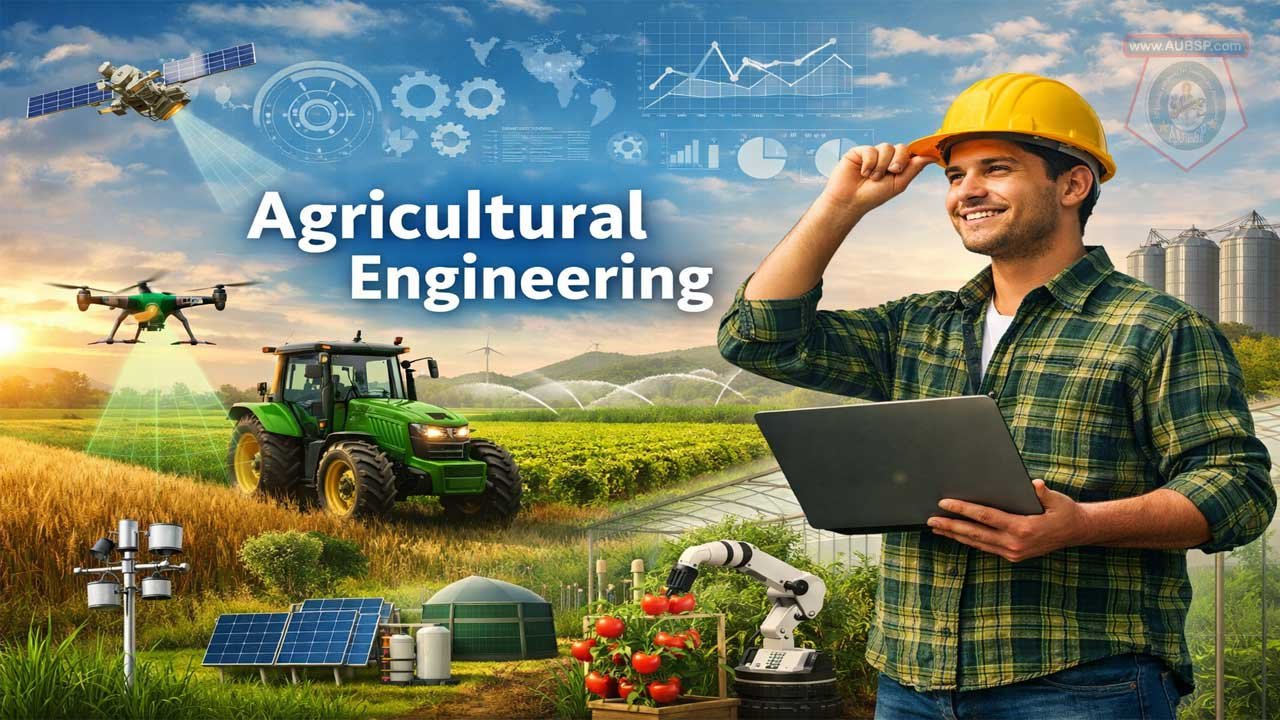
A Bachelor of Agricultural Engineering (BAgE) — also known as B.Tech Agricultural Engineering — is a 3–5 year (typically 4-year) undergraduate program that combines engineering principles with agricultural science to design and improve farming systems, machinery, and sustainable food production technologies.
Students study core engineering subjects alongside specialized areas such as farm machinery, irrigation, soil and water conservation, renewable energy, post-harvest processing, and precision agriculture, with strong emphasis on hands-on training and fieldwork. The degree is increasingly valuable due to rising global food demand, technological transformation in agriculture, and sustainability challenges, offering versatile career paths in engineering, agri-tech, environmental consulting, food processing, research, government, and entrepreneurship.
With steady job growth, competitive salaries, and opportunities to address climate change, resource efficiency, and global food security, BAgE is considered a strategically important STEM qualification for the future of agriculture.
| Category | Information |
|---|---|
| Degree Name | Bachelor of Agricultural Engineering (BAgE) / B.Tech Agricultural Engineering |
| Duration | 3–5 years (typically 4 years, 8 semesters) |
| Focus | Engineering solutions for farming systems, machinery, sustainability, and food production |
| Core Subjects | Engineering basics, farm machinery, irrigation, soil & water conservation, food processing, renewable energy, precision agriculture |
| Eligibility | 12th grade with Physics, Chemistry, Mathematics (sometimes Biology); entrance exams in many countries |
| Learning Style | Labs, fieldwork, industrial training, projects |
| Specializations | Farm machinery, irrigation & water management, precision agriculture, post-harvest engineering, bioenergy |
| Career Roles | Agricultural engineer, irrigation engineer, agri-tech specialist, food processing engineer, consultant, researcher |
| Industries | Agriculture, agri-tech, environmental consulting, food processing, renewable energy, government |
| Salary (example US) | Median ≈ $88,750/year (varies by country, experience, industry) |
| Importance | Supports sustainable farming, climate solutions, and global food security |
What Is a Bachelor of Agricultural Engineering (BAgE)?
A Bachelor of Agricultural Engineering (BAgE) — also referred to as B.Tech in Agricultural Engineering, B.Agr.Eng., or BSAGE — is an undergraduate degree that combines core engineering principles with agricultural science to design, develop, and optimize farming systems, machinery, and technologies. The program typically spans 3 to 5 years depending on the country, though most programs worldwide follow a 4-year (8-semester) structure.
Agricultural engineers solve real-world problems concerning power supplies, machinery efficiency, pollution and environmental protection, soil and water conservation, and the storage and processing of agricultural products. With global food demand projected to surge as the world population reaches 9.7 billion by 2050, agricultural engineering stands at the forefront of sustainable food production, making this degree one of the most strategically valuable STEM qualifications available today.
Why Choose Agricultural Engineering?
Agricultural engineering is far more than traditional farming — it sits at the intersection of cutting-edge technology, environmental sustainability, and global food security. Here are the key reasons to pursue this degree:
- Growing global demand: Employment of agricultural engineers is projected to grow 6% from 2024 to 2034, faster than the average for all occupations. Purdue University and USDA’s 2025–2030 forecast projects approximately 104,766 annual job openings in food, agriculture, renewable natural resources, and the environment — with employer demand expected to dramatically exceed the supply of qualified graduates.
- High earning potential: The median annual salary for agricultural engineers in the U.S. was $88,750 in 2023, with wages ranging from $62,150 to $127,590. Top-paying industries like architectural and engineering services offer mean salaries exceeding $121,000.
- Interdisciplinary versatility: Graduates can pivot into civil engineering, environmental consulting, food technology, renewable energy, and agri-tech startups.
- Sustainability impact: Agricultural engineers directly address climate change, water scarcity, and resource efficiency — making this a purpose-driven career.
Core Curriculum and Subjects
The BAgE curriculum integrates engineering fundamentals with specialized agricultural modules. While specific courses vary by university, the core structure is remarkably consistent worldwide.
Foundation Courses (Year 1–2)
| Subject Area | Example Courses |
|---|---|
| Mathematics & Physics | Engineering Mathematics, Applied Physics, Applied Statistics |
| Basic Engineering | Engineering Mechanics, Strength of Materials, Thermodynamics |
| Agricultural Science | Principles of Crop Production, Soil Science, Agricultural Meteorology |
| Computer Applications | Fundamentals of IT, Computer-Aided Design, Machine Drawing |
Specialized Courses (Year 3–4)
| Subject Area | Example Courses |
|---|---|
| Farm Machinery & Power | Farm Power and Machinery, Tractor Systems, Machine Design |
| Soil & Water Conservation | Irrigation and Drainage Engineering, Watershed Management, Hydrology |
| Post-Harvest Technology | Food Engineering, Agricultural Process Engineering, Refrigeration |
| Renewable Energy | Renewable Energy Sources, Biomass Utilization |
| Agricultural Structures | Farm Building Design, Environmental Control in Agriculture |
| Precision Agriculture | GPS/GIS Applications, Sensor Technology, Drone-Based Monitoring |
Hands-on learning through laboratory work, industrial training, field visits, and capstone projects is a hallmark of most programs worldwide.
Eligibility and Admission Requirements
International Overview
Admission criteria vary by country and institution, but common requirements include:
- Academic qualification: Completion of secondary education (12th grade or equivalent) with strong performance in Physics, Chemistry, and Mathematics (PCM). Some programs also accept Physics, Chemistry, and Biology (PCB).
- Minimum grades: Typically 50–60% aggregate in qualifying subjects, though elite institutions may require 75% or higher.
- Entrance examinations: Many countries require standardized test scores. In India, entrance exams include JEE Main, MHT CET, KCET, TS EAMCET, CUET, and others. In the U.S., SAT/ACT scores and GPA are standard requirements.
- English proficiency: International applicants to programs in English-speaking countries typically need IELTS or TOEFL scores.
Admission Process (India — Example)
- Register for relevant entrance exams and submit application forms
- Appear for the entrance examination and score above the cutoff
- Participate in counseling sessions based on rank/score
- Submit documents (mark sheets, entrance exam rank card, ID proof, category certificate)
- Seat allotment based on merit and preferences
- Fee payment and admission confirmation
Tuition Fee Range
Tuition varies widely: approximately $10,000–$50,000 per year internationally. In India, fees at institutions like Parul University are around ₹1,75,000 (approximately $2,100) per annum, making Indian programs particularly affordable for international students.
Top Universities for Agricultural Engineering
The QS World University Rankings and EduRank research performance rankings highlight the following leading institutions:
| Rank | University | Country |
|---|---|---|
| 1 | Wageningen University & Research | Netherlands |
| 2 | University of California, Davis | United States |
| 3 | Swedish University of Agricultural Sciences | Sweden |
| 4 | China Agricultural University | China |
| 5 | Cornell University | United States |
| 6 | Purdue University | United States |
| 7 | ETH Zurich | Switzerland |
| 8 | Ghent University | Belgium |
| 9 | UC Berkeley | United States |
| 10 | Norwegian University of Life Sciences | Norway |
Other globally recognized programs include Iowa State University, University of São Paulo, University of Tehran, Michigan State University, University of Guelph (Canada), University of Melbourne (Australia), and IIT Kharagpur (India).
In the United States, Purdue University’s BSAGE program — accredited by ABET’s Engineering Accreditation Commission — offers specializations in machine systems engineering and environmental and natural resources engineering.
Key Specializations in Agricultural Engineering
Agricultural engineering offers several distinct specialization tracks, allowing graduates to tailor their expertise to specific industries:
Farm Machinery and Equipment Engineering
Designing, developing, and testing advanced agricultural machinery — from autonomous tractors and robotic harvesters to precision seeders — to improve efficiency and productivity on farms.
Irrigation and Water Management
Creating sustainable water distribution systems that optimize water usage and minimize waste. This includes sprinkler and micro-irrigation systems, drainage engineering, and watershed management.
Precision Agriculture Technology
One of the fastest-growing fields, precision agriculture uses GPS, drones, IoT sensors, remote sensing, and AI-driven data analytics to make site-specific farming decisions. This approach can reduce input costs by up to 30% while improving crop yields. Agri-tech investments surged to $51.7 billion in 2022, reflecting massive industry momentum.
Post-Harvest and Food Processing Engineering
Developing technologies to preserve, process, and package agricultural products — reducing the estimated 30–40% of global food that is lost post-harvest. This includes cold chain logistics, refrigeration systems, and food safety protocols.
Renewable Energy and Bioenergy
Designing renewable energy solutions for farms, including solar-powered irrigation, biogas digesters, and biofuel production from agricultural waste.
Soil and Water Conservation Engineering
Engineering solutions for erosion control, land reclamation, and sustainable soil management to preserve arable land for future generations.
Emerging Technologies Shaping the Field
Agricultural engineering is undergoing a technological revolution. Graduates entering the workforce today must be equipped with knowledge of these transformative technologies:
Artificial Intelligence and Machine Learning
AI is transforming agriculture through predictive analytics, crop health monitoring, automated disease detection, and yield optimization. AI-powered autonomous equipment is already enhancing seeding, irrigation, and pest management.
Drones and Remote Sensing
Drones equipped with multispectral cameras and sensors provide real-time aerial imagery to assess crop health, detect weeds, and map terrain. This technology is becoming standard practice in modern farming operations worldwide.
Internet of Things (IoT)
IoT-connected sensors placed across fields monitor soil moisture, temperature, humidity, and nutrient levels in real time, transmitting data to centralized management platforms for automated decision-making.
Robotics and Automation
From automated planting and harvesting robots to autonomous tractors, robotic systems are reducing labor requirements and improving operational consistency in farming.
Carbon Utilization and MRV Technologies
AI-driven Measurement, Reporting, and Verification (MRV) technologies enable accurate tracking of soil carbon sequestration, making carbon credit markets accessible to farmers and turning sustainable practices into economic opportunities.
Regenerative Agriculture Technologies
Advanced robotic soil sampling, AI-powered soil analytics, and microbiome-based solutions are helping restore soil health and enhance biodiversity — moving agriculture from a carbon emitter to a carbon sink.
Career Paths and Job Roles
Graduates with a BAgE can pursue diverse career paths across multiple sectors:
Engineering and Technical Roles
- Agricultural Engineer — Designing farm equipment, irrigation systems, and environmental control structures
- Farm Machinery Design Engineer — R&D on tractors, combines, planters, and other mechanized equipment
- Irrigation Systems Engineer — Planning and implementing water delivery infrastructure
- Precision Agriculture Specialist — Deploying GPS, drones, and data analytics to optimize farm output
Consulting and Management
- Agricultural Consultant — Advising farmers and agribusinesses on equipment selection, resource management, and technology adoption
- Environmental Consultant — Addressing pollution, waste management, and sustainability compliance
- Farm Manager — Overseeing day-to-day operations with an engineering approach to efficiency
Research and Academia
- Agricultural Researcher — Conducting studies on soil mechanics, crop physiology, or agricultural biotechnology at universities or government agencies
- University Professor — Teaching and guiding the next generation of agricultural engineers
Industry and Government
- Food Processing Engineer — Working in food manufacturing to improve production lines and quality control
- Renewable Energy Engineer (Agricultural) — Developing biogas, solar, and biomass energy solutions for farming
- Government Policy Analyst — Shaping agricultural policy at agencies like the USDA, FAO, or national agricultural ministries
Entrepreneurship
- AgriTech Startup Founder — Building technology solutions for modern farming challenges, from drone-as-a-service platforms to AI-based crop advisory apps
Salary Expectations Worldwide
Compensation for agricultural engineers varies significantly by country, experience level, and industry sector.
United States
| Percentile | Annual Salary |
|---|---|
| 10th Percentile | $62,150 |
| 25th Percentile | $79,620 |
| Median (50th) | $88,750 |
| 75th Percentile | $101,030 |
| 90th Percentile | $127,590 |
The mean annual salary across all agricultural engineers was $93,490, with a mean hourly wage of $44.95.
Salary by Industry (U.S.)
| Industry | Mean Annual Wage |
|---|---|
| Architectural & Engineering Services | $121,160 |
| Federal/State/Local Government | $99,010 |
| Colleges, Universities & Professional Schools | $83,110 |
| State Government (excl. schools/hospitals) | $80,840 |
Salary by U.S. State (Top Earners)
| State | Average Salary |
|---|---|
| Wisconsin | $100,800 |
| Georgia | $99,280 |
| Ohio | $98,590 |
| Illinois | $97,970 |
| North Dakota | $97,110 |
| Nebraska | $95,010 |
| California | $90,400 |
Professional Certifications and Licensure
Obtaining professional certifications enhances career prospects, credibility, and earning potential for agricultural engineers.
| Certification | Issuing Body | Purpose |
|---|---|---|
| Professional Engineer (PE) | NCEES / State Boards | Legally sign off on engineering plans; requires FE exam + work experience + PE exam |
| Engineer-in-Training (EIT) | NCEES | Pre-licensure credential after passing the FE exam; marks a candidate on the path to PE |
| Certified Crop Adviser (CCA) | American Society of Agronomy | Expertise in crop production, nutrient management, and agronomy |
| Certified Professional Agronomist (CPAg) | American Society of Agronomy | Advanced agronomic knowledge and soil science |
| Certified Irrigation Designer | Irrigation Association | Specialization in irrigation and water-management systems |
| BCEE (Environmental Engineering) | AAEES | Specialty credentials in waste management, water quality, and pollution prevention |
The American Society of Agricultural and Biological Engineers (ASABE) oversees the Agricultural and Biological PE exam, administered annually in October via computer-based testing.
Job Market Outlook
The employment landscape for agricultural engineers is characterized by steady demand and a significant talent gap:
- Projected growth: 6% from 2024 to 2034, faster than the national average for all occupations.
- Annual openings: Approximately 100 new agricultural engineer positions per year in the U.S., primarily driven by retirements and transfers.
- Broader agriculture workforce: The USDA-Purdue report forecasts 104,766 annual openings across food, agriculture, and natural resources — with demand far exceeding the supply of FARNRE graduates (50,057), leaving 27% of positions to be filled by candidates from outside the field.
- Technology-driven demand: Emerging areas such as alternative energies, biofuels, precision farming, automated systems, and even space agriculture are creating new demand verticals.
- Cross-disciplinary opportunities: Graduates of agricultural engineering programs can enter related fields such as civil, mechanical, and environmental engineering, broadening employment prospects.
75% of working agricultural engineers hold a bachelor’s degree, while 10% hold a master’s and 10% hold a doctoral degree.
How Agricultural Engineering Differs from Related Degrees
| Feature | Agricultural Engineering (BAgE) | Agricultural Science (B.Sc. Agriculture) | Civil Engineering |
|---|---|---|---|
| Core focus | Engineering design for farming systems | Crop and soil science, farming practices | Infrastructure, structures, transportation |
| Engineering depth | Heavy — machine design, fluid mechanics, thermodynamics | Minimal — focuses on biology and agronomy | Heavy — structural analysis, geotechnical engineering |
| Technology emphasis | Precision agriculture, IoT, farm automation | Crop management, pest control | Construction technology |
| Career path | Farm equipment design, irrigation systems, agri-tech | Agronomist, farm advisor, agricultural officer | Structural engineer, construction manager |
| Typical duration | 4 years | 4 years | 4 years |
How to Succeed in a BAgE Program
Academic Preparation
Strong foundations in mathematics (calculus, linear algebra), physics, chemistry, and biology are essential. Prospective students should ideally score well in PCM subjects at the secondary level.
Hands-On Experience
Seek internships at agricultural technology companies, equipment manufacturers, government agricultural research stations, or irrigation system providers. Fieldwork and practical projects are critical differentiators in this applied discipline.
Stay Current with Technology
Agricultural engineering is evolving rapidly. Developing skills in data analytics, GIS/GPS applications, drone operation, IoT platforms, and programming (Python, MATLAB) will provide a competitive edge.
Build Professional Networks
Join organizations like ASABE (American Society of Agricultural and Biological Engineers), attend industry conferences, and connect with professionals through platforms like LinkedIn.
Consider Advanced Degrees
A Master’s or PhD opens doors to research positions, university teaching, and specialized leadership roles. Top research areas include sustainable agriculture, precision farming, bio-process engineering, and agricultural robotics.
Conclusion
The Bachelor of Agricultural Engineering is a uniquely positioned degree that bridges the gap between engineering innovation and one of humanity’s most essential needs — food production. With global population growth, climate change, and sustainability challenges intensifying, the demand for skilled agricultural engineers has never been greater.
Whether the goal is designing autonomous farm machinery, building intelligent irrigation systems, or launching an agri-tech startup, this degree provides the interdisciplinary foundation to make a meaningful impact on the future of food and farming worldwide.
FAQs about Bachelor of Agricultural Engineering
What is a Bachelor of Agricultural Engineering (BAgE)?
A Bachelor of Agricultural Engineering is an undergraduate degree that combines engineering principles with agricultural science to design farming systems, machinery, and sustainable food technologies.
How long does a BAgE degree take to complete?
Most programs take 4 years, though some countries offer 3–5 year formats depending on curriculum structure.
What subjects are taught in Agricultural Engineering?
Students study mathematics, physics, engineering mechanics, thermodynamics, soil science, irrigation engineering, farm machinery, renewable energy, and precision agriculture.
What is the eligibility for BAgE?
Students typically need to complete 12th grade with Physics, Chemistry, and Mathematics, sometimes Biology, along with entrance exam scores where required.
Is Agricultural Engineering a good career choice?
Yes, it offers strong demand, diverse career paths, good salaries, and the opportunity to work on sustainability and global food security challenges.
What careers can I pursue after BAgE?
Graduates can work as agricultural engineers, irrigation engineers, farm machinery designers, precision agriculture specialists, food processing engineers, consultants, or researchers.
What skills are important for Agricultural Engineering students?
Important skills include problem-solving, technical design, data analysis, programming basics, understanding of farming systems, and practical field experience.
What are the major specializations in Agricultural Engineering?
Common specializations include farm machinery and power, irrigation and water management, precision agriculture, post-harvest technology, renewable energy, and soil conservation.
Does Agricultural Engineering involve practical work?
Yes, programs include laboratory work, field visits, internships, industrial training, and capstone projects.
What is precision agriculture?
Precision agriculture uses technologies like GPS, drones, sensors, and data analytics to optimize farming decisions and improve productivity.
Can Agricultural Engineering graduates work in other engineering fields?
Yes, graduates can transition into civil, mechanical, environmental engineering, renewable energy, and agri-tech industries.
What is the salary after Agricultural Engineering?
Salary varies by country and experience; entry-level roles are moderate while experienced engineers can earn high salaries, especially in technology and consulting sectors.
Which industries hire Agricultural Engineers?
Agriculture, agri-tech companies, equipment manufacturing, food processing, environmental consulting, renewable energy, research institutions, and government agencies hire graduates.
Is Agricultural Engineering different from B.Sc Agriculture?
Yes, Agricultural Engineering focuses on engineering design and technology, while B.Sc Agriculture focuses on crop science, agronomy, and farm management.
What entrance exams are required for BAgE in India?
Common exams include JEE Main, state engineering exams, and university-level entrance tests.
Can I pursue higher studies after BAgE?
Yes, students can pursue M.Tech, MS, MBA, or PhD in areas such as precision agriculture, robotics, sustainable agriculture, or environmental engineering.
What technologies are shaping Agricultural Engineering today?
Artificial intelligence, drones, IoT sensors, robotics, automation, GIS, and data analytics are transforming modern agriculture.
Is Agricultural Engineering suitable for students interested in sustainability?
Yes, the field focuses heavily on climate solutions, water conservation, renewable energy, and sustainable food production.
Do Agricultural Engineers work on machinery design?
Yes, designing tractors, harvesters, irrigation systems, and automated farming equipment is a core part of the field.
What is the scope of Agricultural Engineering in the future?
The scope is strong due to population growth, food demand, climate challenges, and rapid growth of agri-technology worldwide.
Can Agricultural Engineers start startups?
Yes, many graduates build agri-tech startups focused on drones, farm analytics, smart irrigation, supply chain, and digital farming platforms.
Is coding required in Agricultural Engineering?
Basic programming is increasingly useful for data analysis, automation, sensors, and precision agriculture applications.
What is post-harvest engineering?
It involves designing systems for storage, processing, packaging, refrigeration, and reducing food loss after harvest.
Can Agricultural Engineers work abroad?
Yes, the degree is globally recognized and opportunities exist in research, technology companies, consulting, and international development organizations.
What certifications help Agricultural Engineers?
Professional engineering licenses, irrigation design certifications, agronomy credentials, and environmental engineering certifications can improve career prospects.
Is Agricultural Engineering math-intensive?
Yes, mathematics and physics are important for engineering design, fluid mechanics, machinery, and modeling.
What is the difference between farm machinery engineering and irrigation engineering?
Farm machinery focuses on equipment design and mechanization, while irrigation engineering focuses on water distribution systems and water management.
Are internships important in BAgE?
Yes, internships provide practical experience, industry exposure, and improve job opportunities after graduation.
Can Agricultural Engineers work in renewable energy?
Yes, they work on biogas, biomass, solar irrigation, and other energy solutions for farms.
Who should choose Agricultural Engineering?
Students interested in engineering, technology, sustainability, farming innovation, and solving real-world food and environmental challenges should choose this field.
Is Agricultural Engineering future-proof?
It is considered highly future-relevant because it sits at the intersection of food security, climate technology, automation, and sustainability.


Leave a Reply
You must be logged in to post a comment.