
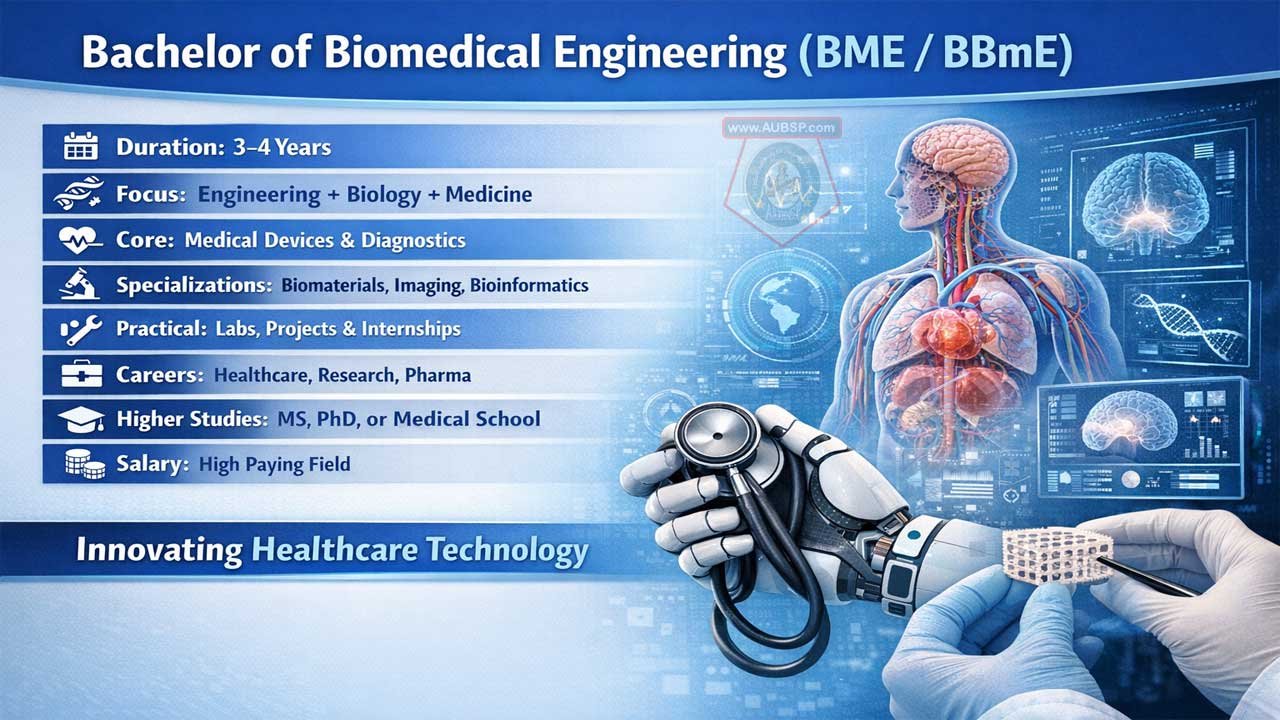
A Bachelor of Biomedical Engineering (BME or BBmE) is a 3–4 year undergraduate degree that combines engineering, biology, and medical sciences to train students to design healthcare technologies such as medical devices, diagnostic systems, imaging tools, and rehabilitation equipment.
The program typically includes foundations in mathematics, physics, life sciences, and core engineering, along with specialized subjects like biomechanics, biomaterials, biomedical instrumentation, and medical imaging, plus lab work and design projects.
Because it bridges engineering and medicine, it prepares graduates for diverse careers in medical device companies, healthcare technology, research, hospitals, and pharmaceuticals, while also offering strong prospects for higher study, medical school pathways, and competitive salaries.
A Bachelor of Biomedical Engineering (BME or BBmE) is a four‑year undergraduate degree that trains students to design medical devices, diagnostics and technologies by combining engineering with biology and medicine. It offers strong international career prospects in healthcare technology, pharma, research and medical device industries, with competitive salaries and options for higher study or medical school.
| Category | Information |
|---|---|
| Degree Name | Bachelor of Biomedical Engineering (BME / BBmE / BEng / BSc) |
| Duration | Typically 3–4 years (6–8 semesters) |
| Field Focus | Combines engineering, biology, and medical sciences |
| Main Goal | Design medical devices, diagnostics, software, and healthcare technologies |
| Core Subjects | Mathematics, physics, biology, circuits, mechanics, programming |
| Specialized Subjects | Biomechanics, biomaterials, biomedical instrumentation, medical imaging, biosignals |
| Practical Components | Labs, design projects, internships, clinical exposure |
| Eligibility | High-school background in math, physics; chemistry/biology often required |
| Key Skills Gained | Device design, signal analysis, CAD, programming, understanding human physiology |
| Common Specializations | Medical devices, imaging, biomechanics, neural engineering, bioinformatics |
| Career Sectors | Medical device industry, hospitals, research labs, pharma, healthcare tech |
| Typical Job Roles | Biomedical engineer, R&D engineer, clinical specialist, quality engineer |
| Higher Study Options | MS/PhD in BME, medical school, public health, data science |
| Salary Outlook | High-paying field; varies by country, experience, and sector |
| Future Scope | Strong demand due to AI in healthcare, aging populations, and medical innovation |
What is Bachelor of Biomedical Engineering?
Biomedical Engineering is the application of engineering principles and life sciences to design and create medical equipment, devices, software and systems used in healthcare.
A Bachelor of Biomedical Engineering (often offered as BME, BBmE, BSc or BEng in Biomedical Engineering) gives students a foundation in maths, physics, biology and core engineering, plus specialized biomedical subjects such as biomechanics, biomaterials and medical imaging. Many universities describe the program as a bridge between cutting‑edge medical technology and real‑world clinical practice.
Why study BME or BBmE?
Biomedical engineering sits at the intersection of engineering, medicine and life sciences, allowing graduates to work on devices and technologies that directly improve patient care.
Universities highlight that BME graduates contribute to solving key challenges such as better diagnostics, minimally invasive surgeries, artificial organs and smarter rehabilitation systems. Because the degree combines engineering, biology and computing, it prepares students for diverse roles in industry, research labs, hospitals, government agencies and startups.
Course duration and structure
Most Bachelor of Biomedical Engineering programs are full‑time degrees of 3–4 years (typically 6–8 semesters), depending on the country. In North America, BME bachelor’s programs usually require about 128–129 credits over four years (for example, at UIC and Johns Hopkins). In Europe, programs commonly span 6 semesters and award around 180 ECTS credits.
Typical structure includes:
- Foundation sciences: mathematics, physics, chemistry and statistics.
- Life sciences: cell biology, human anatomy and physiology, sometimes genetics or pathology.
- Core engineering: circuits, electronics, mechanics, signals and systems, programming and numerical methods.
- Biomedical engineering core: biomechanics, biomaterials, biomedical instrumentation, medical imaging, biosignals, and quantitative physiology.
- Laboratories and projects: design projects, labs, internships or hospital/clinical exposure depending on the university.
Common subjects and syllabus highlights
While exact syllabi vary, many accredited BME programs cover similar key subjects:
- Mathematics & computing: Calculus I–III, differential equations, linear algebra and basic programming.
- Physics & chemistry: Mechanics, electricity & magnetism, thermodynamics and general chemistry.
- Biology & physiology: Biology of cells and organisms, quantitative human physiology, and organ‑specific anatomy/physiology.
- Circuits & electronics: Electrical networks, electronic circuits and electromagnetic fields for understanding medical instruments.
- Biomechanics: Mechanics applied to tissues, joints, blood flow and orthopedic/rehabilitation engineering.
- Biomaterials: Natural and synthetic biomaterials used in implants, prosthetics and tissue engineering.
- Biomedical instrumentation: Sensors, transducers, signal conditioning and data acquisition in medical devices.
- Medical imaging: Principles of MRI, CT, ultrasound and other imaging modalities.
- Control & modeling: Mathematical modeling of physiological systems and control of biomedical devices.
- Capstone design / thesis: A final project or dissertation where students design or analyze a biomedical system or device.
Eligibility and admission requirements
Admission conditions vary by country and university, but most BME/BBmE programs expect a strong high‑school background in mathematics and science. Many curricula explicitly list calculus, physics and chemistry as required preparation for first‑year courses. Some biomedical tracks also expect prior exposure to biology, since early modules include cellular biology and human physiology.
Typical requirements include:
- Completion of secondary education (12 years of schooling or equivalent) with mathematics and physics; chemistry and/or biology are often recommended or required.
- Minimum grade/percentage or GPA as defined by the university’s engineering faculty.
- Standardized tests where applicable (e.g., SAT/ACT for many US universities; specialized entrance tests or national exams for specific programs such as the IIT Madras BS in Medical Sciences & Engineering, which uses the IISER Aptitude Test for admissions).
- Proof of English language proficiency (IELTS/TOEFL or equivalent) for non‑native speakers applying to English‑medium programs.
Some programs also look favorably on prior participation in science Olympiads, projects, research or healthcare volunteering, though these are not always mandatory.
Major specializations in Biomedical Engineering
Because biomedical engineering is broad, many universities offer tracks/specializations within the bachelor’s degree so students can focus on a niche area. Common specializations include:
- Biomechanics: Focuses on mechanical behavior of tissues, orthopedic and rehabilitation engineering, and cardiovascular mechanics.
- Cell & Tissue Engineering: Deals with biomaterials, tissue scaffolds, gene and cell therapies, and regenerative medicine.
- Biomedical Imaging & Bioelectrics: Covers MRI, CT, ultrasound, image processing and bioelectrical systems for diagnosis and therapy.
- Medical Devices & Instrumentation: Emphasizes design, testing and regulation of medical equipment, implants and monitoring systems.
- Neural Engineering: Explores brain–computer interfaces, neuroprosthetics and devices interacting with the nervous system.
- Bioinformatics & Biocomputation: Uses computational tools and data analysis to model biological systems and analyze medical data.
- Community Healthcare & Assistive Technology: Designs technologies for aging populations, disabled persons and global health applications (e.g., NUS’s Community Healthcare & Technology specialisation).
- Robotics in Medicine: Involves surgical robots, rehabilitation robots and robotic assistive devices.
Not all universities list these as formal “specializations,” but many allow students to build such profiles through elective choices in the final years.
Skills you will gain
A BME/BBmE program builds both technical and transferable skills.
Key technical skills include:
- Mathematical modeling of biological systems and signal processing of physiological data.
- Design and analysis of circuits, sensors and embedded systems used in medical devices.
- Understanding of human anatomy, physiology and pathology, especially for device–tissue interactions.
- Use of CAD tools, simulation software and sometimes programming languages for engineering design and data analysis.
Equally important are soft skills like teamwork, communication with clinicians and researchers, project management and ethical decision‑making in healthcare contexts, which are often emphasized through design projects and interdisciplinary teaching.
Top regions and types of universities to study BME
Bachelor’s programs in Biomedical Engineering are now offered across North America, Europe, Asia and other regions.
Examples of strong BME offerings include:
- United States & Canada: Many research universities offer accredited BME majors, such as the University of Michigan’s joint program with its medical school, which highlights close connections to hospitals and clinical research.
- Europe (Germany and others): Universities like Karlsruhe Institute of Technology and Ulm University offer Bachelor of Science degrees in Biomedical Engineering with a mix of mathematics, engineering fundamentals and medical/biological basics over 6 semesters.
- Asia (Singapore & India): National University of Singapore runs a Bachelor of Engineering (Biomedical Engineering) with multiple specialisations, while IIT Madras offers an interdisciplinary BS in Medical Sciences & Engineering focusing on physiology, AI in health, imaging and device development.
Students targeting international careers often look for programs that are ABET‑accredited (or equivalent), have strong research labs and provide clinical or industry exposure through internships.
Career opportunities after Bachelor of BME
Graduates of BME or BBmE programs work in a range of sectors: medical device companies, hospitals, research institutions, government agencies, consulting and tech startups. Common job titles reported by universities include design engineer, clinical application specialist, manufacturing engineer, quality engineer, R&D engineer, systems engineer and research associate.
Industry data show biomedical engineers employed in:
- Scientific research and development services
- Medical equipment and supplies manufacturing
- Pharmaceutical and medicine manufacturing
- Architectural and engineering services
- Computer systems design and related services
Some graduates pursue higher studies (MS/PhD) in biomedical engineering or related fields, while others use the degree as a pathway to medical school, public health, data science or management.
Salary expectations and job outlook
Biomedical engineering is generally a high‑paying field compared with many other professions. In the United States, recent data from the Bureau of Labor Statistics and university sources report:
- A mean annual wage for biomedical engineers around USD 106,000–108,000.
- Median annual salaries for bioengineers and biomedical engineers in the range of USD 97,000–107,000 depending on the year and dataset.
- Entry‑level total compensation figures starting around USD 66,000–82,000, with experienced professionals exceeding USD 100,000.
In India, compiled salary data indicate approximate annual packages for biomedical engineers rising from around ₹12.5 LPA at entry level to over ₹22 LPA at senior levels in 2025, reflecting healthcare growth and medical technology adoption. Salaries also vary significantly by industry segment, with research services and engineering services often showing higher averages than basic equipment maintenance.
Overall, government labor statistics describe bioengineers and biomedical engineers as having favorable job prospects due to aging populations, increased use of medical equipment and ongoing healthcare innovation.
Future scope and emerging trends
The future scope of BME is shaped by several powerful trends:
- Aging societies and chronic diseases are driving demand for implants, assistive technology, remote monitoring and rehabilitation devices.
- Artificial intelligence, machine learning and data analytics are increasingly embedded in imaging, diagnostics and personalized treatment planning, reflected in newer curricula that explicitly teach AI applied to health and medical image analysis.
- Regenerative medicine and tissue engineering are expanding opportunities to engineer tissues, organs and advanced biomaterials for transplantation and repair.
- Global health and low‑cost innovation are opening niches for engineers who can design affordable, robust devices for underserved regions, as highlighted by specializations in global health and community‑focused biomedical engineering.
These trends make BME one of the more future‑oriented engineering degrees in the healthcare technology ecosystem.
Is BME or BBmE the right course for you?
A Bachelor of Biomedical Engineering is a strong fit if you:
- Enjoy mathematics and physics but also have a genuine interest in biology, medicine and human health.
- Want to work on tangible products like devices, sensors, software and systems that improve diagnosis, treatment or quality of life.
- Are comfortable with an interdisciplinary workload that spans circuits, coding, lab work and anatomy instead of a single narrow domain.
If your interests lean more towards pure biology, biotechnology or medicine without heavy engineering, a life‑science or pre‑medical degree might suit you better; conversely, if you love electrical, mechanical or computer engineering but want a healthcare application focus, BME provides that bridge.
FAQ about Bachelor of Biomedical Engineering
1. Is biomedical engineering a good career?
Yes. Salary surveys and government statistics show biomedical engineers earning median and mean salaries significantly above overall occupational averages, especially in research, medical device and high‑tech sectors. Combined with strong demand for medical technology, this makes BME an attractive long‑term career choice.
2. Can a BME graduate become a doctor?
Many BME graduates apply to medical school or equivalent professional programs after completing required pre‑medical courses such as biology, chemistry and physics, which often overlap with the BME curriculum. Admission still depends on meeting each medical school’s specific prerequisites and entrance exams, but the engineering background can be an advantage in fields like radiology, cardiology and surgery.
3. What is the difference between BME and Biotechnology?
Biomedical Engineering focuses on applying engineering (mechanical, electrical, computing) to devices, diagnostics, imaging and instrumentation, while biotechnology degrees usually emphasize biological processes, genetics, bioprocessing and molecular biology for pharma or agriculture. BME students tend to study more circuits, mechanics and device design, whereas biotechnology students take more advanced biology, chemistry and lab‑based molecular courses.
4. Is Bachelor of Biomedical Engineering hard?
Most universities classify BME as a rigorous program because it combines advanced mathematics, physics, core engineering and life sciences in one degree. However, students with strong science backgrounds and consistent study habits manage the workload successfully, particularly when they are motivated by the medical impact of their projects.
5. What is the average salary of a biomedical engineer?
Recent data from US sources report mean and median annual salaries for biomedical engineers around USD 100,000–110,000, with higher earnings in certain industries and locations. In emerging markets like India, reported average annual packages range from roughly ₹12–22 LPA depending on experience level and role.


Leave a Reply
You must be logged in to post a comment.