
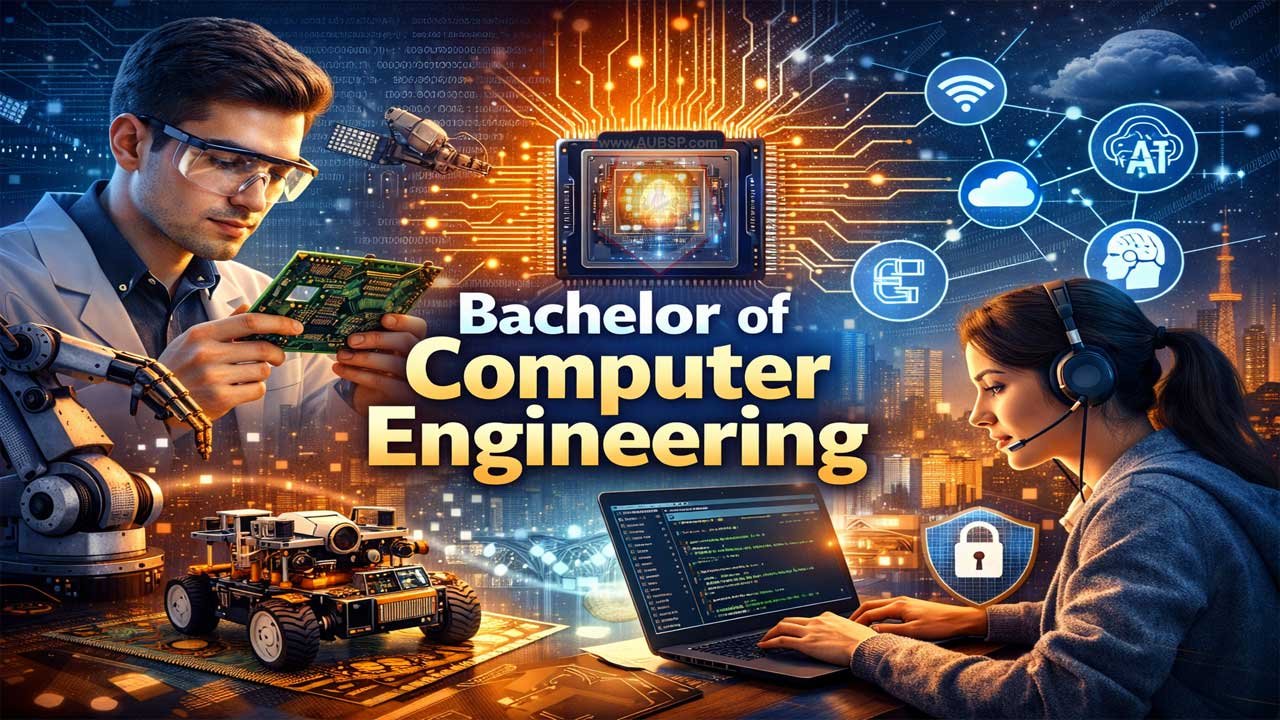
A Bachelor of Computer Engineering (BCompEng) is a four-year undergraduate degree that combines electrical engineering and computer science to train students to design, build, and optimize complete computing systems, focusing on how hardware and software work together.
Unlike computer science, which emphasizes algorithms and software, computer engineering teaches both physical components (circuits, digital electronics, embedded systems) and software development, giving graduates a full-stack understanding of technology. The curriculum typically includes mathematics, programming, computer architecture, operating systems, networks, artificial intelligence, and hands-on projects culminating in a capstone design experience.
This interdisciplinary training provides strong career flexibility, allowing graduates to work in areas such as software development, hardware design, robotics, cybersecurity, cloud computing, AI, and IoT. With global demand, competitive salaries, and emerging opportunities in fields like quantum computing and sustainable computing, a BCompEng degree serves as a strong foundation for innovation-driven technology careers, especially when earned from an accredited program and supported by practical experience and technical skills.
| Category | Information |
|---|---|
| Degree Name | Bachelor of Computer Engineering (BCompEng / B.Tech / BEng / BSCompE) |
| Duration | 4 years (full-time undergraduate program) |
| Field of Study | Combination of Electrical Engineering + Computer Science |
| Primary Focus | Hardware–software integration and computer system design |
| Core Subjects | Programming, Digital Electronics, Data Structures, Operating Systems, Computer Architecture, AI, Networks |
| Learning Style | Theory + hands-on labs + projects + capstone design |
| Key Skills Gained | Programming, circuit design, system architecture, problem-solving, embedded systems |
| Career Options | Software Engineer, Embedded Systems Engineer, AI/ML Engineer, Hardware Engineer, Cloud Engineer, Cybersecurity Engineer |
| Average Salary (US) | $105,000–$128,000 per year (median range) |
| Average Salary (India) | ₹5–10 LPA (entry level), ₹10–18 LPA in AI/ML roles |
| Admission Requirements | Strong Mathematics & Physics background, entrance exams or standardized tests |
| Top Specializations | AI & ML, IoT, Robotics, Cybersecurity, Cloud Computing, Quantum Computing |
| Accreditation | ABET or equivalent national engineering accreditation recommended |
| Best For Students Who | Enjoy both hardware, electronics, and programming |
| Career Outlook | High global demand with strong long-term job growth |
What Is a Bachelor of Computer Engineering?
A Bachelor of Computer Engineering (BCompEng) is an undergraduate degree that integrates the principles of electrical engineering and computer science to prepare students for designing, developing, and optimizing computing systems. Unlike a pure computer science degree that emphasizes software and algorithms, computer engineering focuses on the hardware-software interface — teaching students how physical components communicate with software and how to build complete computing systems from the ground up.
The degree goes by several names depending on the country and institution: Bachelor of Science in Computer Engineering (BSCompE), Bachelor of Engineering in Computer Engineering (BEng), Bachelor of Technology in Computer Engineering (B.Tech), and Bachelor of Computer Engineering (BCompEng). Regardless of the title, the core philosophy remains the same — producing engineers who understand a computer system from top to bottom, from application software to operating systems to hardware and circuits.
Why Choose Computer Engineering?
Computer engineering stands at the intersection of two powerful disciplines, giving graduates a uniquely versatile skill set. While computer scientists typically dive deep into software, data, and theoretical computing, computer engineers work across the full technology stack — designing mobile phone operating systems, creating scalable cloud architectures, developing game engines, and building advanced embedded real-time systems.
This breadth translates directly into career flexibility. Computer engineers can pivot between hardware design, software development, systems architecture, and emerging fields like robotics and IoT, making them highly adaptable in a rapidly evolving job market. The combination of hands-on lab work with theoretical foundations also means graduates are uniquely prepared for roles that require understanding both the physical and digital layers of technology.
Core Curriculum and Subjects
A BCompEng program typically spans four years of full-time study, requiring approximately 128 semester hours of credit. The curriculum blends mathematics, science, engineering fundamentals, and specialized computer engineering coursework.
Foundational Courses (Years 1–2)
The first two years build a strong foundation in mathematics and basic engineering principles:
| Semester | Key Subjects |
|---|---|
| Semester 1 | Mathematics I, Physics I, Chemistry, Basic Mechanical Engineering, Workshop Practice, Communication Skills |
| Semester 2 | Mathematics II, Physics II, Basic Electrical Engineering, Programming Fundamentals, Engineering Graphics |
| Semester 3 | Analog Electronics, Data Structures, Object-Oriented Programming, Discrete Structures, Engineering Economics |
| Semester 4 | Digital Electronics, Database Management Systems, Operating Systems Design, Computer Organization & Architecture, Algorithm Design & Analysis |
Advanced Courses (Years 3–4)
The upper-level curriculum dives into specialized computer engineering topics:
| Semester | Key Subjects |
|---|---|
| Semester 5 | Software Engineering, Theory of Computation, Elective Courses, Professional Ethics |
| Semester 6 | Compiler Design, Artificial Intelligence, Computer Networks, Technical Communication |
| Semester 7 | Capstone Project I, Information & Network Security, Distributed Systems, Electives |
| Semester 8 | Capstone Project II, Data Warehousing & Data Mining, Electives |
Key Subject Areas Explained
- Data Structures and Algorithms: Examines how arrays, hash tables, graphs, heaps, and linked lists are used across industries, along with measuring computational complexity.
- Embedded Systems: Covers memory systems, functional modeling, models of computation, and software architectures for hardware-software integration.
- Digital Electronics: Introduces digital logic, functioning and design of digital devices, logic families, and electronic memory.
- Artificial Intelligence: Explores knowledge representation, problem-solving, and learning methods, along with intelligent system engineering.
- Software Development: Focuses on programming languages like Python, JavaScript, HTML, and C/C++, along with common data structures and tools like Git.
Most programs culminate in a capstone design project and may include mandatory internships or co-op work terms for real-world industry experience.
Computer Engineering vs. Computer Science
One of the most common questions prospective students face is choosing between these two fields. While they share foundational computing topics such as digital logic and computer architecture, their focus areas diverge significantly.
| Dimension | Computer Engineering | Computer Science |
|---|---|---|
| Primary Focus | Hardware-software integration, system design | Algorithms, software systems, theoretical computing |
| Coursework | Circuits, digital logic, microprocessors, embedded systems | Programming, databases, AI, data science |
| Skills Developed | Hardware design, low-level programming, robotics, system integration | Advanced programming, data analysis, software optimization |
| Learning Approach | Hands-on lab work with circuits, microcontrollers, embedded systems | Theoretical and coding-based projects, simulations, datasets |
| Typical Careers | Hardware designer, robotics engineer, systems architect, embedded systems engineer | Software developer, data scientist, AI specialist |
Computer engineering is ideal for students fascinated by how physical devices work and how hardware interacts with software, while computer science suits those drawn to coding, software architecture, and abstract problem-solving.
Top Universities for Computer Engineering
United States
The United States hosts some of the world’s most prestigious computer engineering programs, many of which are ABET-accredited:
| Rank | University | Acceptance Rate | Notable Strength |
|---|---|---|---|
| 1 | Stanford University | ~4% | Close ties to Silicon Valley; startup culture |
| 2 | UC Berkeley | ~12% | Leading research output in CE |
| 3 | Carnegie Mellon University | ~11% | Strong focus on AI and cybersecurity |
| 4 | Massachusetts Institute of Technology | ~5% | Cutting-edge research across all CE domains |
| 5 | Georgia Institute of Technology | ~16% | Threads-based customizable curriculum |
| 6 | University of Illinois Urbana-Champaign | ~44% | #1 by program-specific rankings; nanotechnology research through Holonyak Lab |
| 7 | University of Michigan – Ann Arbor | ~18% | Strong industry partnerships |
International Programs
Computer engineering is offered globally under various degree titles:
| University | Country | Degree Title | Duration | Annual Fees (Approx.) |
|---|---|---|---|---|
| Nanyang Technological University | Singapore | BEng(Hons) in Computer Engineering | 4 years | ~SGD 17,000–40,000 |
| HKUST | Hong Kong | BEng in Computer Engineering | 4 years | HKD 170,000 (~₹19.7 Lakh) |
| University of Canterbury | New Zealand | BE(Hons) – Computer Engineering | 4 years | ~NZD 45,000–50,000 |
| Thompson Rivers University | Canada | BEng in Computer Engineering | 4 years | ~CAD 20,000–25,000 |
| University of Auckland | New Zealand | BE(Hons) – Computer Engineering | 4 years | ~NZD 45,000–50,000 |
Over 800 universities worldwide offer degrees in computer science and related fields, spanning countries from Australia and Canada to Germany, India, and the UAE.
Admission Requirements
Academic Prerequisites
Admission requirements for BCompEng programs vary by country but generally include:
- High school completion (10+2 or equivalent) with strong performance in Mathematics, Physics, and English.
- IB Diploma holders: Typically need Mathematics: Analysis and Approaches and Physics at Higher Level (recommended), with minimum scores of 4 in each subject and a total of 31 points.
- Standardized tests: SAT/ACT scores for US universities (e.g., average SAT of 1545 at Stanford and MIT).
- Entrance exams: Country-specific engineering entrance exams such as JEE (India), ENEM (Brazil), or university-specific assessments.
English Language Proficiency
International students whose first language is not English typically must demonstrate proficiency through IELTS or TOEFL scores. Minimum requirements vary by institution but generally fall in the range of IELTS 6.0–7.0 or TOEFL iBT 80–100.
Supplementary Requirements
Many competitive programs also require an Admission Information Form, letters of recommendation, personal statements, and in some cases video interviews for scholarship consideration.
Accreditation: Why It Matters
ABET (Accreditation Board for Engineering and Technology) is the gold standard for engineering program accreditation globally. ABET accreditation is ISO 9001:2015 certified and covers more than 3,500 programs at over 700 colleges and universities in 29 countries.
Graduating from an ABET-accredited program provides several advantages:
- Enhanced career opportunities and employer confidence in graduates’ competencies.
- Professional licensure eligibility, which is often required for the title of Professional Engineer (PE).
- Global mobility, as ABET accreditation is recognized through international mutual recognition agreements such as the Washington Accord.
- Quality assurance that the program meets rigorous standards in curriculum design, faculty qualifications, and student outcomes.
When evaluating programs, prospective students should verify accreditation status through the ABET website, particularly for programs outside the United States.
Career Paths and Salary Expectations
Job Roles
Computer engineering graduates are equipped for diverse roles across multiple industries:
- Software Engineer / Developer: Full-stack, web, and mobile application development
- Embedded Systems Engineer: Designing firmware and hardware-software co-design for IoT, automotive, and aerospace
- Cybersecurity Engineer: Protecting digital infrastructure, ethical hacking, and security architecture
- Cloud Engineer / Architect: Building and managing cloud infrastructure and SaaS systems
- Data Scientist: Extracting insights from large datasets using statistical and ML techniques
- DevOps Engineer: Bridging development and operations through CI/CD pipelines and automation
- Machine Learning Engineer: Developing AI models and intelligent systems
- Robotics Engineer: Designing autonomous systems for industrial, commercial, and service applications
- Hardware Design Engineer: Creating microprocessors, circuit boards, and digital systems
- Network Engineer: Designing, implementing, and managing computer networks
Salary Overview
Computer engineering remains one of the highest-paying engineering disciplines globally:
| Region/Level | Average Annual Salary |
|---|---|
| United States (Median) | $105,000 – $128,170 |
| US Entry-Level (0–1 years) | ~$76,000 |
| US Early Career (1–4 years) | ~$82,250 |
| US Experienced (10+ years) | ~$102,000+ |
| US Hardware Engineers | ~$139,088 |
| India (Average) | ₹10,50,000/year (~$12,500) |
| India (AI/ML Roles) | ₹10–18 LPA |
| India (Entry-Level Software) | ₹5–10 LPA |
Salary by education level in the United States:
| Education Level | Average Annual Salary |
|---|---|
| Associate Degree | $65,000 |
| Bachelor’s Degree (BSCompE) | $92,000 |
| Master’s Degree (MSCompE) | $103,000 |
| Doctorate (PhD) | $131,000 |
The highest-paying industry for computer engineers is securities, commodity contracts, and financial investments, with an average annual salary of $194,630.
Job Growth Outlook
The U.S. Bureau of Labor Statistics projects a 7% growth in computer engineering opportunities between 2024 and 2034, which is faster than the average growth rate for all occupations. India’s tech sector continues to see rising demand as industries undergo rapid digital transformation, pushing salaries and job prospects upward for skilled computer engineers.
Emerging Specializations and Industry Trends
The field of computer engineering is evolving rapidly, with several emerging specializations shaping the landscape for 2026 and beyond:
Artificial Intelligence and Machine Learning
AI and ML represent the most transformational forces in computer engineering. Roles like AI Engineer and ML Developer are in surging demand as companies integrate intelligent systems into their operations. Applications range from predictive analytics and self-driving vehicles to humanoid robots and natural language processing.
Quantum Computing
Quantum computing is opening new frontiers in algorithms, cryptography, and computational problem-solving. While still emerging, this field offers exciting research and advanced engineering roles for those with strong mathematical foundations.
Cloud and Edge Computing
Cloud-first strategies and the rise of edge computing are creating opportunities in cloud architecture, hybrid infrastructure, and IoT system management. Edge computing provides the computational foundation for smart cities and autonomous vehicles by processing data closer to where it is generated.
Cybersecurity and Blockchain
With increasingly strict data protection regulations worldwide, demand is growing for ethical hackers, cloud security specialists, and blockchain security engineers. This specialization combines networking knowledge with cryptographic techniques.
Internet of Things (IoT) and Smart Devices
The explosive growth in connected devices is expanding career opportunities in embedded systems, industrial IoT, and smart technology development. Computer engineers are uniquely suited for IoT roles due to their hardware-software integration skills.
Sustainable and Green Computing
A newer but rapidly growing area, green computing focuses on developing energy-efficient computing systems and sustainable technology practices. This specialization addresses the environmental impact of large-scale data centers and computational infrastructure.
Skills Needed to Succeed
Beyond formal coursework, successful computer engineers develop a blend of technical and soft skills:
Technical Skills
- Proficiency in programming languages such as C/C++, Python, Java, JavaScript, and assembly language
- Hardware design and troubleshooting, including circuit design and microcontroller programming
- Understanding of computer architecture, networking protocols, and operating systems
- Familiarity with AI/ML frameworks like TensorFlow and PyTorch
- Cloud platforms (AWS, Azure, GCP) and DevOps tools
Soft Skills
- Teamwork and collaboration, which are integrated into senior design courses and capstone projects
- Communication skills for technical writing and presenting complex engineering concepts
- Problem-solving and critical thinking across interdisciplinary contexts
- Adaptability and commitment to lifelong learning, given the continuous evolution of technology
How to Choose the Right Program
Selecting the best BCompEng program requires evaluating several factors:
- Accreditation status: Verify ABET or equivalent national accreditation to ensure global recognition and professional licensure eligibility.
- Curriculum specializations: Look for programs offering threads, concentrations, or electives aligned with career interests — such as AI, cybersecurity, or embedded systems.
- Industry connections: Programs with mandatory co-op terms, internship requirements, and industry partnerships provide invaluable real-world experience.
- Research opportunities: Access to state-of-the-art laboratories and faculty-led research projects can distinguish top programs.
- Global recognition: Consider programs with international mutual recognition agreements for career flexibility across borders.
- Cost and financial aid: Tuition varies dramatically — from under $15,000/year at public US universities to over $66,000/year at private institutions. Many universities offer merit-based scholarships and financial aid for international students.
Conclusion
A Bachelor of Computer Engineering is a powerful launchpad for a technology career, combining the depth of electrical engineering with the versatility of computer science.
With median salaries exceeding $100,000 in the United States, strong global demand across industries from healthcare to finance, and exciting emerging fields like AI, quantum computing, and IoT, this degree positions graduates at the forefront of technological innovation. The key to maximizing its value lies in choosing an accredited program, building both technical and soft skills, and staying current with the rapidly evolving landscape of computer engineering.
FAQs about Bachelor of Computer Engineering
What is a Bachelor of Computer Engineering?
A Bachelor of Computer Engineering is an undergraduate degree that combines electrical engineering and computer science to teach students how to design, develop, and optimize computer systems involving both hardware and software.
How long does a Computer Engineering degree take?
Most computer engineering programs take four years of full-time study to complete, divided into foundational and advanced coursework along with projects and internships.
What subjects are taught in Computer Engineering?
Common subjects include programming, data structures, digital electronics, computer architecture, operating systems, artificial intelligence, computer networks, embedded systems, and software engineering.
Is Computer Engineering the same as Computer Science?
No, computer engineering focuses on hardware–software integration and system design, while computer science mainly emphasizes software, algorithms, and theoretical computing.
What skills do Computer Engineering students learn?
Students learn programming, circuit design, system architecture, embedded systems development, problem-solving, teamwork, and technical communication skills.
What programming languages are taught in Computer Engineering?
Typical languages include C, C++, Python, Java, JavaScript, and sometimes assembly language depending on the program.
What careers can I pursue with a Computer Engineering degree?
Graduates can work as software engineers, embedded systems engineers, hardware designers, AI engineers, cloud engineers, cybersecurity specialists, robotics engineers, and network engineers.
Is Computer Engineering a good career choice?
Yes, it offers strong job demand, high salaries, and flexibility across multiple technology fields such as AI, robotics, cloud computing, and IoT.
What is the average salary for Computer Engineering graduates?
Entry-level salaries typically range from ₹5–10 LPA in India and around $76,000 per year in the United States, with higher earnings in specialized roles.
Do Computer Engineering students study hardware?
Yes, students study circuits, digital logic, microprocessors, and embedded systems along with software development.
Can Computer Engineers become software developers?
Yes, computer engineering graduates are well qualified for software development roles because they learn programming and system-level computing concepts.
Is mathematics important in Computer Engineering?
Yes, mathematics such as calculus, linear algebra, and discrete mathematics is essential for algorithms, electronics, and system design.
What is embedded systems engineering?
Embedded systems engineering involves designing hardware-software systems used in devices like smart appliances, cars, medical equipment, and IoT devices.
What are the admission requirements for Computer Engineering?
Students typically need strong grades in mathematics and physics, completion of high school education, and may need entrance exams or standardized test scores.
Can Computer Engineering students work in AI and machine learning?
Yes, many programs include AI courses, enabling graduates to work in machine learning and intelligent systems development.
Is Computer Engineering difficult?
It can be challenging because it combines electronics, mathematics, and programming, but it is manageable with consistent practice and interest.
What is a capstone project in Computer Engineering?
A capstone project is a final-year project where students design and build a real-world system applying their technical knowledge.
Do Computer Engineering programs include internships?
Many universities offer or require internships or co-op programs to provide industry experience.
What industries hire Computer Engineers?
Technology, automotive, aerospace, finance, healthcare, telecommunications, manufacturing, and robotics industries commonly hire computer engineers.
Can Computer Engineers work in robotics?
Yes, robotics is a popular career path because it requires knowledge of both hardware systems and software programming.
Is accreditation important for Computer Engineering degrees?
Yes, accreditation ensures program quality and improves job prospects and eligibility for professional engineering licensure.
What is the difference between B.Tech and BEng in Computer Engineering?
The difference is mainly naming conventions across countries; the curriculum and career outcomes are generally similar.
Can Computer Engineers work abroad?
Yes, the skills are globally in demand, especially if the degree is accredited and supported by practical experience.
What are the emerging fields in Computer Engineering?
AI, quantum computing, cybersecurity, cloud computing, IoT, edge computing, and green computing are rapidly growing areas.
Do Computer Engineers need electronics knowledge?
Yes, understanding electronics is essential for designing and optimizing hardware systems and embedded devices.
What soft skills are important for Computer Engineers?
Communication, teamwork, problem-solving, adaptability, and critical thinking are highly valued alongside technical skills.
Can I pursue higher studies after Computer Engineering?
Yes, graduates can pursue master’s or doctoral degrees in computer engineering, computer science, AI, robotics, or related fields.
Is Computer Engineering better than IT?
It depends on career goals; computer engineering is broader and includes hardware knowledge, while IT focuses mainly on systems management and software applications.
What tools and technologies do Computer Engineering students use?
Students often use programming IDEs, version control tools like Git, simulation software, microcontrollers, and cloud platforms.
Does Computer Engineering involve coding?
Yes, coding is a major component alongside hardware design and system engineering.
Who should choose Computer Engineering?
Students interested in both electronics and programming, and curious about how computers work internally, are well suited for this field.
What makes Computer Engineering unique?
Its combination of hardware and software expertise allows engineers to design complete computing systems rather than focusing on only one aspect of technology.
Are Computer Engineering jobs future-proof?
While no job is fully future-proof, demand remains strong due to continuous technological innovation and digital transformation worldwide.
Can Computer Engineers start their own tech companies?
Yes, the broad technical foundation makes graduates well prepared for startups and product development.
What is the job growth outlook for Computer Engineering?
Job opportunities are expected to grow steadily as industries adopt automation, AI, and connected technologies.
Do Computer Engineers work with cloud computing?
Yes, many roles involve designing cloud infrastructure, distributed systems, and scalable applications.
Is Computer Engineering suitable for creative people?
Yes, it involves designing innovative systems, solving complex problems, and building new technological solutions.
Can Computer Engineers transition into data science?
Yes, with additional focus on statistics and machine learning, they can move into data science roles.
What is the main advantage of studying Computer Engineering?
The biggest advantage is career flexibility across both hardware and software domains in the technology industry.


Leave a Reply
You must be logged in to post a comment.