
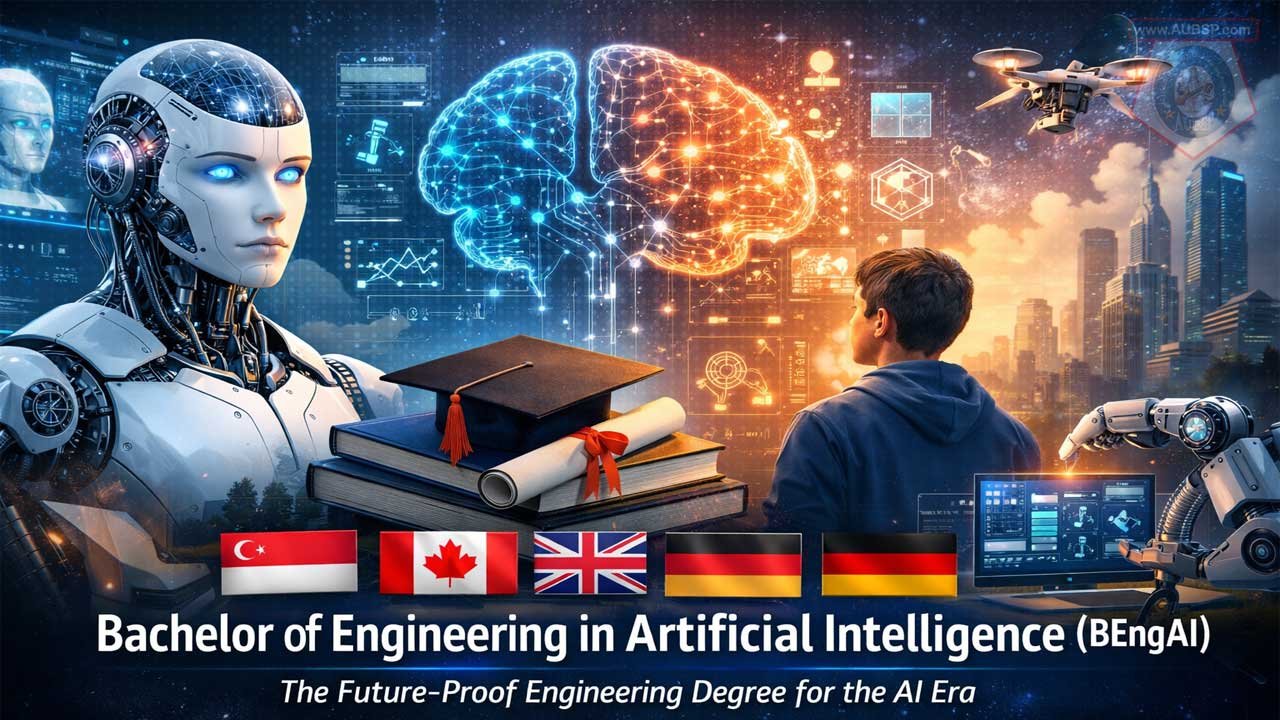
The Bachelor of Engineering in Artificial Intelligence (BEngAI) has become a major standalone degree in 2026 because artificial intelligence is now a separate engineering field, not just part of computer science.
The program focuses on building intelligent systems that can learn and make decisions, unlike traditional software that follows fixed rules. Its curriculum combines strong mathematics, advanced computing, practical AI deployment skills (MLOps), and responsible AI ethics. Universities worldwide now offer specialized AI programs, with strong options in Asia, North America, Europe, and Australia.
Admission is competitive and requires high math skills and English proficiency, while costs and career opportunities vary by country. AI engineers are in high demand across industries like healthcare, finance, and technology, with high salaries and good immigration pathways in many countries. Overall, BEngAI is seen as a future-proof degree that prepares students to design intelligent systems and succeed in the global digital economy.
| Category | Information |
|---|---|
| Degree Name | Bachelor of Engineering in Artificial Intelligence (BEngAI) |
| Focus Area | Designing intelligent systems that learn, adapt, and make decisions |
| Core Subjects | Linear Algebra, Optimization, Machine Learning, Deep Learning, Probability, Ethics in AI |
| Technical Skills | Python, PyTorch, TensorFlow, MLOps, Cloud Computing, AI Deployment |
| Program Pillars | Mathematics, Computational Modeling, Responsible AI |
| Industry Skills | Model deployment, scalable AI systems, CI/CD for ML, GPU optimization |
| Top Study Destinations | Singapore, Canada, UK, Germany, Australia, UAE |
| Admission Requirements | Strong Mathematics background, Physics (recommended), English proficiency (IELTS/TOEFL) |
| Career Roles | AI Engineer, AI Research Scientist, MLOps Engineer, Computer Vision Engineer, AI Safety Engineer |
| Industries Hiring | Technology, Healthcare, Finance, Robotics, Infrastructure |
| Global Demand | AI Engineer among fastest-growing tech jobs worldwide |
| Starting Salary Range | High compared to traditional software roles (varies by country) |
| Immigration Advantage | STEM degrees offer extended post-study work visas in many countries |
| Best For Students Who Want To | Build intelligent systems rather than only analyze data |
| Future Outlook | Highly future-proof due to growing AI adoption across industries |
BEngAI Degree in 2026: Future Scope, Top Universities, Career Opportunities & Global Demand
The structural reconfiguration of the global technological landscape has necessitated a corresponding evolution in the academic credentials that serve as the entry point for the next generation of engineers. In 2026, the Bachelor of Engineering in Artificial Intelligence (BEngAI) has transitioned from a niche specialization within broader computer science departments to a standalone, flagship degree program.
This shift is driven by the maturation of artificial intelligence as its own recognized engineering discipline, distinct from data science or traditional software engineering. As global hiring remains nuanced—prioritizing high-yield productivity over simple headcount—the BEngAI has emerged as a high-leverage differentiator for international students seeking to navigate a labor market where technical fluency is the new baseline and specialized AI expertise is the primary driver of economic growth.
The impetus for this degree lies in the fundamental difference between building software that follows fixed logic and designing systems that adapt, learn, and reason autonomously. While traditional computer science provides the underlying architectural frameworks, the BEngAI focuses on the deployment of intelligent agents capable of performing human-like cognitive tasks.
This distinction is critical for international applicants who must choose between degrees that position them for different long-term career outcomes: designing the infrastructure (Computer Science), interpreting the data (Data Science), or engineering the intelligence itself (Artificial Intelligence).
The Academic Architecture of the BEngAI: Delineating the Discipline
The core of the BEngAI curriculum in 2026 is built upon three pillars: rigorous mathematical foundations, advanced computational modeling, and a new emphasis on the ethics of autonomous systems. Unlike the “black box” approach often found in earlier iterations of technical education, modern BEngAI programs emphasize a “first principles” approach, ensuring that graduates understand the underlying mechanisms of neural architectures rather than just their implementation.
Mathematical Foundations and Theoretical Rigor
The mathematical requirements of the BEngAI exceed those of most generalist computer science programs. The focus is not merely on calculation but on the geometric and probabilistic interpretation of data. Linear algebra serves as the foundational language, specifically in the representation of data as matrices and tensors. Students explore matrix decompositions, such as singular-value decomposition (SVD) and eigen-decomposition, to reveal structural insights within high-dimensional datasets.
Furthermore, the integration of calculus and optimization is essential for understanding the training of deep learning models. Mathematical models such as stochastic gradient descent are taught not just as algorithms but as dynamic systems governed by multivariable calculus. Probability and statistics are restructured around machine learning, focusing on multivariate Gaussians, Hidden Markov Models, and graphical models such as factor graphs.
| Mathematical Pillar | Application in AI Engineering | Core Concepts |
|---|---|---|
| Linear Algebra | Data representation and neural operations | Matrices, Tensors, Eigen-decomposition, SVD |
| Optimization | Model training and loss minimization | Gradient Descent, Constrained/Unconstrained Optimization |
| Probability & Statistics | Handling uncertainty and inference | Bayesian Networks, Markov Models, Stochastic Processes |
| Discrete Mathematics | Algorithm logic and graph theory | Computational Logic, Neural Architectures, Network Analysis |
The Transition to Applied AI Engineering and MLOps
A defining trend in the 2026 BEngAI is the shift from model research to MLOps (Machine Learning Operations). Industry feedback has indicated that the most critical skill gap is not in creating models but in making them work reliably at scale in production environments. Consequently, undergraduate programs now include modules on containerization (Docker, Kubernetes), continuous integration/continuous deployment (CI/CD) pipelines for machine learning, and GPU cost optimization.
Graduates are expected to be proficient in bridge-building roles: taking a “polished” model from a research environment and deploying it into a live, scalable service. This requires a mastery of modern AI APIs and frameworks, particularly PyTorch and TensorFlow, alongside a deep understanding of cloud platforms such as AWS, Azure, and Google Cloud.
The Centrality of Responsible and Generative AI
The mainstreaming of generative AI has fundamentally altered the curriculum. By 2026, specialized modules on Large Language Models (LLMs), Retrieval-Augmented Generation (RAG), and prompt engineering have become standard. Students learn to fine-tune models on custom data while simultaneously addressing the technical challenges of “hallucinations” and model bias.
Ethics is no longer an elective but a core engineering requirement. The Stevens Institute of Technology, for example, emphasizes “human-centered responsible AI,” where students evaluate the security, transparency, and societal impact of the systems they design. This includes “red-team” playbooks to uncover failure modes and the creation of standardized model cards to ensure audit-ready reporting.
Global Institutional Leaders: A Comparative Analysis of Excellence
For international students, the selection of an institution is often influenced by global rankings, which in 2026 reflect a highly competitive landscape between North American, European, and Asian universities.
The Asian Hegemony in AI Research
Institutions in Singapore and China have taken a lead in specialized AI education. Nanyang Technological University (NTU) and Tsinghua University are consistently ranked at the top of subject-specific lists for AI and Computer Science. NTU Singapore offers multiple pathways, including the Bachelor of Computing (Hons) in Data Science and Artificial Intelligence (DSAI), which is jointly offered by the College of Computing and Data Science and the School of Physical and Mathematical Sciences.
The DSAI program at NTU is a four-year direct honours degree that emphasizes hands-on experience in healthcare, finance, and sustainability. Notably, NTU also offers a “Bachelor of Computing in AI and Society,” targeting students who wish to connect technical mastery with its wider societal and governance impacts.
North American Innovation Clusters
The University of Toronto remains Canada’s premier institution for AI engineering. Its Engineering Science (EngSci) program is a “2+2” model: two years of broad foundation followed by two years of hyper-specialization in “Machine Intelligence”. This program is considered one of the most academically demanding in the world, requiring students to complete an independent research thesis in their final year.
Toronto’s ecosystem is bolstered by its proximity to the Vector Institute and the Centre for Analytics and AI Engineering (CARTE), which facilitate the translation of research into industrial applications across the Greater Toronto Area.
The European Hub: UK and German ROI
In the United Kingdom, Imperial College London and the University of Edinburgh provide the most established AI curricula. Imperial’s MEng in Computing (Artificial Intelligence and Machine Learning) is a four-year master’s-level program that includes unique modules such as “Logic-Based Learning” and “Formal Methods for Safe AI”. The program is notable for its high entry standards, typically requiring an A* in Mathematics and Further Mathematics at the A-level.
For students focused on Return on Investment (ROI), Germany has become the primary target. Institutions like the Technical University of Munich (TUM) and Ludwig Maximilian University of Munich (LMU) offer world-class programs in Data Engineering and Robotics with minimal tuition fees compared to US or UK standards.
| Institution | Location | Degree Focus | Key Strength |
|---|---|---|---|
| NTU Singapore | Singapore | B.Comp (DSAI) | Interdisciplinary; Sustainability focus |
| University of Toronto | Canada | B.A.Sc (EngSci MI) | “First Principles” approach; Thesis-led |
| Imperial College London | UK | MEng (AI/ML) | Logic-based learning; Master’s level |
| TUM Munich | Germany | MSc/BSc Data Eng | High ROI; Robotics excellence |
| UTS Sydney | Australia | B.AI | Transdisciplinary electives; Industry links |
| Birmingham Dubai | UAE | BEng Robotics & AI | Middle Eastern tech hub; State-of-the-art campus |
Admission Pathways and Strategic Planning for International Candidates
Entry into elite BEngAI programs is highly competitive, often requiring students to demonstrate both high-level mathematical aptitude and English language proficiency.
Academic Metrics and Prerequisites
Typical A-level offers for top-tier programs range from AAA to AAA, with Mathematics being the most critical subject. Many programs also strongly recommend or require Physics and Further Mathematics. For International Baccalaureate (IB) students, a total score of 38 to 44 is standard, with a mandatory 7 in Higher Level Mathematics.
In 2026, many universities have also introduced “Integrated Foundation Years” or diploma pathways (such as UTS College) for students who do not meet direct entry requirements, allowing them to fast-track into the second year of an undergraduate degree upon successful completion of the foundation period.
Standardized Language Proficiency
Since the BEngAI is a communication-heavy role—requiring engineers to translate complex models into business insights—English proficiency is non-negotiable for international applicants.
| Standardized Test | Typical Requirement | Note |
|---|---|---|
| IELTS (Academic) | Overall 6.5 – 7.5 | Minimum 6.0 in all sub-scores |
| TOEFL iBT | Overall 79 – 110 | Writing score often weighted more heavily |
| Pearson (PTE) | Overall 58 – 75 | Increasing acceptance in Australia and UK |
| Cambridge English | 176 – 185 | (C1 Advanced / C2 Proficiency) |
Financial Planning and Living Costs
International students must account for significant variations in tuition and living costs across global regions. In 2026, the cost of an AI degree in the UK ranges from ₹32,00,000 to ₹40,00,000 per year, while German public universities offer a best-in-class ROI with tuition-free education (only semester fees of approx. ₹32,000) for highly qualified applicants.
The UAE has also positioned itself as an attractive destination through the Mohamed bin Zayed University of Artificial Intelligence (MBZUAI), which provides fully funded scholarships and on-campus state-of-the-art labs to all admitted full-time students.
Global Career Trajectories: The 2026 Labor Market for AI Engineers
The AI engineer job market in 2026 has emerged as a high-demand segment of the tech workforce, characterized by surging salaries and intense competition for talent despite broader fluctuations in the tech sector. A LinkedIn analysis ranked “Artificial Intelligence Engineer” as the #1 fastest-growing job category globally, with AI expertise appearing in 78% of all tech job postings.
Emergent Roles and Specializations
The 2026 workforce has moved beyond the generic “developer” title to highly specialized roles that reflect the maturity of the AI ecosystem.
- Forward-Deployed Engineer: A hybrid role focusing on the effective integration of AI into complex business workflows to maximize ROI.
- AI Research Scientist: Advancing the frontier of algorithm development in frontier labs such as OpenAI, Meta, or Google.
- Safety and Ethics Engineer: Specializing in “red-teaming” models, preventing hallucinations, and ensuring compliance with emerging AI governance frameworks.
- Computer Vision and Robotics Engineer: Applying AI to the physical world through medical imaging, autonomous vehicles, and industrial automation.
Salary Benchmarks by Region and Specialization
AI engineering salaries reflect the premium placed on these specialized skills. Entry-level graduates in high-growth regions can expect starting salaries significantly higher than their non-AI counterparts.
| Region | Average AI Engineer Salary (Annual) | Specialized Senior Salary |
|---|---|---|
| United States | $147,524 | $204,444 – $400,000+ |
| Switzerland | $160,300 | $220,000+ |
| United Kingdom | £72,000 – £90,000 | £140,000 – £205,000+ |
| Germany | €110,291 | €150,000+ |
| Singapore | S$106,922 | S$220,000+ |
| Canada | C$129,850 | C$180,000+ |
| Australia | A$128,400 | A$210,000+ |
| India | ₹12,00,000 | ₹45,00,000 – ₹80,00,000+ |
The salary potential is particularly remarkable at “Big Tech” firms. At companies like Google, senior AI engineers can command total compensation packages (including base, bonus, and equity) ranging from $350,000 to over $650,000. Even in developing talent hubs like India, “senior-level” AI professionals with 10+ years of experience are now earning upwards of 1 crore per annum, reflecting the globalization of the AI talent war.
Sector-Specific Demand
The demand for BEngAI graduates is not restricted to the technology sector. In 2026, healthcare, finance, and infrastructure construction are the primary drivers of AI job growth. Deloitte reports a surge in AI-driven data center construction, creating a secondary market for engineers who can optimize energy infrastructure using predictive AI models. In finance, AI is increasingly used for autonomous navigation in algorithmic trading and complex fraud detection.
The Immigration Pipeline: Post-Study Work and PR Pathways
For international students, the BEngAI serves as a strategic pathway to long-term residency in developed economies. STEM-designated degrees (Science, Technology, Engineering, Mathematics) typically grant graduates longer work permits and higher priority in immigration queues.
National Visa Regulations (2026 Updates)
Governments have begun to refine their visa policies to attract high-skilled AI talent while tightening rules for lower-skilled vocational streams.
- Canada: The Post-Graduation Work Permit (PGWP) allows graduates to stay for up to three years. Canada is widely regarded as having the clearest path from study to Permanent Residency (PR) through the Express Entry system, which awards additional points for Canadian education and high-demand work experience.
- United States: F-1 student visa holders can apply for 12 months of Optional Practical Training (OPT), with a 24-month extension for STEM graduates, totaling 36 months. While lucrative, the transition to an H-1B visa remains a competitive “lottery” that requires employer sponsorship.
- Australia: The Subclass 485 Temporary Graduate Visa allows bachelor’s degree holders to stay for up to four years, with extensions available for those who study and work in regional areas. Australia’s points-based migration program heavily favors those with local qualifications in IT and engineering.
- United Kingdom: The Graduate Route visa provides a two-year window (three years for PhDs) to work without sponsorship. However, as of late 2025, there is increased scrutiny on salary thresholds for transitioning to long-term skilled worker visas.
- Germany: The “Job Seeking” visa allows graduates 18 months to find a position. Once employed, engineers can quickly transition to the EU Blue Card, which offers one of the fastest routes to permanent settlement in Europe.
| Country | Post-Study Work Duration | PR Difficulty | Primary Path |
|---|---|---|---|
| Canada | Up to 3 years | Low | Express Entry / CEC |
| Australia | 2 – 4 years | Moderate | Skilled Independent Visa |
| USA | 3 years (STEM) | High | H-1B / EB-2 |
| UK | 2 years | High | Skilled Worker Visa |
| Germany | 1.5 years | Moderate | EU Blue Card |
| NZ | 1 – 3 years | Moderate | Green List Occupations |
Synthesis: The Global Impact of AI on Engineering and Education
The year 2026 represents a turning point where artificial intelligence has moved from an “experimental novelty” to an essential layer of global business operations. This transformation has profound implications for the BEngAI degree and its graduates.
The Decoupling of Clicks and Intent
The search landscape in 2026 is characterized by “Zero-Click Results,” where users get their answers directly from AI summaries without ever visiting the underlying website. For universities, this means the metric for success has shifted from web traffic to brand authority and citation frequency. An institution that is cited as a source of truth for “safe AI deployment” becomes the default choice for the elite student population, even if their direct click-through rate declines.
The Productivity Mandate
AI has intensified the pressure for productivity, raising the bar for output per worker. Business leaders are no longer looking for “coders”; they are looking for “problem framers” and “design thinkers” who can use AI to automate entire workflows. The BEngAI graduate is uniquely positioned for this environment, possessing the cognitive, creative, and technical skills that complement AI rather than compete with it.
Conclusion: A Strategic Recommendation for the International Student
The analysis of the 2026 landscape leads to a clear strategic conclusion: the Bachelor of Engineering in Artificial Intelligence is the most future-proof credential for the digital economy. While computer science remains a solid foundation, the BEngAI provides the specialized training in MLOps, ethics, and agentic systems that the modern labor market demands.
For the international student, the path forward involves a three-stage decision matrix:
- Technical Alignment: Identifying if their interest lies in building the tool (BEngAI) or interpreting its results (Data Science).
- Institutional ROI: Balancing the prestige of North American hubs like Toronto or Imperial with the cost-effectiveness of German or Middle Eastern excellence.
- Immigration Strategy: Aligning their study destination with the post-study work rights and permanent residency pathways that best suit their long-term professional goals.
In 2026, those who can navigate the technical depth of neural networks while maintaining a human-centered approach to ethics and deployment will not only be at the forefront of the technology—they will be the architects of the global economy’s future.
FAQs about Bachelor of Engineering in AI
What is a Bachelor of Engineering in Artificial Intelligence (BEngAI)?
It is an undergraduate engineering degree focused on building intelligent systems that can learn, reason, and make decisions using artificial intelligence technologies.
How is BEngAI different from Computer Science?
Computer Science focuses on general software and systems, while BEngAI specializes in designing and deploying AI models and intelligent agents.
How is BEngAI different from Data Science?
Data Science mainly analyzes data for insights, whereas BEngAI focuses on engineering AI systems that learn and operate autonomously.
Is BEngAI a good degree in 2026?
Yes, it is considered highly future-proof because AI skills are in strong global demand across many industries.
What subjects are taught in BEngAI?
Common subjects include linear algebra, probability, machine learning, deep learning, optimization, robotics, and AI ethics.
Do I need strong mathematics for BEngAI?
Yes, mathematics is essential, especially algebra, calculus, statistics, and optimization concepts.
What programming languages are required?
Python is the most important language, along with tools and frameworks used in AI development.
What is MLOps and why is it important in BEngAI?
MLOps focuses on deploying and managing AI models in real-world systems, ensuring reliability and scalability.
What skills do BEngAI graduates gain?
Students learn AI modeling, cloud deployment, data handling, algorithm design, and ethical AI development.
Which countries are best for studying BEngAI?
Popular destinations include Singapore, Canada, the UK, Germany, Australia, and the UAE.
What are the admission requirements for BEngAI?
High grades in mathematics are usually required, along with English proficiency tests like IELTS or TOEFL.
Is Physics required for admission?
Many universities recommend or require Physics because it supports engineering fundamentals.
Can students without coding experience apply?
Yes, beginners can apply, but learning basic programming before starting is helpful.
What careers can I pursue after BEngAI?
Graduates can work as AI engineers, machine learning engineers, robotics engineers, or AI researchers.
Are AI engineers in demand globally?
Yes, AI engineering is one of the fastest-growing job roles worldwide.
What industries hire BEngAI graduates?
Technology, healthcare, finance, automotive, robotics, and infrastructure sectors actively hire AI engineers.
What is the average salary for AI engineers?
Salaries are generally higher than traditional software roles and vary depending on country and experience.
Can BEngAI graduates work in research?
Yes, graduates can pursue research roles or continue with master’s and PhD programs.
Is ethics part of the BEngAI curriculum?
Yes, responsible AI and ethical system design are now core subjects.
Do students learn about generative AI?
Yes, modern programs include large language models, prompt engineering, and generative AI systems.
What tools are commonly taught in BEngAI programs?
Students often learn PyTorch, TensorFlow, cloud platforms, and deployment tools.
How long is a BEngAI degree?
Most programs last three to four years depending on the country.
Can international students study BEngAI easily?
Yes, many universities actively welcome international applicants with structured pathways.
Are scholarships available for BEngAI students?
Yes, many universities and governments offer merit-based and fully funded scholarships.
Does BEngAI help with immigration opportunities?
In many countries, STEM degrees provide longer post-study work visas and better residency pathways.
Is Germany a good option for studying AI engineering?
Yes, Germany offers high-quality education with low or minimal tuition fees.
Is Canada good for AI careers?
Yes, Canada has a strong AI ecosystem and clear pathways to permanent residency.
Can BEngAI graduates work remotely?
Yes, many AI roles allow remote or hybrid work opportunities.
What is the difference between AI engineer and software engineer?
AI engineers build learning systems, while software engineers mainly develop rule-based applications.
Is BEngAI harder than Computer Science?
It can be more mathematically intensive due to advanced AI concepts.
Do universities include internships in BEngAI?
Many programs include industry placements or internships as part of the curriculum.
Can I switch to Data Science after BEngAI?
Yes, AI engineering provides strong foundations that allow career flexibility.
What is the future scope of BEngAI?
The demand for AI professionals is expected to grow as AI becomes central to global business operations.
Is BEngAI suitable for beginners interested in AI?
Yes, it is designed to teach fundamentals before moving to advanced AI topics.
What makes BEngAI graduates valuable to employers?
Their ability to design, deploy, and manage intelligent systems at scale.
Do students learn cloud computing in BEngAI?
Yes, cloud platforms are commonly included for real-world AI deployment.
Can BEngAI lead to entrepreneurship?
Yes, many graduates build AI startups or develop AI-based products.
Is communication skill important for AI engineers?
Yes, engineers must explain complex models to business teams and stakeholders.
Are AI jobs limited to tech companies?
No, AI roles exist in finance, healthcare, manufacturing, and many other industries.
What is the biggest advantage of studying BEngAI?
It combines engineering, intelligence systems, and future-ready technical skills in one degree.
Should I choose BEngAI over traditional engineering?
It depends on your interest, but AI engineering offers strong growth potential in the digital economy.


Leave a Reply
You must be logged in to post a comment.