
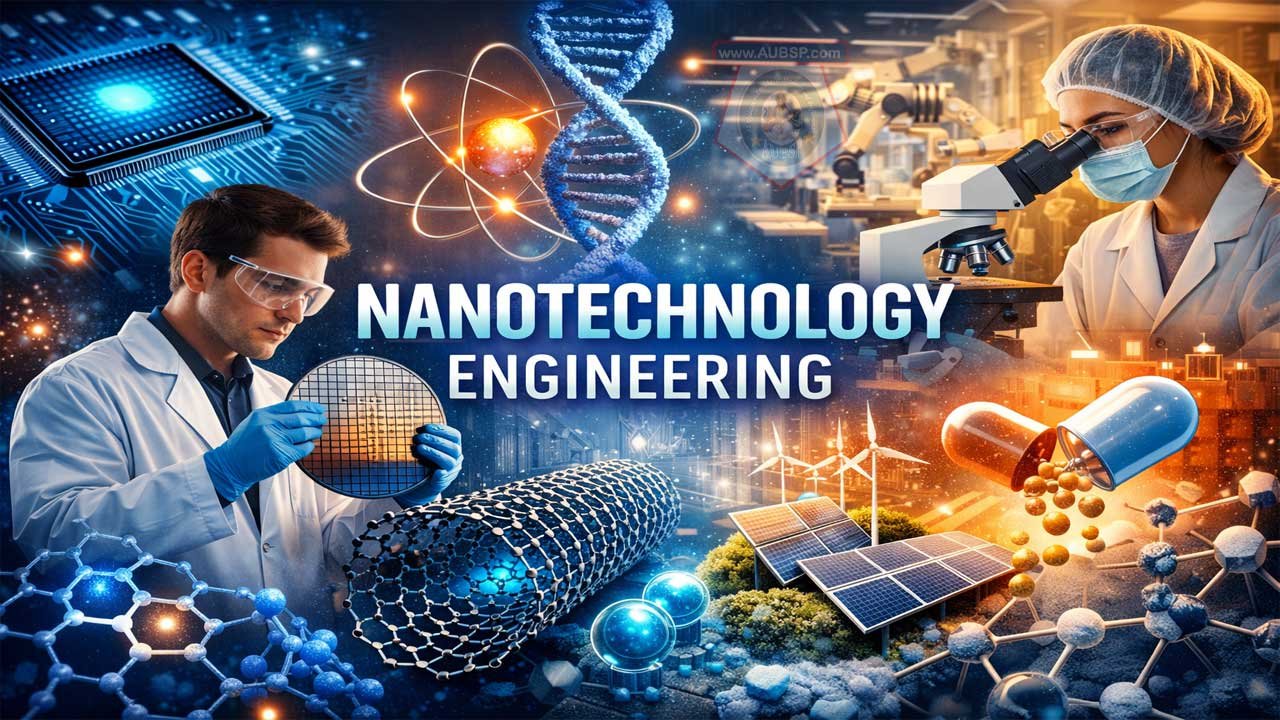
Nanotechnology engineering is a modern field that focuses on designing and controlling matter at the atomic and molecular scale (1–100 nm). At this small size, materials behave differently due to quantum effects and high surface area.
A BEng in Nanotechnology combines math, physics, chemistry, and biology with hands-on training in nanofabrication and advanced imaging tools. Students learn to create new materials and devices for healthcare, electronics, energy, and advanced manufacturing. Top universities in the US, Singapore, Canada, and Europe offer strong programs with research and industry links.
Graduates have high global demand and strong salaries, especially in semiconductors, nanomedicine, and clean energy. The field is growing fast and is expected to play a key role in AI, sustainability, and future technologies.
| Category | Information |
|---|---|
| Degree Name | Bachelor of Engineering (BEng) in Nanotechnology |
| Study Duration | 3–4 years (full-time) |
| Core Subjects | Mathematics, Physics, Chemistry, Biology |
| Specialized Areas | Nanofabrication, Nanomaterials, Nanomedicine, Molecular Modeling |
| Key Industries | Semiconductors, Healthcare, Energy, Advanced Materials |
| Top Study Destinations | USA, Singapore, Canada, Germany, UK |
| Entry Requirements | Strong grades in Math & Science; IELTS 6.5+ / TOEFL 90+ |
| Average Salary (USA) | ~$120,000 per year |
| Global Market Growth | Projected $163B+ by 2035 |
| Career Roles | Nanofabrication Engineer, Materials Researcher, Nanosystems Architect |
Nanotechnology Engineering Degree Guide: Courses, Careers & Global Salary Trends
The emergence of nanotechnology as a distinct engineering discipline marks a fundamental shift in the scientific paradigm, transitioning from the study of bulk materials to the precise manipulation of matter at the atomic, molecular, and macromolecular levels. The Bachelor of Engineering in Nanotechnology (BEngNano), often designated as NanoEngineering in certain jurisdictions, is a multidisciplinary degree designed to equip the next generation of engineers with the tools to innovate at the nanometer scale—a dimension typically defined as being between 1 and 100 nanometers.
At this scale, the physical, chemical, and biological properties of materials deviate significantly from their macroscopic counterparts, governed instead by quantum mechanical effects and significantly increased surface-area-to-volume ratios. As international students increasingly prioritize degrees that offer a convergence of high-growth industrial application and cutting-edge research potential, the BEngNano has established itself as a premier academic pathway across North America, Europe, and Asia.
The foundational premise of nanotechnology engineering lies in its ability to solve complex global challenges by restructuring matter to achieve novel functions. This capability is driving unprecedented growth across sectors such as healthcare, where nanocarriers enable targeted drug delivery; electronics, where sub-3nm semiconductor nodes push the boundaries of computing; and energy, where nano-enhanced materials facilitate the transition to sustainable power sources.
Consequently, the global nanotechnology market is projected to reach approximately $163.30 billion by 2035, growing at a compound annual growth rate of 33.4%. For international students, this trajectory suggests a robust professional landscape characterized by high demand for specialized expertise and competitive global salaries.
The Academic Framework of Nanotechnology Engineering
The curriculum of a BEngNano program is characterized by its rigorous integration of fundamental sciences and specialized engineering principles. Unlike traditional engineering disciplines that may focus on a single domain, nanotechnology engineering requires a comprehensive understanding of how physics, chemistry, and biology intersect at small scales.
The standard academic journey spans three to four years of full-time study, beginning with an intensive focus on mathematics and the basic sciences before progressing into advanced nanofabrication and characterization techniques.
Mathematical and Scientific Foundations
The first two years of a nanotechnology engineering degree are arguably the most demanding, as they establish the theoretical framework necessary for understanding non-classical physical phenomena. Mathematics forms the backbone of the curriculum, with students completing extensive sequences in calculus, linear algebra, and differential equations. These mathematical tools are essential for the predictive modeling of molecular systems and the analysis of quantum wave functions.
Simultaneously, students undergo a deep immersion in physics and chemistry. The physics component typically covers mechanics, electromagnetism, and optics, with a specific emphasis on the transition from classical to quantum physics. Chemistry coursework explores the principles of thermodynamics, kinetics, and molecular interactions, providing the basis for “bottom-up” synthesis techniques where materials are built atom-by-atom. The inclusion of biology is a modern necessity, reflecting the increasing “nanobio” interface where synthetic devices interact with cellular machinery.
| Core Scientific Pillar | Key Subject Areas | Critical Competency for Nanotechnology |
|---|---|---|
| Mathematics | Calculus I-III, Vector Calculus, Linear Algebra, Ordinary Differential Equations | Advanced modeling of dynamic nanoscale systems and statistical mechanics. |
| Physics | Quantum Mechanics, Solid State Physics, Wave-Particle Duality, Electromagnetism | Understanding electron transport and scaling laws at the sub-microscopic level. |
| Chemistry | Organic Chemistry, Inorganic Chemistry, Physical Chemistry, Thermodynamics | Mastery of chemical vapor deposition, self-assembly, and molecular bonding. |
| Biology | Cell Biology, Molecular Biology, Biochemistry | Designing biocompatible interfaces for diagnostics and medical implants. |
Specialized Engineering Core
As students transition into their upper-division years, the focus shifts toward specialized nanotechnology modules that differentiate the BEngNano from a general science or materials degree. These courses are designed to provide hands-on experience with the tools of the “nano-trade”.
Characterization is a central pillar of this phase. Students learn to operate and interpret data from high-resolution instruments such as Scanning Electron Microscopy (SEM), Transmission Electron Microscopy (TEM), and Atomic Force Microscopy (AFM). This training is vital because, at the nanoscale, the ability to see a structure is intrinsically linked to the ability to engineer it.
Another critical component is nanomanufacturing, which explores the two primary paradigms of fabrication: “top-down” and “bottom-up.” Top-down approaches involve techniques like photolithography and nanoimprint lithography, where bulk materials are etched away to create patterns. Bottom-up approaches focus on self-assembly and molecular synthesis, where individual molecules are organized into functional structures. Understanding these processes is essential for the commercial scale-up of nanotechnology products, a current major hurdle in the industry.
| Specialized Module | Functional Focus | Industry Relevance |
|---|---|---|
| Nanoscale Characterization | SEM, TEM, AFM, XRD, and Spectroscopic methods | Quality control in semiconductor and pharmaceutical manufacturing. |
| Nanofabrication | Lithography, Etching, Atomic Layer Deposition (ALD) | Development of high-density microchips and optoelectronic devices. |
| Molecular Modeling | Computational simulations (Monte Carlo, Finite Element) | Reducing R&D costs through predictive material design. |
| Nanomedicine | Targeted drug delivery and Biosensors | Precision oncology and early disease diagnostics. |
Research and Capstone Projects
A defining feature of the nanotechnology engineering degree is the emphasis on research-led learning. Most programs culminate in a senior design or capstone project, where students spend two to three quarters developing a working prototype or conducting original research. These projects are often multidisciplinary, requiring students to collaborate across engineering departments and frequently interface with industry partners or federal research labs. For international students, these capstone experiences are particularly valuable as they provide tangible evidence of technical expertise and professional readiness for the global job market.
Institutional Landscape: Top Universities and Regional Strengths
The choice of institution for a Bachelor of Engineering in Nanotechnology is a multi-faceted decision influenced by research rankings, industry connections, and geographic economic stability. Currently, the global landscape is characterized by established leadership in North America and a rapid ascent of institutions in Singapore and China.
Leadership in the Asia-Pacific Region
Singapore has emerged as perhaps the world’s premier hub for nanotechnology education and research. Nanyang Technological University (NTU) and the National University of Singapore (NUS) consistently rank at the top of global lists for nanoscience and nanotechnology. These universities benefit from an “innovation-driven curriculum” and strong partnerships with global semiconductor and biotechnology firms. NTU, in particular, is noted for its interdisciplinary expertise, drawing from its schools of electrical engineering, physical sciences, and materials science to provide a comprehensive education.
In China, institutions such as Tsinghua University and the University of Science and Technology of China (USTC) have seen dramatic increases in their research output and global citations. These universities are currently leading in qualitative indicators of research impact, often surpassing Western institutions in the number of high-impact publications in the field.
Innovation and Prestige in North America
The United States remains the global leader in the commercialization of nanotechnology, and its universities reflect this strength. Institutions like Harvard, MIT, and Stanford offer world-class laboratories and research centers that are at the forefront of the field. The University of California, San Diego (UCSD) is home to one of the first dedicated departments of NanoEngineering in the world, established in 2007. UCSD’s program is accredited by ABET and focuses on a diverse range of topics from nanobiotechnology to nanotechnologies for energy storage.
In Canada, the University of Waterloo offers the country’s first accredited nanotechnology engineering program. Waterloo is unique due to its world-renowned co-op program, where students complete up to five work terms, totaling nearly two years of professional experience before they graduate. This practical focus makes Waterloo graduates highly sought after in sectors such as semiconductors, renewable energy, and pharmaceuticals.
Engineering Rigor and Material Focus in Europe
Europe offers a different academic perspective, often blending nanotechnology with traditional materials science. In Germany, Friedrich-Alexander-Universität Erlangen-Nürnberg (FAU) offers a B.Sc. in Nanotechnology with a strong emphasis on materials science and sustainability. The FAU program is application-oriented, focusing on manufacturing processes for nanomaterials and modeling nanostructures using biomimetics. A key feature of German engineering programs is their modular structure and the requirement for an industrial internship or a semester abroad, often through the Erasmus program.
In the United Kingdom, the University of Southampton and the University of Surrey provide integrated master’s programs (MEng) that combine electronic engineering with nanotechnology. These programs typically provide three years of foundational electronic engineering followed by a specialized fourth year focusing on advanced topics like microfluidics, lab-on-a-chip, and quantum devices.
| Top Institutions for Nanotechnology | Location | Distinctive Feature |
|---|---|---|
| Nanyang Technological University (NTU) | Singapore | Ranked #1 globally; strong industry R&D ties. |
| Massachusetts Institute of Technology (MIT) | USA | Global leader in nanoelectronics and nanofabrication. |
| University of Waterloo | Canada | Comprehensive co-op program; first accredited in Canada. |
| ETH Zurich | Switzerland | European leader; focus on quantum and materials engineering. |
| UC San Diego (UCSD) | USA | First dedicated NanoEngineering department in the US. |
| University of Southampton | UK | Focus on the intersection of electronics and nanotechnology. |
Comparative Analysis: Nanotechnology vs. Materials Science vs. Chemical Engineering
Prospective students often find it difficult to distinguish between a BEng in Nanotechnology and related degrees such as Materials Science and Engineering (MSE) or Chemical Engineering (ChemE). While these fields are synergistic, they occupy different niches in the engineering ecosystem.
Philosophical and Functional Distinctions
Chemical Engineering is primarily a process-oriented discipline. It focuses on how to scale up chemical reactions into large-scale manufacturing operations, emphasizing fluid dynamics, heat and mass transfer, and reactor design. While chemical engineers may work with nanotechnology, their goal is typically the efficient production of a product rather than the design of the nano-structure itself.
Materials Science and Engineering is a property-oriented discipline. It investigates the relationship between the microstructure of a material and its macroscopic properties, such as strength, conductivity, or corrosion resistance. Materials engineers are typically the “selectors” of materials, choosing the right alloy or composite for specific structural applications.
Nanotechnology Engineering is a design-oriented discipline. It focuses on the creation of entirely new materials and devices by manipulating matter at the atomic level. The nanotechnology engineer is not just interested in the properties of a material but in programming those properties by controlling the arrangement of atoms. For instance, a nanotechnology engineer might design a “quantum dot” with specific optical properties, while a materials engineer would test its durability in a display, and a chemical engineer would design the facility that mass-produces those dots.
Integrated Disciplinary Overlap
In practice, the boundaries between these fields are increasingly blurred. Many modern chemical engineering programs have adopted “molecular transformations” as a core theme, effectively moving into the nanotech space. Similarly, materials science programs often offer specializations in nanomaterials. However, the BEngNano remains the only degree where the manipulation of matter at the $1-100 nm$ scale is the primary, rather than secondary, focus of the curriculum.
| Feature | Nanotechnology Engineering | Materials Science & Eng. | Chemical Engineering |
|---|---|---|---|
| Primary Focus | Atomic/molecular design | Microstructure-property links | Large-scale processes |
| Key Scientific Tool | Quantum Mechanics | Solid State Physics | Thermodynamics & Transport |
| Industrial Goal | Miniaturization/New function | Optimization/Selection | Commercial production |
| Typical Product | Nanosensors, Q-Dots | Advanced Alloys, Polymers | Biofuels, Pharmaceuticals |
International Admission Requirements and Academic Eligibility
For international students, navigating the admission requirements for a BEngNano program requires early planning and a high degree of academic excellence. These programs are often “screened” or “impacted,” meaning they have more applicants than available spaces and require higher entry standards than general engineering degrees.
Academic Credentials and Standards
Leading universities typically require international applicants to have completed 12 years of formal education with exceptional grades in mathematics and the physical sciences. For students following the International Baccalaureate (IB) curriculum, a total score of 38 points or higher is often the minimum, with 6 or 7 points required at the Higher Level in Mathematics and either Physics or Chemistry.
In the United States, standardized tests like the SAT or ACT are frequently required for international applicants, with competitive scores generally exceeding 1250 for the SAT. In Singapore, the admission process is notably competitive, with an acceptance rate for international students around 33%, and a requirement for a high school average often exceeding 90%.
English Language Proficiency
As nanotechnology is a global field with most research published in English, proficiency in the language is non-negotiable. International students from non-English speaking countries must submit scores from tests taken within the last two years.
- IELTS Academic: A minimum overall band score of 6.5, with no individual section (Reading, Writing, Listening, Speaking) falling below 6.0.
- TOEFL iBT: An overall score of 90 or higher is standard, with some institutions requiring a minimum score of 25 in the speaking and writing sections.
- Cambridge English: The C1 Advanced (CAE) or C2 Proficiency (CPE) are often accepted, with a minimum score of 176 or 180 respectively.
Application Documentation
The application process typically involves the submission of a comprehensive portfolio. This includes:
- Transcripts: Certified copies of all academic records from secondary and any post-secondary education.
- Motivation Letter: A personal statement (usually 500-1,000 words) detailing the student’s interest in nanotechnology, their research aspirations, and why they have chosen that specific institution.
- Letters of Recommendation: Typically 2-3 letters from academic mentors or employers who can speak to the applicant’s quantitative skills and passion for innovation.
- Curriculum Vitae (CV): A resume highlighting any relevant extracurricular activities, science competitions, or internships.
Global Market Trends and Career Prospects
The professional outlook for nanotechnology engineering graduates is exceptionally strong, driven by the increasing integration of nanoscale components in consumer and industrial products. The diversification of the field means that a BEngNano degree is a “multipurpose” qualification, enabling entry into a wide range of high-tech industries.
Dominant Industrial Sectors
- Semiconductors and Electronics: This remains the largest market for nanotechnology talent. Engineers are needed to develop the sub-3nm transistors and quantum computing components that will define the next generation of hardware. Employers include global giants like Intel, AMD, TSMC, and Apple.
- Healthcare and Nanomedicine: This sector is projected to be the fastest-growing segment of the market. Nanotechnology engineers design lipid nanoparticles for mRNA vaccines, quantum dots for medical imaging, and “nanobots” for precision surgery. Major players include Pfizer, Moderna, and Philips Healthcare.
- Energy and Environment: Nanotechnology is central to the global sustainability agenda. Graduates work on improving the energy density of EV batteries, developing high-efficiency solar cells, and creating nano-catalysts for carbon capture and water purification.
- Advanced Materials and Coatings: The development of ultra-strong, lightweight nanocomposites is revolutionizing the aerospace and automotive industries. Firms like Tesla, SpaceX, and Lockheed Martin are frequent recruiters of nanotechnology specialists.
Emerging Professional Roles
The BEngNano prepares graduates for several specialized roles that are in high demand:
- Nanosystems Architect: Designing the complex architecture of nanoscale electronic or biological systems.
- Quantum Dot Technologist: Developing semiconductor particles for advanced visual displays and diagnostic imaging.
- Nanofabrication Engineer: Managing the cleanroom processes required for the manufacturing of nano-enabled devices.
- Materials Researcher: Conducting R&D to discover and synthesize new nanomaterials with tailored properties.
Economic Evaluation: Global Salaries and ROI
For international students, the potential return on investment (ROI) is a critical factor in pursuing a BEngNano degree. Salaries in the field are among the highest in engineering, reflecting the high technical barriers to entry and the specialized nature of the expertise.
United States: The Global Benchmark
In the U.S., the average annual salary for a nanotechnology engineer is approximately $120,442, with top earners in high-tech hubs like Silicon Valley making over $217,000. Entry-level positions for those with a bachelor’s degree typically start around $66,831, which is significantly higher than the national average for all occupations. Specialist roles, such as Optical Design Engineers or Semiconductor Device Scientists, often command salaries exceeding $140,000.
International Salary Comparisons
The economic outlook is also strong in other major regions, though figures vary based on local market dynamics and the cost of living. In Canada, the average annual salary is approximately $110,741 CAD. Germany offers average salaries around €84,014, with significant bonuses for engineers working in the automotive or microelectronics sectors.
In Singapore, nanotechnology specialists are among the top-tier earners in the engineering sector, reflecting the nation’s focus on being a “smart nation” and a global technology hub.
| Country | Average Annual Salary | Junior Level (1-3 yrs) | Senior Level (8+ yrs) |
|---|---|---|---|
| United States | $120,442 | $88,338 | $164,213 |
| Canada | $81,000 | $57,000 | $91,000 |
| Germany | $91,000 | $67,000 | $106,000 |
| Singapore | High (Industry-dependent) | Competitive | High (Managerial) |
The Impact of Advanced Education on Earnings
While a bachelor’s degree is the typical entry-level requirement, the ROI is significantly enhanced by pursuing a Master’s or PhD. Graduates with a master’s degree in materials science or nanotechnology often see a 20-30% increase in their starting salary compared to those with only a bachelor’s.
For those aiming for leadership roles in research and development or academia, a PhD is often necessary and leads to top-decile earnings.
International Research Opportunities and Internships
The practical experience gained through internships and undergraduate research is often what differentiates successful nanotechnology graduates in the global job market. For international students, these opportunities also provide critical networking pathways and exposure to different industrial cultures.
Research Experiences for Undergraduates (REU)
Many world-class institutions offer specialized summer research programs for international students. The International Institute for Nanotechnology (IIN) at Northwestern University provides research experiences that connect students with world-renowned researchers and provide stipends and travel support. Similarly, the CERN Summer Student Program in Switzerland allows students to work with international research groups in one of the world’s most advanced physics laboratories.
In Asia, the Singapore International Pre-Graduate Award (SIPGA) supports short-term research attachments for international students at A*STAR (Agency for Science, Technology and Research) institutes, offering a chance to work with distinguished scientists in a vibrant research environment.
Industry Co-ops and Global Internships
Major technology companies have robust internship programs that specifically target nanotechnology engineering students. These internships are often highly structured and provide a “preview” of full-time professional life.
- Tesla: Offers internships in cell engineering and qualification, where students help make best-in-class cell technology decisions.
- Lockheed Martin: Provides materials engineering internships in Orlando, focusing on the micro- and nano-scale fabrication of optical components.
- Intel: Frequently recruits for year-round graduate and undergraduate interns to work on semiconductor material and device sciences.
- Sartorius Stedim Biotech: Offers specialized research internships in the development of lipid nanoparticles (LNPs), a key technology for the future of pharmaceuticals.
| Internship Type | Example Provider | Location | Core Focus Area |
|---|---|---|---|
| National Lab Research | CERN | Switzerland | Particle physics and instrumentation. |
| Semiconductor Industry | Intel / AMD | USA / Global | Sub-3nm manufacturing and design. |
| Biotech & Pharma | Sartorius | USA / Europe | Nanoparticle drug delivery systems. |
| Clean Energy | Tesla | USA | Advanced battery cell qualification. |
Funding and Scholarships for International Students
The cost of a BEngNano degree can be substantial, particularly for international students who are subject to higher tuition fees. However, because nanotechnology is viewed as a strategic field for national economic growth, many scholarships and funding opportunities are available.
Government and International Awards
Singapore is particularly generous in its support of international STEM students. The Singapore International Graduate Award (SINGA) is a major scholarship for students pursuing research-based degrees, covering full tuition fees and providing a monthly stipend and airfare grant. Similarly, the A*STAR Graduate Scholarship is open to international students with strong academic backgrounds in engineering and science.
In Germany, the DAAD (German Academic Exchange Service) offers a range of scholarships for international students, including the Undergraduate Scholarship Program which supports study and research stays in Germany.
University-Specific Merit Scholarships
Most top-tier universities offer merit-based scholarships specifically for international undergraduates.
- National University of Singapore (NUS): Offers the Global Merit Scholarship, which covers full tuition and living allowances for exceptional students.
- Nanyang Technological University (NTU): Provides several scholarships for students with excellent academic and co-curricular records and strong leadership potential.
- University of Waterloo: Offers entrance scholarships and specific awards for international students based on their admission average and potential contribution to the campus community.
- Southampton/Surrey (UK): Provide various international student bursaries and excellence scholarships that reduce the burden of tuition fees.
Future Outlook: Nanotechnology in 2030 and Beyond
As we move toward 2030, the role of the nanotechnology engineer is evolving, influenced by the emergence of Artificial Intelligence (AI) and the global mandate for sustainability.
The Impact of AI on Nanomaterial Discovery
One of the most significant trends is the integration of AI and machine learning in the research and development process. AI is being used to “accelerate the discovery of materials and molecules,” reducing the cost and time required to simulate new structures. For the nanotechnology engineer, this means a shift in focus from manual laboratory experimentation to “AI-synergy in molecular manufacturing,” where computational models guide the physical synthesis of materials.
Green Nanotechnology and Environmental Stewardship
Sustainability is no longer an optional elective but a core principle of the field. “Green Nanotechnology” focuses on the synthesis of nanomaterials using environmentally friendly methods, such as plant-mediated synthesis and the use of green solvents. This movement aims to minimize the environmental footprint of nanomanufacturing and ensure that new materials are “safe by design”. Global investments in green nanotechnology are expected to exceed $15 billion by 2028.
Breakthroughs on the Horizon (2025-2035)
The next decade is expected to witness several “disruptive breakthroughs” that will be driven by BEngNano graduates :
- Quantum AI Systems: The introduction of nanotechnology-enabled quantum AI for the early detection of genetic mutations and cancer-related changes.
- Beyond-Silicon Electronics: The rise of graphene and carbon nanotube semiconductors that exceed the purity and performance of traditional silicon-based integrated circuits.
- Nano-Enabled Energy Storage: The development of batteries with nano-structured electrodes that can charge in minutes and have double the energy density of current lithium-ion technology.
- Advanced Water and Air Filtration: The standardization of nano-filters for the removal of heavy metals, pathogens, and microplastics from global water supplies.
Synthesis and Professional Recommendations
The Bachelor of Engineering in Nanotechnology represents one of the most intellectually rigorous and professionally rewarding academic pathways available today. For international students, it offers a unique opportunity to work at the absolute frontier of science and technology, contributing to solutions for some of the world’s most pressing challenges.
Final Strategic Considerations for International Applicants:
- Prioritize Quantitative Skills: The intensity of the mathematics and physics requirements cannot be overstated. Prospective students should ensure they have a mastery of calculus and classical physics before entering the program.
- Seek Out accredited Programs: International students should prioritize programs that are accredited by recognized bodies such as ABET in the US or the Institution of Engineers in Singapore. This ensures the degree is recognized by global employers and professional engineering boards.
- Leverage Co-op and Internship Opportunities: In a field as practical as nanotechnology, “hands-on” experience is often more valuable than a high GPA alone. Choosing an institution like Waterloo with a robust co-op system can significantly accelerate career entry.
- Adopt a Multidisciplinary Mindset: Success in nanotechnology requires the ability to speak the “languages” of different scientific domains. Graduates who can bridge the gap between electronics and biology, or chemistry and data science, will be the most valuable assets in the 2030 job market.
By aligning their academic choices with these global trends and regional strengths, international students can position themselves at the heart of the “nanotechnology revolution,” securing a future that is both economically prosperous and scientifically impactful.
FAQs about BEng in Nanotechnology
What is nanotechnology engineering?
Nanotechnology engineering is the study and design of materials and devices at the atomic and molecular scale, typically between 1 and 100 nanometers.
What does a BEng in Nanotechnology focus on?
It focuses on mathematics, physics, chemistry, biology, and specialized subjects like nanofabrication, nanomaterials, and nanoscale characterization.
How long does it take to complete a nanotechnology engineering degree?
Most programs take three to four years of full-time study.
What are the entry requirements for international students?
Students usually need strong grades in mathematics and science, along with proof of English proficiency such as IELTS or TOEFL scores.
Is nanotechnology engineering difficult?
Yes, it is academically rigorous because it requires advanced mathematics, quantum physics, and interdisciplinary knowledge.
What careers can I pursue with a nanotechnology engineering degree?
Graduates can work as nanofabrication engineers, materials researchers, semiconductor engineers, nanomedicine specialists, or nanosystems designers.
What industries hire nanotechnology engineers?
Major industries include semiconductors, healthcare, pharmaceuticals, renewable energy, aerospace, and advanced materials manufacturing.
What is the average salary of a nanotechnology engineer?
In the United States, the average salary is around $120,000 per year, with higher earnings for experienced professionals.
Which countries are best for studying nanotechnology?
Top destinations include the United States, Singapore, Canada, Germany, Switzerland, and the United Kingdom.
What is the difference between nanotechnology and materials science?
Nanotechnology focuses on designing materials at the atomic level, while materials science studies the relationship between structure and properties of materials.
How is nanotechnology different from chemical engineering?
Nanotechnology designs nanoscale materials and devices, while chemical engineering focuses on large-scale industrial production processes.
Are internships important in nanotechnology engineering?
Yes, internships and research experience are highly valuable for gaining practical skills and improving job prospects.
Is nanotechnology in high demand?
Yes, global demand is growing due to advances in electronics, nanomedicine, clean energy, and quantum technologies.
Can I pursue a master’s or PhD after a BEng in Nanotechnology?
Yes, many graduates continue with advanced degrees to specialize further or enter research and academic careers.
What tools do nanotechnology engineers use?
They use advanced instruments such as scanning electron microscopes (SEM), transmission electron microscopes (TEM), and atomic force microscopes (AFM).
What is nanofabrication?
Nanofabrication is the process of creating structures and devices at the nanometer scale using techniques like lithography and atomic layer deposition.
Is English proficiency mandatory for international students?
Yes, most universities require IELTS, TOEFL, or equivalent English test scores.
What is the future of nanotechnology?
The future includes breakthroughs in quantum computing, AI-driven material discovery, green nanotechnology, advanced batteries, and precision medicine.
Is nanotechnology related to AI?
Yes, AI is increasingly used to design and discover new nanomaterials and optimize nanoscale manufacturing.
Is nanotechnology a good career choice?
Yes, it offers strong salaries, global opportunities, cutting-edge research exposure, and long-term industry growth.


Leave a Reply
You must be logged in to post a comment.