
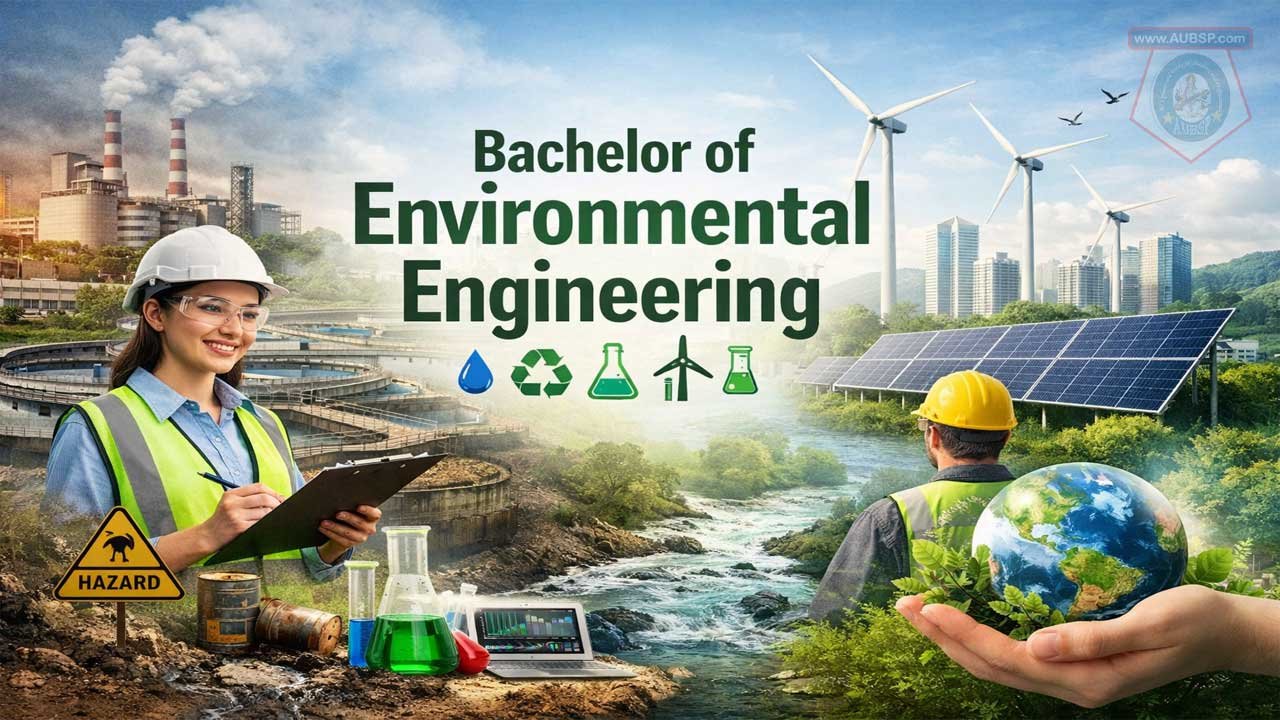
A Bachelor of Environmental Engineering (BEnvE/ BEngEnv/ BSEnvE) is a four-year undergraduate engineering degree that integrates mathematics, chemistry, biology, earth sciences, and core engineering principles to design practical solutions for environmental challenges such as water and wastewater treatment, air pollution control, waste management, sustainable energy systems, and climate resilience.
The curriculum typically progresses from foundational studies in calculus, physics, chemistry, and engineering mechanics to advanced subjects like environmental aquatic chemistry, hydrology, environmental microbiology, membrane technology, and sustainable infrastructure design, culminating in a senior capstone project. Accredited programs—often recognized by bodies such as ABET—prepare graduates for professional licensure (FE and PE exams) and careers in roles including environmental engineer, water resources engineer, sustainability consultant, and climate analyst.
Leading universities offering strong programs include Georgia Institute of Technology, Massachusetts Institute of Technology, Stanford University, University of California, Berkeley, and University of Waterloo, many of which emphasize internships, co-ops, and research integration. With steady employment growth, strong median salaries (over $100,000 in the U.S.), and expanding global demand driven by sustainability mandates and environmental regulation, the degree offers both technical depth and long-term career stability in protecting public health and ecosystems.
| Category | Information |
|---|---|
| Degree Name | Bachelor of Environmental Engineering (BEnvE / BEngEnv / BSEnvE) |
| Duration | 4 years (120–140 credit hours typical) |
| Core Focus | Designing engineering solutions for environmental protection and sustainability |
| Foundation Subjects | Calculus, Physics, Chemistry, Biology, Fluid Mechanics, Statics |
| Major Specializations | Water & Wastewater Treatment, Air Quality, Waste Management, Sustainable Energy, Environmental Data Analytics |
| Capstone Requirement | Senior design project solving real-world environmental problem |
| Accreditation | Often accredited by ABET or equivalent international bodies |
| Licensure Path | FE Exam → 4 years experience → PE Exam |
| Career Roles | Environmental Engineer, Water Resources Engineer, Sustainability Consultant, EHS Specialist |
| U.S. Median Salary | ~$104,170 per year (all experience levels) |
| Job Outlook | ~4% growth (steady demand) |
| Top Universities | Georgia Institute of Technology, Massachusetts Institute of Technology, Stanford University, University of California, Berkeley, University of Waterloo |
What Is a Bachelor of Environmental Engineering?
A Bachelor of Environmental Engineering — commonly abbreviated as BEnvE, BEngEnv, BSEnvE, or B.Eng. (Environmental) — is a four-year undergraduate degree that trains students to solve complex environmental problems using principles of engineering, biology, chemistry, and earth sciences. The degree blends traditional engineering fundamentals with specialized coursework in pollution control, water and wastewater treatment, sustainable energy systems, air quality management, and waste minimization.
Environmental engineers address some of the most pressing challenges facing the modern world: ensuring clean drinking water and sanitation, designing infrastructure for climate change mitigation, remediating contaminated sites, and building systems for sustainable resource management. As global awareness of environmental degradation accelerates, this degree has become one of the most sought-after engineering qualifications internationally.
Unlike broader environmental science programs — which focus on scientific research, hypothesis testing, and data collection — environmental engineering emphasizes the design, construction, and implementation of practical solutions to environmental problems. Graduates emerge equipped to create the infrastructure, technologies, and systems that protect public health and ecosystems alike.
Core Curriculum and Course Structure
Foundation Years (Years 1–2)
The first two years of a BEnvE program establish a strong foundation in mathematics, natural sciences, and introductory engineering. A typical course load includes:
- Mathematics: Calculus I–III, Linear Algebra, Differential Equations, Probability and Statistics
- Sciences: General Chemistry, Physics (mechanics and electromagnetism), Biology, and Earth Science
- Engineering Fundamentals: Introduction to Engineering Design, Statics, Engineering Computing, and Fluid Mechanics
Students at institutions like NC State University, the University of Notre Dame, and Georgia Tech begin laboratory work and hands-on design projects as early as the first semester.
Advanced and Specialization Years (Years 3–4)
The latter half of the degree dives into advanced environmental engineering topics and allows students to specialize. Common upper-level courses include:
- Environmental Aquatic Chemistry
- Biological Processes Design and Environmental Microbiology
- Physical-Chemical Drinking Water Treatment Processes
- Hydraulics and Hydrology
- Air Quality Management and Pollution Control
- Solid and Hazardous Waste Management
- Integrated Urban Stormwater Management
- Environmental Impact Assessment
- Membrane Technology
- Sustainable Infrastructure Design
Most accredited programs require a culminating senior design project (or capstone) in which students apply their accumulated knowledge to solve a real-world engineering challenge, often in partnership with industry or government agencies.
Typical Curriculum Breakdown
| Component | Approximate Credit Share | Examples |
|---|---|---|
| Mathematics & Basic Sciences | ~25–30% | Calculus, Physics, Chemistry, Biology |
| Engineering Core | ~20–25% | Statics, Fluid Mechanics, Thermodynamics |
| Environmental Engineering Specialization | ~30–35% | Water Treatment, Air Quality, Waste Management |
| General Education & Electives | ~10–20% | Humanities, Communication, Ethics |
| Capstone / Design Project | ~5% | Senior Design Experience |
Key Specialization Areas
Environmental engineering is a remarkably interdisciplinary field. Most BEnvE programs allow students to concentrate in one or more focus areas, depending on their interests and career goals.
Water Resources and Treatment
This is one of the largest sub-disciplines, covering drinking water treatment, wastewater management, water reclamation and reuse, stormwater control, and coastal engineering. Students learn to design systems that ensure safe water supply for communities while minimizing ecological impact.
Air Quality and Pollution Control
Specialization in air quality involves monitoring and controlling atmospheric pollutants, modeling dispersion patterns, and designing systems for emissions reduction. With tightening air quality regulations worldwide, this area is increasingly critical.
Sustainable Energy and Climate Engineering
Programs at universities like the University of Illinois at Urbana-Champaign offer focus areas in Energy and Environmental Sustainability (E2S), which examines the interdependencies between energy, water, and the environment, covering renewable energy systems, thermodynamics, and sustainable design.
Waste Management and Circular Economy
This specialization addresses solid waste management, hazardous waste remediation, recycling and resource recovery, and the principles of a circular economy — an approach that minimizes waste by designing products and systems for reuse.
Environmental Data Analytics and Modelling
A growing area of focus, this specialization trains students in coding, big data analysis, optimization, machine learning, and GIS/remote sensing for environmental applications. The University of Waterloo, for example, offers a dedicated stream in Modelling & Data Analytics.
Admission Requirements
Undergraduate Entry
Admission requirements for BEnvE programs vary by country and institution, but common prerequisites include:
- Academic qualifications: Completion of secondary education (high school or equivalent) with strong performance in Mathematics, Physics, and Chemistry. In India, most colleges require at least 55–60% marks in Class 12 PCM subjects.
- Standardized tests: In the United States, SAT or ACT scores are typically required. Top programs like MIT (acceptance rate ~4%) and Stanford (~4%) are extremely competitive. In India, admission to top institutions (IITs, NITs) requires valid JEE Advanced or JEE Main scores.
- English proficiency: International students may need IELTS or TOEFL scores.
- Additional rounds: Some universities conduct interviews, group discussions, or portfolio reviews.
Graduate Prerequisites
For students pursuing a Master’s or PhD after the bachelor’s degree, typical prerequisites include a BS in engineering or a related science, a minimum GPA of 3.0/4.0, and relevant research or professional experience. Programs like UC Berkeley’s Environmental Engineering welcome applicants from both engineering and non-engineering disciplines, provided they have adequate math and science backgrounds.
Top Universities for Environmental Engineering
The field is taught at leading institutions worldwide. The following table summarizes some of the highest-ranked programs based on recent 2025–2026 rankings.
| Rank | University | Country | Notable Highlights |
|---|---|---|---|
| 1 | Georgia Institute of Technology | USA | Ranked #1 by U.S. News 2026 |
| 2 | Massachusetts Institute of Technology (MIT) | USA | Leading global research output |
| 3 | Stanford University | USA | 4% acceptance rate; strong industry ties |
| 4 | University of Michigan – Ann Arbor | USA | Top 5 consistently |
| 5 | University of California, Berkeley | USA | Renowned research in water and air quality |
| 6 | University of Illinois Urbana-Champaign | USA | Five distinct focus areas within EnvE |
| — | ETH Zurich | Switzerland | Top-ranked in Europe |
| — | University of Oxford | UK | Strong interdisciplinary approach |
| — | University of Cambridge | UK | Historic excellence in engineering |
| — | National University of Singapore (NUS) | Singapore | Leading Asian program in sustainability engineering |
| — | Nanyang Technological University (NTU) | Singapore | Comprehensive EnvE with internship focus |
| — | University of British Columbia (UBC) | Canada | Campus-as-living-lab approach; co-op programs |
| — | Hof University | Germany | B.Eng. with German language skills and EU focus |
| — | IIT Kharagpur | India | Ranked among top 100 globally |
The University of Waterloo in Canada also deserves special mention for its mandatory co-op program, which guarantees students two years of paid work experience before graduation.
Accreditation: Why It Matters
ABET Accreditation
In the United States and many other countries, the most important quality benchmark for an environmental engineering program is accreditation by ABET (Accreditation Board for Engineering and Technology). ABET accreditation ensures that a program meets established standards for curriculum, faculty, facilities, and student outcomes.
Graduating from an ABET-accredited program is generally the first step toward becoming a licensed professional engineer (PE). In most U.S. states, graduates of ABET-accredited programs can pursue PE licensure with four years of supervised experience, whereas graduates of non-accredited programs may need 8–12 years.
ABET Program Criteria for Environmental Engineering
ABET requires environmental engineering programs to cover:
- Earth science, biology, and chemistry beyond the introductory level
- Fluid mechanics, thermodynamics, and material/energy balances
- Fate and transport of substances in air, water, and soil
- Hands-on laboratory experiments in more than one environmental engineering focus area
- Design of systems that consider risk, uncertainty, sustainability, and lifecycle principles
- Professional practice concepts, including environmental policy and regulations
Other Accreditation Bodies
Outside the U.S., relevant accreditation bodies include Engineers Australia (EA), the Engineering Council (UK), the Canadian Engineering Accreditation Board (CEAB), and the National Board of Accreditation (NBA) in India. Many of these bodies have mutual recognition agreements through the Washington Accord, which facilitates international mobility for engineering graduates.
Professional Licensure Pathway
Becoming a licensed Professional Engineer (PE) is a significant career milestone that expands job opportunities and earning potential. The pathway typically involves:
- Earn a bachelor’s degree from an accredited environmental engineering program.
- Pass the Fundamentals of Engineering (FE) Exam: A 6-hour, computer-based test with 110 multiple-choice questions, ideally taken during the final semester of undergraduate study.
- Gain supervised work experience: Most jurisdictions require four years of progressive engineering experience under a licensed PE.
- Pass the Principles and Practice of Engineering (PE) Exam: An 8-hour exam with 80 questions covering water, solid/hazardous waste, sustainability, air, site assessment, and environmental health. The last published first-time pass rate was 61%.
- Maintain licensure: Most states require continuing education for license renewal.
At institutions like Cornell University, an undergraduate degree provides 8 years of credit toward the 12-year combined education-and-experience requirement for PE licensure.
Career Prospects and Job Roles
Employment Outlook
The U.S. Bureau of Labor Statistics projects employment of environmental engineers to grow 4% from 2024 to 2034, approximately matching the average for all occupations. About 3,000 job openings are expected annually in the U.S., driven primarily by replacement needs as workers retire or transition to other fields.
Globally, the environmental engineering sector is expanding faster, fueled by stricter environmental regulations, corporate sustainability mandates, investments in clean energy, and climate resilience projects.
Common Job Titles
Graduates of BEnvE programs pursue a wide variety of roles:
- Environmental Engineer
- Water Resources Engineer
- Air Quality Engineer
- Environmental Consultant
- Waste Management Engineer
- Environmental Health and Safety (EHS) Specialist
- Climate Change Analyst
- Environmental Policy Analyst
- Sustainability Consultant
- Hydrologist
- Production/Process Engineer
- Quality Assurance Manager
- Research Officer
Salary Overview
| Region | Entry-Level Salary | Average Salary | Top Earners |
|---|---|---|---|
| United States | ~$64,873/year | $75,926/year | $104,170/year (median for all experience levels) |
| India (fresh graduates) | ~INR 3–7 LPA | INR 4.5 LPA | INR 15+ LPA (4+ years experience) |
| India (experienced) | — | INR 22.6 LPA | INR 50 LPA (top 1%) |
Specific roles in India command varying salaries: Environmental Consultants average INR 7.8 LPA, Climate Change Analysts earn around INR 6 LPA, and Water Resources Engineers approximately INR 5 LPA.
Environmental Engineering vs. Related Degrees
Prospective students often struggle to distinguish environmental engineering from related fields. The following comparison clarifies the differences.
| Dimension | Environmental Engineering | Civil Engineering | Environmental Science |
|---|---|---|---|
| Primary Focus | Designing solutions for environmental protection and sustainability | Designing infrastructure — buildings, roads, bridges, dams | Studying natural systems through scientific research |
| Core Approach | Apply engineering + science to build systems | Apply engineering + physics to build structures | Conduct experiments, collect data, form hypotheses |
| Key Subjects | Water/air treatment, waste management, ecology, sustainability | Structural analysis, transportation, geotechnical engineering | Biology, ecology, geology, atmospheric science |
| Career Outcome | Build pollution control systems, design treatment plants | Build bridges, highways, buildings | Advise policy, conduct field research |
| Degree Duration | 4 years (typically) | 4 years | 3–4 years |
| Licensure Path | FE → PE (Environmental) | FE → PE (Civil) | Not typically licensed as engineers |
The overlap between civil and environmental engineering is substantial, and many universities house both programs within the same department. Modern civil engineering increasingly integrates sustainability considerations, while environmental engineering draws on civil engineering fundamentals like fluid mechanics and structural analysis.
Emerging Trends and Technologies
The environmental engineering profession is evolving rapidly, driven by technological innovation and escalating global environmental challenges.
Artificial Intelligence and Data Analytics
AI is transforming environmental monitoring, modeling, and decision-making. Engineers now leverage machine learning for real-time air and water quality analysis, predictive pollution modeling, and optimized resource allocation.
Smart Water Management
IoT devices integrated with AI are revolutionizing water systems, enabling real-time monitoring, leak detection, and automated treatment optimization.
PFAS and Emerging Contaminant Remediation
Per- and polyfluoroalkyl substances (PFAS) remediation is one of the fastest-growing specializations. Regulatory crackdowns on “forever chemicals” are creating massive demand for engineers who can design treatment and containment systems.
Climate Resilience Engineering
Environmental engineers are increasingly tasked with designing infrastructure that can withstand extreme weather events, sea-level rise, and shifting climate patterns.
Circular Economy and Zero-Waste Design
The shift from linear “take-make-dispose” models to circular systems that minimize waste and maximize resource recovery represents a fundamental change in how environmental engineers approach design.
Green Infrastructure and Nature-Based Solutions
Bio-remediation, constructed wetlands, green roofs, and other nature-based solutions are gaining prominence as cost-effective, ecologically beneficial alternatives to traditional grey infrastructure.
Key Skills in Demand
| Skill | Industry Relevance |
|---|---|
| Environmental Impact Assessment | Required in infrastructure and industrial planning |
| GIS and Remote Sensing | Used in mapping and monitoring natural resources |
| Climate Modelling | Helps predict climate patterns and risks |
| Environmental Data Analytics | Assists in regulatory compliance and reporting |
| Circular Economy Implementation | Promotes waste reduction and efficient resource use |
Internships, Co-ops, and Practical Training
Hands-on experience is a hallmark of quality environmental engineering programs. Many universities integrate practical components directly into the curriculum:
- NTU Singapore requires a full-semester internship with an industrial firm as part of the degree.
- University of Waterloo guarantees two full years of paid co-op experience alternating with academic terms.
- UBC Vancouver operates a “campus as a living lab” program where students work on real sustainability projects within university infrastructure.
- Hof University (Germany) includes a compulsory internship semester and a bachelor’s thesis developed in collaboration with industrial partners.
- Georgia Tech offers an undergraduate research track where students complete at least three terms of research and write a published thesis.
These practical experiences are invaluable for building professional networks, developing applied skills, and meeting the supervised experience requirements for PE licensure.
How to Choose the Right Program
Selecting the best BEnvE program requires evaluating several factors:
- Accreditation: Ensure the program is accredited by ABET (in the U.S.) or an equivalent body recognized under the Washington Accord.
- Specialization alignment: Match available focus areas (water, air, energy, waste, data analytics) with personal career interests.
- Research opportunities: Programs that offer undergraduate research, such as Georgia Tech’s BS/MS track, provide a competitive edge.
- Practical experience: Prioritize programs with mandatory co-ops, internships, or industry partnerships.
- Faculty expertise: Investigate active research areas of faculty members, especially in emerging fields like PFAS remediation or AI-driven environmental monitoring.
- Global recognition: For international mobility, choose a program whose accreditation is recognized across countries.
- Location: Consider proximity to industries, environmental agencies, and research facilities. British Columbia, for example, offers unique fieldwork opportunities in one of the world’s most biodiverse regions.
Frequently Asked Questions
What is a Bachelor of Environmental Engineering?
A four-year undergraduate engineering degree focused on designing systems and technologies that protect the environment and public health.
How long does it take to complete the degree?
Typically four years of full-time study, though co-op programs may extend it to 4.5–5 years.
What subjects are studied in this program?
Core subjects include calculus, physics, chemistry, biology, fluid mechanics, thermodynamics, hydrology, environmental chemistry, and pollution control.
How long does a Bachelor of Environmental Engineering take?
Most BEnvE programs require four years of full-time study (approximately 120–140 credit hours). Some programs, such as the joint UBC-UNBC program in Canada, extend to 4.5 years to accommodate additional fieldwork.
Is environmental engineering a good career choice?
Yes. With a median salary of $104,170 in the U.S. and steady 4% job growth projected through 2034, environmental engineering offers strong financial prospects. The global push toward sustainability, clean energy, and stricter environmental regulations ensures continued demand for qualified professionals.
Can I pursue environmental engineering without a science background?
The degree requires a strong foundation in mathematics, physics, and chemistry. Most programs mandate these subjects at the secondary school level. However, some graduate programs accept non-engineering applicants who complete prerequisite courses.
What is the difference between BEnvE and B.Tech in Environmental Engineering?
The distinction is primarily regional and nomenclature-based. BEnvE and BEngEnv are common in Australia, Singapore, and parts of Europe, while B.Tech is the standard designation in India. The curriculum and career outcomes are broadly equivalent, though specific course structures vary by institution.
Do environmental engineers need a PE license?
While not required for all positions, PE licensure significantly expands career options and is often necessary for roles involving public safety, such as approving engineering plans and specifications. Licensure also leads to higher earning potential and is essential for career advancement in consulting and government roles.
What skills do students develop during the degree?
Analytical problem-solving, engineering design, laboratory techniques, data analysis, environmental modeling, and regulatory compliance knowledge.
Is environmental engineering different from environmental science?
Yes. Environmental engineering focuses on designing practical solutions and infrastructure, while environmental science emphasizes research and data analysis.
What are the main specialization areas?
Water and wastewater treatment, air quality engineering, solid and hazardous waste management, sustainable energy systems, environmental data analytics, and climate resilience engineering.
Does the degree include practical training?
Most programs include laboratory work, field studies, internships, co-ops, and a senior capstone design project.
What is a capstone project?
A final-year design project where students solve a real-world environmental engineering problem, often in collaboration with industry or government.
What are the admission requirements?
Strong background in mathematics, physics, and chemistry at the secondary school level, along with required entrance exams depending on the country.
Is accreditation important?
Yes. Accreditation ensures the program meets professional standards and is often required for engineering licensure.
What is ABET accreditation?
It is a recognized quality standard for engineering programs in the United States that validates curriculum and professional readiness.
Can graduates become licensed engineers?
Yes. Graduates can pursue licensure by passing the FE exam, gaining required work experience, and passing the PE exam.
What is the FE exam?
The Fundamentals of Engineering exam is the first step toward professional engineering licensure.
What is the PE exam?
The Principles and Practice of Engineering exam certifies competency as a licensed Professional Engineer.
What careers can graduates pursue?
Environmental engineer, water resources engineer, air quality specialist, sustainability consultant, waste management engineer, EHS specialist, or environmental analyst.
What industries hire environmental engineers?
Consulting firms, government agencies, construction companies, manufacturing industries, energy companies, and environmental NGOs.
Is environmental engineering a good career choice?
Yes. It offers stable employment, competitive salaries, and growing global demand due to environmental regulations and sustainability initiatives.
What is the average salary for environmental engineers?
In the United States, median salaries exceed $100,000 annually, with variation based on experience and location.
Is mathematics important in this degree?
Yes. Advanced mathematics is essential for modeling environmental systems and solving engineering problems.
Do students need coding skills?
Basic programming and data analysis skills are increasingly important for modeling, simulation, and environmental data analytics.
What is environmental impact assessment?
A systematic process used to evaluate the environmental consequences of proposed projects before approval.
Can I pursue higher studies after this degree?
Yes. Graduates can pursue master’s or doctoral degrees in environmental engineering or related fields.
Are internships mandatory?
Many universities require internships or co-op placements as part of the curriculum.
What is sustainable infrastructure design?
The practice of designing infrastructure systems that minimize environmental impact and promote long-term ecological balance.
Is fieldwork part of the program?
Yes. Field sampling, environmental monitoring, and site assessments are common components.
Can environmental engineers work internationally?
Yes. Accredited degrees often allow international mobility, especially in countries recognizing mutual engineering agreements.
What is circular economy in environmental engineering?
A system design approach that minimizes waste and maximizes resource reuse and recovery.
Are laboratory experiments included?
Yes. Students conduct experiments in water quality analysis, air monitoring, microbiology, and treatment processes.
Is climate change covered in the curriculum?
Yes. Many programs include climate modeling, mitigation strategies, and resilience engineering.
What is water resources engineering?
A specialization focused on hydrology, hydraulics, stormwater management, and water supply systems.
Do environmental engineers work outdoors?
Some roles involve field inspections and site assessments, while others are office- or laboratory-based.
What software tools are commonly used?
GIS tools, modeling software, data analytics platforms, and engineering simulation programs.
Can students switch from civil engineering to environmental engineering?
Yes. Many universities allow transitions due to overlapping foundational coursework.
Is research important in this field?
Yes. Research drives innovation in pollution control, renewable energy, and environmental remediation technologies.
What are emerging trends in environmental engineering?
Artificial intelligence in monitoring, PFAS remediation, smart water systems, green infrastructure, and zero-waste system design.
Does the degree involve teamwork?
Yes. Engineering projects often require collaborative design and multidisciplinary coordination.
What is hazardous waste management?
The safe handling, treatment, storage, and disposal of toxic or dangerous materials.
Can environmental engineers work in policy roles?
Yes. Some graduates advise governments or organizations on environmental regulations and sustainability strategies.
Is physics important for environmental engineering?
Yes. Concepts like mechanics and electromagnetism underpin fluid flow and system design.
What is environmental microbiology?
The study of microorganisms involved in waste treatment and natural environmental processes.
Are scholarships available for this degree?
Yes. Many universities and governments offer merit-based and need-based scholarships.
Is this degree suitable for students passionate about sustainability?
Yes. It directly contributes to environmental protection, climate solutions, and sustainable development goals.


Leave a Reply
You must be logged in to post a comment.