
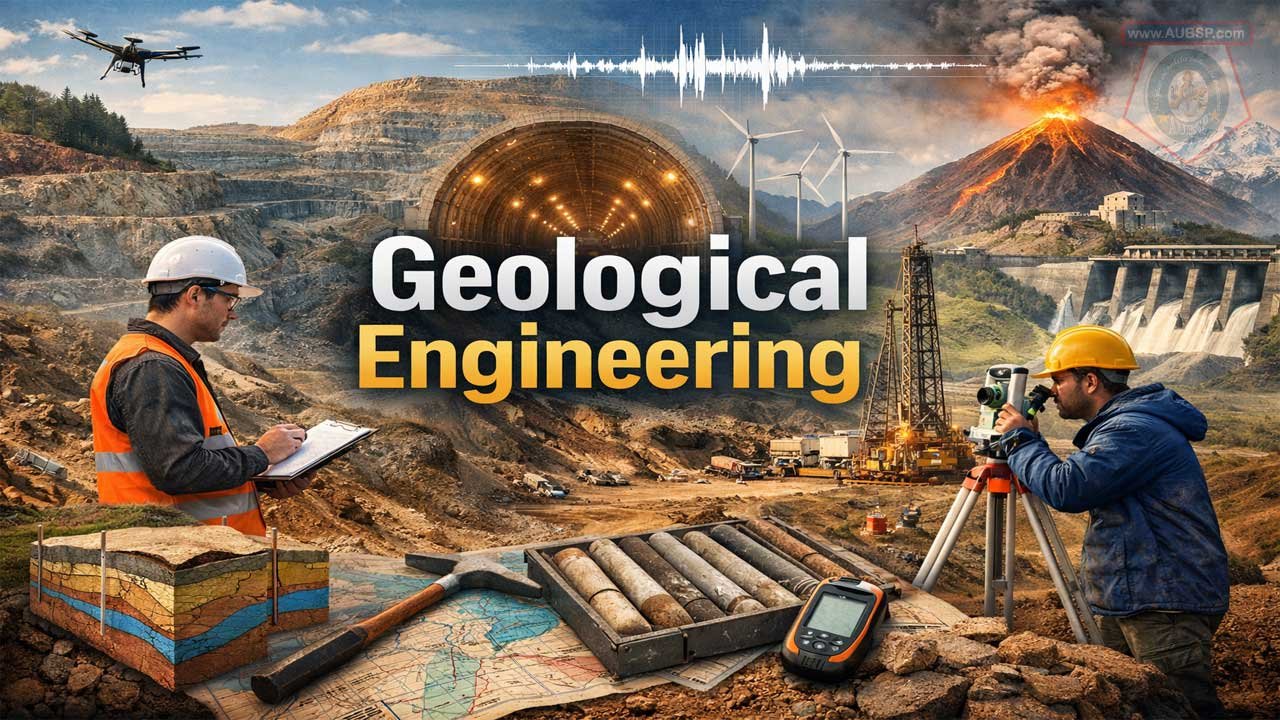
A Bachelor of Geological Engineering (BGeoE) is a four- to five-year interdisciplinary undergraduate degree that combines geology and engineering to address real-world challenges related to earth materials, natural hazards, infrastructure, and resource extraction.
Students develop strong foundations in mathematics, physics, chemistry, and earth sciences before progressing to specialised subjects such as rock and soil mechanics, hydrogeology, geophysics, geotechnical design, and environmental engineering, typically culminating in a senior design capstone project. Accredited programmes (commonly by ABET or equivalent bodies) prepare graduates for careers in geotechnical engineering, hydrogeology, mining, environmental consulting, energy exploration, and government agencies, with competitive salaries and steady job growth driven by infrastructure development, climate adaptation, renewable energy, and critical minerals demand.
The degree also provides pathways to professional licensure (FE, PE, or PG), positioning graduates to design safe foundations, assess geohazards, manage groundwater resources, and contribute to sustainable engineering solutions worldwide.
| Category | Details |
|---|---|
| Degree Name | Bachelor of Geological Engineering (BGeoE), B.S., B.E., or BASc |
| Duration | 4–5 years (full-time) |
| Total Credits | ~127–128 credit hours |
| Accreditation | ABET or equivalent national engineering bodies |
| Core Focus | Rock & soil mechanics, hydrogeology, geophysics, geotechnical design |
| Capstone | Senior design project (often industry-sponsored) |
| Fieldwork | Extensive field mapping, site investigations, field schools |
| Key Skills | Geotechnical analysis, groundwater modelling, GIS, engineering design |
| Software Tools | QGIS, ArcGIS, AutoCAD, MODFLOW, PLAXIS, Python |
| Common Careers | Geotechnical Engineer, Hydrogeologist, Environmental Consultant, Mining Engineer |
| Top Industries | Construction, mining, energy, environmental consulting, government |
| Median U.S. Salary | ~$99,000–$101,000 per year |
| Licensure Path | FE → PE (Professional Engineer) and/or PG (Professional Geologist) |
| Job Outlook | ~3% growth (steady demand driven by infrastructure & energy transition) |
What Is a Bachelor of Geological Engineering?
A Bachelor of Geological Engineering (BGeoE) — also awarded as a B.S. in Geological Engineering, B.E. (Geological), or BASc (Geological Engineering) depending on the institution — is an interdisciplinary undergraduate degree that fuses the principles of geology and engineering to solve real-world problems related to Earth’s materials, processes, and hazards. The program trains students to understand the behaviour of natural materials such as rock, soil, and groundwater, and to apply engineering design techniques to ensure the safety, sustainability, and efficiency of infrastructure and resource extraction projects.
Unlike a pure geology degree that focuses on understanding Earth’s history and processes, or a civil engineering degree centred on designing structures from man-made materials like concrete and steel, geological engineering occupies the critical intersection of both disciplines. Graduates are uniquely positioned to assess whether the ground beneath a dam, tunnel, bridge, or building can support the structure safely, and to design solutions when it cannot.
The degree typically requires four to five years of full-time study and 127–128 credit hours, culminating in a capstone senior design project. Programs are commonly accredited by ABET (Accreditation Board for Engineering and Technology) or equivalent national bodies, ensuring graduates meet rigorous professional standards.
Who Should Pursue This Degree?
The BGeoE is ideal for students who:
- Enjoy spending time outdoors and prefer hands-on fieldwork over a desk-bound career
- Have a strong foundation in mathematics, physics, chemistry, and earth sciences
- Are curious about how natural processes like earthquakes, landslides, and groundwater flow affect human infrastructure
- Want to contribute to solving global challenges such as clean water access, sustainable mining, renewable energy exploration, and natural disaster mitigation
- Seek a career that combines technical problem-solving with environmental stewardship
Core Curriculum and Course Structure
A typical BGeoE program spans four years and is structured to build from foundational science and mathematics to advanced, specialised geological engineering courses. The curriculum at leading universities follows a progressive structure:
Year 1: Foundations
The first year establishes a strong base in mathematics and natural sciences:
- Calculus I and II
- General Chemistry (with laboratory)
- General Physics (with laboratory)
- Introduction to Geological Engineering
- English composition and communication
Year 2: Intermediate Sciences and Engineering Fundamentals
Students begin applying scientific principles to engineering problems:
- Calculus III and Differential Equations
- Mineralogy and Petrology (study of minerals and rocks)
- Introduction to GIS (Geographic Information Systems)
- Statics and Strength of Materials
- Fundamentals of Geophysics
- Structural Geology
Year 3: Advanced Geological Engineering
The programme shifts to specialised geological engineering courses:
- Rock Mechanics
- Soil Mechanics and Geomechanics
- Fluid Mechanics and Thermodynamics
- Hydrogeology and Groundwater Engineering
- Engineering Geology
- Environmental and Engineering Geophysics
- Geostatistics and Mineral Economics
Year 4: Design, Electives, and Capstone
The final year emphasises design application and professional readiness:
- Senior Design Capstone Project (often industry-sponsored)
- Foundation Engineering
- Slope Stability and Geohazard Analysis
- Technical electives in areas such as petroleum geology, permafrost engineering, or GIS applications
- Field Methods and Applied Design
Sample Course Comparison Across Leading Universities
| Subject Area | University of Alaska Fairbanks | Michigan Tech | University of North Dakota |
|---|---|---|---|
| Total Credits Required | 127 | ~128 | 128 |
| Field Courses | Field Methods I & II | Field Geology (summer) | Three field schools |
| Capstone | Senior Design | Senior Design (industry-sponsored) | Full-year team design project |
| Notable Electives | Arctic/Permafrost Engineering, GIS | Volcanology, Natural Hazards | Petroleum Concentration, Cold Region Hydrology |
| Accreditation | ABET | ABET | ABET |
Key Specialisations in Geological Engineering
Geological engineering offers several distinct specialisation tracks, each addressing different aspects of Earth-engineering interactions:
Geotechnical Engineering
Geotechnical engineering focuses on the mechanical behaviour of soils and rocks as they relate to construction. Geotechnical specialists manage ground settlement, slope stability, foundation design, underground excavation, and earthquake hazard mitigation. This is perhaps the most common career pathway for geological engineering graduates.
Hydrogeology and Groundwater Engineering
Hydrogeologists study the movement, distribution, and quality of groundwater. They design systems for groundwater extraction and sustainability, assess contamination risks, and develop remediation strategies for polluted aquifers. This specialisation is increasingly critical as freshwater scarcity becomes a global concern.
Geoenvironmental Engineering
This subdiscipline addresses the environmental effects of anthropogenic contaminants in soil and water. Geoenvironmental engineers design systems for waste disposal, pollution control, contaminated site remediation, and clean water supply infrastructure.
Mining and Mineral Resource Engineering
Geological engineers in this track plan and optimise the extraction of minerals, metals, and energy resources from the earth in environmentally responsible ways. They evaluate potential mining sites, design extraction methods, and ensure regulatory compliance.
Petroleum and Energy Resource Engineering
Some programmes offer a petroleum concentration, preparing students for careers in oil and gas exploration, reservoir modelling, and subsurface energy recovery. With the energy transition underway, this specialisation is evolving to include geothermal energy and underground carbon storage.
Essential Skills and Tools
Geological engineers develop a distinctive blend of technical and practical competencies:
Technical Skills
- Rock and soil mechanics — Understanding the strength, deformation, and failure behaviour of natural materials
- Geophysical survey methods — Using seismic, electromagnetic, and gravity methods to image subsurface conditions
- Hydrogeological modelling — Simulating groundwater flow and contaminant transport
- Geotechnical design — Designing foundations, retaining walls, slopes, tunnels, and dams
- Geological mapping and field investigation — Conducting terrain analysis and site characterisation in the field
Software and Technology
- GIS platforms — QGIS, ArcGIS, and Google Earth Engine for spatial analysis and geological mapping
- Remote sensing — Satellite imagery analysis using Landsat, ASTER, Sentinel-2, and LiDAR for terrain and hazard assessment
- CAD and surveying tools — AutoCAD, Civil 3D, and surveying instruments for engineering design
- Numerical modelling software — FLAC, PLAXIS, MODFLOW, and GeoStudio for geomechanical and hydrological simulations
- Data analysis — Python, R, MATLAB, and geostatistical methods for data processing and interpretation
Soft Skills
- Strong written and verbal communication for technical report writing and client interaction
- Teamwork and multidisciplinary collaboration — geological engineers frequently work alongside civil engineers, environmental scientists, and mining professionals
- Problem-solving under field conditions with incomplete data
- Project management and ethical decision-making
Top Universities Offering Geological Engineering Degrees
United States (ABET-Accredited Programmes)
The following U.S. institutions hold ABET accreditation for geological engineering or similarly named programmes:
- University of Alaska Fairbanks
- Colorado School of Mines
- Michigan Technological University
- University of Minnesota
- University of Mississippi
- Missouri University of Science & Technology
- Montana Tech
- University of Nevada, Reno
- University of North Dakota (offers the only fully online BGeoE in the U.S.)
- South Dakota School of Mines and Technology
- University of Texas at Austin
- University of Utah
- University of Wisconsin-Madison
Canada
- University of British Columbia (BASc in Geological Engineering) — internationally renowned programme combining geotechnical engineering, hydrogeology, and geology
- University of Waterloo — one of only two geological engineering programmes in Ontario, featuring a robust co-op programme with two full years of paid work experience
- University of New Brunswick — the only geological engineering programme in Atlantic Canada, with three specialised streams: geoenvironmental, geotechnical, and mineral resources
- University of Saskatchewan — four-year B.E. programme with a mining option and co-op internship
International
- Istanbul Technical University (Turkey) — ABET-accredited geological engineering programme
- Addis Ababa Science and Technology University (Ethiopia)
- Institut Teknologi Bandung (Indonesia) — internationally accredited programmes in geological and mining engineering
- ETH Zurich, University of Oxford, University of Cambridge, and MIT are among the top-ranked institutions globally for geoscience and geology-related studies at both undergraduate and graduate levels
Career Opportunities and Job Roles
Geological engineering graduates pursue diverse career paths across multiple industries:
Common Job Titles
- Geotechnical Engineer — Designs foundations, retaining structures, and earth dams; assesses slope stability and ground conditions for construction projects
- Hydrogeologist — Studies groundwater distribution, movement, and contamination; manages water resource sustainability
- Environmental Consultant — Assesses environmental impacts of engineering projects; designs remediation strategies for contaminated sites
- Mining/Geological Engineer — Plans mineral and resource extraction operations; evaluates geological conditions at mining sites
- Engineering Geologist — Assesses geological stability and environmental risks for construction and infrastructure projects
- Geophysicist — Conducts subsurface investigations using geophysical methods to support engineering and resource exploration
- Project Geologist — Leads site investigations, prepares technical reports, and supervises field work
Industries That Hire Geological Engineers
- Construction and infrastructure development
- Mining, quarrying, and mineral exploration
- Oil, gas, and energy (including geothermal)
- Environmental consulting and remediation
- Water resource management
- Government agencies (geological surveys, environmental protection, transportation departments)
- Academic and research institutions
Salary Expectations and Compensation
Geological engineering offers competitive compensation that varies by experience level, industry sector, and geographic location:
United States Salary Data
| Career Stage | Annual Salary Range | Details |
|---|---|---|
| Entry-Level (0–3 years) | $58,790 – $75,000 | 10th percentile; early career positions |
| Mid-Career (3–7 years) | $75,000 – $110,000 | Project geologist or consultant roles |
| Median (All Experience) | $99,240 – $101,020 | BLS median for geoscientists and mining/geological engineers |
| Senior/Specialised (10+ years) | $148,760 – $178,880 | Top earners in mining, oil & gas, and federal government roles |
Salary by Industry Sector
- Mining, quarrying, oil and gas extraction: Median $148,760
- Federal government: Median ~$116,470
- Professional, scientific, and technical services: Competitive mid-range salaries with growth opportunities
- State and local government: Lower base pay but strong benefits and job security
Global Perspective
In India, geological and geotechnical professionals earn varying salaries depending on specialisation. Petroleum geologists can expect approximately ₹13 LPA (lakhs per annum), while geotechnical engineers average around ₹5 LPA at entry level. Salaries in Australia, Canada, and Europe are generally comparable to or slightly below U.S. figures, adjusted for cost of living.
Job Outlook and Employment Projections
The employment landscape for geological engineers is shaped by infrastructure development needs, energy transitions, and environmental regulations:
- The U.S. Bureau of Labor Statistics projects 3% growth for geoscientists from 2024 to 2034, roughly in line with the average for all occupations, with approximately 2,000 annual job openings.
- Mining and geological engineers specifically show 1% projected growth with about 7,000 total positions.
- Overall U.S. geoscience employment is projected to increase from 461,152 in 2024 to 478,091 in 2034, a total increase of 3.7%.
- The fastest-growing employment sector is professional, scientific, and technical services, projected to grow from 175,558 to 185,998 jobs.
- Environmental sciences and geoscience-related consulting roles have shown strong recent growth, adding 9,324 jobs between December 2024 and January 2025 alone.
Emerging Growth Areas
Several trends are expected to drive future demand for geological engineers:
- Renewable energy exploration — Geothermal energy assessment, hydroelectric dam siting, and underground energy storage systems
- Climate change adaptation — Natural hazard assessment (landslides, earthquakes, flooding), resilient infrastructure design
- Critical minerals mining — Growing demand for lithium, cobalt, rare earth elements for batteries and technology
- Environmental remediation — Cleanup of contaminated sites and sustainable waste management
- Infrastructure modernisation — Aging infrastructure across developed nations requires geological assessment for rehabilitation and replacement
Professional Licensing and Certification
Geological engineering is a regulated profession in many jurisdictions, and licensing enhances career prospects and earning potential:
Fundamentals of Engineering (FE) Exam
Graduates of ABET-accredited programmes are eligible to sit for the NCEES Fundamentals of Engineering (FE) examination. Passing the FE exam is the first step toward becoming a licensed Professional Engineer (PE). Many students take this exam during their final year or shortly after graduation.
Professional Engineer (PE) License
After accumulating the required years of professional experience (typically four years), engineers can take the Principles and Practice of Engineering (PE) exam. A PE license allows engineers to:
- Sign off on engineering projects and technical documents
- Oversee the work of other engineers
- Provide services directly to the public
- Take on senior leadership positions
Professional Geologist (PG) License
In some jurisdictions, geological engineers may also pursue a Professional Geologist license, particularly when their work focuses more on geological assessment than engineering design. Requirements vary by state and country.
International Equivalents
- Canada: Engineers Canada accreditation and P.Eng. licensure
- United Kingdom: Chartered Engineer (CEng) through the Geological Society
- Australia: CPEng through Engineers Australia
- Turkey and other countries: National engineering boards with ABET-equivalent accreditation
Geological Engineering vs. Related Disciplines
Understanding how geological engineering compares to related fields helps prospective students choose the right programme:
| Aspect | Geological Engineering | Civil Engineering | Geology (Pure Science) |
|---|---|---|---|
| Focus | Natural materials (rock, soil, water) and their engineering behaviour | Man-made structures (concrete, steel) and infrastructure design | Earth’s history, processes, and composition |
| Design Component | Designs foundations, slopes, tunnels using natural materials | Designs buildings, bridges, highways, dams | Minimal design; focused on research and analysis |
| Fieldwork | Extensive — site investigations, geological mapping, drilling | Moderate — site visits, construction oversight | Extensive — field mapping, sampling, expeditions |
| Licensing | PE and/or PG licensure | PE licensure | PG licensure |
| Key Courses | Rock mechanics, hydrogeology, geophysics, soil mechanics | Structural analysis, transportation, water resources | Mineralogy, paleontology, tectonics, geochemistry |
| Typical Employers | Mining, consulting, energy, government | Construction, consulting, government | Research, academia, oil & gas, government surveys |
Admission Requirements
Admission to a BGeoE programme typically requires:
- High school prerequisites: Strong grades in mathematics (calculus-level preferred), physics, chemistry, and English
- Minimum grade requirements: Many programmes require a minimum of 70% or equivalent in prerequisite science and mathematics courses
- Standardised tests: SAT or ACT scores for U.S. institutions; specific requirements vary by country
- For international students: English language proficiency (TOEFL iBT, IELTS, or equivalent)
- Graduate programme prerequisites: A bachelor’s degree in geology or geological engineering, GRE scores (preferably above 295 for U.S. master’s programmes), and a competitive GPA
How to Maximise Your Geological Engineering Degree
During University
- Pursue co-op or internship opportunities — Programmes like Waterloo’s offer two full years of paid co-op experience, which significantly enhances employability
- Engage in undergraduate research — Faculty-mentored research builds critical thinking and prepares students for graduate study or specialised industry roles
- Take the FE exam before graduation — This demonstrates professional commitment and begins the path to PE licensure
- Develop GIS and programming skills — Proficiency in QGIS, ArcGIS, Python, and remote sensing tools is increasingly valued across all geological engineering sectors
- Participate in field schools — Field experience is the hallmark of geological engineering education and a key differentiator in the job market
After Graduation
- Pursue a master’s degree for specialisation and enhanced career prospects — top-ranked graduate programmes include ETH Zurich, MIT, Oxford, Cambridge, and Stanford
- Obtain professional licensure (PE and/or PG) to advance into leadership and independent practice roles
- Join professional organisations such as the Association of Environmental & Engineering Geologists (AEG), Society for Mining, Metallurgy & Exploration (SME), or the International Association for Engineering Geology and the Environment (IAEG)
- Stay current with emerging technologies including machine learning for geological modelling, drone-based surveying, and advanced remote sensing techniques
Conclusion
The Bachelor of Geological Engineering is a uniquely interdisciplinary degree that prepares graduates for high-impact careers at the intersection of earth science and engineering. With competitive salaries — a median of $99,240 in the United States — strong global demand driven by infrastructure development, critical minerals exploration, and climate adaptation needs, and diverse career pathways ranging from geotechnical consulting to renewable energy exploration, the BGeoE offers a compelling value proposition for students passionate about understanding and engineering with the Earth.
As the world faces escalating challenges from natural hazards, water scarcity, resource depletion, and the energy transition, the skills of geological engineers have never been more essential. Whether designing earthquake-resistant foundations in seismically active regions, ensuring the safety of dams and tunnels, protecting groundwater from contamination, or discovering the mineral resources that power modern technology, geological engineers play a vital role in building a sustainable and resilient future.
FAQs about Bachelor of Geological Engineering
What is a Bachelor of Geological Engineering?
A Bachelor of Geological Engineering (BGeoE) is an interdisciplinary engineering degree that combines geology and engineering principles to design safe infrastructure, manage natural resources, and mitigate geohazards.
How long does it take to complete a BGeoE degree?
Most programmes take four to five years of full-time study and require approximately 127–128 credit hours.
What is the difference between geological engineering and geology?
Geological engineering focuses on applying engineering design to natural materials like rock and soil, while geology primarily studies Earth’s history, materials, and processes without a strong design component.
How is geological engineering different from civil engineering?
Civil engineering focuses on designing structures using materials like concrete and steel, whereas geological engineering specialises in understanding and designing with natural ground conditions.
Is geological engineering a good career choice?
Yes, it offers competitive salaries, steady job growth, diverse career paths, and strong demand driven by infrastructure development, mining, environmental protection, and renewable energy.
What subjects are required in high school?
Strong preparation in mathematics (especially calculus), physics, chemistry, and English is typically required.
What are the core courses in a BGeoE programme?
Core courses usually include calculus, physics, chemistry, mineralogy, rock mechanics, soil mechanics, hydrogeology, geophysics, and geotechnical engineering.
Is fieldwork required in geological engineering?
Yes, fieldwork is a major component and often includes geological mapping, drilling investigations, and field schools.
What skills do geological engineers need?
They need strong analytical skills, problem-solving ability, knowledge of rock and soil behaviour, GIS proficiency, and effective communication skills.
What software do geological engineering students learn?
Students often learn GIS platforms, AutoCAD, geotechnical modelling software like PLAXIS and MODFLOW, and programming tools such as Python or MATLAB.
What careers can I pursue with this degree?
Common careers include geotechnical engineer, hydrogeologist, environmental consultant, mining engineer, engineering geologist, and geophysicist.
What industries hire geological engineers?
Industries include construction, mining, oil and gas, renewable energy, environmental consulting, water resource management, and government agencies.
What is the average salary for geological engineers?
In the United States, median salaries typically range around $99,000–$101,000 annually, with higher earnings in mining and energy sectors.
Is geological engineering in demand?
Yes, demand is steady due to infrastructure modernisation, climate adaptation projects, and critical minerals exploration.
Can geological engineers work internationally?
Yes, the skills are globally transferable, especially in countries with active mining, infrastructure development, or energy sectors.
Is professional licensure required?
Licensure is often required for senior roles. Graduates typically take the FE exam and later pursue Professional Engineer (PE) or Professional Geologist (PG) licensure.
What is the FE exam?
The Fundamentals of Engineering (FE) exam is the first step toward becoming a licensed Professional Engineer.
What specialisations are available in geological engineering?
Specialisations may include geotechnical engineering, hydrogeology, geoenvironmental engineering, mining engineering, and petroleum or energy resources.
Can I pursue a master’s degree after BGeoE?
Yes, many graduates pursue master’s or doctoral degrees to specialise further in geotechnical, environmental, or energy-related fields.
Is geological engineering suitable for students who enjoy outdoor work?
Yes, it is ideal for those who enjoy fieldwork, site investigations, and hands-on environmental analysis.
What is a capstone project in geological engineering?
A capstone project is a final-year design project where students solve real-world engineering problems, often in collaboration with industry partners.
Does geological engineering involve environmental protection?
Yes, many roles involve groundwater protection, contaminated site remediation, and sustainable resource extraction.
What are the working conditions like?
Work may involve a mix of office design tasks and fieldwork at construction sites, mines, or remote locations.
Is geological engineering math-intensive?
Yes, the programme requires strong mathematics skills, including calculus, differential equations, and statistics.
Can women pursue geological engineering?
Absolutely, the field is open to all genders and benefits from diverse participation and perspectives.
What is the job outlook for geological engineers?
Job growth is projected to be steady, with opportunities particularly strong in environmental consulting, infrastructure rehabilitation, and renewable energy.
Is ABET accreditation important?
Yes, graduating from an ABET-accredited programme is often required for professional engineering licensure in the United States.
Can geological engineers work in renewable energy?
Yes, they contribute to geothermal energy projects, hydroelectric dam design, and underground energy storage systems.
Do geological engineers study earthquakes and landslides?
Yes, they analyse geohazards such as earthquakes, landslides, and slope instability to design safer infrastructure.
What makes geological engineering unique?
Its unique strength lies in combining earth science knowledge with engineering design to safely build and manage projects on and within the Earth.


Leave a Reply
You must be logged in to post a comment.