
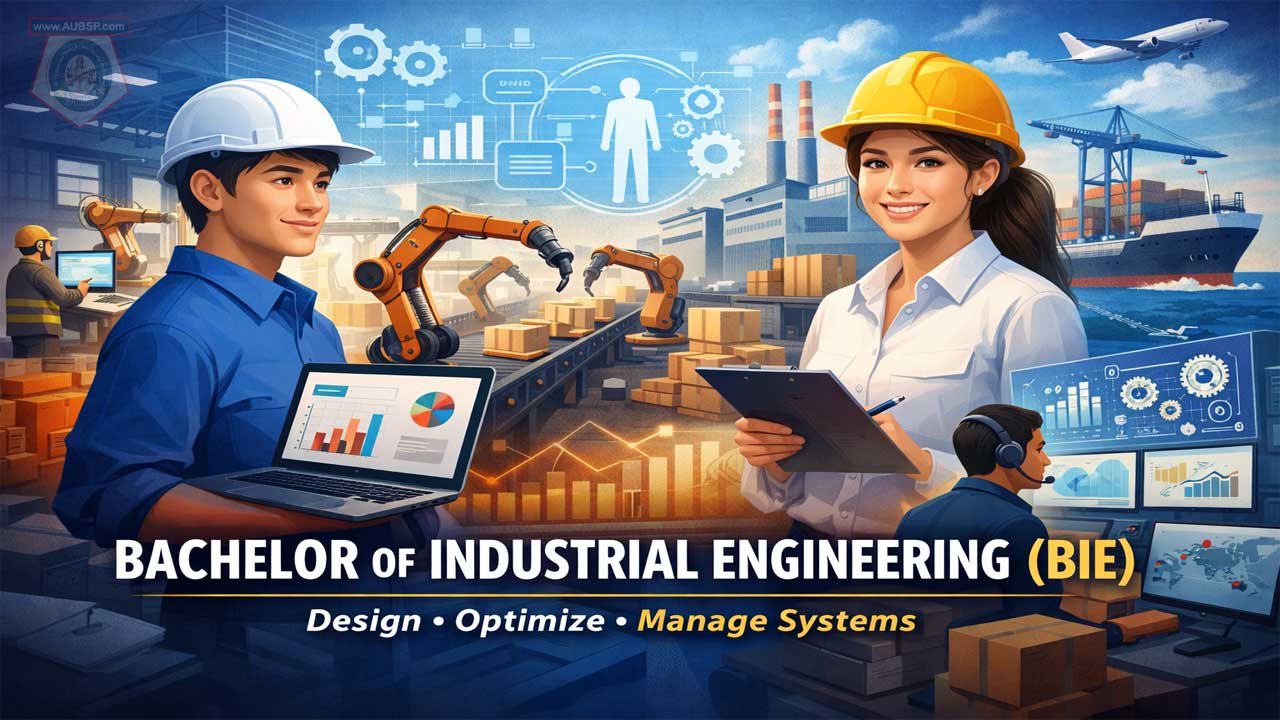
A Bachelor of Industrial Engineering (BIE) is a four-year undergraduate degree focused on designing, improving, and managing complex systems that combine people, machines, data, and processes across industries such as manufacturing, logistics, healthcare, and services.
The program blends engineering fundamentals with mathematics, statistics, operations research, management, and data analysis to help students optimize efficiency, quality, safety, and costs. Graduates develop strong analytical, problem-solving, and project management skills, enabling them to work in diverse roles like process improvement, supply chain management, operations analysis, and quality engineering.
Because organizations worldwide increasingly rely on automation, data-driven decision-making, and productivity improvements, industrial engineering remains a versatile and in-demand field with solid global career prospects and opportunities for further study in engineering, analytics, or business.
| Category | Information |
|---|---|
| Degree Name | Bachelor of Industrial Engineering (BIE) |
| Duration | Typically 4 years (full-time) |
| Focus Area | Designing, optimizing, and managing systems of people, machines, and processes |
| Core Subjects | Math, statistics, operations research, manufacturing, supply chain, quality engineering |
| Key Skills | Data analysis, process improvement, systems thinking, project management |
| Industries | Manufacturing, logistics, healthcare, IT, consulting, finance |
| Common Careers | Industrial engineer, process engineer, operations analyst, supply chain analyst |
| Admission Requirements | Strong background in math & science; English test for international students |
| Global Demand | High due to automation, Industry 4.0, and data-driven operations |
| Further Study Options | Master’s in IE, data analytics, supply chain, or MBA |
Bachelor of Industrial Engineering (BIE): Course Details, Colleges, Jobs & Salary (2026 Guide)
A Bachelor of Industrial Engineering (BIE) is a four‑year undergraduate engineering degree that trains you to design, optimize, and manage complex systems of people, machines, and processes across industries like manufacturing, logistics, healthcare, and services. It combines core engineering with data, operations, and management skills, making it one of the most versatile engineering degrees for international careers.
What is a Bachelor of Industrial Engineering?
A Bachelor of Industrial Engineering (often titled BIE, BSIE, BS in Industrial Engineering, or Industrial & Systems Engineering) focuses on improving efficiency, quality, safety, and profitability in organizations. Students learn how to analyze systems that include people, equipment, information, and materials, then redesign them to achieve better performance and lower costs. Industrial engineers work across many sectors, from factories and logistics hubs to hospitals, banks, government agencies, and tech companies.
Why industrial engineering is in high demand
Industrial engineers are central to productivity, automation, and digital transformation, so global demand is strong and growing. In the United States, employment for industrial engineers is projected to grow about 11% from 2024 to 2034, much faster than the average for all occupations. As companies adopt Industry 4.0, robotics, and data‑driven decision making, they need engineers who can connect technology with business outcomes, which is exactly the role of industrial engineering graduates.
Typical BIE curriculum and subjects
While course titles vary by country and university, most Bachelor of Industrial Engineering programs follow a similar four‑year structure that mixes math, science, engineering fundamentals, and professional courses. Curricula usually progress from basic math and physics to specialized topics like operations research, quality engineering, and supply chain management, ending with a capstone design project or industry internship.
Common subject areas include:
- Mathematics: calculus, linear algebra, probability, and statistics
- Natural sciences: physics, general chemistry, sometimes modern biology
- Basic engineering: computer programming, engineering graphics/CAD, mechanics, materials, and basic electrical concepts
- Core industrial engineering:
- Work/system design and human–machine systems
- Operations research (optimization, simulation, decision analysis)
- Engineering economy and cost analysis
- Manufacturing processes and automation
- Production planning and control
- Quality engineering and reliability
- Logistics and supply chain management
- Facilities layout and planning
- Integrative experiences: industry‑based projects, internships, or a final‑year capstone integrating multiple IE tools
Key skills you develop in a BIE
A BIE program builds both technical and managerial capabilities that are highly transferable across industries. Graduates typically gain strong analytical, data, and communication skills, allowing them to move into technical, operational, or business‑focused roles over time.
Typical skill outcomes include:
- Systems and process thinking: modeling entire workflows, supply chains, and organizations rather than isolated components
- Quantitative analysis: using statistics, optimization, and simulation to test scenarios and support decisions
- Data and decision‑making: working with data, dashboards, and engineering databases to monitor performance
- Quality and continuous improvement: applying tools such as SPC, Six Sigma concepts, and root‑cause analysis
- Human factors: designing work and interfaces that are safe, ergonomic, and productive
- Project and operations management: planning resources, scheduling, and coordinating cross‑functional teams
Admission requirements for international students
Each university sets its own criteria, but international applicants to BIE or similar industrial engineering degrees usually need a strong background in math and science at secondary school level. Typical requirements include good grades in subjects like mathematics, physics, and sometimes chemistry, along with proof of English proficiency through exams such as IELTS or TOEFL when applying to English‑medium universities. Many top institutions also consider standardized tests (for example SAT/ACT in the USA) and may look at motivation statements, recommendation letters, and proof of extracurricular or project experience.
Top countries to study industrial engineering
Because industrial engineering overlaps with mechanical, manufacturing, and systems engineering, it is widely offered in top engineering destinations worldwide. Countries such as the USA, Germany, the UK, Australia, Singapore, and leading European nations host universities consistently ranked highly in engineering and technology, with strong research and industry partnerships.
Leading destinations and example universities
| Country/Region | Example universities offering strong industrial/production/systems programs | Key advantages for BIE students |
|---|---|---|
| United States | Massachusetts Institute of Technology, University of Michigan – Ann Arbor, Purdue University, Georgia Tech, UC Berkeley | Very strong research, co‑op and internship culture, high graduate salaries, large manufacturing and tech sectors |
| Europe (Germany, Italy, Netherlands, etc.) | Politecnico di Milano, RWTH Aachen University, Eindhoven University of Technology, TU Delft, Technical University of Munich | High‑quality engineering education, strong automotive and manufacturing industries, many English‑taught programs, relatively low or no tuition in some countries |
| United Kingdom | University of Cambridge, Imperial College London, University of Manchester, Loughborough University | Established engineering traditions, close links to industry, good employability in Europe and beyond |
| Australia | University of New South Wales, University of Melbourne, University of Sydney, Monash University | Practice‑oriented learning, strong recognition in the Asia‑Pacific region, good post‑study work options |
| Singapore | Universities with engineering and industry tie‑ups (e.g., collaborations involving NUS, NTU, and international partners like MIT and Georgia Tech) | Advanced infrastructure, proximity to Asian manufacturing hubs, strong employment opportunities in logistics and high‑tech sectors |
Always verify the latest program names (industrial engineering, industrial & systems, manufacturing & management, etc.) on university websites, as titles and structures can change over time.
Career paths after a BIE degree
Industrial engineering graduates are employed in manufacturing, automotive, aerospace, logistics, e‑commerce, consulting, healthcare, banking, IT services, and government agencies. Their role is usually to make processes faster, cheaper, safer, more reliable, and more sustainable, often working at the intersection of engineering, data, and management.
Common job titles include:
- Industrial engineer
- Process engineer or manufacturing engineer
- Quality engineer or reliability engineer
- Operations analyst or operations engineer
- Supply chain or logistics analyst
- Production planner and scheduler
- Continuous improvement engineer or Lean/Six Sigma specialist
- Plant engineer, facilities planner, or project engineer
In some regions, BIE graduates also move into business and analytics roles such as management consulting, business analyst positions, or operations research roles, especially after gaining experience or completing a master’s degree.
Salary expectations and job outlook
Salary levels vary widely by country, industry, and experience, but industrial engineering consistently ranks among the better‑paid engineering fields. In the United States, the median annual wage for industrial engineers was about 101,140 USD in May 2024, with employment projected to grow 11% from 2024 to 2034.
Other data points illustrate the strong earning potential:
- One analysis of industrial engineering graduates reported a median graduate salary around 81,993 USD, with top earners above 120,000 USD and typical early‑career salaries near 57,000 USD.
- A survey of engineering graduates across disciplines found average starting salaries around 76,700 USD for bachelor’s‑level engineers, which is broadly aligned with industrial engineering offers.
- In India, recent data shows industrial engineers earning on average around 28,760 INR per month, with higher pay in major industrial centers and for roles such as supply chain analyst or operations analyst.
Because industrial engineers can move into leadership, optimization, and analytics roles, long‑term salary growth is often strong, especially for those who combine their degree with certifications or postgraduate study.
Is a Bachelor of Industrial Engineering right for you?
A BIE is a good fit if you enjoy math and problem‑solving but also want to work closely with people, processes, and business decisions rather than purely designing machines or circuits. Students who are comfortable with data, interested in efficiency and optimization, and willing to learn both technical and management concepts often thrive in industrial engineering. If you like the idea of working across different industries and possibly moving into operations leadership or consulting later, this degree offers strong flexibility.
Tips for international applicants considering BIE
International students can improve both admission chances and career outcomes by planning strategically. Targeting universities in countries with strong engineering industries and favorable post‑study work policies, and documenting relevant projects or internships in statements of purpose and CVs, can make applications more competitive.
Consider these steps:
- Shortlist countries known for engineering strength and manufacturing (for example the USA, Germany, Italy, the Netherlands, the UK, Australia, Singapore).
- Compare program names like “Industrial & Systems Engineering,” “Industrial Engineering,” “Manufacturing & Management,” or “Production Engineering” to find the closest match to your interests.
- Check entry requirements early, including math/physics expectations, language tests, and any standardized exams.
- Look for programs with co‑op, internship, or capstone project components, as these significantly increase employability.
FAQs about Bachelor of Industrial Engineering
How long does a Bachelor of Industrial Engineering degree take?
Most full‑time Bachelor of Industrial Engineering or equivalent industrial engineering degrees take about four years to complete, with roughly 240 credits or their local equivalent. In some European countries with integrated or honors structures, the duration and credit load can vary slightly, so always check the specific program details.
Is industrial engineering hard?
Industrial engineering is mathematically and analytically demanding because it includes calculus, statistics, operations research, and engineering science. However, many students find it more people‑ and process‑oriented than some other branches, which can make it engaging if you enjoy real‑world problem‑solving and teamwork.
What is the difference between industrial engineering and mechanical engineering?
Mechanical engineering focuses more on the design and analysis of physical components and machines, such as engines, structures, and thermal systems. Industrial engineering focuses on optimizing systems and processes—production lines, supply chains, service operations—often using data, statistics, and management science approaches. In practice, the two fields overlap heavily in manufacturing and automotive industries, where mechanical engineers design equipment and industrial engineers design and manage the processes around that equipment.
Do I need coding skills for a BIE program?
Many industrial engineering curricula include at least one programming course and expect basic competence in tools like spreadsheets, databases, and specialized simulation or optimization software. While deep software development is not the core focus, comfort with coding and data analytics is increasingly important as industrial engineers work with large datasets, automation, and digital twins.
Can I work abroad after completing a Bachelor of Industrial Engineering?
Because industrial engineering skills are broadly applicable and many top programs are globally recognized, graduates often find opportunities to work or pursue further study abroad, especially in manufacturing, logistics, and consulting hubs. Your ability to work abroad will also depend on immigration rules, language skills, and whether you choose countries with post‑study work visas or talent programs for engineers.
Is a BIE good preparation for an MBA or master’s degree?
A BIE is a strong foundation for graduate study in industrial engineering, operations research, data analytics, supply chain management, or even an MBA, because it already blends technical and managerial perspectives. Many employers value industrial engineering graduates who later specialize in analytics or business, as they can bridge the gap between engineering operations and strategic decision‑making.


Leave a Reply
You must be logged in to post a comment.