
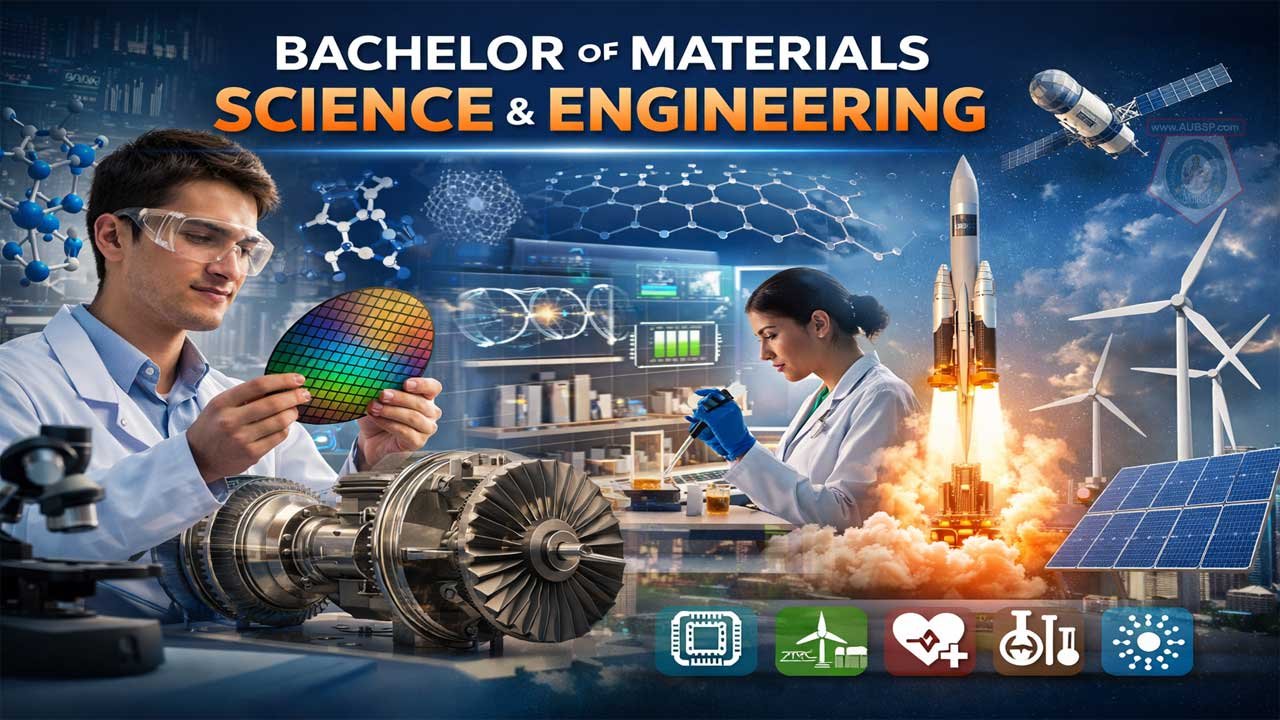
A Bachelor of Materials Science and Engineering (BMSE), also known as BSMSE or BSE in Materials Science and Engineering, is an interdisciplinary undergraduate degree that prepares students to design, analyze, and improve the materials that power modern technologies — including metals, ceramics, polymers, semiconductors, biomaterials, nanomaterials, and composites.
Built around the core principles of structure, properties, processing, and performance, the program combines physics, chemistry, mathematics, and engineering fundamentals with laboratory experience, materials characterization, manufacturing, and senior design projects. Typically completed in four years (120–128 credits), BMSE equips graduates for high-demand careers across industries such as semiconductors, aerospace, energy, biomedical, automotive, and advanced manufacturing.
With strong employment outcomes, competitive salaries, growing relevance in AI-driven materials discovery and sustainability, and global recognition through ABET-accredited programs, the degree offers versatile career pathways and a strong foundation for advanced study in cutting-edge technological fields.
| Category | Details |
|---|---|
| Degree Name | Bachelor of Materials Science and Engineering (BMSE / BSMSE / BSE-MSE) |
| Duration | 4 years (120–128 credit hours); 5 years with co-op option |
| Core Focus | Structure, properties, processing, and performance of materials |
| Materials Covered | Metals, ceramics, polymers, composites, semiconductors, biomaterials, nanomaterials |
| Foundational Subjects | Calculus, physics, chemistry, thermodynamics, statistics |
| Core Courses | Materials processing, mechanical behavior, materials characterization, phase transformations |
| Specializations | Biomaterials, electronic materials, energy materials, nanomaterials, sustainable materials, computational MSE |
| Top Employers | Semiconductor, aerospace, biomedical, automotive, energy, manufacturing industries |
| Entry-Level Salary (US) | ~$76,000–$87,000 per year |
| Median Salary (US) | ~$108,000 per year |
| Job Outlook (US) | ~6% growth (2024–2034) |
| Accreditation | Often accredited by ABET (Engineering Accreditation Commission) |
| Career Roles | Materials engineer, process engineer, research scientist, metallurgist, quality engineer |
| Advanced Study Options | MS, PhD, 4+1 accelerated programs |
| Global Demand | High demand across technology-driven industries worldwide |
What Is a Bachelor of Materials Science and Engineering?
A Bachelor of Materials Science and Engineering (BMSE) — also awarded as BS in Materials Science and Engineering (BSMSE) or BSE in Materials Science and Engineering — is an interdisciplinary undergraduate degree that equips students with the knowledge and skills to design, develop, and improve the materials used in nearly every modern technology. From semiconductors and biomaterials to metals and polymers, the program blends scientific fundamentals with hands-on engineering, preparing graduates to solve real-world challenges at the intersection of science and engineering.
Materials Science and Engineering (MSE) is concerned with the production, structure, characterization, properties, and utilization of metals, ceramics, polymers, composites, electronic materials, optical materials, nanomaterials, and bio-compatible materials. Materials scientists and engineers play a key role in an increasingly complex technological society by extending the limited supply of materials, improving existing ones, and developing superior alternatives with awareness of cost, reliability, safety, and environmental implications.
Although over half a million scientists and engineers currently work in the materials field, only about 10% hold materials-designated degrees — the remainder include chemists, physicists, electrical engineers, chemical engineers, and mechanical engineers. This means there is strong demand for graduates who take the multidisciplinary materials science approach from the start of their careers.
Why Study Materials Science and Engineering?
Interdisciplinary Foundations
MSE sits at the intersection of physics, chemistry, and engineering. The discipline is organized around four interconnected cornerstones — structure, properties, processing, and performance — with characterization at the center. This framework applies universally across all material classes, giving graduates unmatched versatility in solving technical problems across industries.
High Demand, Low Supply of Graduates
Materials Science has a very high ratio of jobs to graduates because it is in high demand but not yet as widely known as traditional engineering fields. Virtually every industry employs materials scientists and engineers — they work with metals, ceramics and glasses, polymers, semiconductors, electronic materials, and composites.
Students with BS degrees in Materials Science and Engineering, along with Chemical Engineers, typically have some of the strongest employment outcomes among engineering disciplines.
Versatility Across Industries
Graduates are prepared for careers in the semiconductor, manufacturing, aerospace, biomedical, energy, automotive, defense, and consumer products sectors. Common job titles include materials engineer, materials scientist, process engineer, quality control analyst, failure analysis engineer, research scientist, composites engineer, metallurgist, and additive manufacturing engineer.
Core Curriculum and Course Structure
A typical BMSE program requires 120–128 credit hours completed over four years. The curriculum integrates a university core (general education), foundational science and math, and specialized MSE courses.
Foundational Courses (Years 1–2)
- Calculus (single-variable, multivariable, and differential equations)
- Calculus-based physics (mechanics, electromagnetism, optics)
- General and organic chemistry
- Statistics and probability
- Introduction to Materials Science and Engineering
- Crystal Chemistry and Structure of Materials
- Thermodynamics of Materials
- Physics of Materials
Core MSE Courses (Years 2–3)
- Materials Processing and Manufacturing
- Kinetics of Materials Processing
- Mechanical Behavior of Materials
- Electrical, Optical, and Magnetic Properties of Materials
- Materials Characterization (with lab components)
- Microstructure and Phase Transformations
- Transport Phenomena
Advanced and Capstone Courses (Years 3–4)
- Materials Selection and Design
- Senior Design Project / Capstone
- MSE Seminar
- Technical Electives in specialization areas
- Engineering Economics
Laboratory experiences are integrated throughout the curriculum, familiarizing students with instruments and advanced techniques used to process and characterize materials and evaluate their structure, properties, and performance. Many programs also embed cooperative education (co-op) experiences, such as Drexel University’s three co-op model which extends the program to five years.
Areas of Specialization
Most programs allow students to tailor their education through concentration tracks or technical elective sequences. Northwestern University, for example, offers nine distinct areas of concentration:
| Specialization | Focus Area | Key Applications |
|---|---|---|
| Biomaterials | Biomedical implants, biomimetic materials, biological systems | Medical devices, prosthetics, tissue engineering |
| Electronic Materials | Semiconductors, microelectronics, ULSI | Chips, sensors, integrated circuits |
| Energy Materials | Batteries, solar cells, fuel cells | Renewable energy, energy storage |
| Nanomaterials | Nanoparticles, thin films, nanowires, quantum confinement effects | Nanoelectronics, biotechnology, advanced manufacturing |
| Polymeric Materials | Polymers, composites, soft materials | Packaging, automotive, aerospace |
| Metals and Ceramics | Alloys, high-temperature materials, structural ceramics | Aerospace, construction, defense |
| Sustainable Materials | Eco-friendly materials, lifecycle assessment, recycling | Green manufacturing, circular economy |
| Design and Manufacturing | Materials selection, computational tools, failure analysis | Industrial engineering, product development |
| Computational Materials Science | Molecular dynamics, materials modeling, machine learning | R&D, simulation, data-driven discovery |
At NC State, the Nanomaterials Concentration delves into fundamental principles governing interactions and characteristics of materials at the atomic level, covering ultra-thin films, nanowires, nanoparticles, quantum confinement, surface area effects, and interfacial properties. IIT Mandi offers specializations in Clean Energy and Sustainable Materials alongside core materials engineering.
Admission Requirements and Eligibility
Undergraduate Prerequisites
Strong high school preparation is essential. Prospective students should complete at least one semester of trigonometry and one year each of algebra (intermediate and advanced), plane geometry, chemistry, and physics. This background supports success in college-level calculus, calculus-based physics, and chemistry for science majors.
Standard undergraduate eligibility requirements include:
- United States: High school diploma with strong grades in math and science; SAT/ACT scores; application essays and recommendations
- India: 10+2 with Physics, Chemistry, and Mathematics (PCM); minimum 50–60% marks; valid entrance exam score such as JEE Main/Advanced
- Europe (e.g., NTNU Norway): A relevant bachelor’s degree with a minimum grade point average of C for master’s programs
Graduate Admission (for advanced study)
For those planning to pursue graduate work after a BMSE, leading programs like UC Berkeley require a bachelor’s degree in engineering, physics, chemistry, or a related field with a minimum GPA of 3.2, three letters of recommendation, a statement of purpose, and TOEFL scores for international applicants. IIT Kanpur’s MSE PhD program requires a minimum 75% or 7.5 CPI in B.E./B.Tech. along with a valid GATE score.
Top Universities Worldwide
The QS World University Rankings 2026 for Materials Sciences included over 550 universities globally. Tsinghua University entered the top 10, climbing from 12th to joint sixth alongside the National University of Singapore.
| QS Rank (2026) | University | Country |
|---|---|---|
| #1 | Massachusetts Institute of Technology (MIT) | United States |
| #2 | University of Tokyo | Japan |
| #3 | Stanford University | United States |
| #4 | University of Cambridge | United Kingdom |
| #5 | UC Berkeley | United States |
| #6 (tied) | Tsinghua University | China |
| #6 (tied) | National University of Singapore | Singapore |
| #8 | Harvard University | United States |
| #9 | University of Michigan, Ann Arbor | United States |
| #10 | University of Oxford | United Kingdom |
Other globally recognized programs include Carnegie Mellon University, Georgia Institute of Technology, Purdue University, Case Western Reserve University, Lehigh University, and in India — IIT Delhi, IIT Mandi, IIT Kanpur, and IISc Bangalore.
ABET Accreditation: Why It Matters
ABET (Accreditation Board for Engineering and Technology) accreditation verifies that a collegiate program has met standards essential to prepare graduates to enter critical STEM fields in the global workforce. For engineering students specifically, ABET accreditation:
- Enhances employment opportunities — multinational corporations often require graduation from an accredited program
- Supports entry to the profession through licensure, registration, and certification
- Establishes eligibility for federal student loans, grants, and scholarships in the United States
- Enables international career mobility, as ABET accreditation is recognized worldwide through international agreements
Programs like Case Western Reserve University’s BSE in Materials Science and Engineering are accredited by the Engineering Accreditation Commission of ABET under criteria for Materials, Metallurgical, Ceramics, and similarly named programs. However, some top-ranked programs — including Stanford and Columbia — are not ABET-accredited, as the PE licensure pathway is less common in MSE compared to civil or mechanical engineering. For students at well-known research universities, the institutional brand and program quality may compensate, but ABET accreditation remains particularly valuable for graduates of less widely recognized institutions.
Career Outlook and Salary Expectations
Employment Projections
The U.S. Bureau of Labor Statistics projects employment of materials engineers to grow 6% from 2024 to 2034, faster than the average for all occupations. Approximately 1,500 openings for materials engineers are projected each year, many resulting from the need to replace workers who transfer to different occupations or retire.
Salary Data
| Career Level | Annual Salary (USD) | Source |
|---|---|---|
| Entry-Level (less than 1 year) | $76,175 | PayScale 2026 |
| Early Career (1–4 years) | $87,409 | PayScale 2026 |
| Average (all experience levels) | $92,639–$93,312 | ZipRecruiter / PayScale 2025–2026 |
| Median (BLS, May 2024) | $108,310 | Bureau of Labor Statistics |
| 75th Percentile | $102,500 | ZipRecruiter |
| Top Earners (90th percentile) | $113,500 | ZipRecruiter |
| Specialized PhD (e.g., Bay Area) | $150,000–$255,000+ (total compensation) | Industry reports |
These figures position materials engineering competitively against other engineering disciplines, with further upside for those specializing in high-demand sectors like semiconductors, aerospace, and energy.
BMSE vs. Related Engineering Degrees
A common question among prospective students is how MSE compares to adjacent fields. The table below highlights the key distinctions:
| Attribute | Materials Science & Engineering | Chemical Engineering | Mechanical Engineering |
|---|---|---|---|
| Core Focus | Structure, properties, processing, and performance of solid materials | Transport processes, kinetics, thermodynamics of chemical systems, reactors, separation | Machines, motion, thermal systems, structural integrity |
| Material Scope | All material classes — metals, ceramics, polymers, semiconductors, composites | Primarily fluids, chemicals, polymers | Metals, composites, structural materials |
| Key Techniques | Characterization, fabrication, structure-property analysis | Process scaling, reactor design, fluid dynamics | Design, dynamics, thermodynamics, manufacturing |
| Typical Industries | Semiconductors, aerospace, biomedical, energy, nanotechnology | Petrochemicals, pharmaceuticals, food processing | Automotive, aerospace, robotics, HVAC |
| Best For | Students interested in the science behind how materials work and how to improve them | Students who want to scale chemical processes industrially | Students who want to design machines and mechanical systems |
MSE fills the gap between chemical and mechanical engineering, with a greater focus on characterization, fabrication, and the fundamental science of solid materials. The field is well-suited for students who are fascinated by why materials behave the way they do and how to engineer better ones.
Emerging Trends Shaping the Field
AI-Driven Materials Discovery
Artificial intelligence and machine learning are revolutionizing how materials are discovered, designed, characterized, and deployed. What once took decades of experimental iteration can now potentially be achieved in months or weeks through AI-augmented computational approaches.
Global leaders like Microsoft, Google, and Lawrence Berkeley National Laboratory have launched initiatives such as MatterGen and GNOME, using AI to vastly expand the scale and precision of materials research. The World Economic Forum highlighted AI for scientific discovery as one of the Top 10 Emerging Technologies of 2024, with direct implications for advanced batteries, solar cells, and carbon capture technologies.
Sustainability and Green Materials
Sustainable materials — those produced at large scale in an eco-friendly manner with reduced dependence on non-renewable sources — are a major growth area.
AI is becoming increasingly pivotal in advancing sustainability and lifecycle assessment in materials science, enabling researchers to find lower-impact alternatives without sacrificing performance. Programs are responding with dedicated concentration tracks in sustainable materials and energy materials.
Semiconductor Industry Growth
The global semiconductor industry is expected to be valued at $1 trillion by 2030, driven by advances in electronic materials. UT Dallas has designed its BMSE program to embed a Certificate in Semiconductor Technology without additional credit hours, preparing graduates for this booming sector.
Nanotechnology and Biomaterials
Research in nanoscale phenomena, nanodevices, biosensors, targeted drug delivery systems, bio-implants, and emerging photovoltaics continues to expand. These fields present lucrative career paths for MSE graduates with specializations in nanomaterials or biomaterials.
Scholarships and Financial Aid
Several organizations offer targeted scholarships for materials science students:
- Acta Materialia Inc. Undergraduate Scholarship: Two $5,000 scholarships for undergraduates majoring in metallurgical engineering, materials science and engineering, or students with significant interest in materials
- Henry DeWitt Smith Scholarship: Two scholarships of approximately $2,000 for graduate students in mineral, metals, and/or materials engineering, funded by AIME
- TMS Foundation: Awards nearly $30,000 in scholarships annually to outstanding students studying minerals, metals, and materials science and engineering
- NUS Science & Technology Undergraduate Scholarship: Available to outstanding undergraduate students from all Asian countries (excluding Singapore), covering tuition fees, compulsory fees, and living costs
- Chevening Scholarships: Available at select universities like Swansea University for students from eligible countries pursuing materials-related master’s programs
- Various institutional scholarships: Many universities offer merit- and need-based aid specifically for engineering students; international students should check individual university financial aid pages
How to Succeed as a BMSE Student
Build a Strong Foundation Early
Arrive at university prepared in calculus, physics, and chemistry. Pre-engineering students should complete at least one semester of trigonometry and one year each of algebra, chemistry, and physics. Strong reading comprehension and clear, effective writing skills are also critical for lab reports, research papers, and presentations.
Pursue Research and Internship Opportunities
Hands-on learning is a cornerstone of MSE education. Programs emphasize lab courses, senior projects, co-op placements, and plant tours to ensure every student sees the field first-hand in current research and industrial settings. Employers like the Air Force Research Laboratory, GE Global Research, Pratt & Whitney, and Ball Aerospace actively recruit MSE graduates.
Stay Current with Emerging Technologies
The integration of AI, machine learning, and computational tools into materials research is reshaping the profession. Students who develop skills in data science, Python programming, and computational modeling alongside traditional MSE coursework will be best positioned for the future job market.
Consider Graduate Education
MSE is an excellent foundation for advanced degrees. Many programs offer accelerated 4+1 options that allow completion of a master’s degree with only one additional year of study. Graduate education unlocks higher-level research positions, faculty careers, and significantly higher earning potential — specialized PhDs in high-demand areas can command total compensation exceeding $200,000.
Frequently Asked Questions
What is the difference between Materials Science and Materials Engineering?
Materials Science focuses on understanding why materials behave the way they do at the atomic and molecular level, while Materials Engineering applies that knowledge to design, process, and manufacture materials for specific applications. Most modern programs integrate both under a unified Materials Science and Engineering (MSE) degree.
Is BMSE a good degree for international students?
Yes. Materials science is a globally recognized field with career opportunities in virtually every industrialized country. ABET-accredited programs are recognized internationally through mutual agreements, and the degree translates well across borders. Additionally, the semiconductor, aerospace, and energy sectors actively recruit internationally.
How long does a BMSE degree take?
A standard BMSE program is designed for completion in four years (120–128 credits). Programs with integrated co-op experiences, like Drexel University’s three co-op option, extend to five years.
What are the highest-paying specializations?
Semiconductor materials, electronic materials, and nanotechnology tend to command the highest salaries, especially in technology hubs like the San Francisco Bay Area, where specialized professionals with advanced degrees can earn total compensation exceeding $250,000. Energy materials and biomaterials are also fast-growing sectors with competitive pay.
Can I work in materials science with a different engineering degree?
Yes — many professionals in the materials field hold degrees in chemical engineering, mechanical engineering, physics, or chemistry. However, a dedicated MSE degree provides a more focused and comprehensive foundation, particularly in materials characterization, structure-property relationships, and cross-material-class expertise.


Leave a Reply
You must be logged in to post a comment.