
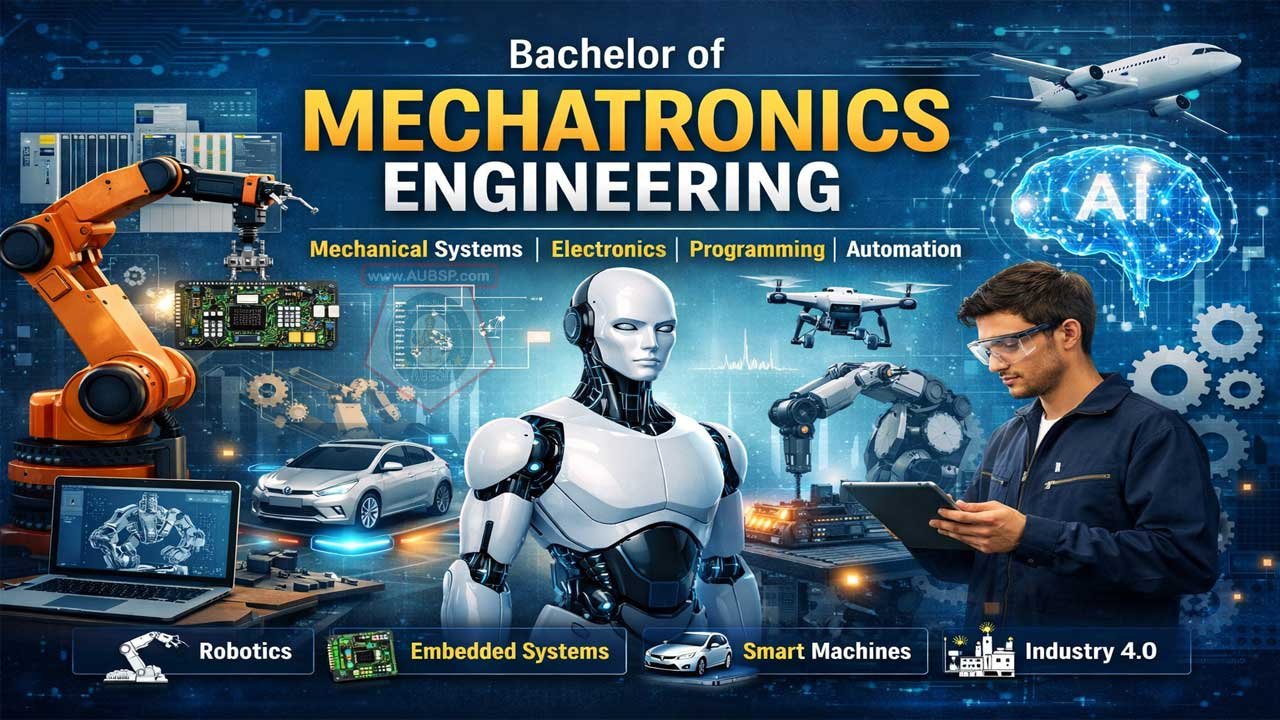
A Bachelor of Mechatronics Engineering (BMechEng) is a 3–4 year undergraduate degree that combines mechanical engineering, electronics, computer science, and control systems to train students to design and build intelligent, automated systems such as robots, smart machines, drones, and industrial automation equipment.
The program develops interdisciplinary skills through coursework in mathematics, mechanics, circuits, programming, embedded systems, robotics, and automation, along with practical labs and a final-year project. Graduates gain both technical and professional skills, preparing them for careers as mechatronics, robotics, automation, control, or embedded systems engineers across industries like automotive, aerospace, manufacturing, healthcare, energy, and logistics.
With the global rise of Industry 4.0, AI, IoT, and autonomous systems, mechatronics offers strong career prospects and flexibility compared to traditional single-discipline engineering degrees.
| Category | Information |
|---|---|
| Degree Name | Bachelor of Mechatronics Engineering (BMechEng), BEng Mechatronics, B.Tech Mechatronics |
| Duration | 3–4 years (full-time) |
| Study Mode | Primarily full-time; some programs offer co-op/internships |
| Core Focus | Integration of mechanical engineering, electronics, programming, and control systems |
| Main Goal | Design and build intelligent, automated systems (robots, smart machines, autonomous systems) |
| Foundation Subjects | Mathematics, Physics, Engineering Fundamentals |
| Mechanical Topics | Mechanics, Thermodynamics, Fluid Mechanics, Machine Design, Manufacturing |
| Electronics Topics | Circuits, Analog/Digital Electronics, Sensors, Microcontrollers |
| Programming | C/C++/Python, Embedded Systems, Data Acquisition |
| Automation & Control | Control Systems, PLCs, Robotics, Industrial Automation |
| Practical Components | Labs, design projects, capstone/industry project |
| Entry Requirements | High school diploma with strong Maths & Physics |
| English Requirement | IELTS ~6.0–6.5 or TOEFL iBT ~80–90 (if applicable) |
| Skills Developed | CAD design, programming, robotics, system integration, problem-solving |
| Career Roles | Mechatronics Engineer, Robotics Engineer, Automation Engineer, Control Systems Engineer |
| Industries | Automotive, Aerospace, Manufacturing, Robotics, Healthcare, Energy, Logistics |
| Further Study | Master’s in Robotics, Automation, Control Systems, Embedded Systems, AI |
What Is a Bachelor of Mechatronics Engineering (BMechEng)?
A Bachelor of Mechatronics Engineering (BMechEng) is a 4‑year undergraduate engineering degree that integrates mechanical engineering, electronics, computer science, and control systems to design and build intelligent, automated systems such as robots, industrial machines, drones, smart devices, and autonomous vehicles.
Instead of focusing on a single discipline, mechatronics prepares students to work across:
- Mechanical systems – mechanisms, machine design, manufacturing
- Electronics & electrical systems – circuits, sensors, actuators
- Computer & software – programming, embedded systems, data acquisition
- Control & automation – PLCs, robotics, feedback control, Industry 4.0 systems
Many universities offer this degree under titles like BMechEng (Mechatronics), BEng Mechatronics Engineering, or B.Tech in Mechatronics Engineering, but the core idea is the same: training engineers to build smart, automated machines for modern industry.
Why Study Mechatronics Engineering?
Choosing mechatronics over a traditional single-discipline degree (like only mechanical or electrical) has several advantages:
- Interdisciplinary skill set
You gain working knowledge of mechanical design, electronics, programming, and control, making you highly versatile in the job market. - Industry 4.0 & automation demand
Smart factories, robotics, AI‑driven systems, and IoT devices all rely heavily on mechatronics engineers to design, integrate, and maintain complex machinery. - Broader career options
Graduates can work as mechatronics engineers, robotics engineers, automation engineers, control engineers, embedded systems engineers, or mechanical/electrical engineers depending on specialization. - Future‑proof skills
As more industries adopt robotics and intelligent systems, engineers who understand both hardware and software are in stronger demand than narrow specialists.
For students who like maths, physics, programming, and practical problem‑solving, mechatronics offers an ideal blend of theory and hands‑on work.
Course Duration and Structure
Most Bachelor of Mechatronics Engineering programs worldwide follow this pattern:
- Duration: 3–4 years full time
- 4‑year programs are common in countries like India, USA, Canada, and many others.
- 3‑year programs (often BEng) can appear in some European systems.
- Credits: Typically 120–240 ECTS (or equivalent), depending on country.
- Study mode: Full‑time; some universities offer co‑op or industrial internship options.
- Teaching language: Often English, especially at universities targeting international students.
The degree usually progresses through themes like:
- Year 1: Foundation in math, physics, basic engineering and programming
- Year 2: Core mechanical, electronics, and mechatronics system courses
- Year 3: Applied mechatronics, robotics, control, embedded systems, labs
- Year 4: Advanced electives, specialization and a major capstone or industry project
Core Subjects and Syllabus Overview
Exact subject names vary by university, but typical BMechEng / Mechatronics Engineering syllabi include the following areas:
1. Mathematics & Basic Sciences
- Calculus and Linear Algebra
- Differential Equations
- Numerical Methods
- Engineering Physics
- Engineering Chemistry (in some universities)
These subjects give you the mathematical and scientific tools needed for modeling and analysis of systems.
2. Core Mechanical Engineering
- Engineering Mechanics / Statics & Dynamics
- Strength of Materials / Solid Mechanics
- Theory of Machines / Mechanisms
- Thermodynamics & Heat Transfer
- Fluid Mechanics
- Manufacturing Processes & Machine Tools
- Engineering Design / Design of Machine Elements
This builds your understanding of mechanical structures, motion, and energy conversion.
3. Electronics & Electrical Engineering
- Circuit Theory (DC & AC Circuits)
- Analog & Digital Electronics
- Power Electronics
- Electrical Machines & Drives
- Sensors and Instrumentation
- Microcontrollers & Microprocessors
You learn how to design and interface electronic components that interact with mechanical systems.
4. Computer Science & Programming
- Programming in C/C++/Python
- Data Structures & Algorithms (in some programs)
- Embedded Systems Programming
- Real‑Time Systems & Data Acquisition
- Basic Computer Networks (in some curricula)
These courses teach you to write software that runs on microcontrollers, robots, and automated machines.
5. Control Systems & Automation
- Control Systems Engineering
- Mechatronic System Design
- PLC Programming & Industrial Automation
- Robotics: Kinematics, Dynamics, and Control
- Modelling & Simulation of Dynamic Systems
- Digital Signal Processing / Digital Filters (elective)
This is the heart of mechatronics: making machines respond intelligently to sensor inputs.
6. Mechatronics‑Specific Integration Courses
- Introduction to Mechatronics Systems
- Mechatronic System Design Projects
- Robotics and Automation Labs
- Mobile Robotics (elective)
- Condition Monitoring, Automotive Technology, Laser Applications (specialized electives)
These subjects integrate mechanical, electrical, and software aspects into complete working systems.
7. Professional & Complementary Skills
Most international programs also include:
- Engineering Graphics and CAD
- Engineering Economics / Management
- Communication Skills
- Project Management
- Final‑Year Capstone / Industry Project
This combination ensures graduates are prepared not only technically, but also for teamwork, communication, and leadership roles.
Eligibility Criteria for International Students
Eligibility varies slightly by country and university, but the common baseline for admission into a BMechEng / BTech Mechatronics program includes:
Academic Requirements
- Completion of upper secondary / high school (12th grade or equivalent).
- Strong background in:
- Mathematics (advanced level)
- Physics
- Many engineering faculties worldwide specify that applicants must have a diploma equivalent to their local pre‑university qualification with good grades in Maths and Physics.
- Some universities also accept Chemistry, Computer Science, or related technical subjects as additional strengths or requirements.
Minimum Marks / Grades
- Requirements typically specify a minimum overall percentage or GPA (for example, around 45–65% or higher, depending on university and country).
- Competitive institutions may demand significantly higher marks or use selective quota systems.
English Language Proficiency
If the program is taught in English and your previous education was not fully in English, you are usually required to provide a valid test score such as:
- IELTS: often around 6.0–6.5 overall, with minimum scores in each band
- TOEFL iBT: commonly around 80–90+ overall
- Equivalent tests (Cambridge, PTE Academic, etc.) at B2 or above on the CEFR scale are often accepted.
Some institutions waive this requirement if you studied in English for the last two years of school or hold specific qualifications.
Additional Requirements
Depending on the university, you may also face:
- Entrance tests (national or university‑specific)
- Interviews or motivation letters
- Portfolios or project descriptions (less common, but may be requested for specialized or highly selective programs)
Skills You Will Develop in BMechEng
A Bachelor of Mechatronics Engineering helps you build a powerful combination of technical and transferable skills:
Technical skills
- 3D CAD modeling and mechanical design
- Circuit design and PCB basics
- Programming (C/C++/Python, embedded systems)
- PLC & industrial automation configuration
- Robotics programming and motion planning
- Control system design and tuning
- Sensor integration and signal conditioning
- System modeling and simulation (MATLAB/Simulink or similar)
Soft & professional skills
- Problem solving and system‑level thinking
- Project management and documentation
- Teamwork in multidisciplinary environments
- Communication with both engineers and non‑technical stakeholders
- Innovation and product development mindset
Career Opportunities After Bachelor of Mechatronics Engineering
Graduates of mechatronics degrees can pursue a wide range of roles. Common job titles include:
- Mechatronics Engineer
- Robotics Engineer
- Automation / Industrial Automation Engineer
- Control Systems Engineer
- Embedded Systems Engineer
- Maintenance & Reliability Engineer
- Test and Commissioning Engineer
- Product Development Engineer
- Mechanical or Electrical Engineer (depending on roles and local licensing rules)
Industries That Hire Mechatronics Engineers
Because mechatronics cuts across multiple disciplines, demand exists in many sectors:
- Automotive & Electric Vehicles – manufacturing lines, robotics, vehicle control systems
- Aerospace & Defense – robotics, avionics, guidance systems, satellites, autonomous drones
- Industrial Automation & Manufacturing – smart factories, PLC‑controlled systems, assembly robots
- Consumer Electronics & Appliances – smart devices, home automation
- Healthcare & Medical Devices – robotic surgery systems, prosthetics, diagnostic equipment
- Energy & Utilities – monitoring, control, and automation of plants
- Logistics & Warehousing – automated storage and retrieval systems, AGVs, sorting robots
In global technology hubs and emerging industrial economies alike, companies seek engineers who can bridge mechanical design, electronics, and software.
Future Scope and Trends in Mechatronics
The future of mechatronics is closely tied to Industry 4.0, AI, and IoT. Key trends shaping demand include:
- Smart factories and cyber‑physical systems – fully automated production lines and predictive maintenance.
- Collaborative robots (cobots) – robots that safely work alongside humans.
- Autonomous vehicles and drones – requiring expertise in sensing, control, and embedded AI.
- Robotics in space exploration – rovers, manipulators, and autonomous systems for lunar and Martian missions.
- Service and healthcare robotics – rehabilitation robots, exoskeletons, surgical systems.
As these technologies mature, interdisciplinary engineers with a mechatronics background are well‑positioned to lead innovation.
Popular Study Destinations for BMechEng / Mechatronics
International students interested in mechatronics commonly look at:
- United States & Canada – Offer BS/BE in Mechatronics or Mechatronics Engineering Technology with strong research and co‑op opportunities.
- Germany & other EU countries – Strong in mechanical and automation engineering, often with English‑taught programs and practical training.
- Australia & New Zealand – Well‑regarded engineering faculties with good industry links.
- India and other Asian countries – Growing number of B.Tech Mechatronics programs with an Industry 4.0 focus.
When comparing universities, look closely at:
- Depth of robotics and automation labs
- Availability of internships / co‑op
- Links with automotive, manufacturing, aerospace, or robotics industries
- Type of degree (BEng/BSc/B.Tech) and accreditation or licensing pathways in your target country
BMechEng vs Mechanical or Electrical Engineering
Many students are unsure whether to choose Mechatronics, Mechanical, or Electrical engineering. In summary:
- Mechanical Engineering
Focuses more deeply on mechanics, thermodynamics, fluids, and machine design. Less emphasis on electronics and programming. - Electrical/Electronics Engineering
Focuses on circuits, power systems, communications, and electronics. Less focus on mechanical design and manufacturing. - Mechatronics Engineering
Offers breadth across mechanical, electrical, and software, centered around automation and intelligent systems. You may not go as deep as a pure specialist in one area, but you gain a powerful integrated profile suitable for modern automated industries.
If you are particularly drawn to robots, automation, smart machines, and embedded systems, mechatronics is often the most direct route.
Frequently Asked Questions (FAQ)
1. Is mechatronics engineering a good career choice?
Yes. Mechatronics is considered a strong and growing career path because it aligns directly with automation, robotics, and Industry 4.0, which are transforming manufacturing, logistics, automotive, aerospace, and many other sectors. The interdisciplinary training also lets you shift between roles and industries more easily over time.
2. What is the difference between BMechEng (Mechatronics) and B.Tech in Mechatronics?
The naming mainly depends on the country and university:
- BMechEng / BEng (Mechatronics) – common in the UK, Europe, and some other regions.
- B.Tech in Mechatronics Engineering – common in India and certain Asian countries.
- BS in Mechatronics or Mechatronics Engineering Technology – common in North America.
In practice, all are undergraduate engineering degrees focused on mechatronics. What matters more is the curriculum depth, accreditation, and industry connections.
3. Can I do a master’s in robotics or AI after BMechEng?
Yes. A mechatronics degree is a strong foundation for postgraduate studies in robotics, automation, control systems, autonomous systems, embedded systems, or even applied AI, provided you meet each program’s entry criteria (often based on GPA, prerequisite subjects, and sometimes work experience).
4. What kind of projects will I work on as a student?
Typical mechatronics projects include:
- Line‑following or obstacle‑avoiding robots
- Automated conveyor or pick‑and‑place systems
- Smart home or IoT‑based devices with sensors and actuators
- Robotic arms with vision or feedback control
- Automated guided vehicles (AGVs)
- Condition‑monitoring systems for machines
These projects help you apply theory to real‑world engineering problems and improve your portfolio for internships and jobs.


Leave a Reply
You must be logged in to post a comment.