
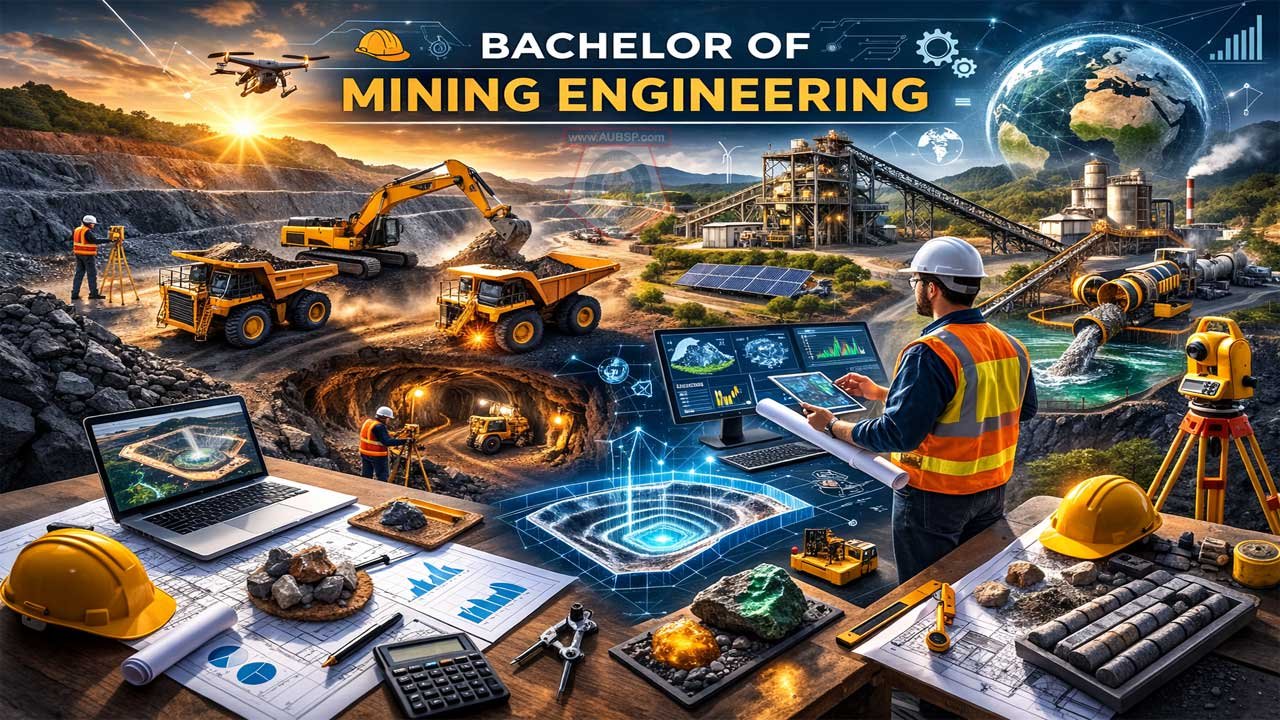
A Bachelor of Mining Engineering (BMineE)—also called B.Eng. (Mining), B.Tech (Mining), or B.S. in Mining Engineering—is a 4–5 year undergraduate degree that trains students to design, plan, and manage both surface and underground mining operations by integrating geology, mechanical and electrical engineering, environmental science, and safety engineering.
The curriculum progresses from foundational math and science to specialized topics such as mine design, rock mechanics, mineral processing, ventilation, safety, and environmental management, often culminating in internships and a capstone mine design project. The degree is increasingly valuable due to rising global demand for critical minerals, an aging workforce, and strong salary prospects, offering graduates diverse careers in mine operations, consulting, equipment manufacturing, finance, government regulation, research, and sustainability.
With emerging trends like automation, data analytics, and green mining reshaping the industry, a BMineE provides strong technical skills, global mobility through accredited programs, and solid return on investment for students pursuing careers in the evolving mining sector.
| Category | Details |
|---|---|
| Degree Name | Bachelor of Mining Engineering (BMineE) / B.Eng. (Mining) / B.Tech (Mining Engineering) / B.S. in Mining Engineering |
| Duration | 4–5 years (depending on country and institution) |
| Eligibility | Completion of secondary education with strong PCM (Physics, Chemistry, Mathematics) marks; entrance exams may be required (JEE, SAT, ACT, UTME) |
| Core Subjects | Calculus, Physics, Chemistry, Geology, Mineralogy, Statics, Rock Mechanics, Mine Design, Explosives Engineering, Mineral Processing, Mine Safety, Environmental Management |
| Specializations | Explosives Engineering, Underground Mining, Mine Automation, Sustainable Mining, Coal Mining, Quarrying & Aggregates |
| Top Universities | Colorado School of Mines (USA), Curtin University (Australia), UNSW (Australia), University of Queensland (Australia), McGill University (Canada) |
| Career Opportunities | Mine Planning Engineer, Mining Operations Engineer, Geotechnical Engineer, Drilling & Blasting Engineer, Mine Safety Officer, Mineral Processing Engineer, Consulting, Equipment Manufacturing, Environmental Management, Research & Academia |
| Average Salary | Entry-level: ~$67,955–$99,500, Average: $89,183–$125,361, Top earners: $127,500–$177,880 (USD) |
| Industry Trends | Automation, Digitalization, Green Mining, ESG Compliance, Critical Minerals Demand |
| Accreditation | ABET (USA), Engineers Australia, ECSA (South Africa), AusIMM, Washington Accord recognition |
| Tuition Fees | USA: $15,000–$40,000, Australia: $20,000–$35,000, Canada: $15,000–$30,000, South Africa: $3,000–$8,000, India: $1,000–$5,000, Europe: $1,500–$10,000 |
What Is a Bachelor of Mining Engineering (BMineE)?
The Bachelor of Mining Engineering (BMineE) — also known as B.Eng. (Mining), B.S. in Mining Engineering, or B.Tech in Mining Engineering depending on the country — is an undergraduate engineering degree that prepares students to design, plan, and manage surface and underground mining operations. The program blends principles from geology, mechanical engineering, environmental science, and safety engineering to train professionals who can safely and efficiently extract minerals from the earth.
Mining engineering is a multidisciplinary profession that spans geology, mineral processing, metallurgy, electrical and mechanical engineering, geotechnical engineering, and surveying. Graduates are equipped to manage every stage of mining operations — from exploration and mineral discovery through feasibility studies, mine design, planning, production, and eventually mine closure.
The degree typically spans 4 to 5 years of full-time study, depending on the country and institution. Programs in Australia, South Africa, Canada, and the United States generally follow a four-year format, while some African and South American universities extend the program to five years to accommodate foundational science preparation.
Why Study Mining Engineering?
Growing Global Demand for Minerals
The global mining industry is experiencing a pivotal transformation in 2026. As the energy transition accelerates, demand for critical minerals such as copper, lithium, and rare earth elements is soaring. Global copper mine output is projected to grow by 4.7% to 24.5 million tonnes in 2026, while precious metals producers are poised for potentially record-breaking profits. This expanding market translates directly into sustained demand for qualified mining engineers.
Workforce Shortage
Half of United States mining professionals are projected to retire by 2029, and university programs across the globe are dwindling in number. Global projections indicate a significant shortage in engineering skills, making mining engineering graduates more valuable than ever. This skills gap creates exceptional job security and negotiating power for new graduates.
Lucrative Salary Potential
Mining engineering is among the highest-paying engineering fields at the entry level. In the United States, the average mining engineer earns approximately $125,361 per year, with entry-level positions starting at around $99,500 and experienced professionals earning up to $177,880 annually. According to other estimates, the salary range for mining engineers spans from $90,000 to $160,000 per year depending on specialization and seniority.
| Salary Level | Annual Salary (USD) |
|---|---|
| Entry-level (0–1 year) | ~$67,955 |
| Early career (1–4 years) | ~$78,604 |
| Average (all levels) | $89,183 – $125,361 |
| 75th Percentile | $109,000 |
| Top Earners (90th Percentile) | $127,500 – $177,880 |
Admission Requirements and Eligibility
Admission criteria vary by country and institution, but most programs share common prerequisites:
- Academic Background: Completion of secondary education (high school/Class 12) with strong performance in Mathematics, Physics, and Chemistry (PCM stream).
- Minimum Marks: Most universities require at least 50–60% aggregate marks in PCM subjects at the higher secondary level. Reserved category candidates may receive a 5% relaxation.
- Entrance Exams: Many countries require national-level entrance examination scores. In India, admission is typically through JEE Main/Advanced. In the United States, SAT/ACT scores are considered. In Nigeria, the UTME examination is required.
- Direct Entry Options: Students with GCE A-level qualifications, relevant diplomas, or Higher National Diplomas (HND) may gain direct entry into the second year at some institutions.
- English Language Proficiency: International students typically need IELTS or TOEFL scores for programs taught in English.
Curriculum and Core Subjects
The BMineE curriculum is designed to build from foundational sciences to specialized mining engineering knowledge across four years.
Year 1: Foundational Sciences
The first year mirrors most engineering programs, covering:
- Calculus and Engineering Mathematics
- University Physics and Chemistry
- Introduction to Engineering Analysis and Problem Solving
- English/Technical Communication
- Introduction to Geology and Earth Sciences
Year 2: Engineering Fundamentals
The sophomore year introduces core engineering and early mining-specific courses:
- Statics and Strength of Materials
- Thermodynamics and Fluid Mechanics
- Mineral Science and Mineralogy
- Introduction to Mining Engineering
- Surveying and Computer-Aided Drafting
- Engineering Statistics
Year 3: Mining Science and Technology
Third-year courses delve deeply into the mining discipline:
- Surface Mine Design — Designing open-pit and strip mining operations
- Underground Mine Design — Planning tunnels, shafts, and underground extraction systems
- Rock Mechanics — Understanding stress, deformation, and failure in geological materials
- Explosives Engineering — Safe and effective drilling and blasting operations
- Mine Ventilation and Thermodynamics — Controlling air quality and temperature underground
- Mineral Processing — Techniques for separating valuable minerals from ore
- Mine Safety and Health — Regulatory compliance and hazard management
- Mining and the Environment — Environmental impact assessment and sustainable practices
Year 4: Advanced Specialization and Capstone
The final year focuses on professional application:
- Mine Planning and Valuation — Economic assessment and mine scheduling
- Mine Systems Analysis — Optimization of mining operations using analytical tools
- Capstone Design Project — Complete design of a mine from start to finish, including financial, social, and environmental concerns, often presented to a panel of industry professionals
- Research Project — Individual or team-based applied research in a mining engineering topic
- Industry Training/Internship — Hands-on professional experience (60 days at UNSW; 12 weeks at UOW)
Available Specializations
Many programs offer focused emphases or elective tracks:
- Explosives Engineering
- Coal Mining Methods and Design
- Underground Construction and Tunneling
- Quarrying and Aggregates
- Mining Health and Safety
- Sustainable Development and Green Mining
- Mine Automation and Robotics
Top Universities for Mining Engineering Worldwide
The following table highlights leading institutions for mining engineering:
| Rank | University | Country |
|---|---|---|
| 1 | Colorado School of Mines | USA |
| 2 | Curtin University | Australia |
| 3 | University of New South Wales (UNSW) | Australia |
| 4 | University of Queensland | Australia |
| 5 | McGill University | Canada |
| 6 | Saint-Petersburg Mining University | Russia |
| 7 | King Fahd University of Petroleum & Minerals | Saudi Arabia |
| 8 | Imperial College London | UK |
| 9 | Universidad de Chile | Chile |
| 10 | University of Toronto / University of British Columbia | Canada |
Additional notable institutions include the University of Alberta (Canada), Pennsylvania State University (USA), University of Witwatersrand (South Africa), IIT Bombay and IIT Kharagpur (India), and China University of Mining and Technology.
Programs by Region
| Region | Notable Universities | Typical Duration |
|---|---|---|
| North America | Colorado School of Mines, Michigan Tech, Missouri S&T, University of Nevada-Reno, South Dakota School of Mines | 4 years |
| Australia | UNSW, Curtin University, University of Queensland, University of Wollongong | 4 years (Honours) |
| Canada | McGill, University of Alberta, University of British Columbia, Queen’s University | 4–5 years |
| Africa | University of Witwatersrand, University of Pretoria, University of Zambia, University of Botswana | 4–5 years |
| India | IIT (ISM) Dhanbad, IIT Bombay, IIT Kharagpur, IIT Madras | 4 years |
| Europe | Imperial College London, TU Bergakademie Freiberg, Delft University, Politecnico di Torino | 4 years |
Career Opportunities After BMineE
Mining engineering graduates enjoy diverse career paths across multiple industries:
Core Mining Roles
| Role | Description | Typical Salary Range |
|---|---|---|
| Mine Planning Engineer | Designs layouts and schedules for efficient mineral extraction | $80,000–$130,000 |
| Mining Operations Engineer | Manages daily operations of open-cast and underground mines | $85,000–$140,000 |
| Drilling and Blasting Engineer | Handles safe and effective drilling and blasting operations | $75,000–$120,000 |
| Mine Safety Officer | Ensures compliance with safety regulations and standards | $70,000–$110,000 |
| Mine Ventilation Engineer | Designs and manages underground air quality systems | $80,000–$125,000 |
| Mineral Processing Engineer | Develops methods to separate valuable minerals from ore | $75,000–$130,000 |
| Geotechnical Engineer | Analyzes soil and rock behavior for mine stability | $80,000–$140,000 |
Beyond Traditional Mining
Graduates are not limited to working at mine sites. Career paths extend into:
- Construction and Tunneling — Underground infrastructure, tunnels, and foundations
- Consulting — Mining and geotechnical consulting firms
- Equipment Manufacturing — Application engineering for mining and construction equipment
- Finance and Investment — Mine valuation, commodity analysis, and project financing
- Government and Regulatory Bodies — Mine inspection, policy development, and environmental regulation
- Academia and Research — Teaching and advancing mining science
- Environmental Management — Mine reclamation, sustainability, and environmental compliance
Industries That Hire Mining Engineers
Mining engineers work across sectors including:
- Base and precious metals (gold, silver, copper, iron ore)
- Industrial minerals and aggregates
- Coal mining
- Oil sands and energy extraction
- Construction companies
- Explosives suppliers
- Technology providers and automation firms
Skills Developed During a BMineE Program
Technical Skills
- Mine design and planning using industry software (e.g., Surpac, Deswik, Vulcan)
- Rock mechanics analysis and geotechnical assessment
- Explosives and blasting design
- Mineral processing and extraction metallurgy
- Environmental impact assessment
- Ventilation system design
- Surveying and geological mapping
Emerging Skills in Demand
The mining industry is rapidly evolving, and future engineers need proficiency in:
- Autonomous Mining Systems — The percentage of autonomous and tele-remote mining equipment has grown from less than 1% in 2020 to over 4% in recent years
- Data Analytics and Machine Learning — Optimizing mine operations through predictive modelling
- ESG (Environmental, Social, Governance) Compliance — Managing community relations and sustainable practices
- Coding and Systems Integration — Python, R, and mine planning software customization
- Remote Sensing and GIS — Satellite imagery analysis for exploration
Soft Skills
- Project management and leadership
- Team collaboration in multidisciplinary settings
- Communication and report writing
- Problem-solving under complex, real-world constraints
- Ethical decision-making regarding safety and environmental stewardship
Industry Trends Shaping Mining Engineering in 2026
Critical Minerals Demand
The energy transition is driving unprecedented demand for copper, lithium, cobalt, nickel, and rare earth elements. Countries are racing to secure supply chains, creating new mine development opportunities worldwide.
Automation and Digitalization
Mining companies are accelerating adoption of autonomous haul trucks, drill rigs, and remote-operated equipment. Australia, Canada, Sweden, Finland, and Chile are leading the deployment of battery-electric vehicles (BEVs) in mining operations. Technology is not replacing engineers but creating a forward-looking environment where technology aids modern professionals in developing more efficient workflows.
Sustainability and Green Mining
Modern mining curricula increasingly emphasize eco-friendly and sustainable practices, mine reclamation, and green mining methodologies. ESG compliance has become as important as technical expertise in many mining organizations.
Market Bifurcation
The mining sector in 2026 is bifurcating into two groups: precious metals and manganese producers positioned to capitalize on rising prices, and battery metals producers (lithium, nickel) facing oversupply challenges and cost-cutting pressure. This dynamic creates varied opportunities for graduates depending on their chosen sub-sector.
Accreditation and Professional Recognition
A BMineE degree from an accredited institution carries significant professional value:
- Engineers Australia (EA): Accredits Australian programs and is recognized through the Washington Accord, enabling international mobility for graduates.
- ABET (Accreditation Board for Engineering and Technology): Accredits US-based engineering programs.
- Engineering Council of South Africa (ECSA): Accredits South African programs, complying with SAQA requirements.
- AusIMM (Australasian Institute of Mining and Metallurgy): Recognizes programs and provides professional membership pathways.
- Washington Accord: An international agreement that allows graduates from signatory countries’ accredited programs to practice engineering across member nations.
After graduation, mining engineers typically pursue further professional registration, such as a Mine Manager’s Certificate of Competency (in Coal or Metalliferous Mining), which requires additional practical experience beyond the degree.
Tuition Fees and Financial Considerations
Tuition for a BMineE varies significantly by country and institution:
| Region | Approximate Annual Tuition (USD) |
|---|---|
| United States | $15,000–$40,000 (public/private) |
| Australia | $20,000–$35,000 (international students) |
| Canada | $15,000–$30,000 (international students) |
| South Africa | $3,000–$8,000 |
| India | $1,000–$5,000 |
| Europe (EU students) | $1,500–$10,000 |
Many mining companies and industry associations offer scholarships, bursaries, and cooperative education programs that offset costs while providing valuable work experience. Given the high starting salaries in the field, the return on investment for a mining engineering degree is typically strong.
How to Choose the Right Mining Engineering Program
When selecting a BMineE program, prospective students should evaluate:
- Accreditation — Ensure the program is accredited by a Washington Accord signatory body for international recognition.
- Industry Connections — Look for programs with strong ties to mining companies, offering internships, co-ops, and field trips to active mines.
- Hands-On Facilities — Access to experimental mines, laboratories, and simulation software enhances practical learning. Missouri S&T, for example, has its own Experimental Mine for student training.
- Research Strength — Universities with strong research output in mining engineering offer better opportunities for advanced study and innovation.
- Location — Proximity to active mining regions (Western Australia, Western Canada, Appalachian USA, Southern Africa) provides better internship and networking opportunities.
- Specialization Options — Programs offering emphases in areas like automation, explosives engineering, or sustainable mining allow tailored career preparation.
Conclusion
The Bachelor of Mining Engineering (BMineE) stands at the intersection of a growing global demand for minerals and a shrinking pipeline of qualified professionals.
With strong earning potential, international mobility, and diverse career pathways — from underground mine management to autonomous systems design — the degree offers exceptional value for students willing to embrace both the technical rigor and the evolving sustainability challenges of modern mining. As the world’s energy transition accelerates and critical minerals become increasingly strategic, mining engineers will be among the most sought-after professionals on the planet.
Frequently Asked Questions (FAQs)
What is a Bachelor of Mining Engineering (BMineE)?
It is a 4–5 year undergraduate engineering degree that prepares students to design, plan, and manage surface and underground mining operations safely and efficiently.
How long does it take to complete a BMineE degree?
Most programs take four years of full-time study, though some universities extend it to five years depending on curriculum structure.
What subjects are required to study mining engineering?
Students typically need Mathematics, Physics, and Chemistry in secondary school to qualify for admission.
Is mining engineering a good career choice in 2026?
Yes. With a projected global shortage of mining professionals, growing demand for critical minerals driving the energy transition, and competitive starting salaries above $90,000 in many markets, mining engineering remains one of the most promising and secure engineering career paths.
What is the difference between BMineE, B.Eng. (Mining), and B.Tech (Mining Engineering)?
These are essentially the same degree offered under different naming conventions depending on the country. BMineE (Bachelor of Mining Engineering) is common in New Zealand and some Commonwealth countries. B.Eng. (Mining) or B.Eng. (Honours) is used in Australia, the UK, and South Africa. B.Tech (Mining Engineering) is common in India. B.S. in Mining Engineering is the standard designation in the United States.
Can mining engineers work internationally?
Absolutely. Degrees accredited under the Washington Accord are recognized across signatory countries, including the USA, UK, Australia, Canada, South Africa, India, and many others. Mining is a global industry, and professionals frequently work across continents.
What are the best countries for mining engineering jobs?
Australia, Canada, the United States, South Africa, Chile, Peru, and China are among the largest employers of mining engineers globally. Emerging markets in sub-Saharan Africa and Central Asia also offer growing opportunities.
Is a master’s degree necessary after a BMineE?
Not always. Many mining engineering graduates enter the workforce directly after their bachelor’s degree and gain experience on the job. However, a master’s degree can open doors to specialized roles, research positions, and higher management, and is required for certain academic and consulting career paths.
What entrance exams are required for mining engineering?
Requirements vary by country; for example, India uses JEE Main/Advanced, while other countries may require SAT, ACT, or national entrance tests.
What are the core subjects in a mining engineering program?
Key subjects include geology, rock mechanics, mine design, explosives engineering, mineral processing, ventilation, and mine safety.
Are internships included in mining engineering degrees?
Yes, most programs require industry training or internships to provide practical experience in real mining environments.
What skills do mining engineering students develop?
Students gain mine planning, geotechnical analysis, blasting design, mineral processing, environmental assessment, and project management skills.
What jobs can I get after a BMineE degree?
Graduates can work as mine planning engineers, operations engineers, geotechnical engineers, blasting engineers, safety officers, and mineral processing engineers.
Is mining engineering only about working in mines?
No, graduates also work in consulting, construction, equipment manufacturing, finance, government regulation, and environmental management.
What is the average salary of a mining engineer?
Salaries vary by country but are generally high, with entry-level roles often starting near $90,000 annually in major mining markets.
What specializations are available in mining engineering?
Common specializations include underground mining, explosives engineering, mine automation, sustainable mining, and quarrying.
Is a master’s degree necessary after BMineE?
Not always; many graduates enter the workforce directly, though a master’s can help with specialization or research roles.
Which countries offer the best mining engineering jobs?
Australia, Canada, the United States, South Africa, Chile, and China are among the leading employers of mining engineers.
What industries hire mining engineers?
Mining engineers work in metals, coal, industrial minerals, energy extraction, construction, and technology sectors.
Is mining engineering physically demanding?
Some roles involve fieldwork at mine sites, but many positions focus on planning, analysis, and management in office environments.
How important is safety in mining engineering?
Safety is central to the profession, with engineers responsible for hazard management, regulatory compliance, and safe mine design.
What software do mining engineers use?
Common tools include Surpac, Deswik, Vulcan, and other mine planning and geological modeling software.
What is the role of automation in modern mining engineering?
Automation involves autonomous equipment, remote operations, and digital monitoring systems that improve efficiency and safety.
Does mining engineering include environmental studies?
Yes, programs cover environmental impact assessment, sustainability, mine reclamation, and regulatory compliance.
Can diploma holders enter mining engineering programs?
Some universities offer lateral entry into the second year for students with relevant diplomas or technical qualifications.
Is mining engineering suitable for research careers?
Yes, graduates can pursue postgraduate study and research in areas like rock mechanics, mineral processing, and sustainable mining.
What are the admission marks required for mining engineering?
Most institutions require around 50–60% in science subjects, though requirements vary by university and category.
What is a capstone project in mining engineering?
It is a final-year project where students design a complete mining operation, integrating technical, economic, and environmental factors.
How does mining engineering contribute to the energy transition?
Mining engineers help supply critical minerals such as lithium, copper, and rare earth elements needed for renewable energy technologies.
Is field training mandatory in mining engineering?
Yes, practical exposure through site visits, training mines, and internships is a standard part of most programs.
What soft skills are important for mining engineers?
Communication, teamwork, leadership, problem-solving, and ethical decision-making are essential for professional success.
Are scholarships available for mining engineering students?
Many universities and mining companies offer scholarships, bursaries, and co-op programs to support students financially.
What is mine ventilation engineering?
It involves designing airflow systems to control temperature, dust, and hazardous gases in underground mines.
What is mineral processing in mining engineering?
Mineral processing focuses on separating valuable minerals from ore through crushing, grinding, and concentration methods.
Is mining engineering dangerous as a profession?
While mining has inherent risks, modern safety regulations and engineering practices significantly reduce hazards.
Can mining engineers move into management roles?
Yes, with experience, engineers can become mine managers, project managers, consultants, or executives in mining companies.
What is the future of mining engineering?
The future includes digital mining, autonomous equipment, sustainable practices, and growing demand for critical minerals globally.


Leave a Reply
You must be logged in to post a comment.