
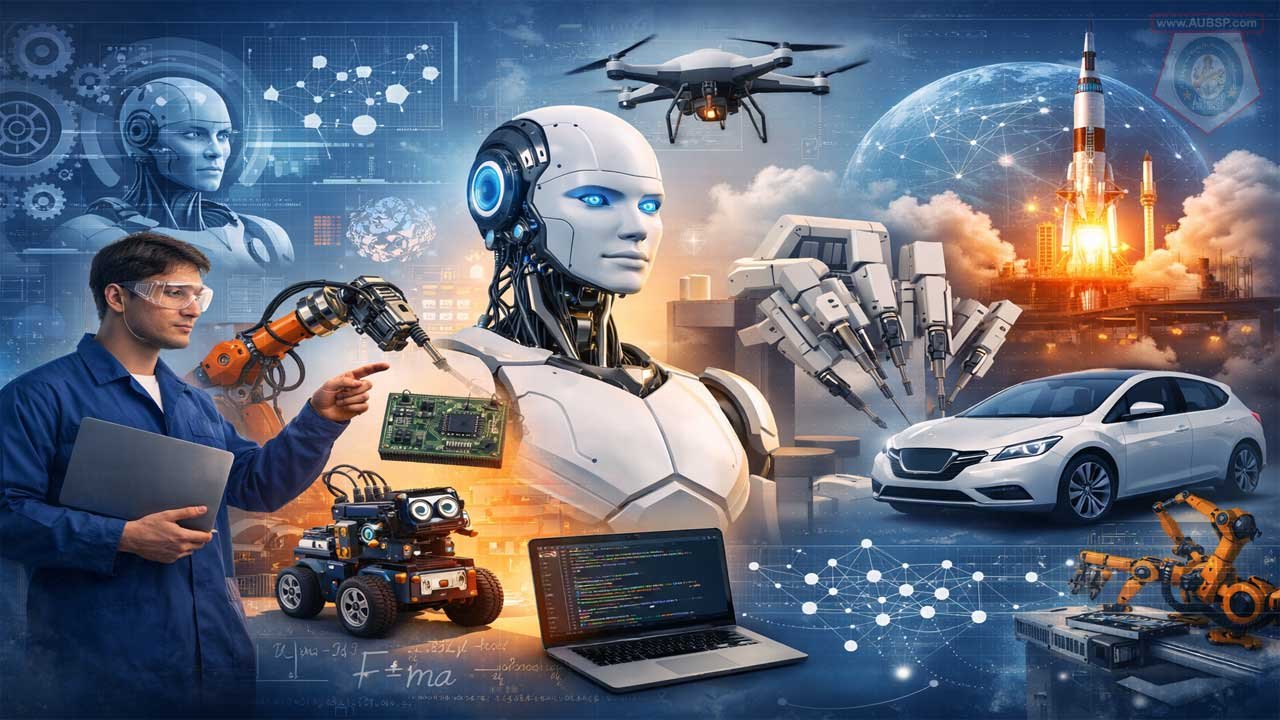
A Bachelor of Robotics Engineering (BRE) is an interdisciplinary undergraduate degree that combines mechanical engineering, electrical engineering, computer science, and artificial intelligence to train students to design, build, program, and maintain intelligent robotic systems.
Typically completed in 3–4 years, the program progresses from foundational math, physics, and programming to advanced topics like machine learning, computer vision, control systems, embedded systems, and autonomous robotics, with strong emphasis on hands-on labs, internships, and capstone projects. Graduates gain versatile technical and soft skills, proficiency in languages such as C++, Python, and ROS, and can pursue careers in manufacturing, healthcare, logistics, aerospace, agriculture, and AI-driven industries.
With the global robotics market rapidly expanding and salaries reaching over $140,000 annually in the U.S., a BRE offers a future-proof, high-growth, and lucrative career path supported by top universities worldwide and increasing global demand for automation and intelligent systems.
| Category | Information |
|---|---|
| Degree Name | Bachelor of Robotics Engineering (BRE) |
| Duration | 3–4 years |
| Core Fields | Mechanical Engineering, Electrical Engineering, Computer Science, AI |
| Key Subjects | Robotics, Control Systems, Machine Learning, Computer Vision, Embedded Systems, ROS |
| Programming Languages | C/C++, Python, Java, MATLAB, ROS, C# |
| Practical Components | Labs, Internships, Workshops, Capstone Project |
| Top Recruiters | Amazon Robotics, Tesla, Boston Dynamics, SpaceX, Nvidia, ABB |
| Entry Salary (USA) | ~$85,000+ per year |
| Median Salary (USA) | ~$140,000 per year |
| Entry Salary (India) | ₹4–7 LPA |
| Career Roles | Robotics Engineer, AI/ML Engineer, Automation Specialist, CV Engineer |
| Major Industries | Manufacturing, Healthcare, Logistics, Aerospace, Agriculture |
| Market Outlook | Rapid global growth; robotics market projected to more than double by 2032 |
What Is a Bachelor of Robotics Engineering?
A Bachelor of Robotics Engineering (BRE) is an interdisciplinary undergraduate degree that prepares students to design, build, program, and maintain robotic systems and autonomous machines. Typically spanning 3 to 4 years depending on the country, this program sits at the intersection of electrical engineering, mechanical engineering, computer science, and artificial intelligence. Graduates emerge with the ability to create intelligent machines capable of sensing their environment, processing information, and executing complex tasks autonomously.
Robotics engineering is not a niche specialization anymore — it is a core discipline powering the Fourth Industrial Revolution. The global robotics market, valued at approximately $63.88 billion in 2026, is projected to reach $174.41 billion by 2032, growing at a CAGR of 15.42%. This explosive growth translates directly into surging demand for qualified robotics engineers across manufacturing, healthcare, logistics, agriculture, defense, and consumer technology.
Why Choose a Bachelor of Robotics Engineering?
A Future-Proof Career Path
The robotics industry is one of the fastest-growing sectors in the global economy. The robotics technology market alone is expected to grow from $108.43 billion in 2026 to $416.26 billion by 2035, at a CAGR of 14.40%. This means graduates entering the workforce today will ride a multi-decade wave of industry expansion. Robotics engineers are needed to develop autonomous vehicles, surgical robots, warehouse automation systems, agricultural drones, and humanoid companions — among countless other applications.
Lucrative Salaries Worldwide
Robotics engineering is among the highest-paying engineering disciplines globally. In the United States, robotics engineers earn a median total salary of $140,000 per year, with entry-level professionals starting around $85,774 in total compensation. According to Glassdoor, the average base salary is approximately $114,052, with an additional $39,682 in bonuses and profit sharing. In India, entry-level robotics engineers earn ₹4–7 LPA, while mid-level professionals command ₹8–15 LPA, and senior specialists with expertise in computer vision or AI can earn ₹35–60 LPA or more.
| Experience Level | USA Salary (Annual) | India Salary (Annual) |
|---|---|---|
| Entry-Level (0–1 years) | ~$85,774 | ₹4–7 LPA |
| Mid-Level (1–4 years) | ~$97,094 | ₹8–15 LPA |
| Senior-Level (5+ years) | $117,000–$140,000+ | ₹18–45 LPA+ |
| AI/CV Specialist | $149,000+ | ₹35–60 LPA+ |
Interdisciplinary Skill Set
Unlike traditional single-discipline engineering degrees, a BRE equips students with knowledge spanning mechanical design, electronics, embedded systems, control theory, artificial intelligence, and software development. This breadth of skills makes robotics engineering graduates highly versatile and employable across diverse industries.
Core Curriculum and Subjects
A Bachelor of Robotics Engineering program is structured to build expertise progressively — from foundational mathematics and physics to advanced robotics systems integration. Below is a representative semester-wise breakdown of the curriculum:
Foundation Phase (Year 1)
- Semester 1: Introduction to Robotics, Engineering Mathematics, Physics for Engineers, Introduction to Programming (Python/C++), Basic Electrical Engineering
- Semester 2: Mechanics of Materials, Digital Logic Design, Object-Oriented Programming (Java), Linear Algebra, Electronics I
Core Engineering Phase (Year 2)
- Semester 3: Kinematics and Dynamics of Robots, Control Systems, Data Structures and Algorithms, Signals and Systems, Microprocessors and Microcontrollers
- Semester 4: Robotics and Automation Engineering, Embedded Systems, Artificial Intelligence, Electromagnetic Theory, Mechanical Design
Advanced Robotics Phase (Year 3)
- Semester 5: Machine Learning, Robot Operating Systems (ROS), Advanced Control Systems, Computer Vision, Robotics Project I
- Semester 6: Mobile Robotics, Autonomous Systems, Advanced Robotics, Sensors and Actuators, Robotics Project II
Specialization and Capstone Phase (Year 4)
- Semester 7: Human-Robot Interaction, Robotics Simulation, Industrial Robotics, Ethics in Robotics, Internship/Co-op Program
- Semester 8: Capstone Project, Robotics Systems Integration, Emerging Technologies in Robotics, Technical Electives
Additional important subjects include Robot Simulation and Programming, Microcontrollers for Robotics, Design Automation with IoT, and Manufacturing Methods for Robotics Components. The curriculum integrates hands-on laboratory sessions, internships, workshops, and a final-year research project to ensure practical competence alongside theoretical knowledge.
Essential Skills and Programming Languages
Success in robotics engineering requires a blend of technical and soft skills. The field demands proficiency in multiple programming languages, each serving different aspects of robotic systems development.
Programming Languages for Robotics
| Language | Primary Use in Robotics | Why It Matters |
|---|---|---|
| C/C++ | Real-time control, embedded systems, hardware interaction | Superior performance, memory control, and low-level hardware access |
| Python | AI/ML development, prototyping, high-level logic | Beginner-friendly, extensive libraries (PyTorch, TensorFlow, OpenCV) |
| Java | Industrial automation, cross-platform systems | Cross-platform compatibility, robust for large-scale systems |
| MATLAB | Research, simulation, control system modeling | Powerful modeling and simulation for academics and R&D |
| ROS (Robot Operating System) | System coordination, sensor integration, testing | Industry-standard middleware for robotics development |
| C#/.NET | Real-time robot control, simulation | Libraries like Machina.NET and ROS.NET for robot developers |
Robotics projects are inherently complex, often requiring multiple languages within a single system. For example, C++ may handle real-time motor control, Python manages high-level decision-making, and ROS coordinates the entire system.
Technical and Soft Skills
Beyond programming, robotics engineers need expertise in:
- Mechanical design and CAD — designing physical robot structures
- Electronics and circuit design — integrating sensors, motors, and power systems
- Control systems theory — ensuring precise and stable robot movement
- Computer vision — enabling robots to interpret visual data using OpenCV and similar tools
- Machine learning and AI — training robots to learn and adapt
- Sensor integration — combining cameras, LiDAR, IMUs, and other sensors into perception systems
- Teamwork and communication — collaborating across engineering, design, and business teams
- Ethical reasoning — understanding the societal implications of robotic technologies
Top Universities Offering Robotics Engineering Degrees
Choosing the right university is critical to building a strong foundation in robotics. Below are some of the world’s leading institutions offering dedicated or closely related robotics engineering programs.
Top Global Universities
| University | Location | Program Highlights |
|---|---|---|
| Carnegie Mellon University | Pittsburgh, USA | Only school with dedicated B.S., M.S., and Ph.D. in Robotics through its Robotics Institute |
| MIT | Cambridge, USA | CSAIL and Biomimetic Robotics Lab; partnerships with Boston Dynamics and Tesla |
| Stanford University | Stanford, USA | Stanford AI Lab (SAIL); interdisciplinary focus blending engineering, CS, and psychology |
| WPI (Worcester Polytechnic Institute) | Worcester, USA | Nation’s first undergraduate robotics engineering degree; average starting salary of $84,571 |
| ETH Zurich | Zurich, Switzerland | World-leading STEM university; multidisciplinary robotics combining mechanical engineering and CS |
| University of Michigan | Ann Arbor, USA | 125-credit-hour B.S.E. in Robotics Engineering covering electrical, mechanical, and systems engineering |
| Imperial College London | London, UK | Strong focus on robot perception, control systems, and human-robot interaction |
| University of Tokyo | Tokyo, Japan | Cutting-edge research in humanoid robots, autonomous systems, and AI-driven robotics |
| KAIST | Daejeon, South Korea | Renowned for humanoid robot development and industrial autonomous systems |
| Technical University of Munich (TUM) | Munich, Germany | Top European program with strong industry partnerships |
Notable Mentions
Other top-ranked institutions include Georgia Institute of Technology, University of Pennsylvania, UC Berkeley, Harvard University, Caltech, and the National University of Singapore (NUS). In India, institutions such as Plaksha University offer BTech programs in Robotics and Autonomous Systems with curriculum covering autonomous vehicles, digital agriculture, smart cities, and medical robotics.
Carnegie Mellon: The Gold Standard
Carnegie Mellon University’s Bachelor of Science in Robotics (BSR) deserves special attention. Housed within the School of Computer Science, the program emphasizes “systems thinking” across disciplines. Students build on a foundation called “RoboMath” — covering linear algebra, calculus, probability, and statistics — before advancing to courses in robotic building, planning and control, cognition systems, manipulation and mechanisms, and computer vision. The curriculum produces graduates who can design, prototype, fabricate, and test complete robotic systems while understanding the ethical and societal implications of their work.
WPI: Pioneer in Undergraduate Robotics
Worcester Polytechnic Institute (WPI) operates one of the nation’s first and most established undergraduate robotics engineering programs. The program features immersive seven-week terms, hands-on project-based learning, and global project centers across 50+ locations. Students gain skills in sensor integration, computer vision (OpenCV), mechatronics design, and control systems using MATLAB and Simulink. Notable employers of WPI robotics graduates include Amazon Robotics, SpaceX, Nvidia, Meta, and Boeing.
Admission Requirements and Eligibility
Admission criteria for a Bachelor of Robotics Engineering vary by country and institution, but there are common requirements across most programs.
Undergraduate (B.Tech / B.E. / B.S.) Admission
- Academic Qualifications: Completion of 10+2 (or equivalent high school diploma) with Physics, Chemistry, and Mathematics as core subjects
- Entrance Exams: Many programs require standardized test scores such as JEE Main/Advanced (India), SAT/ACT (USA), or university-specific entrance examinations
- Minimum GPA: Typically 3.0/4.0 or equivalent; competitive programs expect higher
- Language Proficiency: International students must demonstrate English proficiency via IELTS (minimum 6.5) or TOEFL
- Selection Criteria: Merit-based selection, entrance exam scores, and/or holistic review including personal statements, recommendation letters, and extracurricular involvement
Required Documents
Applications generally require academic transcripts/mark sheets, standardized test scores, identification documents, passport-size photographs, a statement of purpose or personal essay, and letters of recommendation. Application fees vary by institution, typically ranging from $50–$100 in the USA or ₹500–₹2,000 in India.
Career Opportunities and Job Roles
A Bachelor of Robotics Engineering opens doors to a wide array of career paths across multiple industries. The versatility of the degree means graduates are not limited to a single sector.
Key Career Roles
| Career Role | Description | Key Industries |
|---|---|---|
| Robotics Engineer | Design, build, and maintain robots for industrial and service applications | Manufacturing, logistics, consumer tech |
| Automation Specialist | Develop automated systems to streamline processes | Automotive, pharmaceuticals, food processing |
| AI/ML Engineer | Create intelligent algorithms for robot learning and decision-making | Tech, healthcare, finance |
| Computer Vision Engineer | Develop systems that enable robots to interpret visual data | Autonomous vehicles, surveillance, medical imaging |
| Robotics Software Engineer | Design software for robot control, sensor processing, and autonomous navigation | Aerospace, defense, logistics |
| Autonomous Systems Developer | Build self-driving vehicles, drones, and delivery robots | Transportation, e-commerce, agriculture |
| Healthcare Robotics Engineer | Work on surgical robots, prosthetics, and rehabilitation systems | Hospitals, biomedical companies |
| R&D Specialist | Conduct research on advanced robotics, new prototypes, and emerging technologies | Universities, corporate labs |
| Control Systems Engineer | Design control algorithms for precise robot movement and stability | Industrial automation, aerospace |
Top Hiring Companies
Leading employers of robotics engineering graduates include Amazon Robotics, Boston Dynamics, Tesla, SpaceX, Nvidia, Meta, Boeing, ABB, NVIDIA, and Mercedes-Benz. The United States alone is expected to add approximately 9,000 new robotics engineering positions by 2032.
Industry Applications and Sectors
Robotics engineering graduates find opportunities across virtually every sector of the modern economy.
Manufacturing and Industry 4.0
The manufacturing sector remains the largest employer of robotics technology, accounting for approximately 68% of the robotics application market in 2026. Collaborative robots (cobots) now work alongside humans on factory floors, and the industrial robotics market alone is expected to reach $93.31 billion by 2035. Automotive, electronics, and metal fabrication are the primary adopters.
Healthcare and Medical Robotics
Surgical robots and rehabilitation systems are transforming patient outcomes. Robots perform complex orthopedic and neurological procedures with improved accuracy and faster recovery times. The COVID-19 pandemic further accelerated adoption of cleaning, disinfection, and assistive care robots in hospitals and long-term care facilities.
Logistics and Warehousing
Autonomous mobile robots (AMRs) are being deployed at scale for sorting, picking, packaging, and last-mile delivery in e-commerce warehouses. Companies like Amazon have invested heavily in warehouse automation, making robotics skills essential in this sector.
Agriculture
Automated harvesters, crop-monitoring drones, and precision irrigation systems are addressing global labor shortages while increasing crop yields. Agricultural robotics is one of the fastest-growing sub-segments of the industry.
Defense and Aerospace
Military applications include unmanned aerial vehicles (UAVs), bomb disposal robots, surveillance drones, and autonomous logistics vehicles. Aerospace companies employ robotics engineers for satellite servicing, space exploration vehicles, and manufacturing automation.
Other Emerging Sectors
- Construction: 3D printing robots and automated machinery for infrastructure projects
- Education and Entertainment: Interactive teaching robots, theme park animatronics
- Domestic/Consumer: Home cleaning robots, personal assistants, companion robots
- Smart Cities: Autonomous public transport, intelligent traffic management, infrastructure monitoring
Specializations Within Robotics Engineering
As the field matures, several high-demand specializations have emerged within robotics engineering:
- Artificial Intelligence and Machine Learning — Developing algorithms that enable robots to learn, adapt, and make autonomous decisions
- Computer Vision and Perception — Building systems that let robots “see” and interpret their environment using cameras, LiDAR, and sensor fusion
- Autonomous Vehicles and Navigation — Designing self-driving cars, drones, and delivery robots with path planning and obstacle avoidance capabilities
- Medical and Surgical Robotics — Creating robotic systems for minimally invasive surgery, prosthetics, and patient rehabilitation
- Human-Robot Interaction (HRI) — Studying how humans and robots communicate, collaborate, and coexist safely
- Swarm Robotics — Coordinating large groups of robots to perform tasks collectively
- Soft Robotics — Designing robots with flexible, compliant materials for delicate tasks
- Industrial Automation and Control — Implementing PLCs, SCADA systems, and robotic arms for manufacturing environments
Robotics Engineering vs. Related Degrees
Prospective students often compare a Bachelor of Robotics Engineering with related programs. Here is how the key disciplines differ:
| Feature | Robotics Engineering | Mechatronics Engineering | Artificial Intelligence | Mechanical Engineering |
|---|---|---|---|---|
| Primary Focus | Complete robotic systems — design, control, sensing, AI | Integration of mechanical, electronic, and software systems | Algorithms for learning, reasoning, and perception | Physical systems, machines, and structures |
| Key Subjects | Control systems, AI/ML, kinematics, sensors, computer vision | Machine design, circuits, microcontrollers, automation | NLP, deep learning, computer vision, neural networks | Thermodynamics, fluid mechanics, materials science |
| Career Direction | Robotics engineer, autonomous systems developer | Automation engineer, embedded systems designer | AI researcher, ML engineer, data scientist | Design engineer, manufacturing engineer |
| Robot-Specific Depth | Very High | High | Moderate (software-focused) | Low (hardware-focused) |
How to Get Started: A Roadmap for Aspiring Students
Before University
- Build a strong foundation in mathematics (calculus, linear algebra, statistics), physics, and computer science
- Learn Python and C++ through online platforms and personal projects
- Experiment with Arduino, Raspberry Pi, or LEGO Mindstorms to gain hands-on robotics experience
- Participate in robotics competitions such as FIRST Robotics, RoboCup, or VEX Robotics
During University
- Engage with research labs and faculty-led projects from early semesters
- Seek internships at robotics companies like Boston Dynamics, Amazon Robotics, or local startups
- Master ROS (Robot Operating System), MATLAB/Simulink, and CAD tools
- Build a portfolio of projects showcasing autonomous systems, computer vision applications, or mechatronics design
- Develop soft skills — communication, teamwork, and ethical reasoning are critical in multidisciplinary robotics teams
After Graduation
- Entry-level roles typically require a bachelor’s degree in robotics, mechanical, electrical, or computer science engineering
- Pursuing a master’s degree (M.S. or M.Tech) can open doors to advanced R&D positions and significantly increase earning potential
- Professional certifications in ROS, machine learning, or specific automation platforms further boost employability
- Approximately 65% of robotics engineers hold a bachelor’s degree, 13% hold a master’s degree, and 15% hold an associate degree
The Global Job Market Outlook
The outlook for robotics engineers is strongly positive. The United States currently employs an estimated 170,300 robotics engineers, with the market expected to grow by 3.3% between 2022 and 2032. Demand is expected to generate approximately 9,000 new positions during this period — driven by 5,700 new roles and the retirement of 3,300 existing professionals.
Globally, the picture is even more promising. Asia Pacific dominates the industrial robotics market, contributing over 65% of global revenue in 2026. Countries like China, Japan, South Korea, and India are rapidly expanding their robotics capabilities. India, in particular, is experiencing growth through initiatives like Make in India and the Production Linked Incentive (PLI) scheme, which are fueling investment in advanced manufacturing and robotics.
The top US states for robotics engineering employment include California (29,330 positions), Texas (9,630), Michigan (9,600), Georgia (8,200), and Florida (7,550). However, opportunities are global — from Germany’s manufacturing heartland to Japan’s humanoid robotics labs, South Korea’s KAIST, and Switzerland’s ETH Zurich ecosystem.
Conclusion
A Bachelor of Robotics Engineering is one of the most forward-looking and rewarding degree choices available to students today. The convergence of AI, machine learning, computer vision, and physical engineering into the discipline of robotics means graduates possess a uniquely versatile skill set applicable across nearly every industry sector.
With the global robotics market projected to more than double by 2032, median salaries exceeding $140,000 in the USA, and a growing network of world-class university programs, the time to pursue a career in robotics engineering has never been more opportune. Whether the goal is to build the next generation of surgical robots, autonomous vehicles, or intelligent industrial systems, the BRE provides the knowledge, skills, and professional foundation to make that ambition a reality.
FAQs about Bachelor of Robotics Engineering
What is a Bachelor of Robotics Engineering?
A Bachelor of Robotics Engineering (BRE) is an interdisciplinary undergraduate degree that trains students to design, build, program, and maintain robotic and autonomous systems by combining mechanical engineering, electronics, computer science, and artificial intelligence.
How long does it take to complete a Bachelor of Robotics Engineering?
The program typically takes 3 to 4 years to complete, depending on the country and university structure.
What subjects are taught in Robotics Engineering?
Core subjects include engineering mathematics, physics, programming, control systems, kinematics and dynamics, embedded systems, artificial intelligence, machine learning, computer vision, sensors and actuators, and robotics system integration.
Is Robotics Engineering a good career choice?
Yes, it is considered a future-proof and high-growth career due to rapid advancements in automation, AI, and autonomous systems across multiple industries.
What programming languages are required for Robotics Engineering?
Common languages include C/C++, Python, Java, MATLAB, ROS (Robot Operating System), and sometimes C# for simulation and industrial applications.
What skills are needed to succeed in Robotics Engineering?
Students need strong foundations in mathematics and physics, programming skills, knowledge of electronics and mechanical design, problem-solving ability, teamwork, and communication skills.
What is the average salary of a robotics engineer?
In the United States, median salaries can exceed $140,000 per year, while entry-level roles start around $85,000. In India, entry-level salaries range from ₹4–7 LPA and increase significantly with experience.
What industries hire robotics engineers?
Robotics engineers work in manufacturing, healthcare, logistics, aerospace, automotive, agriculture, defense, consumer electronics, and smart city development.
What are common job roles after completing this degree?
Graduates can work as robotics engineers, automation specialists, AI/ML engineers, computer vision engineers, robotics software engineers, control systems engineers, or autonomous systems developers.
Is Robotics Engineering better than Mechanical or Mechatronics Engineering?
Robotics Engineering focuses specifically on complete robotic systems and AI integration, while Mechanical and Mechatronics degrees are broader. The best choice depends on career goals.
Do I need strong math skills for Robotics Engineering?
Yes, proficiency in calculus, linear algebra, probability, and statistics is essential for understanding control systems, AI, and robotics algorithms.
Are internships important in Robotics Engineering?
Yes, internships provide practical industry exposure and significantly improve employability after graduation.
What is ROS in robotics?
ROS (Robot Operating System) is an industry-standard middleware framework used to develop, test, and integrate robotic systems.
Can I pursue higher studies after a Bachelor of Robotics Engineering?
Yes, graduates can pursue a Master’s or Ph.D. in robotics, artificial intelligence, mechatronics, or related fields to access advanced research and development roles.
Is Robotics Engineering in demand globally?
Yes, global demand is increasing due to rapid growth in automation, Industry 4.0, autonomous vehicles, and AI-driven systems.
What entrance exams are required for admission?
Requirements vary by country. Examples include JEE in India, SAT/ACT in the USA, or university-specific entrance exams.
Can I work in AI with a Robotics Engineering degree?
Yes, the curriculum includes machine learning and AI, allowing graduates to work in AI-focused roles.
What are the practical components of the program?
Programs typically include laboratory work, robotics projects, internships, workshops, and a final-year capstone project.
Is Robotics Engineering suitable for students interested in both hardware and software?
Yes, it is ideal for students who want to work at the intersection of mechanical systems, electronics, and intelligent software.
What are emerging specializations in Robotics Engineering?
Popular specializations include autonomous vehicles, computer vision, medical robotics, human-robot interaction, swarm robotics, and industrial automation.
Which countries are best for studying Robotics Engineering?
The USA, Germany, Japan, Switzerland, South Korea, and the UK are known for strong robotics programs and research facilities.
Can robotics engineers work in healthcare?
Yes, they develop surgical robots, rehabilitation systems, prosthetics, and assistive care technologies.
Is coding mandatory in Robotics Engineering?
Yes, coding is a fundamental requirement for controlling robots, processing sensor data, and implementing AI algorithms.
What is the future scope of Robotics Engineering?
The field is expected to expand significantly over the next decade as industries increasingly adopt automation and intelligent robotic systems.
Do robotics engineers only work with industrial robots?
No, they also work with drones, autonomous vehicles, humanoid robots, medical robots, agricultural robots, and consumer robotics products.
Can I start learning robotics before university?
Yes, students can begin by learning Python or C++, experimenting with Arduino or Raspberry Pi, and participating in robotics competitions.
Is Robotics Engineering stressful?
It can be challenging due to its multidisciplinary nature, but it is rewarding for students passionate about technology and innovation.
Does Robotics Engineering involve artificial intelligence?
Yes, AI and machine learning are central components that enable robots to learn, adapt, and make decisions autonomously.
What makes Robotics Engineering different from Artificial Intelligence degrees?
Robotics Engineering focuses on integrating AI with physical machines, while AI degrees mainly concentrate on software algorithms and data-driven systems.
Are robotics engineers needed in developing countries?
Yes, as automation and smart manufacturing expand globally, demand for robotics professionals is rising in emerging economies as well.


Leave a Reply
You must be logged in to post a comment.