
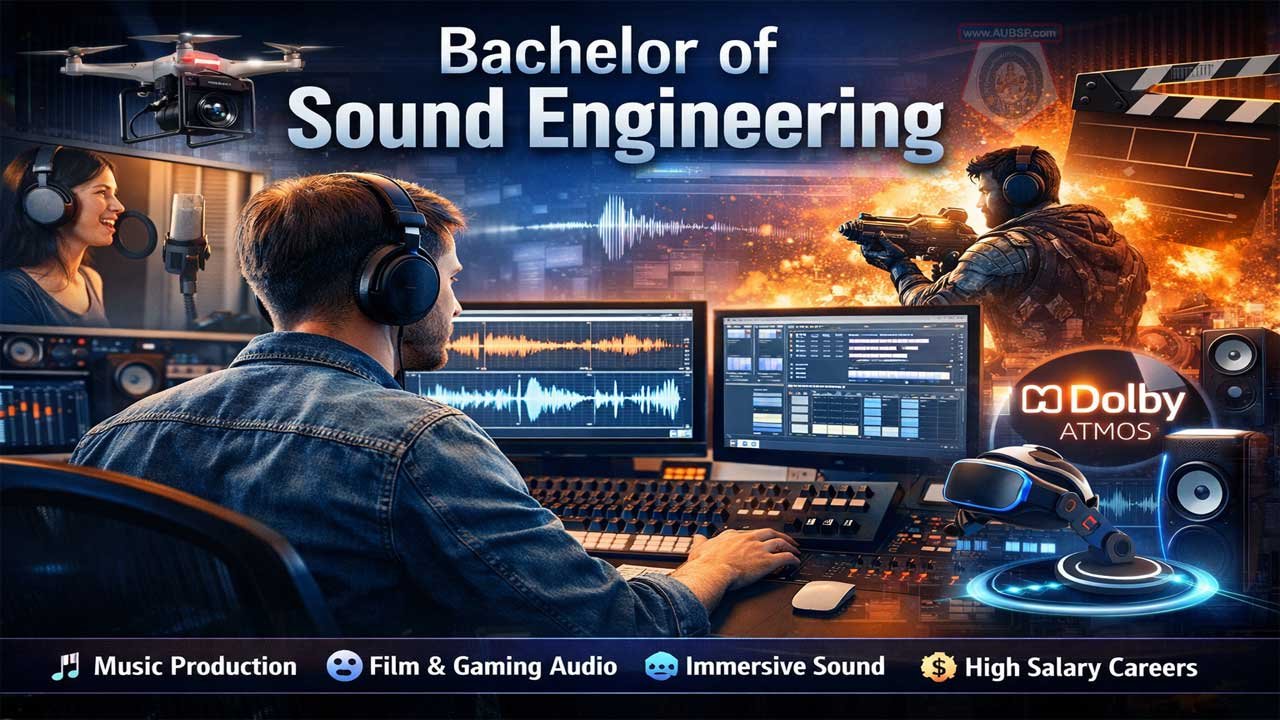
A Bachelor of Sound Engineering (BSE) is an interdisciplinary undergraduate degree that blends art, science, and technology to train students in the recording, mixing, mastering, and design of sound for music, film, gaming, live events, and emerging immersive audio platforms.
Typically spanning 3–4 years, it combines core subjects like acoustics, electronics, and digital signal processing with creative areas such as music theory, sound design, and studio production. Offered globally by top institutions such as the University of Michigan, Berklee College of Music, and SAE Institute, the program equips graduates with technical and creative skills for diverse careers in audio production, post-production, live sound, gaming, and acoustics.
With the global sound reinforcement market growing steadily and rising demand for immersive and AI-assisted audio, BSE graduates enjoy strong career prospects and competitive salaries in a rapidly evolving industry driven by innovation and digital transformation.
| Aspect | Details |
|---|---|
| Degree Name | Bachelor of Sound Engineering (BSE) |
| Duration | 3–4 years |
| Eligibility | 10+2 (with Physics, Mathematics, and Chemistry preferred) |
| Core Subjects | Acoustics, Electronics, Digital Signal Processing, Music Theory, Sound Design |
| Popular Software (DAWs) | Pro Tools, Ableton Live, Logic Pro |
| Key Skills | Recording, Mixing, Mastering, Audio Programming, Critical Listening |
| Top Universities | University of Michigan; Berklee College of Music; Carnegie Mellon University; SAE Institute; Vijaybhoomi University |
| Admission Requirements | Entrance exams (e.g., JEE Main, CUET), portfolio/audition, English proficiency |
| Average Starting Salary (India) | ₹4.5 LPA |
| Global Average Salary Range | $33,000 – $120,000+ per year |
| Career Options | Sound Engineer, Music Producer, Sound Designer, Game Audio Engineer, Acoustic Consultant |
| Emerging Fields | AI Audio, Immersive Sound (Dolby Atmos), VR/AR Audio, Cloud Production |
| Industry Growth | Sound reinforcement market projected to grow at 3.5%+ CAGR through 2032 |
Bachelor of Sound Engineering (BSE): The Complete Guide to Launching a Career in Audio Technology
Sound engineering sits at the powerful intersection of art, science, and technology. A Bachelor of Sound Engineering (BSE) is a specialized undergraduate degree that equips students with the technical knowledge, creative skills, and hands-on experience needed to record, mix, master, and design sound for music, film, gaming, live events, broadcasting, and emerging immersive audio platforms.
As the global audio and entertainment industries continue their rapid expansion — with the sound reinforcement market alone projected to grow at a CAGR of over 3.5% through 2032 — trained sound engineers have never been more in demand.
This AUBSP guide covers everything prospective students and professionals need to know about the Bachelor of Sound Engineering: what the degree entails, core curriculum details, admission requirements, top universities worldwide, career paths, salary expectations, industry trends, and the future outlook for audio professionals.
What Is a Bachelor of Sound Engineering?
A Bachelor of Sound Engineering (BSE) is a 3- to 4-year undergraduate program focused on the science and art of capturing, manipulating, and reproducing sound. The degree blends engineering fundamentals — physics, mathematics, electronics, digital signal processing — with creative disciplines such as music theory, studio production, sound design, and critical listening.
Depending on the institution, this degree may be offered under various titles:
| Degree Title | Duration | Focus |
|---|---|---|
| B.Sc. (Hons) Sound Engineering | 3–4 years | Combines science with studio practice |
| B.S. in Sound Engineering | 4 years | Heavy emphasis on math, physics, and electrical engineering |
| B.Tech in Sound Engineering | 4 years | Engineering-centric with hardware/software design |
| BA (Hons) in Sound Engineering | 3 years | Creative and production-focused approach |
| B.S. in Audio Production | 2–4 years | Production-oriented with business fundamentals |
Regardless of the title, all programs share common threads: developing proficiency with professional audio equipment, mastering Digital Audio Workstations (DAWs), understanding acoustics, and building a portfolio of real-world projects.
Core Curriculum and Subjects
A Bachelor of Sound Engineering curriculum is meticulously designed to produce well-rounded audio professionals. The University of Michigan’s B.S. in Sound Engineering, for instance, requires a minimum of 120 credits, including 12 in math, 10 in physics, and 20 in engineering, alongside music-specific coursework.
Foundation Courses
- Sound Physics and Acoustics — Fundamentals of sound waves, frequency, wavelength, psychoacoustics, and room acoustics
- Mathematics — Three semesters of calculus and differential equations, essential for signal processing
- Electronics and Circuits — Analog and digital circuits, amplifier design, and transducer systems
- Music Theory and Ear Training — Melody, harmony, rhythm, sight-reading, chords and extended chords, and counterpoint
Technical Core
- Digital Signal Processing (DSP) — Algorithms that power audio effects, equalization, and compression
- Digital Audio Workstation (DAW) Proficiency — Mastery of industry-standard software such as Pro Tools, Ableton Live, and Logic Pro. Pro Tools remains the DAW of choice in professional recording and post-production studios, including Abbey Road and Pinewood Studios
- Microphone Techniques and Recording — Types of microphones, polar patterns, miking techniques for vocals and acoustic instruments, and signal flow
- Mixing and Mastering — Stereo and multichannel mixing, EQ, dynamics processing, time-based effects, automation, and stem mixing
- Sound Design and Post-Production — SFX creation, dialogue editing, Foley recording, score mixing, and surround sound design for film and media
Advanced and Elective Modules
- Immersive Audio and Spatial Sound — Dolby Atmos, Ambisonics, binaural audio, and mixing for 3D environments
- Audio Programming — Developing custom audio plugins (VST, AU, AAX), real-time audio processing, and creative coding
- Studio Design and Construction — Sound isolation, control room design, acoustic treatment, HVAC design, and AV cabling
- Live Sound Reinforcement — System setup, monitor engineering, and managing audio for concerts, festivals, and theatres
- Game and Interactive Audio — Implementation using audio middleware like FMOD and Wwise, adaptive audio systems, and spatial audio for VR/AR
- Music Business and Entrepreneurship — Industry overview, copyright, project management, and freelancing fundamentals
Admission Requirements and Eligibility
Admission criteria vary by institution and country, but several common requirements apply globally:
Academic Prerequisites
- Minimum qualification: Completion of high school (10+2, A-levels, or equivalent)
- Preferred subjects: Physics is almost universally mandatory; Mathematics and Chemistry are strongly recommended. Many programs require a minimum aggregate of 50% in qualifying examinations
- For engineering-focused programs (B.Tech/B.S.): Strong achievement in mathematics, physics, and computer programming is expected
Additional Requirements
- Musical proficiency: Some top programs, like the University of Michigan, require a high level of proficiency on an acoustic instrument and experience with music recording and production technologies
- Entrance exams: In India, admissions may involve exams such as JEE Main, MHT CET, CUET UG, or university-specific entrance tests
- Portfolio or audition: Certain institutions request a portfolio of audio work or a practical audition
- English proficiency: International students may need to submit IELTS or TOEFL scores
Application Steps
- Research programs and verify specific eligibility criteria
- Complete the application form (online or offline) and pay the application fee
- Prepare for and appear in any required entrance exams
- Submit supporting documents: transcripts, recommendation letters, portfolio, and proof of English proficiency
- Await selection results and complete enrollment formalities
Top Universities for Sound Engineering Worldwide
Several prestigious institutions offer world-class sound engineering programs, each with unique strengths.
| University | Location | Program | Notable Features |
|---|---|---|---|
| University of Michigan (SMTD) | Ann Arbor, USA | B.S. in Sound Engineering | Minor in Electrical Engineering included; 120-credit program |
| Berklee College of Music | Boston, USA | B.M. in Music Production & Engineering | Industry-leading music school; immersive audio courses in Dolby Atmos |
| Carnegie Mellon University | Pittsburgh, USA | B.S. in Music and Technology | Interdisciplinary across Music, Computer Science, and ECE |
| Full Sail University | Winter Park, USA | B.S. in Audio Production / Recording Arts | Accelerated programs; state-of-the-art studio facilities |
| Nottingham Trent University | Nottingham, UK | BSc (Hons) Sound Engineering & Audio Production | Pro Tools-focused; strong industry connections |
| Queen’s University Belfast | Belfast, UK | BSc Audio Engineering | Engineering-focused program for audio and digital media industries |
| University of Hertfordshire | Hatfield, UK | BSc (Hons) Music and Sound Design Technology | Focus on immersive audio applications and sound design |
| SAE Institute | Worldwide (50+ campuses) | Various bachelor’s programs | Global presence; programs vary by country |
| 3iS International Institute | Paris/Bordeaux, France | BA in Sound Engineering | 100% English-taught; RNCP Level 6 certification |
| Catalyst Institute | Berlin, Germany | BA (Hons) Creative Audio Production & Sound Engineering | Creative arts focus in a vibrant European city |
| Vijaybhoomi University | India | B.Tech in Sound Engineering | India’s only B.Tech program in sound engineering |
| Seamedu School of Pro-Expressionism | Pune/Kolkata, India | B.Sc. in Sound Engineering | Ableton-certified; 3+1 year NEP 2020 structure |
Essential Skills Developed During the Degree
Graduates of a Bachelor of Sound Engineering emerge with a versatile skill set that spans both technical and creative domains:
Technical Skills
- DAW mastery: Proficiency in Pro Tools, Ableton Live, Logic Pro, and other platforms for recording, editing, mixing, and mastering
- Signal processing: Understanding of EQ, compression, reverb, delay, and advanced spectral processing
- Acoustic analysis: Ability to evaluate room acoustics, design studio spaces, and troubleshoot audio environments
- Electronics and hardware: Competency with analog and digital audio equipment, consoles, and networking
- Audio programming: Skills in creating custom plugins, real-time audio applications, and interactive sound systems
Creative and Soft Skills
- Critical listening and production analysis: The ability to deconstruct professional mixes and identify production techniques
- Problem-solving under pressure: Essential for live sound and broadcast environments where issues must be resolved in real time
- Collaboration: Working with musicians, directors, game developers, and other stakeholders
- Project management: Overseeing recording sessions, post-production workflows, and delivery timelines
- Portfolio development: Building a body of professional-quality work throughout the degree
Career Paths and Job Opportunities
A Bachelor of Sound Engineering opens doors to a remarkably diverse range of careers across multiple industries.
Music and Recording
- Recording Engineer — Capturing performances in studio environments
- Mixing Engineer — Blending multiple tracks into a cohesive final product
- Mastering Engineer — Preparing final mixes for distribution across platforms
- Music Producer — Overseeing the creative and technical aspects of music creation
Film, Television, and Post-Production
- Sound Designer — Creating and integrating sound effects for visual media
- Dialogue Editor — Cleaning up and refining spoken audio for film and TV
- Re-recording Mixer — Combining dialogue, music, and effects into a final mix
- Foley Artist/Engineer — Creating and recording custom sound effects synchronized to on-screen action
Live Events and Broadcast
- Live Sound Engineer — Managing audio for concerts, festivals, theatre, and corporate events
- Broadcast Sound Engineer — Operating audio for radio, television, and streaming platforms
- Monitor Engineer — Managing stage mixes for performers during live shows
- Location Sound Recordist — Capturing high-quality audio on film and TV sets
Gaming and Interactive Media
- Game Audio Designer — Creating and implementing sound for video games using middleware like FMOD and Wwise
- VR/AR Audio Engineer — Developing spatial and adaptive audio for virtual and augmented reality experiences
- Interactive Audio Programmer — Building real-time audio systems within game engines like Unity and Unreal Engine
Acoustics and Consultancy
- Acoustic Consultant — Advising on building design to optimize sound quality and control noise
- Environmental Noise Engineer — Monitoring and mitigating noise pollution in urban planning
- Product Acoustic Engineer — Shaping the sonic profile of consumer products, from headphones to automobiles
Emerging Roles
- AI Audio Engineer — Preparing and refining vocal data for AI model training, working on speech synthesis and recognition
- Immersive Audio Specialist — Mixing and mastering in Dolby Atmos and other spatial audio formats for streaming platforms
- Podcast Producer/Engineer — Managing audio production for the booming podcast industry
Salary Expectations
Compensation in sound engineering varies significantly based on experience level, specialization, geographic location, and industry sector.
Global Salary Overview (USD)
| Experience Level | Annual Salary Range (USD) |
|---|---|
| Entry-level | $33,980 – $55,000 |
| Mid-level (3–7 years) | $60,000 – $85,000 |
| Senior / Specialist | $90,000 – $120,000+ |
| Top 10% earners | $104,610+ |
The median annual salary for sound engineering technicians in the United States was approximately $66,430 in 2024, according to the U.S. Bureau of Labor Statistics.
Salary by Industry Sector
| Sector | Salary Range (USD) |
|---|---|
| Broadcasting | $50,000 – $95,000 |
| Video Games | $60,000 – $155,000 |
| Corporate and Event AV | $50,000 – $95,000 |
| Film Post-Production | $60,000 – $120,000+ |
India-Specific Salaries
In India, the average starting salary for a sound engineer is approximately INR 4.5 LPA (lakhs per annum). Freshers can expect INR 1.8–2 LPA, while professionals with 6–7 years of experience typically earn INR 6–8 LPA. Top professionals in the film and advertising sectors can earn significantly more.
Factors That Boost Earning Potential
- Certifications: Industry certifications from organizations like AVIXA (CTS), Avid (Pro Tools), Dante, Yamaha, and Dolby can increase earning potential substantially
- Location: Salaries are higher in major metropolitan areas where entertainment and broadcast industries are concentrated, such as Los Angeles, New York, London, and Mumbai
- Specialization: Niche expertise in immersive audio, game audio, or acoustic consultancy commands premium rates
- Freelancing: Independent contractors can earn higher per-project rates, though income may be variable
Industry Trends Shaping Sound Engineering
The sound engineering landscape is undergoing a significant transformation driven by technological innovation and changing consumer expectations.
Immersive and Spatial Audio
Spatial audio has moved from a niche technology to mainstream adoption. Formats like Dolby Atmos are now supported across major streaming platforms, podcasts, and even YouTube.
Sound engineers must now master mixing for 3D space — not just left and right, but a fully immersive sonic environment. Modern degree programs are actively incorporating immersive audio modules, including Berklee’s Introduction to Immersive Audio course and Full Sail’s Immersive Audio Engineering program.
AI-Assisted Production and Mixing
Artificial intelligence is rapidly becoming an everyday tool in audio engineering. From automated mastering services to AI-powered stem separation, these technologies accelerate technical tasks while freeing engineers to focus on creative decision-making. AI is being integrated directly into DAWs, offering real-time suggestions and adaptive processing. Engineers who can combine AI’s speed with human artistic judgment will be the most sought-after professionals.
Growth of Gaming and VR/AR Audio
The gaming industry represents one of the fastest-growing sectors for sound engineers, with game audio salaries ranging from $60,000 to $155,000. The demand for immersive, adaptive audio continues to surge, particularly in VR and AR applications. Game audio designers now use sophisticated middleware tools like FMOD and Wwise, alongside engines like Unity and Unreal, to create dynamically responsive soundscapes.
Cloud-Based Audio Production
Cloud-based audio production is emerging as a major trend, enabling engineers to collaborate on projects remotely and access powerful processing tools from anywhere. The growth of remote production and hybrid events has created new opportunities for engineers to work from virtually any location.
Personalized Sound and Smart Audio
Personalized sound experiences — driven by AI algorithms that adapt audio to individual listener preferences, hearing profiles, and devices — are becoming increasingly sophisticated. Smart hearables and active noise cancellation technologies continue to evolve, creating new roles for audio engineers in consumer electronics.
Market Growth
The global sound reinforcement market is projected to surpass USD 11.48 billion by 2032, growing at a CAGR of over 3.5%. The Asia-Pacific and Latin American regions are key growth drivers, aided by urbanization, infrastructure development, and a thriving live events sector.
Sound Engineering vs. Related Degrees
Prospective students often wonder how a BSE compares to related programs. Here is a breakdown of key distinctions:
| Aspect | Sound Engineering | Music Production | Electrical Engineering | Audio Technology |
|---|---|---|---|---|
| Core Focus | Recording, mixing, acoustics, live sound | Songwriting, arrangement, production techniques | Circuits, signals, systems design | Scientific analysis of audio systems |
| Math/Physics Load | Moderate to heavy | Light to moderate | Very heavy | Heavy |
| Creative Component | High (studio work, sound design) | Very high (music creation) | Low | Moderate |
| Career Emphasis | Audio engineering, live events, post-production | Music industry, artist development | Hardware design, telecommunications | R&D, acoustic consultancy |
| Typical Degree | B.Sc. / B.Tech / BA | B.M. / B.A. | B.S. / B.E. | B.S. / M.S. |
How to Choose the Right Program
Selecting the ideal Bachelor of Sound Engineering program depends on personal goals, budget, and career aspirations. Key factors to evaluate include:
- Curriculum balance: Determine whether the program leans more toward engineering fundamentals (math, physics, DSP) or creative production (studio work, mixing, sound design). Programs like Michigan’s B.S. emphasize engineering, while Berklee’s B.M. prioritizes music production.
- Facilities and equipment: Access to professional-grade studios, Dolby Atmos suites, live sound rigs, and post-production labs is critical for hands-on learning.
- Industry connections and internships: Programs with strong ties to recording studios, broadcast networks, gaming companies, and live event firms provide valuable networking and placement opportunities.
- Accreditation and certifications: Check whether the program offers or prepares students for industry certifications (Avid Pro Tools, Dante, AVIXA CTS).
- Location: Proximity to entertainment hubs (Los Angeles, Nashville, London, Mumbai, Berlin) can provide access to internships and job opportunities.
- Alumni network and placement record: A strong alumni community in the audio industry signals program quality and career support.
Frequently Asked Questions
Is a degree necessary to become a sound engineer?
While a formal degree is not a strict legal requirement, it provides structured education, access to professional equipment, networking opportunities, and a recognized credential that many employers value. The industry increasingly demands demonstrated expertise in advanced areas like immersive audio and audio programming, which are best learned through formal education.
Can I study sound engineering online?
Several institutions offer hybrid or online components, though the practical, hands-on nature of sound engineering means most reputable programs require significant in-person studio time. Online certificate courses from platforms and institutions can supplement formal education.
What software should I learn before starting the program?
Familiarizing oneself with DAWs like Pro Tools, Ableton Live, or Logic Pro is beneficial. Many programs begin with introductory DAW training, but prior exposure accelerates learning.
Is sound engineering a good career in 2026 and beyond?
The career outlook is strong. Growth in streaming, gaming, immersive audio, podcasting, live events, and AI-driven audio applications is creating sustained demand for skilled sound engineers across industries. Professionals who combine technical skills with creative expertise and stay current with evolving technologies will find abundant opportunities worldwide.
Conclusion
A Bachelor of Sound Engineering offers a powerful launchpad into one of the most dynamic and creatively fulfilling fields in modern technology. The degree bridges science and art, equipping graduates with the technical expertise to work with cutting-edge audio systems and the creative skills to shape how the world experiences sound.
From traditional roles in music recording and live events to emerging opportunities in gaming, VR/AR, AI audio, and immersive formats like Dolby Atmos, the scope of this degree continues to expand. With careful program selection, strong technical foundations, and a commitment to staying at the forefront of industry trends, graduates of sound engineering programs are well-positioned to build rewarding, future-proof careers in the global audio industry.


Leave a Reply
You must be logged in to post a comment.