
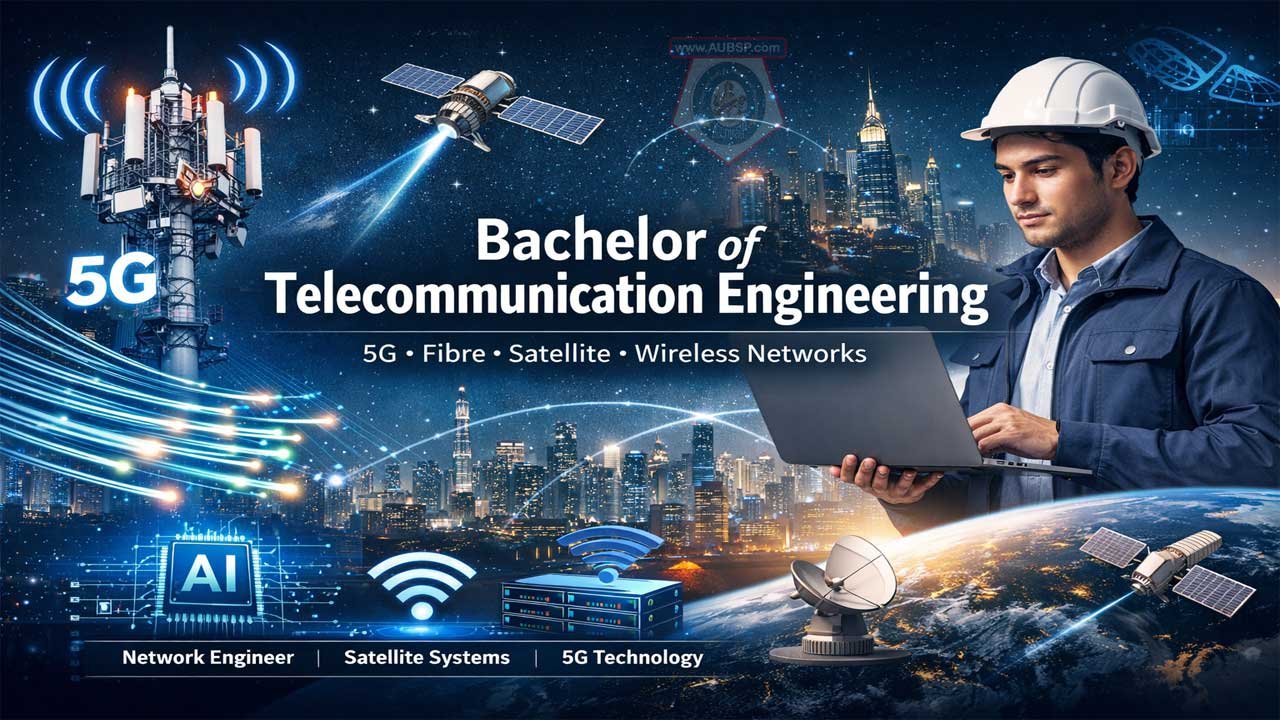
A Bachelor of Telecommunication Engineering (BTE) is a four-year undergraduate degree that prepares students to design, develop, and manage modern communication systems, including 5G networks, fibre-optic infrastructure, satellite systems, and wireless broadband.
Blending electrical engineering, computer science, and signal processing, the programme builds strong foundations in mathematics, electronics, networking, and communication theory before advancing into specialised areas such as digital signal processing, wireless and mobile communication, optical fibre systems, and IoT. With the global telecom market projected to grow significantly in the coming years, BTE graduates benefit from strong demand across roles like network engineer, RF engineer, satellite communication engineer, and telecom project manager, working with major operators and technology firms.
The degree combines extensive laboratory work, internships, and a final-year capstone project to ensure hands-on experience, while certifications and skills in 5G, AI-driven networks, and cybersecurity further enhance career prospects, making telecommunication engineering a future-focused and high-growth field.
| Category | Details |
|---|---|
| Degree Name | Bachelor of Telecommunication Engineering (BTE) |
| Duration | 4 Years (8 Semesters) |
| Study Level | Undergraduate |
| Core Focus | Communication systems, 5G/6G, fibre optics, satellite, networking |
| Entry Requirements | Strong background in Mathematics & Physics; entrance exams (varies by country) |
| Key Subjects | Signals & Systems, Digital Communication, DSP, Wireless Communication, Optical Fibre, Antennas |
| Practical Component | Labs every semester + Final Year Capstone Project |
| Top Career Roles | Network Engineer, RF Engineer, Satellite Engineer, Telecom Project Manager |
| Industries | Telecom Operators, Network Equipment Companies, ISPs, Tech Firms |
| Entry-Level Salary (US) | ~USD 67,000/year |
| Entry-Level Salary (India) | ~INR 2–5 Lakh/year |
| Growth Areas | 5G/6G, IoT, AI-driven Networks, Satellite Communication |
| Higher Study Options | Master’s in Telecommunications, Network Engineering, Data Science |
What Is a Bachelor of Telecommunication Engineering?
A Bachelor of Telecommunication Engineering (BTE) is a four-year undergraduate degree that trains students to design, develop, install, and maintain voice, data, and video communication systems. The programme integrates principles from electrical engineering, computer science, and systems engineering to create professionals who can build and manage the global communication infrastructure — from 5G networks and fibre-optic cables to satellite systems and wireless broadband.
With the global telecommunication market valued at approximately USD 2.29 trillion in 2026 and projected to reach USD 3.82 trillion by 2034 at a compound annual growth rate (CAGR) of 6.63%, the demand for skilled telecommunication engineers has never been higher. This degree positions graduates at the intersection of hardware and connectivity, making them essential to a world that runs on instant, reliable communication.
Why Choose Telecommunication Engineering?
A Booming Industry
The telecommunication sector is one of the largest and fastest-growing industries globally. Global telecom service revenue is set to rise from USD 1.15 trillion in 2024 to roughly USD 1.32 trillion in 2029. Mobile data services represent the most lucrative segment, accounting for over 37% of global telecom service revenue in 2025, with the Asia-Pacific region being the largest revenue generator.
The rollout of 5G technology is creating an unprecedented wave of demand. The 5G IoT market expanded from USD 8.39 billion in 2025 to USD 9.16 billion in 2026 and is projected to reach USD 15.93 billion by 2032. Healthcare and smart city services are expected to drive over 60% of 5G IoT device connections by 2026. India, in particular, is expected to register the highest CAGR in global telecom services from 2026 to 2030.
Future-Proof Career
Telecommunication engineering is not just about traditional phone networks anymore. The field now encompasses 5G-Advanced, early 6G research, software-defined networking (SDN), satellite communication, Internet of Things (IoT), and artificial intelligence (AI)-driven network management. These emerging technologies ensure that BTE graduates remain relevant in a rapidly evolving job market.
Core Curriculum and Subjects
The BTE programme is typically structured across eight semesters (four years) and balances foundational sciences with advanced telecommunication-specific coursework. The first year builds a strong base in mathematics, physics, and basic electronics, while subsequent years dive deep into specialised areas.
Semester-Wise Subject Overview
| Year | Key Subjects |
|---|---|
| Year 1 (Semesters 1–2) | Engineering Mathematics, Engineering Physics, Engineering Chemistry, Basic Electronics, Computer Programming, Introduction to Telecommunication Engineering |
| Year 2 (Semesters 3–4) | Electronic Devices and Circuits, Digital Electronics, Network Analysis, Signals and Systems, Microprocessors, Analog Communications, Control Systems |
| Year 3 (Semesters 5–6) | Digital Signal Processing, Digital Communication, Microwave Engineering, Electromagnetic Theory, Antenna and Wave Propagation, Computer Networking |
| Year 4 (Semesters 7–8) | Wireless and Mobile Communication, Optical Fibre Communication, Satellite Communication, VLSI Design, Embedded Systems, Final Year Project/Capstone |
Core Subjects in Detail
- Communication Systems: Covers both analog and digital communication principles, modulation techniques, signal encoding, and transmission protocols.
- Electromagnetic Theory and Antennas: Deals with electromagnetic wave propagation, antenna design, radiation patterns, and microwave engineering.
- Digital Signal Processing (DSP): Focuses on the mathematical manipulation of signals for applications in audio, video, radar, and telecommunications.
- Computer Networking and Data Communication: Explores LAN, WAN, TCP/IP protocols, network security, and modern data transmission systems.
- Wireless and Mobile Communication: Covers cellular network architecture, 4G/5G technologies, spectrum management, and wireless propagation models.
- Optical Fibre Communication: Teaches the fundamentals of light-based data transmission, fibre-optic cable design, and long-distance communication systems.
Elective Specialisations
Students can tailor their degree by choosing electives such as:
- Power Electronics
- VLSI Design and Nanoelectronics
- Satellite Communication Systems
- Software Defined Networking (SDN)
- IoT and Embedded Systems
- Radar and Navigation Systems
- 6G Prototyping
Practical and Lab Components
The BTE curriculum includes extensive laboratory work in every semester to ensure hands-on learning. Typical lab modules include:
- Electronics and Digital Electronics Labs
- Microprocessor and Microcontroller Labs
- Communication Systems Labs
- Signal Processing Labs
- Computer Networking Labs
- Telecommunications Software Labs
Additionally, final-year students complete a capstone project that involves designing, building, or optimising a real-world telecommunication system. Industrial visits and internships are typically mandatory in the final semesters.
Entry Requirements and Eligibility
Admission to a BTE programme generally requires:
- Completion of secondary education (high school or equivalent) with strong grades in Mathematics, Physics, and a Science subject.
- For many programmes, a minimum of two Advanced Level passes in Mathematics and Physics, or equivalent standardised test scores.
- Entrance exam scores — depending on the country, common exams include JEE Main/Advanced (India), SAT/ACT (USA), or university-specific aptitude tests.
Some universities also offer special entry pathways for students holding a diploma in a related engineering field, as well as mature entry routes for working professionals.
Top Universities Offering Telecommunication Engineering
Global Research Rankings
The following universities are ranked among the best globally for telecommunication research based on citation analysis of academic papers:
| Rank | University | Country |
|---|---|---|
| 1 | Massachusetts Institute of Technology (MIT) | USA |
| 2 | Stanford University | USA |
| 3 | University of California, Berkeley | USA |
| 4 | Georgia Institute of Technology | USA |
| 5 | Tsinghua University | China |
| 6 | University of California, Los Angeles (UCLA) | USA |
| 7 | University of Illinois at Urbana-Champaign | USA |
| 8 | University of Michigan, Ann Arbor | USA |
| 9 | Federal Institute of Technology Lausanne (EPFL) | Switzerland |
| 10 | University of Electronic Science and Technology of China | China |
Notable Programmes Worldwide
- Universitat Politècnica de Catalunya (UPC), Spain: Offers a 240-credit Bachelor’s degree in Telecommunications Technologies and Services Engineering with majors in Audiovisual Systems, Telecommunications Systems, and Network Systems.
- University of Wollongong, Australia: Offers a 4-year B.Eng in Telecommunications Engineering with tuition around A$40,272/year.
- New York City College of Technology, USA: Provides a B.Tech in Telecommunications Engineering Technology with tuition around USD 18,600/year.
- Midlands State University, Zimbabwe: Offers a BSc Honours in Telecommunications Engineering with focus on communication systems and satellite engineering.
Career Paths and Job Roles
BTE graduates are qualified for a wide range of technical and managerial roles in the telecommunications industry. Key job roles include:
- Network Engineer: Designs, implements, and manages computer and communication networks including LAN, WAN, and wireless infrastructure.
- Telecommunications Design Engineer: Creates detailed design specifications for telecom systems, performs system analysis, and ensures regulatory compliance.
- Signal Processing Engineer: Develops algorithms for processing audio, video, and data signals in real-time communication systems.
- Mobile Communication Systems Engineer: Specialises in cellular network planning, 4G/5G deployment, and spectrum management.
- Satellite Communication Engineer: Designs and manages satellite-based communication systems, satellite link analysis, and ground station operations.
- Network Security Engineer: Protects telecommunications networks from cybersecurity threats, implements security protocols, and monitors network traffic.
- Telecom Project Manager: Manages telecom projects from planning through execution, coordinating resources, budgets, and timelines.
- VoIP Engineer: Designs and maintains Voice over Internet Protocol systems for enterprise communication.
- RF (Radio Frequency) Engineer: Works on wireless system design, antenna placement, and radio frequency spectrum analysis.
Top Employers
Major employers of telecommunication engineers include global telecom operators such as AT&T, Verizon, Vodafone, Deutsche Telekom, China Mobile, Reliance Jio, Bharti Airtel, and Orange. Equipment manufacturers like Cisco, Nokia, Ericsson, Huawei, and Samsung also hire extensively, alongside technology giants such as Google, Amazon, Microsoft, and Apple.
Salary Expectations
Salaries for telecommunication engineers vary significantly based on geography, experience, and specialisation.
Salary Comparison by Region
| Region/Country | Entry-Level Salary | Mid-Career Salary | Senior-Level Salary |
|---|---|---|---|
| United States | ~USD 67,400/year | ~USD 86,000/year | Up to USD 122,000/year |
| India | ~INR 2,00,000/year | ~INR 5,12,000/year (average) | Up to INR 10,00,000/year |
| India (with 5-8 years) | INR 10–13 Lakh/year | INR 13–20 Lakh/year (senior) | INR 18 Lakh+ (with 5G/IoT expertise) |
The highest-paying specialisations in the United States include Analog Design Engineer (up to USD 202,000/year), Wireless Communications Engineer, and OSS Architect. In India, engineers with Cisco certifications can expect salaries in the range of INR 8–15 Lakh per year, while those with 5G expertise can earn INR 12–18 Lakh per year.
Essential Skills for Telecommunication Engineers
Technical (Hard) Skills
- Network design and configuration (LAN/WAN, VoIP, SIP, QoS)
- Familiarity with telecom equipment (PBX, switches, routers, multiplexers)
- Experience with fibre-optic technology and wireless communication
- Knowledge of protocols: TCP/IP, MPLS, BGP, OSPF
- Network analysis and monitoring tools (Wireshark, SolarWinds)
- Programming skills in Python, C/C++, MATLAB
- Understanding of 5G NR, network slicing, and edge computing
Soft Skills
- Strong analytical and problem-solving abilities
- Excellent written and verbal communication
- Project management and team leadership
- Vendor management and coordination
- Adaptability to rapidly changing technologies
Professional Certifications to Boost Your Career
Certifications significantly enhance employability and salary prospects. Key certifications for telecommunication engineers include:
| Certification | Issuing Organisation | Focus Area |
|---|---|---|
| CCNA (Cisco Certified Network Associate) | Cisco Systems | Networking fundamentals, routing, switching |
| CCNP (Cisco Certified Network Professional) | Cisco Systems | Advanced networking and enterprise infrastructure |
| CompTIA Network+ | CompTIA | General networking knowledge |
| Telecommunications (TCM) | iNARTE | Wired and wireless communication fundamentals |
| Telecommunications Master Engineer | iNARTE | Advanced scientific telecom principles |
| IEEE Wireless Communications Engineering Technologies | IEEE Communications Society | Wireless systems engineering |
| CISSP | (ISC)² | Information security and cybersecurity |
| Registered Communications Distribution Designer (RCDD) | BICSI | Communication infrastructure design |
| Certified Optical Network Engineer | FiberGuide | Optical fibre networking |
| Nokia Network Routing Specialist | Nokia | Network routing and management |
Telecommunication Engineering vs Related Degrees
Prospective students often confuse BTE with closely related programmes. Here is how it compares:
| Aspect | Telecommunication Engineering | Electrical Engineering | Electronics & Communication Engineering (ECE) |
|---|---|---|---|
| Primary Focus | Voice, data, and video communication systems; signal transmission and network design | Power systems, electrical equipment, energy generation and distribution | Electronic components, circuit design, and communication systems |
| Key Subjects | Wireless communication, fibre optics, satellite systems, network protocols | Power electronics, control systems, electrical machines | VLSI, signal processing, embedded systems |
| Career Focus | Telecom networks, 5G, satellite, ISPs | Power plants, utilities, manufacturing | Consumer electronics, semiconductor companies |
| Overlap with BTE | — | Broad foundation; BTE is a specialisation | ~90% curriculum overlap; ECE is broader in scope |
Telecommunication engineering is akin to being a specialist in the medical field — it offers depth within the communication domain, whereas electrical engineering offers a broad perspective across electrical systems.
Industry Trends Shaping the Future
5G and Beyond
The global 5G rollout continues to accelerate. China has over 4.2 million 5G sites, India has deployed nationwide 5G Standalone, and Germany is marketing “5G+” services commercially. Operators are already planning for 5G-Advanced and early 6G research, creating long-term career opportunities for BTE graduates.
AI-Native Telecom Operations
Artificial intelligence is becoming the operating fabric of modern telecom. Operators are adopting AI-driven “TelcOS” models to lower costs, reduce downtime, improve capital allocation, and raise productivity. BTE graduates who combine telecom knowledge with AI and machine learning skills will command premium positions.
Fibre-Optic Expansion
Fibre is now the global upgrade path of choice. Singapore is an all-fibre nation pushing towards 10 Gbps, China has over 206.8 million gigabit fibre users, and India’s fixed broadband subscriptions are projected to nearly double to 95.8 million by 2029. This expansion creates significant demand for engineers skilled in optical fibre systems.
Satellite and Non-Terrestrial Networks
The convergence of terrestrial and satellite communication is another frontier. Initiatives like Starlink, Saudi Arabia’s Neo Space Group, and the Airbus-Leonardo-Thales joint venture in Europe are driving investment into hybrid connectivity solutions. BTE graduates with satellite communication expertise are well-positioned for this emerging market.
IoT and Smart Cities
By 2026, over 60 million 5G smart city connections are projected globally, and the 5G IoT market is expected to reach USD 479.47 billion by 2034. Transportation monitoring, telemedicine, connected vehicles, and industrial automation are key use cases driving this growth.
How to Succeed in a BTE Programme
- Build a strong mathematical foundation — calculus, linear algebra, probability, and differential equations are the backbone of signal processing and communication theory.
- Gain hands-on experience early — participate in lab projects, join robotics or electronics clubs, and seek internships at telecom companies.
- Stay current with industry trends — follow developments in 5G, AI, edge computing, and network security.
- Pursue certifications alongside your degree — a CCNA or CompTIA Network+ certification while still in university can give an early career advantage.
- Develop programming skills — proficiency in Python, MATLAB, C/C++, and familiarity with network simulation tools is increasingly essential.
- Consider specialisation — identify areas like 5G, satellite communication, or IoT early and build expertise through electives and projects.
Frequently Asked Questions
How long does a BTE degree take?
A BTE degree typically takes 4 years (8 semesters) for full-time students. Some universities offer 3-year accelerated programmes or part-time options that extend the duration.
What is the difference between BTE and B.Tech in ECE?
BTE focuses specifically on communication systems, network design, and signal transmission, while B.Tech in ECE (Electronics and Communication Engineering) covers a broader range including electronic circuit design, VLSI, and semiconductor technology. The two degrees share approximately 90% of their curriculum.
Is telecommunication engineering still relevant in 2026?
Absolutely. With the global telecom market projected to exceed USD 3.82 trillion by 2034, the rollout of 5G/6G, massive IoT expansion, and AI-driven network operations, telecommunication engineering is more relevant than ever.
What is the average starting salary for a BTE graduate?
In the United States, entry-level telecom engineers earn approximately USD 67,400/year. In India, starting salaries average around INR 2,00,000–5,00,000/year depending on the employer and location.
Can I pursue higher education after BTE?
Yes. BTE graduates can pursue Master’s and Doctoral programmes in Telecommunications Engineering, Electronic Communications, Network Engineering, Data Science, and related fields at top universities worldwide. Average tuition for master’s programmes abroad ranges from USD 30,000 to USD 60,000 per year.


Leave a Reply
You must be logged in to post a comment.