
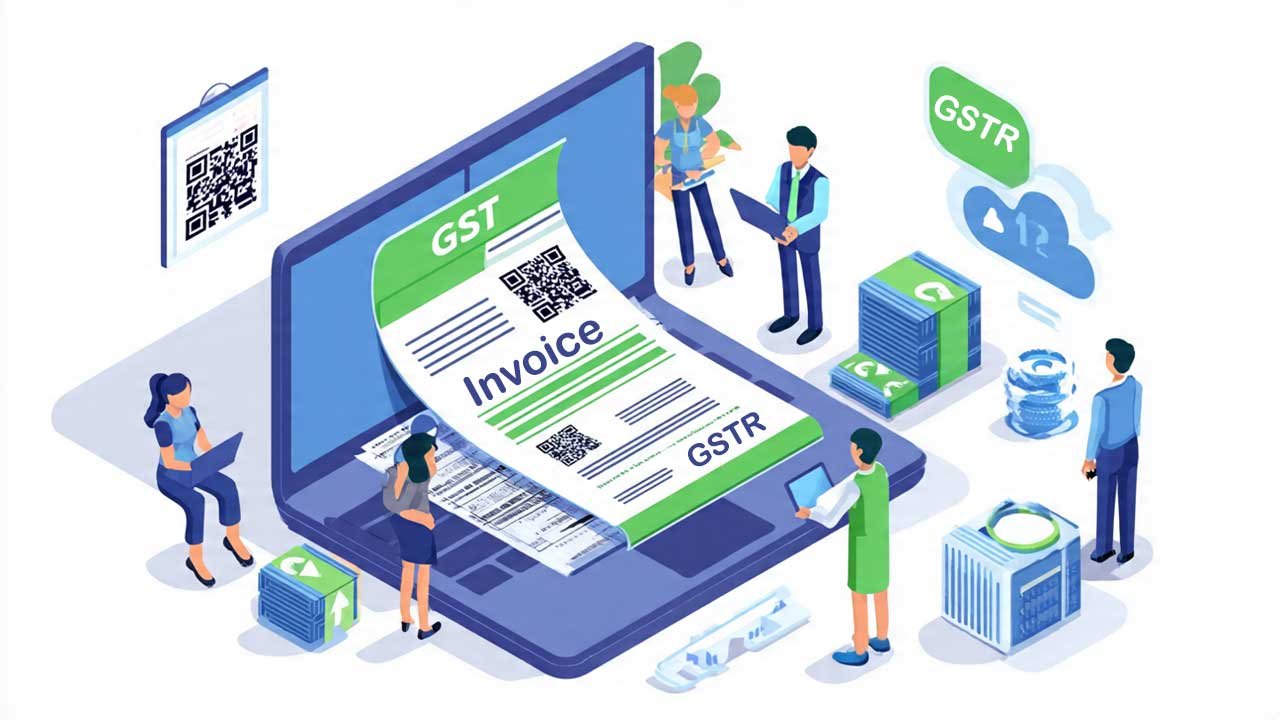
E-Invoicing under GST in India has become a cornerstone of digital tax compliance, mandating businesses with turnover above ₹5 crore to electronically validate B2B, export, and B2G invoices through the Invoice Registration Portal (IRP).
The financial year 2025–26 brings critical updates, including a 30-day reporting deadline for high-turnover taxpayers, mandatory ISD registration, restrictions on e-way bill generation, and new invoice series requirements. With JSON-based schemas, IRN generation, and QR code validations, e-invoicing ensures transparency, reduces fraud, and simplifies GST return filing.
For businesses, timely system upgrades, accurate data mapping, and workflow integration are vital to stay compliant and secure seamless Input Tax Credit (ITC).
E-Invoicing under GST in India: Compliance and Technical Framework (Latest Updates 2025)
The Indian taxation landscape is undergoing one of its biggest digital transformations with the implementation of e-invoicing under Goods and Services Tax (GST). Initially rolled out in 2020 for large enterprises, the system has now become mainstream and is set to touch almost every registered business in the country by 2025. But what exactly is e-invoicing, and why is it considered a landmark reform?
At its core, GST e-invoicing requires businesses to electronically authenticate every Business-to-Business (B2B), Business-to-Government (B2G), and export invoice through the Invoice Registration Portal (IRP), maintained by the GST Network (GSTN). Instead of merely issuing an invoice from accounting software, companies must now generate a structured JSON file of the invoice and submit it for validation. Upon approval, the system assigns a unique Invoice Reference Number (IRN) and a QR code, making the invoice legally valid under GST.
By 2025, the scope of e-invoicing has widened dramatically. The threshold turnover limit has been lowered to ₹5 crore, making compliance essential for thousands of mid-sized enterprises. The framework also introduces stricter deadlines, mandatory ISD registration, and technical upgrades. This evolution highlights India’s vision of moving towards a real-time tax compliance ecosystem where data transparency, fraud prevention, and ease of doing business go hand in hand.
Key Compliance Updates for Financial Year 2025–26 🚨
Every financial year brings significant updates in GST, but 2025–26 marks a turning point for e-invoicing. The government’s focus is on widening coverage, tightening loopholes, and encouraging automation. The changes are not just regulatory hurdles—they are measures designed to plug revenue leakages and ensure smooth credit flow for genuine taxpayers.
Businesses must particularly take note of the lower turnover threshold, which brings more companies under the net of e-invoicing. Similarly, the 30-day reporting window for high-turnover taxpayers reflects a global trend of real-time reporting. Another game-changing reform is the mandatory Input Service Distributor (ISD) registration, which replaces optional cross-charge mechanisms and brings uniformity to ITC distribution across entities.
To help you navigate, here’s a quick but detailed breakdown of the latest mandates:
| Compliance Area | New Requirement (Effective Date) | Impact on Taxpayers |
|---|---|---|
| Applicability Threshold | ₹5 Crore (since 2017–18) | Any business with AATO above ₹5 crore must issue e-invoices for B2B, exports, and B2G supplies. |
| Reporting Time Limit | 30-Day Rule (April 1, 2025) | For AATO > ₹10 crore, invoices must be reported within 30 days. Delayed invoices will be invalid, risking ITC denial for buyers. |
| ISD Registration | Mandatory (April 1, 2025) | PAN-based businesses with multiple GSTINs must use ISD for ITC distribution. |
| E-Way Bill Restriction | 180-Day Validity (Jan 1, 2025) | E-Way Bills can only be generated for invoices issued within the last 180 days, curbing misuse of old invoices. |
| Invoice Series | Fresh Series (April 1, 2025) | New sequential invoice numbering is mandatory from FY 2025–26 onwards. |
| Technical Update | Case-Insensitive IRN (June 1, 2025) | Invoice numbers will be auto-converted to uppercase to prevent duplicate IRN errors. |
👉 AUBSP Tip: Businesses should reconfigure their billing software before April 1, 2025, to avoid disruptions. Non-compliance can lead to penalties, blocked ITC, and audit risks.
The Technical Core: E-Invoice Schema and JSON Format
E-invoicing is not merely about digitizing invoices—it is about standardization. Every e-invoice in India follows a common e-invoice schema that ensures uniformity across industries, software, and taxpayers. This schema is designed in JSON format, which allows invoices to be machine-readable and easily validated by the IRP.
Why JSON? Because unlike PDFs or Excel files, JSON carries structured data that computers can process seamlessly. This ensures that invoice details can be validated, signed, and transmitted within seconds. Businesses must therefore ensure their ERP or accounting software can generate compliant JSON files in real time.
The schema is divided into sections:
- Basic Details: Document type, number, and date.
- Supplier & Recipient Info: GSTIN, name, address, state.
- Transaction Details: Supply type (B2B, exports, SEZ, etc.).
- Item Details: HSN code, description, quantity, unit price, taxable value, GST rate.
- Tax & Total: CGST, SGST, IGST, cess, total invoice value.
- IRP Response: IRN, QR code, timestamp.
👉 AUBSP Tip: Regularly update your ERP with the latest schema version released by GSTN. Outdated schema files can cause validation failures.
Role of the Invoice Registration Portal (IRP) 🏢
The Invoice Registration Portal (IRP) is the backbone of e-invoicing. It is responsible for authenticating invoices and issuing legal identifiers. Without IRP validation, invoices cannot be recognized under GST law.
Here’s how IRP ensures authenticity and compliance:
- De-Duplication Check: Prevents duplicate invoices by verifying GSTIN + Document Type + Invoice Number + Financial Year.
- IRN Generation: Creates a unique 64-character alphanumeric hash.
- Digital Signature: Signs validated invoices using IRP’s private key.
- QR Code Creation: Generates a QR code embedding invoice data for on-the-spot verification.
- Data Sharing: Transmits validated data to GSTN (for GSTR-1 auto-population) and to the E-Way Bill system.
👉 AUBSP Note: Tax officers and auditors can instantly scan QR codes to verify invoice authenticity. This reduces fraud and strengthens compliance checks.
Mandatory Fields in the E-Invoice Schema
The GST e-invoicing schema enforces strict compliance by requiring specific mandatory fields. Missing or incorrect details lead to IRN rejection, making the invoice invalid. This can directly affect ITC eligibility for buyers and create accounting discrepancies.
Examples of Mandatory Fields:
- Document Details: Invoice number, type (INV/CRN/DBN), and date.
- Supplier Details: GSTIN, legal name, address, and state code.
- Recipient Details: GSTIN, legal name, place of supply.
- Transaction Details: Supply type (B2B, EXP, SEZWP, etc.).
- Item Details: HSN code, quantity, taxable value, GST rate.
- Tax Details: Breakup of CGST, SGST, IGST, cess.
- IRP Response: IRN, QR code, validation timestamp.
👉 Pro Insight from AUBSP: Businesses should map all mandatory fields with ERP masters to avoid repetitive entry errors.
Optional Fields: Enhancing Business Flexibility
Optional fields in the schema are not legally binding, but they provide additional scope for businesses to document transactions effectively. These include:
- Payment Information: Bank details, IFSC, credit terms, payment due dates.
- References: Linking original invoices with amended ones.
- Supporting Docs: Contracts, POs, or delivery challans.
- Custom Fields: Business-specific identifiers or internal references.
While optional, these fields offer practical benefits—clearer documentation, faster reconciliations, and fewer disputes with clients and auditors.
Integration and Workflow ⚙️
The GST e-invoicing workflow involves multiple stages, but when streamlined, it ensures transparency and efficiency.
Step-by-Step Workflow:
- Invoice Creation: ERP generates an invoice in human-readable format.
- JSON Conversion: Data is converted into e-invoice schema (JSON).
- IRP Submission: JSON is uploaded via API or offline tools.
- Validation: IRP checks for duplicates and schema compliance.
- IRN & QR Code Issuance: IRP returns digitally signed JSON.
- Final Invoice: Business issues invoice with IRN & QR code to buyer.
👉 Key Advantage: Once validated, data auto-flows into GSTR-1 and e-way bill portals, reducing manual entry and reconciliation errors.
Common Mistakes to Avoid in GST E-Invoicing
Even seasoned businesses make errors in e-invoicing. Some frequent mistakes include:
- Using non-compliant invoice numbering.
- Failing to report invoices within the deadline.
- Incorrect HSN code classification.
- Missing or mismatched GSTIN details.
- Uploading duplicate invoices due to ERP sync issues.
👉 AUBSP Recommendation: Conduct periodic e-invoice audits within your company to identify errors before they affect compliance or ITC claims.
Benefits of E-Invoicing for Businesses 📊
While compliance-driven, e-invoicing also delivers tangible business advantages:
- Reduced Errors: Automation minimizes manual entry mistakes.
- Faster Reconciliation: Buyers and sellers see real-time data sync.
- Fraud Prevention: Duplicate or fake invoices are eliminated.
- ITC Assurance: Buyers gain confidence in claiming ITC from validated invoices.
- Operational Efficiency: Automatic integration with GSTN and e-way bill system.
👉 Long-Term Impact: E-invoicing will evolve into a real-time digital audit ecosystem, giving businesses competitive advantages in compliance and efficiency.
AUBSP Insights: Preparing Your Business for 2025 E-Invoicing
To stay future-ready, businesses should:
- Upgrade ERP systems to handle JSON schemas.
- Train staff on e-invoice workflows.
- Start fresh invoice series for FY 2025–26.
- Ensure ISD registration if operating across multiple GSTINs.
- Establish API integration for high-volume reporting.
At AUBSP, we recommend treating e-invoicing not as a compliance burden but as a strategic enabler. Businesses that adapt early will enjoy smoother audits, quicker ITC claims, and stronger credibility with stakeholders.
FAQs on GST E-Invoicing (2025 Updates) ❓
Q1. Is e-invoicing applicable for businesses below ₹5 crore turnover?
👉 No, but once turnover exceeds ₹5 crore in any financial year since 2017–18, e-invoicing becomes mandatory.
Q2. What happens if an invoice is not reported within 30 days (for AATO > ₹10 crore)?
👉 The invoice will be rejected by IRP, and the buyer cannot claim ITC on it.
Q3. Can e-invoices be modified once validated?
👉 No. Instead, a credit note or debit note must be issued for corrections.
Q4. Do e-invoices replace physical invoices?
👉 No, businesses must still issue invoices in physical or PDF format, but only after IRP validation.
Q5. How does e-invoicing impact exports?
👉 All export invoices must be validated via IRP before shipping, ensuring compliance and faster customs clearance.
Final Thoughts: Future of GST E-Invoicing in India 🌐
India is steadily moving toward a real-time digital tax ecosystem where compliance, reporting, and ITC validations happen simultaneously. With expanded coverage, stricter reporting timelines, and deeper integration, e-invoicing is no longer just for large corporations—it is the new standard for every growing business.
Over the next few years, we may see even real-time GST audits, AI-driven compliance checks, and blockchain-powered invoice validation. Businesses that embrace this transformation early will not only ensure compliance but also unlock efficiency, transparency, and trust in their operations.
👉 AUBSP Commitment: We will continue to empower professionals, accountants, and businesses with latest updates, practical guides, and trusted compliance resources on GST and e-invoicing.
✅ Stay updated with AUBSP – Your trusted partner for GST, e-invoicing, and tax compliance insights. Subscribe now for timely updates!


Leave a Reply
You must be logged in to post a comment.