
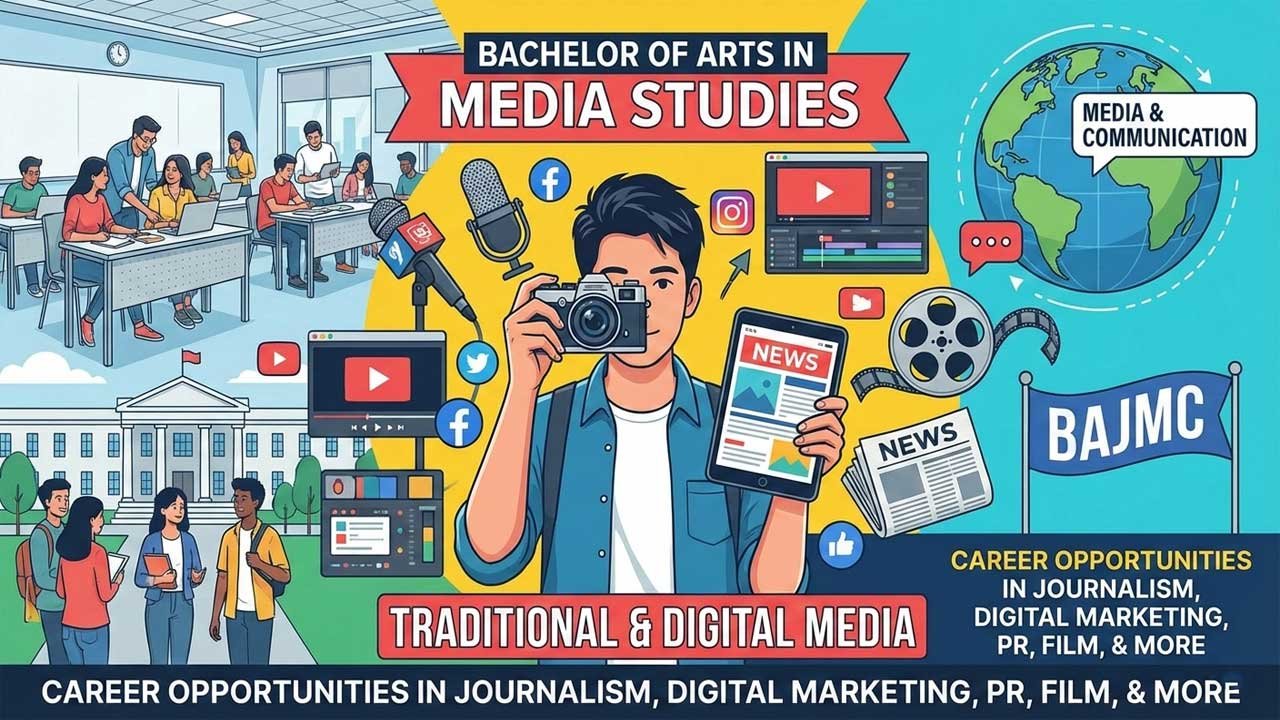
A Bachelor of Arts in Media Studies (also known as BAJMC or Mass Communication) is a three-year undergraduate program that provides comprehensive knowledge of traditional and digital media, combining theory with hands-on practical training.
It covers journalism, broadcasting, film and video production, digital content creation, advertising, public relations, social media, media research, ethics, law, and emerging areas like AI-powered media writing. Open to students from any academic background after 12th grade, the course develops strong writing, communication, technical, creative, and analytical skills while offering real-world exposure through projects, internships, and industry tools.
Graduates can pursue diverse careers in journalism, content creation, digital marketing, broadcasting, PR, corporate communications, entertainment, freelancing, and entrepreneurship, with growing job opportunities and competitive salaries driven by the rapid expansion of digital and media industries.
| Aspect | Information |
|---|---|
| Degree Name | Bachelor of Arts in Media Studies (BA Media Studies / BAJMC / Mass Communication) |
| Duration | 3 Years (Undergraduate) |
| Eligibility | 12th pass from any stream (Arts, Science, Commerce) |
| Admission Process | Merit-based or Entrance Exam (varies by college) |
| Course Focus | Journalism, Digital Media, Broadcasting, Film, Advertising, PR |
| Teaching Style | Theory + Practical training + Projects + Internships |
| Core Subjects | Journalism, Mass Communication, Media Theories, TV & Radio Journalism, New Media, Advertising & PR, Press Law & Ethics |
| Skills Developed | Writing, Editing, Video & Audio Production, Photography, Research, Social Media, Communication |
| Tools & Technology | Cameras, Editing Software, Audio Equipment, AI & Digital Media Tools |
| Career Options | Journalist, Content Creator, Social Media Manager, PR Officer, Video Producer, Copywriter, Digital Marketer |
| Employment Sectors | Media Houses, Digital Platforms, Advertising Agencies, Corporates, Government, Freelancing |
| Entry-Level Salary (India) | ₹20,000 – ₹50,000 per month |
| Mid–Senior Salary (India) | ₹6 – ₹20+ LPA (experience-based) |
| Global Opportunities | Yes (Digital Media, Content, Broadcasting, Marketing) |
| Future Scope | High growth due to digital media, social platforms, video, AI, and content demand |
What is a Bachelor of Arts in Media Studies?
A Bachelor of Arts in Media Studies is a three-year undergraduate degree program. This course is also known as BAJMC or Bachelor of Arts in Mass Communication. The degree teaches you all about modern media. It covers both traditional and digital media industries.
Students learn journalism, broadcasting, film production, and digital content creation. The program combines theory with practical skills. You get to work with real media equipment during your studies.
Who Can Take This Course?
You need to pass 12th grade to apply for this degree. Most universities accept students from any background. Some colleges conduct entrance examinations. You don’t need special marks in any particular subject. Your interest in media and communication is what matters most. Many students from commerce, science, and arts streams join this program. The admission process is straightforward and student-friendly.
What Will You Study in This Program?
The course covers many important subjects over three years. In the first year, you learn the basics of journalism and mass communication. The second year focuses on specialized areas like radio, television, and digital media. In the third year, you work on real projects and internships.
Main Subjects You’ll Study
Development of Journalism
Development of Journalism teaches you the history of news reporting. Understanding the evolution of news helps you become a better journalist. You learn how journalism changed over centuries. Modern journalism practices have roots in historical traditions.
Introduction to Mass Communication
Introduction to Mass Communication helps you understand media theory. This subject covers all types of media channels. You learn how different media platforms work. Understanding media basics is essential for all careers in this field.
Media Theories and Communication
Media Theories and Communication explore how media influences society. You study famous communication theories and models. These theories help you understand audience behavior. Media impact on culture and society becomes clear through these studies.
Visual and Audio Communication
Visual and Audio Communication focuses on video and podcast production. This subject teaches technical and creative skills. You learn camera operation and lighting techniques. Audio recording and editing become your practical skills.
Introduction to Journalism
Introduction to Journalism covers news writing and reporting. You learn to write news stories in proper format. Interview techniques and research methods are covered thoroughly. Ethical journalism practices are emphasized throughout.
Radio Journalism
Radio Journalism teaches you audio production and interviewing skills. Creating radio content requires different skills than writing. You learn to work with audio equipment professionally. Voice modulation and script writing for radio are important skills.
Photojournalism
Photojournalism trains you to tell stories through photography. Visual storytelling is more powerful than words alone. You learn photography techniques and equipment handling. Editing and processing photos for publication are covered.
New Media and Web Journalism
New Media and Web Journalism is about online news reporting. Digital platforms require different writing styles. SEO optimization for online articles is taught. Social media distribution of news content is covered.
Advertising and Public Relations
Advertising and Public Relations covers promotional campaigns. Creating compelling ads requires creative thinking. PR strategies help organizations communicate effectively. You learn to manage reputation and public image.
Television Journalism
Television Journalism teaches you broadcast news production. TV news requires visual storytelling skills. You learn about camera work and studio production. News anchoring and report delivery are practical components.
Creative Media Writing
Creative Media Writing helps you develop original content. Different writing styles are needed for different media. Screenwriting and script development are covered. Creative thinking combined with clear writing is emphasized.
Video Editing
Video Editing develops your technical production skills. Editing software becomes your primary tool. You learn color grading and visual effects. Professional video production workflows are taught.
Media Industry and Management
Media Industry and Management teaches business aspects of media. Understanding the business side helps career growth. Media economics and budget management are covered. Career advancement strategies are discussed.
Mass Media Research
Mass Media Research helps you analyze audience data. Statistical methods help understand viewer behavior. Survey and questionnaire design are covered. Data interpretation improves decision-making abilities.
Press Law and Ethics
Press Law and Ethics focuses on responsible journalism. Legal aspects of media are important to understand. Ethical guidelines protect both journalists and audiences. Professional standards maintain media credibility.
Understanding Cinema
Understanding Cinema teaches you film analysis. Film history and important films are studied. Technical filmmaking aspects are covered. Critical analysis of cinema improves your media literacy.
Social Media Management
Social Media Management covers platform-specific content strategies. Each platform requires different content approaches. Engagement strategies help build online communities. Analytics help measure social media success.
AI and ChatGPT Empowered Media Writing
AI and ChatGPT Empowered Media Writing is the newest addition. Artificial intelligence is transforming content creation. Learning AI tools makes you more competitive. You learn to use technology for better productivity.
What Skills Will You Develop?
This degree develops many valuable professional skills. You’ll learn to write clearly and concisely for different media. You’ll develop critical thinking abilities to analyze media messages. Technical skills like video editing and audio production become your strength. You learn how to use modern media equipment and software. Interview and research skills help you gather information effectively.
Technical Skills
Digital skills are very important in today’s media industry. You’ll understand social media platforms and content strategies. Data analysis helps you understand audience behavior. You’ll learn storytelling techniques for different formats. Project management skills help you complete assignments on time. Team collaboration becomes natural through group projects.
Professional Skills
Strong writing and grammar are fundamental competencies. Editing and proofreading skills ensure quality content. Research methodology helps verify information. Time management ensures deadline compliance. Organizational skills keep projects running smoothly. Communication abilities help work with teams effectively.
Creative Skills
Visual storytelling helps convey messages powerfully. Scriptwriting develops your narrative abilities. Design thinking improves your creative problem-solving. Innovative thinking helps generate fresh ideas. Artistic sensitivity enhances your creative output. Emotional intelligence helps connect with audiences.
Career Opportunities After Your Degree
The media industry is growing rapidly. Many exciting job options are available for graduates. The job market is expanding across print, digital, broadcast, and corporate sectors.
Journalism and News Careers
Digital Journalist
A Digital Journalist reports news online. They write, edit, and publish articles on websites. SEO optimization is part of their daily work. Breaking news requires fast reporting skills. Building online audiences is essential for success.
News Reporter
A News Reporter gathers and presents current events. They research stories thoroughly before writing. Interviewing sources is a core responsibility. Fact-checking ensures accuracy in reporting. Meeting tight deadlines is crucial in this role.
Broadcast Journalist
A Broadcast Journalist works for television and radio. They present news to live audiences. On-camera presence and speaking skills are important. Handling breaking news situations calmly is necessary. Live reporting requires quick thinking abilities.
News Anchor
A News Anchor presents news to audiences. They read news bulletins and anchor news shows. Professional appearance and communication skills are essential. Voice modulation and delivery matter greatly. Credibility is built through consistent quality performance.
Photojournalist
A Photojournalist tells stories through photographs. Visual journalism is powerful and impactful. Photography skills must be technically excellent. Editing and processing photos professionally is required. Safety awareness is important when covering dangerous situations.
Content Creation Careers
Content Creator
A Content Creator produces videos, articles, and graphics. They develop content for multiple platforms. Audience engagement is their main focus. Creative thinking and originality are essential. Consistency in posting maintains audience interest.
Content Writer
A Content Writer develops written material for websites and blogs. They create engaging and informative content. SEO knowledge helps content rank higher. Writing for different audiences requires skill. Regular publishing maintains website traffic.
Copywriter
A Copywriter creates advertising messages. They write persuasive marketing copy. Understanding consumer psychology is important. Concise writing with strong impact is required. Creative headlines grab reader attention.
Podcast Producer
A Podcast Producer creates audio content. They manage recording, editing, and distribution. Guest selection and interview skills matter. Audio quality must be professional. Building listener loyalty requires consistency.
Video Producer
A Video Producer manages film and video production. They oversee all production stages. Budget management is part of their responsibility. Creative vision must translate to final product. Team management skills are essential.
Digital Marketing and Social Media
Social Media Manager
A Social Media Manager handles brand accounts on platforms. They create and schedule content daily. Community engagement and responding to comments is important. Analytics help measure campaign success. Crisis management during negative situations is necessary.
Digital Marketing Strategist
A Digital Marketing Strategist plans online campaigns. They analyze market trends and competitor activities. Budget allocation across channels is strategic. Performance metrics guide optimization decisions. Continuous testing improves campaign results.
Content Strategist
A Content Strategist decides what content to create. They plan content calendars months in advance. Audience research informs content decisions. Different platforms require different strategies. Measuring content performance guides future decisions.
Broadcasting and Entertainment
Television Producer
A Television Producer manages TV show production. They oversee all production stages from concept to broadcast. Budget management and timeline adherence are crucial. Creative decisions shape the final product. Team coordination ensures smooth production flow.
Radio Presenter
A Radio Presenter hosts radio shows. They entertain and inform audiences daily. Voice quality and personality matter greatly. Script writing combines with improvisation skills. Building listener relationships creates loyal audiences.
Video Editor
A Video Editor creates final video products. They assemble footage into coherent stories. Color grading enhances visual quality. Sound editing creates audio atmosphere. Creative editing improves storytelling impact.
Location Manager
A Location Manager finds filming locations. They scout locations matching production needs. Securing permits and permissions is their responsibility. Safety and logistics are carefully planned. Cost-effective location finding saves production budget.
Public Relations and Communications
Public Relations Officer
A Public Relations Officer manages company communications. They create positive public perception. Press releases and media kits are their tools. Crisis communication requires quick response. Building media relationships is part of the job.
Media Planner
A Media Planner decides where to place advertisements. They analyze audience demographics and media consumption. Budget optimization across channels is crucial. Campaign reach and frequency are calculated. Performance tracking measures campaign effectiveness.
Media Buyer
A Media Buyer purchases advertising space. They negotiate rates with media outlets. Bulk buying often secures better rates. Campaign timing maximizes audience reach. Vendor relationship management is important.
Communications Specialist
A Communications Specialist develops messaging strategies. They ensure consistent messaging across channels. Internal and external communications are managed. Crisis communication protocols are prepared. Employee engagement through communication is maintained.
Other Career Options
Event Manager
An Event Manager organizes conferences and shows. Planning and coordination are core responsibilities. Budget management keeps events profitable. Team coordination ensures smooth execution. Client satisfaction is measured through feedback.
UX Designer
A UX Designer creates user-friendly digital experiences. They conduct user research for design decisions. Wireframes and prototypes guide development. User testing validates design decisions. Continuous improvement based on feedback is ongoing.
Marketing Executive
A Marketing Executive develops market strategies. They analyze market trends and consumer behavior. Campaign planning and execution are their responsibilities. Performance metrics guide strategy adjustments. Team collaboration ensures campaign success.
Graphic Designer
A Graphic Designer creates visual content. They design logos, posters, and marketing materials. Visual hierarchy and design principles guide their work. Client requirements must be met creatively. Design software proficiency is essential.
Web Content Manager
A Web Content Manager updates website materials. They ensure website content remains current. SEO optimization improves search visibility. User experience is improved through content decisions. Analytics help understand content performance.
Top Recruiting Companies
The top companies hiring media studies graduates include:
- India Today Group
- Republic Bharat Group
- Business Standards
- Dainik Jagran
- Pinkvilla
- Scoop Whoop
- Wizcraft
- Government organizations also hire media professionals
- Educational institutions need media specialists
What Is the Salary for Media Studies Graduates?
Entry-Level Salary
Fresh graduates typically earn between ₹20,000 to ₹50,000 per month. This equals about ₹2.4 to 6 lakhs per year. In international markets, entry-level salaries range from $30,000 to $60,000 per year. Your first salary depends on the company size and location. Internships during your studies help you get better starting offers.
Mid-Level Salary
With two to five years of experience, your salary increases significantly. Mid-level professionals earn ₹50,000 to ₹1,00,000 per month. This equals about ₹6 to 12 lakhs per year. International salaries at this level are $60,000 to $80,000 per year. Promotions and skill development lead to higher earnings.
Senior-Level Salary
Experienced professionals earn ₹1,00,000 or more per month. Annual earnings can exceed ₹12 to 20 lakhs per year. International senior professionals earn $80,000 to $120,000 per year. Senior positions include editors, directors, and managers. Specialists in popular fields earn even more.
Self-Employment Earnings
Many graduates start their own media businesses. Freelance writers and videographers set their own rates. Content creators on YouTube and podcasts earn from advertisements. Consultants charge clients for their expertise. Successful entrepreneurs in media earn much more than salaried employees.
Where Can You Work After This Degree?
Media Companies
Television channels need journalists, producers, and technicians. Newspaper companies hire reporters and editors. Magazine publishers employ writers and designers. News agencies require skilled media professionals. These traditional media sectors continue to grow.
Digital Media Companies
Online news platforms hire digital journalists. Content creation agencies employ video and graphic specialists. Social media marketing agencies need strategic planners. Streaming platforms like OTT services hire producers. Digital startups offer exciting opportunities for young talent.
Corporate Communications
Large companies maintain in-house media departments. They need communications specialists and content creators. Corporate videos require producers and editors. Internal communications need writers and designers. Every company needs someone to manage their image.
Broadcasting and Entertainment
Radio stations hire presenters and producers. Podcast production companies need skilled professionals. Film production companies employ various media specialists. Television production houses require many skilled workers. Entertainment industry growth creates many opportunities.
Government and Educational Institutions
Government media departments hire media professionals. Public broadcasting services employ journalists. Universities need media teachers and trainers. Schools hire people to manage their communications. Educational institutions are growing employers of media graduates.
Freelance and Entrepreneurial Opportunities
You can work as an independent freelancer from anywhere. Content creation platforms reward successful creators. Consulting services help companies with media strategy. Photography and videography businesses are always in demand. Starting your own media venture is possible with skills and determination.
What Makes This Degree Valuable?
Industry-Ready Skills
This degree teaches exactly what the industry needs. You learn with real equipment and software. Internships give you workplace experience. You build a portfolio of actual work samples. Employers prefer graduates who can start working immediately.
Diverse Career Paths
You’re not limited to one job type. Journalism, advertising, public relations, and entertainment are all options. Your skills transfer across different industries. You can change specializations during your career. This flexibility helps you adapt to market changes.
Growing Job Market
The media industry is expanding rapidly. Digital media growth creates new opportunities. Content consumption increases every year. Social media platforms need more content creators. Online advertising spending grows continuously. This ensures strong job prospects for graduates.
Creative and Challenging Work
Media work is never boring or repetitive. Each project is unique and interesting. You get to impact public opinion and culture. Your stories and content reach millions of people. Creative satisfaction comes from producing meaningful work.
Competitive Advantage in Digital Age
Companies need media professionals more than ever. Digital transformation requires skilled content creators. Social media management is now essential for all businesses. Video content dominates online platforms. Your degree gives you competitive advantage over non-specialists.
How to Choose the Right College?
Check Accreditation
Choose colleges approved by education authorities. Accredited degrees are recognized by employers. Check if the college is affiliated with recognized universities. Verify the college’s official recognition status.
Review Faculty and Infrastructure
Experienced faculty members teach better. Modern equipment and studios are essential. Library resources should be comprehensive. Computer labs should have current software. Campus facilities should support student learning.
Look at Placement Records
Check where previous graduates got jobs. High placement rates indicate quality education. Know the average salary offered to graduates. See which companies visit the campus for recruitment. Strong placements mean better career prospects.
Consider Industry Connections
Colleges with industry partnerships offer better opportunities. Guest lectures from professionals enhance learning. Internship opportunities at media companies are valuable. Alumni networks help with job placements. These connections are very important.
Evaluate Course Curriculum
Check if the syllabus includes modern topics. AI and digital media courses are important. Practical training should be significant. Elective options allow specialization. Updated curriculum reflects current industry needs.
What Challenges Do Media Graduates Face?
Competitive Job Market
Many graduates apply for the same positions. Building a strong portfolio helps you stand out. Freelancing can be a good starting point. Networking with industry professionals is crucial. Starting with lower-paying roles is often necessary.
Income Variability in Freelance Work
Freelancers face inconsistent monthly income. Building a client base takes time. Contracts can end without notice. You need financial discipline and planning. Starting as an employee first provides stability.
Continuous Learning Requirement
Media technology changes very quickly. You must update your skills regularly. New platforms and tools emerge constantly. Professional development is never-ending. Staying current is mandatory for success.
Demanding Work Schedule
Media deadlines can be very tight. Emergency situations require immediate response. Working weekends and holidays is common. Evening and night shifts may be required. Work-life balance can be challenging initially.
Competition from AI and Automation
Artificial intelligence is changing content creation. Automation affects certain job types. Robotics handles repetitive tasks. You need unique human skills to stay valuable. Continuous innovation keeps you ahead of technology.
How to Prepare for This Career?
During Your Degree
Complete all assignments with excellence. Build a strong portfolio of your work. Do internships at reputable media organizations. Work on real-world projects and campaigns. Join college media clubs and publications. Take on leadership roles in student media. Develop strong writing and communication skills.
After Your Degree
Create a professional website showcasing your work. Use social media to demonstrate your expertise. Freelance to gain diverse experience. Network with industry professionals actively. Attend media conferences and workshops. Stay updated with industry trends. Consider specialized certification courses. Build relationships with potential employers.
Essential Skills to Develop
Strong writing and grammar are fundamental. Video and audio editing skills are valuable. Photography skills help your career prospects. Data analysis and statistics knowledge is useful. SEO and digital marketing understanding helps. Proficiency with industry-standard software is required. Public speaking and presentation abilities matter. Time management and deadline meeting skills are crucial.
Future Scope of Media Studies Graduates
The media industry will keep growing. Digital platforms create endless content needs. Video content consumption continues increasing. Podcasting is becoming a major medium. Live streaming opens new opportunities. Virtual reality media is emerging. Interactive content is becoming popular. Artificial intelligence will create new roles. Media jobs will continue multiplying. Salary growth will accelerate over time.
Conclusion
A Bachelor of Arts in Media Studies opens exciting career doors. You gain skills that the industry desperately needs. Diverse career options ensure you find suitable work. Salary prospects are attractive and growing. The job market is expanding continuously.
Media professionals shape public opinion and culture. Your work can impact millions of people. This degree prepares you for a rewarding, dynamic career. Consider this path if you love media and communication. The future of media careers looks very bright indeed.
FAQs
What is a Bachelor of Arts in Media Studies?
A Bachelor of Arts in Media Studies is a three-year undergraduate program that focuses on journalism, mass communication, digital media, broadcasting, advertising, public relations, and content creation, combining theoretical knowledge with practical media skills.
Is BA Media Studies the same as BAJMC or Mass Communication?
Yes, BA Media Studies, BAJMC (Bachelor of Arts in Journalism and Mass Communication), and Mass Communication are often used interchangeably, though the exact curriculum may vary slightly by university.
Who is eligible to apply for this course?
Any student who has passed 12th grade from a recognized board, regardless of stream (Arts, Science, or Commerce), is eligible to apply.
Is there any entrance exam for BA Media Studies?
Some colleges offer admission based on merit, while others conduct entrance exams followed by interviews or aptitude tests.
Do I need prior media or journalism experience to join this course?
No prior experience is required; interest in media, communication, and creativity is more important.
What is the duration of the BA Media Studies course?
The course duration is typically three years, divided into six semesters.
What subjects are taught in BA Media Studies?
Subjects include journalism, mass communication, media theories, television and radio journalism, digital media, advertising, public relations, photojournalism, video editing, media law, ethics, and social media management.
Does the course include practical training?
Yes, the program emphasizes hands-on training through studio work, field reporting, production labs, projects, and internships.
What skills will I gain from this degree?
You will develop writing, editing, communication, research, photography, video production, audio editing, digital marketing, and critical thinking skills.
Is this course suitable for creative students?
Yes, it is ideal for students interested in storytelling, content creation, design, video, photography, and creative communication.
What career options are available after BA Media Studies?
Graduates can work as journalists, content creators, social media managers, video producers, PR executives, copywriters, digital marketers, editors, and broadcasters.
Can I work in digital media after this degree?
Yes, the course strongly prepares students for digital media roles such as web journalism, social media management, content strategy, and online marketing.
Is journalism still a good career choice?
Yes, journalism continues to evolve with digital platforms, offering opportunities in online news, multimedia reporting, podcasts, and investigative journalism.
What is the starting salary after BA Media Studies?
Entry-level salaries in India usually range from ₹20,000 to ₹50,000 per month, depending on skills, location, and employer.
How much can I earn with experience in this field?
With experience, professionals can earn ₹6–12 LPA at mid-level and ₹12–20+ LPA in senior or managerial roles.
Are freelance opportunities available after this course?
Yes, many graduates work as freelance writers, photographers, videographers, editors, consultants, and independent content creators.
Can I start my own media or content business after this degree?
Yes, the skills gained allow you to start blogs, YouTube channels, production houses, digital agencies, or freelance ventures.
Is BA Media Studies a good option for YouTube or podcast careers?
Yes, the course teaches content creation, scripting, production, editing, and audience engagement, which are essential for YouTube and podcasting.
Does the course include AI and modern media tools?
Many updated curricula include AI-based media writing, digital tools, analytics, and modern content production technologies.
Can I pursue higher studies after BA Media Studies?
Yes, you can pursue MA in Media Studies, Journalism, Mass Communication, Film Studies, Advertising, PR, or MBA in Media Management.
Is this degree recognized for government jobs?
Yes, as long as it is from a recognized and accredited institution, it is valid for government and public sector roles.
Which industries hire media studies graduates?
Media houses, digital platforms, advertising agencies, PR firms, corporate communication departments, entertainment companies, government bodies, and educational institutions hire graduates.
Is BA Media Studies difficult?
The course is manageable for students who enjoy reading, writing, creativity, and practical work, though deadlines and projects can be demanding.
Does the course require good English skills?
Basic English proficiency is helpful, but the course also helps improve language, writing, and communication skills over time.
Is there a lot of competition in the media industry?
Yes, competition is high, but strong portfolios, internships, skills, and networking significantly improve job prospects.
Are internships important during the course?
Yes, internships are crucial as they provide real-world experience, industry exposure, and better placement opportunities.
Can science or commerce students succeed in this course?
Absolutely, students from all academic backgrounds perform well if they are interested in media and communication.
Does BA Media Studies involve fieldwork?
Yes, field reporting, interviews, shoots, and on-ground assignments are common parts of the course.
Is this course suitable for introverts?
Yes, introverts can succeed in roles like writing, editing, research, design, and digital content where behind-the-scenes work is valued.
What makes BA Media Studies valuable in today’s world?
The growing demand for digital content, social media, video, branding, and communication makes this degree highly relevant and future-oriented.


Leave a Reply
You must be logged in to post a comment.