
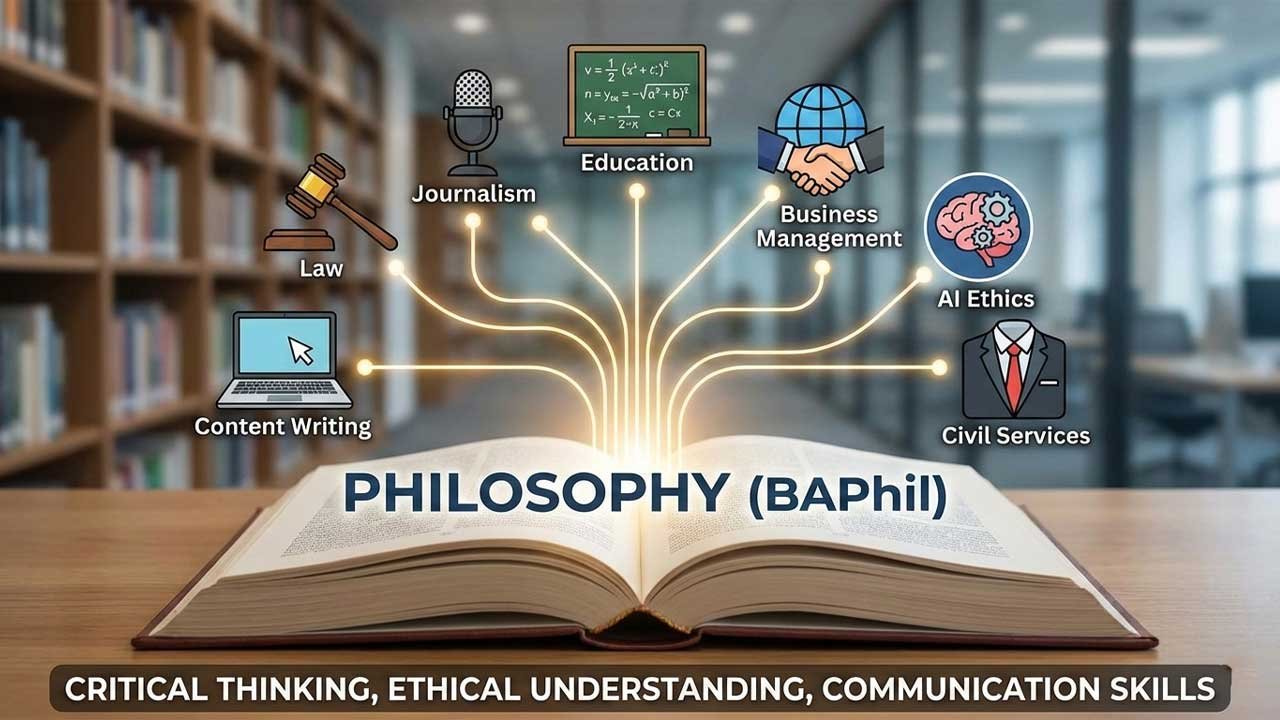
Bachelor of Arts in Philosophy (BAPhil) is a three-year undergraduate degree that develops deep critical thinking, logical reasoning, ethical understanding, and strong communication skills by exploring fundamental questions about truth, knowledge, morality, reality, language, science, politics, and human nature through Indian and Western traditions.
The program emphasizes analysis, debate, and writing rather than rote learning, making it a highly flexible and versatile degree that prepares graduates for diverse careers in law, journalism, content writing, education, business management, human resources, civil services, public policy, corporate ethics, and emerging fields like AI ethics and technology policy.
With transferable skills valued across industries, competitive salary growth over time, and opportunities for higher studies and research, a BA in Philosophy offers both intellectual fulfillment and strong long-term career prospects.
| Aspect | Details |
|---|---|
| Degree Name | Bachelor of Arts in Philosophy (BAPhil) |
| Duration | 3 Years (6 Semesters) |
| Level | Undergraduate |
| Eligibility | 10+2 passed (Minimum ~50%, varies by college) |
| Admission Process | Merit-based / Entrance exams (CUET, university tests) |
| Core Subjects | Logic, Ethics, Epistemology, Metaphysics, Political Philosophy |
| Skills Developed | Critical thinking, logical reasoning, writing, ethics, analysis |
| Top Career Options | Lawyer, Journalist, Content Writer, HR Manager, Professor, Civil Services |
| Average Entry Salary | ₹3–4 LPA |
| Mid–Senior Salary Range | ₹8–20+ LPA (role & experience dependent) |
| Top Recruiters/Fields | Media, Law firms, Corporates, Government, Academia |
| Higher Studies Options | MA Philosophy, LLB, MBA, PhD, Civil Services |
Bachelor of Arts in Philosophy (BAPhil): A Complete Career Guide
What Is Bachelor of Arts in Philosophy?
Bachelor of Arts in Philosophy is a three-year undergraduate degree program. This degree helps you think deeply about life. It teaches you about ideas, values, and knowledge. Philosophy explores big questions. “What is truth?” “What is right and wrong?” “How do we know things?” These are questions philosophy answers.
This best university degree in the higher education degree category is perfect for curious minds. You will learn to think critically. You will learn to argue logically. You will learn to write clearly. Philosophy prepares you for many careers.
Why Study Bachelor of Arts in Philosophy?
Develop Critical Thinking Skills
Philosophy teaches critical thinking. You learn to analyze arguments. You learn to spot weak reasoning. You learn to question assumptions. These skills help in every job. Employers value critical thinkers highly.
Learn to Communicate Effectively
Philosophy requires lots of writing. You write essays and arguments. You learn to express ideas clearly. Good communication is essential in business. It is essential in law. It is essential in all professions.
Understand Human Nature
Philosophy explores what it means to be human. You study ethics and values. You learn about different cultures and beliefs. You develop empathy. You understand different perspectives. This knowledge makes you a better person.
Prepare for Multiple Careers
A philosophy bachelor degree opens many doors. Lawyers use philosophical thinking. Journalists use it. Business leaders use it. Teachers use it. You can build any career you want.
Bachelor of Arts in Philosophy: Course Structure
Degree Duration and Format
The best university degree in philosophy takes three years to complete. Each year has two semesters. That means six semesters total. The program includes both Indian and Western philosophy. You take required courses and elective courses.
Semester-Wise Course Breakdown
Semester 1: Foundations
You start with basics. You learn Formal Logic. You study Ethics. These foundation courses prepare you.
- Formal Logic: Learn to construct valid arguments
- Ethics: Study right and wrong
- Basic Logical Concepts: Understand reasoning
- Symbolic Logic: Work with logical symbols
Semester 2: Philosophical Areas
The second semester expands your knowledge. You explore new areas.
- Aesthetics: Study beauty and art
- Philosophy of Language: Learn how language works
- Philosophy of Mind: Explore consciousness
- Philosophy of Science: Understand scientific thinking
Semester 3: Advanced Topics
You go deeper into philosophy. You study history and specialized topics.
- Political Philosophy: Learn about government and power
- Philosophy of Religion: Study faith and belief
- History of Philosophy: Learn from great thinkers
- Analytic Philosophy: Study modern philosophy methods
Semester 4: Western and Indian Philosophy
This semester focuses on major traditions.
- Modern Philosophy: Study recent thinkers
- Ancient Philosophy: Study classical thinkers
- Moral Philosophy: Explore ethics deeply
- Philosophy of Law: Understand legal concepts
Semesters 5 and 6: Specialization
You choose electives. You specialize in areas you love.
- Epistemology: Study knowledge and belief
- Metaphysics: Explore reality
- Indian Logic: Learn Indian traditions
- Contemporary Philosophy: Study current ideas
Key Subjects in Bachelor of Arts Philosophy
Core Subjects You Will Study
Logic
Logic is fundamental. It teaches reasoning. You learn to spot fallacies. You learn valid arguments. Logic improves your thinking forever.
Ethics
Ethics studies right and wrong. You learn moral theories. You apply ethics to real situations. You develop your values.
Epistemology
Epistemology asks: “What is knowledge?” How do we know things? Can we trust our senses? These questions fascinate philosophers.
Metaphysics
Metaphysics explores reality. What is real? What is time? What is identity? Metaphysics asks the deepest questions.
Philosophy of Mind
This subject studies consciousness. It explores mental states. How does the brain work? What is the mind? These are exciting questions.
Philosophy of Language
Language is fundamental to thinking. This subject explores how language works. How do words mean things? How do we communicate?
Philosophy of Science
Science and philosophy connect. This subject explores scientific thinking. What is a good scientific theory? How do we know science is true?
Political Philosophy
Political philosophy studies government and power. It explores justice and rights. It asks big political questions.
Why Bachelor of Arts in Philosophy Is a Best University Degree
Unique Learning Approach
Philosophy is different from other degrees. You don’t memorize facts. You learn to think. You practice arguing and debating. You write constantly. You become a better thinker.
Flexibility and Versatility
This higher education degree is flexible. You can combine it with other subjects. You can use it in law. You can use it in business. You can use it in education. The possibilities are endless.
Development of Transferable Skills
Philosophy develops many valuable skills:
- Critical thinking
- Analytical skills
- Writing skills
- Speaking skills
- Problem-solving ability
- Decision-making ability
These skills work everywhere. Every employer wants these skills.
Bachelor of Arts in Philosophy Career Opportunities
1. Lawyer
Philosophy and law connect naturally. Lawyers use logical reasoning. Lawyers analyze complex arguments. Philosophy graduates make excellent lawyers.
Average Salary in India: ₹3,91,265 per year
Why Philosophy Helps: Legal analysis requires critical thinking. Philosophy teaches this perfectly.
2. Content Writer
Content writers create written material. Philosophy graduates write well. They think clearly. They explain complex ideas simply.
Average Salary in India: ₹3.6 LPA per year
Why Philosophy Helps: Philosophy teaches clear communication. It teaches you to organize thoughts.
3. Journalist
Journalists investigate and report. Philosophy teaches research skills. Philosophy teaches questioning. Philosophy teaches clear communication.
Average Salary in India: ₹3,36,702 per year
Why Philosophy Helps: Philosophy develops analytical thinking. Journalists need this skill.
4. College Professor
Many philosophy graduates become professors. This requires further study (PhD or Master’s). But philosophy degrees prepare you well.
Average Salary in India: ₹3,49,880 – ₹15.4 LPA per year
Why Philosophy Helps: You already know the subject. You love philosophical thinking.
5. Business Executive
Philosophy graduates work in business. They become managers. They become consultants. They become business leaders.
Average Salary in India: ₹3.6 LPA per year (entry-level)
Why Philosophy Helps: Philosophy teaches ethical thinking. It teaches decision-making. Business needs these skills.
6. Human Resources Manager
HR managers work with people. Philosophy teaches about human nature. Philosophy teaches about ethics and values.
Average Salary in India: ₹10.9 LPA per year
Why Philosophy Helps: Understanding humans is philosophical. Philosophy teaches empathy.
7. Government and Civil Services
Philosophy graduates join civil services. They become government officers. They work in public administration. They make policy decisions.
Average Salary in India: Varies widely (₹5-20 LPA)
Why Philosophy Helps: Philosophy teaches ethical governance. It teaches policy thinking.
8. Corporate Ethics Consultant
Companies now hire ethics consultants. These consultants develop ethical policies. They handle ethical problems.
Average Salary in India: ₹5-8 LPA (entry-level), ₹20 LPA+ (senior)
Why Philosophy Helps: Ethics is core to philosophy. This is your expertise.
Top Colleges Offering Bachelor of Arts in Philosophy
Indian Universities (Average Packages)
| College Name | Average Salary |
|---|---|
| Lady Shri Ram College for Women, Delhi | ₹10.2 LPA |
| Delhi University | ₹9.25 – ₹10 LPA |
| Miranda House, Delhi | ₹9.8 LPA |
| St. Stephen’s College, Delhi | ₹9.22 LPA |
| Ramakrishna Mission Vidyamandira | ₹8 LPA |
| Presidency College, Kolkata | ₹7.5 – 7.96 LPA |
| Hindu College, Delhi | ₹6 LPA |
| Shri Ram College of Commerce | ₹6 LPA |
| Banaras Hindu University | ₹6 LPA |
These colleges offer excellent bachelor of arts philosophy programs. They have good placements. They have experienced faculty.
Salary Prospects After Bachelor of Arts in Philosophy
Entry-Level Salaries
Right after graduation, you can earn:
- Journalism: ₹2.9 LPA per year
- Content Writing: ₹3.6 LPA per year
- Teaching Assistant: ₹3-4 LPA per year
- HR Entry-Level: ₹3.5 LPA per year
These are starting salaries. Your salary grows with experience.
Mid-Career Salaries
After 5-10 years, you can earn:
- Senior Journalist: ₹6-8 LPA per year
- Content Manager: ₹6-9 LPA per year
- Assistant Professor: ₹8-12 LPA per year
- HR Manager: ₹10.9 LPA per year
- Research Analyst: ₹8-12 LPA per year
Senior-Level Salaries
With 10+ years experience:
- Senior Editor: ₹12-15 LPA per year
- Professor: ₹15.4+ LPA per year
- Corporate Ethics Officer: ₹15-20 LPA per year
- Legal Advisor (with LLB): ₹20+ LPA per year
Philosophy graduates earn well. Your earning potential is excellent.
Admission Requirements for Bachelor of Arts in Philosophy
Basic Eligibility
To join a bachelor of arts in philosophy program:
- You must pass 10+2 (Higher Secondary School)
- You need minimum 50% marks (approximately)
- Different colleges have different cutoffs
- Check specific college requirements
Selection Process
Most colleges use one of these:
- Merit-based selection (marks-based)
- Entrance exams (CUET, university exams)
- Direct admission (in some colleges)
- Management quota (private colleges)
Required Documents
You need to submit:
- 10+2 mark sheet
- Birth certificate
- Address proof
- Category certificate (if applicable)
- Passport-size photographs
- Migration certificate (if from different board)
Skills You Will Develop
Academic Skills
- Critical Analysis: Break down complex ideas
- Logical Reasoning: Think step-by-step
- Research Skills: Find and analyze information
- Writing Skills: Express ideas clearly
- Reading Comprehension: Understand difficult texts
Professional Skills
- Problem-Solving: Find solutions to tough problems
- Communication: Speak and write effectively
- Debate and Discussion: Argue your points well
- Decision-Making: Make good choices
- Ethical Thinking: Apply values to decisions
Personal Development
- Self-Reflection: Understand yourself better
- Empathy: Understand other perspectives
- Intellectual Curiosity: Love learning always
- Open-Mindedness: Consider different views
- Leadership: Lead through thinking
Future Scope of Philosophy Degree
Growing Demand in Corporate World
Companies now need philosophy graduates. They hire them for:
- Ethics compliance roles
- CSR (Corporate Social Responsibility) positions
- Decision-making roles
- Leadership training
- Policy development
Technology and AI
Philosophy is relevant to artificial intelligence. AI ethics is important. Philosophy graduates will work in:
- AI ethics
- Data privacy consulting
- Technology policy
- Algorithm fairness
- Responsible AI development
Public Policy and Governance
Governments need philosophical thinking. Philosophy graduates work in:
- Policy making
- Government administration
- Public service
- International relations
- Diplomatic services
Education and Research
Philosophy will always need educators:
- University teaching
- Research positions
- Think tanks
- Publishing
- Academic writing
Conclusion
Bachelor of Arts in Philosophy is an excellent choice. This best university degree teaches thinking. It teaches communication. It teaches values. It opens many career doors.
If you love ideas, choose philosophy. If you want to think deeply, choose philosophy. If you want a flexible, valuable degree, choose philosophy.
Philosophy graduates succeed in law, business, education, journalism, and government. They earn good salaries. They build meaningful careers. They make a difference in the world.
Start your philosophy journey today. Join a top college. Study deeply. Think critically. Build your future. Your philosophy degree awaits.
FAQs
What is Bachelor of Arts in Philosophy?
Bachelor of Arts in Philosophy is a three-year undergraduate degree that studies logic, ethics, knowledge, reality, and human values while developing critical thinking and communication skills.
What is the duration of BA Philosophy?
The duration of BA Philosophy is three years, usually divided into six semesters.
Who should study BA Philosophy?
Students who enjoy deep thinking, reading, writing, debating, ethics, and understanding human behavior should study BA Philosophy.
What are the eligibility criteria for BA Philosophy?
Candidates must have passed 10+2 from a recognized board, generally with at least 50% marks, though cutoffs vary by college.
Is BA Philosophy a good degree?
Yes, BA Philosophy is a valuable degree as it builds transferable skills like critical thinking, reasoning, and communication that are useful in many careers.
What subjects are taught in BA Philosophy?
Subjects include Logic, Ethics, Epistemology, Metaphysics, Political Philosophy, Philosophy of Mind, Philosophy of Language, and Philosophy of Science.
Does BA Philosophy include Indian philosophy?
Yes, most universities teach both Indian and Western philosophical traditions.
What skills do students gain from BA Philosophy?
Students develop analytical thinking, logical reasoning, writing skills, research ability, ethical judgment, and effective communication.
What are the career options after BA Philosophy?
Career options include law, journalism, content writing, teaching, HR management, civil services, business roles, and ethics consulting.
Can I become a lawyer after BA Philosophy?
Yes, after completing BA Philosophy, you can pursue an LLB and become a lawyer.
What is the average salary after BA Philosophy?
Entry-level salaries range from ₹3–4 LPA, with mid-career earnings of ₹8–12 LPA and senior roles reaching ₹20 LPA or more.
Is BA Philosophy useful for civil services?
Yes, philosophy is a popular optional subject for UPSC and helps in ethical and analytical decision-making.
Can BA Philosophy graduates work in corporate jobs?
Yes, graduates work in management, HR, consulting, policy roles, and corporate ethics positions.
Is BA Philosophy good for journalism and content writing?
Yes, philosophy graduates write clearly, think critically, and analyze issues deeply, which are essential for media careers.
What higher studies can be pursued after BA Philosophy?
Options include MA Philosophy, MBA, LLB, MA in Public Policy, PhD, and civil services preparation.
Is BA Philosophy difficult?
It is intellectually challenging but manageable for students who enjoy reading, writing, and logical thinking.
Does BA Philosophy require strong writing skills?
Yes, writing essays and arguments is a major part of the course, but skills improve over time.
Are there entrance exams for BA Philosophy?
Some universities use entrance exams like CUET, while others admit students based on merit.
Can science or commerce students study BA Philosophy?
Yes, students from any stream can study BA Philosophy after 10+2.
Is BA Philosophy relevant in the modern world?
Yes, it is highly relevant in areas like ethics, AI, technology policy, governance, and leadership.
Does BA Philosophy help in personal growth?
Yes, it improves self-awareness, empathy, open-mindedness, and ethical thinking.
Are there good colleges for BA Philosophy in India?
Yes, top colleges include Delhi University colleges, BHU, Presidency College Kolkata, and Ramakrishna Mission Vidyamandira.
Can BA Philosophy lead to teaching careers?
Yes, with a master’s degree and PhD, graduates can become college professors or researchers.
Is BA Philosophy a professional degree?
It is an academic degree, but it strongly supports professional careers through transferable skills.
What is the future scope of BA Philosophy?
The future scope includes corporate ethics, AI ethics, public policy, governance, education, research, and leadership roles.


Leave a Reply
You must be logged in to post a comment.