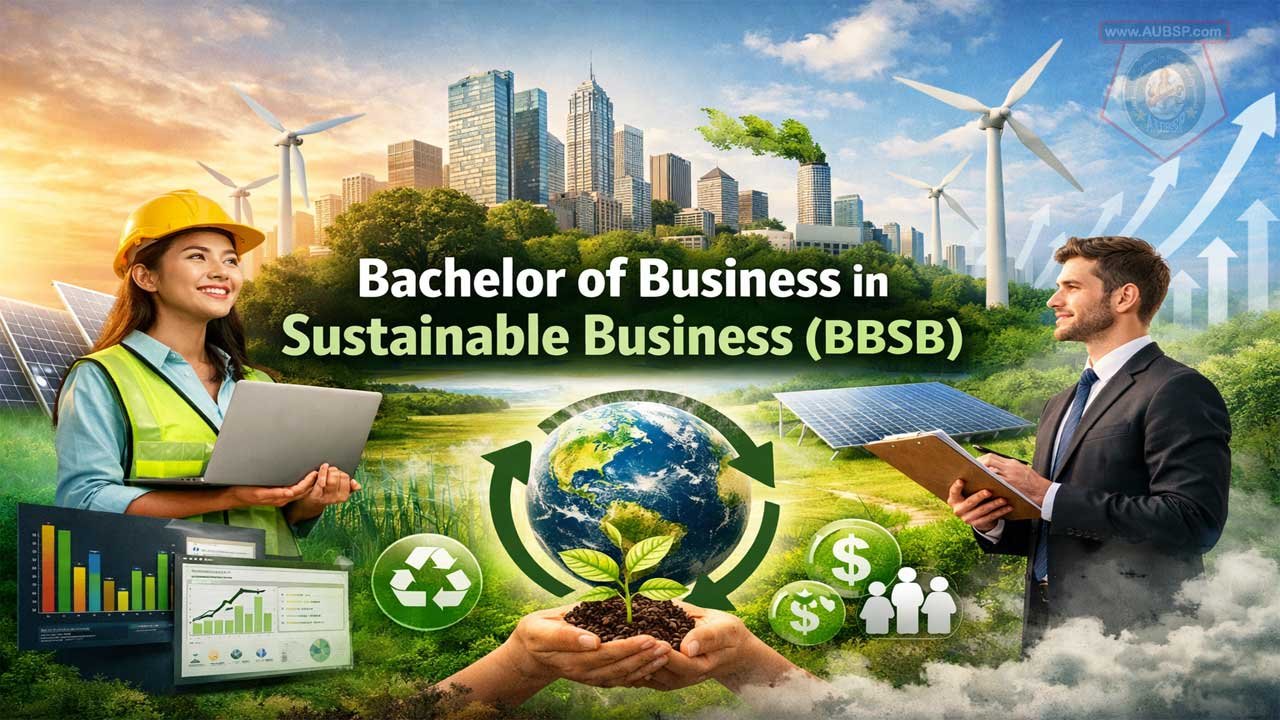
The Bachelor of Business in Sustainable Business (BBSB) is a modern business degree that focuses on running companies in ways that protect the environment, support society, and ensure long-term profit. It combines traditional subjects like accounting, finance, and marketing with sustainability topics such as environmental science, ethics, and climate management.
The program is based on the Triple Bottom Line, which balances economic, social, and environmental goals. Demand for sustainability professionals is growing quickly, creating many “green collar” jobs in areas like ESG analysis, sustainability management, and sustainable supply chains. Universities around the world offer these programs, and students learn skills such as carbon accounting, circular economy strategies, and ethical leadership.
Graduates can work in consulting, finance, policy, and corporate sustainability roles. Overall, the degree prepares students to help businesses grow responsibly while solving global environmental and social challenges.
| Category | Information |
|---|---|
| Degree Name | Bachelor of Business in Sustainable Business (BBSB) |
| Duration | 3–4 years (depending on country/university) |
| Field of Study | Business, Sustainability, Environmental Management |
| Core Focus | Triple Bottom Line – Economic, Environmental, and Social sustainability |
| Key Subjects | Sustainable Marketing, ESG Reporting, Carbon Accounting, Circular Economy, Ethical Leadership |
| Skills Gained | Sustainability strategy, data analysis, responsible management, ESG reporting |
| Popular Study Destinations | USA, Germany, Austria, Australia, Singapore |
| Career Roles | Sustainability Manager, ESG Analyst, Sustainability Consultant, Supply Chain Specialist |
| Industry Demand | Green jobs growing faster than general job market |
| Average Salary (USA) | $100,000+ for sustainability analysts/managers (varies by experience) |
| Work Sectors | Corporate sustainability, finance, consulting, government, NGOs |
| Global Trend | Rising demand due to climate policies, ESG regulations, and green economy |
Study Sustainable Business (BBSB): Skills, Universities, and Career Opportunities
The modern corporate landscape is currently experiencing a tectonic shift in its foundational logic, as the historical mandate for short-term profit maximization is increasingly supplanted by the imperatives of environmental stewardship, social equity, and long-term economic resilience. This transformation has necessitated the emergence of a specialized academic discipline: the Bachelor of Business in Sustainable Business (BBSB), also frequently categorized as a Bachelor of Science or Bachelor of Arts in Sustainable Management.
For international students, this degree represents more than just a credential; it is an entry point into a global “green collar” workforce that is expanding at twice the rate of the general labor market. The BBSB curriculum distinguishes itself by synthesizing traditional business disciplines—such as accounting, finance, and marketing—with environmental science, ethical philosophy, and systems thinking to address the pressing challenges of climate change, resource depletion, and social injustice.
The Philosophical and Theoretical Foundations of Sustainable Business
The philosophy of sustainable business is fundamentally rooted in the transition from a linear, profit-centric model to a holistic, stakeholder-centric framework. This approach moves beyond conventional metrics of success, emphasizing the creation of long-term value for a broad range of stakeholders, including the environment and future generations.
At its core, the discipline is guided by the “Triple Bottom Line”—a strategic framework that balances economic, social, and environmental factors to ensure organizational longevity and societal health.
Etymological and Historical Context
The linguistic origins of the terms provide significant insight into the academic philosophy of the BBSB. The term “sustainable” is derived from the Latin sustinere, which means to uphold, support, or endure. When applied to commerce, it signifies the capacity of a business to maintain its operations over time without depleting the natural or social capital upon which it depends. “Business” itself stems from roots indicating care or concern, while “philosophy” represents a wisdom-driven system of guiding principles.
Consequently, a Sustainable Business Philosophy signifies a wisdom-driven approach to trade focused on enduring support for both present and future needs. This academic field gained significant prominence in the late 20th century as corporations began to recognize that their success was inextricably linked to planetary health and social equity.
The Three Pillars of Sustainability in Corporate Strategy
The BBSB curriculum is typically structured around three interconnected pillars that define the modern sustainable enterprise.
| Pillar | Focus and Objectives | Business Application |
|---|---|---|
| Economic Sustainability | Ensuring long-term profitability and resilience through efficient resource management and innovation. | Shifting from short-term gains to resilient models that withstand market fluctuations and provide equitable growth. |
| Environmental Sustainability | Minimizing negative impacts on the natural world by reducing emissions and conserving resources. | Adopting green practices to find cost savings, comply with regulations, and attract eco-conscious stakeholders. |
| Social Sustainability | Promoting the well-being of people and communities, including fair labor and diversity. | Fostering trust and loyalty among employees and ensuring ethical integrity throughout global supply chains. |
These pillars function as a cohesive unit, recognizing that a business cannot thrive in the long term if it neglects the environment or the social fabric of the communities in which it operates.
The Global Talent Landscape: Demand, Supply, and the Green Skills Gap
The impetus for international students to pursue a BBSB is grounded in a significant and widening disparity between the demand for sustainability expertise and the current supply of skilled professionals. According to LinkedIn’s 2025 Global Green Skills Report, “green hiring” is growing at nearly twice the pace of green skills development among the global workforce. From 2021 to 2025, the annual pace of green hiring grew by approximately 8%, whereas the share of workers possessing at least one green skill increased by only 4.3%.
The “Green Advantage” in the Labor Market
As organizations face intensifying regulatory mandates and investor pressure, the value of a sustainability-focused degree has reached an inflection point. Professionals who possess specialized green skills are currently being hired into roles at a rate 46.6% higher than the general workforce. In specific markets, this premium is even more pronounced; for example, in India, the hiring rate for green talent is 59.7% higher than the overall average.
The Proliferation of Green Skills in Non-Green Roles
A critical insight for BBSB students is that sustainability expertise is no longer confined to niche “green” departments. In 2025, for the first time, workers with green skills in traditionally non-green job titles accounted for 53% of all green hires. This suggests that green skills are becoming foundational, rather than specialized, as they are increasingly integrated into mainstream functions such as operations, finance, manufacturing, and technology.
| Industry Sector | Year-on-Year Growth in Green Hiring (2024-2025) | Drivers of Demand |
|---|---|---|
| Financial Services | 16.3% | EU legislation requiring climate risk management and sustainable finance expertise. |
| Technology | 14.9% | Need to manage AI resource intensity and develop climate solution software. |
| Retail | 14.0% | Consumer demand for greener brands and sustainable product lifecycles. |
| Supply Chain & Logistics | 11.8% | Focus on decarbonization and ethical sourcing mandates. |
The technology sector, in particular, is witnessing a “twin transition” where fluency in both Artificial Intelligence (AI) and sustainability is becoming essential. AI-adjacent talent is rapidly adding green skills such as operational efficiency (+579%) and product lifecycle management (+152%) to address the massive electricity and water demands of data centers.
Institutional Profiles: Leading Global Programs in Sustainable Business
For international students, selecting the appropriate institution involves evaluating the program’s regional focus, accreditation, and industry connections.
North American Institutions: Applied and Interdisciplinary Excellence
In the United States, several universities have pioneered specialized sustainability business programs that blend rigorous management training with environmental stewardship.
- Colorado State University (CSU): Housed within the College of Business, CSU’s Concentration in Sustainable Business is recognized as a Top 5 Business School for Responsible Business Education by the Financial Times. The curriculum focuses on preparing students to analyze social and environmental change through a business lens, offering a diverse range of courses from sustainable marketing to corporate sustainability strategy.
- University of Redlands: The Bachelor of Science in Sustainable Business at Redlands is an interdisciplinary program that hones strategy and management practices in relation to environmental issues. The program is notable for its “May Term” offerings, which allow students to study conservation and sustainability on-site in locations such as Panama and Palau.
- Unity Environmental University: Offering a 100% online Applied Bachelor of Science in Sustainable Business Management, Unity focuses on workplace-ready expertise in carbon accounting, ESG reporting, and sustainable branding. The program is designed for flexibility, utilizing asynchronous 5-week terms and an AI-enhanced curriculum.
European Institutions: Regional Leadership and Multi-Campus Models
European programs often emphasize the integration of circular economy principles and complex ESG legal frameworks.
- Kozminski University (Poland) & ESCP Business School: This collaborative Sustainable Business Major involves a 3-year rotation across various European campuses, including Warsaw, Paris, Turin, and Madrid. This international exposure is designed to build a highly selective network and provide students with a deep understanding of global sustainability challenges, such as climate change and social injustice.
- Hochschule Burgenland (Austria): The Bachelor in International Sustainable Business is a pioneering program where sustainability is the core subject from the first semester rather than an elective. The program is taught entirely in English and is “job-friendly,” typically scheduling classes on no more than four days a week to accommodate internships.
- Trier University of Applied Sciences (Germany): Known as Germany’s most sustainability-oriented university, Trier offers a B.A. in Sustainable Business and Law. The program combines business strategy with ESG law and communication skills to ensure students can lead responsibly in a global marketplace.
Asia-Pacific and Other Global Leaders
The Asia-Pacific region is a critical growth market for sustainability consulting, and its universities reflect this through innovative urban and resource-focused degrees.
- University of Technology Sydney (UTS): The Bachelor of Business/Bachelor of Sustainability and Environment is a dual degree that requires 192 credit points over four years. It includes unique core subjects such as “The Carbonisation of Society” and “Sustainability and Social Justice in the City,” focusing on the intersection of urban systems and environmental health.
- Singapore Management University (SMU): The Bachelor of Business Management with a major in Sustainability is a 4-year program offered by the Lee Kong Chian School of Business. The program is situated in the heart of Singapore, providing students with proximity to a major global financial hub that is increasingly focused on sustainable finance and ESG investing.
Curriculum Deep Dive: Core Modules and Learning Outcomes
The BBSB curriculum is designed to re-engineer traditional business logic. Students are trained to see sustainability not as a cost center, but as a source of innovation, risk reduction, and competitive advantage.
Circular Economy and Regenerative Design
A central component of the BBSB is the transition from a linear “take-make-waste” model to a circular economy. In a circular system, products and services are designed from the outset to be long-lasting, reused, and recycled.
- Product-as-a-Service: Students study case studies such as Philips’ “lighting-as-a-service” model, where the company retains ownership of equipment and the customer pays only for the light consumed, incentivizing durability and energy efficiency.
- Closed-Loop Systems: Courses explore reverse logistics and recycling strategies to ensure resources are kept in use for as long as possible, reducing the need for virgin materials.
Accounting for Impact: ESG and Carbon Management
Sustainable accounting practices enable organizations to measure what they manage. BBSB students acquire technical skills in several emerging reporting frameworks.
- Carbon Accounting: Learning to quantify Greenhouse Gas (GHG) emissions across the entire value chain (Scopes 1, 2, and 3) is a critical skill for helping firms reach net-zero targets.
- ESG Reporting: Students master standards such as those provided by the Global Reporting Initiative (GRI) and the Sustainability Accounting Standards Board (SASB) to provide transparent data to investors and regulators.
Ethical Marketing and Sustainable Branding
The curriculum emphasizes the importance of authenticity in communications to prevent “greenwashing”—the practice of making misleading environmental claims. Students learn storytelling techniques that connect corporate sustainability efforts with consumer values, backed by verifiable impact data.
Social Responsibility and Ethical Leadership
Modern business leaders must navigate complex relationships between commerce and human rights. Subjects such as “Strategic Management for Social Change” and “Ethical Resource Management” prepare students to uphold fair labor standards, promote diversity and inclusion, and engage with communities affected by their business operations.
Admission Requirements for International Students
Admission into BBSB programs is competitive and requires documentation that demonstrates both academic capability and a genuine commitment to sustainability.
General Educational Requirements
Most programs require a school-leaving certificate equivalent to the host country’s standard, such as the Austrian Matura, the Australian Year 12, or the Polish Matura. International students often need to provide official transcripts and diplomas, translated by certified translators. In the United States, programs like Miami Herbert require a WES (World Education Services) evaluation of foreign transcripts to ensure grade equivalence.
Language Proficiency Standards
As English is the primary language of instruction for most leading international BBSB programs, non-native speakers must submit standardized test scores.
| Program/Institution | Minimum IELTS Score | Minimum TOEFL iBT Score | Other Accepted Tests |
|---|---|---|---|
| SMU Singapore | 7.0 (7.0 Reading, 6.5 Writing) | Not specified | PTE |
| Miami Herbert (USA) | 7.0 | 94 | Duolingo (125) |
| AUAS (Netherlands) | 6.5 (5.5 subscores) | 90 (21 subscores) | Cambridge C1 (176) |
| Hochschule Burgenland | B2 Level | B2 Level | Internal English Test |
The Qualitative Application: Motivation and Vision
Universities increasingly utilize qualitative assessments to identify future sustainability leaders.
- Personal Essays: Applicants may be asked to describe their passion for protecting the environment and how their studies will contribute to combating climate change.
- Self-Presentation Videos: Kozminski University requires a 120-second video covering the applicant’s interests, passions, and motivation for the scholarship and the major.
- Interviews: Highly selective programs include a mandatory interview to assess the student’s suitability and communication skills.
Financial Planning: Costs, Living Expenses, and Scholarships
The financial commitment for a BBSB varies widely by geography, with some European countries offering significantly lower costs than North American or Singaporean counterparts.
Tuition Fee Comparison for International Students
| Location | Annual Tuition Estimate (USD/Approx) | Notes |
|---|---|---|
| Austria (Public UAS) | $1,500 – $1,600 | Includes student union fees and insurance. |
| Germany (Public) | $500 – $1,000 | Primarily administrative fees; many programs are tuition-free. |
| Singapore (SMU) | $33,000 | SGD 44,950 for first-year international students. |
| Australia (UNE) | $21,000 | AUD 32,016 for international tuition. |
| USA (Private) | $20,000 – $50,000+ | Costs vary significantly by institutional ranking and location. |
Estimated Monthly Living Expenses
International students must budget for accommodation, food, transport, and insurance.
- Austria: Between €850 and €1,200 ($920 – $1,300) per month. Accommodation is the largest expense, ranging from €200 to €500.
- Singapore: Students often manage costs through careful budgeting for hostels, meals, and public transportation, with a baseline monthly expense starting around SGD 375 for basic needs, though total costs are typically higher.
- Germany: Monthly costs are estimated at approximately $900 – $1,200, covering housing (~$400), food (~$200), and insurance.
Scholarships and Financial Assistance
Several prestigious scholarship programs specifically target sustainability students to help mitigate these costs.
- University of Reading Global Sustainability Leaders Scholarship: This program offers up to 400 awards annually. Each scholar receives £6,000 per year for up to four years, specifically for maintenance and living costs. Eligibility requires high academic achievement (AAA at A-level or equivalent) and an offer of admission.
- Kozminski Sustainability Leaders Scholarship: This award covers 40% of the tuition fee for the first year of the Sustainable Business major.
- Environmental Kindness Scholarship: A smaller award of $500 given to students pursuing environmental studies who write a compelling essay on combating climate change.
- Brittney Fox Watts Endowment: A $1,000 enhancement for UGA students pursuing study abroad programs focused on sustainability.
Career Development: Roles, Responsibilities, and Salaries
Graduates of a BBSB program are prepared for a diverse range of roles across the private, public, and non-profit sectors.
Primary Green Career Paths
- Sustainability Consultant: These professionals help organizations audit their operations, identify risks, and recommend strategies for reducing environmental footprints and meeting ESG standards.
- ESG Analyst/Investment Strategist: Operating primarily in the finance sector, they interpret climate and social data to align investment portfolios with global sustainability benchmarks.
- Sustainability Manager: An internal role focused on designing and monitoring corporate ESG goals, ensuring compliance, and supporting long-term strategic planning.
- Sustainable Supply Chain Specialist: These managers ensure ethical sourcing and optimize logistics to reduce carbon emissions and waste within global value chains.
- Policy Analyst/Advisor: Working for governments or NGOs, they help design environmental frameworks, climate regulations, and public-sector sustainability programs.
Salary Expectations and Market Outlook
The “green collar” sector offers competitive compensation, reflecting the high demand for specialized expertise.
| Job Title | Average Annual Salary (USA) | Salary Range (Europe) |
|---|---|---|
| Sustainability Manager | $130,000 | €35,000 – €80,000 |
| Sustainability Analyst | $101,000 | Varies by region |
| Chief Sustainability Officer | $174,000+ | Varies by region |
The job market is projected to remain robust, with a 9% increase in sustainability-related roles through 2034 in the United States alone. Organizations are increasingly viewing sustainability not as a niche function but as a fundamental driver of business value, resilience, and efficiency.
The Sustainability Consulting Market Forecast 2025-2030
The rapid institutionalization of ESG reporting has created a massive market for specialized consulting services. Various research reports indicate significant growth trajectories for this sector through 2030.
| Source | 2025 Market Value (Est) | 2030 Market Value (Est) | CAGR (Growth Rate) |
|---|---|---|---|
| Mordor Intelligence | $16.99 Billion | $54.76 Billion | 26.38% |
| The Business Research Company | $15.35 Billion | $24.44 Billion | 9.7% |
| Verdantix | $12.37 Billion (2024) | $30.00 Billion | 16% |
Key Drivers of Market Expansion
The growth of this market is fueled by corporate net-zero commitments, which are accelerating advisory spend by over 6% globally. Additionally, expanding disclosure regulations, such as the EU’s CSRD, are expected to have a significant short-term impact on the demand for ESG data management and strategy.
As firms move from broad sustainability programs to “outcome-driven” engagements, they increasingly seek consultants who can deliver measurable value through cost savings, operational efficiency, and risk reduction.
Future Trends: AI and the Evolutionary BBSB
As we look toward 2030, the BBSB curriculum is expected to evolve in response to the “twin transition.” The integration of AI into sustainability management is already underway, with tools like Unity University’s “Una Guide” providing a blueprint for the future of personalized, AI-enhanced education.
The Role of AI in Sustainability
AI literacy is becoming a core skill within BBSB programs. Students are learning how to combine human judgment with AI tools to:
- Optimize energy and water consumption in real-time.
- Perform automated lifecycle assessments for new products.
- Analyze massive datasets for ESG disclosures and carbon accounting.
This technological integration ensures that BBSB graduates are not only environmentally conscious but also technologically proficient, making them uniquely qualified to lead organizations in a digital-first, net-zero economy.
Strategic Conclusion: Navigating the BBSB Pathway
For the international student, the Bachelor of Business in Sustainable Business is more than an academic pursuit; it is a strategic investment in a career that aligns individual purpose with global necessity. The degree offers a comprehensive framework for understanding the complex intersections of economic prosperity, environmental health, and social justice. By acquiring technical skills in ESG reporting, circular design, and carbon management, graduates position themselves at the forefront of a global economic transformation.
As the demand for green skills continues to outpace supply, BBSB graduates will find themselves in a high-leverage position within the labor market, enjoying greater employment resilience and competitive salaries. Whether through the multi-campus internationalism of European programs or the applied, interdisciplinary models of North American universities, the BBSB provides the essential tools to build a sustainable future—for both the individual professional and the planet.
FAQs about Bachelor of Business in Sustainable Business
What is a Bachelor of Business in Sustainable Business (BBSB)?
A Bachelor of Business in Sustainable Business is a degree that combines traditional business education with sustainability practices. It teaches students how companies can grow while protecting the environment, supporting communities, and maintaining long-term profitability.
What subjects are taught in a Sustainable Business degree?
Students usually study subjects such as sustainable marketing, environmental management, ESG reporting, carbon accounting, circular economy, corporate ethics, finance, and supply chain sustainability.
How long does a BBSB degree take to complete?
Most BBSB programs take about three to four years to complete, depending on the university and country where the student studies.
What careers can graduates pursue with a Sustainable Business degree?
Graduates can work as sustainability managers, ESG analysts, sustainability consultants, sustainable supply chain specialists, corporate social responsibility managers, or policy advisors.
Is there demand for sustainable business professionals?
Yes, demand is growing rapidly as companies face stricter environmental regulations and investor pressure. Many organizations are hiring professionals who understand sustainability, ESG reporting, and responsible business strategies.
Which countries are popular for studying Sustainable Business?
Popular destinations include the United States, Germany, Austria, Australia, Singapore, and other European countries that offer strong sustainability-focused programs.
What skills do students gain from a Sustainable Business program?
Students learn strategic planning, environmental impact analysis, ethical leadership, sustainability reporting, carbon management, and responsible business decision-making.
Can international students apply for Sustainable Business programs?
Yes, international students can apply to many universities worldwide. They usually need academic transcripts, proof of English proficiency such as IELTS or TOEFL, and sometimes a personal statement or interview.
What is the Triple Bottom Line in sustainable business?
The Triple Bottom Line is a framework that measures business success based on three factors: economic growth, environmental protection, and social responsibility.
Is a Sustainable Business degree worth studying?
Yes, it is considered valuable because businesses are increasingly focusing on sustainability. Graduates can access growing “green career” opportunities and contribute to solving environmental and social challenges.


Leave a Reply
You must be logged in to post a comment.