
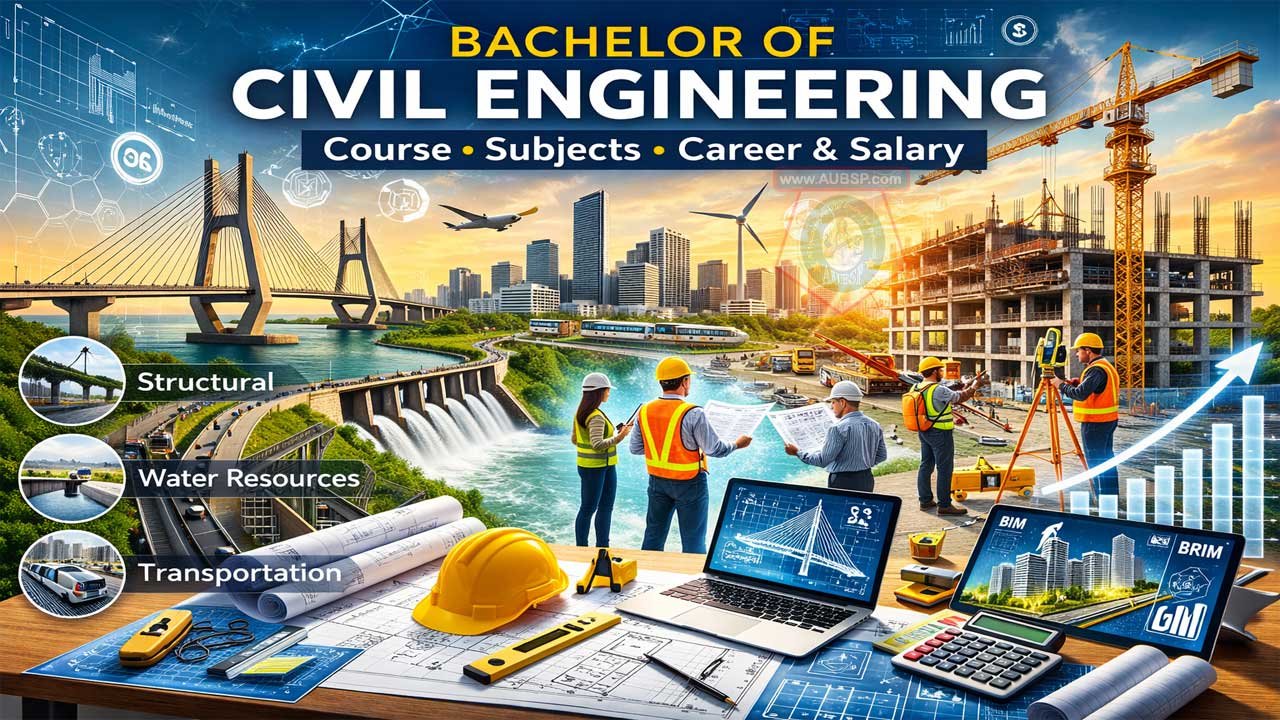
A Bachelor of Civil Engineering (BCE)—also known as BSCE, BE Civil, or BTech Civil—is a 3–4 year undergraduate degree that prepares students to design, build, and maintain infrastructure such as buildings, bridges, roads, water systems, and environmental projects.
The program combines strong foundations in mathematics, physics, and engineering sciences with core civil disciplines including structural, geotechnical, transportation, water resources, environmental engineering, and construction management, along with labs, design projects, and a final-year capstone. Graduates gain technical skills in analysis, design, materials, surveying, hydraulics, CAD/BIM, and project management, as well as professional skills like teamwork and communication.
Civil engineering offers global career opportunities driven by urbanization, infrastructure renewal, and sustainability needs, with competitive salaries in countries such as the US, Canada, Australia, the UK, Germany, the UAE, Singapore, New Zealand, and Japan. Accredited degrees and professional licensing (e.g., PE) further enhance mobility and earnings. With growing focus on smart cities, climate-resilient infrastructure, and green construction, a BCE remains a strong, future-oriented choice for students interested in impactful, real-world engineering careers.
| Category | Details |
|---|---|
| Degree Name | Bachelor of Civil Engineering (BCE) / BSCE / BE Civil / BTech Civil |
| Degree Level | Undergraduate |
| Duration | 3–4 years (typically 4 years / 8 semesters) |
| Eligibility | 12 years of schooling with Mathematics & Physics (often Chemistry) |
| Admission Basis | Entrance exams (varies by country), academic merit, standardized tests (e.g., SAT), English proficiency for international students |
| Core Subjects | Engineering Mathematics, Physics, Mechanics, Structural Engineering, Geotechnical Engineering, Transportation Engineering, Environmental Engineering, Water Resources, Construction Management |
| Practical Components | Laboratories (structural, geotechnical, environmental), fieldwork, surveying, capstone/final-year project |
| Specializations | Structural, Geotechnical, Transportation, Environmental, Water Resources, Construction Management, BIM & GIS |
| Key Skills Gained | Structural design, soil analysis, hydraulics, surveying, CAD/BIM, project planning, cost estimation |
| Career Roles | Structural Engineer, Site Engineer, Project Engineer, Geotechnical Engineer, Environmental Engineer, Construction Manager |
| Global Demand | Strong due to infrastructure development, urbanization, sustainability needs |
| Median Salary (US) | ~USD 99,590 per year (2024 median) |
| Licensing | Professional Engineer (PE) or equivalent boosts salary and career mobility |
| Higher Study Options | MSc/MTech/MS in Civil Engineering, Project Management, MBA, PhD |
What Is a Bachelor of Civil Engineering (BCE)?
A Bachelor of Civil Engineering (BCE) is a 3–4 year undergraduate engineering degree that prepares students to design, build, and maintain essential infrastructure such as buildings, bridges, highways, tunnels, dams, airports, water supply systems, and environmental protection projects.
Globally, the same degree may appear under different names:
- BCE – Bachelor of Civil Engineering
- BSCE – Bachelor of Science in Civil Engineering
- BE Civil Engineering – Bachelor of Engineering in Civil
- BTech Civil Engineering – Bachelor of Technology in Civil
Despite the naming differences, the core goal is similar: to equip students with strong mathematical, scientific, and engineering foundations and the ability to solve real-world infrastructure and sustainability challenges.
Why Study Civil Engineering?
Civil engineering is one of the oldest and most impactful engineering branches, responsible for much of the modern built environment. Choosing a BCE offers several advantages:
- Global demand and strong job outlook
Civil engineers are required worldwide to build, repair, and upgrade infrastructure, from smart cities to transportation networks and renewable energy structures. - Diverse career paths
Graduates can specialize in structural, environmental, transportation, water resources, geotechnical engineering, or construction management. - Attractive salaries in many countries
In developed economies like the US, Canada, Australia, and parts of Europe and the Gulf, civil engineers enjoy competitive salaries, often above general workforce averages. - High social impact
Civil engineers work on projects that improve public safety, mobility, water access, sanitation, and climate resilience, directly affecting quality of life.
Course Duration and Structure
Most Bachelor of Civil Engineering–type programs are designed as:
- Duration:
- Typically 4 years (8 semesters) in many countries (US, Canada, India, Australia, Gulf).
- Sometimes 3 years in parts of Europe if combined with strong pre-university preparation.
- Credits / workload:
- Around 120–130 semester credit hours (for example, a typical BSCE program).
- Study pattern:
- Years 1–2: Mathematics, physics, basic engineering sciences
- Years 3–4: Core civil engineering subjects, electives, labs, and a final-year project/capstone design.
Eligibility Criteria
Exact requirements differ by country and university, but common eligibility criteria for BCE/BSCE/BE/BTech Civil include:
- Academic background
- Completion of 12 years of schooling or equivalent, typically with strong grades in Mathematics and Physics (and often Chemistry).
- Entrance exams
- In many countries, admission may be based on national or institutional entrance tests or standardized exams (e.g., JEE-type exams, SAT, or university entrance tests).
- English language proficiency (for international students)
- Proof of English skills through tests such as IELTS, TOEFL, or PTE, as required by the university.
- Other requirements
- Statement of purpose, letters of recommendation, and sometimes an interview, depending on the institution.
Always check the official university website for precise, updated criteria.
Core Subjects and Syllabus in a BCE Program
While every university has its own syllabus, most civil engineering bachelor programs share a similar structure in terms of core subjects and lab work.
1. Foundation: Mathematics, Science, and Computing
Typical subjects:
- Engineering Mathematics (Calculus, Differential Equations, Linear Algebra, Probability, Statistics)
- Engineering Physics & Engineering Chemistry
- Applied Mechanics / Engineering Mechanics
- Basic Electrical & Electronics Engineering (in many universities)
- Computer Programming and Data Structures
These courses develop the quantitative and analytical base required for higher-level civil engineering subjects.
2. Engineering Fundamentals
- Engineering Graphics and Descriptive Geometry
- Engineering Principles and Solid Mechanics / Strength of Materials
- Materials Science and Building Materials
- Surveying and Geospatial Data (Surveying & GIS)
These subjects help students understand loads, forces, deformations, materials behavior, and spatial measurement, which are crucial for safe design.
3. Core Civil Engineering Subjects
Most BCE programs include core modules covering the major sub-disciplines of civil engineering:
- Structural Engineering
- Structural Analysis
- Theory of Structures
- Design of Reinforced Cement Concrete (RCC) Structures
- Design of Steel Structures
- Geotechnical Engineering (Soil Mechanics)
- Soil Mechanics and Foundation Engineering
- Geotechnical Engineering I
- Foundations and Earth Retaining Systems
- Transportation Engineering
- Transportation Engineering I (highways, traffic engineering)
- Pavement Design, Construction, and Maintenance
- Water Resources and Hydraulic Engineering
- Fluid Mechanics and Hydraulics
- Hydrology & Water Resources
- Water-Resources Engineering
- Irrigation Engineering & Hydrology
- Environmental Engineering
- Environmental Engineering I & II
- Air Pollution and Control
- Environmental Engineering and Management
- Water and wastewater treatment basics
- Construction Engineering & Management
- Construction Technology / Construction Processes
- Construction Engineering
- Construction Management and Accounts
- Quantity Surveying, Estimating, and Costing
4. Labs, Design Studios, and Project Work
Hands-on learning is central to civil engineering education:
- Structural laboratory (testing beams, columns, materials)
- Geotechnical laboratory (soil testing, compaction, shear strength)
- Transportation, concrete technology, and environmental labs (in many curricula)
- Building Information Modeling (BIM) courses and design studios in some universities
- A major final-year or senior design project, integrating structural, geotechnical, water, and transportation design into a real or simulated project.
Electives and Specializations in BCE
In later semesters, students can typically choose electives to shape a specialization. Common electives include:
- Bridge Engineering
- Structural Dynamics and Earthquake Engineering
- Advanced Highway and Transportation Engineering
- Hydraulic Structures and Dam Engineering
- Water Resources Planning and Management
- Environmental Pollution and Control
- Remote Sensing and GIS
- Pavement Design and Maintenance
- Advanced Construction Technology
- Civil Engineering Applications of Remote Sensing and GIS
This elective structure allows students to align their degree with future roles such as bridge engineer, hydrologist, transportation planner, environmental consultant, or project manager.
Key Skills You Gain from a BCE
A Bachelor of Civil Engineering builds both technical and professional skills:
Technical skills:
- Structural analysis and design using codes and software
- Material selection and testing (concrete, steel, soils, asphalt)
- Surveying and geospatial data handling
- Hydraulics, water distribution, and stormwater management
- Transportation planning and traffic analysis
- Environmental impact assessment and mitigation
- Use of CAD, BIM, and sometimes FEM tools
Professional skills:
- Project planning, scheduling, and cost control
- Teamwork and interdisciplinary collaboration
- Technical report writing and presentation
- Ethical decision-making and understanding of safety and sustainability responsibilities
Career Scope After Bachelor of Civil Engineering
Civil engineering remains in strong demand globally, driven by urbanization, infrastructure expansion, and the need to upgrade aging structures and utilities.
Typical Job Roles for BCE Graduates
- Site / Project Engineer
- Structural Engineer
- Geotechnical Engineer
- Transportation / Highway Engineer
- Water Resources or Hydraulics Engineer
- Environmental Engineer (water, waste, pollution control)
- Construction Manager / Planning Engineer
- Quantity Surveyor / Cost Engineer
- BIM Engineer or Infrastructure Design Engineer
Many graduates later move into:
- Consultancy and design firms
- Government public works and transport departments
- Real estate and construction companies
- Infrastructure developers (roads, rails, airports, ports, metros)
- International organizations and NGOs working on development and infrastructure projects
Global Salary Trends for Civil Engineers
Civil engineering salaries vary widely by country, experience, sector, and specialization, but recent data shows a generally positive trend.
- In developed economies, entry-level salaries are typically strong, with mid- and senior-level civil engineers earning significantly more:
- Example: Average civil engineering salaries in countries like Australia, the UK, and Gulf nations are often in the USD 50,000–90,000+ range per year, depending on role and experience.
- According to US data:
- The median annual wage for civil engineers in the US was about USD 99,590 in May 2024, with employment projected to grow around 5% from 2024–2034, roughly as fast as average but supported by large infrastructure needs.
- Professional licensing boosts earnings:
- A recent survey reported that civil engineers with a Professional Engineer (PE) license can earn around USD 40,000 more per year than those without such credentials.
In many South Asian and African countries, salaries in local currency may be lower but aligned with cost of living, with higher earning potential in mega-projects and international roles.
Best Countries for Civil Engineers in 2026–2030
A recent guide highlights several countries as attractive destinations for civil engineers based on salaries, demand, and quality of life.
Top countries for civil engineering careers include:
- Canada – High demand, good work-life balance, strong infrastructure investment
- Australia – Infrastructure boom and strong salaries
- United States – High salaries and diverse sectors (transportation, water, energy, sustainability)
- Germany – Advanced engineering culture and stable economy
- United Arab Emirates & other Gulf countries – Large mega-projects and tax-free income
- Singapore – Smart city initiatives and high-tech infrastructure
- United Kingdom – Focus on sustainable design and historic preservation
- New Zealand & Japan – Strong demand for infrastructure renewal, seismic design, and climate resilience
For international students, a BCE or equivalent bachelor’s degree can be the foundation for:
- Direct employment (often with local licensing requirements)
- Further study (Master’s in Structural, Transportation, Environmental, or Project Management)
- Global mobility across regions investing heavily in infrastructure.
Future Trends in Civil Engineering
The civil engineering field is rapidly evolving, and modern syllabi now include themes like:
- Sustainable and green construction (energy-efficient buildings, low-carbon materials, ecological design)
- Smart cities and intelligent infrastructure (IoT, sensors, data-driven maintenance)
- Advanced materials and structural systems
- Building Information Modeling (BIM) and digital twins for lifecycle project management
- Climate-resilient infrastructure (flood defenses, resilient transportation networks)
These trends make civil engineering a long-term, future-oriented career for those interested in sustainability and technology.
BCE vs BE vs BTech vs BSCE: Is There a Difference?
In practice, BCE, BE Civil, BTech Civil, and BSCE all refer to undergraduate civil engineering degrees, but there may be small differences depending on the region:
- BE Civil Engineering:
Often considered more theory-oriented, focusing on conceptual understanding of structures and materials. - BTech Civil Engineering:
Generally more application- and skill-based, with emphasis on hands-on training and practical engineering work. - BCE / BSCE:
Common global naming for a broad civil engineering science degree, mixing theory, analysis, design, and practical labs.
However, most employers focus more on:
- Whether the degree is accredited (e.g., by national engineering councils)
- The university’s reputation and curriculum strengths
- The graduate’s skills, portfolio, internship experience, and licenses
than the exact title alone.
How to Choose the Right Civil Engineering University
When comparing BCE/BSCE/BE/BTech programs across countries, consider:
- Accreditation and recognition
- Check if the program is recognized by national and international engineering bodies.
- Curriculum depth and modern subjects
- Look for coverage in structural, geotechnical, water, environmental, and transportation engineering, plus modern topics like BIM, sustainability, and GIS.
- Labs and facilities
- Strong structural, geotechnical, environmental, and transportation labs indicate better hands-on experience.
- Industry partnerships and internships
- Universities with active links to construction firms, consultants, and government agencies tend to offer better placement and internship opportunities.
- Location and market
- Studying in a region with major infrastructure growth can provide strong job prospects and networking opportunities.
- Pathways to licensing
- In countries like the US and Canada, specific accredited degrees are often required to become a licensed professional engineer (PE).
Who Should Choose a Bachelor of Civil Engineering?
A BCE is ideal if you:
- Enjoy Mathematics, Physics, and problem-solving
- Are interested in buildings, bridges, transportation systems, water systems, and sustainability
- Like a mix of fieldwork and office/desk design work
- Want a career that has direct physical impact on cities, communities, and the environment
- Are comfortable taking responsibility for safety, quality, and long-term performance of structures and infrastructure.
FAQs about Bachelor of Civil Engineering (BCE)
Is a Bachelor of Civil Engineering a good career choice internationally?
Yes. The global civil engineering market is projected to reach USD 12.9 trillion by 2027, driven by urbanization, infrastructure development, and sustainable construction. Countries around the world are investing in transportation, housing, water, energy, and climate-resilient infrastructure, creating consistent demand for qualified civil engineers.
Which country is best for civil engineers?
Recent analyses highlight Canada, Australia, the US, Germany, Singapore, the UAE, the UK, New Zealand, and Japan as some of the best destinations for civil engineers due to salary levels, job demand, and lifestyle quality. The “best” choice depends on personal preferences (climate, culture, language), eligibility, and immigration rules.
What is the typical starting salary for a civil engineer?
Starting salaries vary widely:
- In India, fresh graduates may earn around INR 2.5–4 LPA, with experienced professionals reaching INR 20 LPA or more in senior or specialized roles.
- In New Zealand, entry-level salaries typically start around NZD 60,000 per year, increasing to about NZD 141,000 for highly experienced engineers.
- In Gulf countries like Dubai, fresh civil engineers may earn around AED 3,768 per month, with experienced professionals going up to AED 31,566 per month.
- In the US, the median civil engineer salary is close to USD 100,000 per year, with growth expected over the next decade.
Can a BCE graduate work in other countries?
Yes, but usually with conditions:
- Credential evaluation and degree recognition
- Passing licensing or registration exams (e.g., FE and PE in the US)
- Meeting language and visa requirements
- Sometimes completing a local master’s program can make migration and licensing easier.
What higher studies options exist after a Bachelor of Civil Engineering?
After BCE, popular postgraduate options include:
- MSc / MTech / MS in Civil Engineering (with a specialization: Structural, Geotechnical, Transportation, Environmental, Water Resources, Construction Management, etc.)
- Master’s in Project Management or Construction Management
- MBA with a focus on infrastructure, real estate, or operations
- Research-focused programs leading to PhD in Civil or Environmental Engineering.
What is a Bachelor of Civil Engineering (BCE)?
A Bachelor of Civil Engineering (BCE) is a 3–4 year undergraduate degree that trains students to design, construct, and maintain infrastructure such as buildings, bridges, highways, dams, water supply systems, and environmental projects.
Is BCE the same as BSCE, BE Civil, or BTech Civil?
Yes, BCE, BSCE, BE Civil Engineering, and BTech Civil Engineering are largely equivalent undergraduate degrees, with minor regional differences in naming and curriculum emphasis.
How long does it take to complete a BCE degree?
Most programs take 4 years (8 semesters), though some European systems offer 3-year formats depending on prior academic preparation.
What subjects are studied in a BCE program?
Students typically study mathematics, physics, engineering mechanics, structural engineering, geotechnical engineering, transportation engineering, environmental engineering, water resources, construction management, and related labs.
What are the eligibility requirements for BCE?
Students must usually complete 12 years of schooling with strong grades in Mathematics and Physics, and sometimes Chemistry, along with meeting entrance exam or university-specific requirements.
Are entrance exams required for civil engineering admission?
In many countries, admission may require national or institutional entrance exams, while others admit students based on academic merit or standardized tests.
Is civil engineering a good career choice in 2026?
Yes, civil engineering remains in strong global demand due to urbanization, infrastructure renewal, sustainability initiatives, and climate-resilient construction projects.
What skills do civil engineering students gain?
Students gain skills in structural analysis, soil testing, hydraulics, surveying, CAD/BIM software, project management, cost estimation, teamwork, and technical reporting.
What are the main specializations in civil engineering?
Common specializations include structural engineering, geotechnical engineering, transportation engineering, environmental engineering, water resources engineering, and construction management.
What jobs can I get after a BCE degree?
Graduates can work as site engineers, structural engineers, project engineers, geotechnical engineers, transportation engineers, environmental engineers, construction managers, or quantity surveyors.
What is the average salary for civil engineers?
Salaries vary by country and experience; in developed countries, mid-career civil engineers often earn competitive salaries, while entry-level salaries depend on region and sector.
Is civil engineering in demand globally?
Yes, governments and private sectors worldwide continue investing in transportation, water systems, housing, renewable energy, and smart infrastructure, sustaining long-term demand.
Can a BCE graduate work abroad?
Yes, but graduates may need credential evaluation, licensing exams, language proficiency, and appropriate work visas depending on the destination country.
What is a Professional Engineer (PE) license?
A PE license is a professional certification in some countries that allows engineers to approve designs and take legal responsibility for projects, often increasing earning potential.
What higher studies can I pursue after BCE?
Graduates can pursue MSc, MS, or MTech in specialized civil fields, a Master’s in Project or Construction Management, an MBA, or a PhD for research careers.
Is civil engineering more theoretical or practical?
It combines both theory and practical application, including laboratory work, field training, internships, and a final-year design project.
Does civil engineering involve fieldwork?
Yes, many roles include site visits, inspections, surveying, and construction supervision alongside office-based design work.
What software do civil engineering students learn?
Students often learn CAD tools, structural analysis software, Building Information Modeling (BIM) platforms, and sometimes geospatial or hydraulic modeling software.
Is civil engineering difficult?
It can be challenging due to advanced mathematics, physics, and technical design concepts, but students with strong analytical and problem-solving skills can succeed.
What industries hire civil engineers?
Civil engineers are hired by construction firms, consulting companies, government agencies, infrastructure developers, real estate firms, and environmental organizations.
What is the difference between structural and geotechnical engineering?
Structural engineering focuses on designing buildings and bridges to withstand loads, while geotechnical engineering deals with soil behavior and foundation systems.
Are internships important during a BCE program?
Yes, internships provide practical experience, industry exposure, and improve job prospects after graduation.
What is the scope of civil engineering in sustainable development?
Civil engineers design energy-efficient buildings, green infrastructure, water conservation systems, and climate-resilient structures that support sustainability goals.
Can civil engineers move into management roles?
Yes, with experience, many civil engineers transition into project management, construction management, consultancy leadership, or executive roles.
Is civil engineering suitable for women?
Yes, civil engineering is open to all genders, and many women are successfully building careers in design, research, project management, and construction leadership.
Does civil engineering require strong math skills?
Yes, mathematics is essential for structural calculations, fluid mechanics, geotechnical analysis, and engineering modeling.
What is the job outlook for civil engineers?
The job outlook is stable to growing in many countries due to ongoing infrastructure expansion, maintenance of aging structures, and climate adaptation projects.
Can I specialize during my bachelor’s degree?
Most programs allow students to choose electives in later semesters to focus on specific subfields.
Is civil engineering future-proof?
Yes, infrastructure development and maintenance are continuous global needs, and new technologies like smart infrastructure and digital twins enhance its long-term relevance.
What is the difference between civil engineering and construction management?
Civil engineering focuses on technical design and analysis, while construction management emphasizes planning, budgeting, scheduling, and project execution.
Do civil engineers work only on large projects?
No, they work on projects of all sizes, from residential buildings to mega infrastructure developments.
What personality traits suit civil engineering?
Attention to detail, analytical thinking, problem-solving ability, responsibility, teamwork, and interest in infrastructure and sustainability are valuable traits.
Is coding required in civil engineering?
Basic programming knowledge is increasingly useful for modeling, data analysis, and automation, though it is not always the central focus of the degree.
Can civil engineers work in renewable energy projects?
Yes, they contribute to wind farms, solar installations, hydropower plants, and energy-efficient infrastructure development.
How important is accreditation for a BCE degree?
Accreditation ensures the degree meets professional standards and is often required for licensing and international recognition.
What is the difference between a bachelor’s and a master’s in civil engineering?
A bachelor’s provides foundational engineering education, while a master’s offers deeper specialization and advanced technical expertise.
Is civil engineering a desk job?
It involves both office-based design and on-site supervision, depending on the role and specialization.
What are emerging trends in civil engineering?
Key trends include sustainable construction, smart cities, BIM and digital twins, advanced materials, and climate-resilient infrastructure design.
A Bachelor of Civil Engineering (BCE) is a powerful gateway to a global, high-impact, and future-oriented career. With strong foundations in maths, physics, engineering science, and specialized civil disciplines, graduates are well placed to contribute to sustainable cities, safe transportation, clean water systems, and resilient infrastructure worldwide.
For international aspirants, carefully compare curricula, accreditation, industry links, and country-level demand before choosing a program. With the right university, skills, and specialization, a BCE can unlock excellent career prospects across continents over the next decade and beyond.


Leave a Reply
You must be logged in to post a comment.