
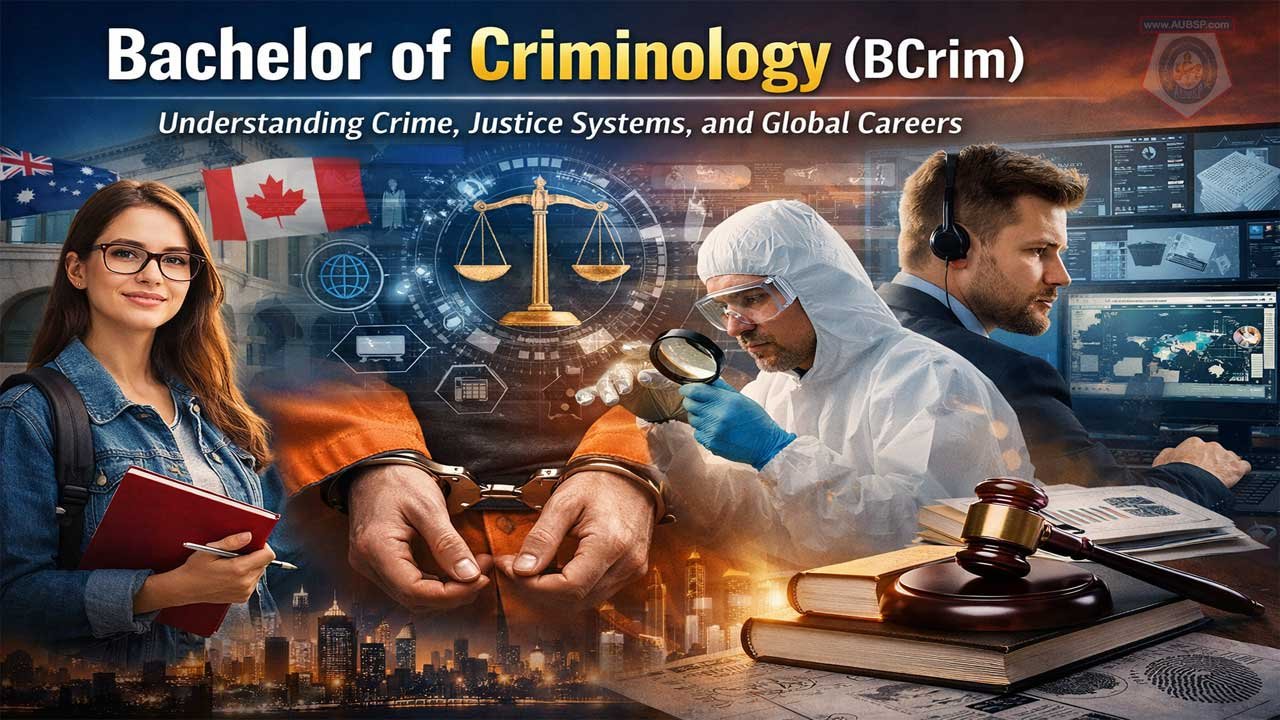
A Bachelor of Criminology (BCrim) is a degree that studies crime, criminal behavior, and how societies respond to it. It combines subjects like sociology, psychology, law, and politics to understand why crime happens and how it can be prevented. The program usually includes core courses in criminology theory, research methods, statistics, and the criminal justice system, along with specializations such as cybercrime, forensic psychology, or social justice.
Many universities also require internships so students gain practical experience. Popular study destinations for international students include Australia, New Zealand, and Canada. Graduates can work in careers such as criminologists, intelligence analysts, detectives, forensic technicians, or policy analysts, helping governments and organizations improve crime prevention and justice systems.
| Information | Details |
|---|---|
| Degree Name | Bachelor of Criminology (BCrim) |
| Study Level | Undergraduate |
| Duration | 3–4 years (depending on country/university) |
| Main Subjects | Criminology Theory, Criminal Justice System, Research Methods, Statistics, Sociology, Psychology |
| Specializations | Cybercrime, Forensic Behavioral Science, Victimology, Social Justice & Policy |
| Top Study Destinations | Australia, New Zealand, Canada |
| Typical Entry Requirements | High school completion with ~3.0 GPA or equivalent |
| English Requirements | IELTS 6.0–6.5 / TOEFL 68–79 / PTE 48–53 / Duolingo 100–105 |
| Experiential Learning | Internships or field placements with justice agencies |
| Career Paths | Criminologist, Intelligence Analyst, Detective, Forensic Science Technician, Policy Analyst |
| Post-Study Work Options | Available in countries like Australia, New Zealand, and Canada |
Bachelor of Criminology (BCrim): Course Overview, Subjects, Universities & Career Opportunities
The academic pursuit of a Bachelor of Criminology (BCrim) represents a significant commitment to understanding the intricate mechanisms of human behavior, social control, and the systemic responses to deviance in modern society. For the international student, this degree is not merely a credential but a multifaceted gateway into the sociological, psychological, and legal frameworks that define how global communities identify and mitigate crime.
The discipline is fundamentally interdisciplinary, drawing heavily from sociology, law, political science, history, and psychology to examine the causes and consequences of criminal activity and the role of the state in enforcement and prevention. As societies grapple with increasingly complex threats—ranging from transnational organized crime to cyber-enabled exploitation—the role of the trained criminologist has evolved from a theoretical observer to a critical data analyst and policy architect.
Theoretical Foundations and the Interdisciplinary Lens
The Bachelor of Criminology is structured to provide a comprehensive overview of crime as a social phenomenon. Unlike more vocational degrees focused solely on the mechanics of law enforcement, criminology treats crime as the product of complex social forces, seeking to understand why laws are established, how they are violated, and how society reacts to such violations. This holistic perspective is essential for international students who may later work in diverse legal and cultural environments, as it fosters the capacity to think critically and creatively about the efficacy of various crime control efforts.
The interdisciplinary nature of the degree is its greatest strength. By adopting academic lenses from biology, psychology, economics, sociology, and even mathematics and statistics, students gain a nuanced understanding of the “how,” “when,” and “why” behind criminal behavior. For instance, a sociological approach might examine how urban life and neighborhood dynamics influence street crime, while a psychological lens focuses on the cognitive processes of the individual offender.
Comparative Disciplinary Frameworks
International students often navigate a choice between Criminology and Criminal Justice. While these fields are deeply interrelated and often share faculty or departments, they maintain distinct philosophical foundations. Criminology is primarily analytical and research-based, focusing on root causes; Criminal Justice, conversely, examines the legal systems that address crime—essentially the practical application of criminological theory.
| Feature | Criminology (Analytical Focus) | Criminal Justice (Procedural Focus) |
|---|---|---|
| Core Objective | Understanding the causes and origins of crime | Examining the operation of justice systems |
| Primary Method | Research-based and theoretical analysis | Application of law and procedural activities |
| Academic Roots | Branch of sociology and psychology | Grounded in law and public administration |
| Career Orientation | Research, policy analysis, profiling | Policing, corrections, court administration |
Curricular Architecture: Core Competencies and Specializations
The curriculum of a Bachelor of Criminology typically requires the completion of 120 credit hours, meticulously balanced between a university’s core curriculum and major-specific requirements. For an international student, the first three years of study generally establish a baseline of theoretical knowledge, followed by specialized electives and capstone projects in the final year.
The Core Criminological Pillar
Foundational courses serve as the bedrock of the degree, ensuring that every graduate possesses a shared vocabulary and methodological toolkit. These courses often include:
- Introduction to Criminology: A high-level overview of the field, examining the definition of crime and the history of criminological thought.
- Criminological Theory: An in-depth analysis of major theoretical perspectives, from classical and biological models to social constructionism.
- Research Methods in Criminology: Instruction on the scientific approach to problem-solving, teaching students to identify assumptions, organiz information, and distinguish between verifiable facts and value claims.
- Social Inquiry and Statistics: The application of quantitative tools to crime data, enabling students to use data analytics to identify behavior patterns and evaluate policy outcomes.
- The Criminal Justice System: A survey of the interdependent operations of law enforcement, the courts, and the correctional system.
Advanced Specializations and Emerging Fields
As students progress, they are encouraged to specialize through elective credits. This flexibility is vital for international students aiming for niche global markets. Courses in Cybercrime examine the digital threads of harassment, exploitation, and terrorism, a sector experiencing significant growth. Victimology explores the experiences of those impacted by crime and how to advocate for restorative justice. Forensic Behavioral Sciences allow students to apply psychology and linguistics within the justice system, preparing them for roles in criminal profiling or behavioral analysis.
| Specialization Area | Focus Subjects | Prospective Career Path |
|---|---|---|
| Forensic Behavioral Science | Forensic Psychology, Profiling, Anthropology | Forensic Psychologist, Profiler |
| Global/Transnational Crime | Terrorism, Global Justice Systems, Cyber Harassment | Intelligence Analyst, Border Patrol |
| Social Justice & Policy | Gender and Crime, Race and Ethnicity, Social Policy | Policy Analyst, Victim Advocate |
| Legal Advocacy | Criminal Law, Theories of Justice, Law Adjudication | Paralegal, Legal Researcher |
Experiential Learning and Field Placement
A hallmark of a prestigious BCrim program is the integration of mandatory field placements or internships. RMIT University, for instance, requires a 50-day internship in the final year, providing students with professional experience in policing, corrections, or community-based agencies. These opportunities are critical for international students to build local professional networks and determine whether their theoretical interests align with the operational realities of the field.
Regional Analysis: Australia, New Zealand, and Canada
Selecting a destination for a Bachelor of Criminology requires an understanding of the local educational landscape and the specific strengths of regional institutions. Australia, New Zealand, and Canada remain the primary hubs for international students due to their globally recognized credentials and robust post-study work frameworks.
Australia: A Hub for High-Ranking Social Studies
Australia is home to several of the world’s top-ranked criminology programs. The University of Melbourne, the University of Sydney, and the University of Queensland are frequently ranked in the top 0.5% globally for their social studies and law disciplines. These institutions are particularly noted for their theoretical and methodological focus, preparing students for both academic research and high-level policy roles.
| Institution | Global Discipline Rank (Law/Social Studies) | 2026 Annual Fee (Estimated) |
|---|---|---|
| University of Melbourne | #35 | AU 45,000 – 50,000 |
| University of Sydney | #40 | AU 46,000 – 49,000 |
| University of Queensland | #41 | AU 41,120 |
| RMIT University | #206 | AU 38,400 |
| Charles Sturt University | N/A | AU 28,320 |
Australian programs often require non-academic screenings, such as a National Police Records Check and a Working with Children Check, which are essential for students participating in field placements within justice organizations.
New Zealand: Indigenous Focus and Community Justice
Criminology in New Zealand is distinguished by its deep commitment to Indigenous perspectives and the examination of colonization’s impact on the justice system. The University of Waikato and Victoria University of Wellington offer unique curricula that engage with mātauranga Māori to understand the mass incarceration of Indigenous people globally.
| Institution | Subject Rank in NZ | Key Feature |
|---|---|---|
| University of Auckland | #135 | Strong Honours and Research programs |
| University of Otago | #175 | Integrated Sociology and Criminology focus |
| Victoria University of Wellington | #218 | Proximity to national governmental agencies |
| University of Waikato | #253 | Comprehensive online and campus delivery |
New Zealand institutions also provide specialized papers such as CRIMN101, which introduces issues in defining criminality and the functioning of the justice system, and advanced research seminars like LEGAL503, which require a supervised research project of up to 12,500 words.
Canada: Interdisciplinary Integration and Professional Breadth
Canadian programs are characterized by their integration into broader social science faculties. Simon Fraser University (SFU), for instance, offers certificates in specialized areas like Correctional Studies, Forensic Studies, and Police Studies alongside the major in Criminology. This breadth allows international students to graduate with a degree that is both theoretically sound and professionally targeted.
| Institution | Duration | 2025-2026 Annual Tuition (CAD) |
|---|---|---|
| Simon Fraser University | 4 Years | CAD 37,442 |
| University of Ottawa | 4 Years | CAD 42,367 |
| Carleton University | 4 Years | CAD 30,000 – 46,500 |
| University of Windsor | 3-4 Years | CAD 28,000 – 35,000 |
The University of Ottawa is particularly attractive for Francophone or Francophile international students, as it offers differential tuition fee exemptions for those enrolled in French-immersion streams.
Admission Mechanics: Navigating Requirements and Standards
For international students, the application process for a Bachelor of Criminology is a multi-step journey that requires careful documentation of academic history and linguistic proficiency. Admission is generally competitive, with high-tier institutions maintaining stringent benchmarks.
Academic Prerequisites and the GPA Benchmark
Applicants typically need to demonstrate a cumulative GPA of at least 3.0 on a 4.0 scale for standard entry into a four-year bachelor’s program. Some state-level universities may accept a lower threshold of 2.25, while elite honors tracks often demand a 3.25 to 3.5 GPA. In Australia, entry is often determined by the ATAR or an equivalent qualification like the Foundation Studies course, with indicative scores ranging from 55 to 70.
Transcripts must be evaluated by recognized agencies (such as NACES members) to ensure they meet the U.S., Australian, or Canadian equivalencies. Additionally, some programs may require or recommend standardized test scores like the SAT or ACT for undergraduate admission, particularly for students coming from non-traditional education systems.
English Language Proficiency Requirements
Since criminology involves heavy critical reading and professional report writing, demonstrating English proficiency is a non-negotiable requirement for non-native speakers. The thresholds vary significantly between general arts colleges and specialized professional schools.
| Test Type | Standard Entry Score | Higher Requirement (e.g., Nursing/Journalism) |
|---|---|---|
| IELTS Academic | 6.0 – 6.5 | 7.0 |
| TOEFL iBT | 68 – 79 | 86 – 100 |
| Duolingo | 100 – 105 | 115 – 120 |
| PTE Academic | 48 – 53 | 58 – 65 |
Exemptions are sometimes granted to students who have completed at least four years of high school in an English-speaking country or who have achieved specific grades in Cambridge IGCSE English.
The Personal Statement: Crafting a Narrative of Intent
A critical component of the application for many high-ranking programs is the personal statement. Admissions tutors look for clarity regarding the student’s motivations and career aspirations. Successful international applicants often highlight a personal fascination with criminal psychology, inspired by documentary evidence, research into notable historical cases, or family backgrounds in law enforcement.
Advice for the personal statement includes:
- Explain the ‘Why’: Be specific about what interests you—whether it is the over-representation of ethnic minorities in crime statistics or the psychology of serial killers.
- Demonstrate Suitability: Reflect on how current studies in psychology, law, or sociology have prepared you for the rigor of criminology.
- Highlight Transferable Skills: Discuss work experience in retail or volunteering at charities to demonstrate empathy and interpersonal skills, which are vital for future roles in rehabilitation or victim advocacy.
Financial Support and Scholarship Frameworks
The cost of an international education is a primary barrier, but a wide array of merit-based and region-specific scholarships exists to support high-achieving students.
- Australia (Charles Darwin University): Offers Global Merit Scholarships covering 30% of tuition fees for undergraduate students, with more generous awards covering 50% for those with outstanding academic records.
- New Zealand (University of Otago): Provides Global Scholarships valued at NZD 15,000 and Vice-Chancellor’s Scholarships for NZD 10,000 to new international bachelor degree students from specific countries including India, China, Malaysia, and Vietnam.
- Canada (University of Ottawa): Features renewable International English Excellence Scholarships ranging from CAD 2,500 to CAD 12,500 per term, depending on the candidate’s country of origin and admission average.
Students are also encouraged to explore government-funded awards like the Australia Awards or the Manaaki New Zealand Scholarships, which provide full tuition and living expenses to eligible citizens from developing countries.
Professional Trajectories: From Theory to High-Impact Careers
A Bachelor of Criminology prepares international students for a diverse range of roles across the justice system and beyond. While many students enter the degree with the goal of joining law enforcement, the analytical skills gained allow for pathways into high-level policy, intelligence, and data science.
Traditional and Alternative Career Paths
Graduates often find themselves in roles that require a deep understanding of human behavior and the legal landscape. The Bureau of Labor Statistics predicts steady growth in demand for these specialized professionals.
| Career Path | Primary Responsibilities | Median Salary (Approximate) |
|---|---|---|
| Criminologist | Compiling data, conducting surveys, and developing crime-prevention policies | USD 92,910 |
| Intelligence Analyst | Analyzing intelligence to determine areas of potential risk for federal bureaus | USD 92,476 |
| Financial Examiner | Monitoring bank protocols and expenses to assess risk and compliance | USD 81,410 |
| Forensic Science Technician | Evaluating crime scene evidence and performing laboratory analysis | USD 66,850 |
| Detective/Criminal Investigator | Gathering facts, collecting evidence, and conducting suspect interviews | USD 90,370 |
Other roles include Victim Advocates, who provide restorative justice for crime victims, and Private Security Managers, which is one of the fastest-growing sectors in criminal justice. It is important to note that many federal law enforcement or intelligence positions in the U.S., Canada, and Australia may require local citizenship or permanent residency. However, roles in data analysis, research firms, and non-profits are often open to international graduates on work visas.
Navigating the Post-Study Work Landscape: 2025 and 2026
For international students, the ability to remain in the host country to gain professional experience is a critical component of their education. The regulations governing these visas are currently undergoing significant transformations in Australia, New Zealand, and Canada.
Australia: The Subclass 485 Visa Updates
The Australian government has introduced a new Migration Strategy for 2025-26, which tightens rules for the Temporary Graduate (subclass 485) visa.
- Age Limit Reduction: Effective for new applications, the age limit has dropped from 50 to 35 for most streams.
- Stay Durations: Graduates of a Bachelor’s degree in city centers like Sydney or Melbourne can now stay for 2 years. Previously, some graduates could stay up to 4 or 6 years under ‘bonus year’ rules which have now been scrapped.
- Regional Bonus: Students who study and live in regional areas (everywhere except Sydney, Melbourne, and Brisbane) remain eligible for an extra 1 to 2 years, bringing their total work rights to 4 years in some cases.
- English Benchmarks: The minimum IELTS score has increased to 6.5 (with no band lower than 5.5), and test results must be no more than one year old at the time of application.
New Zealand: The 2026 Visa Extension
New Zealand is rolling out new options in late 2026 to better align graduate pathways with national skill needs.
- Post-Study Work Visa (PSWV): This visa allows holders to work for up to 3 years depending on their qualification.
- Graduate Diploma Eligibility: From late 2026, eligibility will be extended to students who have completed a Level 7 Graduate Diploma, provided they also hold a bachelor’s degree (from New Zealand or overseas).
- New Short-Term Visa: A ‘Short Term Graduate Work Visa’ will launch in late 2026, offering 6 months of work rights to those who studied in NZ for at least 24 weeks but do not qualify for the full PSWV.
Canada: Post-Graduation Work Permit (PGWP) and CIP Codes
Canada’s PGWP system is evolving to prioritize fields with labor shortages.
- Field of Study Requirement: Graduates who applied for their study permit on or after November 1, 2024, must graduate from an eligible field of study to qualify for a PGWP.
- CIP Code Alignment: Eligible programs are identified by their 6-digit Classification of Instructional Programs (CIP) code. Criminology programs (typically CIP 45.0401) must be verified against the IRCC’s latest eligible list.
- Degree-Level Exemption: Notably, graduates with a bachelor’s, master’s, or doctoral degree are currently exempt from the field of study requirement—meaning they remain eligible for a PGWP regardless of their major.
- List Freeze: For the year 2026, the government has announced a “freeze” on the eligible field of study list, meaning no CIP codes will be added or removed during that calendar year.
Professional Integration: The Role of Associations
Professional societies play an essential role in bridging the gap between academic study and professional practice, providing international students with access to mentors, journals, and networking events.
- ANZSOC (Australian and New Zealand Society of Criminology): Dedicated to promoting criminological research in the region. Membership provides free subscriptions to the Journal of Criminology and opportunities to meet distinguished visiting scholars.
- AIC (Australian Institute of Criminology): Australia’s national research center. Its library and “CINCH” database are vital for students researching local and transnational organized crime.
- CCJA (Canadian Criminal Justice Association): Offers a specialized ‘Student’ membership for CAD 25 per year, providing web access to position statements, annual reports, and publication opportunities in the Justice Report.
Strategic Outlook and Recommendations
The Bachelor of Criminology is more than a study of crime; it is an examination of social equilibrium. For international students, success in this field requires more than just academic diligence—it requires strategic planning regarding geographic placement, linguistic proficiency, and early professional networking.
A critical insight for prospective students is the increasing reliance on data analytics within justice departments. Those who supplement their criminology degree with minors or electives in computer science or statistics will be better positioned for high-paying roles as intelligence or security analysts. Furthermore, international students should prioritize programs with robust internship frameworks, as the practical skills gained during a 50-day placement often serve as the primary catalyst for post-study employment.
As global regulations around student and post-study work visas continue to tighten in 2025 and 2026, staying informed through official immigration portals and professional associations is essential. The BCrim degree offers a powerful intellectual foundation that, when combined with a clear understanding of the professional and regulatory landscape, enables international students to make a profound difference in the world of justice and public policy.
FAQs about Bachelor of Criminology
What is a Bachelor of Criminology?
A Bachelor of Criminology is an undergraduate degree that studies crime, criminal behavior, and how justice systems respond to it. It combines subjects like sociology, psychology, law, and research methods.
How long does it take to complete a Bachelor of Criminology?
The degree usually takes 3 to 4 years to complete, depending on the country and university.
What subjects are included in a criminology degree?
Common subjects include criminological theory, criminal justice systems, research methods, statistics, sociology, psychology, and crime analysis.
What careers can you pursue with a criminology degree?
Graduates can work as criminologists, intelligence analysts, detectives, forensic science technicians, policy analysts, or victim advocates.
Which countries are popular for studying criminology?
Australia, New Zealand, and Canada are popular choices for international students because of their strong universities and post-study work opportunities.
Do criminology programs include internships?
Yes, many universities include internships or field placements with law enforcement agencies, courts, or community organizations to provide practical experience.
What are the English language requirements for international students?
Most universities require IELTS scores of around 6.0–6.5 or equivalent tests such as TOEFL, PTE, or Duolingo.
Is criminology the same as criminal justice?
No. Criminology focuses on studying the causes of crime and criminal behavior, while criminal justice focuses on how the legal and law enforcement systems operate to handle crime.


Leave a Reply
You must be logged in to post a comment.