
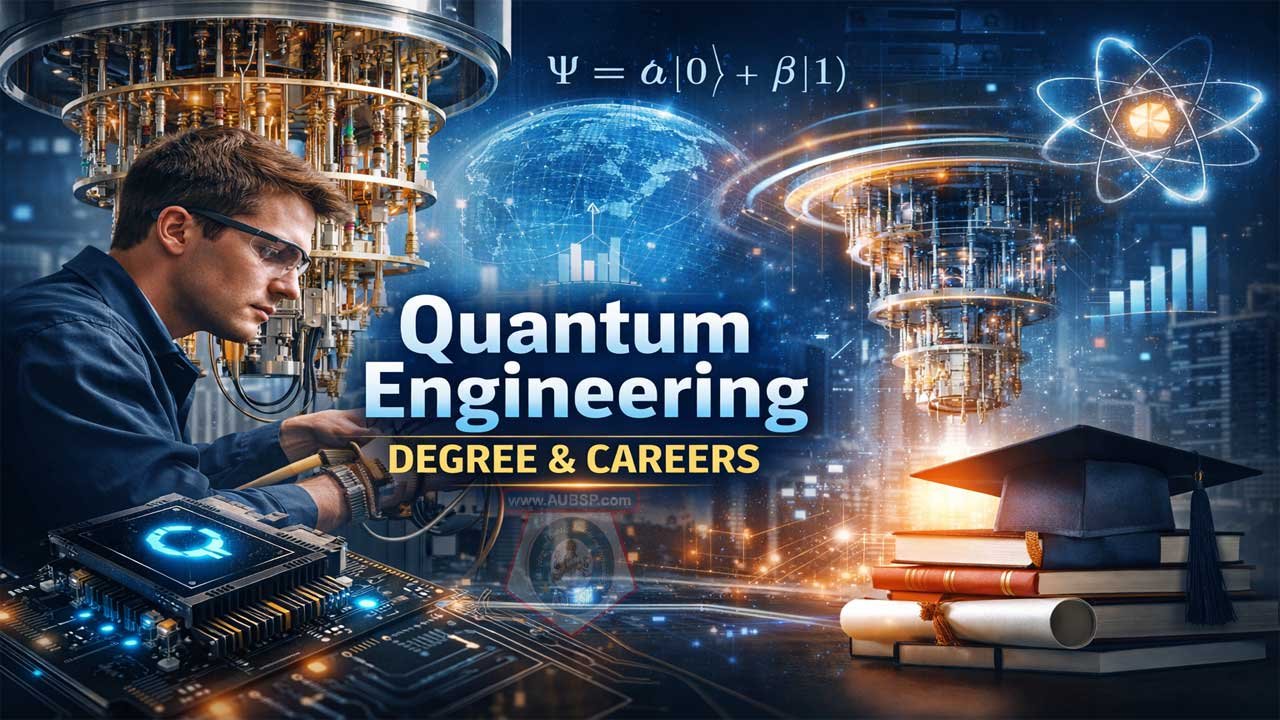
Quantum engineering is becoming a new and important field in higher education. It moves quantum science from theory to real technology. The Bachelor of Engineering in Quantum Engineering trains students in physics, math, electronics, and programming.
It prepares them to build and control quantum systems. Universities such as UNSW Sydney, Colorado School of Mines, TU Delft, and ETH Zurich lead this area. Career demand is growing fast, and salaries are high. Jobs now include hardware, software, and security roles.
Global investment and government funding are also rising quickly. Many scholarships support international students. This degree offers strong career growth and future opportunities in a rapidly expanding industry.
| Category | Information |
|---|---|
| Degree Name | Bachelor of Engineering in Quantum Engineering (BEngQE) |
| Main Focus | Combines quantum physics, electronics, mathematics, and computing |
| Core Subjects | Quantum physics, control electronics, algorithms, systems engineering, programming |
| Key Skills Gained | Quantum system design, hardware control, problem-solving, advanced math, coding |
| Leading Universities | UNSW Sydney, Colorado School of Mines, TU Delft, ETH Zurich |
| Career Paths | Quantum hardware engineer, quantum software developer, systems engineer, security specialist |
| Entry-Level Salary (USD) | ~$80,000 – $120,000 |
| Mid-Career Salary (USD) | ~$120,000 – $200,000 |
| Industry Demand | Rapidly growing with global talent shortage |
| Market Outlook | Multi-billion to trillion-dollar growth projections by 2035 |
| Scholarship Availability | Strong support from universities and governments |
| Why It Matters | Prepares engineers for next-generation computing and secure technologies |
Bachelor of Engineering in Quantum Engineering: Careers, Salaries, and Top Universities
The rapid maturation of quantum information science into a recognized engineering discipline represents one of the most significant paradigm shifts in the history of higher education. For decades, the manipulation of quantum states was confined to the realm of theoretical physics and high-level postgraduate research.
However, as the “second quantum revolution” transitions from proof-of-concept experiments to the industrialization of hardware, the global academic community has identified a critical need for a specialized undergraduate pathway: the Bachelor of Engineering in Quantum Engineering (BEngQE). This degree is designed to produce a new cohort of professionals capable of bridging the gap between fundamental physics and scalable technology.
This article examines the multidisciplinary architecture of the BEngQE, the global landscape of institutions offering this curriculum, the burgeoning career opportunities for international graduates, and the complex economic drivers pushing quantum technology toward a multi-trillion-dollar valuation by 2035.
The Academic Architecture of Quantum Engineering
The Bachelor of Engineering in Quantum Engineering is not merely an extension of physics or electrical engineering; it is a synthesis of several fields tailored to the requirements of sub-nanoscale and high-frequency environments.
Traditional engineering focuses on the behavior of macro-scale objects governed by classical mechanics, where parameters such as position and momentum are deterministic. Quantum engineering, conversely, operates under the Uncertainty Principle, which posits that certain pairs of physical properties cannot be known with infinite precision.
Core Curricular Components and Interdisciplinary Foundations
A standard BEngQE curriculum integrates fundamental physics with the broad skill set necessary to solve contemporary problems in microelectronics, microwave systems, and telecommunications. The primary objective is to train engineers who can leverage the power of quantum mechanics—specifically superposition and entanglement—to deliver solutions that are fundamentally impossible for classical systems.
| Curricular Pillar | Technical Focus and Learning Objectives | Institutional Examples |
|---|---|---|
| Quantum Physics of Solids | Understanding electron behavior in semiconductors and superconductors at the nanoscale. | UNSW Sydney, ETH Zurich |
| Control Electronics | Designing high-frequency (microwave) circuits to manipulate qubits with nanosecond precision. | Colorado School of Mines, Bristol |
| Quantum Algorithms | Developing software for post-Moore computing architectures using Qiskit, Cirq, or Q#. | Waterloo, MIT, Nanyang Technological University |
| Systems Engineering | Managing the integration of cryogenics, vacuum systems, and quantum hardware into a unified machine. | Colorado School of Mines, Bristol |
The transition from theory to hardware is facilitated by courses in Digital Circuit Design, Electronics, and Programming Fundamentals. At the University of New South Wales (UNSW), the degree is offered as a four-year honors program that includes 60 days of industrial training, ensuring that graduates possess the practical experience required by a rapidly evolving industry.
The Mathematical Framework of Quantum Engineering
To operate at the level of a domain expert, a quantum engineer must possess a profound understanding of the mathematical notation used to describe quantum states. The standard representation of a quantum bit, or qubit, in a state of superposition is expressed as:
where and are complex numbers representing probability amplitudes, satisfying the normalization condition . The engineering challenge lies in the implementation of quantum gates—physical operations that transform these states—while maintaining “coherence,” or the stability of the quantum system against environmental noise.
Global Institutional Leaders in Quantum Engineering
The proliferation of BEngQE and related undergraduate degrees is concentrated in regions with high concentrations of research funding and industrial activity. While the United States and Australia were early movers, Europe and the Asia-Pacific region have rapidly expanded their offerings.
The Australian Pioneer: UNSW Sydney
UNSW Sydney is widely recognized for launching the world’s first undergraduate degree in quantum engineering. The program is situated within the School of Electrical Engineering and Telecommunications, Australia’s largest engineering faculty. The curriculum is informed by the university’s world-leading research in silicon-based quantum computing, where researchers have made significant breakthroughs in qubit stability and gate fidelity.
The UNSW model emphasizes “Work Integrated Learning” (WIL) through its ChallEng program, which connects students with industry partners on real-world projects. This approach is designed to produce “graduate employability,” with UNSW graduates being highly preferred by top employers in telecommunications, defense, and microelectronics.
The North American Shift: Colorado School of Mines
In the United States, the Colorado School of Mines has introduced the nation’s first Bachelor of Science in Quantum Systems Engineering. This program is distinct in its focus on the “complete quantum-enabled system.” Rather than focusing solely on the physics of the qubit, the Mines curriculum integrates mechanical engineering, computer science, and engineering design to prepare students to manage the full lifecycle of a quantum product—from design and integration to deployment and scaling.
The Mines program was developed with significant industry input from leaders like Infleqtion and Maybell Quantum. Industry experts noted that the workforce increasingly requires “technicians, welders, and systems-level engineers” rather than just PhD-level researchers. This “systems thinking” is essential for transitioning quantum technology from laboratory prototypes to fielded capabilities in sectors like national security and global positioning.
European Centers of Excellence
Europe maintains a strong presence in the quantum landscape through a mix of dedicated engineering degrees and specialized streams within traditional physics and electronics programs.
| Country | Key Institutions and Programs | Notable Research Focus |
|---|---|---|
| United Kingdom | University of Bristol, Oxford, University College London (UCL). | Quantum photonics, cryptography, and sensing systems. |
| Germany | Karlsruhe Institute of Technology (KIT), Ulm University, Leibniz Universität Hannover. | Nanotechnology, advanced materials, and quantum optics. |
| Netherlands | TU Delft (QuTech), University of Amsterdam. | Fault-tolerant quantum computing and quantum internet. |
| Switzerland | ETH Zurich. | High-precision measurement and quantum control systems. |
Germany, in particular, offers a unique environment for international students due to the strong presence of institutes like Fraunhofer and Max Planck, which drive innovation through public-private partnerships. Many German universities offer quantum engineering programs with low or no tuition fees for international students, making them highly attractive for high-achieving global talent.
The Career Landscape: Salary Benchmarks and Employment Trends
The career outlook for graduates of a BEngQE is exceptionally promising, with demand for talent far outstripping the current supply. Industry data suggests that available positions in the quantum sector increased by 35% between 2022 and 2024.
Entry-Level Compensation and Growth Trajectories
Fresh graduates entering the field can expect some of the highest starting salaries in the engineering sector. Unlike traditional software engineering, quantum engineering requires a specialized understanding of both hardware and software, creating a “talent scarcity” that drives up compensation.
| Experience Level | Salary Range (USD) | Roles and Responsibilities |
|---|---|---|
| Entry-Level (0–2 years) | $80,000 – $120,000 | Junior Developer, Lab Technician, Research Assistant. |
| Mid-Career (3–7 years) | $120,000 – $200,000 | Systems Engineer, Quantum Developer, Project Manager. |
| Senior-Level (8+ years) | $180,000 – $300,000 | Lead Hardware Engineer, Senior Scientist, Algorithm Developer. |
| Executive/Leadership | $250,000 – $500,000+ | VP of Engineering, CTO, Director of Research. |
A unique aspect of the quantum industry is the rapid progression of salary levels. Many entry-level professionals achieve mid-career compensation benchmarks within just 2 to 3 years, compared to the 4 to 5 years standard in other engineering disciplines. Furthermore, technical skills such as “Quantum Error Correction” or “Superconducting Qubit Knowledge” can result in a 10% to 30% salary premium.
Diversification of Roles
The job market for quantum engineers has expanded beyond basic research. New grads are finding roles in diverse areas such as:
- Quantum Hardware Engineer: Designing and assembling the physical components of a quantum computer, with average salaries between $120,000 and $220,000.
- Quantum Algorithm Developer: Writing code that leverages quantum speedups for finance, medicine, and logistics, with salaries reaching $230,000.
- Quantum Security Consultant: Helping enterprises develop “quantum-safe” roadmaps to protect against future decryption threats, earning up to $300,000.
- Technical Writers and Educators: Bridging the gap between scientists and the public, with salaries ranging from $58,000 to $115,000.
Geographically, the highest salaries are found in innovation hubs such as Silicon Valley ($140k–$400k), New York ($130k–$350k), and Boston ($125k–$320k).
Market Projections and the Economic Value of Quantum Engineering
The economic impetus for the BEngQE degree is rooted in the projected growth of the quantum technology market. Analysts anticipate that the transition from “NISQ” (Noisy Intermediate-Scale Quantum) devices to “fault-tolerant” systems will unlock trillions of dollars in value across multiple sectors.
Market Size and Sectoral Impact
As of 2025, the global quantum computing market is valued at approximately $1.3 billion, but it is projected to grow at a Compound Annual Growth Rate (CAGR) of 27.04%, reaching $14.19 billion by 2035. Some high-growth scenarios from McKinsey & Company suggest that the potential economic value across just four industries—chemicals, life sciences, finance, and mobility—could reach $2 trillion by 2035.
| Market Segment | 2035 Projected Valuation (USD) | Primary Economic Driver |
|---|---|---|
| Quantum Computing | $28 Billion – $72 Billion | Simulation of molecular interactions; logistics optimization. |
| Quantum Communication | $11 Billion – $15 Billion | Secure data transmission; quantum-resilient networking. |
| Quantum Sensing | $7 Billion – $10 Billion | High-precision gravity sensors for mining; atomic clocks for navigation. |
The cryptography segment is expected to see the most significant surge, growing from a $0.6 billion valuation in 2024 to over $12 billion by 2035. This is driven by the urgent need for “Quantum-Safe Storage” and encryption-as-a-service to protect national security and financial infrastructure.
Investment Trends and Startup Ecosystems
Investment in quantum technology has moved from speculative venture capital toward strategic institutional funding. In 2024 alone, over $2 billion was invested in quantum startups, a 50% increase from the previous year. While hardware companies like PsiQuantum and Quantinuum received the majority of this funding, there is a noticeable shift toward quantum software and application-specific platforms.
Furthermore, government investment has reached unprecedented levels, with approximately $42 billion in public funding announced globally to support the development of quantum “innovation clusters”. These clusters, emerging in cities like Abu Dhabi, Tokyo, and Chicago, provide fertile ground for BEngQE graduates to launch startups or join regional research initiatives.
Navigating the International Scholarship and Admission Landscape
For international students, the cost of pursuing a BEngQE can be a significant barrier. However, because quantum technology is viewed as a matter of national strategic importance, many universities and governments offer lucrative scholarship programs to attract global talent.
Institutional Scholarship Programs
Leading institutions use scholarships not only to support students but also to build a diverse and high-achieving learning environment.
- UNSW International Scientia Coursework Scholarship: This prestigious award offers either full tuition fee coverage or a $20,000 annual contribution. Eligibility is based on academic merit (typically 85% or higher in secondary school), leadership skills, and extracurricular involvement.
- QuTech Scholarships (TU Delft): Aimed at international students interested in quantum technology, these scholarships cover full tuition fees and provide a contribution toward living expenses.
- Colorado School of Mines Admissions Award: International first-year students can receive up to $8,000 in merit-based aid, which is renewable for four years.
National and Strategic Funding
Governments are increasingly funding international student mobility to ensure their domestic industries have access to the best minds.
| Scholarship Name | Region/Country | Target Group and Benefits |
|---|---|---|
| France Excellence Quantum | France/Netherlands | Funding for students in quantum computing, sensing, and cryptography. |
| National Quantum Scholarships Scheme (NQSS) | Singapore | Master’s and PhD opportunities for individuals studying at autonomous universities in Singapore. |
| Barry Goldwater Scholarship | USA (Mines) | Provides up to $7,500 per year for outstanding sophomores and juniors in STEM research. |
| International Student Award (UNSW) | Australia | A 20% tuition fee reduction for the duration of the program for eligible international students. |
Admissions strategies for these programs often require more than just high test scores. Universities such as UNSW value leadership in “student councils, sports, or volunteer work”. For Indian students, qualifications from partner institutions like VIT, Thapar, or Manipal can lead to “articulation scholarships,” which simplify the transfer process and stack financial benefits.
Conclusion: The Strategic Imperative of Quantum Engineering Education
The emergence of the Bachelor of Engineering in Quantum Engineering is a direct response to the industrialization of the sub-atomic world. As the technology moves from laboratory benches to commercial data centers, the demand for a workforce that understands both the physics of the qubit and the rigors of systems engineering will only intensify.
For the international student, the BEngQE offers a unique “ROI” proposition: a high starting salary, a rapid career trajectory, and the chance to participate in a technology that promises to redefine everything from drug discovery to global security. The global landscape of education is shifting to accommodate this need, with institutions in Australia, North America, and Europe leading the way through innovative curricula and substantial scholarship support.
Ultimately, the quantum engineering degree represents the “post-Moore” future of the tech industry. It is a field where the limits of classical physics are left behind, and the next generation of engineers is trained to build machines that operate on the very edge of the possible. As market valuations climb toward the trillions, the BEngQE will remain the most critical pipeline for the talent that will drive the 21st century’s most essential technological revolution.
FAQs about Bachelor of Engineering in Quantum Engineering
What is a Bachelor of Engineering in Quantum Engineering?
It is an undergraduate degree that combines quantum physics with engineering, electronics, mathematics, and computing to train students to build and work with quantum technologies.
What do students study in quantum engineering?
Students typically study quantum physics, linear algebra, electronics, control systems, programming, quantum algorithms, and systems engineering.
Is quantum engineering different from physics?
Yes. Physics focuses on theory and fundamental science, while quantum engineering emphasizes practical design, hardware, and real-world technology development.
Is quantum engineering a good career choice?
Yes. The field is growing quickly, demand for talent is high, and salaries are among the highest in engineering and deep-tech industries.
What jobs can I get with a quantum engineering degree?
Common roles include quantum hardware engineer, quantum software developer, systems engineer, quantum researcher, and quantum security specialist.
Do I need strong math skills for quantum engineering?
Yes. Mathematics, especially linear algebra and probability, is essential for understanding quantum systems and algorithms.
Do I need coding skills for quantum engineering?
Yes. Programming is important for simulations, algorithms, and working with quantum software frameworks.
What programming languages are useful in quantum engineering?
Python is widely used, along with tools and frameworks such as Qiskit, Cirq, and Q#.
Are quantum engineering salaries high?
Yes. Entry-level salaries are often higher than many traditional engineering fields due to the shortage of skilled professionals.
Which countries offer quantum engineering degrees?
Programs are available in countries such as Australia, the United States, the United Kingdom, the Netherlands, Germany, and Switzerland.
Which universities are known for quantum engineering?
Well-known institutions include UNSW Sydney, Colorado School of Mines, TU Delft, ETH Zurich, University of Bristol, and others.
Is quantum engineering hard to study?
It can be challenging because it involves advanced physics and mathematics, but it is manageable with consistent study and interest.
Can international students study quantum engineering?
Yes. Many universities actively recruit international students and offer scholarships or tuition reductions.
Are scholarships available for quantum engineering?
Yes. Many universities and governments provide merit-based and research-focused scholarships.
What background is best for quantum engineering?
A strong foundation in mathematics, physics, and basic programming is highly beneficial.
Is quantum engineering only about quantum computers?
No. It also covers quantum communication, sensing, cryptography, materials, and measurement technologies.
What is a qubit?
A qubit is the basic unit of quantum information. Unlike a classical bit, it can exist in multiple states at the same time through superposition.
Why is superposition important?
Superposition allows quantum systems to process many possibilities simultaneously, enabling new types of computation.
What is quantum entanglement?
Entanglement is a quantum property where particles become linked, and the state of one instantly relates to another, even at a distance.
What industries use quantum technology?
Industries include computing, cybersecurity, finance, pharmaceuticals, materials science, telecommunications, and defense.
Is quantum engineering future-proof?
While no field is fully future-proof, quantum technology is expected to be highly influential for decades.
Can I switch to quantum engineering from another field?
Yes. Students with backgrounds in physics, electrical engineering, computer science, or mathematics can transition with additional coursework.
Is graduate study required after a quantum engineering degree?
Not always. Many roles are open to bachelor’s graduates, though advanced research roles may require a master’s or PhD.
What skills are most valuable in quantum engineering?
Strong math, problem-solving, programming, electronics knowledge, and systems thinking are highly valued.
How long does a quantum engineering degree take?
Most programs take four years, though structures vary by country and institution.
Is laboratory work part of the degree?
Yes. Many programs include hands-on labs and industry training components.
Why is there high demand for quantum engineers?
Quantum technology is expanding rapidly, but trained specialists are still limited worldwide.
What is quantum coherence?
Coherence refers to the stability of a quantum state. Maintaining coherence is crucial for reliable quantum operations.
What is quantum error correction?
It is a set of methods used to protect quantum information from noise and errors, a major challenge in quantum systems.
Is quantum engineering only for top students?
It is demanding, but motivated students with strong fundamentals can succeed.
Can quantum engineers work in software roles?
Yes. Many positions involve developing quantum algorithms, simulations, and hybrid computing systems.
Can quantum engineers work in hardware roles?
Yes. Hardware engineering is a major part of the field, including circuits, cryogenics, and device fabrication.
What is systems engineering in quantum technology?
It focuses on integrating hardware, software, and supporting infrastructure into functional quantum machines.
Are quantum technologies already in use?
Yes. Early-stage systems exist, though many large-scale applications are still under development.
Is quantum engineering a risky field to enter?
It is emerging and evolving, but investment and research momentum are very strong globally.
Can quantum technology replace classical computers?
Quantum computers are expected to complement rather than fully replace classical systems.
What personal traits help in quantum engineering?
Curiosity, persistence, analytical thinking, and comfort with abstract concepts are very helpful.
Is quantum engineering interdisciplinary?
Yes. It bridges physics, electrical engineering, computer science, and materials science.
Can I study quantum engineering online?
Full degrees are mostly in-person, but many courses and certifications are available online.
What is the job growth outlook for quantum engineering?
Growth is strong, with many reports showing rapid increases in job postings and investment.
Do quantum engineers work only in research labs?
No. Opportunities exist in startups, tech companies, government agencies, and consulting.
What makes quantum engineering unique?
It works with the laws of quantum mechanics to build technologies that classical systems cannot achieve.
Is quantum engineering suitable for long-term careers?
Yes. The field is expected to expand as technologies mature and commercialize.
How can a student prepare early for quantum engineering?
Focus on mathematics, physics, logical thinking, and basic programming skills during school years.


Leave a Reply
You must be logged in to post a comment.