
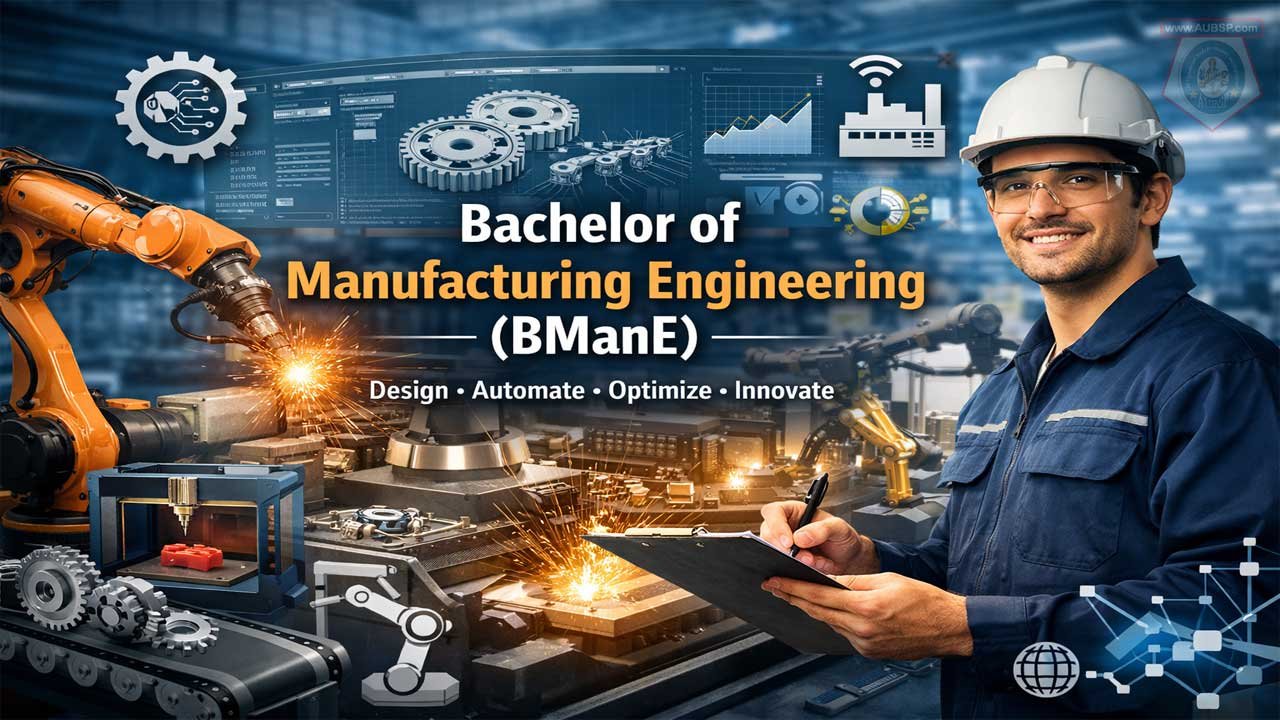
A Bachelor of Manufacturing Engineering (BManE) is a 3–5 year undergraduate degree focused on designing, optimizing, and managing manufacturing processes and production systems to deliver high-quality, cost-effective products at scale.
Unlike mechanical engineering, which centers on designing mechanical systems, BManE emphasizes production efficiency, quality control, automation, and systems integration, blending foundations in mathematics, physics, materials science, and computing with specialized training in manufacturing processes, CAD/CAM, industrial automation, robotics, lean manufacturing, and Industry 4.0 technologies such as AI, IoT, and additive manufacturing.
Graduates develop both technical and managerial competencies, preparing for roles like manufacturing, process, quality, automation, and project engineers across sectors including aerospace, automotive, electronics, energy, and pharmaceuticals. With strong global demand driven by smart manufacturing, sustainability initiatives, and supply chain reshoring, the degree offers solid salary prospects, especially from ABET-accredited programs, and positions graduates as critical links between product design and efficient large-scale production.
| Category | Details |
|---|---|
| Degree Name | Bachelor of Manufacturing Engineering (BManE / B.Man.Eng.) |
| Duration | 3–5 years (most commonly 4 years) |
| Core Focus | Manufacturing processes, production systems, automation, quality, and efficiency |
| Foundation Subjects | Calculus, Physics, Chemistry, Materials Science, Programming |
| Advanced Subjects | Manufacturing Processes, CAD/CAM, Robotics, Industrial Automation, Quality Engineering |
| Specializations | Smart Manufacturing, Additive Manufacturing, Sustainability, Biomanufacturing, Data-Driven Manufacturing |
| Accreditation (US) | ABET (Engineering Accreditation Commission) |
| Typical Industries | Aerospace, Automotive, Electronics, Energy, Pharmaceuticals, Consumer Goods |
| Common Job Roles | Manufacturing Engineer, Process Engineer, Quality Engineer, Automation Engineer, Industrial Engineer |
| US Median Salary | ~$81,400 per year |
| Entry-Level Salary (US) | ~$63,000 per year |
| Growth Outlook | ~12% projected growth (Industrial Engineering category, 2023–2033) |
| Key Skills | Lean Manufacturing, Six Sigma, PLC Programming, CAD/CAM, Data Analytics, Robotics |
| Global Availability | 40+ bachelor’s programs worldwide |
| Tuition Range | ~$10,000–$50,000 per year (varies by country) |
What Is a Bachelor of Manufacturing Engineering?
A Bachelor of Manufacturing Engineering (BManE), also abbreviated as B.Man.Eng., is an undergraduate degree program designed to provide students with the knowledge and skills necessary to design, develop, and improve manufacturing processes and systems. The program typically spans 3 to 5 years depending on the country and institution, and combines theoretical and practical coursework in areas such as materials science, manufacturing processes, quality control, and project management. Manufacturing engineers are innovators who transform ideas into high-quality, cost-effective products — they plan, design, develop, and optimize how products are produced.
Unlike a general mechanical engineering degree, which focuses broadly on designing mechanical systems using physics and materials science, the BManE degree zeroes in on the production side of engineering — ensuring that products are manufactured efficiently, cost-effectively, and at scale while maintaining quality. It examines methods to design, plan, develop, improve, and manage the machinery, processes, and systems that produce the products used daily across all industries.
Core Curriculum and Subjects
The BManE curriculum blends mechanical, materials, electrical, and computer engineering with specialized manufacturing engineering topics, equipping students with both practical and analytical skills. A typical program spans 8 academic semesters, and students complete around 40 credits per year, including complementary studies and technical electives.
Foundational Courses (Years 1–2)
The first two years establish a strong engineering foundation:
- Mathematics: Calculus with Analytic Geometry (I, II, III), Differential Equations, Multivariable Calculus, and Elementary Statistics
- Sciences: General Physics (I & II with labs), Chemistry with lab
- Core Engineering: Introduction to Engineering, Engineering Graphics, Statics and Strength of Materials, Circuits and Electromagnetics, Engineering Materials
- Computing: Programming, Software Design for Engineering
- Communication: Technical Communication, Public Speaking, Argument and Research
Advanced Manufacturing Courses (Years 3–4)
Upper-level coursework dives into specialized manufacturing disciplines:
- Manufacturing Processes: Machining, casting, forming, welding, additive manufacturing, electronic manufacturing, and fabrication techniques
- Production Engineering and Systems Management: Production planning, scheduling, and control systems
- Quality Engineering: Statistical process control, quality assurance, inspection methods
- CAD/CAM: Computer-aided design, computer-aided manufacturing, and CNC programming
- Industrial Automation: Flexible manufacturing systems, programmable logic controllers, industrial robotics
- Materials Science: Advanced materials engineering, composites, ceramics, and powder metallurgy
- Capstone Design Project: A final-year, industry-relevant manufacturing design project
Emerging Specialization Streams
Modern programs increasingly offer specializations aligned with Industry 4.0 trends:
| Specialization | Focus Area |
|---|---|
| Biomanufacturing | Production of biological products like vaccines and pharmaceuticals |
| Sustainability in Manufacturing | Eco-friendly manufacturing processes and green engineering |
| Data-Driven Manufacturing | Big data and analytics for optimizing operations |
| Smart Manufacturing | IoT, AI, automation, and cyber-physical systems |
| Additive Manufacturing | 3D printing design and rapid prototyping |
| Machine Design | Designing and developing advanced manufacturing machinery |
Technical electives at leading universities now include courses such as AI and Machine Learning Applications in Manufacturing, Biomedical Device Manufacturing, Manufacturing for Clean Energy, and Industrial Robotics.
BManE vs. Mechanical Engineering
Manufacturing engineering and mechanical engineering share common foundations, but diverge significantly in focus and career application.
| Aspect | Bachelor of Manufacturing Engineering (BManE) | Bachelor of Mechanical Engineering |
|---|---|---|
| Core Focus | Production processes, systems optimization, factory efficiency | Design, analysis, and testing of mechanical systems |
| Key Skills | Process planning, quality control, automation, lean manufacturing | Stress analysis, thermodynamics, fluid dynamics, CAD design |
| Typical Work | Bridging design to finished product; optimizing production lines | Creating mechanical designs, ensuring structural integrity |
| Day-to-Day Tools | ERP software (SAP), PLM systems, Six Sigma methodologies | 3D CAD software (SolidWorks, Creo, Catia) |
| Industry Role | Middle ground between design engineering and production | Upstream design and development |
| Median Salary (US) | ~$100,640 | ~$95,300 |
Manufacturing engineers essentially act as the bridge between what design engineering produces and an actual finished part, also handling tooling, packaging, and machining coordination with vendors. This makes the BManE degree particularly valuable for those who enjoy both the technical and operational sides of engineering.
Top Universities Offering the BManE Degree
The BManE is offered at institutions across North America, Europe, Asia, and Oceania. Approximately 40+ bachelor’s-level programs in manufacturing engineering are available globally.
North America
- Cal Poly San Luis Obispo (USA): B.S. Manufacturing Engineering — a Learn By Doing program with four curriculum pillars covering materials/processes, product/tooling/assembly, manufacturing systems, and competitiveness
- Robert Morris University (USA): B.S. Manufacturing (Manufacturing Engineering) — the only four-year manufacturing engineering program in western Pennsylvania, ABET-accredited
- University of British Columbia (Canada): B.A.Sc. Manufacturing Engineering — 8-semester program with optional 16-month Co-op and specialization streams including biomanufacturing and AI-driven manufacturing
- University of Texas Rio Grande Valley (USA): B.S. Manufacturing Engineering — one of only two such programs in Texas, with research in additive manufacturing, robotics, and AI
- McMaster University (Canada): B.Tech Manufacturing Engineering Technology — a 4-year program in Ontario
Europe
- Trinity College Dublin (Ireland): B.S. Mechanical and Manufacturing Engineering — a 5-year program ranked #141 in QS Manufacturing Engineering rankings
- Ulster University (UK): B.Eng Mechanical and Manufacturing Engineering — a 4-year program in Northern Ireland
- University of Applied Sciences Upper Austria: B.Sc. in Materials Science and Manufacturing Technology
Asia-Pacific
- University of New South Wales, Sydney (Australia): B.Eng Mechanical and Manufacturing Engineering — ranked #50 in QS Manufacturing Engineering rankings with a 60% acceptance rate
- City University of Hong Kong: BEng Intelligent Manufacturing Engineering — a 4-year program focused on cutting-edge engineering knowledge, computational techniques, and intelligent manufacturing systems
- De La Salle University (Philippines): BS Manufacturing Engineering and Management with Biomedical Engineering specialization
ABET Accreditation
In the United States, several manufacturing engineering programs hold ABET accreditation through the Engineering Accreditation Commission (EAC), including programs at Central State University, Georgia Southern University, North Dakota State University, Wichita State University, and Robert Morris University.
ABET accreditation is widely recognized as the gold standard for engineering education quality assurance, and graduates from ABET-accredited programs enjoy enhanced global mobility for employment and licensure.
Tuition and Program Duration
The cost and duration of a BManE degree vary significantly by country and institution:
| Parameter | Typical Range |
|---|---|
| Duration | 3–5 years (most commonly 4 years) |
| Tuition (Annual) | $10,000–$50,000 per year |
| Australia (UNSW) | ~A$26,400/year (~$18,500 USD) |
| Ireland (Trinity College Dublin) | ~€28,250/year (~$33,600 USD) |
| Canada (McMaster) | ~CA$49,485/year (~$36,600 USD) |
| UK (Ulster University) | ~£17,490/year (~$24,000 USD) |
Many programs also offer optional cooperative education (Co-op) placements of 12–16 months, providing paid industry experience that offsets tuition costs and dramatically improves employment outcomes upon graduation.
Career Prospects and Job Roles
Graduates of a BManE program can pursue careers across a wide range of industries including aerospace, automotive, electronics, consumer goods, energy, pharmaceuticals, and transportation.
Common Job Titles
- Manufacturing Engineer: Plan, design, and optimize manufacturing processes and systems
- Process Engineer: Develop and improve industrial processes for efficiency and cost-effectiveness
- Quality Engineer: Ensure product quality through inspection, testing, and quality management systems
- Project Engineer/Manager: Manage engineering projects from concept to completion
- Automation and Robotics Engineer: Design and implement robotic and automated production systems
- Additive Manufacturing Specialist: Leverage 3D printing for rapid prototyping and custom manufacturing
- Industrial Engineer: Optimize workflows, resources, and production layouts
- Field Engineer/Consultant: Provide on-site technical expertise for manufacturing operations
Salary Expectations
Salary varies significantly by geography, industry, and experience level:
| Region/Level | Salary Range |
|---|---|
| USA — Entry Level | ~$63,376/year |
| USA — 5 Years Experience | ~$74,161/year |
| USA — Median (All Levels) | ~$81,408/year |
| USA — Top Earners | Up to $148,685/year |
| USA — Senior/Leadership | $100,640–$150,000+ |
| India — Average | ~₹21,400/month (~₹2.57 lakh/year) |
Specific manufacturing sub-sectors command even higher premiums. Computer and electronic product manufacturing pays a median of $101,020 annually, while professional, scientific, and technical services pay approximately $102,670. Petroleum and coal products manufacturing and electric power sectors pay even higher, reaching $111,570 and $112,380 respectively.
Job Market Outlook and Demand
The manufacturing engineering job market is experiencing robust growth driven by several converging trends.
Employment Growth Projections
Industrial engineering — the closest BLS category encompassing manufacturing engineering — is the fastest-growing engineering subfield, with a 12% projected growth from 2023 to 2033, equating to 40,900 new jobs nationally in the United States. Mechanical engineering, the closely related field, is projected to grow at 11%, adding 32,100 positions by 2033.
Both growth rates are significantly above the national average of 4% for all occupations. Projections indicate approximately 35,600 new manufacturing engineering roles globally by 2029, reflecting an annual growth rate of 1.36%.
Key Demand Drivers
- Industry 4.0 and Smart Manufacturing: Companies are integrating IoT, big data, digital twins, AI, and collaborative robots into production systems, creating massive demand for engineers who understand these technologies
- Automation Acceleration: The industrial robotics sector was valued at $19.89 billion in 2024, with projections indicating growth to $55.55 billion by 2032, representing a 14.2% compound annual growth rate
- Sustainability and Green Manufacturing: The push for net-zero emissions and circular economy practices has made sustainability engineering a top priority across manufacturing sectors
- Reshoring and Supply Chain Resilience: Manufacturing is returning to domestic markets, with the sector expected to remain the largest employer of mechanical and manufacturing engineers, accounting for 45.4% of the profession
Essential Skills for Success
To thrive as a manufacturing engineer in the current Industry 4.0 environment, graduates need a blend of technical and soft skills.
Technical Skills
- Automation and Robotics: Programming robotic systems, integrating sensors, managing automated production lines, and understanding collaborative robot (co-bot) technologies
- CAD/CAM Proficiency: Advanced competency in Computer-Aided Design and Manufacturing software
- Data Analytics and Digital Literacy: Data management, predictive maintenance, and process optimization using data-driven insights
- Lean Manufacturing and Six Sigma: Continuous improvement methodologies for waste reduction and productivity enhancement
- AI and Machine Learning: Applying predictive analytics and intelligent automation to manufacturing operations
- Additive Manufacturing: 3D printing technologies for rapid prototyping and custom production
- PLC Programming: Programmable Logic Controller programming for industrial control systems
Soft Skills
- Project Management: Managing timelines, budgets, and cross-functional teams
- Problem-Solving: Identifying and resolving production bottlenecks and quality issues
- Communication: Coordinating between design engineers, production staff, and vendors
- Sustainability Awareness: Understanding ESG objectives, renewable materials, and energy efficiency measures
Eligibility and Admission Requirements
Admission criteria for BManE programs generally follow standard engineering admission requirements:
- Academic Prerequisite: Completion of secondary education (10+2 or equivalent) in the science stream with strong performance in physics, chemistry, and mathematics — typically a minimum of 50% aggregate marks or equivalent
- Standardized Tests: Depending on the country, applicants may need to submit SAT scores (e.g., 1130+ for UNSW), or country-specific entrance examinations like JEE in India
- English Proficiency: International students typically require IELTS (6.0–6.5), TOEFL (86+), PTE (60–64), or Duolingo (120+) scores
The Future of Manufacturing Engineering Education
Manufacturing engineering education is rapidly evolving to keep pace with technological transformation. Modern BManE programs are increasingly integrating:
- AI and Machine Learning modules for predictive maintenance and quality optimization
- IoT and Cyber-Physical Systems for smart factory design
- Sustainable and Green Manufacturing practices to address climate change and circular economy requirements
- Digital Twin Technology for virtual simulation of production environments
- Collaborative Robotics and human-robot interaction design
Institutions like BITS Pilani in India now offer B.Tech programs specifically in Smart Manufacturing, reflecting the growing convergence of traditional manufacturing engineering with digital technologies. The City University of Hong Kong has launched a BEng in Intelligent Manufacturing Engineering that integrates computational, experimental, and analytical techniques for technology-based manufacturing systems.
As global supply chains continue to evolve and nations invest in reshoring advanced manufacturing capabilities, the BManE degree positions graduates at the intersection of innovation, technology, and production — making it one of the most versatile and future-proof engineering qualifications available today.
FAQs about Bachelor of Manufacturing Engineering
What is a Bachelor of Manufacturing Engineering (BManE)?
A Bachelor of Manufacturing Engineering (BManE) is an undergraduate degree focused on designing, improving, and managing manufacturing processes, production systems, automation, and quality control to produce goods efficiently and cost-effectively.
How long does a BManE degree take to complete?
The program typically takes 3–5 years to complete, with 4 years being the most common duration in many countries.
What is the main focus of manufacturing engineering?
It focuses on production systems, process optimization, automation, quality assurance, cost efficiency, and scaling products from design to mass production.
How is BManE different from mechanical engineering?
Manufacturing engineering concentrates on production processes and factory systems, while mechanical engineering focuses more on designing and analyzing mechanical components and systems.
What subjects are studied in the first two years?
Students study calculus, differential equations, physics, chemistry, materials science, programming, engineering graphics, statics, circuits, and technical communication.
What advanced courses are included in later years?
Advanced courses include manufacturing processes, CAD/CAM, CNC programming, robotics, industrial automation, quality engineering, production planning, and systems management.
Does the degree include practical training?
Yes, most programs include laboratory work, workshops, internships, co-op placements, and a final-year capstone project.
What is a capstone project in BManE?
A capstone project is a final-year, industry-related engineering project where students design or optimize a manufacturing system or process.
What specializations are available in modern programs?
Common specializations include smart manufacturing, additive manufacturing, sustainability in manufacturing, biomanufacturing, data-driven manufacturing, and machine design.
Is ABET accreditation important?
Yes, ABET accreditation ensures the program meets recognized quality standards and improves global mobility and licensure opportunities.
What industries hire manufacturing engineers?
Industries include aerospace, automotive, electronics, energy, pharmaceuticals, consumer goods, transportation, and heavy manufacturing.
What job roles can graduates pursue?
Graduates can work as manufacturing engineers, process engineers, quality engineers, automation engineers, robotics engineers, industrial engineers, project managers, and consultants.
What is the average salary of a manufacturing engineer in the US?
The median salary is approximately $81,000 per year, with higher earnings possible based on experience and industry.
What is the entry-level salary for BManE graduates?
Entry-level salaries in the US typically start around $63,000 per year, depending on location and employer.
Is manufacturing engineering in demand?
Yes, demand is growing due to Industry 4.0, automation, sustainability initiatives, and supply chain reshoring efforts.
What technical skills are essential for success?
Key skills include CAD/CAM proficiency, PLC programming, robotics integration, data analytics, lean manufacturing, Six Sigma, and automation systems design.
Are soft skills important in this field?
Yes, communication, problem-solving, teamwork, and project management are critical for coordinating production teams and vendors.
What is Industry 4.0 in manufacturing engineering?
Industry 4.0 refers to smart manufacturing technologies such as IoT, artificial intelligence, digital twins, robotics, and cyber-physical systems integrated into production.
Can manufacturing engineers work in sustainability?
Yes, they can focus on green manufacturing, energy efficiency, waste reduction, and circular economy practices.
What is additive manufacturing?
Additive manufacturing is 3D printing technology used for rapid prototyping and customized production.
Is programming required in BManE?
Yes, students learn programming for engineering applications, automation systems, CNC machines, and industrial control systems.
What is CAD/CAM?
CAD/CAM stands for Computer-Aided Design and Computer-Aided Manufacturing, used to design products and control production machinery.
Are co-op programs available?
Many universities offer optional 12–16 month paid co-op placements that provide real industry experience.
What are the admission requirements?
Applicants typically need a strong background in physics, chemistry, and mathematics, along with required standardized test scores depending on the country.
Is English proficiency required for international students?
Yes, tests like IELTS, TOEFL, PTE, or Duolingo are commonly required for non-native English speakers.
Can graduates pursue higher education?
Yes, graduates can pursue master’s or doctoral degrees in manufacturing engineering, industrial engineering, mechanical engineering, or related fields.
Is manufacturing engineering suitable for entrepreneurs?
Yes, the degree provides strong knowledge of production systems, cost optimization, and product scaling, which is valuable for startups and manufacturing businesses.
What tools do manufacturing engineers use daily?
They use ERP systems, PLM software, CAD tools, CNC programming platforms, robotics systems, and quality management software.
Does the degree involve mathematics?
Yes, advanced mathematics including calculus, statistics, and differential equations is essential.
Is manufacturing engineering future-proof?
Yes, due to automation growth, smart factories, and global supply chain shifts, it remains one of the most adaptable and resilient engineering fields.


Leave a Reply
You must be logged in to post a comment.