
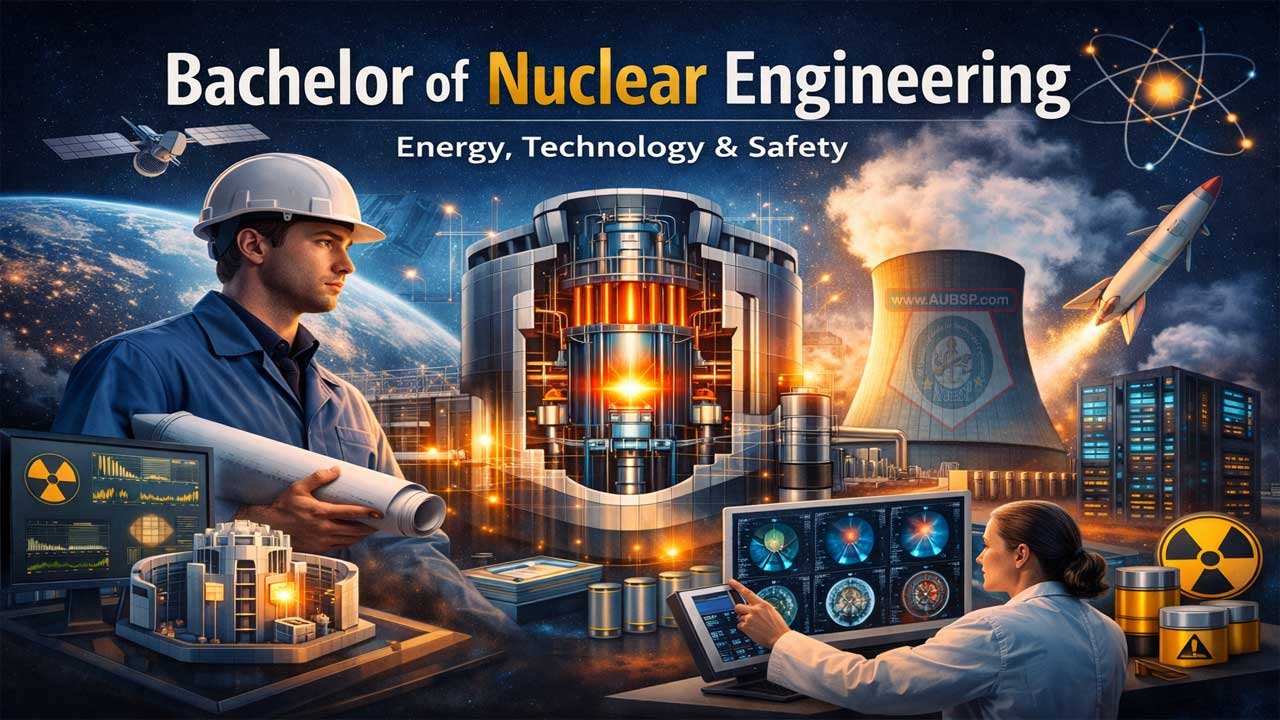
A Bachelor of Nuclear Engineering (BNE), often awarded as a BS in Nuclear Engineering, is a four-year degree that combines physics, mathematics, and core engineering principles with specialised study in reactor physics, radiation detection, thermal hydraulics, nuclear materials, radiation protection, and nuclear fuel cycle management.
Students progress from foundational courses in calculus, chemistry, and physics to advanced reactor design and a senior capstone project, with opportunities to specialise in areas such as reactor operations, fusion energy, nuclear medicine, waste management, or nuclear security. Admission typically requires strong preparation in physics, chemistry, and mathematics, and top programs—such as those at Massachusetts Institute of Technology, University of Michigan, Tsinghua University, and KTH Royal Institute of Technology—often feature research reactors and strong industry links.
Graduates work in power generation, national laboratories, government agencies, defence, medical technology, and emerging sectors like Small Modular Reactors (SMRs), earning some of the highest salaries in engineering. Although official job growth projections are modest, rising global energy demand, decarbonisation goals, AI-driven data centre expansion, and renewed international interest in nuclear power are strengthening long-term prospects for well-trained nuclear engineers.
| Category | Details |
|---|---|
| Degree Name | Bachelor of Nuclear Engineering (BNE) / BS in Nuclear Engineering |
| Duration | 4 years (8 semesters); some 5-year BS/MS options available |
| Core Focus | Nuclear reactor physics, radiation science, thermal hydraulics, nuclear materials |
| Foundation Subjects | Calculus, Physics, Chemistry, Differential Equations, Thermodynamics, Fluid Mechanics |
| Key Skills Developed | Mathematical modelling, radiation analysis, reactor design, safety assessment, simulation |
| Common Specialisations | Reactor Design, Radiation Protection, Fusion Energy, Nuclear Medicine, Waste Management |
| Admission Requirements | Strong background in Physics, Chemistry, Mathematics (high school/10+2) |
| Accreditation (US) | Engineering programs typically accredited by ABET |
| Top Recruiters | National laboratories, utilities, defence agencies, medical technology firms |
| Median Salary (US) | ~$127,520 per year |
| Average Salary (India) | ~₹11.7 LPA |
| Job Outlook | Stable demand; growth driven by SMRs, clean energy transition, AI data centre power needs |
| Career Sectors | Power generation, research labs, government, defence, nuclear medicine, consulting |
Bachelor of Nuclear Engineering (BNE): The Complete Guide to Degree, Career, and Future Outlook
A Bachelor of Nuclear Engineering (BNE) — also commonly awarded as a Bachelor of Science (BS) in Nuclear Engineering — is a four-year undergraduate degree that prepares students to design, develop, and maintain systems that harness nuclear energy and radiation. The program integrates foundational sciences with specialized nuclear topics, equipping graduates for roles in power generation, scientific research, medicine, defence, and environmental protection.
Nuclear engineering is an inherently multifaceted discipline that relies on physics, mathematics, and several branches of engineering to model and simulate complex systems involving nuclear reactions, radiation transport, heat transfer, and fluid flow. With the global push toward clean energy, the renewed interest in Small Modular Reactors (SMRs), and the growing energy demands of artificial intelligence data centres, nuclear engineering remains a strategically vital field of study.
What Is Nuclear Engineering?
Nuclear engineering is the field of engineering that deals with the science and application of nuclear and radiation processes, including the release, control, and utilisation of nuclear energy and the production and use of radiation and radioactive materials. Nuclear engineers work in nuclear systems research, design, development, testing, operation, environmental protection, and regulatory compliance.
The discipline requires engineers with an understanding of the physical processes of nuclear energy and the ability to apply concepts in new and creative ways. Some nuclear engineers focus on environmentally sound, passively safe fission reactors, while others work on nuclear fusion systems, space energy sources, radioactive waste disposal, medical isotopes, and radiation applications in industry and agriculture.
Degree Structure and Duration
A Bachelor of Nuclear Engineering typically takes four years (eight semesters) to complete. Some universities offer accelerated five-year BS/MS combined programs that allow students to earn both a bachelor’s and a master’s degree within five years.
The curriculum is built upon a solid foundation of physics, mathematics, and general engineering, followed by specialised nuclear science and technology coursework. Design concepts are progressively introduced throughout the program, culminating in a senior capstone project involving reactors and radiation systems.
Typical Year-by-Year Progression
| Year | Focus Areas |
|---|---|
| Year 1 | Calculus, General Chemistry, Physics, Introduction to Engineering, Computer Programming |
| Year 2 | Differential Equations, Thermodynamics, Fluid Mechanics, Materials Science, Electrical Engineering Fundamentals |
| Year 3 | Nuclear Reactor Physics, Radiation Detection and Measurement, Reactor Thermal Hydraulics, Nuclear Materials Science |
| Year 4 | Nuclear Reactor Design, Radiation Protection & Health Physics, Nuclear Power Systems, Senior Capstone Design Project |
Core Subjects and Curriculum
The nuclear engineering curriculum combines rigorous theoretical study with hands-on laboratory work and computer simulation. Core subject areas include:
- Nuclear Reactor Physics — Study of neutron-induced fission, reactor criticality, and neutron transport
- Radiation Detection and Measurement — Techniques for measuring alpha, beta, gamma, and neutron radiation
- Reactor Thermal Hydraulics — Heat transfer and coolant flow within reactor cores for energy extraction
- Nuclear Materials Science — Behaviour of materials under radiation exposure and extreme conditions
- Radiation Protection and Health Physics — Principles of radiation shielding, dose limits, and environmental safety
- Nuclear Fuel Cycle Management — Fuel fabrication, enrichment, reprocessing, and waste disposal
- Nuclear Reactor Design — Design of reactor cores, safety systems, and containment structures
- Nuclear Power Economics — Economic analysis of nuclear power plant construction, operation, and decommissioning
Supporting courses typically include differential equations, linear algebra, numerical methods, computer programming (including MATLAB and simulation tools), and engineering ethics.
Specialisations Within Nuclear Engineering
Nuclear engineering offers several areas of specialisation that students can explore through electives and research projects:
| Specialisation | Description |
|---|---|
| Nuclear Reactor Design & Operation | Focus on reactor core design, safety systems, and operational procedures |
| Radiation Protection & Safety | Designing shielding systems and ensuring compliance with radiation dose regulations |
| Fusion Energy & Plasma Physics | Research into fusion power as a future energy source |
| Nuclear Medicine & Medical Physics | Applications of radiation in diagnostics and cancer therapy |
| Nuclear Waste Management | Safe disposal and long-term storage of radioactive waste |
| Nuclear Security & Non-Proliferation | Preventing misuse of nuclear materials and technology |
| Naval Nuclear Propulsion | Nuclear power systems for submarines and aircraft carriers |
Admission Requirements and Eligibility
General Eligibility
Admission to a BNE program generally requires completion of secondary education (high school/10+2) with strong performance in Physics, Chemistry, and Mathematics, with minimum marks typically ranging from 50% to 60% depending on the institution.
Prerequisite Knowledge
A strong foundation in the following areas is essential:
- Mathematics — Calculus, algebra, geometry, trigonometry
- Physics — Mechanics, electromagnetism, and modern physics
- Chemistry — General and introductory chemistry
- Computer Science — Basic programming skills
Entrance Examinations
Admission processes vary by country:
- United States — SAT/ACT scores plus individual university applications; ABET accreditation is critical
- India — JEE Main and JEE Advanced for IITs; state-level entrance exams for other institutions
- Europe — Varies by country; some use national examinations while others accept direct applications with transcripts
- South Korea, Japan, China — National university entrance examinations specific to each country
Top Universities Offering Nuclear Engineering Worldwide
North America
| University | Country | Notable Features |
|---|---|---|
| Massachusetts Institute of Technology (MIT) | USA | Campus research reactor; top-ranked program |
| University of Michigan | USA | Research reactor on campus; broad specialisations |
| Texas A&M University | USA | ABET-accredited; strong industry connections |
| NC State University | USA | ABET-accredited BS program; 5-year BS/MS option |
| UC Berkeley | USA | Emphasis on fusion, medical imaging, waste management |
| Georgia Institute of Technology | USA | BS in Nuclear and Radiological Engineering |
| University of Wisconsin-Madison | USA | Nuclear power-focused curriculum |
| US Naval Academy | USA | Subcritical reactor, neutron generators, strong lab facilities |
| Purdue University | USA | Campus research reactor |
| University of Tennessee Knoxville | USA | Radiological concentration option; accelerated BS/MS |
Asia
| University | Country | Notable Features |
|---|---|---|
| Tsinghua University | China | Top-ranked in Asia for nuclear engineering |
| Xi’an Jiaotong University | China | Major nuclear research centre |
| University of Tokyo | Japan | Globally ranked in nuclear engineering research |
| Tokyo Institute of Technology | Japan | Strong nuclear research programs |
| KAIST (Korea Advanced Institute of Science & Technology) | South Korea | Nuclear engineering and SMR research leadership |
| IIT Kanpur | India | NET Programme; M.Tech via GATE exam |
| IIT Madras | India | #1 NIRF-ranked engineering institute |
| Harbin Engineering University | China | Specialised nuclear energy programs |
Europe
| University | Country | Notable Features |
|---|---|---|
| KTH Royal Institute of Technology | Sweden | MSc in Nuclear Energy Engineering |
| University of Oxford | UK | Nuclear physics research |
| Warsaw University of Technology | Poland | Power Engineering with nuclear focus |
| University Politehnica of Bucharest | Romania | PhD in Nuclear Engineering |
| University of Ljubljana | Slovenia | Doctoral programme in Nuclear Engineering |
In the United States alone, ABET accredits nuclear engineering programs at 16 institutions, plus additional programs offering nuclear engineering concentrations within mechanical or chemical engineering.
Essential Skills for Nuclear Engineers
Success in nuclear engineering demands a combination of technical mastery and professional competencies:
- Mathematical Proficiency — Daily use of differential equations, linear algebra, and statistical analysis for modelling nuclear systems
- Physics Understanding — Deep knowledge of nuclear and radiation physics, including how radiation interacts with matter
- Computational Skills — Proficiency in simulation software, Monte Carlo radiation transport codes, and computational fluid dynamics
- Attention to Detail — Errors in nuclear engineering can have severe consequences; meticulous work habits are non-negotiable
- Problem-Solving — Ability to diagnose unexpected behaviours in complex systems under operational conditions
- Communication — Translating complex technical information for regulators, managers, and the public
- Teamwork — Coordinating with mechanical engineers, electrical engineers, health physicists, and operations personnel
Career Opportunities and Industries
Nuclear engineering graduates have diverse career pathways across multiple sectors:
Key Employment Sectors
| Sector | Roles | Median Salary (USA) |
|---|---|---|
| Electric Power Generation | Reactor operations, safety systems design, maintenance planning | $135,760 |
| Scientific Research & Development | Advanced reactor design, nuclear weapons safety, materials research | $140,070 |
| Federal Government | Regulatory oversight (NRC), policy development, nuclear weapons programs | $116,230 |
| Medical Equipment Manufacturing | Radiation therapy equipment, medical imaging technology | Varies |
| Nuclear Waste Management | Waste disposal strategies, decommissioning planning | Varies |
| Defence & Navy | Nuclear propulsion systems for submarines and carriers | Competitive |
| Consulting & Engineering Firms | Advisory services, safety assessments, project management | Varies |
Top Employers
Major employers include national laboratories (Los Alamos, Oak Ridge, Sandia), utilities and power companies (Duke Energy, Exelon), government agencies (NRC, Department of Energy, Navy Nuclear Propulsion), and private technology companies (NuScale Power, X-energy).
In India, key recruiters include NPCIL (Nuclear Power Corporation of India Limited), BARC (Bhabha Atomic Research Centre), ISRO, DRDO, and the Atomic Energy Regulatory Board (AERB).
Salary and Compensation
Nuclear engineering is among the highest-compensated engineering specialities globally.
United States Salary Data
| Metric | Annual Salary |
|---|---|
| Median Salary (May 2024, BLS) | $127,520 |
| Entry-Level (10th percentile) | ~$88,290 |
| Average Salary | $105,594 |
| 75th Percentile | $118,000 |
| 90th Percentile | $187,430+ |
| Top Earners (DOE Nuclear Engineer) | $144,746 |
Entry-level nuclear engineers with less than one year of experience earn an average total compensation of approximately $78,882, while those with 1–4 years of experience earn around $90,234.
India Salary Data
The average salary of a nuclear engineer in India is approximately ₹11.7 LPA (Lakhs Per Annum). Salaries at organisations such as BARC and NPCIL are structured per government pay scales and include additional allowances and benefits.
Highest-Paying US States
States with the highest wages include Washington, D.C. ($163,610), New Mexico ($147,350), and the Atlanta metropolitan area ($172,830). States with the most nuclear engineering jobs include Washington (~1,410 positions), New Mexico (~1,190), Virginia (~1,190), South Carolina (~970), and Pennsylvania (~730).
Job Outlook and Future Demand
Current BLS Projections
The U.S. Bureau of Labor Statistics projects a modest 1% decline in nuclear engineering employment from 2024 to 2034. Despite this, approximately 800 job openings are projected annually due to retirements and career transitions.
Why the Future Is Brighter Than the Numbers Suggest
Several emerging trends are creating new demand for nuclear engineering graduates:
Small Modular Reactors (SMRs): SMRs represent a paradigm shift in nuclear power, offering modular, factory-fabricated units generating up to 300 MW. Deloitte has identified more than 150 SMRs in development worldwide. These compact designs unlock new markets — from remote communities and military installations to industrial process heat and desalination. U.S. companies are at the cutting edge of SMR development, though competition from China, Russia, South Korea, and Europe is intensifying.
AI and Data Centre Demand: The increasing demand for clean, reliable, 24/7 power from data centres driven by artificial intelligence growth is creating significant new demand for nuclear energy solutions. Big Tech firms are actively seeking nuclear power for their rapidly growing computing infrastructure.
Decarbonisation Goals: With corporate net-zero commitments and government climate targets tightening, nuclear power offers the only scalable solution for carbon-free baseload power that complements intermittent renewables.
Nuclear Renaissance in Developing Countries: Countries across Southeast Asia, the Middle East, and Africa are exploring nuclear energy programs for the first time, creating international demand for nuclear engineering expertise.
Licensing and Professional Certifications
Professional Engineer (PE) Licence
While not universally required in nuclear engineering, PE licensure enhances career prospects, especially for consulting, independent practice, or roles involving public safety oversight. The process involves:
- Passing the Fundamentals of Engineering (FE) exam after completing the bachelor’s degree
- Working for four years under a licensed PE
- Passing the PE exam in nuclear engineering
Security Clearances
Many positions at national laboratories, defence agencies, and Navy nuclear programs require Department of Energy or Department of Defense security clearances — often more critical than PE licensure for employment.
Other Certifications
Specialised certifications exist in health physics, radiation protection, and reactor operations. In the UK, achieving Chartered Engineer status (CEng) or Chartered Chemical Engineer (MIChemE) is a prestigious qualification recognised globally.
Career Advancement Pathway
Nuclear engineering careers typically follow a structured progression:
- Entry-Level (0–4 years): Junior engineer performing calculations, assisting with design, analysing data under experienced mentors
- Mid-Career (5–10 years): Leading design projects, managing safety analyses, earning PE licensure, developing recognised expertise
- Senior Technical Track: Serving as the go-to expert for complex problems, mentoring junior engineers, representing the organisation in technical forums
- Management Track: Engineering manager overseeing teams, plant management, or executive leadership roles
- Career Pivots: Transitioning between power generation, research, consulting, nuclear medicine, or radiation safety
Nuclear Engineering vs. Related Degrees
| Feature | Nuclear Engineering | Mechanical Engineering | Electrical Engineering | Physics |
|---|---|---|---|---|
| Focus | Nuclear systems, radiation, reactors | Thermal systems, mechanics, manufacturing | Circuits, power systems, electronics | Fundamental science, theory |
| Specialisation | Highly specialised | Broad, multi-industry | Broad, multi-industry | Research-focused |
| Median Salary (US) | $127,520 | ~$96,000 | ~$104,000 | ~$82,000 |
| Job Growth (2024–2034) | -1% | ~2% | ~6% | ~5% |
| Typical Employers | Power plants, national labs, government | Manufacturing, aerospace, automotive | Tech, utilities, telecom | Universities, research labs |
| Regulatory Burden | Very high | Moderate | Moderate | Low |
How to Choose the Right Program
Selecting the right nuclear engineering program involves evaluating several key factors:
- ABET Accreditation — Essential for employability and licensing; verify the program is accredited by the Engineering Accreditation Commission of ABET
- Research Facilities — Programs with on-campus research reactors or partnerships with national laboratories offer invaluable hands-on experience
- Internship and Co-op Opportunities — Summer internships at national laboratories, power plants, or Navy facilities can lead directly to full-time job offers
- Combined Degree Options — Accelerated BS/MS programs save time and money while providing a competitive edge
- Faculty Expertise — Look for faculty actively engaged in research areas that align with career goals
- Industry Connections — Strong ties to employers like DOE national labs, utilities, and defence contractors improve placement outcomes
Professional Organisations and Resources
Engagement with professional societies enhances career development, networking, and industry knowledge:
- American Nuclear Society (ANS) — Primary professional body for nuclear engineers in the US; publishes journals, hosts conferences, and offers student chapters
- World Nuclear Association (WNA) — Provides international perspectives on nuclear energy policy and technology
- North American Young Generation in Nuclear (NAYGN) — Supports early-career professionals with networking events and development workshops
- European Nuclear Society (ENS) — Connects nuclear professionals across Europe with educational and training resources
- Indian Nuclear Society (InS) — Professional body for nuclear scientists and engineers in India
Conclusion
A Bachelor of Nuclear Engineering offers a pathway into one of the most intellectually demanding and well-compensated engineering fields. While traditional job growth metrics appear modest, the convergence of SMR development, AI-driven energy demand, global decarbonisation goals, and nuclear renaissance in developing nations is reshaping the field’s future outlook.
Graduates with ABET-accredited degrees, strong computational skills, and hands-on reactor experience are positioned for rewarding careers across power generation, scientific research, defence, medicine, and the emerging SMR industry.
For students worldwide considering this degree, the key to success lies in choosing an accredited program with strong research facilities, pursuing internships early, and staying engaged with the rapidly evolving landscape of nuclear technology and policy.
FAQs about Bachelor of Nuclear Engineering
What is a Bachelor of Nuclear Engineering (BNE)?
A Bachelor of Nuclear Engineering is a four-year undergraduate degree focused on the design, analysis, and operation of nuclear energy and radiation systems, including reactors, fuel cycles, and radiation safety technologies.
How long does it take to complete a BNE degree?
The degree typically takes four years (eight semesters) to complete, although some universities offer accelerated five-year combined BS/MS programs.
What subjects are studied in nuclear engineering?
Students study calculus, physics, chemistry, thermodynamics, fluid mechanics, nuclear reactor physics, radiation detection, nuclear materials, reactor thermal hydraulics, and radiation protection.
Is nuclear engineering difficult?
Yes, it is considered one of the more challenging engineering disciplines because it requires strong mathematical skills, deep understanding of physics, and careful attention to safety and regulatory standards.
What are the admission requirements for nuclear engineering?
Admission usually requires strong performance in Physics, Chemistry, and Mathematics at the high school level, along with entrance exams or standardized tests depending on the country.
What skills are essential for nuclear engineers?
Key skills include mathematical modelling, computational simulation, analytical thinking, problem-solving, attention to detail, teamwork, and technical communication.
What careers can I pursue with a nuclear engineering degree?
Graduates can work in nuclear power plants, national laboratories, government agencies, defence, medical imaging and radiation therapy equipment, nuclear waste management, and research institutions.
What is the average salary of a nuclear engineer?
In the United States, the median salary is approximately $127,520 per year, while in India the average salary is around ₹11.7 LPA, depending on experience and employer.
Is nuclear engineering in demand?
While overall job growth is modest, demand remains steady due to retirements, clean energy goals, Small Modular Reactor development, and rising electricity demand from data centres.
What is a Small Modular Reactor (SMR)?
An SMR is a compact nuclear reactor designed for modular construction and enhanced safety, typically generating up to 300 megawatts of electricity.
Can nuclear engineers work in medicine?
Yes, nuclear engineers contribute to nuclear medicine, medical imaging, radiation therapy systems, and the production of medical isotopes.
Do nuclear engineers need a license?
A Professional Engineer (PE) license is not always required but can improve career prospects, especially in consulting and public safety roles.
What industries hire nuclear engineers?
Industries include electric utilities, government agencies, defence organizations, research laboratories, consulting firms, and medical technology companies.
Is nuclear engineering a good career choice?
Yes, it offers high earning potential, intellectually challenging work, and strong relevance in clean energy and advanced technology sectors.
What is the difference between nuclear engineering and mechanical engineering?
Nuclear engineering focuses specifically on nuclear reactions, radiation, and reactor systems, while mechanical engineering covers broader areas such as manufacturing, mechanics, and thermal systems.
Can I pursue higher studies after a BNE?
Yes, graduates often pursue a Master’s or PhD in nuclear engineering, reactor physics, fusion energy, health physics, or related fields.
Are there research opportunities during the degree?
Many universities offer undergraduate research opportunities in reactor laboratories, radiation labs, or partnerships with national research facilities.
Is nuclear engineering safe as a profession?
Yes, the industry operates under strict safety and regulatory frameworks, and professionals are trained extensively in radiation protection and safety standards.
What countries offer strong nuclear engineering programs?
Leading programs are available in the United States, China, Japan, South Korea, India, Sweden, and several European countries.
Can nuclear engineers work internationally?
Yes, nuclear engineering skills are globally transferable, particularly in countries developing or expanding nuclear energy programs.
What is nuclear reactor physics?
It is the study of neutron behavior, fission reactions, reactor criticality, and the principles governing energy production in nuclear reactors.
What is radiation protection and health physics?
It is the field focused on protecting people and the environment from harmful effects of radiation through shielding, monitoring, and regulatory compliance.
Is coding required in nuclear engineering?
Yes, programming and simulation tools are widely used for modelling reactors, radiation transport, and thermal systems.
What are the main specialisations in nuclear engineering?
Specialisations include reactor design, radiation safety, fusion energy, nuclear waste management, nuclear security, and nuclear medicine.
What is the job outlook for nuclear engineers?
Although projected growth is slow overall, steady job openings are expected due to retirements and emerging nuclear technologies.
Do nuclear engineers work only in power plants?
No, they also work in research labs, defence, space energy systems, regulatory agencies, consulting, and medical technology sectors.
Is nuclear engineering environmentally friendly?
Nuclear energy produces low carbon emissions during operation and plays a significant role in global decarbonisation strategies.
What is the nuclear fuel cycle?
It includes uranium mining, fuel enrichment, reactor use, spent fuel management, reprocessing, and radioactive waste disposal.
Are internships important in nuclear engineering?
Yes, internships at power plants, national labs, or regulatory agencies significantly improve employment prospects.
What professional organizations support nuclear engineers?
Organizations such as the American Nuclear Society and the World Nuclear Association provide networking, conferences, and career development resources.
Can nuclear engineers work in defence?
Yes, many work in naval nuclear propulsion, weapons safety, and national security roles, often requiring security clearance.
Is nuclear engineering suitable for students interested in clean energy?
Yes, nuclear power is a major source of low-carbon baseload electricity and is central to many clean energy strategies worldwide.
What makes nuclear engineering unique compared to other engineering fields?
Its combination of advanced physics, strict safety regulation, high societal impact, and strategic global importance makes it one of the most specialized and technically demanding engineering disciplines.


Leave a Reply
You must be logged in to post a comment.