
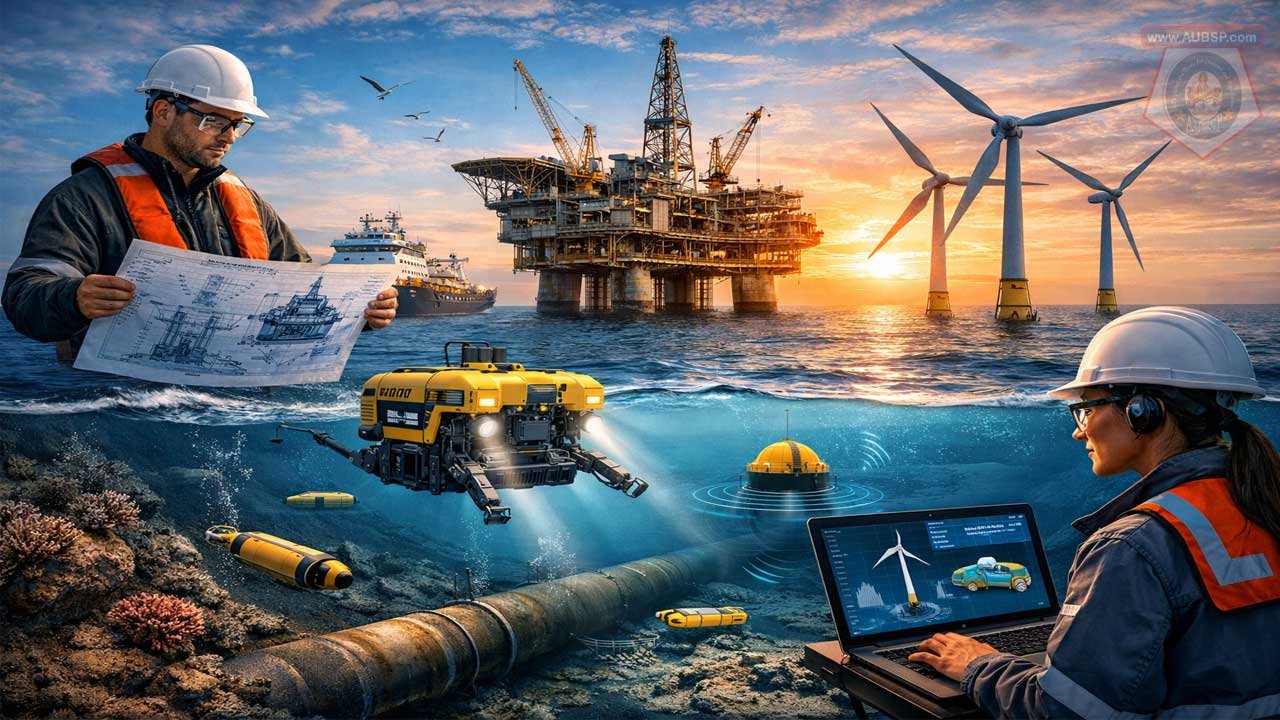
Ocean engineering is an interdisciplinary field that focuses on designing, building, and maintaining structures and systems that operate in or near the ocean—such as offshore platforms, coastal infrastructure, underwater instruments, and marine renewable energy systems—by applying principles from civil, mechanical, electrical, chemical, and acoustic engineering along with ocean science.
Unlike marine engineering, which concentrates on shipboard machinery and propulsion, ocean engineering addresses broader ocean-based infrastructure and collaborates closely with oceanographers and environmental scientists. A Bachelor of Ocean Engineering, offered by institutions such as the University of Rhode Island and Texas A&M University, typically spans four years and combines foundational engineering sciences with specialized coursework in hydrodynamics, coastal engineering, ocean acoustics, offshore structures, and marine renewable energy.
Graduates pursue careers in offshore energy, coastal protection, naval defense, marine research, and underwater robotics, benefiting from strong salary prospects and growing global demand driven by offshore wind expansion, sustainable infrastructure needs, and the broader blue economy.
| Category | Information |
|---|---|
| Field | Interdisciplinary engineering focused on ocean-based structures and systems |
| Degree | B.S./B.Tech in Ocean Engineering |
| Duration | 4 years (8 semesters) |
| Eligibility | 10+2 with Physics, Chemistry & Mathematics (50–60% minimum) |
| Core Subjects | Fluid Mechanics, Hydrodynamics, Coastal Engineering, Ocean Acoustics, Offshore Structures |
| Top Recruiters | Offshore energy firms, naval defense, marine research institutes, shipbuilding companies |
| Average Salary (US) | ~$65,000 entry-level; ~$146,000 average |
| Key Industries | Offshore wind, oil & gas, coastal infrastructure, marine renewable energy |
| Job Outlook | 6–8% growth (driven by offshore wind & blue economy expansion) |
| Top Skills | Mathematics, CAD/CAE, ocean dynamics, problem-solving, teamwork |
What Is Ocean Engineering?
Ocean engineering is an interdisciplinary field concerned with the design, development, and operational evaluation of systems and structures that function in or adjacent to the ocean. This includes coastal structures like harbours and piers, offshore platforms, underwater life-support systems, and ocean wave energy conversion systems. Unlike oceanography, which focuses on studying natural ocean processes, ocean engineering applies engineering principles to build and maintain infrastructure that harnesses ocean resources and withstands harsh marine conditions.
The field draws on knowledge from acoustic, civil, electrical, mechanical, and chemical engineering, combining these with an understanding of how oceans behave. Ocean engineers must account for high winds, waves, storms, marine life fouling, and corrosion to ensure that instruments and structures continue to function correctly. Disciplines supporting ocean engineering include materials and fabrication, control and robotics, continuum mechanics, dynamical system theory, design methodology, mathematical analysis, and statistics.
How Ocean Engineering Differs from Marine Engineering
Although often grouped together, ocean engineering and marine engineering are distinct disciplines with different focal points.
| Aspect | Ocean Engineering | Marine Engineering |
|---|---|---|
| Primary Focus | Structures and systems in or adjacent to the ocean — offshore platforms, coastal infrastructure, wave energy systems | Design, construction, and maintenance of shipboard propulsion and machinery systems |
| Scope | Broad — includes coastal modelling, underwater acoustics, marine geo-mechanics, offshore structures | Vessel-specific — engines, HVAC, power generation, structural integrity of ships |
| Work Environment | Coastal zones, offshore installations, research labs, deep-sea exploration | Onboard ships, shipyards, docks, and marine vessel manufacturing |
| Collaboration | Works closely with oceanographers, environmental scientists, and civil engineers | Collaborates with naval architects and ship engineers |
Ocean engineering is increasingly branching out to collaborate with oceanographers so that research expeditions can explore previously uncharted ocean sectors, contributing to ocean bed studies, underwater current tracking, and evolutionary pattern research.
Bachelor of Ocean Engineering: Program Overview
A Bachelor of Ocean Engineering (BOE) — often designated as B.S. in Ocean Engineering or B.Tech in Ocean/Naval Architecture Engineering — is typically a four-year undergraduate program (eight semesters) requiring approximately 126–130 credit hours. The curriculum fuses foundational engineering sciences with specialized ocean-focused coursework to prepare graduates for professional careers or advanced study.
Admission Eligibility
Eligibility requirements vary by country and institution, but common criteria include:
- Academic Qualification: Completion of high school (10+2 or equivalent) with Physics, Chemistry, and Mathematics (PCM) as core subjects, with a minimum aggregate of 50–60% marks.
- English Proficiency: A minimum of 50% marks in English at the 10th or 12th standard level is often required, particularly for programs in India.
- Entrance Exams: Many programs require qualifying scores on standardized tests such as JEE Main, IMU CET, state-level engineering entrance exams (India), SAT/ACT (USA), or equivalent international assessments.
- Age Limit: Some institutions impose an age limit — typically below 25 years at the time of program commencement.
- International Students: TOEFL (79–100), IELTS (6.0–7.5), Duolingo (105–125), or PTE (53–65) scores are typically required for non-native English speakers.
Core Curriculum Structure
The BOE curriculum is structured to build from foundational sciences toward increasingly advanced ocean-specific engineering. Using the University of Rhode Island (URI) and University of New Hampshire (UNH) as representative examples, the typical progression follows this pattern:
Year 1 — Foundations:
- Calculus I & II, General Chemistry, Elementary Physics
- Foundations of Engineering, Programming
- Introduction to Ocean Engineering and Oceanography
Year 2 — Engineering Core:
- Mechanics of Solids, Fluid Mechanics, Thermodynamics
- Differential Equations, Numerical Methods
- Statics, Dynamics, and Materials Science
Year 3 — Specialized Ocean Coursework:
- Ocean Instrumentation, Waves and Tides
- Coastal Engineering, Ocean Measurements
- Ocean Acoustics, Marine Hydrodynamics
- Vibration of Floating Structures
Year 4 — Advanced Topics and Capstone:
- Design of Ocean Structures, Advanced Ocean Systems
- Two-semester Senior Capstone Design Project
- Professional and Technical Electives
Students also complete courses in arts, humanities, and social sciences to provide a well-rounded education. Technical elective options often include coastal engineering, marine construction, offshore structure design, and marine renewable energy systems.
Specializations Within Ocean Engineering
Ocean engineering encompasses several areas of specialization, allowing students and professionals to develop focused expertise:
- Hydrodynamics: Studies how water flow affects structures and objects in its path, including drag reduction, fluid-structure interaction, and cavitation.
- Underwater Acoustics: Uses sound waves to study the ocean floor, enabling mapping, navigation, and submarine communication.
- Coastal Modelling: Applies physics and mathematics to predict tidal changes, erosion rates, and coastline evolution.
- Marine Geo-mechanics: Examines changes to the seabed from erosion, earthquakes, slope deformities, and human-made intrusions.
- Offshore Structures: Focuses on how synthetic structures (piers, tide breaks, pipelines, oil rigs) affect coastlines and ocean floors.
- Marine Renewable Energy: Dedicated to harnessing the ocean’s energy through offshore wind, wave energy, tidal energy, and floating turbine platforms.
- Oceanography (Applied): An integrated understanding of ocean physics, chemistry, and ecology, including the impacts of global change and the blue economy.
- Design, Production, and Management: Focuses on making marine structures more efficient to build, using set-based design methodology, optimization, and advanced manufacturing.
Contemporary research areas also include tsunami propagation, sea-bed mechanics, computational methodologies for nonlinear waves, dynamic positioning of mobile offshore bases, and hydroelastic behaviour of floating airports.
Top Universities Offering Ocean Engineering Programs
Several globally respected institutions offer undergraduate programs in ocean engineering or closely related disciplines:
| University | Country | Program | Duration | Key Details |
|---|---|---|---|---|
| United States Naval Academy | USA | B.S. Ocean Engineering | 4 years | Ranked #1 for ocean engineering bachelor’s programs |
| Florida Institute of Technology | USA | B.S. Ocean Engineering | 4 years | Strong focus on coastal and marine technology |
| University of Rhode Island | USA | B.S. Ocean Engineering | 4 years | ABET-accredited; 126-credit curriculum |
| University of New Hampshire | USA | B.S. Ocean Engineering | 4 years | ABET-accredited; emphasis on acoustics and instrumentation |
| Texas A&M University | USA | B.S. Ocean Engineering | 4 years | Largest graduating class — 46 bachelor’s degrees in 2023 |
| Florida Atlantic University | USA | B.S. Ocean Engineering | 4 years | Early career salary ~$67,941 |
| Virginia Tech | USA | B.S. Ocean Engineering | 4 years | Strong aerospace and ocean engineering department |
| University of Strathclyde | UK | B.Eng Naval Architecture with Ocean Engineering | 4 years | Tuition ~£22,250/year |
| IIT Kharagpur | India | B.Tech Ocean Engineering & Naval Architecture | 4 years | Premier Indian institution with comprehensive curriculum |
| Technical University of Berlin | Germany | Related naval/ocean programs | Varies | Strong European engineering tradition |
| DTU (Technical University of Denmark) | Denmark | M.Sc. Ocean Engineering (with specializations) | 2 years | Specializations in Oceanography and Applied Ocean Technology |
In the United States, approximately 165 students earn bachelor’s degrees in ocean engineering annually, with 27% identifying as women and 73% as men. Texas produces the most ocean engineering graduates.
Career Paths and Job Roles
A Bachelor of Ocean Engineering opens doors to diverse career opportunities across multiple industries:
Primary Job Roles
- Ocean/Marine Engineer: Designs and develops marine systems, offshore platforms, and coastal structures.
- Coastal Engineer: Plans and designs structures that protect shorelines, manage erosion, and support harbour infrastructure.
- Offshore Structure Engineer: Designs oil rigs, subsea pipelines, and offshore wind platforms.
- Oceanographic Researcher: Conducts studies on marine environments, underwater mapping, resource exploration, and coastal zone management.
- Project Engineer (Marine): Oversees planning, execution, and management of marine engineering projects.
- Naval Architect: Designs the form and structure of ships and marine vessels.
- Marine Renewable Energy Engineer: Develops offshore wind farms, wave energy converters, and tidal energy systems.
- Underwater Acoustics Engineer: Designs sonar systems, underwater communication equipment, and ocean floor mapping technologies.
- Environmental/Sustainability Consultant: Advises on coastal zone management, environmental impact assessments, and sustainable marine resource development.
Industries That Hire Ocean Engineers
- Offshore oil and gas exploration
- Renewable energy (offshore wind, wave, tidal)
- Naval defence and military (Navy, Coast Guard, DRDO, ISRO in India)
- Shipbuilding and marine transportation
- Coastal infrastructure and harbour construction
- Marine research institutions (NIOT, NOAA, oceanographic labs)
- Environmental consulting and coastal management
- Underwater robotics and autonomous vehicles
Salary Expectations
Ocean engineering is among the higher-paying engineering disciplines, reflecting the specialized skills and demanding work environments involved.
United States
| Metric | Salary (USD) |
|---|---|
| Average Annual Salary | $146,868 |
| Average Hourly Wage | $70.61 |
| Entry-Level (< 1 year experience) | ~$65,000 |
| Early Career (1–4 years) | ~$81,951 |
| Mid-Career Average | ~$98,510 |
| Top Earners (90th percentile) | $173,000+ |
| Highest Reported Pay | $160,000+ |
The average starting salary for undergraduate ocean engineering graduates is approximately $64,763. Salary growth potential is significant, with advancement into management, specialized consulting, or senior engineering roles.
India
In India, ocean and marine engineers in government roles can expect salaries ranging from Pay Level 7 to Pay Level 11, corresponding to approximately ₹44,900 to ₹1,42,400 per month. Private sector salaries for marine engineers typically range from ₹25,000 to ₹50,000 per month at entry level, increasing substantially with experience and specialization.
Job Outlook and Future Demand
The employment outlook for ocean engineers is strongly positive, driven by several converging global trends.
Growth Projections
Employment of marine engineers and naval architects is projected to grow 6–8% from 2023 to 2034, faster than the average for all occupations. Approximately 600–900 openings are expected annually, many resulting from retirements and career transitions.
Key Growth Drivers
Offshore Wind Energy: The offshore wind energy market was valued at $76.9 billion in 2025 and is projected to grow at a CAGR of 12.2% from 2026 to 2035. The United States alone has over 50 GW of offshore wind capacity in various stages of development. Floating offshore wind is expected to reach 56.2 GW by 2040, rising dramatically in the 2030s. This creates unprecedented demand for installation engineers, marine operations coordinators, floating platform designers, and maintenance specialists.
Blue Economy Expansion: The World Economic Forum’s Future of Jobs Report 2025 projects 22% total job churn by 2030, with climate-change mitigation ranking as the #3 most transformative trend. Environmental stewardship has entered the top-10 fastest-growing skills for the first time.
Coastal Infrastructure: As coastal communities grow globally and face rising sea levels, the need for engineers who can design flood control systems, coastal defences, and sustainable harbour infrastructure continues to accelerate.
Sustainability and Green Transition: There is increasing demand for professionals who can lead sustainable engineering solutions in maritime environments, particularly in green fuels, automation, and innovation at sea.
Ocean Engineering vs. Related Degrees
Prospective students often compare ocean engineering with related disciplines. Here is how these programs differ:
| Degree | Focus | Typical Career |
|---|---|---|
| Ocean Engineering | Systems and structures in/adjacent to the ocean — platforms, coastal infrastructure, energy conversion | Offshore engineer, coastal engineer, renewable energy engineer |
| Marine Engineering | Shipboard systems — propulsion, power generation, onboard machinery | Ship engineer, marine surveyor, vessel designer |
| Naval Architecture | Hull design, vessel form, stability, and structural integrity of ships | Naval architect, ship designer, classification surveyor |
| Oceanography | Scientific study of the ocean — physical, chemical, biological processes | Oceanographer, marine scientist, climate researcher |
| Coastal/Environmental Engineering | Shoreline protection, environmental impact, water quality | Environmental consultant, coastal planner |
Skills Required for Success
Ocean engineering demands a blend of technical expertise and soft skills:
- Technical Skills: Proficiency in fluid mechanics, hydrodynamics, structural analysis, thermodynamics, materials science, and CAD/CAE software.
- Mathematical Foundations: Strong skills in calculus, differential equations, numerical methods, and statistical analysis.
- Oceanographic Knowledge: Understanding of wave dynamics, tidal forces, current movements, and ocean environmental conditions.
- Programming: Competence in computational tools such as MATLAB, Python, and simulation software for modelling marine systems.
- Problem-Solving: Ability to design structures that withstand extreme and unpredictable ocean conditions.
- Teamwork and Communication: Collaboration with multidisciplinary teams including scientists, architects, and policy makers.
How to Apply: Step-by-Step Guide
- Research Programs: Identify accredited programs at universities offering B.S. or B.Tech in Ocean Engineering. Check ABET accreditation for US programs.
- Meet Academic Requirements: Ensure strong grades in Physics, Chemistry, and Mathematics at the high school level (minimum 50–60% aggregate).
- Take Entrance Exams: Register for and complete required entrance examinations — JEE Main/Advanced (India), SAT/ACT (USA), or equivalent.
- Prepare Language Proficiency Scores: International students should take TOEFL, IELTS, PTE, or Duolingo as required by the target institution.
- Submit Applications: Apply through the university’s admissions portal with transcripts, test scores, letters of recommendation, and a statement of purpose.
- Secure Financial Aid: Explore scholarships, assistantships, and financial aid options offered by institutions and external bodies.
- Complete Medical Fitness Requirements: Some programs, especially those linked to maritime certification, require medical fitness clearance.
Conclusion
A Bachelor of Ocean Engineering offers a unique pathway into one of the most dynamic and high-impact engineering fields of the 21st century. With oceans covering more than 70% of the Earth’s surface, the demand for engineers who can design sustainable coastal infrastructure, develop offshore energy systems, and explore deep-sea environments is growing rapidly.
Strong salary prospects, diverse career options across defence, energy, research, and infrastructure, and the accelerating global transition toward marine renewable energy make this degree an increasingly attractive choice for students worldwide. Whether the goal is to work on floating wind farms, design resilient coastal defences, or pioneer underwater exploration technologies, ocean engineering provides the interdisciplinary foundation to make a meaningful impact.
FAQs about Ocean Engineering
What is ocean engineering?
Ocean engineering is a branch of engineering focused on designing, developing, and maintaining structures and systems that operate in or near the ocean, such as offshore platforms, coastal infrastructure, underwater vehicles, and marine renewable energy systems.
How is ocean engineering different from marine engineering?
Ocean engineering focuses on offshore and coastal structures, wave energy systems, and ocean-based infrastructure, while marine engineering primarily deals with shipboard machinery, propulsion systems, and onboard power systems.
What degree is required to become an ocean engineer?
A Bachelor of Science (B.S.) or Bachelor of Technology (B.Tech) in Ocean Engineering is typically required, and some professionals pursue a master’s degree for specialization.
How long does it take to complete a Bachelor of Ocean Engineering?
It generally takes four years (eight semesters) to complete the undergraduate program.
What subjects are studied in ocean engineering?
Core subjects include fluid mechanics, hydrodynamics, thermodynamics, coastal engineering, ocean acoustics, structural analysis, materials science, and marine renewable energy systems.
What are the eligibility criteria for admission?
Students must complete high school with Physics, Chemistry, and Mathematics, usually with a minimum of 50–60% aggregate marks. Some universities also require entrance exam scores.
Are entrance exams required for ocean engineering?
Yes, depending on the country. Exams such as JEE Main (India) or SAT/ACT (USA) may be required for admission.
Is ocean engineering a good career choice?
Yes, it offers strong salary prospects, global career opportunities, and growing demand due to offshore renewable energy and coastal infrastructure development.
What is the average salary of an ocean engineer in the United States?
The average annual salary is around $146,000, with entry-level salaries typically starting near $65,000.
What is the average salary of an ocean engineer in India?
Entry-level salaries in the private sector typically range from ₹25,000 to ₹50,000 per month, while government roles follow structured pay scales.
What industries hire ocean engineers?
Industries include offshore oil and gas, offshore wind energy, naval defense, coastal infrastructure development, marine research institutions, and underwater robotics companies.
What job roles are available after graduation?
Graduates can work as ocean engineers, coastal engineers, offshore structure engineers, marine renewable energy engineers, naval architects, underwater acoustics engineers, or project engineers.
What skills are required to succeed in ocean engineering?
Strong mathematical ability, knowledge of fluid dynamics, CAD/CAE proficiency, programming skills, problem-solving ability, and teamwork are essential.
Is ocean engineering in demand?
Yes, demand is increasing due to offshore wind expansion, climate adaptation projects, and sustainable coastal infrastructure needs.
What is marine renewable energy in ocean engineering?
It involves harnessing ocean resources such as wind, waves, and tides to generate clean and sustainable energy.
Can ocean engineers work in research?
Yes, many work in oceanographic research, underwater mapping, environmental monitoring, and marine technology development.
Do ocean engineers work offshore?
Yes, some roles require offshore assignments on platforms, research vessels, or coastal construction sites, while others are lab- or office-based.
Is ocean engineering physically demanding?
Certain field roles may involve offshore travel and challenging environments, but many positions are design- and research-focused.
What is the job outlook for ocean engineers?
Employment is projected to grow 6–8% over the next decade, driven by renewable energy and coastal resilience projects.
Can ocean engineers transition into naval architecture?
Yes, with additional specialization, ocean engineers can work in ship design and structural analysis.
Is programming important in ocean engineering?
Yes, tools like MATLAB and Python are widely used for modeling, simulation, and data analysis.
Which countries offer strong ocean engineering programs?
The United States, United Kingdom, India, Germany, and Denmark are known for reputable ocean and marine engineering programs.
Is ocean engineering suitable for students interested in climate change solutions?
Yes, the field plays a major role in coastal protection, renewable energy, and sustainable ocean resource management.
Are internships important in ocean engineering?
Yes, internships with offshore energy firms, research labs, or coastal engineering companies greatly improve career prospects.
What is the difference between ocean engineering and oceanography?
Ocean engineering focuses on building and designing systems for the ocean, while oceanography studies the physical, chemical, and biological processes of the ocean.
Can ocean engineers work in defense sectors?
Yes, they contribute to naval infrastructure, underwater surveillance systems, and marine defense technologies.
Is higher education necessary for career growth?
While not mandatory, a master’s or Ph.D. can lead to advanced research roles, higher salaries, and leadership positions.
What are the working environments for ocean engineers?
They may work in coastal zones, offshore platforms, laboratories, design offices, shipyards, or research vessels.
Is ocean engineering stressful?
It can be demanding due to environmental challenges and project complexity, but it is rewarding for those passionate about marine technology and innovation.
Does ocean engineering involve environmental protection?
Yes, it includes sustainable coastal development, environmental impact assessment, and green energy solutions.
What are the emerging trends in ocean engineering?
Key trends include floating offshore wind farms, autonomous underwater vehicles, smart ocean monitoring systems, and climate-resilient coastal infrastructure.


Leave a Reply
You must be logged in to post a comment.