
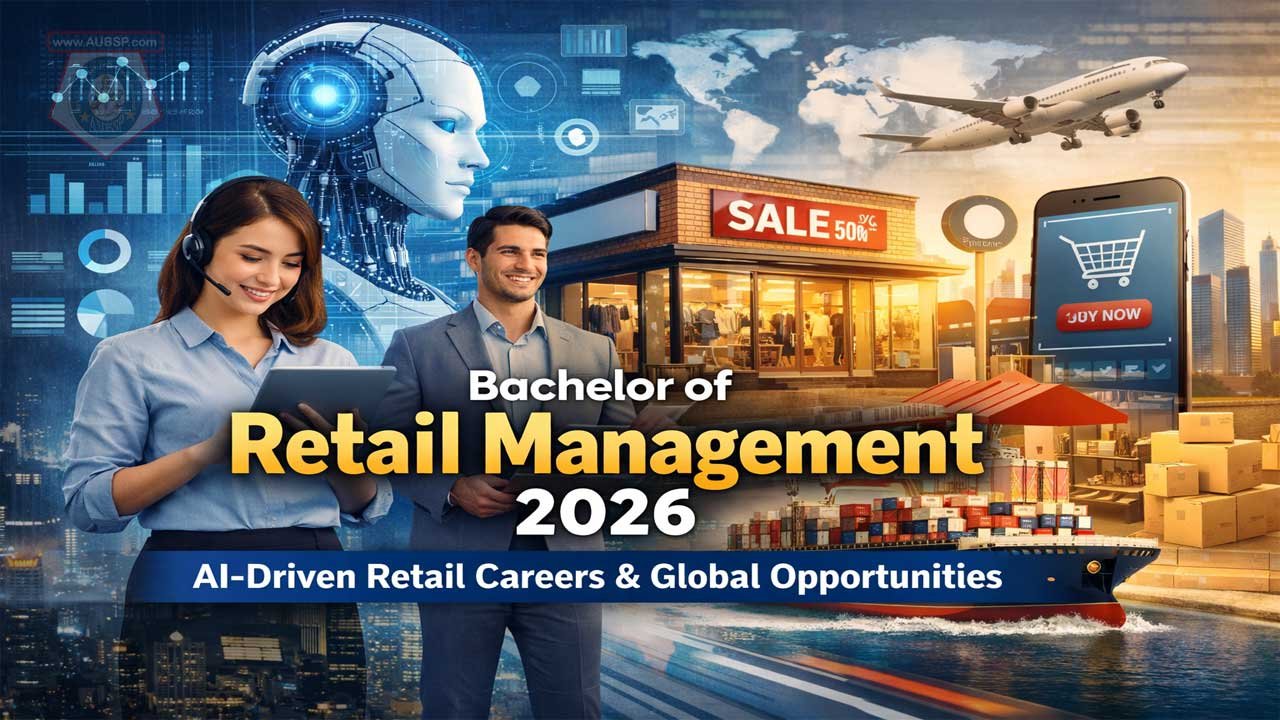
In 2026, the retail industry blends physical stores and digital platforms into one smooth system called unified commerce. This change has made retail more data-driven and technology-focused. A Bachelor of Retail Management (BRM) now teaches students business basics, AI, data analysis, supply chains, and customer behavior.
Students learn how to manage online and in-store sales together, use artificial intelligence for forecasting and personalization, and apply sustainable practices like recycling and waste reduction. The degree usually takes three to four years and includes internships, specializations, and practical projects. Graduates can work as store managers, e-commerce managers, supply chain managers, or business analysts.
Salaries grow with experience, especially in countries like the US, Canada, and Singapore. Many countries also offer post-study work visas, making the degree attractive for international students. Overall, the BRM prepares students to lead modern retail businesses in a fast-changing, tech-powered world.
| Category | Details |
|---|---|
| Degree Name | Bachelor of Retail Management (BRM) |
| Duration | 3–4 years (full-time) |
| Core Focus | Retail operations, digital commerce, AI, data analytics, supply chain |
| Key Skills | Omnichannel management, demand forecasting, customer analytics, leadership |
| Technology Integration | Generative AI, predictive analytics, smart inventory systems |
| Specializations | E-commerce, AI-driven merchandising, supply chain, sustainability, customer experience |
| Career Paths | Store Manager, E-commerce Manager, Supply Chain Manager, Business Analyst |
| Entry-Level Salary (US) | $40,000 – $60,000 per year |
| Mid-Career Salary (US) | $60,000 – $90,000 per year |
| Global Opportunities | USA, Canada, UK, Australia, Singapore, Germany |
| Post-Study Work Options | Available in countries like US (OPT), Canada (PGWP), UK (Graduate Route), Australia (Subclass 485) |
| Industry Trend 2026 | Unified commerce, AI automation, sustainability, circular economy |
Bachelor of Retail Management in 2026: Careers, AI Skills, Salaries & Global Opportunities
The global retail sector in 2026 is defined by a radical convergence of physical and digital environments, a phenomenon increasingly characterized by the transition from omnichannel strategies toward unified commerce platforms. This evolution has fundamentally altered the competencies required for leadership within the industry, positioning the Bachelor of Retail Management (BRM) as a critical academic gateway for professionals navigating high-stakes operational and strategic challenges.
Historically, retail management was often perceived as a vocationally grounded trade; however, the contemporary landscape demands an interdisciplinary mastery of data science, consumer psychology, generative artificial intelligence, and global logistics. As traditional search behaviors fragment and students increasingly rely on generative engines for academic discovery, the discoverability of these programs depends on a sophisticated understanding of how academic rigor aligns with professional outcomes in a volatile economic climate.
The Strategic Renaissance of Retail Education: Theoretical Foundations and the Omnichannel Imperative
The core objective of a modern Bachelor of Retail Management program is to bridge the gap between theoretical business management and the functional realities of a phygital marketplace. This educational paradigm is rooted in the shift from a product-centric model to a customer-centric architecture where the shopping journey is synchronized across every touchpoint.
In 2026, the retail environment necessitates a frictionless integration of mobile apps, social media, websites, and physical storefronts. The omnichannel approach, which serves as the foundational theory for the BRM curriculum, ensures that if a consumer interacts with a brand on a mobile device, that context is preserved when they enter a brick-and-mortar location.
This synchronization is not merely a service enhancement but a structural requirement driven by data. By leveraging customer and product data, an omnichannel marketing platform allows retailers to create deep personalization, which has evolved from simple product recommendations into real-time, context-aware engagement.
The academic study of retail management focuses on the mechanisms required to unify these fragmented experiences. As identified by industry analysts, the next evolution—unified commerce—utilizes a single, integrated platform to manage sales, fulfillment, and service, providing retailers with unparalleled control over the transaction chain. For the BRM graduate, this shift implies a career focused on system integration and data-driven decision-making rather than simple store oversight.
| Operational Paradigm | Key Characteristics | Customer Experience Implication |
|---|---|---|
| Multichannel Retail | Isolated shopping channels (Web, Store, App) working in silos. | Fragmented experience; customers must restart their journey across channels. |
| Omnichannel Retail | Interconnected channels that retain context and customer data. | Seamless transition; ability to browse on app and pick up in-store (BOPIS). |
| Unified Commerce | A single, integrated platform unifying all back-end processes. | Total consistency; real-time accuracy in inventory and personalized offers. |
| Adaptive Commerce | Real-time journeys that respond instinctively to customer intent. | The retail environment acts as a companion, moving with the customer. |
The importance of this theoretical shift is underscored by its impact on the bottom line. Retailers that achieve maturity in unified commerce reported 27% lower fulfillment costs and an 18% reduction in cart abandonment rates. Consequently, the Bachelor of Retail Management curriculum has evolved to prioritize the optimization of these systems, ensuring that graduates are prepared to implement cost-saving and revenue-boosting technologies from the first day of their professional tenure.
Technological Disruption and the 2026 Retail Ecosystem: The AI and Automation Frontier
As the global retail industry enters 2026, the adoption of artificial intelligence (AI) has moved from experimental hype to a competitive necessity. The Bachelor of Retail Management programs of this era reflect this reality by integrating advanced technical modules into their business cores. The primary driver for this shift is the need for operational efficiency amid labor shortages and increasing consumer expectations for near-instant support.
The Mechanism of Agentic AI and Predictive Operations
The 2026 marketplace is characterized by “agentic” shopping agents and autonomous systems that sense disruptions and resolve them before human intervention is required. In this environment, retail leadership is defined by the ability to sense “weak signals” in the market and interpret customer intent with precision. Predictive infrastructure allows for proactive operations, such as automatically adjusting supplier terms the moment store conditions change. This shift necessitates that BRM graduates possess a high degree of technological literacy, particularly in interpreting AI-driven demand forecasting and price elasticity models.
| AI Application in Retail | Functional Benefit | Strategic Impact for 2026 |
|---|---|---|
| Generative AI | Simulates virtual fitting rooms and designs product variations. | Reduces time-to-market and enhances creative personalization. |
| Predictive Analytics | Forecasts demand and optimizes inventory levels. | Minimizes waste, reduces spoilage, and improves vendor relations. |
| Smart Inventory | Real-time stock control and automated repricing. | Ensures product availability across omnichannel touchpoints. |
| Agentic Chatbots | 24/7 instant support and automated purchase assistance. | Elevates customer service while reducing human labor costs. |
| Biometric Verification | Real-time fraud detection and transaction security. | Protects margins and prevents chargebacks before they occur. |
The pedagogical response to these trends involves moving beyond traditional business subjects to include courses on Introduction to Generative AI and Business Intelligence. Graduates are expected to lead “augmented workforces,” where human expertise is amplified by intelligent assistants that sharpen judgment and accelerate decision cycles. This synergy between human intuition and machine intelligence is the primary marker of a high-tier retail management education in 2026.
Sustainability and the Circular Economy Mandate
Parallel to the technological revolution is the rise of sustainability as a core operational variable. In 2026, retail economics are shaped by tighter regulations and a consumer base that prioritizes environmental responsibility. “Circularity”—the reduction of waste through the reuse, resale, and recycling of products—has moved from a niche concept to a mainstream retail solution.
Bachelor of Retail Management programs have responded by embedding sustainability into data and decision-making modules. Students learn to optimize energy consumption and logistics in real-time to minimize carbon impacts, reflecting a broader industry trend where efficiency is no longer optional.
Curricular Architecture: Mapping the BRM Academic Framework
A Bachelor of Retail Management degree typically requires three to four years of full-time study, depending on the national educational system. The curriculum is a hybrid of foundational business principles and highly specialized retail modules, designed to produce experts rather than generalists.
Foundational Business Core and Specialized Retail Modules
The initial years of a BRM program often parallel a standard Bachelor of Business Administration (BBA), providing grounding in accounting, economics, and business law. However, even these foundational courses are frequently tailored to the retail context—for instance, focusing on retail-specific financial performance measurement and economic-financial forecasts for store locations.
| Academic Year | Focus Area | Core Modules and Learning Outcomes |
|---|---|---|
| Year 1: Fundamentals | Business Basics & Communication | Economics, financial accounting, and business communication. |
| Year 2: Functional Areas | Core Retail Operations | Principles of retailing, marketing research, and operations management. |
| Year 3: Specialization | Advanced Management & Strategy | Supply chain management, retail analytics, and digital commerce. |
| Year 4: Synthesis | Leadership & Practical Application | Retail management strategies, consumer behavior, and a final-year dissertation or capstone project. |
Specialized Concentrations and Electives
To meet the demands of the 2026 workforce, programs offer diverse concentrations that allow students to align their education with specific career goals. These specializations are critical, as graduates who focus on a specific niche reportedly achieve a 20% higher employment rate in their chosen sector within one year of finishing their degrees.
- Omnichannel Management and Inventory Optimization: This concentration addresses the need for seamless channel integration and stock control in a unified commerce environment.
- AI-Driven Merchandising and Demand Forecasting: Prepares students to use predictive tools to optimize product assortments and pricing.
- Supply Chain Disruption and Risk Management: Equips candidates to design resilient logistics strategies capable of navigating global interruptions.
- Customer Experience and Engagement Strategies: Focuses on CRM, personalized marketing, and loyalty programs to drive repeat business.
- Sustainability and Ethical Retail: Trains students to implement circular business models and sustainable sourcing practices.
- E-commerce and Digital Retailing: Concentrates on managing online storefronts, social commerce, and emerging marketplace models on platforms like TikTok and YouTube.
The integration of “Professional Development and Practice” modules ensures that students develop the soft skills necessary for the fast-paced retail environment, including effective communication, team leadership, and conflict resolution. These programs often culminate in a comprehensive dissertation or capstone project, allowing students to apply theoretical models to real-world retail challenges.
Global Institutional Landscapes: Top Universities for Retail Management
The choice of institution for a Bachelor of Retail Management is increasingly influenced by the university’s geographic location, its links to major retail corporations, and its ability to adapt to digital transformations.
North American Leadership: The United States and Canada
The United States hosts some of the largest and most prestigious retailing programs in the world. These institutions benefit from proximity to the world’s largest consumer market and partnerships with retail giants like Walmart, Amazon, and Target.
| University | Location | Notable Strengths | Average Degrees Awarded (Retail) |
|---|---|---|---|
| University of Arizona | Tucson, AZ | Strong reputation for research and industry-aligned specialization. | 87. |
| University of South Carolina | Columbia, SC | One of the largest programs; focus on operations and merchandising. | 147. |
| University of North Texas | Denton, TX | High volume of graduates; strong focus on retail management. | 98. |
| University of Wisconsin-Madison | Madison, WI | Top-ranked for retailing and retail operations. | 220. |
| Purdue Global | West Lafayette, IN | Focus on experimental learning and hands-on retail strategy. | High (Public focus). |
In Canada, the focus is heavily on the intersection of commerce and technology. Toronto Metropolitan University offers a specialized Retail Management (Hons) BComm, while McGill University provides a Retail Management Major within its Bachelor of Commerce, emphasizing buyer behavior and operations management.
European Innovations: The Netherlands, UK, and France
European retail education is often characterized by a focus on entrepreneurship, sustainability, and cross-border commerce.
- NHL Stenden University of Applied Sciences (Netherlands): Offers a Bachelor in Entrepreneurship and Retail Management, focusing on international e-commerce and sustainable business. It is notable for its competitive tuition for EU/EEA students and its accreditation by the NVAO.
- University of Stirling (United Kingdom): The BA (Hons) in Retail Marketing is a four-year single honours degree known for its high employability record and AACSB accreditation. Students have opportunities to study abroad in the USA, Canada, or Singapore.
- L’École De Design Nantes Atlantique (France): Provides a unique specialization in Retail & Interior Design, focusing on the design of commercial spaces and the “phygital” customer journey.
The Rise of Asia and the MENA Region
In 2026, student interest is shifting toward Asia and the MENA region, driven by lower costs, flexible delivery, and high-quality English-taught programs.
| Region | University / College | Program Offered | Context & Competitive Edge |
|---|---|---|---|
| Hong Kong | Hong Kong Baptist University (HKBU) | BBA (Hons) Strategic Retail Management & Innovation. | Integration of innovation and ethical leadership. |
| Singapore | Raffles Education Network | Diploma in Fashion Retail Management. | Exploration of luxury and fashion retail fundamentals. |
| UAE | Dubai College of Tourism | Diploma in Retail Business Management. | Direct alignment with Dubai’s rapidly growing retail industry. |
| Malaysia | Gugusan University | Bachelor of Retail Management (Hons). | Focus on practical skills valued in the regional sector. |
| Indonesia | Pradita University | Bachelor’s Degree in Retail Management. | Commitment to omnichannel retail education. |
The University of Hong Kong remains the top-ranked institution in Asia for 2026, while countries like Singapore maintain the highest average scores for faculty-student ratios and international engagement. This regional growth is supported by substantial government funding and the establishment of transnational branch campuses.
Economic Valuation: ROI, Salaries, and Career Progression
The return on investment (ROI) of a Bachelor of Retail Management degree is a multifaceted calculation involving tuition costs, opportunity costs (forgone income during study), and post-graduation earning trajectories. Compared to a general business degree, the BRM offers a more targeted industry path, often leading to faster promotions into mid-management roles.
Comparative Salary Benchmarks for 2026
The earning potential for retail management graduates is influenced by geography, experience, and the level of education attained.
| Country | Entry-Level Salary (0-2 years) | Mid-Career Salary (3-5 years) | Senior/Executive Salary (10+ years) |
|---|---|---|---|
| United States | $40,000 – $60,000 | $60,000 – $90,000 | $90,000 – $164,000+ |
| Canada | C$56,000 – C$71,000 | C$87,000 – C$105,000 | C$121,000 – C$315,000+ |
| Australia | A$49,000 – A$62,000 | A$70,000 – A$85,000 | A$90,000 – A$150,000+ |
| Germany | €35,000 – €45,000 | €50,000 – €81,000 | €88,000 – €150,000+ |
| Singapore | S$45,000 – S$50,000 | S$53,000 – S$84,000 | S$100,000+ |
| India | ₹3L – ₹6L (Lakhs) | ₹15L – ₹20L | ₹30L – ₹50L+ |
In the United States, specialized roles such as Retail Business Manager or Retail Sales Director command significantly higher ranges, reflecting the complexity of managing large-scale operations or regional territories. In Germany, the IT and finance-heavy sectors within retail offer higher wages due to talent shortages, with marketing managers in retail earning upwards of €88,000.
Career Progression and Specialized Roles
The career path for a BRM graduate often begins in store operations or as a management trainee, but the “fast-paced and exciting” nature of the industry allows for rapid advancement. Proven leadership and communication skills enable store managers to advance into higher roles, such as district or regional management, overseeing multiple locations.
- Entry Level: Sales Coordinator, Assistant Store Manager, Junior Buyer, Merchandise Representative.
- Mid-Level: Store Manager, Merchandise Planner, Retail Operations Manager, Category Manager.
- Senior Level: District Manager, Store Director, Division Merchandising Manager, Regional Operations Executive.
- Specialized Corporate Roles: E-commerce Manager, Supply Chain & Logistics Manager, Brand Manager, Business Analyst.
A significant trend in 2026 is the growth of e-commerce management roles, projected to grow by over 10% as online platforms expand and adopt new technologies. Similarly, inventory control specialists are in high demand (8% growth) as retailers prioritize supply chain efficiency and waste reduction.
Graduate Programs and Internships
To facilitate this progression, many global retailers offer intensive graduate management programs (GMPs). For example, Uniqlo’s Fast Retailing GMP in Tokyo provides a 6-day immersive experience for undergraduates worldwide to learn from global business leaders.
Lindt & Sprüngli offers 18-to-24-month rotational programs in International Direct-to-Consumer (D2C) business, exposing graduates to retail, e-commerce, and operations across multiple global affiliates. LVMH also provides specialized retail management trainee programs, particularly in China and Singapore, designed to identify and train the next generation of luxury leaders.
Admissions and International Student Compliance: Navigating the 2026 Landscape
The landscape for international student recruitment in 2026 is characterized by “intensifying competition” and “increased volatility”. Major destinations like the UK, Canada, and Australia have introduced stricter visa regulations and higher financial requirements, forcing students to plan more carefully.
Admission Prerequisites for International Applicants
Standardized testing requirements have largely shifted toward “test-optional” or “test-free” policies in the U.S., with over 1,800 colleges waiving SAT/ACT requirements. However, international students must still demonstrate high school completion with a minimum GPA (often around 2.0 to 2.5) and English language proficiency.
| English Language Test | Minimum Score (General) | Notes for 2026 |
|---|---|---|
| TOEFL iBT | 81 | “New TOEFL” (beginning Jan 2026) may have different scales. |
| IELTS | 6.5 | Higher scores (7.5-8.0) required for top-tier competitive programs. |
| Duolingo (DET) | 110 | Increasingly accepted as a convenient, remote-proctored option. |
| PTE Academic | 55 – 58 | Favored for its rapid results processing. |
Applicants often need between 60 to 90 transferable credits if they are entering as transfer students, and residency rules typically mandate completing at least 30 credits at the degree-granting institution.
Post-Study Work Visas and Immigration Pathways
Post-study work rights are a primary driver for international students. As of 2026, the major destinations offer the following pathways:
- Australia (Subclass 485): Allows graduates to work for 18 months to 3 years depending on their qualification. Applicants must be 35 years of age or under and apply within six months of course completion.
- Canada (PGWP): Offers up to 3 years for Master’s, PhD, and select professional degree graduates, with living cost requirements rising to CA$22,895.
- United Kingdom (Graduate Route): Provides 2 years of work rights (3 for PhD), though the route faces potential reduction to 18 months in 2027. Settlement requires a five-year stay in eligible visa categories.
- United States (OPT): Allows for 12 months of post-completion work, though 2026 rules may introduce “duration of status” limits that could cap master’s visas at two years and undergraduate visas at four years.
Students are increasingly turning to expert education consultants to navigate these evolving systems, focusing on programs that align with “shortage occupations” to maximize their chances of permanent residency.
Strategic Conclusions: The Future of Retail Leadership
The Bachelor of Retail Management in 2026 is an essential credential for navigating an industry at the crossroads of human-AI collaboration and sustainable global commerce. As retailers shift from traditional channel designs to “moment design” and adaptive journeys, the academic preparation for this field has become more rigorous, data-intensive, and strategically critical.
For the international student, the BRM offers a clear economic advantage, supported by high employability in e-commerce, logistics, and corporate management roles. The institutions that will thrive are those that provide authentic, outcome-focused content across all digital platforms, acknowledging that student discovery is now a decentralized, AI-driven process. Ultimately, the value of the degree lies in its ability to transform graduates into foresight-driven leaders capable of turning omnichannel complexity into sustainable competitive advantage.
FAQs about Bachelor of Retail Management
What is a Bachelor of Retail Management (BRM)?
A Bachelor of Retail Management is a 3–4 year undergraduate degree that teaches students how to manage modern retail businesses, including stores, e-commerce platforms, supply chains, and digital systems.
What skills do students learn in a BRM program?
Students learn retail operations, marketing, data analytics, artificial intelligence basics, inventory management, customer behavior, leadership, and digital commerce strategies.
Is retail management a good career in 2026?
Yes. Retail in 2026 is technology-driven and global. There is strong demand for professionals who understand AI, unified commerce, and supply chain systems.
What jobs can I get after a BRM degree?
Graduates can work as Store Managers, E-commerce Managers, Retail Operations Managers, Supply Chain Managers, Business Analysts, or Category Managers.
What is the average salary after completing a BRM?
In the United States, entry-level salaries typically range from $40,000 to $60,000 per year. Salaries increase with experience and specialization.
Can international students work after graduation?
Yes. Countries like the US, Canada, the UK, and Australia offer post-study work visas that allow graduates to gain professional experience after completing their degree.
Does the BRM program include AI and digital skills?
Yes. Modern BRM programs include training in generative AI, predictive analytics, smart inventory systems, and digital marketing tools.
Is a BRM better than a general business degree?
A BRM is more specialized. It focuses directly on retail and commerce careers, which can help graduates enter retail management roles faster than a general business degree.


Leave a Reply
You must be logged in to post a comment.