
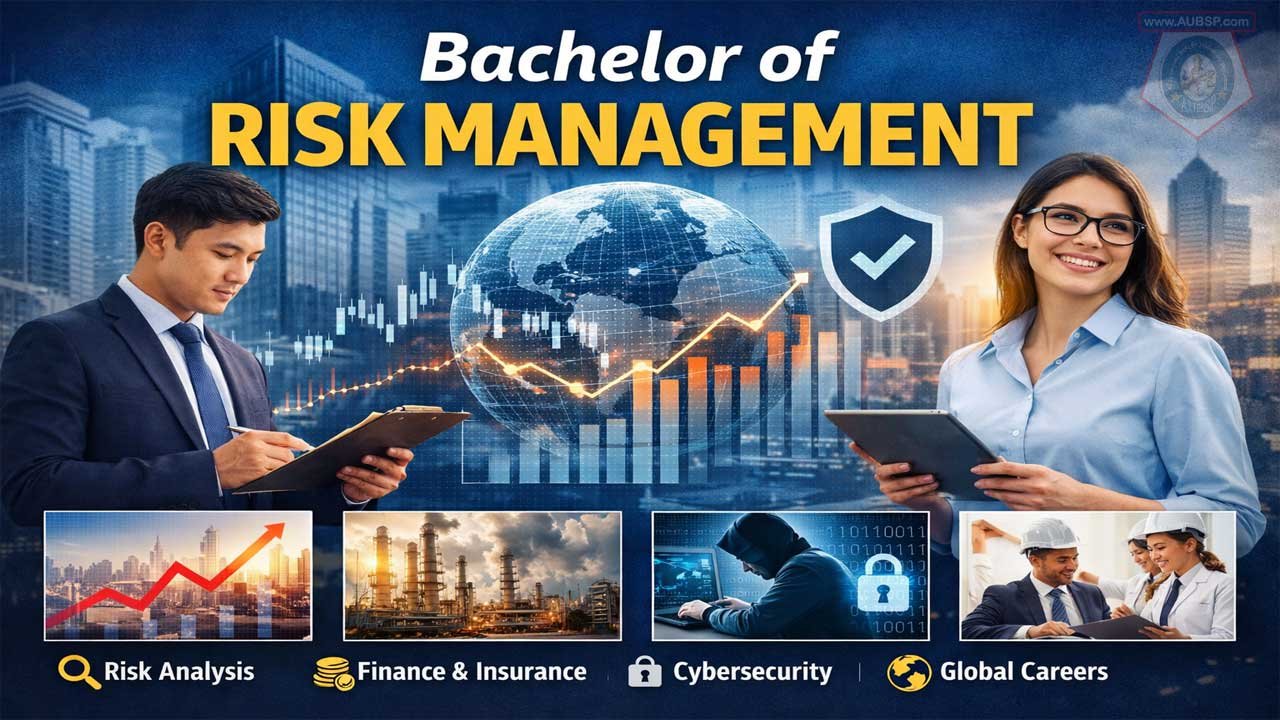
A Bachelor of Risk Management prepares students to help organizations handle uncertainty and avoid major losses in a complex world. The degree combines finance, statistics, business law, and human behavior to teach students how to identify, analyze, and reduce risks such as financial losses, cyber threats, climate issues, or reputation damage.
Modern risk management focuses on Enterprise Risk Management (ERM), which means managing all types of risks across an organization instead of only buying insurance. Demand for risk professionals is growing worldwide because companies need experts to deal with global regulations, technology risks, and environmental challenges. Graduates can work in banking, insurance, corporations, healthcare, or government, often earning strong salaries and advancing to senior roles like risk manager or chief risk officer. The field also values international skills such as cultural understanding and multilingual communication, making it a strong career option for global students.
| Category | Information |
|---|---|
| Degree Name | Bachelor of Risk Management |
| Field | Business, Finance, and Risk Analysis |
| Duration | 3–4 years (depending on country/university) |
| Core Subjects | Risk Management, Insurance, Finance, Statistics, Business Law, Economics |
| Key Skills Learned | Risk analysis, decision-making, financial modeling, data analysis, strategic planning |
| Popular Study Destinations | USA, UK, Canada, Australia |
| Entry Requirements | Strong math background, high school diploma, IELTS/TOEFL for international students |
| Career Roles | Risk Analyst, Insurance Underwriter, Compliance Officer, Financial Risk Manager |
| Top Industries | Banking, Insurance, Corporate Sector, Healthcare, Government |
| Average Entry Salary | $60,000 – $90,000 per year (varies by country) |
| Professional Certifications | FRM (Financial Risk Manager), CRM (Certified Risk Manager), CPCU |
| Job Outlook | High demand due to global financial, cyber, and environmental risks |
Why Study Bachelor of Risk Management? Courses, Skills, and Salary Guide
The contemporary global economic landscape is characterized by a state of “permancrisis,” where the convergence of geopolitical instability, technological disruption, and environmental emergencies has elevated the management of uncertainty from a specialized back-office function to a primary strategic imperative for multinational organizations. For the international student, the decision to pursue a Bachelor of Risk Management represents a sophisticated engagement with the mechanisms of modern institutional survival.
This degree is not merely a subset of finance or business administration; it is an interdisciplinary field that harmonizes quantitative rigor with qualitative strategic vision to enable rational decision-making under conditions of high-stakes uncertainty. The rising complexity of the global regulatory environment, coupled with the proliferation of digital threats and the systemic impact of climate change, has created a robust and growing demand for a new generation of risk professionals who possess both technical expertise and cross-cultural adaptability.
Historically, risk management was perceived as a reactive process centered on the procurement of insurance—a mechanism for the transfer of financial loss following an adverse event. However, the evolution of the discipline toward Enterprise Risk Management (ERM) has shifted the focus toward a proactive, holistic, and “all-hazards” approach that considers every potential disruption to an organization’s mission, ranging from price volatility and cyber security to reputation damage and pandemics. Consequently, the Bachelor of Risk Management has emerged as a high-value academic pathway, offering graduates access to lucrative career trajectories in the financial, corporate, and governmental sectors globally.
The Philosophical and Theoretical Foundations of Risk Education
The academic architecture of a Bachelor of Risk Management is built upon the premise that risk is an inherent component of every human and organizational endeavor. Rather than seeking to eliminate risk entirely—which would stifle innovation and growth—the discipline seeks to optimize the risk-reward ratio. This involves a sophisticated three-stage process: identification, assessment, and mitigation.
During the identification phase, students are trained to recognize potential setbacks before they occur, focusing on financial, legal, safety, and reputational vulnerabilities. In the assessment phase, they apply principles from probability and statistics to measure the potential frequency and severity of these threats. Finally, in the mitigation phase, they develop strategies to reduce, transfer, or finance these exposures through insurance markets, derivative instruments, or internal controls.
The pedagogical approach to risk management is increasingly interdisciplinary, reflecting the complex nature of the risks facing modern enterprises. A student in this field does not only study finance; they explore organizational behavior to understand how human error can lead to systemic failure, business law to navigate the labyrinth of international regulations, and ethics to manage the moral dimensions of corporate decision-making.
Programs such as the one offered at Grand Canyon University integrate a “Christian worldview” and the concept of “conscious capitalism,” emphasizing servant leadership as a tool for mitigating ethical risk. Similarly, St. John’s University embeds “Vincentian values” of service into its curriculum, positioning the risk professional as a steward of both corporate assets and social well-being.
Global job Market Projections and Economic Rationale
The economic rationale for pursuing a Bachelor of Risk Management is supported by robust labor market data. The U.S. Bureau of Labor Statistics (BLS) projects that demand for financial and risk management roles will grow by approximately 16% to 17% between 2022 and 2033, a rate significantly higher than the average for all occupations. This growth is driven by the increasing necessity for organizations to navigate “creeping risks” such as climate change, which requires long-term strategic planning and sophisticated governance frameworks. The global risk management market itself is projected to reach an estimated $21.62 billion by 2029, reflecting the massive investment corporations are making in their internal risk functions.
| Professional Metric | Data/Statistic | Contextual Significance |
|---|---|---|
| Projected Job Growth (US BLS) | 16% – 17% (through 2033) | Indicates long-term career stability and expansion. |
| Global Market Value (2025-2029) | $13.78B to $21.62B | Reflects rising corporate investment in risk infrastructure. |
| Compound Annual Growth Rate (CAGR) | 11.9% | Signals a rapidly accelerating industry sector. |
| Average Starting Salary (Australia) | $100,000 AUD | High entry-level value for specialized risk graduates. |
| Entry-Level Salary Range (Germany) | €45,000 – €55,000 | Competitive European compensation for new professionals. |
Institutional Analysis: Top Global Destinations for Risk Education
For international students, selecting an institution requires an analysis of both academic prestige and geographic proximity to major financial hubs. The rankings of risk management institutions often highlight the United States and the United Kingdom as the dominant players, though institutions in Australia and Canada offer specialized expertise and strong migration pathways.
The United States: Specialized Academic Leaders
The United States hosts many of the world’s most highly regarded risk management programs, often housed within prestigious business schools. The Stern School of Business at New York University (NYU) and the Wharton School at the University of Pennsylvania consistently rank at the top of the field due to their extensive research output and deep ties to the Wall Street financial ecosystem.
Temple University’s Fox School of Business provides a Bachelor of Business Administration (BBA) in Risk Management and Insurance that is particularly notable for its three distinct tracks: Employee Benefits, Healthcare Risk, and Property Liability and Corporate Risk. This level of specialization allows students to align their education with specific industry demands, such as the rising need for healthcare risk managers in the wake of global health crises.
Other institutions like Florida State University and the University of South Carolina offer combined bachelor’s and master’s programs, allowing students to accelerate their education and enter the workforce with advanced credentials. These programs often integrate experiential learning and industry-specific tools, such as the Bloomberg Suite, which provides real-time data and analytics on global markets. The University of North Texas and Michigan State University also offer focused degrees in quantitative risk analytics, emphasizing the mathematical treatment of probability, interest-rate theory, and financial mathematics—skills that are in high demand at investment banks and insurance headquarters.
The United Kingdom: Traditional and Innovative Frameworks
In the United Kingdom, the London School of Economics and Political Science (LSE) offers a BSc in Finance and a BSc in Accounting and Finance that are highly prized for their analytical rigor. These programs do not just teach the mechanics of risk; they delve into the behavior of financial markets and the use of specific finance techniques for risk management. Competition for these programs is intense, with approximately 16 applicants for every available place, requiring international students to demonstrate exceptional mathematical ability and a broad mix of traditional academic subjects.
For students seeking a more dedicated risk management degree, Glasgow Caledonian University (GCU) offers a BA (Hons) in Risk Management that is accredited by the Chartered Insurance Institute (CII). This program is specifically designed to build job-specific practical skills in business continuity, crisis management, and international risk management. Similarly, Bayes Business School (formerly Cass) in London offers a BSc in Investment and Financial Risk Management that provides students with hands-on experience using cutting-edge tools and a potential professional placement year in the heart of London’s financial district.
Canada and Australia: Pathways and Specialization
Canada and Australia have become increasingly popular destinations for international students due to their high-quality education systems and favorable post-study work rights. The University of British Columbia’s (UBC) Sauder School of Business offers a Bachelor of Commerce with a concentration in Finance that covers significant risk management components. UBC’s admissions process is holistic, evaluating students on their academic record, personal profile, and a timed video interview to assess qualities like leadership and critical thinking.
In Australia, the University of New South Wales (UNSW Sydney) offers a Bachelor of Actuarial Studies with a focus on Actuarial Risk Management and Analytics. This program is particularly quantitative, preparing students to use predictive analytics and statistical models to assess high-stakes financial risks. Graduates from these Australian programs are highly sought after by insurance and reinsurance firms, with projected job growth for actuaries and risk analysts expected to rise by 11% over the next five years.
Comprehensive Curriculum Breakdown: The Pillars of Risk Literacy
A Bachelor of Risk Management curriculum typically requires 120 to 124 credit hours, distributed across general education, a business core, and major-specific modules. The curriculum is designed to transform a student from a generalist into a specialized strategist capable of managing the diverse exposures of a multinational entity.
Foundational Portals and the Business Core
Many programs, such as the one at Brenau University, divide their curriculum into “learning portals” like World Understanding, Scientific and Analytic Curiosity, and Communication Fluency. This broad foundation is essential because risk management is fundamentally about understanding the world. A risk manager must understand history to grasp geopolitical shifts, anthropology to navigate cultural risks, and science to assess environmental hazards.
The business core provides the technical “language” of the profession. This includes:
- Microeconomics and Macroeconomics: Understanding how supply, demand, and global economic cycles influence organizational risk.
- Financial and Managerial Accounting: Mastering the accounting cycle and financial statements to identify “off-balance-sheet” risks and ensure fiscal transparency.
- Business Statistics and Analytics: Using data and quantitative tools to drive fact-based management and exploratory models.
- Managerial Finance: Learning about capital budgeting, asset management, and leverage, which are the foundations of financial stability.
Major-Specific Risk Modules
As students progress into their major, the coursework becomes highly specialized, focusing on the mechanics of the risk management process.
- Principles of Risk Management and Insurance: This introductory course explores the theory of risk, identifying methods of developing financial protection against loss.
- Property and Liability Insurance: A deep dive into commercial insurance instruments, focusing on how to mitigate exposures related to physical assets and legal responsibilities.
- Life and Health Insurance: Understanding the risks associated with human capital, including employee benefits, health and welfare programs, and retirement planning.
- Insurance Operations and Regulations: Examining the functional areas of insurance companies, such as underwriting, rate setting, and claims processing, along with the legal frameworks governing the industry.
- Enterprise Risk Management (ERM): This capstone-style course teaches students to take a proactive and holistic perspective, integrating risk management into the overall corporate strategy.
Technical Competencies and Mathematical Foundations
Risk management is increasingly a quantitative discipline, requiring students to develop a mathematical foundation that extends beyond basic algebra. In high-level finance programs like those at LSE or UNSW, the expectation for mathematical proficiency is substantial.
The Quantitative Requirement
International students must often demonstrate high performance in calculus and statistics before admission. Once enrolled, they encounter advanced concepts such as interest-rate theory, stochastic processes, and financial mathematics. These tools are used to model the probability of catastrophic events, a process that relies on the formulaic representation of risk. For example, a student might use the variance-covariance method to calculate the Value at Risk (VaR) for a portfolio, which can be simplified in notation as:
Where represents the expected return, the standard deviation (volatility), and the confidence level. Understanding these relationships allows a risk manager to quantify the maximum potential loss over a given time period.
Software and Data Tools
The modern risk professional must also be proficient in specialized software. Curricula often include training in:
- Bloomberg Professional Services: For real-time market data and financial analysis.
- @RISK and Excel VBA: For Monte Carlo simulations and advanced risk modeling.
- FinCad: For pricing and risk management of derivative instruments.
- Statistical Software: Tools like SAS or R for large-scale data analysis and predictive modeling.
Admission Requirements for International Students: A Strategic Overview
Applying for a Bachelor of Risk Management as an international student involves meeting both university-wide and program-specific criteria. Given the analytical nature of the degree, institutions prioritize students with strong backgrounds in mathematics and English.
Academic and Language Standards
International applicants are typically evaluated on their high school performance (GPA) or equivalent national exam scores, such as the International Baccalaureate (IB) or A-levels. For instance, LSE’s 2026 entry requirements for its BSc in Accounting and Finance are AAA at the A-level, including an A in Mathematics, or an IB score of 38 points. For UBC Sauder, a competitive admission average is approximately 87% to 90%, although the process is holistic.
English language proficiency is mandatory, as the role of a risk manager requires the clear communication of complex ideas to diverse stakeholders.
| Country | Typical IELTS Score | Typical TOEFL Score | Notes |
|---|---|---|---|
| USA | 6.5 – 7.0 | 90 – 100 | Scores vary by institution selectivity. |
| UK | 7.0 (with 6.5 in all bands) | 100+ | Higher requirements for top institutions like LSE. |
| Canada | 6.5 – 7.0 | 90 – 100 | UBC requires 90+ with 22 in each component. |
| Australia | 7.0 (with 6.0 in all bands) | 94+ | High standards for actuarial programs at UNSW. |
The Supplemental Application: Personal Profiles and Interviews
Elite programs often require a “Personal Profile” or a supplemental application. This is a critical opportunity for students to demonstrate their “soft skills.” UBC Sauder, for example, asks students to describe their activities and achievements in areas like leadership, teamwork, and community involvement through both written responses and a timed video interview.
This evaluation process counts for approximately 50% of the total admission decision, with grades making up the remaining 50%. International students are encouraged to highlight their ability to perform under pressure and their “intellectual curiosity” about global markets.
Professional Certifications: Enhancing Global Employability
A Bachelor’s degree in risk management often serves as the foundational step toward earning professional designations that are recognized globally. These certifications act as “tickets” into high-paying roles and C-suite leadership.
Financial Risk Manager (FRM)
The FRM designation, administered by the Global Association of Risk Professionals (GARP), is considered the premier certification for those managing financial risk. It consists of two parts: Part I focuses on quantitative analysis, financial markets, and valuation models, while Part II emphasizes market, credit, and liquidity risk management. To become certified, a candidate must pass both exams and submit evidence of two years of relevant professional work experience. The FRM is recognized in over 190 countries, making it a powerful tool for international career mobility.
Certified Risk Manager (CRM)
The CRM designation is highly regarded in the insurance and enterprise risk sectors. It requires the completion of five courses—Principles of Risk Management, Analysis of Risk, Control of Risk, Financing of Risk, and Practice of Risk Management—and passing five 2.5-hour proctored exams. Certified professionals earn an average of $16,000 to $20,000 more annually than their non-certified peers.
Other Specialized Designations
- Chartered Property Casualty Underwriter (CPCU): Focuses on property-casualty insurance and risk management, providing a competitive advantage in the underwriting and brokerage sectors.
- Certified Employee Benefit Specialist (CEBS): Essential for those focusing on human capital risk and retirement planning.
- Professional Risk Manager (PRM): Offered by PRMIA, emphasizing mathematical foundations and financial theory.
Career Outcomes: Salary Trajectories and Industry Sectors
Graduates with a Bachelor of Risk Management enter a versatile job market with lucrative starting wages that grow rapidly with experience. Because risk management is embedded within every type of business, graduates are not limited to one industry.
Earning Potential and Advancement
Entry-level risk analysts in the United States typically earn between $60,000 and $90,000 annually. In Europe, starting salaries range from €45,000 to €55,000 gross per year. As professionals gain experience and pass certification exams, mid-level salaries often rise to $100,000–$150,000. For those who reach management roles, such as Head of Risk Management or Chief Risk Officer (CRO), salaries of $200,000 to over $500,000 are common at major financial institutions in centers like New York, London, or Sydney.
Primary Employment Sectors
- Finance and Banking: Evaluating potential losses from credit, market volatility, and operational failures at firms like Morgan Stanley, Nomura, or Bank of China.
- Insurance and Reinsurance: Working as underwriters, brokers, or claims managers at companies like AIG, Chubb, or MSIG North America.
- Corporate Sector (Global Supply Chain): Managing risks ranging from lawsuits to supply chain disruptions at multinational corporations like ExxonMobil or Royal Caribbean.
- Healthcare: Ensuring patient safety, regulatory compliance, and financial stability in complex hospital environments.
- Government and NGOs: Planning for emergencies, enforcing safety standards, and protecting public resources.
The Competitive Edge of International Students: Cultural Intelligence (CQ)
In an increasingly hyperconnected world, technical expertise alone is insufficient for successful risk management. International students possess a unique “native” asset: Cultural Intelligence (CQ), which is the ability to relate to and work effectively with people from different cultural backgrounds.
CQ as a Tool for Risk Mitigation
High CQ is no longer a “soft skill” but a strategic imperative that reduces risk in global operations. Failure to understand cultural nuances can lead to reputational damage, regulatory compliance issues, or misaligned partnerships. For example, a leader with high CQ understands that direct feedback may be appreciated in Germany but could be seen as deeply disrespectful in Japan, potentially derailing a high-stakes negotiation. By adjusting their communication and behavior, culturally intelligent risk managers build trust and foster psychological safety, which is essential for ensuring that risks are not hidden due to fear of blame or cultural hierarchies.
Bilingualism in Global Risk Management
The demand for bilingual and globally minded professionals is surging. Proficiency in multiple languages allows risk managers to decode verbal and nonverbal cues accurately and navigate “ethical gray areas” shaped by cultural norms.
| Target Region/Market | In-Demand Language | Career Rationale |
|---|---|---|
| China & East Asia | Mandarin Chinese | Essential for bridging trade, tech, and manufacturing law in the world’s largest e-commerce market. |
| Latin America & USA | Spanish | Spoken by 460 million; crucial for the world’s second-largest Hispanic population in the US. |
| Middle East & Africa | Arabic | Unlocks access to growing energy and finance markets in the MENA region. |
| Global Diplomacy | French | Official language of the UN, EU, and International Olympic Committee; connects Europe and Africa. |
| Brazil & Africa | Portuguese | Useful for branching out across the Lusophone world, especially in emerging markets. |
Internships and Professional Networking: Bridging Academia and Industry
For international students, internships are the primary bridge to full-time employment and often the only way to secure a post-study work visa through employer sponsorship.
Top Internship Programs
Global financial leaders like Morgan Stanley, JPMorganChase, and Nomura offer structured summer analyst programs for undergraduates. These internships provide on-the-job training in areas like creditworthiness assessment, model risk governance, and market news monitoring. In the United States, these roles can pay between $25 and $38 per hour, or an annualized salary of $80,000 to $100,000.
The Role of Professional Organizations
Student participation in professional organizations like Gamma Iota Sigma (GIS) is highly encouraged. GIS provides members with career development seminars, resume assistance, and interview skills training. It also hosts career receptions specifically dedicated to Risk Management and Insurance, providing direct access to recruiters from major firms like Chubb, Allianz, and AIG. In Australia, the Career Accelerator program at UNSW provides actuarial students with access to global industry networks and Work Integrated Learning (WIL) experiences.
Post-Study Work Visas and Migration Pathways in 2026
Navigating the 2026 post-study work visa rules is essential for international students planning their long-term futures. These visas allow graduates to remain in the host country and gain international experience without requiring immediate employer sponsorship.
Country-Wise Rules for 2026
- United States: Offers Optional Practical Training (OPT) for 12 months. Graduates of STEM-designated programs (which often include quantitative risk and actuarial science degrees) can apply for a 24-month extension, allowing for a total of 36 months of work authorization.
- Canada: The Post-Graduation Work Permit (PGWP) allows graduates to work for up to three years. Canada is considered the strongest option for long-term immigration, with work experience earned through the PGWP significantly boosting Permanent Residency (PR) chances through Express Entry.
- United Kingdom: The Graduate Route allows students to stay and work for two years (three for PhD students) without sponsorship. While this does not lead directly to PR, it provides a bridge to the Skilled Worker Visa route.
- Australia: The Subclass 485 Visa offers 2 to 4 years of work rights. Australia has aligned these rights with labor market needs, prioritizing graduates in sectors like healthcare, IT, and specialized finance.
Comparative Post-Study Visa Durations (2026)
| Country | Bachelor’s Degree PSW Duration | PR Pathway Ease | 2026 Policy Focus |
|---|---|---|---|
| Canada | Up to 3 years | Strong (⭐⭐⭐⭐⭐) | Prioritizing labor-shortage fields. |
| Australia | 2 – 3 years | Moderate (⭐⭐⭐⭐) | Occupation-list alignment. |
| UK | 2 years | Limited (⭐⭐⭐) | Transition to Skilled Worker status. |
| Germany | 18 months | Strong (⭐⭐⭐⭐) | Blue Card PR route. |
| USA | 12 – 36 months (STEM) | Variable (⭐⭐⭐) | Strict adherence to major-field link. |
Future Trends: The Impact of AI and ESG on Risk Management
The risk management landscape of 2026 and beyond is being reshaped by technological progress and social accountability.
AI and Big Data
Digital capabilities and Artificial Intelligence are creating both opportunities and challenges. While AI empowers the risk function with faster data processing and predictive analytics, it also necessitates a new blend of positions, including data scientists and AI specialists. Chief Risk Officers (CROs) are increasingly spearheading governance frameworks for AI to ensure that technology is deployed responsibly and ethically, guarding against regulatory breaches and biased decision-making.
The ESG Mandate
Environmental, Social, and Governance (ESG) considerations are now a core duty of the risk manager. There is a particular demand for specialists who can identify “creeping risks” such as climate change and assess their long-term impact on business productivity and growth. Forward-thinking institutions are already incorporating these themes into their “additional courses” and certificates, such as Sustainability and Climate Risk (SCR).
Resilience as a Strategic Nerve Center
The future of risk demands that the risk function be more agile and cross-functional. Rather than acting as an inhibitor of change, the modern risk leader acts as a critical enabler of adoption for new technologies and strategies. Organizations are shifting away from silos toward “enterprise-wide” response capabilities, ensuring that the company remains secure and resilient in a dynamic, international business environment.
Conclusion: The Professional Path for the Global Citizen
The Bachelor of Risk Management offers international students an intellectually rigorous and economically stable pathway in a world defined by volatility. By harmonizing advanced mathematical tools with a deep understanding of human behavior, law, and culture, the degree prepares students to protect people and resources across every sector of the global economy. For the international student, the professional journey is uniquely enhanced by their inherent cultural intelligence and linguistic versatility—traits that are indispensable in navigating the complexities of modern global markets.
As institutions and corporations continue to prioritize resilience over short-term gain, the risk professional remains the essential architect of organizational stability and ethical foresight. Whether pursuing a career in the high-stakes world of investment banking, the vital sector of healthcare risk, or the strategic halls of government policy, the graduate of a Bachelor of Risk Management is equipped with the vision and the technical expertise to thrive in the new normal of the 21st century.
FAQs about Bachelor of Risk Management
What is a Bachelor of Risk Management?
A Bachelor of Risk Management is an undergraduate degree that teaches students how to identify, analyze, and manage risks that may affect businesses or organizations. It combines finance, statistics, business law, and strategic planning to help companies reduce losses and make better decisions.
What subjects are studied in a Risk Management degree?
Common subjects include principles of risk management, insurance, business statistics, finance, economics, business law, enterprise risk management, and financial analytics. Some programs also include data analysis and cybersecurity risk topics.
What career options are available after a Bachelor of Risk Management?
Graduates can work as risk analysts, insurance underwriters, compliance officers, financial risk managers, claims managers, or consultants. Jobs are available in banking, insurance companies, multinational corporations, government agencies, and healthcare organizations.
Is Risk Management a good career choice?
Yes, risk management is considered a strong career choice because companies across all industries need professionals who can manage financial, operational, and strategic risks. The demand for risk professionals is growing globally.
What skills are needed to study Risk Management?
Students need strong analytical thinking, problem-solving skills, basic knowledge of mathematics and statistics, attention to detail, and good communication skills to explain risk strategies to organizations.
Which countries are best for studying Risk Management?
Popular destinations include the United States, the United Kingdom, Canada, and Australia. These countries offer strong business programs, global job opportunities, and post-study work options for international students.
What is the average salary for Risk Management graduates?
Entry-level salaries typically range from $60,000 to $90,000 per year in countries like the United States. Salaries increase with experience, certifications, and senior positions in risk management.
Do Risk Management graduates need professional certifications?
While not mandatory, certifications such as Financial Risk Manager (FRM), Certified Risk Manager (CRM), or Chartered Property Casualty Underwriter (CPCU) can improve career opportunities and salary potential.


Leave a Reply
You must be logged in to post a comment.