
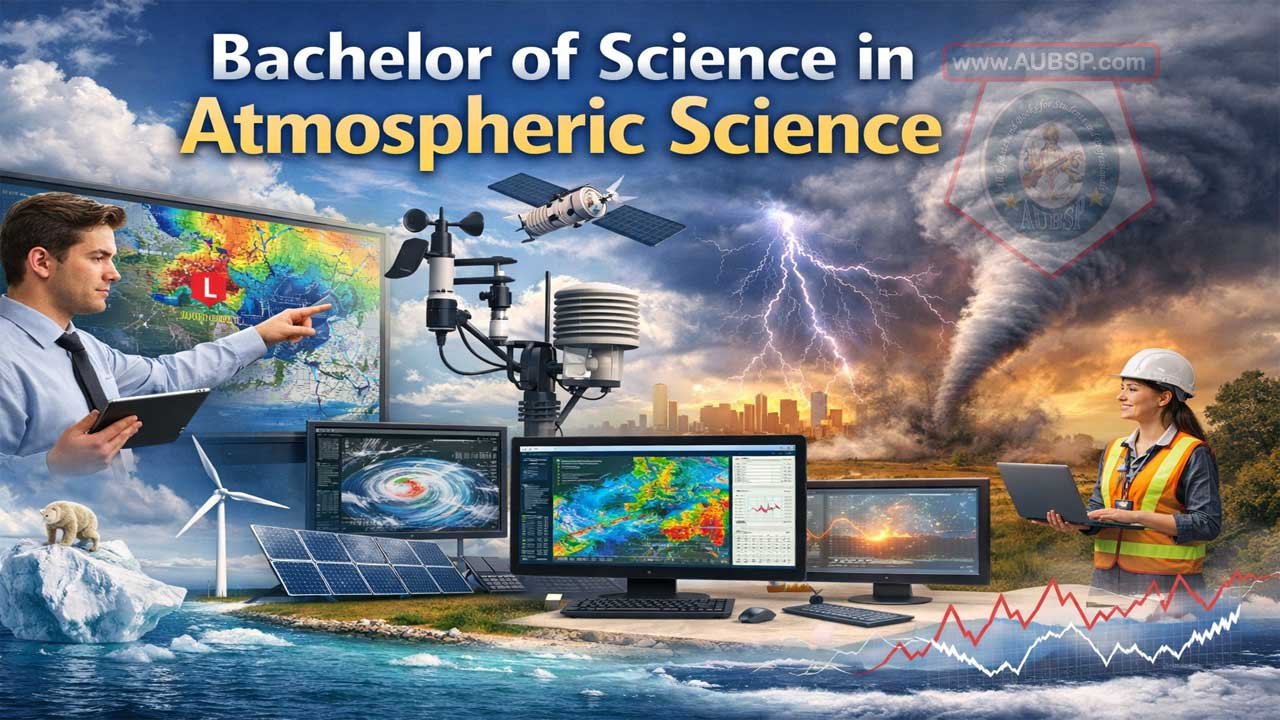
A Bachelor of Science in Atmospheric Science is a four-year college degree that teaches students how weather and climate work using science and math. Students learn about the atmosphere, storms, climate change, and how to predict weather by studying physics, chemistry, and computer tools.
Graduates can work in jobs like weather forecasting, climate and environmental research, renewable energy, insurance, and government agencies. The field is growing in importance because of climate change and extreme weather, and people with strong data and programming skills often have the best job opportunities and pay.
| Key Point | Details |
|---|---|
| Degree Name | Bachelor of Science in Atmospheric Science (BSc Atm Sci) |
| Duration | 4 years |
| Field of Study | Weather, climate, and atmospheric processes |
| Core Subjects | Meteorology, Physics, Mathematics, Climate Science |
| Skills Learned | Weather forecasting, data analysis, modeling, research |
| Career Options | Meteorologist, Climate Analyst, Environmental Scientist, Researcher |
| Sectors | Government, private weather firms, energy, insurance, research |
| Entry-Level Salary (Approx.) | $30,000–$55,000 per year (varies by role & country) |
| Top Employers | Weather services, research institutes, energy & climate companies |
| Higher Study Options | Master’s, PhD in Atmospheric Science / Meteorology |
| Best For | Students interested in weather, climate change, and science |
What Is a Bachelor of Science in Atmospheric Science?
A Bachelor of Science in Atmospheric Science (BScAtmSc) is a four-year undergraduate degree program that prepares students to understand, analyze, and forecast weather patterns, climate systems, and atmospheric phenomena.
The discipline, often interchangeably called meteorology, combines physics, chemistry, mathematics, and earth sciences to examine how the atmosphere behaves across local, regional, and global scales. This degree is ideal for students fascinated by weather phenomena, climate change, environmental protection, and scientific research who want to translate their passion into a competitive career.
The field has gained significant momentum over the past decade as climate change concerns and extreme weather events have intensified global demand for atmospheric expertise. Universities worldwide now recognize atmospheric science as a critical discipline, leading to expanded program offerings and improved career prospects across both government and private sectors.
Why Study Atmospheric Science? Career Prospects and Earning Potential
Competitive Salary Outlook
One of the most compelling reasons to pursue a BScAtmSc degree is the strong earning potential. The median annual salary for atmospheric scientists in the United States stands at $97,450 according to 2024-2025 data, placing the profession well above the national average for all occupations.
Entry-level graduates typically earn between $33,000 and $50,000, but this increases substantially with experience. The 25th percentile earns approximately $69,400, while the 75th percentile reaches $128,900. Top professionals in the field exceed $160,000 annually, particularly those working in specialized research or elite private sector roles.
Geographic location significantly influences compensation. Atmospheric scientists in California, Massachusetts, and Virginia earn notably higher salaries—ranging from $113,600 to $143,600 annually—compared to colleagues in other regions. This geographic premium reflects the concentration of major research institutions and corporate headquarters in these states.
Emerging High-Paying Sectors
The intersection of atmospheric science and data science has created lucrative opportunities in the private sector that many graduates overlook. Financial institutions, insurance companies, and technology firms now actively hire atmospheric scientists for climate risk assessment and predictive modeling roles.
Senior professionals combining atmospheric science expertise with software engineering skills can earn $200,000+ in fintech and quantitative trading firms. Additionally, renewable energy companies, agriculture technology firms, and alternative energy consultancies increasingly demand atmospheric specialists, often offering entry-level salaries ranging from $65,000 to $85,000—significantly above traditional meteorology broadcasting roles that typically start at $20,000 to $30,000.
Job Market and Employment Growth
The employment outlook for atmospheric scientists shows mixed signals depending on sector. The U.S. Bureau of Labor Statistics projects that employment for atmospheric scientists will grow 8% between 2018 and 2028—faster than the average for all occupations.
However, more recent data indicates 1% growth rate, reflecting budget constraints in federal agencies like NOAA and the National Weather Service. The total number of atmospheric scientists in the U.S. is approximately 10,500, with an estimated 7,100 new positions expected over the next decade, though most will result from retirements rather than expansion.
The silver lining: The private sector represents the fastest-growing employment segment. Insurance firms, consulting companies, technology firms, and energy corporations are aggressively building atmospheric science teams to address climate risks, weather derivatives, and extreme event predictions.
| Career Sector | Entry Salary | Growth Potential | Job Availability |
|---|---|---|---|
| Broadcast Meteorology | $20,000-$30,000 | Limited | High Competition |
| National Weather Service (NWS) | $35,000-$55,000 | Moderate | Competitive |
| Energy/Financial Consulting | $65,000-$85,000 | High | Growing |
| Government Research (NOAA, NASA) | $50,000-$75,000 | Very High | Limited |
| Private Climate Tech/Insurance | $60,000-$90,000+ | Very High | Rapidly Growing |
Curriculum and Core Course Requirements
A typical BScAtmSc degree requires 120 credit hours (approximately 400-450 classroom contact hours). While specific requirements vary by institution, most programs share a common core structured around fundamental physics and mathematics, with specialized atmospheric courses.
Mathematics and Physics Foundation
All atmospheric science programs require a rigorous quantitative foundation. Typical requirements include:
- Calculus: Three-semester calculus sequence (Calculus I, II, and III) covering single and multivariable calculus
- Differential Equations: Essential for modeling atmospheric dynamics and wave propagation
- Physics: Two semesters of calculus-based general physics (mechanics and electromagnetism)
- Linear Algebra: Critical for numerical weather prediction models (sometimes combined with differential equations)
This mathematical preparation typically consumes 15-18 credit hours and usually must be completed before admission into upper-level atmospheric courses.
Atmospheric Core Courses (Federal Requirements)
The American Meteorological Society (AMS) establishes minimum standards for atmospheric science degrees seeking federal accreditation. These standards ensure graduates meet requirements for positions with agencies like the National Weather Service, NOAA, and NASA.
| Core Course Area | Credit Hours | Key Topics |
|---|---|---|
| Atmospheric Dynamics & Thermodynamics | 6 | Pressure, temperature, wind dynamics, atmospheric layers |
| Weather Systems Analysis (Synoptic/Mesoscale) | 6 | High/low pressure systems, storm formation, forecasting |
| Physical Meteorology | 3 | Radiation, clouds, precipitation physics |
| Remote Sensing & Instrumentation | 2-3 | Radar, satellites, weather instruments |
These courses typically occupy 17-18 credit hours and form the core competency expected of all atmospheric science graduates.
Specialized Electives and Advanced Topics
Upper-level electives allow students to specialize based on career interests:
- Climate Science: Climate modeling, paleoclimate, climate change impacts
- Air Quality: Atmospheric chemistry, air pollution, emissions
- Severe Weather: Tornado dynamics, hurricane forecasting, storm chasing
- Numerical Weather Prediction: Model development, data assimilation, forecasting algorithms
- Physical Oceanography: Ocean-atmosphere interactions
- Remote Sensing: Satellite meteorology, radar technology
- Environmental Science: Sustainability, environmental policy
Laboratory and Research Components
Most programs require 6-12 credits of laboratory courses and hands-on research. Many universities mandate a senior capstone project, research thesis, or internship experience. This practical training gives students experience with real-world meteorological equipment, data analysis software (Python, MATLAB, GrADS), and weather prediction models (WRF, NAM, GFS).
General Education Requirements
Typically 45 credit hours of general education courses round out the degree:
- Physics and Chemistry (already listed above as major requirements)
- Writing and Communication (3-6 credits)
- Social Sciences and Humanities (12-15 credits)
- Cultural and International Studies (6-9 credits)
- Electives (5-10 credits)
Top Universities Offering Atmospheric Science Degrees
United States (Ranked by Research Excellence)
Choosing the right university is crucial for both learning outcomes and career networking. Below are the top-ranked institutions globally for atmospheric science:
| Rank | University | Location | Acceptance Rate | Avg. SAT | Key Strengths |
|---|---|---|---|---|---|
| 1 | Massachusetts Institute of Technology (MIT) | Massachusetts | 5% | 1545 | Cutting-edge research, elite reputation, highest starting salaries |
| 2 | University of Washington | Washington | 43% | N/A | Top atmospheric program, excellent research facilities |
| 3 | Stanford University | California | 4% | 1545 | Innovation focus, tech industry connections, silicon valley location |
| 4 | University of Colorado Boulder | Colorado | 83% | 1325 | Renowned meteorology program, 35,000+ students, accessible pricing |
| 5 | California Institute of Technology (Caltech) | California | 3% | 1545 | Rigorous academics, exceptional research opportunities |
| 6 | UC Berkeley | California | 12% | N/A | World-class faculty, extensive research funding |
International Standouts:
- ETH Zurich (Switzerland): 8% acceptance rate, globally recognized for atmospheric research
- University of Reading (UK): Founded 1892, leading European meteorology program
- University of Melbourne (Australia): Premier atmospheric science program in Southern Hemisphere
- University of Tokyo & Nagoya University (Japan): Strong Asian research institutions
Quality vs. Accessibility Trade-offs
Elite universities (MIT, Stanford, Caltech) offer unparalleled research opportunities and networking, but acceptance rates range from 3-5% and net price can reach $21,000-$27,000 annually.
Mid-tier state universities (University of Colorado Boulder, Penn State, University of Wisconsin) accept 40-54% of applicants, cost $5,600-$15,000 annually, and provide excellent education without elite prestige. Comprehensive university comparisons using databases like Niche.com and U.S. News help prospective students balance academic quality, affordability, and career support.
Admission Requirements and Academic Standards
Typical GPA and Test Score Expectations
Most universities offering BScAtmSc degrees require a minimum high school GPA of 3.0-3.5 and competitive standardized test scores (SAT: 1300-1550 or ACT: 30-35, depending on institution). However, specific program admission criteria vary considerably:
- Highly Selective (MIT, Stanford, Caltech): GPA 3.9+, SAT 1500+
- Selective (UC Berkeley, Cornell, University of Michigan): GPA 3.7-3.9, SAT 1400-1550
- Moderately Selective (Penn State, University of Wisconsin, University of Colorado): GPA 3.3-3.7, SAT 1300-1400
- Open Access (Arizona State, Iowa State): GPA 2.0-3.0, SAT 1200+
Prerequisites Before Admission
Most universities require completion of prerequisite courses before formal admission to the atmospheric science major:
High School Preparation (Strongly Recommended):
- AP Calculus AB or BC (score of 4+)
- AP Physics (Mechanics or C&E)
- AP Chemistry
- Honors Chemistry and Physics
College Prerequisite Courses (Required for Major Entry):
- Calculus I, II, III (typically completed in first year)
- Physics I & II (calculus-based)
- Chemistry (general or organic, depending on program)
Many universities allow students to change majors into atmospheric science after completing these prerequisites, even if initially admitted as undeclared or different science majors.
GPA Requirements for Upper-Division Courses
To continue in the atmospheric science major, most universities require maintaining a minimum 2.0-2.5 GPA in all attempted courses and prerequisite courses, with some programs requiring a 2.3+ GPA specifically in major courses. This weeding process after the first two years is common in STEM disciplines.
International Student Requirements
International students typically must demonstrate English proficiency via TOEFL (minimum 80-90 on internet-based test) or IELTS (6.5-7.0). Many universities also require GRE scores for graduate-level programs, though not uniformly for bachelor’s degrees. Visa sponsorship and international tuition rates apply—typically 2-3x higher than domestic rates, ranging from $30,000 to $60,000+ annually at U.S. universities.
Cost of Education and Return on Investment
Total Cost of Attendance (4-Year Degree)
Calculating the true cost of an atmospheric science degree requires examining tuition, fees, room and board, and books:
| Institution Type | Annual Tuition | Room & Board | Annual Total | 4-Year Total |
|---|---|---|---|---|
| Public State Universities (In-State) | $8,000-$14,000 | $10,000-$14,000 | $18,000-$28,000 | $72,000-$112,000 |
| Public Universities (Out-of-State/International) | $25,000-$45,000 | $10,000-$16,000 | $35,000-$61,000 | $140,000-$244,000 |
| Private Universities | $45,000-$60,000 | $12,000-$18,000 | $57,000-$78,000 | $228,000-$312,000 |
| Elite Universities (MIT, Stanford) | $60,000-$65,000 | $15,000-$20,000 | $75,000-$85,000 | $300,000-$340,000 |
Financial Aid Context: Many universities offer substantial financial aid packages. For example, MIT and Stanford provide need-based aid, reducing net price to $17,998-$26,455 for qualifying students. The University of Michigan achieves a net price of just $5,670 annually for students from families earning $30,000-$48,000, with a 1.3% loan default rate (well below national average of 10.1%).
Return on Investment (ROI) Analysis
With a median atmospheric scientist salary of $97,450 and average entry-level salary of $33,196-$50,000, the ROI depends heavily on institution choice and career path:
Best Value Path: State university (public in-state, $72,000-$112,000 total cost) + government position ($50,000-$60,000 entry salary) = 3-4 year payback period.
Elite Institution Path: Private university ($300,000-$340,000 cost) + tech sector position ($65,000-$90,000+ entry salary) = 5-7 year payback period but significantly higher lifetime earnings.
Highest ROI Private Sector Path: State university + energy/consulting firm role ($65,000-$85,000 entry, $150,000+ within 10 years) = 2-3 year payback with steepest salary growth.
The field is described as “high-value” with strong long-term earning potential, particularly for graduates combining atmospheric science with data science and programming skills.
Diverse Career Paths for Atmospheric Science Graduates
A BScAtmSc degree opens doors to surprising breadth of careers, each with distinct salary and advancement profiles:
Government and Public Sector Careers
National Weather Service (NWS) Meteorologist: Entry-level positions in the NWS start at GS-7 (~$35,000-$45,000) with potential to reach GS-14 levels ($100,000+) after 20 years. These positions offer exceptional job security, federal pension benefits, and stable advancement.
NOAA and NASA Researcher: Research positions at major federal agencies (National Oceanic and Atmospheric Administration, National Aeronautics and Space Administration) typically start at $50,000-$75,000 for bachelor’s degree holders, reaching $120,000-$150,000 for PhD researchers. Competition is intense but offers world-class research opportunities.
EPA and Environmental Agencies: Air quality meteorologists and climate policy analysts earn $55,000-$80,000 entry level, advancing to $100,000+ in senior roles. These positions directly impact environmental regulation and sustainability.
Private Sector and Commercial Opportunities
Broadcast Meteorology: Television weather forecasters serve local media markets, earning $20,000-$30,000 entry level in small markets, advancing to $60,000-$150,000 in major markets. While glamorous, this path typically plateaus in earning potential without advanced degrees.
Energy and Renewable Sector: Wind energy analysts, solar resource assessors, and hydroelectric forecasters earned $60,000-$85,000 entry level, with rapid advancement to $100,000+ as companies expand renewable portfolios. This sector shows the strongest growth.
Insurance and Reinsurance Industry: Climate risk assessors analyze extreme weather events and help insurers model catastrophic risk. Entry salaries range from $65,000-$90,000, with potential to exceed $150,000 in senior roles. This sector aggressively recruits atmospheric science graduates.
FinTech and Quantitative Trading: Weather derivatives traders, climate quantitative analysts, and environmental risk analysts at hedge funds and investment banks earn $100,000-$300,000+ when combining atmospheric science with finance skills. This represents the highest-earning track.
Consulting and Professional Services: Weather and climate consulting firms employ atmospheric scientists at $60,000-$100,000 entry level, advancing rapidly based on client billability and specialized expertise.
Academic and Research Pathways
University Professor/Researcher: With a PhD, graduates lead atmospheric research groups at universities, earning $60,000-$150,000 depending on seniority and institution. This path requires 5-7 years of additional education but offers intellectual freedom and tenure security.
Research Scientist at National Labs: Positions at national laboratories (Argonne, Pacific Northwest National Lab, Lawrence Livermore) offer $70,000-$140,000 entry-level salaries with excellent benefits and research support.
| Career Path | Entry Salary | 10-Year Salary | Best For |
|---|---|---|---|
| Broadcast Meteorology | $25,000 | $60,000 | Public communication, media interest |
| NWS Meteorologist | $40,000 | $100,000+ | Job security, federal benefits |
| Energy/Renewable Analyst | $70,000 | $120,000+ | Tech interest, sustainability focus |
| Insurance/FinTech | $80,000 | $150,000+ | High earning potential, quantitative skills |
| University Researcher (PhD required) | $50,000 | $120,000+ | Academic freedom, cutting-edge research |
Essential Skills and Personal Traits for Success
Success in atmospheric science demands specific competencies beyond academic knowledge:
Technical Skills
Programming and Data Analysis: Python, MATLAB, R, and shell scripting have become essential. Modern atmospheric scientists spend 40-60% of time coding, analyzing datasets, and automating workflows. Students lacking programming experience should prioritize learning before graduation.
Numerical Modeling: Familiarity with Weather Research and Forecasting (WRF) model, Global Forecast System (GFS), and ensemble prediction systems is increasingly required, even for entry-level positions.
Geographic Information Systems (GIS): Spatial analysis, data visualization, and map creation are core competencies in consulting, environmental analysis, and research roles.
Data Visualization: Creating compelling graphics from complex atmospheric datasets is essential for communication with non-technical stakeholders.
Professional Skills
Communication: Ability to explain complex meteorological concepts to diverse audiences—from technical colleagues to media and policymakers. Written, oral, and visual communication are equally critical.
Problem-Solving: Atmospheric science inherently involves incomplete data, uncertain predictions, and competing interpretations. Resilience, flexibility, and scientific skepticism are essential.
Collaboration: Most research and forecasting occurs in team environments. Teamwork, mentorship capability, and cross-disciplinary collaboration are increasingly valued.
Common Challenges and How to Overcome Them
Challenge #1: Competitive Job Market with Limited Growth
Reality: Despite high salaries, atmospheric science faces slower employment growth (1-4%) than average occupations, and federal sector hiring faces budget constraints.
Solutions:
- Develop dual expertise in data science/programming (makes you competitive in private sector)
- Consider geographic flexibility (willingness to relocate expands opportunities significantly)
- Pursue master’s or PhD for research-focused roles with better long-term prospects
- Network aggressively through internships and professional conferences
Challenge #2: High Loan Debt for Limited Entry-Level Salaries
Reality: Private university graduates ($300,000+ debt) entering broadcast meteorology ($25,000 salary) face impossible loan repayment scenarios.
Solutions:
- Attend public in-state universities to minimize debt burden
- Apply aggressively for scholarships and fellowships (AMS, NSF, NOAA all offer funding)
- Seek employers offering loan forgiveness (federal positions often do)
- Target private sector roles with higher entry salaries
- Consider part-time work or internships while building credentials
Challenge #3: Narrow Initial Job Market for Bachelor’s Degree Holders
Reality: Many premier positions require Master’s or PhD degrees, particularly in research, academia, and government.
Solutions:
- Pursue graduate school (master’s degree requires 2 years, significantly improves earning and career options)
- Gain competitive work experience as technician or forecaster before pursuing advanced degrees
- Build research experience through undergraduate research and internships
- Network with graduate students and faculty to understand long-term career paths
Atmospheric Science vs. Related Degrees: How They Compare
Students sometimes confuse atmospheric science with related earth science disciplines. Here’s how they compare:
| Degree | Focus | Career Salary | Job Outlook | Best For |
|---|---|---|---|---|
| Atmospheric Science | Weather, climate, atmosphere | $97,450 median | Moderate 1-8% | Weather prediction, climate research |
| Environmental Science | Broad environmental systems | $85,000 median | 8% | Conservation, policy, sustainability |
| Geology/Earth Science | Rocks, minerals, earth structure | $78,000 median | 5% | Petroleum, mining, natural resources |
| Physics | Fundamental forces and energy | $95,000 median | 5% | Research, academia, technology |
| Chemistry | Molecular interactions | $85,000 median | 4% | Industry, pharmaceuticals, research |
Key Distinction: Atmospheric science is the most specialized and offers the highest upside earning potential, particularly in emerging climate tech and FinTech sectors, but also has narrower entry-level job markets than general environmental science or physics.
Should You Major in Atmospheric Science? Key Considerations
Atmospheric Science Is Right for You If:
✓ You’re passionate about weather, climate, and understanding how Earth’s atmosphere works
✓ You excel in physics, calculus, and quantitative reasoning
✓ You’re willing to be flexible about relocation after graduation (many positions are geographically concentrated)
✓ You’re interested in pursuing advanced degrees (master’s or PhD) for research careers
✓ You want to contribute to climate change research and environmental protection
✓ You combine atmospheric science interest with complementary skills in data science, programming, or business
Reconsider If:
✗ Your primary motivation is rapid wealth accumulation (better options exist in finance or software engineering with fewer barriers to entry)
✗ You’re unwilling to relocate (many positions concentrate in specific regions like the Pacific Northwest, Colorado, California)
✗ You dislike advanced mathematics and physics (the degree is quantitatively intensive)
✗ You have substantial student loans and need immediate high income (entry-level positions pay $25,000-$55,000 depending on path)
✗ You’re uncertain whether you enjoy the discipline (consider internships or research experiences first)
How to Prepare for an Atmospheric Science Degree
High School Preparation (Ideal Candidate Profile)
Strong atmospheric science students should have:
- Advanced Placement (AP) Coursework: AP Calculus BC, AP Physics, AP Chemistry (scores of 4+ preferred)
- Strong Math Background: Proficiency through Algebra II, Trigonometry, Pre-Calculus
- Science Courses: At least two semesters each of Chemistry and Physics (honors level if available)
- Electives: Environmental Science, Oceanography, or Geology courses strengthen foundational knowledge
- Computing Skills: Basic programming experience (Python), computer literacy
First-Year University Strategy
Incoming freshman should:
- Complete calculus and physics prerequisites immediately: These gate-keep access to upper-level atmospheric courses, so completion in Year 1 is essential.
- Seek undergraduate research opportunities: Even Year 1 students can participate in research assistant roles, gaining mentorship and experience.
- Join meteorology clubs and attend seminars: Network with advanced students and faculty to understand specializations.
- Secure internships by Year 2: NOAA, NWS, and private companies recruit heavily for summer internships; beginning the process in Year 2 maximizes opportunities.
- Develop programming skills independently: Take computer science courses or online tutorials in Python—this differentiates competitive candidates.
FAQs about Atmospheric Science Degrees
Q: Do I need a PhD to work as an atmospheric scientist?
A: No. A bachelor’s degree qualifies you for many government, private sector, and academic positions. However, PhD is essential for leading research groups, securing tenure-track professorships, and accessing the highest-paying research roles. Master’s degrees provide a middle ground, improving earning potential and career flexibility.
Q: What’s the difference between meteorology and atmospheric science?
A: These terms are largely interchangeable in modern usage. “Meteorology” historically refers to weather prediction and forecasting, while “atmospheric science” encompasses broader study of atmospheric processes, chemistry, and climate. Universities often use both terms for the same program.
Q: Can I work internationally with a U.S. atmospheric science degree?
A: Yes. Atmospheric science is globally recognized, and many international governments, research institutions, and companies hire U.S. graduates. However, specific visa sponsorship requirements, credential recognition, and salary packages vary by country. European and Australian positions are most accessible to U.S. graduates.
Q: What’s the typical job search timeline after graduation?
A: Highly variable—anywhere from 2-12 months. Government positions require lengthy background checks (3-6 months). Research positions depend on advisor availability and funding. Private sector roles move faster (3-8 weeks). Broadcast meteorology is the quickest (2-4 weeks) but lowest-paying. Networking and internships dramatically accelerate the process.
Q: Is atmospheric science a dying field?
A: No. While federal hiring is constrained, private sector demand is accelerating due to climate change, renewable energy growth, and financial sector interest in climate risk. The field is shifting from government-dominant to private-dominant employment, creating uncertainty for traditional paths but exciting opportunities in emerging sectors.
Q: What programming languages are most important?
A: Python is now essential and universal. MATLAB remains important for legacy atmospheric models. R is growing for statistical analysis and data visualization. Shell scripting and Linux fundamentals are increasingly required. C/C++ helps for high-performance computing roles.
Making Your Decision: Next Steps
- Research Specific Programs: Visit university websites, email professors, and request informational interviews. Ask specifically about job placement, starting salaries, and graduate school support.
- Explore Internship Opportunities: Seek summer internships at NOAA, NWS, or private weather companies to experience the field firsthand. These often convert to job offers.
- Assess Career Interests: Determine whether you’re drawn to research, forecasting, consulting, private sector, or academia. Each path requires different preparation.
- Evaluate Financial Scenarios: Calculate realistic 4-year costs at target institutions and compare against expected entry-level salaries. State universities often offer best ROI; elite institutions offer better networks but slower payback.
- Develop Complementary Skills Early: If interested in fintech or energy sector roles, invest time in programming and statistics courses during high school or first-year university. These skills dramatically improve earning potential.
Final Thought: A Bachelor of Science in Atmospheric Science represents a compelling investment for students passionate about weather, climate, and environmental science who also want solid earning potential and meaningful work.
The field is rapidly evolving, with the private sector offering unexpected high-earning pathways that traditional meteorology career guides don’t highlight. Success requires intentionality about specialization, geographic flexibility, and commitment to continuous skill development—but for the right candidate, the rewards are substantial.


Leave a Reply
You must be logged in to post a comment.