
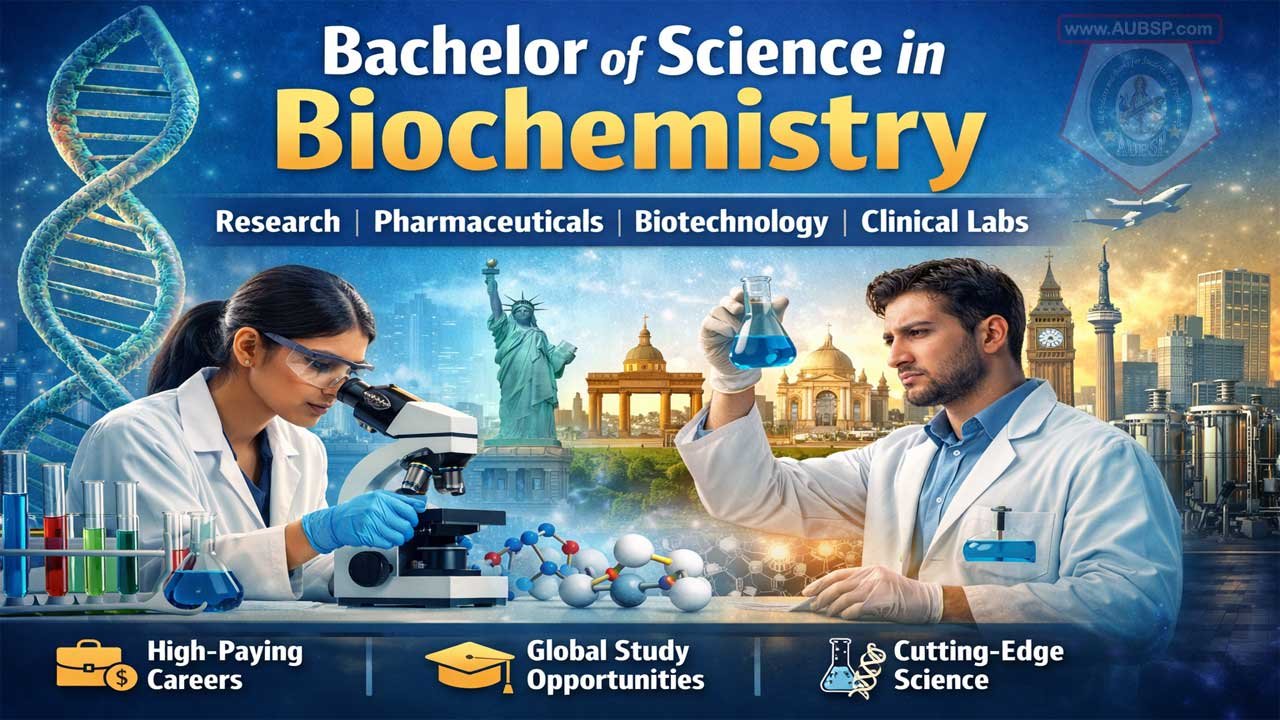
A Bachelor of Science in Biochemistry is a rigorous undergraduate degree that blends chemistry and biology to explore the molecular processes of life, preparing students for high-demand careers in pharmaceuticals, biotechnology, clinical diagnostics, research, and academia worldwide.
The program typically spans 3–4 years and covers core areas like enzyme kinetics, metabolism, molecular biology, protein structure, and hands-on laboratory techniques, with options to specialize in fields such as clinical biochemistry, drug development, structural biology, or biotechnology.
Graduates benefit from strong global opportunities and competitive pay—ranging from ₹3–6 LPA entry-level in India to $60,000+ in developed countries, with six-figure potential at senior levels—along with pathways to master’s, PhD, or professional degrees. With study options across cost-effective hubs like Germany and Romania and prestigious destinations like the US and UK, biochemistry offers a versatile, future-proof career combining strong earning potential with meaningful scientific impact.
| Category | Information |
|---|---|
| Degree Name | Bachelor of Science in Biochemistry (BSc Biochemistry) |
| Duration | 3–4 years (varies by country) |
| Core Subjects | Biochemistry, Molecular Biology, Enzymology, Metabolism, Genetics, Lab Techniques |
| Eligibility | 12th grade with Physics, Chemistry, Biology (or equivalent science background) |
| Entrance Exams | CUET (India), university-specific exams; IELTS/TOEFL for study abroad |
| Top Career Paths | Pharmaceutical Scientist, Clinical Biochemist, Biotechnologist, Research Scientist, QC/QA Officer |
| Entry-Level Salary | ₹3–6 LPA (India), $60,000+ (US/UK) |
| Mid–Senior Salary | ₹10–25+ LPA (India), $90,000–150,000+ (US) |
| Top Study Destinations | India, Germany, USA, UK, Romania |
| Higher Study Options | MSc (Biochem, Molecular Biology, Pharmacology), PhD, MD/PharmD |
| Key Skills Gained | Lab research, data analysis, molecular techniques, critical thinking |
| Global Demand | High demand in pharma, biotech, diagnostics, research sectors |
| Scholarships | DAAD (Germany), Fulbright (US), Clarendon (UK), university merit aid |
Bachelor of Science in Biochemistry: Complete Guide to Degree, Career & Global Opportunities
A Bachelor of Science in Biochemistry is a prestigious undergraduate degree that equips students with expertise in the molecular and chemical processes governing living organisms. As of 2026, biochemistry remains one of the most sought-after STEM fields globally, offering graduates access to lucrative career paths in pharmaceutical research, biotechnology, clinical diagnostics, and academic institutions across developed and emerging markets.
With entry-level salaries starting at ₹3–6 LPA in India and $60,000+ in developed nations, and experienced professionals commanding six-figure compensation packages, this degree combines high earning potential with meaningful research impact. This comprehensive guide explores degree structures, admission requirements, international study opportunities, career trajectories, and salary expectations across major global education markets.
What is a Bachelor of Science in Biochemistry?
A Bachelor of Science in Biochemistry (BSc Biochemistry or BScBiochem) is a three to four-year undergraduate program that integrates chemistry, biology, and molecular sciences to study the chemical processes within living organisms. Students examine how biological molecules—proteins, lipids, nucleic acids, and carbohydrates—function at the molecular level and how their interactions determine cellular and organismal behavior.
The degree differs fundamentally from pure biology or chemistry programs by bridging both disciplines. While biologists focus on organisms and ecosystems, and chemists study atomic and molecular structures, biochemists investigate the chemistry of life itself—the enzymatic reactions that drive metabolism, DNA replication, protein synthesis, and cellular communication.
Core learning outcomes include:
- Understanding enzyme kinetics, molecular mechanisms, and catalytic processes
- Mastering metabolic pathways including carbohydrate, lipid, and protein metabolism
- Analyzing protein structure, folding mechanisms, and function
- Studying genetic expression, molecular biology, and cellular regulation
- Applying laboratory techniques in modern research environments
Program Structure & Curriculum Overview
Typical Course Distribution
| Year | Focus Area | Key Subjects |
|---|---|---|
| Year 1 | Foundational Sciences | General Chemistry, Biology, Organic Chemistry, Mathematics, Physics |
| Year 2 | Core Biochemistry | Biochemistry Fundamentals, Molecular Biology, Organic Chemistry II, Cell Biology |
| Year 3 | Specialized Modules | Enzymology, Metabolic Pathways, Clinical Biochemistry, Bioinformatics, Proteins & Nucleic Acids |
| Year 4 | Advanced Research | Research Project/Thesis, Optional Specializations, Electives |
Specialization Options Available
Depending on the university, students can focus on specific domains:
Molecular Biochemistry: In-depth study of protein structure, enzyme mechanisms, and genetic regulation. Ideal for aspiring researchers and PhD candidates.
Clinical Biochemistry: Diagnostic techniques, biomarkers, pathophysiology, and clinical laboratory analysis. Prepares students for clinical research associate and diagnostic technician roles.
Pharmaceutical Biochemistry: Drug design, medicinal chemistry, pharmacogenomics, and therapeutic applications. Pathway to pharmaceutical industry careers.
Structural Biology: X-ray crystallography, cryo-electron microscopy, computational modeling, and drug target identification.
Metabolic Engineering & Biotechnology: Industrial fermentation, biofuel production, genetic engineering, and bioprocess optimization.
Global Education Opportunities: Where to Study Biochemistry Abroad
High-CPM Study Destinations
1. Germany – Premium Research + Zero Tuition
Germany offers the highest value proposition for international biochemistry students, combining world-class research facilities with minimal financial barriers.
| Aspect | Details |
|---|---|
| Tuition Fees | Free to €350/year (varies by state) |
| Living Costs | €1,000/month (~$1,100 USD) |
| Course Duration | 2 years (Masters), 3-4 years (Bachelor) |
| Language | English programs widely available |
| Top Universities | Technical University of Munich, University of Freiburg, Humboldt University Berlin |
| Scholarships | DAAD (€934/month for Masters, €1,300 for PhD) |
German universities like the Technical University of Munich and University of Freiburg rank among Europe’s top biochemistry institutions. The German research ecosystem attracts international funding and collaboration, providing students with exposure to cutting-edge molecular research.
2. Romania – Affordable European Alternative
Romania has emerged as a cost-effective gateway to European biochemistry education with Schengen mobility benefits.
| Aspect | Details |
|---|---|
| Tuition Fees | €600–€3,500/year |
| Bachelor Requirements | 75% in secondary school, Biology/Chemistry/Physics mandatory |
| Key Advantage | Schengen freedom of movement across 29 EU countries |
| Top Universities | University of Bucharest, Babes-Bolyai University, Carol Davila (€0 tuition) |
| Living Costs | €500–€800/month |
Romanian universities offer modern, state-of-the-art laboratory facilities with practical, hands-on training emphasizing real-world applications over theoretical knowledge.
3. United Kingdom – Prestigious Degree with Year Abroad Option
UK biochemistry degrees are globally recognized and often include international study components. Imperial College London and Lancaster University offer integrated year-abroad programs.
| Aspect | Details |
|---|---|
| Tuition (Overseas) | £45,500/year (Imperial College) |
| Program Structure | 3-4 years with optional year abroad |
| Year Abroad | 15% of annual fee (Imperial), exchange partnerships with 20+ European universities |
| Partner Countries | France, Germany, Netherlands, Spain, Austria, Switzerland |
| Entry Requirements | IELTS 6.5+ |
Imperial’s biochemistry students spend Year 3 at partner institutions in Vienna, Copenhagen, Lyon, Heidelberg, or Zurich, with grades counting toward their final degree classification.
4. United States – Career Impact & Scholarship Potential
The US offers the highest career earning potential but requires significant upfront investment or scholarship support.
| Aspect | Details |
|---|---|
| Tuition (Private) | $50,000–$80,000/year |
| Tuition (Public) | $15,000–$35,000/year (in-state) |
| Biochemist Salary (Post-Grad) | $103,650 average; $125,000+ with experience |
| Available Scholarships | Fulbright, university merit aid, research fellowships |
| REU Programs | Free summer research internships with stipends |
The US education investment yields premium returns: a 2026 biochemistry graduate earns approximately $103,650 annually—30% above Indian entry-level salaries in absolute terms.
5. India – Domestic & Affordable High-Quality Programs
For India-based students, domestic universities offer exceptional value and growing research opportunities.
| Institution | Location | Approximate Fees (Annual) | Placement Salary (Average) |
|---|---|---|---|
| University of Delhi | Delhi | ₹10,000–₹20,000 | ₹8–12 LPA |
| Banaras Hindu University | Varanasi | ₹15,000–₹30,000 | ₹6–10 LPA |
| University of Calcutta | Kolkata | ₹10,000–₹25,000 | ₹5–8 LPA |
| Christ University | Bangalore | ₹50,000–₹1,00,000/year | ₹10–15 LPA |
India’s leading institutions combine affordable fees with quality research infrastructure and growing industry connections in the pharmaceutical and biotechnology sectors.
Admission Requirements for Bachelor of Science in Biochemistry
International Student Prerequisites
1. Academic Qualifications
- High School Diploma/12th Grade Equivalent with strong performance in Physics, Chemistry, Biology, and Mathematics
- Minimum GPA/Percentage: 50% aggregate in science stream, equivalent to B-/3.0 GPA or higher in international contexts
- Subject Requirements: PCB (Physics, Chemistry, Biology) or PCMB mandatory for Indian students; equivalent science background required internationally
2. Standardized English Language Tests
For non-English speaking countries (essential for UK, US, Germany English-medium programs):
| Test | Minimum Score | Details |
|---|---|---|
| IELTS Academic | 6.5–7.0 bands overall | Minimum 6.0 per component; UK universities require 6.5+ |
| TOEFL iBT | 90–100 | Minimum 20 per section; US universities range 90–110 |
| PTE Academic | 58–68 | Increasingly accepted by international universities |
Postgraduate biochemistry programs require IELTS 7.0 with 6.0+ per component, reflecting advanced academic English demands.
3. Entrance Examinations
India-specific entrance exams:
- CUET (Common University Entrance Test): Accepted by Delhi University and participating national universities
- ICAR AIEEA: For agricultural and applied science programs with biochemistry components
- University-Specific Exams: Individual institutions like Banaras Hindu University, Jamia Hamdard, and Amity University conduct merit or entrance-based admission
CUET and ICAR AIEEA provide merit-based competition pathways for highly motivated students seeking premier institution placement.
Document Checklist for International Applications
- Official secondary school transcripts with English translation
- English language test scores (IELTS, TOEFL, PTE)
- Personal Statement or Statement of Purpose (500–750 words)
- 2–3 Letters of Recommendation from science/chemistry teachers
- Completed university application form with application fee (€50–$100 typically)
- Valid passport copy
- Financial proof/bank statements (if required by visa regulations)
- Medical certificates and vaccination records (if specified)
Career Paths After Bachelor of Science in Biochemistry
Direct Entry Roles (Immediate Post-Graduation)
1. Pharmaceutical Research Scientist
- Salary: ₹6–12 LPA (India), $55,000–$75,000 (US/UK)
- Responsibilities: Drug candidate screening, formulation development, bioanalytical testing
- Required Skills: Laboratory techniques, data analysis, regulatory knowledge
- Career Progression: 2–3 years → Senior Research Scientist (₹12–18 LPA)
Pharmaceutical Scientists earn premium entry-level compensation in the biochemistry field.
2. Clinical Biochemist / Clinical Research Associate
- Salary: ₹4–8 LPA (India), $50,000–$70,000 (US)
- Responsibilities: Patient sample analysis, biomarker interpretation, clinical trial support
- Work Environment: Hospital labs, diagnostic centers, contract research organizations (CROs)
- Career Path: Clinical pathway for those interested in healthcare applications
Clinical Biochemists earn ₹4–8 LPA, with experienced professionals in private hospitals commanding upward of ₹12 LPA.
3. Biotechnology Specialist
- Salary: ₹6–12 LPA (India)
- Responsibilities: Genetic engineering, bioprocess optimization, quality control
- Sector Growth: 15%+ annual industry growth in India and Southeast Asia
- Advancement: 3–5 years → Bioprocess Engineer or Technical Lead
4. Quality Control/Quality Assurance Officer
- Salary: ₹3–5 LPA (entry-level)
- Responsibilities: Product testing, regulatory compliance, batch documentation
- Growth Trajectory: Fast promotion track in pharma/biotech companies
- Certification: ISO 17025 and internal company training accelerates advancement
QC/QA positions offer stable entry points with rapid advancement to ₹7–10 LPA within 3–5 years.
5. Laboratory Technician / Scientific Officer
- Salary: ₹2.5–4 LPA
- Entry Path: Immediate post-graduation role with lower barriers
- Responsibilities: Equipment operation, sample preparation, data recording
- Progression: Pathway to Research Scientist or Specialist roles with experience
Graduate School Preparation Routes
Master’s Programs (Advanced Career Specialization)
A BSc Biochemistry serves as the foundational qualification for specialized Master’s programs:
| Master’s Program | Career Focus | Average Salary (Post-Masters) |
|---|---|---|
| MSc Molecular Biology | Genetic research, biotech | ₹8–15 LPA |
| MSc Pharmacology | Drug development, clinical research | ₹10–18 LPA |
| MSc Clinical Biochemistry | Diagnostic labs, hospital research | ₹6–12 LPA |
| MBA (Biotech/Pharma Management) | Industry leadership, business roles | ₹12–25 LPA |
| MSc Bioinformatics | Computational biology, drug design | ₹8–16 LPA |
Master’s graduates earn ₹3–35 LPA depending on specialization, institution, and work experience—a significant premium over bachelor’s-only careers.
Professional Doctorates
- MD/DO (Medicine): Biochemistry BSc serves as prerequisite; US medical school median salary $250,000+
- DVM (Veterinary Medicine): Biochemistry pathway to veterinary research or clinical practice ($125,510 average)
- PharmD (Pharmacy): Direct pathway; pharmacist salary $130,000+
PhD Programs (Research & Academia)
Biochemistry BSc holders commonly pursue PhD programs in molecular biology, structural biochemistry, pharmacology, or toxicology, leading to:
- Faculty positions (university salaries $80,000–$150,000+)
- Principal Investigator roles (securing research grants)
- Industrial R&D leadership positions
- Postdoctoral fellowships with stipends ($50,000–$80,000)
Salary Expectations by Country & Experience Level
India
| Job Role | Entry-Level (0–2 years) | Mid-Level (3–5 years) | Senior (6+ years) |
|---|---|---|---|
| Research Scientist | ₹5–8 LPA | ₹10–15 LPA | ₹15–25 LPA |
| Pharmaceutical Scientist | ₹6–10 LPA | ₹12–18 LPA | ₹18–30 LPA |
| Clinical Biochemist | ₹4–6 LPA | ₹8–12 LPA | ₹12–20 LPA |
| Biotechnologist | ₹5–8 LPA | ₹10–15 LPA | ₹15–25 LPA |
| Lab Technician | ₹2.5–3.5 LPA | ₹4–6 LPA | ₹6–10 LPA |
| QC/QA Officer | ₹3–4 LPA | ₹5–7 LPA | ₹8–12 LPA |
Entry-level professionals earn ₹3–6 LPA on average, while experienced biochemists with specialization command six-figure compensation packages exceeding ₹15 LPA.
United States
| Job Role | Salary Range | Market Demand |
|---|---|---|
| Biochemist | $103,650 average; $80,000–$150,000+ | 9% growth (faster than average) |
| Medical Scientist | $100,590 average | 11% growth |
| Pharmaceutical Scientist | $90,000–$130,000+ | High demand |
| Forensic Science Technician | $67,440 average | 14% growth |
| Bioprocess Engineer | $95,000–$120,000 | High demand |
The US market offers premium compensation for biochemistry professionals, with positions in pharmaceutical companies and research institutions commanding $100,000+ starting salaries for advanced degree holders.
United Kingdom
| Job Role | Salary Range (GBP) | Notes |
|---|---|---|
| Postdoctoral Researcher | £25,000–£35,000 | Entry-level research |
| Research Scientist | £35,000–£50,000 | 3–5 years experience |
| Senior Research Fellow | £50,000–£75,000 | 5+ years, leadership |
| Biotech Industry | £40,000–£80,000+ | Faster salary growth |
UK salaries are competitive in research and biotech but typically lower than US counterparts. Pharmaceutical industry positions offer premium compensation.
Germany
German universities typically do not publish specific salary data, but international benchmarks indicate:
- Research Associate: €30,000–€45,000 annually
- Postdoctoral Position: €42,000–€55,000
- Industry Biochemist: €45,000–€75,000+
The cost of living advantage (€1,000/month) combined with competitive salaries makes Germany financially attractive for early-career researchers.
Specializations & Career Niches
High-Demand Specialization Areas
1. Clinical Biochemistry & Medical Laboratory Science
Clinical biochemists interpret patient test results and biomarkers to diagnose and monitor diseases. With aging global populations and increasing chronic disease prevalence, clinical biochemistry demand is projected to grow 12% annually through 2030.
Entry Requirements: BSc Biochemistry + 1–2 year clinical fellowship or MSc Clinical Biochemistry
Salary Potential: ₹6–12 LPA (India), $60,000–$85,000 (US), £35,000–£60,000 (UK)
Key Skills: Analytical thinking, diagnostic interpretation, quality management, regulatory compliance
2. Pharmaceutical Research & Drug Development
Pharmaceutical biochemists design, test, and optimize drug candidates. This sector generates the highest salaries and attracts strong investment globally. India’s pharmaceutical industry alone employs 15,000+ research professionals with projected 8% CAGR.
Career Path:
- Graduate Research Associate ($50,000–$60,000)
- Research Scientist ($70,000–$90,000)
- Senior Research Manager ($120,000–$160,000)
- Director of R&D ($180,000+)
3. Forensic Biochemistry & Legal Science
Forensic biochemists analyze biological evidence including DNA, proteins, and toxins for criminal investigations. Employment projections show 14% job growth—faster than average.
Salary: $67,440 average, with senior positions exceeding $90,000
Work Environment: Crime labs, legal consulting firms, government agencies
4. Biotechnology & Genetic Engineering
Biotech specialists use recombinant DNA technology, CRISPR, and synthetic biology to develop therapeutics. This emerging field attracts venture capital and startup opportunities.
Specializations:
- Molecular cloning and vector design
- Protein expression and purification
- Fermentation and bioprocess engineering
- Quality control and regulatory affairs
Salary Potential: ₹6–15 LPA (India), $65,000–$120,000 (US)
5. Structural Biochemistry & Computational Biology
Structural biochemists use X-ray crystallography, cryo-electron microscopy, and computational modeling to understand protein function and design therapeutics. This highly specialized field commands premium compensation.
Required Tools: PyMOL, GROMACS, AMBER, AlphaFold, bioinformatics coding
Career Prospects: Academic research, pharmaceutical structure-based drug design, biotech companies
Salary: $85,000–$140,000+ (US positions commanding highest premiums)
Scholarships & Financial Aid for International Study
Fully Funded Scholarships
| Scholarship | Eligibility | Coverage | Application Deadline |
|---|---|---|---|
| Fulbright Foreign Student Program | Masters/PhD from 160+ countries | Tuition, living expenses, health insurance, travel | Varies by country (Sept–Nov typically) |
| Clarendon Scholarship (Oxford/UK) | Graduate students with top academic record | 100% tuition + £18,000/year stipend | January 31 |
| DAAD Scholarships (Germany) | Masters/PhD students from developing countries | €934/month (Masters), €1,300 (PhD), travel, insurance | October 31 |
| Australia Awards Scholarships | Indo-Pacific region students | Full tuition, travel, living expenses | Country-specific |
International biochemistry students have access to 50+ dedicated scholarships and grants through universities, governments, and private foundations.
Partial Funding & Merit-Based Aid
- University Scholarships: 25–50% tuition waivers for academic excellence
- Research Assistantships: Full tuition + $15,000–$25,000 stipend for lab work
- Teaching Assistantships: Tuition coverage + stipend ($12,000–$18,000/year)
- Country-Specific Grants: Indian government scholarships for study in Commonwealth countries
Cost-Effective Study Destinations
Germany: Free/minimal tuition + DAAD support = total cost ₹8–15 LPA for 2-year Masters
Romania: €600–€1,500/year tuition + €600/month living = total cost ₹10–15 LPA
India: ₹3–8 LPA total for 3-year Bachelor’s degree at premier institutions
Why Choose Biochemistry: Career Growth & Impact
Industry Demand & Job Security
Biochemistry graduates enter recession-resistant sectors. Pharmaceutical and biotechnology companies worldwide employ 2.5+ million professionals with projected 8–12% annual growth through 2030. Pandemic-driven investments in mRNA vaccines, personalized medicine, and biologics have accelerated hiring across all experience levels.
Research Impact & Intellectual Engagement
Unlike routine technical roles, biochemistry careers involve intellectual problem-solving at the frontier of human knowledge. Graduate biochemists contribute to:
- Cancer prevention and treatment mechanisms
- Vaccine development and immunology
- Environmental remediation and sustainable biofuels
- Rare disease diagnosis and therapeutic pathways
- Aging research and longevity science
Interdisciplinary Career Flexibility
A biochemistry degree opens doors beyond pure research. Graduates transition into:
- Science Communication & Journalism: Explain complex science to public audiences
- Patent Law & Intellectual Property: Legal protection of biochemical innovations
- Science Policy & Government: Regulatory affairs, FDA, health ministry positions
- Business Development & Entrepreneurship: Biotech startups (high-growth, high-reward)
- Medical Writing & Publishing: Technical documentation, academic journals
- Clinical Practice: Medicine, dentistry, veterinary science, pharmacy
Frequently Asked Questions (FAQ)
Q1: Is Biochemistry harder than other science degrees?
Biochemistry integrates multiple disciplines—organic chemistry, cell biology, and analytical methods—making it intellectually demanding but not impossible. Success requires consistent effort, strong mathematical foundations, and willingness to learn laboratory techniques. Students typically spend 15–20 hours/week in labs and coursework during the first two years.
Q2: What’s the difference between Biochemistry, Molecular Biology, and Biotechnology degrees?
Biochemistry: Focuses on chemical reactions and molecular mechanisms in living systems (enzyme kinetics, metabolic pathways, protein structure)
Molecular Biology: Emphasizes gene expression, DNA replication, and genetic regulation at the cellular level
Biotechnology: Applies biological discoveries to industrial/medical production (fermentation, genetic engineering, therapeutics development)
Biochemistry provides the foundational theory; biotechnology and molecular biology represent applied specializations.
Q3: Can I pursue Biochemistry without strong math background?
Strong mathematical skills (particularly calculus and statistics) significantly accelerate success. However, dedicated students can strengthen quantitative abilities during first-year courses. Universities offer math support programs and tutoring.
Q4: What research opportunities exist for undergraduates?
Excellent pathways include:
- Undergraduate Research Apprenticeships (URA): Paid lab positions during academic year
- Summer Research Programs (REU): 10-week NSF-funded programs with $6,000 stipends + free housing
- Honors Thesis Projects: Independent research with faculty mentorship
- Conference Presentations: Present findings at biochemistry conferences
These substantially strengthen graduate school applications.
Q5: Is a PhD necessary for a biochemistry career?
No. Bachelor’s degree holders access stable careers earning ₹3–8 LPA immediately. However, PhD holders advance 1–2 salary tiers higher (₹15–30 LPA+) and access leadership/academic roles. PhD choice depends on career ambitions: industry roles don’t strictly require PhD, while academic/research positions typically do.
Q6: How competitive is biochemistry for graduate school admission?
Competitiveness varies by institution. Top-tier programs (MIT, Stanford, Cambridge) accept <10% of applicants. Mid-tier programs accept 15–30%. Strong GPA (3.5+), research experience, strong GRE scores, and enthusiastic recommendation letters typically ensure admission to reputable programs.
Q7: Can I study biochemistry part-time or online?
Biochemistry is fundamentally laboratory-intensive, making fully online degrees uncommon. Some universities offer hybrid models with online lectures + required on-campus lab rotations. Evening/weekend programs exist but are rare. Most programs demand full-time in-person commitment.
Conclusion: Your Next Steps
A Bachelor of Science in Biochemistry represents one of the most versatile and financially rewarding pathways in STEM education, combining intellectual challenge with genuine societal impact. Whether you aspire to pharmaceutical innovation, medical research, biotech entrepreneurship, or clinical practice, a biochemistry foundation opens doors globally.
For Indian students, domestic universities like Delhi, BHU, and Jamia Hamdard offer exceptional value at ₹3–8 LPA total investment, while international study in Germany or Romania expands research exposure and network opportunities.
For international students, premium destinations like the UK, US, and Germany command higher costs but deliver disproportionate career returns: US biochemists earn $103,650 starting salaries with 9% job growth, while German research positions offer stability plus quality-of-life advantages.
Action items:
- Assess your academic strengths (chemistry, math, laboratory skills)
- Research university rankings and specializations aligned with your interests
- Prepare for entrance exams (CUET, IELTS, GRE if pursuing graduate study)
- Identify scholarship opportunities 12 months before target admission
- Build research experience through internships or lab volunteer work
The biochemistry field remains dynamic, with emerging opportunities in personalized medicine, synthetic biology, and climate-focused biotech. Start your application process today to position yourself at the frontier of this high-impact, high-earning field.


Leave a Reply
You must be logged in to post a comment.