
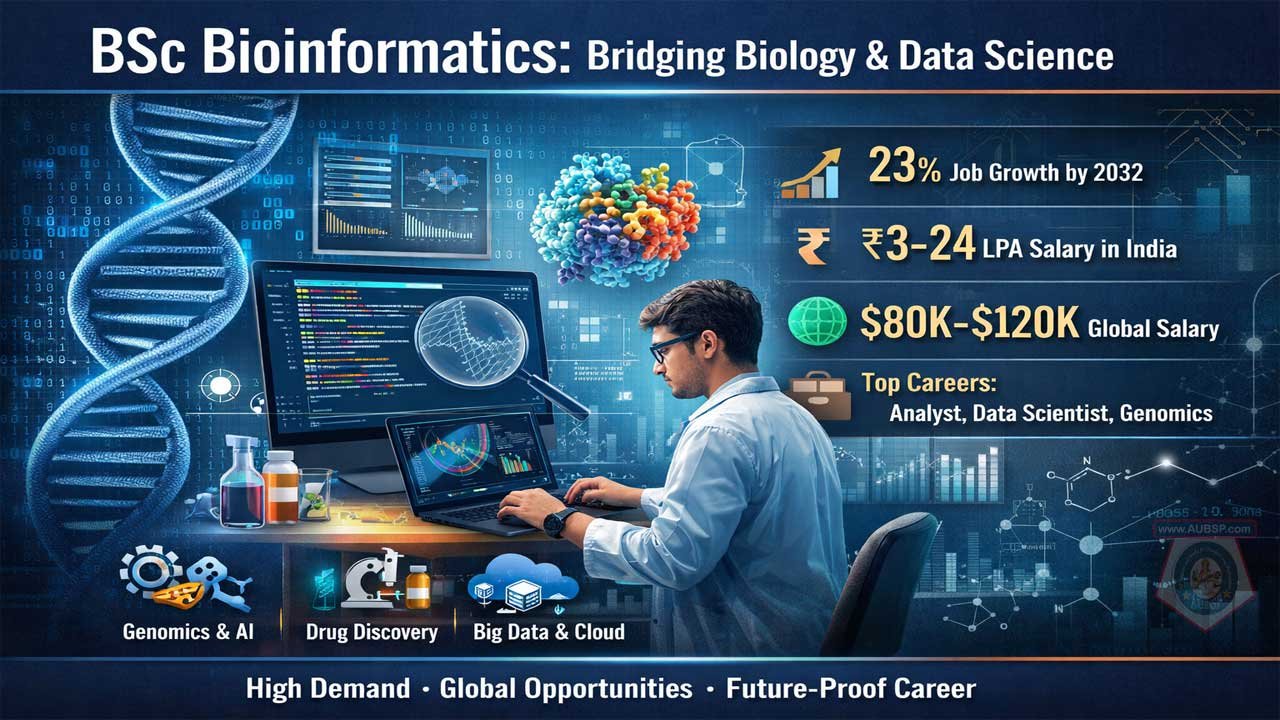
The future of life sciences is increasingly data-driven, and bioinformatics sits at the center of this transformation by integrating biology, computer science, statistics, and mathematics to analyze massive biological datasets.
With the global bioinformatics market growing rapidly and strong demand across pharma, biotech, healthcare, and IT, a BSc in Bioinformatics offers a solid foundation through a structured curriculum covering molecular biology, programming, databases, machine learning, genomics, and real-world projects. Graduates can pursue diverse, well-paying career paths such as bioinformatics analyst, genomics data scientist, drug discovery specialist, or clinical bioinformatician, both in India and internationally, with salaries rising significantly based on skills, specialization, and experience.
Driven by advances in AI, precision medicine, multi-omics, cloud computing, and genomic research, bioinformatics promises long-term relevance, global opportunities, and meaningful contributions to healthcare, making it a future-proof career for students who enjoy biology, data, and problem-solving.
| Category | Information |
|---|---|
| Field | Bioinformatics (Biology + Data Science + Computing) |
| Degree | Bachelor of Science (BSc) in Bioinformatics |
| Duration | 3 years (6 semesters) |
| Eligibility | Class 12 with PCB/PCM, ~50% aggregate |
| Core Skills | Biology, Python/R, statistics, databases, ML |
| Major Tools | BLAST, FASTA, NGS tools, SQL, cloud platforms |
| Top Careers | Bioinformatics Analyst, Genomics Analyst, Drug Discovery Specialist, Data Scientist |
| Job Growth | ~23% growth by 2032 |
| Salary (India) | ₹3–24 LPA (based on experience) |
| Global Salary | $80K–$120K+ annually |
| Top Industries | Pharma, Biotech, Healthcare, IT |
| Future Trends | AI/ML, precision medicine, multi-omics, cloud computing |
| Global Demand | USA, UK, Germany, Canada, Switzerland, Australia |
| Career Outlook | High demand, future-proof, research & industry roles |
The Future of Life Sciences Is Data-Driven
The global bioinformatics market is projected to reach unprecedented heights, growing at a compound annual growth rate (CAGR) of 13.7% from 2023 to 2030. If you’re passionate about biology, data science, and technology, the Bachelor of Science in Bioinformatics (BSc Bioinformatics) might be your ideal career path.
This comprehensive guide explores everything you need to know about pursuing a BSc in Bioinformatics—from admission requirements to international career opportunities, salary expectations, and emerging trends in the field.
What Is Bioinformatics? Understanding the Foundation
Defining Bioinformatics
Bioinformatics is an interdisciplinary field that combines biology, computer science, statistics, and mathematics to analyze and interpret biological data at scale. It involves using computational tools, algorithms, and databases to understand complex biological systems, from individual genes to entire ecosystems.
Bioinformatics vs. Computational Biology: Key Differences
While these terms are often used interchangeably, they represent distinct specializations:
| Aspect | Bioinformatics | Computational Biology |
|---|---|---|
| Focus | Data analysis, tool development, database management | Mathematical modeling, simulations, theoretical predictions |
| Primary Tools | Programming languages, databases, sequence analysis software | Mathematical equations, simulation software, modeling frameworks |
| Career Path | Data scientist, bioinformatics analyst, software developer | Research scientist, mathematician, theoretical biologist |
| Industry Application | Pharma, biotech, healthcare IT | Academic research, pharmaceutical R&D |
| Job Outlook | Faster growth in industry | Stronger in academic settings |
Understanding this distinction will help you align your career goals with the right specialization.
Bachelor of Science in Bioinformatics: Program Overview
Course Duration and Structure
The BSc in Bioinformatics is typically a 3-year undergraduate degree comprising 6 semesters. Each semester focuses on building foundational knowledge while progressively introducing advanced topics.
Eligibility Criteria for BSc Bioinformatics
To pursue a BSc in Bioinformatics, you typically need:
- Educational Background: Class 12 (or equivalent) with Physics, Chemistry, and Biology or Mathematics
- Minimum Marks: 50% aggregate in 12th standard (varies by institution)
- Stream Requirement: Science stream (PCB or PCM)
- English Proficiency: For international programs, TOEFL/IELTS may be required
- Age Limit: Generally, no upper age limit, though some institutions prefer candidates aged 17-25
Course Curriculum and Key Subjects
First Year (Foundational)
- Molecular Biology: Cell structure, DNA replication, protein synthesis
- Biochemistry: Metabolic pathways, enzyme kinetics, cellular energy
- Mathematics & Statistics: Probability theory, hypothesis testing, regression analysis
- Programming Basics: C, C++, or Python fundamentals
- General Biology: Genetics, evolution, ecology
Second Year (Intermediate)
- Bioinformatics Tools: BLAST, FASTA, Clustal alignment software
- Database Management Systems: SQL, relational databases, data organization
- Object-Oriented Programming: Java, OOP concepts, design patterns
- Sequence Analysis: DNA/protein sequence comparison, homology modeling
- Immunology: Antibody structure, immune response mechanisms
Third Year (Advanced)
- Machine Learning in Biology: Neural networks, classification algorithms, predictive modeling
- Structural Bioinformatics: Protein folding, 3D structure prediction, drug docking
- Comparative Genomics: Evolutionary relationships, genome annotation
- Big Data Analytics: Hadoop, Apache Spark, cloud computing
- Project/Internship: Real-world research or industry application
- Specialized Electives: NGS analysis, systems biology, or personalized medicine
Admission Process: How to Get Into a BSc Bioinformatics Program
Admission Routes
1. Merit-Based Admission
- Most common route in Indian universities
- Based on Class 12 marks or 12+2 score
- Direct admission without entrance examination
2. Entrance Examination
Some universities conduct entrance exams:
- GATE (Graduate Aptitude Test in Engineering) – for postgraduate programs
- JEST (Joint Entrance Screening Test) – for research programs
- BINC (Biotechnology Information and National Center) – specialized entrance
- University-specific exams – varies by institution
3. Interview-Based Admission
- Conducted by premier institutes
- Typically follows written test or document evaluation
- Assesses motivation, subject knowledge, and research interests
4. International Student Admission
For global students:
- TOEFL/IELTS scores (English proficiency)
- A-Level or equivalent qualification
- University-specific prerequisites
- Application through university portal or Common App
Top Universities Offering BSc Bioinformatics
India:
- Delhi University (Delhi)
- Bangalore University (Bangalore)
- University of Pune (Pune)
- Dr. D.Y. Patil University (Mumbai)
- Sri Dalip University (Haryana)
International (English-taught programs):
- University of Hong Kong (Hong Kong)
- University of Manchester (UK)
- University of Uppsala (Sweden)
- UMBC – University of Maryland Baltimore County (USA)
- University of Melbourne (Australia)
Why Pursue a BSc in Bioinformatics? Career Prospects & Growth
Market Demand and Job Outlook
The bioinformatics sector is experiencing explosive growth:
- Market Size: USD 10.1 billion in 2022, projected to grow to over USD 30 billion by 2032
- Job Growth: 23% increase in bioinformatics positions by 2032 (faster than average careers)
- Geographic Hotspots: USA, UK, Germany, Canada, Switzerland, Australia, and China
- Industry Drivers:
- Pandemic-driven genomic research acceleration
- Personalized medicine revolution
- Artificial intelligence integration
- Next-generation sequencing (NGS) advancements
- Multi-omics data explosion (genomics, proteomics, metabolomics)
Why Employers Are Hiring Bioinformaticians
- Data Deluge: Biological data doubles every 18 months; traditional analysis is insufficient
- Drug Discovery Acceleration: Computational screening reduces time-to-market from 10+ years to 5-6 years
- Precision Medicine: Personalized treatment requires massive genomic databases
- Cost Efficiency: Computational methods reduce wet-lab costs significantly
- AI/ML Integration: Predictive models improve disease diagnosis and prognosis
- Regulatory Requirement: Healthcare regulations increasingly require data analysts
Bioinformatics Salary: What You Can Expect
Salary Range by Experience Level (India)
| Experience Level | Monthly Salary (INR) | Annual Salary (INR) |
|---|---|---|
| Entry-Level (0-2 years) | ₹25,000 – ₹50,000 | ₹3,00,000 – ₹6,00,000 |
| Mid-Level (3-7 years) | ₹60,000 – ₹120,000 | ₹7,20,000 – ₹14,40,000 |
| Senior-Level (8+ years) | ₹120,000 – ₹200,000 | ₹14,40,000 – ₹24,00,000 |
Salary by Industry Sector (India)
- Pharmaceutical & Biotech: ₹60,000 – ₹150,000/month (highest demand)
- IT & Software Companies: ₹70,000 – ₹180,000/month (premium for AI/ML skills)
- Healthcare & Diagnostics: ₹55,000 – ₹140,000/month
- Government Research Institutes: ₹50,000 – ₹120,000/month
- Academia & Universities: ₹40,000 – ₹90,000/month
International Salary Comparison (Annual, USD/Local Currency)
| Country | Average Salary | Range |
|---|---|---|
| USA | $80,000 – $120,000 | Entry: $55K |
| UK | £40,000 – £70,000 | Entry: £28K |
| Germany | €50,000 – €80,000 | Entry: €35K |
| Canada | CAD 70,000 – 100,000 | Entry: CAD 50K |
| Switzerland | CHF 90,000 – 120,000 | Highest salary globally |
| Australia | AUD 80,000 – 120,000 | Entry: AUD 60K |
| China | ¥300,000 – 600,000 | Rapidly growing tech hubs |
Factors Influencing Your Salary
- Technical Skills Premium:
- Machine Learning & AI expertise: +40-50% salary bump
- Big Data tools (Hadoop, Spark, Cloud): +30-40% increase
- Programming proficiency: +25-35% increase
- Geographic Location: Switzerland, USA, and UK offer premium salaries; costs of living vary
- Industry Sector: Pharma/Biotech > IT/Software > Healthcare > Academia
- Company Size: Large MNCs offer 20-40% higher salaries than startups
- Education Level: MSc/PhD graduates earn 30-50% more than BSc holders initially
- Experience & Specialization: Niche expertise (structural biology, immunoinformatics) commands premium rates
Top Career Paths for BSc Bioinformatics Graduates
1. Bioinformatics Analyst
- Responsibilities: Analyze DNA/protein sequences, run bioinformatics software, interpret results
- Average Salary: ₹20,666 – ₹125,000/month
- Skills Required: Python, sequence analysis, statistical analysis
- Top Employers: Pharma companies, diagnostic labs, biotech firms
2. Bioinformatics Software Developer
- Responsibilities: Develop tools, maintain databases, build pipelines
- Average Salary: ₹39,474/month
- Skills Required: Java, C++, database design, version control
- Top Employers: Biotech software companies, research institutes
3. Bioinformatics Scientist / Research Scientist
- Responsibilities: Design research projects, publish findings, mentor junior staff
- Average Salary: ₹87,480/month
- Skills Required: Research methodology, publications, advanced programming
- Top Employers: Pharma R&D, government research labs, universities
4. Drug Discovery Specialist
- Responsibilities: Computational target identification, drug screening, molecular docking
- Average Salary: ₹60,000 – ₹150,000/month
- Skills Required: Molecular modeling, CADD tools, chemistry basics
- Top Employers: Pharma giants (Roche, Pfizer, GSK, Sun Pharma)
5. Genomics Data Analyst
- Responsibilities: NGS data analysis, variant calling, quality control
- Average Salary: ₹70,000 – ₹130,000/month
- Skills Required: NGS tools (SAMtools, GATK), bioconda, cloud platforms
- Top Employers: Genetic testing companies, cancer research centers
6. Clinical Bioinformatician
- Responsibilities: Support clinical decision-making, rare disease diagnosis, precision medicine
- Average Salary: ₹65,000 – ₹140,000/month
- Skills Required: Clinical knowledge, HIPAA compliance, EHR systems
- Top Employers: Hospitals, diagnostic centers, telemedicine platforms
7. Data Scientist (Life Sciences)
- Responsibilities: Build ML models, predictive analytics, system optimization
- Average Salary: ₹80,000 – ₹180,000/month
- Skills Required: Python/R, machine learning, deep learning, cloud platforms
- Top Employers: Tech companies (Google Health, IBM Watson), AI startups
8. Healthcare IT Specialist
- Responsibilities: EHR systems, health informatics, compliance management
- Average Salary: ₹55,000 – ₹120,000/month
- Skills Required: HIPAA, HL7 standards, database management
- Top Employers: Hospitals, health IT companies, digital health startups
Emerging Trends in Bioinformatics (2026-2030)
1. Artificial Intelligence & Machine Learning Integration
- Deep learning for protein structure prediction (AlphaFold 3)
- Predictive modeling for disease risk assessment
- Automated drug discovery pipelines
- Natural language processing for biomedical literature mining
2. Multi-Omics Integration
- Combining genomics, proteomics, metabolomics, and transcriptomics data
- Systems biology approaches
- Holistic patient health profiling
- Personalized treatment strategies
3. Precision Medicine Revolution
- Genomic profiling for cancer treatment
- Pharmacogenomics (personalized drug response)
- Rare disease diagnosis acceleration
- AI-driven clinical decision support systems
4. Cloud Computing Democratization
- Reduced infrastructure costs
- Scalable analysis platforms (AWS, Google Cloud, Azure)
- Collaborative research environments
- Cybersecurity and data privacy focus
5. Real-World Data Analytics
- Electronic health record (EHR) mining
- Patient outcome prediction
- Drug safety monitoring (pharmacovigilance)
- Real-world evidence generation for regulatory approval
6. Synthetic Biology & Gene Editing
- CRISPR-based therapeutic design
- Genetic algorithm optimization
- Custom organism design
- Computational biology meets synthetic biology
How to Succeed in Your BSc Bioinformatics Program
Essential Skills to Develop
- Programming Languages:
- Python (Most versatile for bioinformatics)
- R (Statistical analysis and visualization)
- Java/C++ (System software development)
- Bash/Linux (Operating system familiarity)
- Bioinformatics Tools:
- BLAST/FASTA (Sequence alignment)
- Clustal (Multiple sequence alignment)
- Jalview (Sequence visualization)
- IGV (Genome browsing)
- PyMOL (Protein visualization)
- Data Management:
- SQL database design
- Data normalization
- Big data concepts (Hadoop, Spark)
- Cloud platforms (AWS, GCP, Azure)
- Statistical Analysis:
- Hypothesis testing
- Regression analysis
- Multivariate analysis
- Machine learning algorithms
- Soft Skills:
- Research paper writing
- Scientific presentation
- Teamwork and collaboration
- Problem-solving mindset
Study Tips for Success
- Pursue Internships: Gain hands-on experience in pharma labs or biotech companies
- Contribute to Open Source: Develop bioinformatics tools on GitHub
- Publish Research: Attempt to publish undergraduate research findings
- Learn Continuously: Keep pace with rapid field evolution; attend webinars and workshops
- Build a Portfolio: Create projects demonstrating Python/R skills in biological data analysis
- Network: Join bioinformatics communities; attend conferences
- Specialize Early: Focus on genomics, drug discovery, or immunoinformatics by Year 3
International Opportunities for Bioinformatics Graduates
Top Countries for Bioinformatics Career
1. United States
- Market Size: Largest bioinformatics sector globally
- Salary: $80,000 – $120,000+
- Advantages: Innovation hub, highest salary, numerous opportunities
- Visa: Optional Practical Training (OPT) for international students; H1-B sponsorship available
- Top Hubs: San Francisco, Boston, San Diego, New York, Research Triangle
2. United Kingdom
- Market Size: Second-largest European bioinformatics market
- Salary: £40,000 – £70,000
- Advantages: World-class universities, strong NHS genomics programs
- Visa: Graduate visa allows 2-3 years post-study work
- Top Hubs: London, Oxford, Cambridge, Manchester
3. Germany
- Market Size: Leading European pharma and biotech hub
- Salary: €50,000 – €80,000
- Advantages: Strong biotech ecosystem, lower cost of living than Western Europe
- Visa: EU Blue Card available
- Top Hubs: Berlin, Munich, Heidelberg, Cologne
4. Canada
- Market Size: Growing biotech sector
- Salary: CAD 70,000 – 100,000
- Advantages: Quality of life, immigration-friendly, strong universities
- Visa: Post-Graduation Work Permit (PGWP); path to permanent residency
- Top Hubs: Toronto, Vancouver, Montreal, Calgary
5. Switzerland
- Market Size: Highest salary and quality of life globally
- Salary: CHF 90,000 – 120,000+ (highest worldwide)
- Advantages: Pharmaceutical giants, R&D centers, excellent infrastructure
- Visa: Competitive; typically requires MSc/PhD
- Top Hubs: Zurich, Basel, Geneva
6. Australia
- Market Size: Rapidly growing genomics and biotech sector
- Salary: AUD 80,000 – 120,000
- Advantages: Lifestyle, quality of life, strong research institutions
- Visa: Graduate visa (2-3 years), pathway to permanent residency
- Top Hubs: Sydney, Melbourne, Brisbane, Perth
7. China
- Market Size: Explosive growth in biotech; rising opportunities
- Salary: ¥300,000 – 600,000
- Advantages: Rapid growth, government research funding, tech advancement
- Visa: Z visa (work visa) requirements vary
- Top Hubs: Beijing, Shanghai, Shenzhen
Visa & Work Permit Options
| Country | Post-Study Work Visa | Duration | Path to PR |
|---|---|---|---|
| USA | OPT (Optional Practical Training) | 12 months (STEM extension: 24-36 months) | H1-B → Green Card (2-8 years) |
| UK | Graduate Visa | 2-3 years | Skilled Worker Route |
| Canada | PGWP (Post-Graduation Work Permit) | 3 years | Express Entry, Provincial Nominee |
| Australia | Post-Study Work Visa | 2-3 years | 189 visa, employer sponsorship |
| Germany | Job Seeker Visa | 6 months | EU Blue Card, settlement permit |
| Switzerland | Limited (requires employer sponsorship) | 3-5 years | Establishment permit (difficult) |
Cost of Study: BSc Bioinformatics Fees
India
- Government Universities: ₹50,000 – ₹2,00,000 total (3 years)
- Private Universities: ₹5,00,000 – ₹15,00,000 total (3 years)
- Entrance Exam: Free to ₹500 (varies by exam)
International Universities
- USA: $20,000 – $40,000 per year (private); $10,000 – $15,000 (public, out-of-state)
- UK: £12,000 – £25,000 per year
- Canada: CAD 15,000 – 30,000 per year
- Australia: AUD 20,000 – 40,000 per year
Scholarships & Financial Aid
- Fulbright Scholarship (USA)
- Chevening Scholarship (UK)
- DAAD Scholarship (Germany)
- Commonwealth Scholarship
- University-specific merit scholarships
- Government scholarships (India: MHRD, DBT)
Bioinformatics Scope: Future-Proof Career?
Why Bioinformatics Will Remain In-Demand
- Perpetual Data Growth: Biological data production doubles every 18 months
- Aging Population: Increased disease research and drug development
- Pandemic Preparedness: Virus tracking and vaccine development
- Climate Change: Environmental genomics and sustainability research
- Personalized Medicine: Shift toward precision treatments
- Regulatory Requirements: Increasing data analysis mandates
- AI/ML Evolution: Continuous advancement in analytical techniques
Challenges to Consider
- Continuous Learning Required: Field evolves rapidly; skills become obsolete quickly
- PhD Preference: Some research positions prefer PhD over BSc
- Saturation in Competitive Markets: Job competition increasing in USA/UK
- Work-Life Balance: Research positions can involve long hours
- Funding Dependency: Academic positions depend on grant funding
Conclusion: Is BSc Bioinformatics Right for You?
The Bachelor of Science in Bioinformatics is an excellent choice if you:
✅ Love biology and are fascinated by how life works at the molecular level
✅ Enjoy programming and problem-solving with data
✅ Want a career with strong global demand and excellent salary prospects
✅ Seek work in cutting-edge scientific research
✅ Value both job security and continuous learning opportunities
✅ Are interested in making meaningful contributions to healthcare and medicine
With a projected 23% job growth rate, global salary ranges of $80,000 – $200,000+, and emerging opportunities in AI, precision medicine, and genomics, the BSc in Bioinformatics positions you at the intersection of biology and technology—the future of science.
Start today: Research universities in your region, prepare for entrance exams, develop programming skills, and pursue internships. Your career in bioinformatics awaits!
FAQ: Bachelor of Science in Bioinformatics
Q1: Is a BSc in Bioinformatics sufficient, or do I need a Master’s degree?
A: BSc is sufficient for most industry positions. However, MSc/PhD is preferred for research-focused careers and can lead to 30-50% higher initial salaries.
Q2: Can I pursue Bioinformatics without a biology background?
A: Yes, if you have strong mathematics, statistics, and programming skills. Some programs admit non-biology graduates.
Q3: How difficult is the BSc Bioinformatics program?
A: Moderately challenging. It requires strong fundamentals in biology, chemistry, mathematics, and programming. Success depends on consistent effort.
Q4: What’s the difference between BSc and BTech in Bioinformatics?
A: BSc emphasizes theory and research; BTech emphasizes application and engineering. BTech graduates often earn slightly higher salaries initially.
Q5: Can I work abroad after completing BSc in Bioinformatics from India?
A: Yes, absolutely. Indian graduates are highly valued globally. Post-study work visas are available in USA, UK, Canada, and Australia.
Q6: Which companies hire BSc Bioinformatics graduates?
A: Pharma giants (Roche, Pfizer, GSK, Sun Pharma), biotech firms (Genentech, Moderna), diagnostics companies (Illumina, Strand Genomics), and IT companies (Google Health, IBM Watson).
Q7: What is the job market like in 2025-2026?
A: Excellent. The bioinformatics job market is growing faster than average careers at 23% through 2032, with particularly high demand for AI/ML skills.
Q8: How do I choose between Bioinformatics and Computational Biology?
A: Choose Bioinformatics if you prefer data analysis, tools, and industry roles. Choose Computational Biology if you prefer mathematical modeling and academic research.


Leave a Reply
You must be logged in to post a comment.