
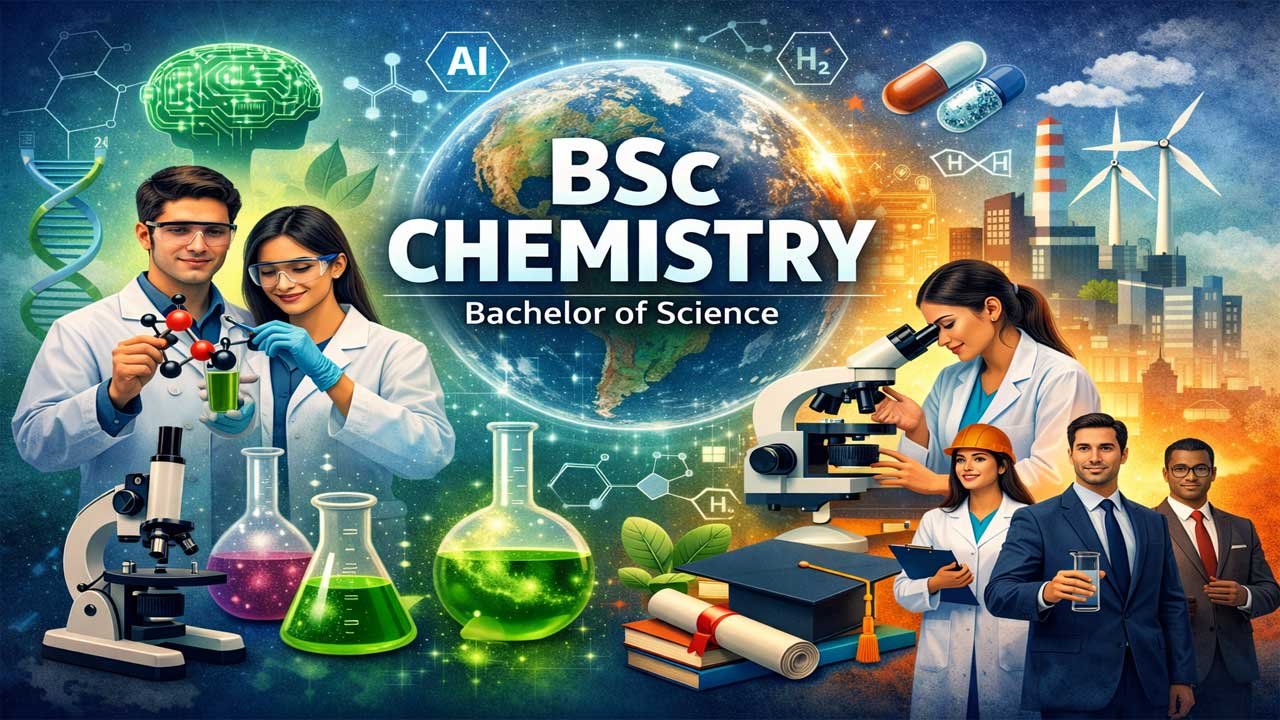
The Bachelor of Science in Chemistry (BSc Chemistry) is a highly versatile undergraduate degree that prepares students for diverse global careers across pharmaceuticals, biotechnology, materials science, environmental sustainability, and emerging fields like AI-driven and green chemistry, as the global chemistry market grows toward $188.7 billion by 2034.
Typically spanning three to four years, the program builds strong foundations in organic, inorganic, physical, and analytical chemistry while increasingly integrating computational skills, research exposure, and interdisciplinary learning. Graduates can pursue immediate roles in quality control, R&D, analytics, production, and regulatory functions, with starting salaries of ₹3–6 LPA in India and $50K–$85K internationally, or advance through MSc, PhD, and specialized certifications to unlock significantly higher earnings and leadership positions.
With top opportunities at institutions such as IITs, Harvard, MIT, Cambridge, and rising Asian universities, and strong demand driven by biotech expansion, sustainability mandates, and AI adoption, BSc Chemistry in 2026 offers excellent ROI, global mobility, and long-term career resilience for students who strategically specialize and continuously upskill.
| Aspect | Information |
|---|---|
| Degree | Bachelor of Science in Chemistry (BSc Chemistry) |
| Duration | 3–4 years |
| Core Subjects | Organic, Inorganic, Physical, Analytical Chemistry |
| Emerging Areas | AI & Computational Chemistry, Green Chemistry, Materials, Biotech |
| Top Careers | Analytical Chemist, R&D Scientist, QA/QC, Process Chemist |
| Starting Salary | India: ₹3–6 LPA · Global: $50K–$85K |
| Higher Studies | MSc, PhD, Clinical Research, Patent Law |
| Top Recruiters | Pharma, Biotech, FMCG, Cosmetics, Research Labs |
| Global Scope | USA, UK, Germany, Australia, Asia |
| Future Outlook | High growth due to biotech, sustainability, and AI integration |
Bachelor of Science in Chemistry (BSc Chemistry): Complete Guide to Programs, Careers & Global Opportunities 2026
The Bachelor of Science in Chemistry (BScChem) represents one of the most versatile and in-demand undergraduate degrees in the global scientific landscape. With the chemistry market projected to reach $188.7 billion by 2034 at a compound annual growth rate (CAGR) of 9.5%, chemistry graduates face unprecedented career opportunities spanning pharmaceuticals, biotechnology, environmental science, materials innovation, and emerging fields like green chemistry and artificial intelligence-driven research.
This comprehensive guide explores every dimension of pursuing a BSc Chemistry degree, from program structure and top global universities to salary prospects, emerging job roles, and strategic pathways for both Indian and international students seeking to maximize their competitive advantage in this rapidly evolving field.
What is a Bachelor of Science in Chemistry?
A Bachelor of Science in Chemistry is a rigorous three-to-four-year undergraduate degree program that provides comprehensive education in chemical theory, experimental techniques, and practical laboratory skills. This degree bridges fundamental scientific principles with real-world applications across multiple industries.
The degree equips graduates with:
- Theoretical Knowledge: Deep understanding of atomic structure, chemical bonding, thermodynamics, kinetics, and quantum mechanics
- Practical Laboratory Skills: Hands-on experience with analytical instruments, spectroscopy, chromatography, and synthesis techniques
- Computational Proficiency: Data analysis, molecular modeling, and increasingly, artificial intelligence applications in chemistry
- Research Capabilities: Design, conduct, and communicate original scientific investigations
- Interdisciplinary Foundation: Connections to biology, physics, material science, and environmental science
Unlike chemistry degrees offered through engineering programs (such as BTech Chemical Engineering), a BSc Chemistry maintains pure science depth while increasingly incorporating applied and industrial dimensions. This positioning makes chemistry graduates uniquely qualified for roles spanning academia, industry research, regulatory affairs, and entrepreneurship.
BSc Chemistry Program Structure & Duration
Standard Program Components
United States and UK Models (3-4 Years)
At premier institutions like MIT, Harvard, and Cambridge, the chemistry degree typically requires:
- Year 1: General Institute Requirements, foundational chemistry (inorganic, organic, physical chemistry), mathematics, physics, and humanities
- Year 2: Core chemistry subjects (organic chemistry II, thermodynamics, spectroscopy, laboratory techniques)
- Year 3-4: Advanced electives, specialization options, independent research, and thesis work
MIT’s Chemistry program, for instance, requires 147 units in the major with unrestricted electives, totaling 180 units beyond general requirements. This structure emphasizes both breadth and depth while permitting substantial customization.
India Model (4 Years)
Indian universities offering BSc Chemistry typically structure programs as:
- Semesters 1-2: Foundational courses in organic, inorganic, and physical chemistry; mathematics; and soft skills
- Semesters 3-4: Core subject deepening with practical laboratory components
- Semesters 5-6: Specialization electives (green chemistry, computational chemistry, polymer chemistry, industrial chemistry)
- Semesters 7-8: Advanced research projects, internships, and capstone work
IIT Delhi’s newly launched BS Chemistry program (2026) exemplifies modern curriculum design, integrating 30% hands-on learning with courses in AI-ML applications in chemistry, cross-departmental electives, and minor degree options across semesters.
Choice Based Credit System (CBCS)
Most Indian universities employ CBCS frameworks allowing students to select from:
- Core chemistry courses
- Elective subjects (specialized domains)
- Minor courses (from other disciplines)
- Soft skill and professional development programs
This flexibility enables students to tailor degrees toward specific career trajectories—whether pure research, pharmaceutical development, environmental work, or industry-focused roles.
Core Subjects & Specializations
Foundational Subjects (Across All Programs)
Physical Chemistry: Thermodynamics, quantum mechanics, electrochemistry, solutions and ionic equilibrium, kinetics
Inorganic Chemistry: Periodic table trends, chemical bonding, coordination chemistry, transition metals, crystallography
Organic Chemistry: General organic chemistry, hydrocarbons, functional groups, synthesis, mechanisms, isomerism
Analytical Chemistry: Qualitative and quantitative analysis, chromatography, spectroscopy, mass spectrometry
Emerging Specialization Areas (2026-2027)
Given accelerating global demand, modern BSc Chemistry programs increasingly offer specializations in:
Computational Chemistry: Molecular orbital theory, quantum chemical simulations, drug discovery modeling, machine learning applications
- Demand driver: Computational biology market projected to grow from $6.6B (2026) to $20.5B (2033)
Green Chemistry & Sustainability: Biodegradable polymers, renewable energy conversion, waste minimization, sustainable manufacturing
- Demand driver: Global emphasis on ESG compliance and circular economy models
Pharmaceutical & Medicinal Chemistry: Drug synthesis, formulation development, bioavailability optimization, patent analysis
- Demand driver: Pharmaceutical industry growth in biosimilars, gene therapy, and personalized medicine
Materials Chemistry: Nanotechnology, polymers, semiconductors, advanced materials for electronics and energy
- Demand driver: $556B cosmetics market projected by 2032, plus semiconductor manufacturing expansion
Chemical Biology: Biochemical processes, cellular chemistry, protein engineering, biotechnology applications
- Demand driver: Biotech workforce projected to grow 30-40 lakh jobs in India by 2030
Environmental Chemistry: Water treatment, pollution monitoring, analytical environmental assessment, sustainable practices
Top Universities for BSc Chemistry: Global Rankings 2026
United States Dominance
According to QS World University Rankings 2026 and Times Higher Education Chemistry Rankings, American institutions continue to lead globally:
| Rank | University | Country | Score | Key Strength |
|---|---|---|---|---|
| 1 | Harvard University | USA | 95.1 | Perfect employer reputation; research impact; academic prestige |
| 2 | MIT | USA | 94.8 | Academic reputation (100/100); citations per paper (97.4) |
| 3 | Stanford University | USA | 93.1 | Research excellence; interdisciplinary integration |
| 4 | UC Berkeley | USA | 90.1 | Strong graduate pipeline; research innovation |
| 7 | Caltech | USA | 96.3 | Citations per paper (96.3); focused research intensity |
| 10 | Yale University | USA | 94.1 | Research focus; graduate success |
Admission Context: Top US institutions maintain highly selective admission (3-8% acceptance rates), requiring SAT/ACT scores averaging 1520-1555 and net costs ranging $17,900-$27,979 annually.
UK Excellence
| Rank | University | Country |
|---|---|---|
| 5 | University of Cambridge | UK |
| 8 | University of Oxford | UK |
| 9 | Imperial College London | UK |
Asian Rising Stars
Emerging Leadership: Zhejiang University (China) and Seoul National University (South Korea) recently entered the top 20 for the first time, reflecting Asia’s investment in chemistry research infrastructure.
India’s Premier Institutions
While comprehensive rankings vary, India’s strongest chemistry programs operate through:
IIT System: IIT Delhi, IIT Bombay, IIT Madras, and others offer rigorous curriculum with industry placement emphasis. IIT Delhi’s M.Sc. Chemistry program reports average salaries of ₹23.5 lakh with highest packages reaching ₹1.68 crore.
Other Elite Institutions: Delhi University, Shiv Nadar University, and specialized chemistry colleges offer quality programs at lower costs (₹1-4 lakh total fees) with strong regional employer networks.
Career Paths & Job Roles for BSc Chemistry Graduates
Direct Career Opportunities (Entry-Level)
Chemistry graduates transition into diverse professional roles within 6-12 months of graduation:
| Job Role | Typical Employer | Starting Salary (India) | Starting Salary (USA) |
|---|---|---|---|
| Quality Control/QA Chemist | FMCG, pharmaceuticals, manufacturing | ₹3.5-5 LPA | $50K-$65K |
| Lab Technician (R&D) | Pharma, CROs, research institutes | ₹2.5-4 LPA | $45K-$60K |
| Analytical Chemist | Pharma, food testing, environmental labs | ₹3.5-6 LPA | $60K-$85K |
| Process Chemist | Petrochemicals, paints, fertilizers | ₹3.5-5 LPA | $55K-$75K |
| Environmental Scientist | Pollution control boards, water companies | ₹4-6 LPA | $65K-$90K |
| Production Chemist | Manufacturing, industrial chemicals | ₹3-5 LPA | $50K-$70K |
| Chemical Sales Executive | Pharma, biotech, chemical suppliers | ₹3.5-6 LPA (+ commission) | $50K-$80K (+ bonus) |
| Medical Representative | Pharmaceutical companies | ₹3-5 LPA | $40K-$65K |
Starting Salary Range: Fresh BSc Chemistry graduates in India typically earn ₹3-6 LPA depending on employer size, location, and specialization. International positions (US, UK, Germany) offer $50K-$85K equivalents.
Mid-Career Progression (5-10 Years)
With experience and specialization, salary trajectories accelerate significantly:
Senior Analytical Chemist: ₹8-12 LPA (India); $85K-$120K (USA)
R&D Scientist: ₹10-15 LPA (India); $100K-$140K (USA)
Quality Assurance Manager: ₹12-18 LPA (India); $95K-$140K (USA)
Process Development Manager: ₹12-20 LPA (India); $100K-$150K (USA)
Specialized High-Income Roles
Patent Chemist/IP Assistant: ₹5-12 LPA; requires patent law training or additional education
Cosmetic Chemist/Formulation Scientist: ₹4-10 LPA entry, $56K-$122K+ internationally (growing 8-10% annually)
Clinical Research Associate: ₹6-12 LPA; accelerates with advanced degrees
Toxicologist/Safety Assessor: ₹8-14 LPA; requires specialized certification (DABT)
Salary Outlook: India vs. International Markets
India Salary Progression
Entry-Level (BSc): ₹3-6 LPA
MSc Graduates: ₹6-15 LPA depending on specialization
PhD Holders: ₹20-25 LPA in MNCs; ₹10-20 LPA in academia
Postdoctoral/Senior Scientist: ₹30-40 LPA internationally
International Markets
United States: $60K-$130K+ depending on specialization and company size
- Pharmaceutical Scientists: $80K-$130K
- Chemical Research Scientists: $70K-$120K
- Materials Scientists (Nanotech): $90K-$150K
- Environmental Chemists: $65K-$110K
United Kingdom: £28K-£55K+ entry and mid-level roles
Germany: €45K-€85K+ with additional benefits
Australia: AUD 60K-AUD 110K+
Remote Opportunities: Increasingly, specialized chemistry roles (AI training for chemistry, computational work, regulatory writing) offer remote positions at $85K-$200K+.
Salary Growth Factors
Compensation trajectories depend on:
- Specialization: Cosmetic chemistry, pharmaceutical sciences, and nanotechnology offer faster growth (13% over 5 years vs. general inflation)
- Advanced Degrees: MSc adds ₹2-5 LPA; PhD adds ₹10-20 LPA
- Geographic Location: Metropolitan hubs (Bangalore, Mumbai, NCR in India; Boston, San Francisco, Basel in international markets) command 20-40% premiums
- Company Type: MNCs offer 30-50% higher salaries than mid-cap firms; startups offer equity but lower base salaries
- Industry: Pharma > cosmetics > FMCG > manufacturing > academia in terms of starting salary
Global Job Market Dynamics (2026-2027)
Driving Demand
1. Pharmaceutical & Biotechnology Expansion
- Biotech workforce grew by ~740,000 jobs globally in 2026 (13.2M total employment)
- Precision medicine segment added 79,000 jobs with 12.6% growth rate
- Gene therapy and advanced biologics manufacturing emerging as highest-growth areas
2. Emerging Technologies
- AI-Driven Chemistry: Computational chemistry market to triple by 2030; demand for chemists with Python, ML skills accelerating
- Green Chemistry: Regulatory mandates (EU Green Deal, India’s ESG focus) driving demand for sustainable formulation specialists
- Advanced Materials: Semiconductor manufacturing, nanotechnology, battery chemistry fueling growth
3. Geographic Distribution
- India: 3+ lakh biotech professionals; projected 30-40 lakh by 2030; South India (Bangalore, Hyderabad) remains epicenter
- USA: Massachusetts projected to grow 32% by 2033; increasing demand for advanced therapy manufacturing
- China: Zhejiang and Peking Universities climbing global rankings; government R&D investment driving opportunities
Job Growth Projections
- Overall Chemistry: 6% growth 2021-2031 (Bureau of Labor Statistics estimate)
- Cosmetic Chemistry Specifically: 8-10% annual growth through 2026
- Annual Openings (USA): 7,200 positions for chemistry graduates annually
Emerging Roles (High-Growth 2026+)
| Emerging Role | Why It’s Growing | Typical Salary |
|---|---|---|
| Computational Biologist (with chemistry background) | Biotech firms automating drug discovery with AI; market growing $6.6B → $20.5B by 2030 | $120K-$180K (USA) |
| Gene Therapy Chemist | Advanced therapeutics scaling; manufacturing bottleneck creating demand | $100K-$150K (USA) |
| Green Chemistry Engineer | Regulatory compliance (EU, India ESG mandates) | $80K-$130K |
| Regulatory & Compliance Scientist | Increasing complexity of pharma/cosmetics regulation | $75K-$120K |
| Bioprocess Chemist | Manufacturing scale-up of biologics | $90K-$140K |
Higher Education Pathways After BSc Chemistry
Postgraduate Specialization Options
Master’s Degree (MSc/M.Tech)
- Duration: 1-2 years
- Cost: ₹1-5 lakh (India); $20K-$60K (USA); €15K-€40K (Europe)
- Salary Impact: Adds ₹2-5 lakh to annual package
- Specializations: Organic chemistry, analytical chemistry, physical chemistry, industrial chemistry, pharmaceutical chemistry, green chemistry
- Top Programs: IIT system (India); University of Cambridge, Oxford (UK); MIT, Stanford (USA)
Doctor of Philosophy (PhD)
- Duration: 3-5 years (fully funded in most countries)
- Cost: Typically no tuition; stipend provided
- Salary Impact: ₹10-25 LPA in India; $60K-$90K+ postdoctoral salary internationally
- Prerequisites: MSc or strong BSc with research experience
- Research Areas: Materials science, pharmaceutical chemistry, green chemistry, theoretical chemistry, biochemistry
Specialized Certificates/Diplomas
- Clinical Research Associate Certificate: ₹2-5 lakh; 6-12 months; salary boost: ₹3-7 lakh
- Patent Law Certificate: ₹3-8 lakh; 3-6 months; positions in IP law firms and R&D companies
- Quality Management (ISO/GMP Certification): ₹1-3 lakh; 3-4 months; entry requirement for many QA roles
Strategic Higher Education Decisions
For Industry Career: MSc in specialization (pharmaceutical chemistry, materials, analytical) → Job placement within 1-2 years
For Research/Academia: PhD essential; international PhD from top institution significantly enhances career prospects and salary
For Faster Job Entry: Pursue specialized certificates immediately post-BSc; enhances earning potential by 30-50%
Emerging Opportunities in Chemistry (2026-2027)
1. Artificial Intelligence & Machine Learning Integration
Computational chemistry is revolutionizing drug discovery, materials design, and chemical process optimization. Chemistry graduates with Python, machine learning, and computational modeling skills command salary premiums of 25-40% over traditional chemists.
Action Step: Complete online courses in machine learning (Coursera, edX) during final BSc year or immediately post-graduation.
2. Sustainable & Green Chemistry
Global ESG mandates and circular economy policies are creating unprecedented demand for chemists specializing in:
- Biodegradable polymers
- Sustainable manufacturing processes
- Renewable energy chemistry
- Zero-waste formulation
India Advantage: Government’s National Action Plan on Climate Change and “Make in India” initiatives prioritize green chemistry, creating competitive advantage for Indian chemists globally.
3. Biotech & Gene Therapy Manufacturing
Advanced therapeutics (gene therapy, CAR-T cell therapy, CRISPR applications) are scaling manufacturing, creating severe skill shortages. Bioprocess chemists and manufacturing specialists can earn $100K-$150K+ in developed markets.
4. Remote & Freelance Chemistry Opportunities
- AI Chemistry Trainers: Companies like Alignerr, DataAnnotation hiring remote chemistry experts for AI model training ($50K-$100K+)
- Regulatory Writing: Chemical/pharmaceutical regulatory specialists working remotely for consulting firms
- Scientific Writing & Editing: Chemistry PhDs/MScs earning $5K-$20K monthly writing for journals, publishers
- Consultation: Independent consulting for startups, particularly in formulation chemistry and regulatory affairs
5. Cosmetics & Personal Care Chemistry (High-Growth Niche)
Global cosmetics market projected to reach $556B by 2032 with 8-10% annual growth. Specialization in formulation chemistry, natural ingredients, and sustainable beauty products offers:
- Faster career growth (+13% salary trajectory vs. inflation)
- International mobility (global supply chains)
- Startup opportunities (indie beauty brands)
- Salaries: $56K-$122K+ in developed markets
Skills Required for 2026 & Beyond
Technical Competencies (Non-Negotiable)
Laboratory Mastery: Synthesis techniques, chromatography, spectroscopy (NMR, IR, UV), mass spectrometry, gel electrophoresis
Instrumentation Expertise: HPLC, GC-MS, atomic absorption spectroscopy, x-ray diffraction, electron microscopy
Data Analysis: Statistical analysis, Excel/Python for data visualization, quality control methodologies
Regulatory Knowledge: GMP, ISO standards, pharmacopeial standards (USP, BP, IP), safety data sheets
Emerging Technical Skills (Competitive Advantage 2026+)
- Python Programming: Data analysis, machine learning applications
- Computational Chemistry Software: Gaussian, MOPAC, GROMACS for molecular modeling
- AI/Machine Learning Fundamentals: Understanding ML applications in drug discovery, materials screening
- Chemical Informatics: Cheminformatics tools, SMILES notation, database management
- Bioinformatics: Sequence analysis, protein structure prediction (increasingly relevant for biochemistry roles)
Soft Skills (Increasingly Critical)
- Communication: Scientific writing, presentation skills, cross-functional collaboration with non-scientists
- Project Management: Managing timelines, budgets, cross-departmental projects
- Problem-Solving: Systems thinking, creative approach to complex challenges
- Leadership & Mentoring: Essential for mid-career advancement to senior scientist/manager roles
- Regulatory Compliance & Documentation: Critical for pharma/quality-focused roles
Certifications Enhancing Employability
| Certification | Provider | Duration | Salary Impact | Best For |
|---|---|---|---|---|
| Six Sigma Green Belt | ASQ, IASSC | 2-3 weeks | +₹1-2 lakh | Quality/process roles |
| ISO 9001 Lead Auditor | Accredited bodies | 3-5 days | +₹0.5-1 lakh | QA/compliance |
| Diploma in Clinical Research | ACRP, SOCRA | 3-4 months | +₹3-5 lakh | CRA/clinical research |
| Patent Agent/Patent Examiner | WIPO, IP offices | 6-12 months | +₹3-7 lakh | Patent/IP firms |
| Advanced HPLC Certification | Vendor-specific | 1-2 weeks | +₹0.5 lakh | Analytical roles |
| AI/ML for Chemistry Certificate | Coursera, edX | 3-6 months | +₹2-4 lakh | R&D, drug discovery |
Admission Requirements & Application Strategy
Global University Requirements
Standard Prerequisites:
- High school qualification (12th standard pass or equivalent)
- Strong foundation in Physics, Chemistry, Mathematics (PCM stream)
- Competitive entrance examinations (country/institution-specific)
Test Scores & Academic Performance:
| Target Institution Type | Required Test | Typical Score | GPA |
|---|---|---|---|
| Top US Universities (Harvard, MIT, Stanford) | SAT/ACT | SAT: 1520-1555; ACT: 34-35 | 3.8-4.0 |
| UK Universities (Cambridge, Oxford) | A-Levels/IB | A*/A in sciences | 3.7+ |
| Australia/NZ | ATAR/Equivalent | 85+ | 3.5+ |
| India (IIT/NIT) | JEE Mains/Advanced | Rank in top 10K (JEE Advanced) | N/A |
| India (University Programs) | 12th board exam | 85%+ | N/A |
India-Specific Pathways
JEE Route (Most competitive for premium placements):
- JEE Mains: Qualify for top 1.5 lakh ranks to appear in JEE Advanced
- JEE Advanced: Secure top 4,000-5,000 rank to access IIT chemistry programs
- Benefits: Access to IIT Delhi BS Chemistry (2026+), advanced research infrastructure, international placement networks
- Alternative: State engineering entrance exams for NITs, Tier-2 colleges
University Direct Admission (Less competitive, broader access):
- Delhi University (DU), Mumbai University, regional universities
- Admission through 12th board score (typically 85%+ requirement)
- Advantage: Lower cost, established chemistry programs, strong regional networks
- Consideration: Placement prospects generally tier below IITs but solid for regional industries
International Student Considerations
Visa & Scholarship:
- USA: F-1 visa; average scholarship covers $10K-$30K annually; many scholarships available for meritorious international students
- UK: Student visa; scholarships from British Council, UKVI, institutional sources
- Australia: Student visa; work rights up to 20 hours/week; scholarships available through Australian government
Cost Comparison (4-year program):
- India: ₹4-20 lakh total (₹1-5 lakh/year)
- USA: $100K-$180K ($25K-$45K/year)
- UK: £80K-£140K (£20K-£35K/year)
- Australia: AUD 80K-AUD 160K (AUD 20K-AUD 40K/year)
Return on Investment (ROI) Timeline:
- India Graduate (₹5 lakh cost): ROI within 3-4 years (earning ₹10+ lakh salary differentials)
- USA Graduate ($150K cost): ROI within 5-7 years if targeting $100K+ career path
- International Degree Premium: 20-40% higher starting salary offsets tuition investment over 5-10 year horizon
How to Choose the Right BSc Chemistry Program
Decision Framework
Step 1: Define Career Objective
- Pure Research Path? → Prioritize research reputation, PhD placement success, international collaborations
- Industry Path? → Prioritize placement records, internship partnerships, industry-aligned curriculum
- Entrepreneurship? → Prioritize startup ecosystem, business courses, incubation support
- Teaching Career? → Prioritize academic prestige, teaching methodology courses
Step 2: Geographic Preference
- India: Cost advantage, strong biotech ecosystem (South), growing opportunities, but international opportunities more limited initially
- International: Higher initial cost, but global networking, research exposure, international job mobility, salary premiums
Step 3: Program Structure Evaluation
Compare institutions on:
- Research Opportunities: UROP (MIT), undergraduate research programs, lab access, publications
- Industry Partnerships: Internship placements, company collaborations, co-op programs
- Specialization Flexibility: Ability to customize degree toward career interest
- Faculty Expertise: Faculty research groups, supervision availability, mentorship reputation
- Laboratory Facilities: Equipment access, computational resources, modern instrumentation
- Placement Records: Alumni salaries, employer diversity, international placement success
Step 4: Financial Analysis
- Total cost of attendance (tuition + living expenses)
- Scholarship availability and competitiveness
- Loan options and repayment scenarios
- Opportunity cost (years to ROI)
Sample Decision Matrix
| Institution | Research Rep | Industry Links | Flexibility | Cost | Overall |
|---|---|---|---|---|---|
| IIT Delhi (BS Chemistry) | ★★★★★ | ★★★★ | ★★★★ | ★★★★★ (low) | ★★★★★ |
| Harvard | ★★★★★ | ★★★★★ | ★★★★ | ★★ (high) | ★★★★★ |
| MIT | ★★★★★ | ★★★★★ | ★★★ | ★★ (high) | ★★★★★ |
| Cambridge | ★★★★★ | ★★★★ | ★★ | ★★★ | ★★★★ |
| Delhi University | ★★★ | ★★★ | ★★★★ | ★★★★★ (low) | ★★★★ |
Future Outlook: Chemistry in 2030 & Beyond
Market Projections
- Chemistry 4.0 Market: $188.7B by 2034 (9.5% CAGR)
- Computational Chemistry Market: $20.5B by 2030 (up from $6.6B in 2023)
- Global Biotech Employment: Expected to reach 13.5M+ professionals by 2030 with accelerating growth in gene therapy and precision medicine
- Green Chemistry Adoption: Estimated to become 40-50% of new pharmaceutical development by 2030
Career Trajectory Scenarios
Scenario 1: Traditional Industry Path
- Year 0-2: Analyst/QA Chemist (₹4-5 lakh)
- Year 3-5: Senior Chemist/Scientist (₹8-12 lakh)
- Year 6-10: Manager/Project Lead (₹15-25 lakh)
- Year 10+: Director/VP R&D (₹25-50+ lakh, internationals: $200K+)
Scenario 2: Research & Academia Path
- Year 0-3: PhD in specialized field
- Year 3-5: Postdoctoral researcher ($60K-$80K)
- Year 5-10: Independent researcher/Assistant professor (₹15-25 lakh equivalent internationally)
- Year 10+: Tenured professor/Lab director (₹30 lakh+; internationals: $150K+)
Scenario 3: Entrepreneurship & Startups
- Year 0-2: Industry experience + business skills development
- Year 2-5: Co-founder (equity-based compensation; $0-$500K depending on startup stage)
- Year 5-10: Scale phase (potential acquisitions, funding rounds, $1M+ for successful founders)
Key Trends Shaping 2026+
- Interdisciplinary Integration: Pure chemistry degrees evolving toward chemistry + data science, chemistry + biology, chemistry + materials science hybrids
- Remote & Flexible Work: Increasing opportunities for specialized chemists to work remotely in AI training, regulatory writing, computational roles
- Sustainability Mandates: Green chemistry transitioning from niche to mainstream across all chemical production
- AI-Augmented Research: Automation in routine chemical analysis; chemists becoming “AI-chemistry translators”
- Personalization & Precision: Precision medicine, personalized cosmetics, individualized pharmaceutical profiles driving demand for adaptive chemists
Conclusion
A Bachelor of Science in Chemistry in 2026 represents a gateway to one of the most dynamic, well-compensated, and globally mobile career paths available. With the chemistry market expanding at 9.5% annually toward $188.7 billion by 2034, and emerging sub-sectors (computational chemistry, green chemistry, gene therapy manufacturing) growing at 12-15% rates, chemistry graduates face exceptional opportunity density.
For Indian students, the combination of cost-effective education (particularly through India’s premier IIT system) and strong biotech/pharma industries (especially in South India) creates a unique advantage. The IIT Delhi BS Chemistry program exemplifies modern curriculum innovation, combining research rigor with AI-ML integration and entrepreneurial flexibility.
For international students, the global mobility of chemistry expertise—combined with starting salaries of $80K-$130K in developed markets and clear pathways to $150K+ senior roles—justifies investment in premium institutions offering world-class research and industry partnerships.
Strategic Action Steps for 2026:
- Choose wisely: Align program selection (research intensity, industry focus, geographic location) with career objectives
- Specialize early: Select electives and courses aligned with emerging opportunities (AI-chemistry, green chemistry, biotech specialization)
- Build practical skills: Pursue certifications (Six Sigma, advanced analytics) while pursuing degree
- Network strategically: Join professional societies, attend chemistry conferences, engage with alumni networks
- Stay adaptive: Given rapid sector evolution, commit to continuous learning—especially in emerging technologies (AI, computational methods, green chemistry)
The future belongs to chemists who combine deep technical mastery with adaptive learning, cross-disciplinary thinking, and entrepreneurial mindset. For those making the choice today, the Bachelor of Science in Chemistry offers precisely this pathway.
FAQs
What is BSc Chemistry?
BSc Chemistry is an undergraduate science degree that focuses on the study of matter, its composition, properties, reactions, and applications across industries like pharmaceuticals, materials, and environmental science.
What is the duration of a BSc Chemistry course?
The duration is typically 3 years in many countries and 4 years in newer or honors-based programs, including research-focused curricula.
Who is eligible for BSc Chemistry?
Students who have completed 12th grade or equivalent with Chemistry and usually Physics and Mathematics are eligible.
Is BSc Chemistry a good career option in 2026 and beyond?
Yes, due to strong growth in pharmaceuticals, biotechnology, green chemistry, AI-driven research, and materials science.
What subjects are taught in BSc Chemistry?
Core subjects include Organic Chemistry, Inorganic Chemistry, Physical Chemistry, Analytical Chemistry, and laboratory practicals.
What skills do students gain from BSc Chemistry?
Students gain laboratory skills, analytical thinking, problem-solving ability, data analysis, research skills, and scientific communication.
What are the best specializations in BSc Chemistry?
Popular specializations include Pharmaceutical Chemistry, Analytical Chemistry, Green Chemistry, Computational Chemistry, Materials Chemistry, and Environmental Chemistry.
What jobs can I get after BSc Chemistry?
Graduates can work as Analytical Chemists, QA/QC Chemists, Lab Technicians, Process Chemists, Environmental Scientists, or Chemical Sales Executives.
What is the starting salary after BSc Chemistry in India?
Starting salaries usually range from ₹3 to ₹6 LPA depending on skills, location, and employer.
What is the starting salary after BSc Chemistry abroad?
International salaries typically range from $50,000 to $85,000 per year at entry level.
Is BSc Chemistry better than Chemical Engineering?
BSc Chemistry focuses on pure science and research, while Chemical Engineering is more process- and industry-oriented; the better option depends on career goals.
Can I do MSc after BSc Chemistry?
Yes, MSc is the most common next step and significantly improves specialization, salary, and research opportunities.
Is PhD possible after BSc Chemistry?
Yes, students with strong academic and research backgrounds can pursue a PhD, often after or alongside a master’s degree.
Which entrance exams are required for BSc Chemistry in India?
Admissions may be based on 12th board marks, CUET, or JEE-based routes for IIT and premium institutions.
Which are the top universities for BSc Chemistry globally?
Top universities include Harvard, MIT, Stanford, Cambridge, Oxford, Imperial College London, and leading IITs in India.
Is BSc Chemistry suitable for research careers?
Yes, it is one of the strongest foundations for research careers in academia, pharmaceuticals, materials, and biotechnology.
Can BSc Chemistry graduates work in pharmaceuticals?
Yes, pharma is one of the largest employers, offering roles in R&D, quality control, formulation, and regulatory affairs.
Does BSc Chemistry have scope in biotechnology?
Yes, especially in chemical biology, bioprocessing, drug discovery, and gene therapy manufacturing.
Is BSc Chemistry useful for green and sustainable careers?
Yes, green chemistry is a fast-growing field driven by ESG regulations and sustainability mandates worldwide.
Can I work abroad after BSc Chemistry?
Yes, with the right skills, higher education, or experience, graduates can work in the USA, UK, Europe, Australia, and Asia.
What certifications help after BSc Chemistry?
Certifications in GMP, ISO, Six Sigma, Clinical Research, Patent Law, HPLC, and AI/ML for chemistry add strong value.
Is coding useful for chemistry students?
Yes, Python and data analysis skills are increasingly important in computational chemistry and AI-based research.
Can BSc Chemistry lead to high-paying careers?
Yes, especially with specialization, advanced degrees, or roles in pharmaceuticals, materials science, AI-chemistry, and regulatory affairs.
Is BSc Chemistry good for teaching careers?
Yes, with MSc, PhD, and teaching qualifications, graduates can pursue careers in schools, colleges, and universities.
Can BSc Chemistry graduates start their own business?
Yes, opportunities exist in cosmetics, chemical trading, analytical services, startups, and consulting.
What is the future scope of BSc Chemistry?
The future is strong due to growth in AI-driven research, precision medicine, sustainability, advanced materials, and global biotech expansion.
Is BSc Chemistry hard?
It is challenging but manageable with consistent study, strong fundamentals, and practical engagement.
What makes a BSc Chemistry graduate competitive in 2026?
Strong lab skills, specialization, computational knowledge, certifications, internships, and adaptability to new technologies.


Leave a Reply
You must be logged in to post a comment.