
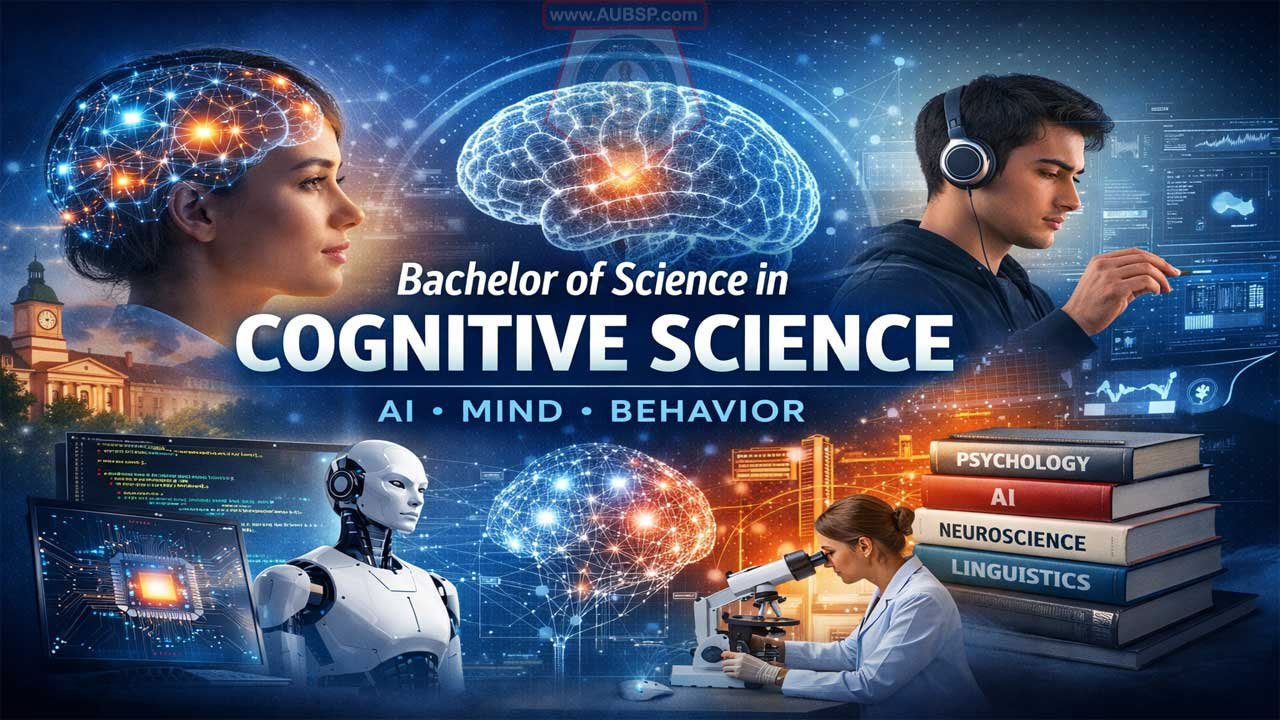
A Bachelor of Science in Cognitive Science is a highly interdisciplinary, future-oriented degree that integrates psychology, neuroscience, computer science, AI, linguistics, and philosophy to understand human and artificial intelligence, offering strong flexibility across careers in tech, healthcare, education, business, and research.
With a science- and computation-heavy curriculum, the BS track is especially suited for roles in AI, machine learning, data science, UX/HCI, neuroscience, and product management, as well as for preparation for competitive graduate programs. While entry-level salaries are moderate compared to pure computer science, graduates who develop strong programming and specialization—particularly in AI or HCI—often see rapid mid-career growth, with top earners reaching $150,000–$300,000+ in technology and leadership roles.
Globally available across the US, Europe, and Asia, cognitive science stands out as a “bridge” discipline, equipping graduates to design human-centered technologies, navigate ethical AI challenges, and thrive in an economy increasingly shaped by intelligent systems.
| Category | Information |
|---|---|
| Degree | Bachelor of Science (BSc) in Cognitive Science |
| Core Fields | Psychology, Computer Science, AI, Neuroscience, Linguistics, Philosophy |
| Focus | Scientific, quantitative, and computational study of mind and intelligence |
| Typical Duration | 3–4 years (107–120 credits) |
| Best For | AI/ML, data science, UX/HCI, neuroscience, research careers |
| Key Skills | Programming (Python), statistics, ML, cognitive modeling, human-centered design |
| Entry-Level Salary (US) | ~$45,000–$70,000 |
| Mid–Senior Career Salary | $120,000–$300,000+ (tech & AI roles) |
| Top Employers | Tech companies, AI labs, healthcare, research institutions |
| Graduate Pathways | MS/PhD in CS, AI, Neuroscience, Cognitive Science, Psychology, HCI |
| Global Study Hubs | USA, Germany, UK, Canada, India |
| Major Advantage | Combines human cognition + AI for future-proof careers |
Bachelor of Science in Cognitive Science (BScCogSci): Complete Guide to Education, Careers, and Salary
The Bachelor of Science in Cognitive Science represents one of the most intellectually dynamic and career-flexible undergraduate degrees available today. Unlike traditional single-discipline majors, a BScCogSci integrates psychology, computer science, neuroscience, philosophy, and linguistics to answer fundamental questions about how the mind works, how we think, and how artificial intelligence can simulate human cognition.
This comprehensive guide explores the program structure, career pathways, salary prospects, and international opportunities for students considering or currently pursuing a cognitive science degree. Whether you’re evaluating university options or researching career outcomes, this guide provides evidence-based insights to support your decision-making.
What is Cognitive Science?
Cognitive science is the interdisciplinary scientific study of mind and intelligence from multiple perspectives. It examines how biological brains and artificial systems process information, learn, remember, perceive the world, and solve problems. The discipline emerged in the 1970s as researchers recognized that understanding cognition required insights from multiple fields—no single discipline could fully explain how the mind works.
The field spans several core domains:
Psychology provides empirical methods for studying human behavior, memory, perception, and decision-making. Researchers conduct experiments to understand how people learn, process information, and interact socially.
Neuroscience investigates the biological foundations of cognition, examining how brain structures and neural networks enable mental processes. This includes studying neuroplasticity, neural development, and brain-behavior relationships.
Computer Science and Artificial Intelligence enable researchers to build computational models of cognition and develop intelligent systems that simulate human thinking. Machine learning and deep learning applications directly inform our understanding of human learning processes.
Philosophy addresses foundational questions about consciousness, knowledge, ethics, and the nature of mind. Philosophical inquiry ensures cognitive science addresses ethical implications of AI and neurotechnology.
Linguistics examines language structure, acquisition, and processing—how the brain understands and produces language. This includes psycholinguistics (how people process language) and computational linguistics (how machines process natural language).
Bachelor of Science vs. Bachelor of Arts in Cognitive Science
Most universities offering cognitive science provide both BA and BS degree options. Understanding the differences helps you choose the right path for your career goals.
| Aspect | BA in Cognitive Science | BS in Cognitive Science |
|---|---|---|
| Focus | Liberal arts emphasis; social, cultural, and applied aspects | Science and research emphasis; quantitative and computational foundations |
| Math & Science Requirements | Standard general education | Additional courses: calculus, physics, chemistry, biology, linear algebra |
| Programming | Optional or minimal | Mandatory; multiple programming languages required |
| Research Methods | General psychology methods | Advanced experimental design, statistics, lab work |
| Coursework | More flexibility and humanities electives | More specialized depth in computational/neuroscience areas |
| Career Path | Counseling, marketing, education, UX design, product management | AI/ML engineering, research, data science, cognitive engineering |
| Graduate School Preparation | Good for psychology or applied master’s programs | Better preparation for PhD programs in computer science or neuroscience |
Key Decision Point: Choose BS if you’re interested in AI, machine learning, computational modeling, or research-intensive careers. Choose BA if you prefer applied psychology, human factors, user experience, or counseling-related fields.
Program Curriculum and Course Structure
Core Curriculum Components
A typical Bachelor of Science in Cognitive Science requires approximately 107-120 credits over 3-4 years. The curriculum illustrates the comprehensive nature of these degrees:
Foundation Courses (Preparatory Subject Matter):
- Introduction to Cognitive Science
- Discrete Mathematics for Computer Science
- Programming Series (12 credits minimum): Introduction to Programming, Data Structures, Software Development
- Introduction to Linguistics
- Calculus Series (12 credits)
- Linear Algebra & MATLAB
- Symbolic Logic
- General Psychology
- Research Methods in Psychology
- Elementary Statistics
Specialized Depth Courses:
- Introduction to Cognitive Psychology
- Intermediate Symbolic Logic
- Artificial Intelligence and Machine Learning
- Cognitive Neuroscience
- Computational Linguistics
- Philosophy of Mind
- Advanced courses in perception, memory, language, and development
Specialization Emphasis Options
Most BS programs offer specialization tracks to match student interests:
Computational Emphasis: Focuses on artificial intelligence, machine learning, algorithms, and building computational models of cognition. Ideal for students pursuing careers in AI, data science, or tech companies.
Neuroscience Emphasis: Emphasizes brain structure, neural mechanisms, cognitive neuroscience, and biological foundations of cognition. Suitable for students interested in neuroscience research or medical fields.
Human-Computer Interaction (HCI): Combines cognitive science with UX design, usability research, and interface design—one of the most employable specializations.
Language and Cognition: Focuses on psycholinguistics, computational linguistics, and how language shapes thought.
Top Universities for Cognitive Science
Cognitive science programs vary significantly in strength, resources, and research opportunities. The following universities consistently rank among the world’s best for undergraduate cognitive science education:
| University | Country | Strengths | Notability |
|---|---|---|---|
| UC San Diego | USA | Highest-ranked undergraduate program; strong HCI and computational cognition research | Largest undergraduate cog sci program in North America |
| UC Berkeley | USA | Exceptional computational and cognitive neuroscience research; strong AI connections | Top-tier research facilities |
| Stanford University | USA | Industry connections; computational cognition and AI focus; excellent career placement | Silicon Valley location; high internship opportunities |
| MIT | USA | Brain and Cognitive Sciences department; cutting-edge neuroscience and AI research | Highest salaries for graduates |
| Carnegie Mellon University | USA | Strong computational focus; robotics and AI integration | Excellent for ML/AI career paths |
| University of California-Los Angeles (UCLA) | USA | Research depth in cognitive neuroscience; psychology connections | Large alumni network |
| University of Pennsylvania | USA | Interdisciplinary strength; neuroscience and philosophy integration | Ivy League prestige |
| University of Osnabrück | Germany | Modern research-oriented program; free/low tuition; international environment | Strong industry connections in Europe |
| University of Sheffield | UK | Philosophy of AI integration; strong cognitive neuroscience | 1-2 year master’s programs available |
Career Paths and Job Opportunities
The versatility of a cognitive science degree opens doors across multiple industries and career trajectories. Unlike specialized majors, BScCogSci graduates find employment in tech, healthcare, education, research, and business sectors.
Technology and AI Industry Roles
The technology sector offers the highest-paying opportunities for cognitive science graduates, particularly those with computational emphasis:
Machine Learning Engineer: Develops and deploys machine learning algorithms for real-world applications. Salary range: $120,000-$180,000+ annually in the USA. Machine learning engineers are in exceptionally high demand globally, with projected 40% growth through 2026.
AI/Software Engineer: Integrates AI systems into production software, develops intelligent applications, and optimizes algorithms for performance. Salary: $110,000-$160,000+ (with senior roles exceeding $180,000).
Natural Language Processing (NLP) Engineer: Develops systems for chatbots, voice assistants, machine translation, and automated text analysis. Salary: $130,000-$195,000+. Cognitive science training in linguistics and language processing provides strong preparation for NLP roles.
Data Scientist: Analyzes complex datasets, builds predictive models, and transforms data into actionable business insights. Salary: $100,000-$160,000+ depending on specialization. Cognitive science background uniquely prepares graduates for human-centered data science.
Human-AI Interaction Specialist: Designs and evaluates how humans interact with AI systems, ensuring interfaces are intuitive and user-friendly. This emerging role blends cognitive science, psychology, and UX design. Salary: $80,000-$150,000+.
UX/Product Designer: Leverages cognitive science principles to design interfaces, products, and user experiences. Cognitive science graduates often earn $80,000-$130,000+ in UX roles, with senior positions reaching $180,000+.
Healthcare and Clinical Roles
Cognitive Rehabilitation Specialist: Designs therapeutic programs to restore cognitive abilities after brain injury or neurological illness. Salary: $50,000-$80,000+.
Clinical Research Coordinator: Manages medical trials and cognitive neuroscience research studies. Salary: $45,000-$70,000+.
Neuropsychologist: (Requires master’s or PhD) Diagnoses and treats cognitive disorders. Salary: $100,000-$150,000+.
Healthcare Analytics Professional: Applies data science and cognitive principles to improve patient outcomes and healthcare systems. Salary: $70,000-$120,000+.
Education and EdTech
Educational Technologist: Develops learning platforms, adaptive educational systems, and personalized learning experiences using cognitive science principles.
Cognitive Skills Trainer: Develops programs to improve memory, attention, problem-solving, and critical thinking in students and professionals.
Instructional Designer: Creates curricula and training materials informed by cognitive science research on how people learn.
Business and Market Research
Market Research Analyst: Studies consumer behavior, decision-making, and psychological factors influencing purchasing. Salary: $45,000-$78,880+ annually.
Behavioral Data Analyst: Interprets consumer data using cognitive and behavioral science insights. Salary: $50,000-$100,000+.
Consumer Psychologist: Investigates how thoughts, beliefs, and emotions influence consumer behavior and brand loyalty.
Product Manager: Leverages understanding of human cognition to guide product strategy and design decisions. Salary: $120,000-$180,000+.
Research and Academia
Cognitive Scientist/Researcher: Conducts empirical research on perception, learning, memory, language, or consciousness. Salary varies widely; entry-level research positions start at $45,000-$60,000; senior researchers and faculty earn $100,000+.
Salary Prospects by Career Level and Geography
Entry-Level Salaries (Bachelor’s Degree)
| Country/Region | Average Starting Salary | Range |
|---|---|---|
| United States | $47,533 | $34,000-$70,000 |
| California (Tech Hub) | $70,000-$110,000 | Entry roles for ML/AI tracks |
| India | ₹6-12 lakh (~$7,200-$14,400 USD) | Varies by sector and city |
| Germany | €25,000-€35,000 (~$27,000-$38,000) | Lower but tuition-free education |
| United Kingdom | £22,000-£30,000 (~$27,500-$37,500) | Finance/tech premium higher |
Mid-Career Earnings (5-10 Years Experience)
Cognitive science graduates with 5-10 years of experience typically see substantial salary growth, particularly in technology:
- Machine Learning Engineer: $150,000-$220,000
- Senior UX Designer: $120,000-$180,000
- Data Scientist (senior): $130,000-$190,000
- Product Manager: $150,000-$250,000+
Graduates working in Silicon Valley report substantial salary progression, with some earning $180,000+ in total compensation within 5 years of graduation.
Senior-Level Earnings
Research scientists and senior AI specialists with cognitive science PhDs or extensive experience earn $150,000-$300,000+, with C-level roles in tech companies reaching $500,000+ (including equity and bonuses).
Global Opportunities: Where to Study Cognitive Science
United States
The USA offers the strongest concentration of undergraduate cognitive science programs, leading industry connections, and highest graduate salaries. Top-tier schools (Stanford, MIT, UC San Diego, Carnegie Mellon) offer exceptional career placement and alumni networks.
Advantages: Largest job market for cognitive science careers, highest salaries, extensive research opportunities, internship programs
Disadvantages: High tuition costs ($50,000-$80,000+ annually)
Germany
Germany is an emerging destination for cognitive science education, with universities offering free or heavily subsidized tuition. Programs provide research-intensive, internationally respected education.
Advantages: Free/low tuition, excellent research facilities, strong AI and neurotechnology industry, English-taught programs available
Disadvantages: Smaller job market within Germany; language barrier for some roles; salaries lower than USA
United Kingdom
Universities including Cambridge, Oxford, LSE, and Sheffield offer postgraduate cognitive science programs. Integration of cutting-edge AI research and philosophy create distinctive programs.
Advantages: Prestigious institutions, 1-year master’s programs, English-speaking environment, strong research culture
Disadvantages: High tuition for international students; bachelor’s programs less common; master’s focus
Canada
Canadian universities including University of Toronto and University of British Columbia offer cognitive science programs with welcoming policies for international students.
Advantages: Strong universities, welcoming to international students, pathway to permanent residency, lower costs than USA
Disadvantages: Smaller job market; salaries lower than USA; competitive admissions
India
Dayalbagh Educational Institute (DEI) offers India’s first Bachelor of Science in Cognitive Science—a 3-year interdisciplinary program integrating psychology, neuroscience, AI, and philosophy. This program is particularly relevant for students seeking education in South Asia.
Advantages: Highly affordable tuition, newly developed modern curriculum, pathway to international graduate schools
Disadvantages: Still-developing reputation; fewer established alumni networks; emerging job market in India
Skills Employers Demand in 2026
As artificial intelligence reshapes industries, employers seek cognitive science graduates with a specific skill combination:
Technical Skills (High Priority)
Programming Languages: Python, Java, C++, JavaScript—critical for ML/AI roles.
Machine Learning & AI: Understanding of supervised learning, unsupervised learning, deep learning, neural networks, and large language models.
Data Analysis & Statistics: Expertise in statistical testing, A/B testing, hypothesis validation, and data visualization tools (Tableau, Power BI).
AI Literacy: 92% of employers prioritize candidates with generative AI knowledge and micro-credentials.
Cognitive & Human-Centered Skills (Critical)
Analytical Thinking: The single most essential core skill for employers in 2025-2026, rated critical by 70% of companies.
Creative Problem-Solving: As AI handles routine analysis, human creativity becomes the differentiating factor.
Adaptability & Resilience: Flexibility to learn new tools, navigate ambiguity, and thrive in changing work environments.
Cognitive Flexibility: Ability to shift perspectives, challenge assumptions, and consider novel solutions.
Communication & Interpersonal Skills
Complex Communication: Translating cognitive science concepts for non-technical stakeholders.
Collaboration: Working across disciplines (engineers, designers, marketers, researchers) to solve complex problems.
Leadership: Guiding teams through ambiguous problems and driving innovation.
Career Advancement and Graduate Education
Immediate Career Paths
Most bachelor’s degree holders in cognitive science enter industry positions directly:
- Tech companies: ML engineer, AI researcher, data scientist, UX designer
- Healthcare organizations: Research coordinator, product designer, data analyst
- Consulting firms: Strategic consulting, behavioral consulting, user research
- Startups: Founding roles in AI, neurotechnology, and edtech companies
Graduate School Options
A BScCogSci provides strong preparation for specialized graduate programs:
Master’s Programs:
- MS/MA in Cognitive Science
- MS Computer Science (with cognitive science emphasis)
- MS Machine Learning
- MS Human-Computer Interaction
- MS Neuroscience
- MBA (strong preparation for product/business careers)
Doctoral Programs:
- PhD in Cognitive Science
- PhD in Neuroscience
- PhD in Computer Science/AI
- PhD in Psychology
- PhD in Linguistics
Many tech companies prefer hiring bachelor’s degree holders directly into technical roles rather than requiring a master’s, particularly for ML and AI engineering positions where hands-on experience is valued.
Salary Comparison Table: Cognitive Science vs. Related Majors
For context, here’s how cognitive science salary outcomes compare with related undergraduate degrees:
| Major | Average Starting Salary (USA) | 5-Year Median | Top Career Earnings Potential |
|---|---|---|---|
| Cognitive Science (BS) | $47,533 | $70,000-$90,000 | $180,000-$300,000+ |
| Computer Science | $60,000-$70,000 | $90,000-$120,000 | $200,000-$400,000+ |
| Psychology | $35,000-$42,000 | $55,000-$75,000 | $100,000-$150,000 |
| Neuroscience | $40,000-$50,000 | $65,000-$85,000 | $120,000-$200,000 |
| Data Science | $55,000-$65,000 | $85,000-$110,000 | $180,000-$300,000 |
Cognitive science graduates pursuing technology careers match or exceed computer science graduates’ earnings, particularly in emerging AI and machine learning roles.
Key Advantages of a Cognitive Science Degree
1. Future-Proof Career Preparation
As automation and AI become ubiquitous, cognitive science education uniquely prepares graduates for a technology-driven future. The discipline’s emphasis on understanding both human and artificial cognition positions graduates perfectly for roles in AI ethics, human-AI interaction, and neurotechnology—among the fastest-growing fields.
2. Competitive Advantage in Tech
While computer science graduates may have stronger programming foundations, cognitive science graduates possess deeper knowledge of human behavior, cognition, and perception—increasingly valuable in designing human-centered AI systems. Major tech companies actively recruit cognitive science graduates for UX, AI ethics, and product management roles.
3. Interdisciplinary Flexibility
The breadth of cognitive science opens doors across diverse industries. Unlike specialized single-discipline majors, cognitive science graduates credibly pursue careers in tech, healthcare, education, business, research, and policy.
4. Strong Graduate School Preparation
The program’s quantitative, research-oriented curriculum prepares students exceptionally well for advanced degrees in computer science, neuroscience, psychology, or cognitive science itself.
5. High Intellectual Engagement
Cognitive science directly addresses profound questions about consciousness, learning, intelligence, and the nature of mind. Graduates report high intellectual satisfaction and intrinsic motivation in their careers.
Challenges and Considerations
Moderate Entry-Level Salaries
While long-term earning potential is strong, bachelor’s degree holders in cognitive science start with moderate salaries ($47,533 average) compared to computer science graduates ($60,000+). This gap typically closes by mid-career as cognitive science graduates move into specialized AI and leadership roles.
Strategy: Pursue computational emphasis and strong programming skills to improve entry-level offers; consider internships at major tech companies during undergraduate studies.
Competitive Job Market for Generalist Roles
Because cognitive science is interdisciplinary but not specialized, graduates may face competition from specialists when seeking specific technical roles. A computer science graduate may be preferred for pure software engineering; a neuroscience graduate for neuroscience research.
Strategy: Develop genuine specialization through coursework, internships, and projects in your target area (AI, neuroscience, HCI, etc.). Consider double-major or strong minors.
Limited Academic Career Path
If pursuing academia, fewer universities offer dedicated cognitive science faculty positions. Most academic careers require PhD and are highly competitive.
Strategy: PhD programs in related fields (computer science, neuroscience, psychology) offer academic pathways; alternatively, pursue industry research at tech companies and labs.
Geographic Salary Variance
Salary prospects vary significantly by geography. Outside tech hubs (Silicon Valley, Boston, Seattle), entry-level salaries may be $20,000-$30,000 lower.
Strategy: Consider relocating to major tech centers post-graduation or working remotely for companies in high-salary regions.
Action Plan: Getting Started
For High School Students Considering the Major
- Strengthen Math & Science Foundation: Take advanced calculus, physics, chemistry, and computer science courses
- Develop Programming Skills: Learn Python independently through free resources (Codecademy, MIT OpenCourseWare)
- Explore Psychology & Neuroscience: Read popular science books; watch TED talks on cognition and AI
- Build a Research Profile: Seek summer internships in neuroscience or psychology labs
- Choose Universities Strategically: Apply to programs with strong industry connections (especially for tech career focus)
For Current Undergraduate Students
- Choose BS Over BA: Unless pursuing counseling/clinical psychology, the BS provides better career preparation
- Select Computational or HCI Emphasis: These tracks align with highest-demand, highest-paying careers
- Gain Programming Proficiency: Excel in programming courses; develop portfolio projects
- Internship Strategy: Secure internships at tech companies (Google, Meta, Microsoft, etc.) or research labs
- Build AI/ML Skills: Take electives in machine learning, deep learning, natural language processing
- Network: Join cognitive science clubs, attend conferences, connect with alumni working in target careers
For Career Changers or Prospective Graduate Students
- Consider Master’s Programs: MS in Cognitive Science, MS in Human-Computer Interaction, or MS in Machine Learning
- Online Learning: Supplement degrees with online specializations (Coursera, edX) in AI, data science, or UX
- Leverage Bachelor’s Foundation: Your undergraduate degree provides foundation; focus on specialization in graduate work
- Internships & Projects: Build portfolio of real work; demonstrate practical application of knowledge
Conclusion
The Bachelor of Science in Cognitive Science represents a compelling educational choice for intellectually curious students seeking careers at the intersection of mind, technology, and human behavior. The program combines rigorous scientific training with practical relevance to urgent contemporary challenges—how to design ethical AI systems, improve human-computer interaction, advance brain-computer interfaces, and understand consciousness.
While entry-level salaries are moderate, career progression in technology roles offers substantial earning potential ($150,000-$300,000+) within 10 years. The interdisciplinary nature of the degree provides flexibility across industries, from tech and healthcare to education and policy.
As artificial intelligence and neurotechnology become central to 21st-century innovation, cognitive science graduates possess uniquely valuable expertise combining deep understanding of both human cognition and artificial intelligence. This positions them not merely as technical specialists, but as bridge-builders between human needs and technological capability—a role increasingly vital to responsible AI development.
For students passionate about understanding how minds work and how technology can augment human capability, a Bachelor of Science in Cognitive Science offers intellectual fulfillment, career security, and the opportunity to shape how humanity relates to intelligent machines.
FAQs
What is a Bachelor of Science in Cognitive Science?
It is an interdisciplinary undergraduate degree combining psychology, neuroscience, computer science, AI, linguistics, and philosophy to study human and artificial intelligence.
What subjects are included in a cognitive science curriculum?
Core subjects include cognitive psychology, neuroscience, AI and machine learning, programming, linguistics, philosophy of mind, statistics, and research methods.
What is the difference between a BS and a BA in cognitive science?
A BS emphasizes science, math, programming, and research, ideal for AI, data science, and PhD paths. A BA emphasizes liberal arts, psychology, and applied fields like UX, counseling, or education.
How long does it take to complete a BSc in Cognitive Science?
Typically 3–4 years, requiring around 107–120 credits depending on the university and country.
What are the main career paths for cognitive science graduates?
Graduates can work in AI/ML, data science, UX/HCI design, neuroscience research, healthcare analytics, education technology, business analytics, and product management.
What programming skills are important for this degree?
Proficiency in Python, Java, C++, and JavaScript is often required, especially for AI, machine learning, and computational modeling roles.
What is the average starting salary for a cognitive science graduate?
In the US, it averages around $47,500, varying by specialization and location; tech roles often start higher ($70,000–$110,000).
Which universities are best for cognitive science?
Top institutions include UC San Diego, UC Berkeley, Stanford, MIT, Carnegie Mellon, UCLA, University of Pennsylvania, University of Osnabrück, and University of Sheffield.
Can I pursue graduate studies with a BSc in Cognitive Science?
Yes, graduates can pursue MS or PhD programs in cognitive science, computer science, AI, neuroscience, psychology, linguistics, HCI, or even an MBA.
Is a cognitive science degree future-proof?
Yes, its focus on human cognition, AI, and technology positions graduates for high-demand, interdisciplinary careers in rapidly evolving industries.
What are specialization options within cognitive science?
Common tracks include computational cognition, neuroscience, human-computer interaction (HCI), and language and cognition.
Are internships important for cognitive science students?
Yes, internships in tech companies, research labs, or healthcare settings enhance practical experience, employability, and salary potential.
Can cognitive science graduates work in healthcare?
Yes, roles include cognitive rehabilitation specialist, clinical research coordinator, healthcare analytics, and neuropsychology (advanced degrees required).
What is the difference between cognitive science and psychology?
Cognitive science is interdisciplinary, including AI, programming, and neuroscience, whereas psychology primarily focuses on human behavior, emotion, and mental processes.
Do cognitive science graduates need advanced degrees to work in AI?
Not necessarily; many tech companies hire BSc graduates directly for AI, ML, and data science roles, though specialized or senior positions may require MS or PhD.
Which countries offer strong cognitive science programs?
The USA offers the largest programs and highest salaries, Germany provides low-cost research-intensive programs, the UK and Canada offer strong research and international opportunities, and India has emerging programs.
What technical skills are most in demand for 2026?
Programming, machine learning, AI literacy, data analysis, statistics, and experience with large language models are highly valued.
What soft skills are important for cognitive science graduates?
Analytical thinking, creative problem-solving, cognitive flexibility, adaptability, communication, collaboration, and leadership.
How can high school students prepare for cognitive science?
Focus on advanced math, science, and programming courses, explore psychology and neuroscience, and seek research internships or online coding projects.
Is cognitive science a good fit for someone interested in AI and human behavior?
Yes, it combines both technical and cognitive knowledge, enabling graduates to work on AI systems, human-computer interaction, and behavioral research.
What are the challenges of a cognitive science degree?
Moderate entry-level salaries, competition with specialists, limited academic positions, and geographic salary variation are notable challenges.
What industries hire cognitive science graduates?
Technology, AI, healthcare, research institutions, education and edtech, business analytics, and product design/management.
Can I combine cognitive science with another major?
Yes, many students pursue double majors or minors in computer science, neuroscience, psychology, or data science to increase employability.
Do cognitive science graduates earn as much as computer science graduates?
Entry-level salaries may be lower, but mid- to senior-career earnings in AI, ML, and UX can match or exceed computer science salaries.
How does cognitive science prepare students for AI ethics and human-centered tech?
By integrating knowledge of human cognition, behavior, and technology, graduates can design ethical AI systems and user-focused applications.
What kind of research opportunities are available for undergraduates?
Students can engage in cognitive neuroscience labs, AI/ML research projects, psycholinguistics studies, HCI experiments, and computational modeling.
Is programming mandatory for the BS track?
Yes, multiple programming courses and practical coding skills are essential for computational and AI-focused career paths.
What is human-computer interaction (HCI) in cognitive science?
HCI is a specialization that studies how humans interact with technology, applying cognitive principles to design intuitive and user-friendly systems.
How do salaries vary by geography?
Tech hubs like Silicon Valley or Boston offer the highest salaries; outside major cities, starting salaries can be $20,000–$30,000 lower.
Are cognitive science graduates in demand?
Yes, especially for AI, ML, data science, HCI, UX design, neurotechnology, and interdisciplinary research roles worldwide.
Can cognitive science graduates work in education?
Yes, they can become educational technologists, cognitive skills trainers, or instructional designers applying cognitive principles to learning.
How does cognitive science integrate AI and human cognition?
It studies computational models, machine learning, and neural networks alongside human memory, perception, and decision-making processes.
Is a cognitive science degree suitable for entrepreneurship?
Yes, the interdisciplinary skills support founding startups in AI, edtech, neurotechnology, and user-focused product development.
What are the advantages of pursuing a BSc over a BA?
The BS emphasizes computational skills, research methods, and quantitative training, better preparing students for AI, ML, neuroscience, and PhD programs.
What is the role of neuroscience in cognitive science?
Neuroscience studies the biological basis of cognition, brain structure, neural networks, and how these relate to behavior and learning.
Does cognitive science cover philosophy?
Yes, it addresses consciousness, knowledge, ethics, and the philosophical implications of AI and neurotechnology.
What languages and tools are used in computational cognitive science?
Python, Java, C++, MATLAB, R, and machine learning libraries like TensorFlow or PyTorch are commonly used.
Can cognitive science graduates work in data science?
Yes, their knowledge of human behavior, cognition, and statistics prepares them for predictive modeling, analytics, and human-centered data roles.
What is the typical workload for a cognitive science undergraduate?
Around 107–120 credits over 3–4 years, including core courses, specialized electives, programming, math, lab work, and research projects.
How does cognitive science prepare students for machine learning roles?
Through courses in AI, ML, computational modeling, programming, data analysis, and understanding of human learning processes.
Is cognitive science intellectually engaging?
Yes, it tackles profound questions about consciousness, intelligence, learning, perception, and the nature of mind, offering high intrinsic motivation.
What is psycholinguistics in cognitive science?
It studies how humans acquire, process, and produce language, often combined with computational approaches to understand or model language systems.
Are there online courses for cognitive science skills?
Yes, platforms like Coursera, edX, and MIT OpenCourseWare offer courses in AI, ML, programming, neuroscience, and HCI.
Can cognitive science graduates work in product management?
Yes, understanding human cognition and behavior allows them to guide product strategy, UX design, and user research effectively.
What makes cognitive science interdisciplinary?
It combines psychology, neuroscience, AI, computer science, linguistics, and philosophy to provide a holistic understanding of mind and intelligence.
Do cognitive science graduates need research experience?
While not always required for industry roles, research experience strengthens graduate applications, technical expertise, and employability in AI or neuroscience.
How do cognitive science graduates apply skills in AI ethics?
They assess ethical implications of AI systems, human-AI interactions, bias mitigation, and responsible deployment of intelligent technologies.
What is the future outlook for cognitive science careers?
Strong growth is expected in AI, ML, human-computer interaction, neurotechnology, and cognitive research, with salaries and demand rising globally.
Can cognitive science graduates switch careers later?
Yes, the interdisciplinary foundation allows movement into tech, research, healthcare, education, business analytics, or entrepreneurship.
Is collaboration important in cognitive science?
Yes, working across disciplines—engineers, psychologists, designers, and researchers—is key to solving complex cognitive and technological problems.
Are cognitive science degrees internationally recognized?
Yes, top programs in the US, Europe, Canada, and India are globally respected and often provide pathways to international graduate schools.
Does the degree include lab work?
Yes, students engage in lab experiments, neuroscience research, HCI studies, computational modeling, and psychology experiments.
Can cognitive science graduates become neuropsychologists?
Yes, but this requires a master’s or PhD along with specialized clinical training.
What is the average mid-career salary for tech-focused cognitive science graduates?
Typically $120,000–$300,000+ depending on role, location, and specialization in AI, ML, or product leadership.
Do cognitive science programs offer international opportunities?
Yes, programs in Germany, UK, Canada, and India often include international research collaborations and global industry connections.
How should undergraduates choose a specialization?
Select tracks aligned with career goals: computational/AI for tech, neuroscience for research/healthcare, HCI for UX, and language/cognition for NLP or linguistics roles.
Can cognitive science graduates contribute to AI research?
Yes, their knowledge of cognition, behavior, and computational modeling is crucial for developing intelligent, human-centered AI systems.
Are there scholarships for cognitive science students?
Yes, many universities provide merit-based or need-based scholarships, especially for high-performing students in STEM or interdisciplinary programs.
How does cognitive science help in human-AI interaction roles?
Graduates apply cognitive principles to design intuitive interfaces, evaluate usability, and ensure AI systems align with human needs.
What is the typical coursework for a computational emphasis?
AI and ML courses, programming series, data structures, computational modeling, statistics, and applied neuroscience.
How does cognitive science differ from neuroscience alone?
Cognitive science integrates computational, philosophical, linguistic, and psychological perspectives, whereas neuroscience focuses primarily on brain structure and function.
Is continuous learning important in cognitive science careers?
Yes, staying updated in AI, ML, neuroscience, and HCI is critical due to rapid technological and research advancements.
Can cognitive science graduates work in startups?
Yes, they often start companies or join early-stage ventures in AI, neurotechnology, edtech, and human-centered tech products.
How important is math in a BS cognitive science program?
Very important; calculus, linear algebra, discrete math, and statistics form the foundation for AI, ML, and research courses.
What software skills are useful for cognitive science students?
MATLAB, Python, R, TensorFlow, PyTorch, statistical software, and data visualization tools like Tableau or Power BI.
Do cognitive science students study artificial intelligence?
Yes, AI courses cover machine learning, deep learning, neural networks, computational modeling, and applications in human cognition.
Can cognitive science graduates work internationally?
Yes, the interdisciplinary skill set is highly valued in global tech hubs, research labs, and universities worldwide.
What are the main challenges for cognitive science graduates entering the workforce?
Moderate starting salaries, competition with specialists, geographic salary disparities, and needing to develop strong technical skills.
How can students maximize career opportunities?
Focus on computational or HCI specializations, gain programming and AI skills, pursue internships, and build portfolios or research experience.
What is cognitive flexibility and why is it important?
It’s the ability to shift perspectives and adapt thinking; essential for problem-solving, innovation, and interdisciplinary collaboration in cognitive science careers.
Do BSc cognitive science programs include ethics?
Yes, courses in philosophy and AI ethics address the responsible design and deployment of technology and human-centered systems.
How do cognitive science graduates apply knowledge in business?
They analyze consumer behavior, design products, optimize user experience, and provide insights through behavioral data analytics.
Are online certifications useful for cognitive science students?
Yes, certifications in AI, machine learning, data science, and HCI supplement degree knowledge and improve employability.
Does cognitive science prepare students for PhD programs?
Yes, particularly in computer science, neuroscience, AI, psychology, linguistics, and cognitive science itself.
What role does linguistics play in cognitive science?
Linguistics studies language structure, acquisition, and processing, informing psycholinguistics, NLP, and AI language models.
Can cognitive science graduates pursue UX design?
Yes, understanding human cognition and perception allows them to design intuitive, user-friendly interfaces and products.
What is the typical class size for cognitive science programs?
It varies; US top-tier universities may have 100–300 students per cohort, while smaller programs in Europe or India have 30–100.
How competitive is admission to cognitive science programs?
Highly competitive at top universities due to interdisciplinary rigor and strong demand in tech, research, and healthcare sectors.
Is research mandatory in cognitive science undergraduate programs?
Most programs require research methods courses and lab projects; optional research internships can enhance career prospects.
What is the role of statistics in cognitive science?
Statistics is used for experimental design, data analysis, hypothesis testing, and validating AI or behavioral models.
Can cognitive science graduates work in AI ethics advisory roles?
Yes, they can guide companies on responsible AI deployment, bias mitigation, human-centered design, and regulatory compliance.
Does the degree involve teamwork?
Yes, students often collaborate on lab projects, research studies, programming assignments, and interdisciplinary design challenges.
Are cognitive science programs more common in the US or Europe?
They are most prevalent in the US, with growing programs in Germany, UK, Canada, and India offering international perspectives.
Can cognitive science graduates work in educational technology?
Yes, they design adaptive learning platforms, personalized curricula, and cognitive skill training programs.
What electives are common in cognitive science programs?
Electives include advanced AI, neuroscience, psycholinguistics, HCI, philosophy of mind, data visualization, and machine learning applications.
Is hands-on lab experience important?
Yes, practical experience in programming, neuroscience experiments, AI modeling, and HCI design is crucial for career readiness.
How does cognitive science relate to AI development?
It provides insights into human learning, perception, and decision-making, guiding the design of intelligent, human-centered AI systems.
What is the role of computational modeling in cognitive science?
It simulates cognitive processes to study learning, perception, decision-making, and language processing in humans and machines.
Do cognitive science programs offer career services?
Top universities provide career counseling, internship placement, industry connections, alumni networks, and job placement support.
Can cognitive science graduates pursue PhD in psychology?
Yes, with sufficient psychology coursework and research experience, graduates can enter doctoral programs in psychology.
What distinguishes a cognitive science graduate from a pure computer science graduate?
They combine computational expertise with deep understanding of human cognition, behavior, perception, and ethics, enabling human-centered technology development.
Are cognitive science graduates suited for leadership roles?
Yes, interdisciplinary knowledge, problem-solving, communication, and cognitive flexibility make them well-suited for team and project leadership.
What research areas are common in cognitive science?
Perception, memory, learning, consciousness, language processing, AI-human interaction, computational modeling, and neuroscience.
Do cognitive science programs include capstone projects?
Yes, many programs culminate in research or applied projects integrating computational, neuroscience, and cognitive principles.
How does the degree help in consumer behavior analysis?
Graduates apply cognitive principles to understand decision-making, brand loyalty, and user experience in marketing and business analytics.
Can cognitive science graduates work remotely in tech?
Yes, programming, data analysis, AI, and UX roles often allow remote work for global companies.
Do cognitive science students study AI algorithms?
Yes, including supervised and unsupervised learning, deep learning, neural networks, and natural language processing.
How does cognitive science prepare students for product design?
By applying knowledge of perception, cognition, and human behavior to design intuitive, effective, and user-centered products.
What industries value cognitive science graduates the most?
Tech (AI/ML), healthcare, education, UX/HCI, neuroscience research, data analytics, and consulting are key industries.
Is ethics a significant part of cognitive science education?
Yes, ethical considerations in AI, neuroscience, and human-computer interaction are integrated into coursework and research.
How can cognitive science graduates enhance employability?
Gain strong programming and AI skills, pursue internships, specialize in computational/HCI tracks, build portfolios, and network with professionals.
Are there emerging career fields for cognitive science graduates?
Yes, including human-AI interaction, neurotechnology, cognitive UX design, behavioral analytics, and AI ethics advisory roles.
Does the degree prepare students for interdisciplinary collaboration?
Yes, graduates are trained to work with engineers, designers, researchers, and business professionals to solve complex problems.
Can cognitive science graduates pursue careers in consulting?
Yes, particularly in behavioral consulting, strategic consulting, user research, and data-driven decision-making roles.
Is a BSc in Cognitive Science suitable for tech startups?
Absolutely; graduates’ blend of AI, cognition, programming, and human-centered design is ideal for launching innovative tech ventures.
Do graduates often continue to PhDs or industry roles?
Many choose industry for AI, ML, and tech roles, while others pursue PhDs in cognitive science, neuroscience, AI, psychology, or linguistics.
Can cognitive science graduates design AI learning systems?
Yes, they can develop adaptive, human-centered AI and machine learning systems informed by cognitive principles.
What makes cognitive science a high-growth field?
Integration of AI, human cognition, neuroscience, and technology


Leave a Reply
You must be logged in to post a comment.