
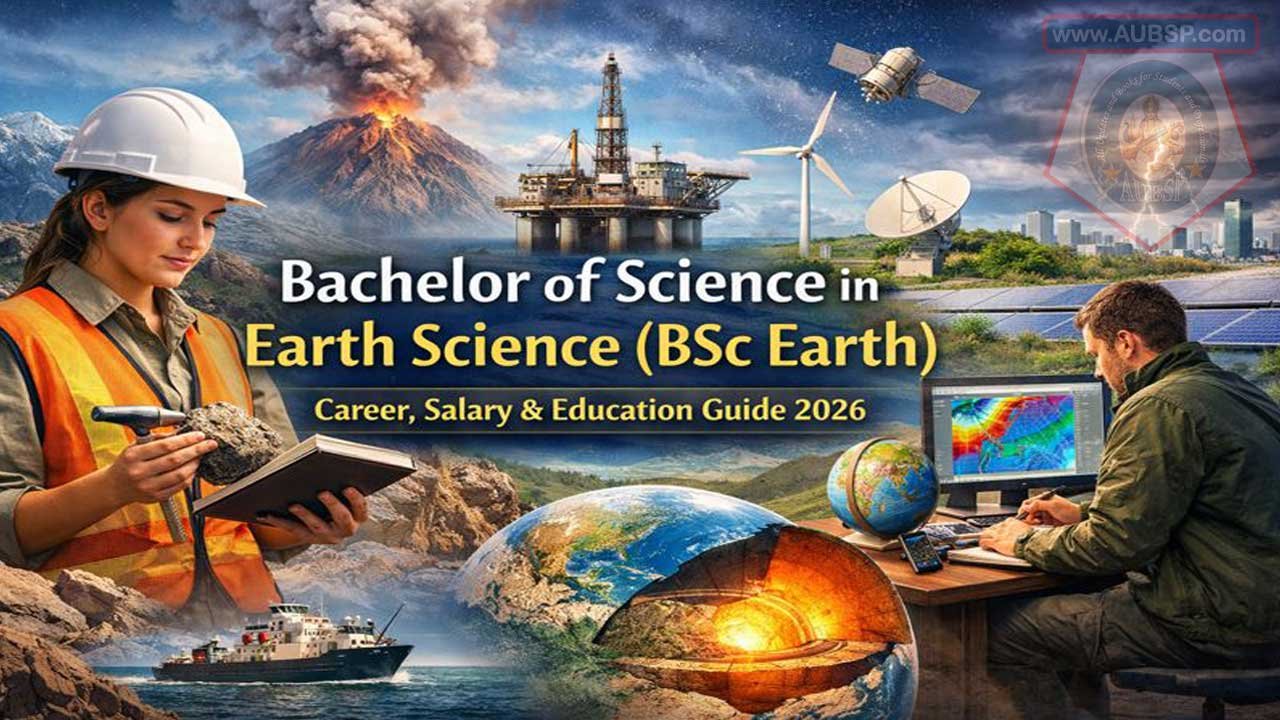
A Bachelor of Science in Earth Science (BSc Earth) is an interdisciplinary undergraduate degree that studies Earth’s materials, processes, and systems—integrating geology, chemistry, physics, biology, environmental science, GIS, and remote sensing—to address global challenges like climate change, natural hazards, resource management, and sustainability.
Typically completed in 3–4 years with significant fieldwork, the program offers diverse specializations including environmental geology, hydrogeology, petroleum geology, climate science, geophysics, and planetary science, leading to careers in government agencies, environmental and engineering consulting, mining, energy, research, and academia.
Graduates enjoy steady job growth, global mobility, and competitive long-term earning potential (especially with a master’s degree and technical skills), making BSc Earth Science a strong-return, future-relevant choice for students interested in both scientific inquiry and real-world environmental impact.
| Category | Information |
|---|---|
| Degree Name | Bachelor of Science in Earth Science (BSc Earth) |
| Degree Level | Undergraduate |
| Duration | 3–4 years (varies by country) |
| Study Mode | Full-time |
| Core Focus | Earth systems, geology, environment, climate, natural resources |
| Major Disciplines | Geology, Environmental Science, Geophysics, Oceanography, Meteorology, GIS |
| Practical Training | Mandatory fieldwork (4–12 weeks), lab work, GIS projects |
| Popular Specializations | Environmental Geology, Petroleum Geology, Hydrogeology, Climate Science, Geotechnical Engineering |
| Eligibility | High school (12th grade) with Physics, Chemistry, Maths/Biology |
| Top Recruiters | USGS, NOAA, Shell, ExxonMobil, ONGC, Environmental Consultancies |
| Career Options | Geoscientist, Environmental Consultant, Hydrogeologist, GIS Analyst, Seismologist |
| Average Starting Salary | $50,000–$65,000 (US) / ₹3–5 LPA (India) |
| Median Salary (US) | ~$99,240 per year |
| Higher Study Options | MSc Earth Science, Petroleum Geoscience, Environmental Geology, PhD |
| Job Outlook | Stable to strong growth (3–6%), climate-related roles growing rapidly |
| Global Demand | High (US, Canada, Australia, Middle East, Europe) |
| Best Suited For | Students interested in Earth, environment, climate, and field-based science |
Bachelor of Science in Earth Science (BSc Earth): Complete Career & Education Guide 2026
What is a Bachelor of Science in Earth Science? A Bachelor of Science in Earth Science (BSc Earth) is a comprehensive undergraduate degree program that examines the composition, structure, processes, and systems of our planet. This interdisciplinary field integrates geology, chemistry, physics, biology, and environmental science to understand everything from mineral formation and plate tectonics to climate systems and natural hazards.
Earth Science differs from traditional geology programs by taking a broader, more holistic approach to understanding Earth’s systems. While geology focuses specifically on rocks, minerals, and the planet’s structural makeup, Earth Science encompasses meteorology, oceanography, environmental science, and planetary science alongside geological studies.
The program is designed for students who want to address global challenges including climate change, natural resource management, environmental remediation, and sustainable development. Graduates work in sectors ranging from oil and gas exploration to environmental consulting, government agencies, and academic research institutions.
Key Disciplines Covered:
- Physical Geology & Earth Materials
- Environmental Science & Sustainability
- Oceanography & Marine Systems
- Atmospheric Science & Meteorology
- Geochemistry & Mineralogy
- Geophysics & Seismology
- Environmental Remediation & Conservation
- Geographic Information Systems (GIS)
- Remote Sensing Technology
Program Structure & Duration
Standard Program Length
Most Bachelor of Science in Earth Science programs require 3-4 years of full-time study, depending on the country and institution:
- United Kingdom & Ireland: 3 years (180 ECTS credits)
- United States: 4 years (120 semester credits)
- Canada: 4 years
- Australia: 3 years
- India: 3 years
Typical Course Breakdown
First Year (Foundation)
- General Chemistry & Physics
- Introduction to Earth Systems
- Mineralogy Basics
- Mathematical Methods for Geoscience
- Environmental Science Principles
- Computer Applications in Geoscience
Second Year (Core Specialization)
- Structural Geology & Deformation
- Stratigraphy & Sedimentation
- Petrology (Igneous & Metamorphic)
- Geochemistry
- Geophysics & Seismology
- Economic Geology & Resource Exploration
Third/Fourth Year (Advanced & Electives)
- Field Geology & Practical Training
- Specialized Electives (Petroleum, Environmental, Planetary)
- Research Project or Dissertation
- Advanced GIS & Remote Sensing
- Geohazards & Natural Disaster Management
Practical Components:
All reputable BSc Earth Science programs include mandatory field work, typically involving 4-12 weeks of field camps where students study geological formations, collect rock samples, and conduct geological surveys in diverse environments.
Top Universities Offering BSc Earth Science
Global Rankings (2026-2027)
| Rank | University | Country | Key Strengths |
|---|---|---|---|
| 1 | ETH Zurich | Switzerland | Research excellence, geological field access |
| 2 | University of Oxford | United Kingdom | Ancient institution, comprehensive geology program |
| 3 | University of Cambridge | United Kingdom | Research-intensive, strong theoretical foundation |
| 4 | Stanford University | United States | Innovation focus, proximity to Silicon Valley tech |
| 5 | MIT | United States | Engineering geology, advanced technologies |
| 6 | UC Berkeley | United States | Environmental focus, field research opportunities |
| 7 | University of Washington | United States | Arctic research, environmental geology |
| 8 | Imperial College London | United Kingdom | Planetary science, advanced geophysics |
| 9 | University of Manchester | United Kingdom | Applied geoscience, industry partnerships |
| 10 | Australian National University | Australia | Southern Hemisphere perspectives, mining geology |
Asia-Pacific Leaders
- University of Tokyo – Seismology & earthquake geology specialization
- Tsinghua University (China) – Mineral resources & mining geology
- China University of Geosciences (Beijing) – Petroleum geology focus
India-Specific Institutions
- IIT Bombay – Average placement ₹17.92 LPA
- IIT Dhanbad – Average placement ₹11.56 LPA
- Delhi University – Range ₹5.5-16 LPA
- Manipal University – Average placement ₹11.68 LPA
Specializations & Concentrations
Most BSc Earth Science programs allow students to specialize in specific areas from the second year onward:
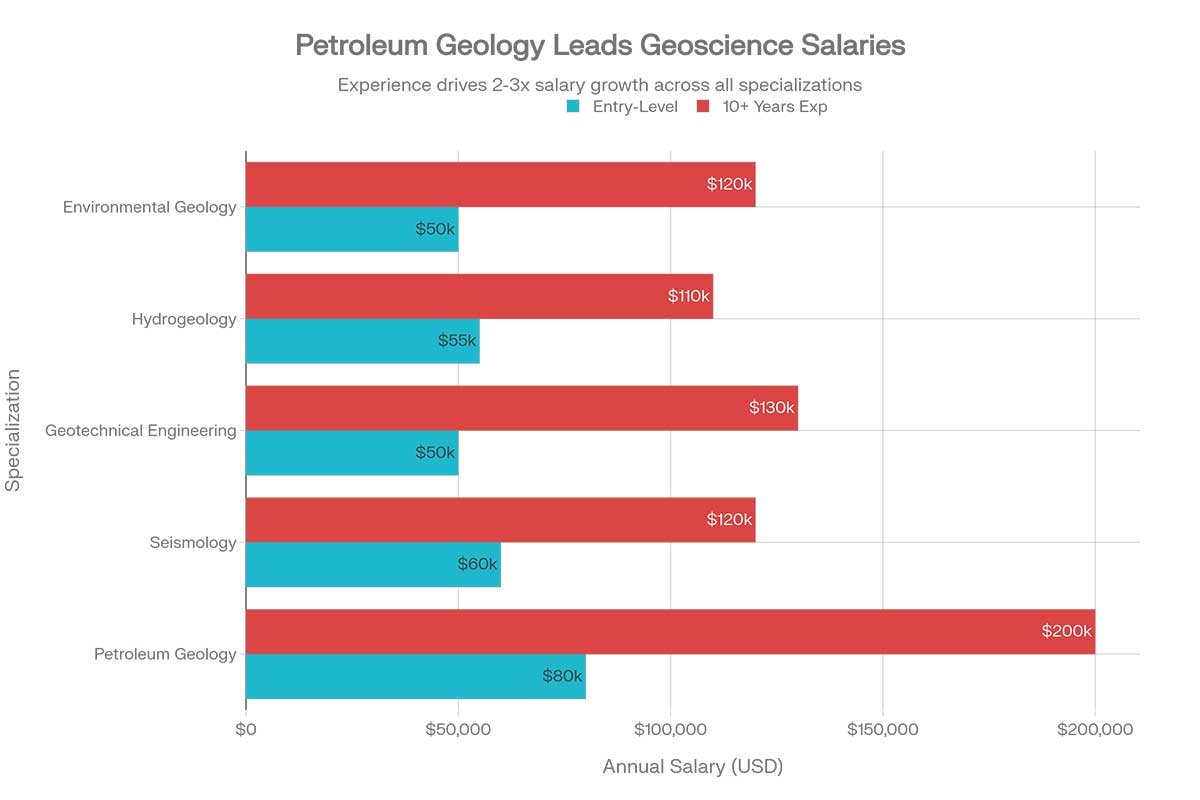
1. Petroleum Geology & Hydrocarbon Exploration
- Focus: Oil and gas reservoir characterization, seismic interpretation, exploration techniques
- Salary Potential: Highest in geoscience field ($150,000-$250,000+ experienced professionals in premium locations)
- Job Outlook: Evolving due to renewable energy transition; strong demand in Asia, Middle East, and developing economies
- Employers: Shell, ExxonMobil, Saudi Aramco, ONGC
2. Environmental Geology & Geotechnics
- Focus: Contamination assessment, groundwater remediation, engineering geology, foundation stability
- Salary Potential: $76,530 median (US), with 6% projected growth through 2032
- Job Outlook: Fastest-growing specialty due to climate change and environmental regulations
- Employers: Consulting firms, EPA, environmental contractors, mining companies
3. Hydrogeology & Water Resources
- Focus: Groundwater systems, aquifer management, water supply development
- Salary Potential: $65,000-$110,000 depending on experience and location
- Job Outlook: Strong due to freshwater scarcity and climate change impacts
- Employers: Water utilities, USGS, engineering firms, agriculture sector
4. Geotechnical Engineering
- Focus: Soil mechanics, foundation design, slope stability, underground construction
- Salary Potential: ₹5-6.6 LPA (India), $70,000-$100,000 (US)
- Job Outlook: Strong in construction and infrastructure development sectors
- Employers: Construction firms, civil engineering companies, mining operations
5. Seismology & Natural Hazards
- Focus: Earthquake analysis, tsunami modeling, volcanic hazards, disaster prediction
- Salary Potential: ₹11 LPA entry level (India), $80,000-$120,000 (developed nations)
- Job Outlook: Growing due to increasing extreme weather events and climate change
- Employers: USGS, NOAA, meteorological departments, research institutions
6. Planetary Geology & Astrobiology
- Focus: Formation of solar system, planetary surfaces, potential for extraterrestrial life
- Salary Potential: $85,000-$130,000 (specialized research positions)
- Job Outlook: Emerging field with space exploration expansion
- Employers: NASA, ESA, space agencies, research universities
7. Climate Science & Paleoclimatology
- Focus: Historical climate patterns, climate change analysis, paleoclimate reconstruction
- Salary Potential: $77,000-$86,000 median, growing rapidly
- Job Outlook: Explosive growth (27% increase in climate jobs globally in 2026)
- Employers: NOAA, research universities, climate consulting firms
Salary Ranges by Specialization (Entry vs. Experienced):
Career Opportunities & Job Outlook
Employment Projections
- US Growth Rate: 3% from 2024-2034 (as fast as average)
- Geoscientist Positions: ~25,100 workers, with 800 annual openings
- Environmental Science Growth: 4% from 2024-2034
- Global Climate Jobs: 27% increase in hiring (2026)
Primary Employers
Government & Public Sector
- United States Geological Survey (USGS)
- National Oceanic and Atmospheric Administration (NOAA)
- Environmental Protection Agency (EPA)
- Ministry of Earth Sciences (India)
- Geological Survey Organizations (UK, Canada, Australia)
Private Industry
- Oil & Gas: ExxonMobil, Shell, Chevron, Saudi Aramco, ONGC
- Consulting: Golder Associates, SoilCare, Environmental Resources Management
- Mining: Rio Tinto, BHP, Hindustan Zinc Limited, Coal India
- Environmental: Ecosphere Technologies, Waste Management Inc.
- Engineering: Aecon, Jacobs Engineering, Bechtel
Research & Academic
- Universities (Professorship pathway)
- National Research Councils
- Climate Research Institutions
- Planetary Science Centers
Diverse Career Paths
| Career Title | Entry Salary | Experienced Salary | Required Education |
|---|---|---|---|
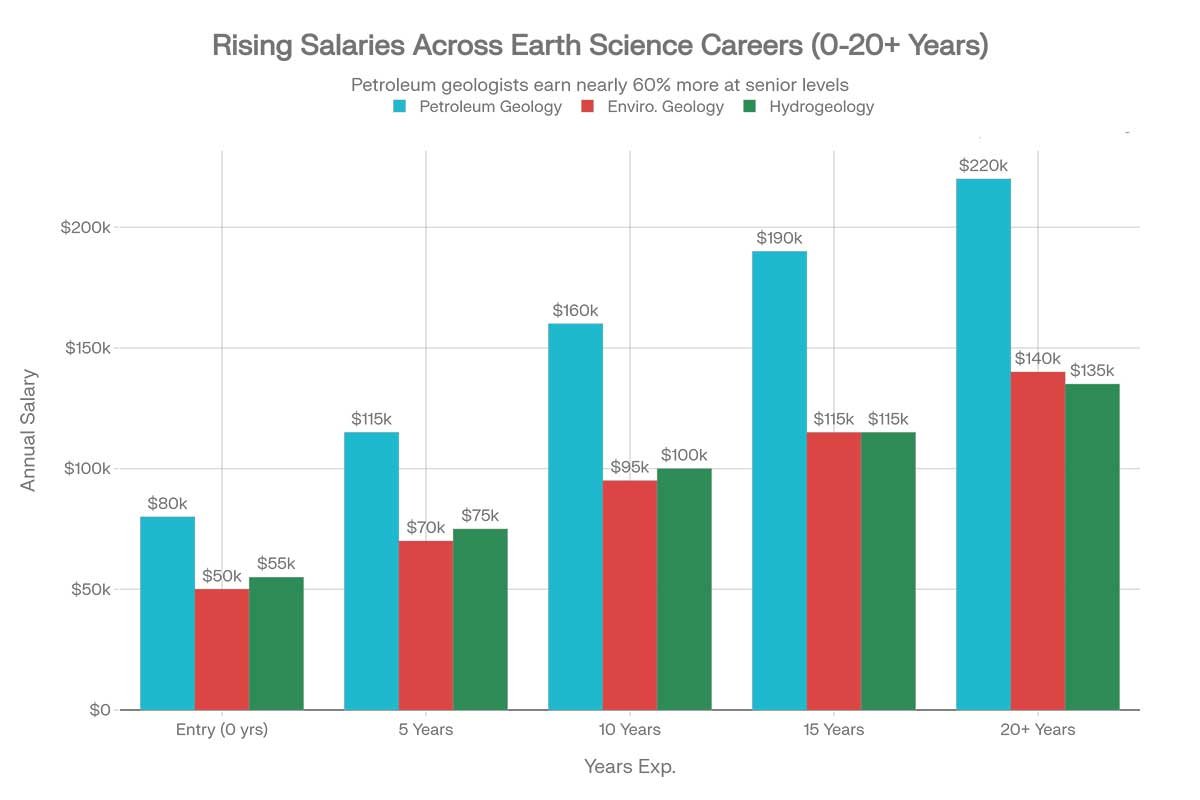
| Environmental Consultant | $50,000-$60,000 | $80,000-$120,000 | BSc + certifications |
| Petroleum Geologist | $80,000-$100,000 | $150,000-$250,000+ | BSc/MSc petroleum geology |
| Hydrogeologist | $55,000-$65,000 | $85,000-$110,000 | BSc + field experience |
| Geotechnical Engineer | $50,000-$60,000 | $100,000-$130,000 | BSc + PE license |
| Seismologist | $60,000-$75,000 | $110,000-$140,000 | BSc + MSc/PhD recommended |
| Environmental Scientist | $42,000-$55,000 | $75,000-$100,000 | BSc in environmental science |
| GIS Specialist | $45,000-$58,000 | $70,000-$95,000 | BSc + GIS certifications |
| Geophysicist | $55,000-$70,000 | $95,000-$130,000 | BSc + technical specialization |
Skills That Increase Earning Potential
- Professional licenses (P.G., P.E., P.Geo)
- GIS & Remote Sensing expertise
- Programming skills (Python, MATLAB, R)
- Master’s degree or specialization
- Bilingual capabilities
- Project management experience
Salary Expectations by Country
United States
- Entry Level: $50,000-$65,000/year
- Median (All Levels): $99,240/year (2024 BLS data)
- Experienced (10+ years): $120,000-$160,000/year
- Senior/Management: $150,000-$250,000+/year
- Top Earners (Petroleum): $250,000+/year
Highest-Paying States: Texas, Alaska, California, North Dakota
Canada
- Entry Level: $67,000-$75,000/year
- 5-10 Years Experience: $80,000-$150,000/year
- Senior Geoscientists: $150,000+/year
Premium Salary Drivers: Oil and gas sector, northern provinces, specialized expertise
United Kingdom
- Entry Level: £30,000-£40,000/year (~$38,000-$51,000 USD)
- Mid-Career: £50,000-£70,000/year
- Senior Positions: £80,000-£120,000/year
Australia
- Entry Level: AUD 55,000-$70,000/year (~USD $37,000-$47,000)
- Mid-Career: AUD 85,000-$110,000/year
- Senior Positions: AUD 130,000-$180,000/year
Premium Sectors: Mining, petroleum exploration, major cities
India
- Entry Level: ₹3-5 LPA (approximately USD $3,600-$6,000/year)
- 3-5 Years Experience: ₹6-8 LPA
- Senior Positions: ₹12-18 LPA
- Specialized (Petroleum, Seismology): ₹13+ LPA
Highest-Paying Organizations:
- ONGC (Oil & Natural Gas Corporation): ₹13+ LPA
- Hindustan Zinc Limited
- Coal India Limited
- Major international consulting firms
Salary Progression Tip: Indian geoscientists with international experience and master’s degrees can earn significantly more in multinational companies.
Career Salary Progression Over 20 Years:
Global Remote/International Opportunities
- Companies like SoilCare, Golder Associates, and international consulting firms increasingly hire from India for global projects
- Potential to earn 1.5x-2x local salaries while working remotely for international employers
Admission Requirements
United States
- High School Diploma or GED
- Standardized Tests: SAT/ACT
- GPA: 3.0+ (highly competitive schools: 3.5+)
- Prerequisites: Chemistry, Physics, Mathematics (Calculus preferred)
- Application Materials: Essay, letters of recommendation, transcript
United Kingdom
- A-Levels: AAB-AAA (specific subjects required)
- International Baccalaureate: 35-39 points with HL requirements
- UCAS Application: Submitted via centralized system
- Prerequisites: Physics, Chemistry, Mathematics
Canada
- High School Diploma with strong grades
- Math & Science Courses: Essential (Calculus, Physics, Chemistry)
- Provincial variations: Check specific university requirements
Australia
- Australian High School Certificate or equivalent
- Minimum ATAR: 70-85 (varies by institution)
- Prerequisites: Chemistry, Physics, Mathematics
India
- 12th Standard (CBSE/State Board)
- Entrance Exams: NEET (for some institutions), Merit-based admissions
- Prerequisites: Physics, Chemistry, Biology/Mathematics
International Students
- English Proficiency: TOEFL 80+/IELTS 6.5+ (US), IELTS 6.0-7.0 (UK)
- Visa Requirements: Valid student visa
- Financial Documentation: Proof of funds
Cost & Scholarships
Tuition Costs
| Country | Annual Tuition | Avg. Total Cost (4 years) |
|---|---|---|
| United States | $25,000-$45,000 | $100,000-$180,000 |
| United Kingdom | £9,000-$15,000 | £27,000-£45,000 |
| Canada | CAD 6,000-15,000 | CAD 24,000-60,000 |
| Australia | AUD 12,000-18,000 | AUD 48,000-72,000 |
| India | ₹50,000-3,00,000/year | ₹2-12 LPA total |
Scholarship Opportunities
- Merit-Based: Full tuition at top-tier universities
- Need-Based: Common in North America
- Departmental Scholarships: $2,000-$10,000/year
- Research Assistantships: Free tuition + $500-$1,500/month stipend
- Government Scholarships: Varies by country and scholarship body
Is BSc Earth Science Worth It?
Advantages
✓ Strong Career Prospects: 3-6% employment growth, ~800 annual openings (US)
✓ High Earning Potential: Median $99,240 (US), petroleum specialists $150,000+
✓ Diverse Career Paths: 20+ specializations, public and private sectors
✓ Global Relevance: Climate change driving 27% increase in related jobs
✓ Stable Government Jobs: Low unemployment, comprehensive benefits
✓ Research Opportunities: Path to PhD and academic careers
✓ Fieldwork Appeal: For those who enjoy outdoor work and hands-on learning
Challenges
✗ Energy Transition Impact: Petroleum geology declining in developed nations
✗ Geographic Limitation: Some specializations concentrated in specific regions
✗ Higher Education Needed: Many advanced positions prefer/require MSc
✗ Entry-Level Salaries Modest: Starting at $50,000-$65,000 in developed countries
✗ Physical Demands: Fieldwork can be demanding and sometimes in remote locations
✗ Regulatory Changes: Environmental regulations frequently shift career landscape
ROI Assessment
For most graduates, a BSc Earth Science degree breaks even financially within 5-7 years post-graduation. Given median career earnings of $80,000-$100,000+, the investment in education typically pays substantial dividends. The field is particularly lucrative for those specializing in petroleum geology or those willing to pursue master’s degrees in high-demand areas.
Master’s Degree Pathways
Many employers prefer or require master’s degrees for advanced positions. Popular specializations include:
- MSc Petroleum Geoscience (STEM pathway, salary advantage)
- MSc Mineral Exploration & Economic Geology
- MSc Applied Geophysics
- MSc Hydrogeology & Groundwater Management
- MSc Environmental Geology & Engineering
- MSc Marine Geology & Oceanography
- MSc Geochemistry
- MSc Earth Science & Resource Management
Salary Premium: Master’s degree holders earn 15-25% more than bachelor’s holders in most positions.
FAQs
Q: What’s the difference between Earth Science, Geology, and Geoscience?
A: Earth Science is the broadest discipline, encompassing geology, environmental science, oceanography, and atmospheric science. Geology focuses specifically on rocks and minerals. Geoscience is often used interchangeably with Earth Science.
Q: Can I study BSc Earth Science if I didn’t take Chemistry in high school?
A: Most programs require chemistry; however, some universities offer preparatory courses. Contact your target institution to explore bridging programs.
Q: Is petroleum geology still a good career path in 2026?
A: While traditional oil exploration is declining in developed nations, petroleum geologists remain highly sought in Asia, Africa, and the Middle East. Transition to renewable energy positions offers alternative paths.
Q: Do I need a Professional Geologist (P.G.) license?
A: The P.G. license is required in some jurisdictions (Pennsylvania, California) for independent consulting work but not universally required. It does enhance career prospects and earning potential.
Q: What’s the job market like for graduates outside the US?
A: Canada and Australia have strong geoscience sectors. India is growing but salaries are lower. UK and European countries have stable government and research opportunities.
Q: Can I work internationally with a BSc Earth Science?
A: Yes, but you may need additional certifications or a master’s degree. English proficiency and understanding of international regulations is essential.
Q: What’s the best specialization for guaranteed employment?
A: Environmental geology and hydrogeology offer the most stable employment due to ongoing regulations and climate change concerns. Petroleum geology offers highest salaries but faces long-term uncertainty.
Conclusion
A Bachelor of Science in Earth Science opens doors to a globally relevant career field addressing humanity’s most pressing challenges—climate change, natural resource management, environmental protection, and disaster mitigation. With median salaries of $99,240 in the US, diverse specialization options, and steady 3-6% employment growth, the degree offers strong ROI for motivated students.
The field is particularly attractive for those who combine technical expertise with environmental consciousness. Whether pursuing petroleum exploration in resource-rich regions, environmental consulting in developed nations, or climate science research, Earth Science graduates find abundant opportunities.
Success in this field requires continuous learning, particularly in GIS, coding, and specialized software. Pursuing a master’s degree significantly enhances both career prospects and earning potential, particularly in competitive markets.
Start your Earth Science journey today—the planet needs qualified geoscientists tomorrow.


Leave a Reply
You must be logged in to post a comment.