
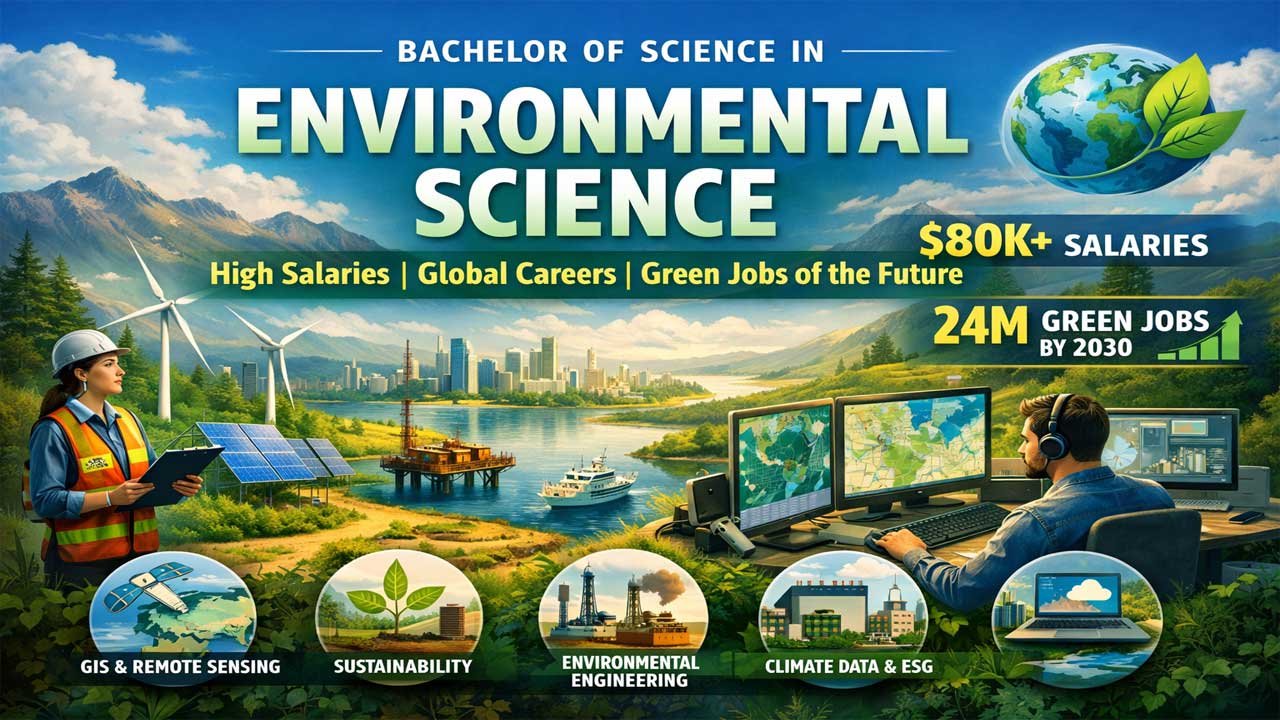
A Bachelor of Science in Environmental Science is a highly future-ready degree for 2026 and beyond, combining strong global job demand, competitive salaries, and meaningful impact as economies transition toward sustainability.
With median salaries around $80,000 in the US, rapid growth of green jobs (24 million projected by 2030), and opportunities across consulting, government, corporate sustainability, GIS, climate finance, and renewable energy, the degree offers excellent ROI—especially when paired with high-value skills like GIS, data science, or environmental engineering.
Programs range from affordable 3-year degrees in countries like India and Europe to research-intensive 4-year honors programs in the US, UK, and Australia, enabling global mobility and remote work. Graduates benefit from strong job security driven by climate regulations and ESG mandates, with clear pathways to six-figure and executive roles, making environmental science one of the most strategically positioned undergraduate degrees of the coming decade.
| Aspect | Details |
|---|---|
| Degree Name | Bachelor of Science (BSc) in Environmental Science |
| Duration | 3 Years (India/Europe), 4 Years – Honors (USA/UK/Australia) |
| Core Subjects | Ecology, Environmental Chemistry, Biology, Geology, GIS, Climate Science |
| Average Cost | India: ~$1,380/year · Germany: Free · Australia: $8,800–$24,800/year · USA: $16,000–$60,000+/year |
| Entry-Level Salary | $50,000–$62,000 (USA) · ₹5–7 LPA (India) |
| Median Salary | ~$80,060 (USA) |
| High-Paying Specializations | GIS, Environmental Engineering, Climate Data Science, ESG & Sustainability |
| Job Growth Outlook | 4–6% growth through 2034; 24M green jobs globally by 2030 |
| Top Employers | Consulting Firms, Government Agencies, Tech Companies, Energy & Finance |
| Career Potential | $120,000–$300,000+ in senior and leadership roles |
Bachelor of Science in Environmental Science: Complete Career & Education Guide 2026
A Bachelor of Science in Environmental Science has become one of the most strategically positioned degrees for the global economy, combining strong earning potential with meaningful career impact. With median salaries of $80,060 in the United States and projected job growth of 4-6% through 2034, this degree opens pathways to lucrative careers across government agencies, consulting firms, corporate sustainability divisions, and international organizations.
The global market projects 24 million green jobs to emerge by 2030, positioning environmental science graduates at the forefront of a rapidly expanding economic sector. This comprehensive guide explores program structure, admission requirements, career pathways, salary expectations, and strategic decisions for prospective students globally.
What Is a Bachelor of Science in Environmental Science?
A Bachelor of Science (B.Sc.) in Environmental Science is a science-based undergraduate degree that integrates ecological principles, chemistry, biology, geology, and earth systems with practical applications for addressing modern environmental challenges. The program develops scientific literacy around climate change, biodiversity conservation, pollution control, sustainability practices, and resource management.
Unlike purely theoretical science degrees, environmental science emphasizes field research, laboratory work, and real-world environmental monitoring. Students learn to conduct environmental impact assessments, analyze ecosystem health, evaluate pollution sources, and design sustainability solutions for organizations and communities.
The degree typically comprises three components: core scientific foundation (physics, chemistry, biology, mathematics, statistics), specialized environmental coursework (ecology, environmental policy, environmental chemistry), and practical fieldwork or industry internships.
Program Structure and Duration
Standard Bachelor’s Degree (3 Years)
The most common format in India and parts of Asia offers a 3-year B.Sc. Environmental Science degree with six semesters. Each semester typically spans six months and includes both theoretical classes and practical laboratory or field components.
Typical Curriculum Structure:
| Semester | Core Subjects |
|---|---|
| Year 1 | General Biology, Chemistry, Physics, Mathematics, Environmental Basics |
| Year 2 | Ecology, Environmental Chemistry, Environmental Biology, Geology, GIS Fundamentals |
| Year 3 | Pollution Control (Air, Water, Soil), Environmental Policy, Research Methodology, Capstone Project |
Sample specialized courses include Environmental Monitoring, Disaster Management, Environmental Planning, Renewable Energy Systems, and Ecological Resource Conservation.
Honors/Advanced Degree (4 Years)
The 4-year B.Sc. (Hons.) Environmental Science, aligned with India’s National Education Policy 2020, offers a research-intensive curriculum with specializations. This format is standard in USA, UK, Canada, Australia, and Europe.
Students engage in project-based learning, research internships, and advanced coursework in climate science, geospatial technologies, environmental policy, and sustainable development. The extended duration allows deeper specialization and better preparation for postgraduate studies or research careers.
Admission Requirements: Global Standards
India (Most Accessible Market)
Eligibility Criteria:
- Passed 10+2 (Class XII) examination from a recognized board
- Science stream (Physics, Chemistry, Biology/Mathematics)
- Minimum marks: 45-50% aggregate
- Some universities conduct entrance tests; many use merit-based admission
Application Process:
- Direct admission based on Class 12 marks in most cases
- Some prestigious universities (Delhi University, Parul University) require entrance examinations
- Statement of Purpose and Letters of Recommendation typically not required for domestic Indian applications
United States
Eligibility:
- High school diploma or equivalent (GED)
- Minimum GPA: typically 2.5-3.0 (varies by institution)
- SAT/ACT scores (varies; many universities are test-optional as of 2026)
- English proficiency if international student
Competitive Universities: MIT, UC Berkeley, Stanford, Princeton, Northwestern, Yale typically require 3.8+ GPA and strong standardized test scores.
United Kingdom
Eligibility:
- A-levels or equivalent (IB, Canadian AP, American high school diploma)
- Minimum grades: typically B or above in relevant subjects
- IELTS 6.0-6.5 for international students
Cost Considerations: EU students: €7,362/year; Non-EU international students: €21,000-€27,640/year
Australia
Eligibility:
- Secondary school completion (HSC, IB, or equivalent)
- Minimum ATAR score: typically 60-70
- IELTS 6.0-6.5 for international students
Cost: A$12,900-A$36,500 per year, making it more affordable than UK/US options
Worldwide Program Costs: Investment & ROI Analysis
Cost-to-Salary Ratio by Region
Comparing program cost versus median starting salary reveals compelling ROI prospects:
| Region | Annual Cost | 4-Year Total | Entry Salary | Years to ROI | Senior Salary |
|---|---|---|---|---|---|
| India | ₹115,000 ($1,380) | ₹460,000 ($5,520) | ₹5-7 LPA ($6,000-$8,400) | 0.7 years | ₹30+ LPA ($36,000+) |
| USA (Public) | $16,400-$34,300 | $65,600-$137,200 | $50,000-$62,000 | 1.5-2.7 years | $103,000-$135,000 |
| USA (Private) | $40,000-$50,000+ | $160,000-$200,000+ | $50,000-$62,000 | 3-4 years | $103,000-$135,000 |
| UK (Non-EU) | €20,900-€27,640 | €83,600-€110,560 | £32,000-£40,000 | 2-3 years | £60,000-£90,000 |
| Australia | A$12,900-A$36,500 | A$51,600-A$146,000 | A$52,000-A$62,000 | 0.8-2.8 years | A$80,000-A$110,000 |
| Ireland/EU | €4,262-€7,362 | €17,048-€29,448 | €35,000-€45,000 | 0.4-0.8 years | €55,000-€85,000 |
Key Insight: Students in India and EU countries achieve return on investment within 1 year, while US private university graduates typically break even in 3-4 years. However, long-term earning potential (10-20 years) typically justifies higher initial investment, particularly in the USA and UK.
Top Universities: Global Rankings & Specializations
Tier 1 Universities (USA)
| University | Specialization | Tuition (2026-27) | Admission Rate |
|---|---|---|---|
| MIT | Environmental Engineering, Climate Science | $60,000+ | 3-4% |
| UC Berkeley | Conservation Biology, GIS | $48,000 (in-state), $75,000+ (out-of-state) | 8-10% |
| Stanford | Sustainable Development, Policy | $63,000+ | 3-4% |
| Duke University | Environmental Science, Ecosystem Ecology | $64,000+ | 5-6% |
| Princeton | Environmental Engineering, Climate Studies | $65,000+ | 3% |
UK & Europe Leaders
| University | Country | Specialization | Annual Cost (Non-EU) |
|---|---|---|---|
| Imperial College London | UK | Environmental Engineering, Climate Tech | £32,000-£38,000 |
| University of Edinburgh | UK | Environmental Science, Sustainable Development | £28,000-£35,000 |
| ETH Zurich | Switzerland | Environmental Sciences, Renewable Energy | CHF 1,200/year (0.4% of peer cost for residents) |
| University of Göttingen | Germany | Environmental Science | FREE (3-year program) |
India’s Best Environmental Science Programs
| University | Quality Rating | Fee/Year | Specialization |
|---|---|---|---|
| Delhi University | Tier 1 | ₹10,000-₹50,000 | Conservation, Policy |
| Parul University | Tier 1 | ₹115,000 | Environmental Management, GIS, Climate Science |
| Azim Premji University | Tier 1 | ₹450,000 | Sustainability, Ecological Justice |
| Jawaharlal Nehru University (JNU) | Tier 1 | ₹20,000-₹50,000 | Environmental Studies, Social Ecology |
| Chennai Mathematical Institute | Tier 1 | ₹100,000 | Quantitative Environmental Science |
Affordable Global Options
For cost-conscious students seeking quality, several institutions offer exceptional value:
- Friedrich-Alexander-Universität Erlangen-Nürnberg (Germany): FREE tuition (3-year program)
- University of Göttingen (Germany): FREE tuition
- Seoul National University (South Korea): $1,729/year
- Universiti Malaysia Terengganu: $872/year
- University of Namibia: $1,131/year
Essential Skills That Drive Six-Figure Careers
Not all environmental science graduates earn equally. Those who develop specialized, high-demand skills command premium salaries. The most economically valuable competencies include:
1. Geographic Information Systems (GIS) & Spatial Analysis
GIS expertise is the highest-ROI specialization within environmental science. Professionals with advanced GIS skills earn significantly above baseline salaries:
- GIS Analyst: $73,500 median, with 10+ years experience reaching $85,000-$95,000
- GIS Manager/Specialist: $99,741 median salary
- Remote Sensing Specialist: $100,593 median
- Freelance GIS Consultant: $35-$50/hour (equivalent to $72,800-$104,000 annually for full-time work)
Employment in GIS roles is projected to grow faster than average through 2032, driven by demand in urban planning, environmental monitoring, agriculture, and defense sectors.
Why GIS Pays: Organizations depend on spatial data for decision-making in climate adaptation, disaster management, land use planning, and environmental monitoring. GIS specialists bridge the gap between raw data and actionable intelligence, making them indispensable.
2. Environmental Engineering Specialization
Environmental engineers earn median salaries of $92,120, significantly above environmental scientists ($80,060):
- Entry-level: $58,680
- 90th percentile: $144,810
- Consulting roles: Often $120,000-$150,000+ for experienced professionals
The salary premium reflects engineering’s emphasis on quantitative problem-solving, infrastructure design, and regulatory compliance—skillsets commanding premium pay in energy, water treatment, waste management, and construction sectors.
3. Data Science & Climate Modeling
With the climate crisis accelerating funding for climate tech and climate finance, professionals who combine environmental science with data science, machine learning, and climate modeling earn top-tier salaries:
- Climate Risk Analyst: $92,000-$145,000
- Environmental Data Scientist: $100,000-$140,000 (private sector)
- ESG (Environmental, Social, Governance) Analyst: $85,000-$130,000 depending on firm size
Why It Pays: Financial institutions, insurance companies, and energy firms now mandate climate risk assessment and ESG reporting. Data scientists with environmental domain expertise are rare and highly valued.
4. Remote Sensing & Environmental Monitoring
Advanced remote sensing specialists combining remote sensing software (ERDAS Imagine, ENVI), photogrammetry, and LiDAR interpretation earn $100,000+ annually. Defense, agriculture, environmental monitoring, and oil & gas sectors compete intensely for this talent.
5. Environmental Policy & Sustainability Strategy
Corporate sustainability roles have exploded in demand as ESG regulations tighten globally:
- Sustainability Consultant: $70,000-$120,000 (varies by firm prestige)
- Corporate Environmental Strategist: £50,000-£100,000+ (UK)
- Chief Sustainability Officer (executive level): $150,000-$300,000+
Market Driver: Fortune 500 companies now must meet net-zero commitments, ESG disclosure requirements, and stakeholder demands. Sustainability professionals who can design and implement strategies that reduce costs while meeting these targets are highly compensated.
Environmental Science Career Paths: Salary Progression & Specializations
Career Path 1: Environmental Consulting
Role Progression:
- Environmental Consultant (Entry): $50,000-$62,000 (0-3 years experience)
- Senior Consultant: $75,000-$95,000 (5-8 years)
- Project Manager/Principal Consultant: $100,000-$150,000+
Work: Conduct environmental impact assessments, pollution remediation, compliance audits, sustainability strategies for corporate and government clients.
Why Lucrative: Consulting firms bill $150-$400+ per hour for senior consultants. Entry-level consultants typically bill $75-$125/hour, creating substantial margins.
Remote Work: Highly compatible; major firms employ remote environmental consultants.
Career Path 2: Government & Regulatory Agencies
Typical Positions:
- Environmental Scientist (EPA/State agencies): $80,060 median
- Senior Environmental Manager: $113,980 (Federal positions)
- Director/Principal Scientist: $120,000-$140,000+
Compensation Structure: Government roles offer excellent benefits (healthcare, pension), job security, and 4-6% average annual raises. Long-term security compensates for slightly lower peak salaries versus consulting.
Geographic Pay Variation: Federal positions pay $20,000-$30,000 more than state government equivalents.
Career Path 3: Corporate Sustainability & ESG
Role Progression:
- Sustainability Coordinator: $50,000-$65,000
- Sustainability Manager: $70,000-$95,000
- Head of Sustainability/Chief Sustainability Officer: $150,000-$300,000+
Employer Base: Tech, energy, FMCG, finance, healthcare, real estate sectors all hire sustainability professionals. Tech companies typically pay 15-20% premiums versus traditional industries.
Remote Opportunity: Strong—many firms now offer fully remote sustainability roles at $120,000-$150,000+ annually.
Career Path 4: GIS Specialist → GIS Manager
Salary Trajectory:
- GIS Technician: $46,000-$60,000
- GIS Analyst: $65,000-$85,000
- Senior GIS Analyst/Specialist: $80,000-$100,000
- GIS Manager: $99,741 median (9% projected job growth through 2028)
- GIS Director/Principal: $120,000-$180,000+
Industries: Urban planning, environmental monitoring, energy, mining, agriculture, defense, telecommunications.
Career Path 5: Conservation & Environmental Science Research
Positions & Salaries:
- Conservation Scientist/Ecologist: $64,010 median
- Ecological Researcher (NGO/Academia): $55,000-$80,000
- Research Director: $90,000-$140,000
Note: Research roles typically offer lower entry-level salaries but stability and significant advancement potential to leadership positions. Academic positions include tenure, sabbaticals, and research funding opportunities.
Job Market Outlook: Where the Growth Is
Fastest-Growing Environmental Science Sectors
1. Renewable Energy & Clean Technology
- Solar, wind, hydroelectric, geothermal sectors expanding at 10-15% annually
- Environmental engineers designing renewable infrastructure earn $92,120-$144,810
- Growth drivers: Net-zero mandates, government subsidies, corporate clean energy commitments
2. Climate Risk & ESG Finance
- Banks, insurance firms, asset managers expanding climate risk teams by 20-30% annually
- Financial risk models incorporating climate scenarios require specialized talent
- Salaries: $95,000-$145,000 depending on firm prestige
3. Environmental Remediation & Waste Management
- Forever chemicals (PFAS), microplastics, e-waste remediation creating demand for specialized expertise
- Waste management engineering: strong job security, $70,000-$110,000 range
4. Water & Hydrology Management
- Climate change altering rainfall patterns globally—demand for water resource experts growing
- Salaries competitive with pollution control ($70,000-$95,000)
5. Agro-Environmental Science
- Sustainable agriculture, soil ecology, agroforestry transforming with precision farming technology
- Growing demand particularly strong in Asia, Africa
Global Job Projections
| Region | Growth Rate | Time Horizon | Projected Annual Openings |
|---|---|---|---|
| USA | 4-6% | 2026-2036 | 6,900-8,500 |
| Global | 24 million new jobs | By 2030 | ~3.4 million annually |
| India | 8-12% | 2026-2030 | High (estimated 50,000+) |
| UK | 5-8% | 2026-2030 | Estimated 10,000+ |
| EU | 6-10% | 2026-2030 | Estimated 30,000+ |
Key Insight: Supply of trained environmental professionals significantly lags demand, particularly in GIS, climate science, and sustainability specializations. This supply-demand gap is driving rapid salary growth.
International Career Opportunities: Geographic Earnings Differences
United States: Highest Entry-Level & Mid-Career Salaries
- Entry-level: $50,000-$62,000
- Median: $80,060
- Mid-career (10 years): $100,000-$120,000
- Senior positions: $120,000-$180,000+
Best sectors: Consulting, federal agencies, energy, tech
Remote salaries: Often 10-20% premium for remote roles with geographic flexibility
United Kingdom: Strong Salaries with Lower Cost of Living in Some Regions
- Entry-level: £28,000-£35,000
- Mid-career: £50,000-£70,000
- Senior: £70,000-£120,000+
Advantage: No debt burden (unlike US students)—UK universities cost £20,000-£35,000/year but graduates avoid massive student loans
Canada: Balanced Compensation & Quality of Life
- Entry-level: CAD $50,000-$62,000 (equivalent to ~USD $37,000-$46,000)
- Mid-career: CAD $80,000-$100,000
Advantage: Free/heavily subsidized tuition at many public universities for residents; international students face higher costs but achieve strong ROI
Australia: Competitive Salaries, Affordable Education
- Entry-level: A$52,000-$62,000
- Mid-career: A$75,000-$95,000
- Senior: A$110,000-$150,000+
Major Advantage: Significantly cheaper than USA/UK (A$12,900-A$36,500/year = USD $8,800-$24,800/year). International graduates can work 3+ years on post-study visas, building experience and high salaries.
India: Lowest Barriers to Entry, Rapid Growth Market
- Entry-level: ₹5-7 LPA (USD $6,000-$8,400)
- Mid-career (5 years): ₹8-15 LPA (USD $9,600-$18,000)
- Senior (10+ years): ₹25-40+ LPA (USD $30,000-$48,000)
- Consulting/multinational roles: ₹30-60+ LPA (USD $36,000-$72,000+)
Strategic Advantage: Lowest program costs (₹115,000/year = USD $1,380/year), rapid market expansion with 24+ million green jobs globally, and potential to work for international firms while maintaining low cost of living.
How to Maximize Earning Potential: A Strategic Guide
1. Choose GIS + Environmental Science Combination
Students who develop strong GIS capabilities earn 25-40% premiums over baseline environmental science salaries. Recommended approach:
- Take GIS as major/minor in undergraduate program
- Obtain ESRI GIS certification (recognized globally; adds $8,000-$15,000 to starting salary)
- Develop expertise in remote sensing or LiDAR analysis
Expected salary premium: $15,000-$25,000 annually from entry-level onward
2. Pursue Engineering Track (4-Year Honors or Bachelor of Engineering)
Environmental engineers earn $92,120 median versus environmental scientists’ $80,060—a $12,060 permanent premium plus faster advancement.
Requires stronger mathematics/physics foundation but expands career options into infrastructure, energy, and compliance-heavy sectors.
3. Develop Data Science Skills During Undergraduate
Students who add Python, R, SQL, and machine learning capabilities position themselves for 20-40% salary premiums in emerging roles like climate modeling, ESG analysis, and environmental data science.
Implementation: Take undergraduate statistics courses, participate in data science competitions (Kaggle), build a portfolio project combining environmental data and machine learning.
4. Intern Strategically: Consulting Firms > Government > NGOs (for salary trajectory)
Interns at consulting firms like Stantec, Jacobs, ERM gain exposure to high-billing clients and command higher starting salaries. Government and NGO internships provide mission satisfaction but may limit earning potential trajectory.
5. Target High-CPM Geography & Sectors
Consulting salaries in NYC, SF, Boston: 30-40% higher than rural areas. Energy, finance, and tech sectors pay 15-20% premiums versus government.
6. Consider MBA/Executive Education
Environmental scientists with MBA degrees advance to Chief Sustainability Officer and C-suite roles ($150,000-$300,000+). ROI analysis: MBA adds 1.5-2 years salary investment but opens $50,000-$100,000+ annual compensation increase long-term.
Advanced Skills for 2026: The Future-Proofing Strategy
As of January 2026, the most future-proof skill combinations are:
Tier 1 (Highest Demand): Climate Finance & ESG Analysis
- Demand: Exploding (10-20% annual growth)
- Salary: $95,000-$160,000+ in financial services
- Entry barrier: Moderate (combines environmental science with financial acumen)
- Learning path: Environmental science degree + certifications in ESG (SASB, TCFD, GRI standards)
Tier 2 (High Demand): Renewable Energy Engineering
- Demand: 12-15% annual growth
- Salary: $85,000-$145,000+
- Entry barrier: Requires engineering fundamentals (stronger math/physics background)
- Learning path: Environmental engineering degree or environmental science + advanced course work in renewable systems
Tier 3 (High Demand): Environmental AI & Predictive Modeling
- Demand: Emerging; 15-25% annual growth projected
- Salary: $100,000-$180,000+ for specialized talent
- Entry barrier: High (requires strong CS + environmental science background)
- Learning path: Environmental science degree + computer science/machine learning bootcamp or minor
Tier 4 (Steady Demand): Conservation & Biodiversity Science
- Demand: Moderate (4-6% growth)
- Salary: $64,000-$95,000
- Entry barrier: Low (aligns with traditional environmental science)
- Learning path: Standard environmental science degree with ecology specialization
The Case for Environmental Science in 2026: Why This Degree Delivers ROI
Economic Arguments
- Emerging Market Opportunity: 24 million green jobs projected by 2030 creates tremendous supply-demand imbalance favoring job seekers
- Regulatory Tailwinds: Climate regulations (EU Carbon Border Adjustment, US Inflation Reduction Act, India’s NET-ZERO 2070 pledge) mandate hiring environmental professionals
- Corporate Pressure: ESG mandates, net-zero commitments, and stakeholder pressure force companies to hire sustainability talent at premium salaries
- Geographic Arbitrage: Study in low-cost country (India, Eastern Europe) and work remotely for high-salary markets (USA, UK, Switzerland)
Educational & Career Arguments
- Interdisciplinary foundation: Environmental science provides flexibility—graduates work in engineering, policy, finance, consulting, government, tech
- Job security: Environmental regulations are politically durable; environmental roles persist across economic cycles
- Mission alignment: 70%+ of graduates report high job satisfaction due to meaningful environmental impact work
- International mobility: Environmental science degrees are globally recognized; graduates work across continents
Addressing Common Misconceptions About Environmental Science Degrees
Myth 1: “Environmental Science Degrees Don’t Pay Well”
Reality: Median environmental scientist salaries ($80,060) are higher than:
- Average US salary ($60,000)
- Journalism ($54,100)
- Social work ($50,500)
- Public relations ($63,000)
GIS and engineering-specialized environmental graduates earn $92,000-$145,000+ annually.
Myth 2: “Environmental Science Graduates Are Limited to NGO/Nonprofit Roles”
Reality: Major employers include:
- Federal/state government (EPA, USGS, environmental agencies)
- Consulting firms (Stantec, Jacobs, ERM, Arcadis, Atkins)
- Energy companies (renewable, oil & gas, utilities)
- Tech companies (Microsoft, Google sustainability divisions)
- Finance (ESG teams in investment banks, insurance firms)
- Real estate and construction
Less than 15% of environmental science graduates work in traditional nonprofits.
Myth 3: “Environmental Science Requires Advanced Degrees to Earn Competitive Salaries”
Reality: Bachelor’s degree graduates earn $50,000-$62,000 entry-level. Master’s degree adds $20,000-$35,000 annually to peak salary, but 5+ years of experience in a bachelor’s role often matches master’s-holder compensation.
Recommendation: Work 3-5 years, build expertise, then pursue MBA/MS if targeting C-suite roles—employer-sponsored education is common.
Action Plan: From Admission to $100,000+ Career
Phase 1: Undergraduate (Years 0-3/4)
- Focus: Strong GPA (aim for 3.5+) in core sciences
- Specialization: Add GIS minor or double major in computer science/data science
- Certifications: Pursue ESRI GIS certification during 2nd year
- Internships: Target consulting firms, federal agencies, tech company sustainability teams (Year 2-3)
- Expected outcome: Internship experience → job offers, 2-3 offers typical by graduation
Phase 2: First Job (Years 4-6)
- Target role: Environmental consultant, GIS analyst, or corporate sustainability coordinator ($50,000-$75,000)
- Strategy: Prioritize skill development over immediate salary; early career experience determines long-term earning potential
- Key milestones: Lead first project, develop client relationships, build technical portfolio
- Expected outcome: Promotion to senior consultant or specialist role ($70,000-$95,000)
Phase 3: Mid-Career Specialization (Years 7-12)
- Decision point: Pursue one of three paths—consulting advancement, government/agency progression, or corporate/private sector
- Salary target: $100,000-$140,000 depending on path
- Key milestone: Lead proposals, manage teams, develop expertise reputation
Phase 4: Senior Leadership (Year 13+)
- Roles: Principal consultant, director, chief sustainability officer, VP sustainability
- Salary: $120,000-$300,000+ depending on sector
- Educational requirements: MBA often required for executive roles
Final Recommendations: Is Environmental Science Right for You?
Best fit for:
- Students passionate about climate, conservation, or sustainability (mission-driven motivation sustains careers)
- Those with strong science foundation (biology, chemistry, physics) and quantitative skills
- Individuals seeking global career mobility and international opportunities
- Early-career professionals wanting geographic flexibility (remote environmental jobs abundant)
Not ideal for:
- Students prioritizing purely financial returns over meaningful work (yes, environmental science pays well, but many higher-paying fields exist)
- Those with weak mathematics/science background (degree requires strong quantitative foundations)
- Individuals seeking guaranteed 6-figure salaries without specialization (requires GIS, engineering, or data science focus)
Geographic recommendation by situation:
| Situation | Recommended Geography | Rationale |
|---|---|---|
| Lowest cost; rapid ROI | India (₹115,000/year) | Excellent universities, $6,000-8,000 entry salary achievable in multinational/consulting firms |
| Best global reputation | USA (prestigious universities) | MIT, Stanford degrees open doors globally; highest peak salaries ($150,000-$300,000+) |
| Best cost-benefit ratio | Australia (A$12,900-36,500/year) | Affordable education, strong job market, 3-year post-study work visa for international students |
| Free education | Germany (EU citizens) | Complete degree free; strong environmental regulations create job demand |
| Best remote work environment | Anywhere with internet; work for US/UK firms while living in low-cost country | Earn $80,000-$120,000+ USD while spending $20,000-40,000 annually |
Conclusion: Environmental Science in 2026—A Strategic Investment
The Bachelor of Science in Environmental Science represents one of the most strategically positioned undergraduate degrees for the 2026-2036 decade. Combining mission-driven work with substantial earning potential ($80,000-$300,000+ career arc), job security amid regulatory requirements, and global mobility, this degree addresses the dual crisis of climate change and professional opportunity.
The 4-6% job growth, 24 million emerging green jobs globally, and supply-demand imbalance heavily favor job seekers. Strategic specialization in GIS, environmental engineering, or climate data science pushes earning potential toward $100,000-$180,000 annually.
For students in India and other lower-cost markets, the ROI is exceptional: invest $5,000-$10,000 for a degree, work remotely for US/UK firms earning $80,000-$150,000, and maintain a cost of living of $15,000-30,000 annually—creating substantial wealth-building potential.
The future of work is increasingly environmental. Environmental science graduates aren’t just choosing meaningful careers; they’re positioning themselves in the fastest-growing economic sector globally.
FAQs
What is a Bachelor of Science in Environmental Science?
It is an interdisciplinary undergraduate degree combining biology, chemistry, geology, ecology, and data analysis to solve real-world environmental and sustainability challenges.
Is Environmental Science a good career choice in 2026?
Yes, it is one of the fastest-growing fields globally due to climate regulations, ESG mandates, and the projected creation of 24 million green jobs by 2030.
What jobs can you get with a BSc in Environmental Science?
Graduates work as environmental scientists, consultants, GIS analysts, sustainability managers, climate risk analysts, environmental engineers, and policy advisors.
What is the average salary after Environmental Science?
Entry-level salaries range from $50,000–$62,000 in the US, with median salaries around $80,060 and senior roles reaching $120,000–$300,000+.
Does Environmental Science pay well compared to other degrees?
Yes, especially with specializations like GIS, environmental engineering, ESG, or data science, which can boost earnings by 25–40%.
Is Environmental Science better than Environmental Engineering?
Environmental engineering typically pays more but requires stronger math and physics, while environmental science offers broader career flexibility across policy, data, and sustainability roles.
Which countries are best to study Environmental Science?
Top options include the USA, UK, Australia, Germany, and India, depending on budget, career goals, and desired return on investment.
Is Environmental Science in demand globally?
Yes, demand exceeds supply worldwide, particularly in climate science, GIS, renewable energy, and sustainability strategy.
What skills increase salary in Environmental Science?
GIS, remote sensing, Python, R, data science, ESG reporting, climate modeling, and environmental engineering skills significantly increase earning potential.
Can Environmental Science graduates work remotely?
Yes, many roles in GIS, consulting, ESG analysis, and sustainability strategy are remote and pay global-market salaries.
Is a master’s degree required for success in Environmental Science?
No, many professionals reach senior and six-figure roles with a bachelor’s degree and experience; a master’s or MBA mainly accelerates leadership paths.
What is the duration of a BSc in Environmental Science?
It is typically 3 years in India and parts of Europe, and 4 years (honors) in the USA, UK, Australia, and Canada.
What is the cost of studying Environmental Science?
Costs range from nearly free in Germany to $60,000+ per year at top US private universities, with strong long-term ROI across regions.
Is Environmental Science suitable for science students only?
A strong foundation in science helps, but students interested in policy, economics, or data can also succeed with the right skill development.
What industries hire Environmental Science graduates?
Government agencies, consulting firms, renewable energy companies, tech firms, finance, real estate, construction, and manufacturing all hire environmental professionals.
Is Environmental Science a stable career?
Yes, environmental roles are regulation-driven and remain stable even during economic downturns.
Can Environmental Science lead to executive roles?
Yes, with experience and often an MBA, graduates can become Chief Sustainability Officers or sustainability directors earning $150,000–$300,000+.
Is Environmental Science only about conservation and NGOs?
No, fewer than 15% of graduates work in NGOs; most are employed in government, consulting, corporate, tech, and finance sectors.
What is the best specialization within Environmental Science?
GIS, climate finance, environmental engineering, renewable energy, and environmental data science currently offer the highest salaries.
Is Environmental Science a future-proof degree?
Yes, climate change, ESG compliance, and sustainability transitions ensure long-term relevance and strong job growth through 2036 and beyond.


Leave a Reply
You must be logged in to post a comment.