
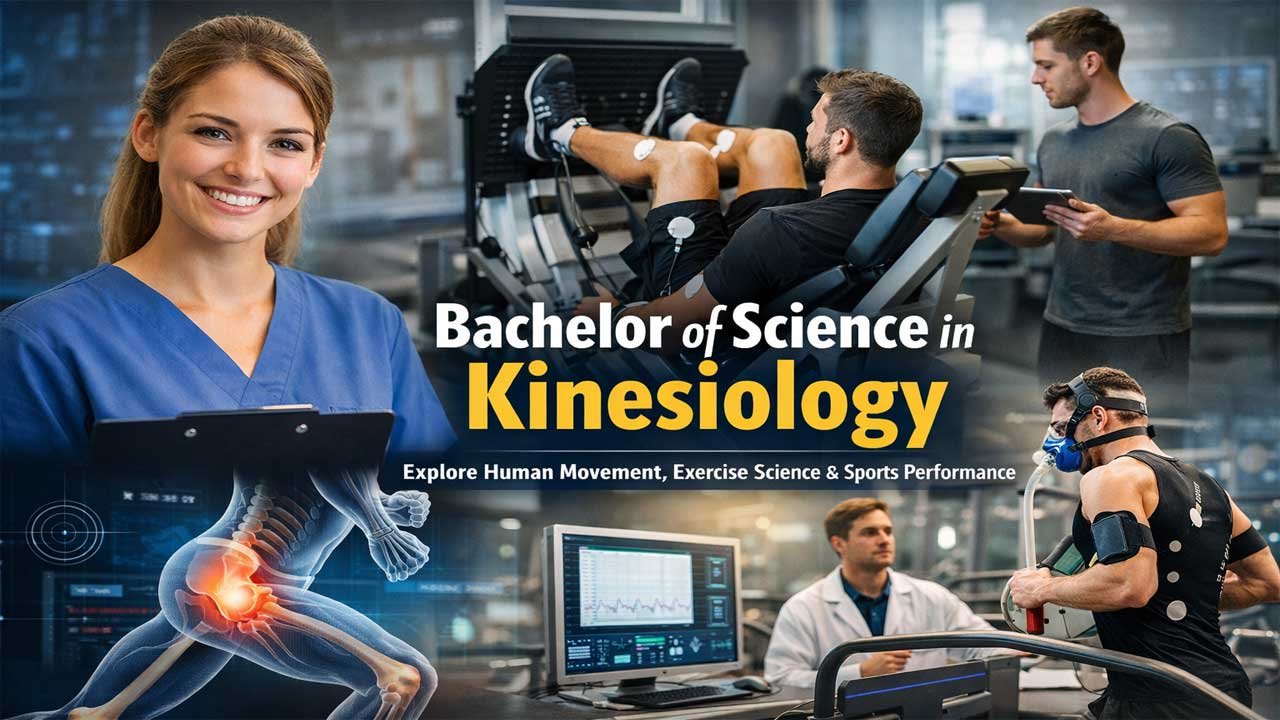
A Bachelor of Science in Kinesiology (BScKin) is a four-year undergraduate degree that focuses on understanding how the human body moves, exercises, and stays healthy using a strong science-based approach.
It includes subjects like anatomy, physiology, biomechanics, biology, chemistry, and physics, along with kinesiology courses, to explain how physical activity affects the body and how it can be used for health, performance, and rehabilitation.
This degree is ideal for students who want to work in health, fitness, sports, or research, or who plan to continue into graduate or professional programs such as physical therapy, occupational therapy, sports medicine, or exercise physiology.
What is Bachelor of Science in Kinesiology?
A Bachelor of Science in Kinesiology (BScKin) is an undergraduate degree program that combines rigorous scientific education with the study of human movement, exercise physiology, biomechanics, and health promotion. The program emphasizes research-based knowledge and theoretical understanding of how the human body moves, responds to physical activity, and adapts to exercise and rehabilitation.
The Bachelor of Science in Kinesiology is designed for students who wish to pursue advanced studies in allied health professions, conduct research in exercise science, or develop specialized expertise in human movement science. Unlike general exercise science programs, the BScKin degree integrates substantial coursework in chemistry, physics, mathematics, and biology alongside kinesiology-specific courses, providing graduates with a strong scientific foundation.
This degree is particularly valuable for students aspiring to attend graduate programs in physical therapy, occupational therapy, exercise physiology, sports medicine, or other health-related professional schools. The program typically requires 120 credit hours (40 courses) over four years, with a minimum of 21 courses focused on science-based disciplines to earn the Bachelor of Science designation.
BScKin vs BKin: Key Differences Explained
Many universities offer two distinct kinesiology bachelor’s degrees: Bachelor of Kinesiology (BKin) and Bachelor of Science in Kinesiology (BScKin). Understanding the differences between these programs is essential for selecting the right path based on your career goals and academic preferences.
Core Differences at a Glance
| Aspect | Bachelor of Science (BScKin) | Bachelor of Kinesiology (BKin) |
|---|---|---|
| Science-based courses required | 21 of 40 courses must be science-designated | No minimum science requirement; more flexible |
| Focus | Emphasis on biological and physical sciences | Balanced between science and humanities |
| Best for | Graduate school preparation, research roles | Applied practice, teaching, coaching |
| Core courses | Same 18 core courses for both programs | Same 18 core courses for both programs |
| High school prerequisites | Physics, Chemistry, Biology, Advanced Math | English, Math, one science elective |
| Elective flexibility | More restricted (science-focused electives) | Greater flexibility in course selection |
| Difficulty level | Higher rigor in science requirements | Comparatively more accessible |
| Majors available | Biomechanics, Exercise & Health Physiology (primarily) | Multiple majors including Leadership, Pedagogy, Coaching |
Which Program Should You Choose?
Choose BScKin if you:
- Plan to pursue graduate studies (Master’s, PhD, or professional programs)
- Aspire to careers in research or specialized clinical practice
- Want to apply to medical school, physical therapy, or occupational therapy programs
- Prefer a deeper understanding of the biological mechanisms underlying human movement
- Are interested in biomechanics, exercise physiology, or clinical research
Choose BKin if you:
- Prefer a balanced approach between theory and practical application
- Plan to work directly in fitness, coaching, or sports settings
- Want more elective flexibility to explore diverse interests
- Aim for teaching positions in secondary schools or universities
- Seek careers in sports administration or fitness management
Program Curriculum and Core Courses
The Bachelor of Science in Kinesiology curriculum is structured to provide students with comprehensive knowledge across multiple domains of human movement science. While specific courses vary by institution, typical core course requirements include:
Foundational Science Courses
- Human Anatomy (Gross and Functional)
- Exercise Physiology
- Biomechanics
- Chemistry (Organic and Biochemistry)
- Physics (particularly relevant to movement mechanics)
- Mathematics and Biostatistics
- Advanced Calculus
Core Kinesiology Courses
- Introduction to Kinesiology and Movement Science
- Motor Learning and Control
- Exercise Psychology
- Sport Psychology
- Applied Nutrition for Exercise and Sport
- Anatomy for Kinesiology
- Structural Kinesiology and Movement Analysis
- Health Behavior and Lifestyle Management
- Professional Ethics in Kinesiology
Specialized and Elective Courses (Science-Based)
- Advanced Exercise Physiology
- Advanced Biomechanics
- Research Methods in Kinesiology
- Ergonomics
- Sports Medicine and Injury Prevention
- Clinical Exercise Science
- Motor Development
- Environmental Physiology
- Aging and Physical Activity
Research and Capstone Components
Most BScKin programs require students to complete an independent research project or thesis that applies scientific methodology to kinesiology-related topics. This research experience is invaluable for graduate school applications and develops critical thinking and analytical skills.
Career Paths and Job Opportunities
Graduates with a Bachelor of Science in Kinesiology have diverse career options across healthcare, sports, wellness, and research sectors. The program provides foundational knowledge and credentials needed for immediate employment or further specialization through certification and graduate education.
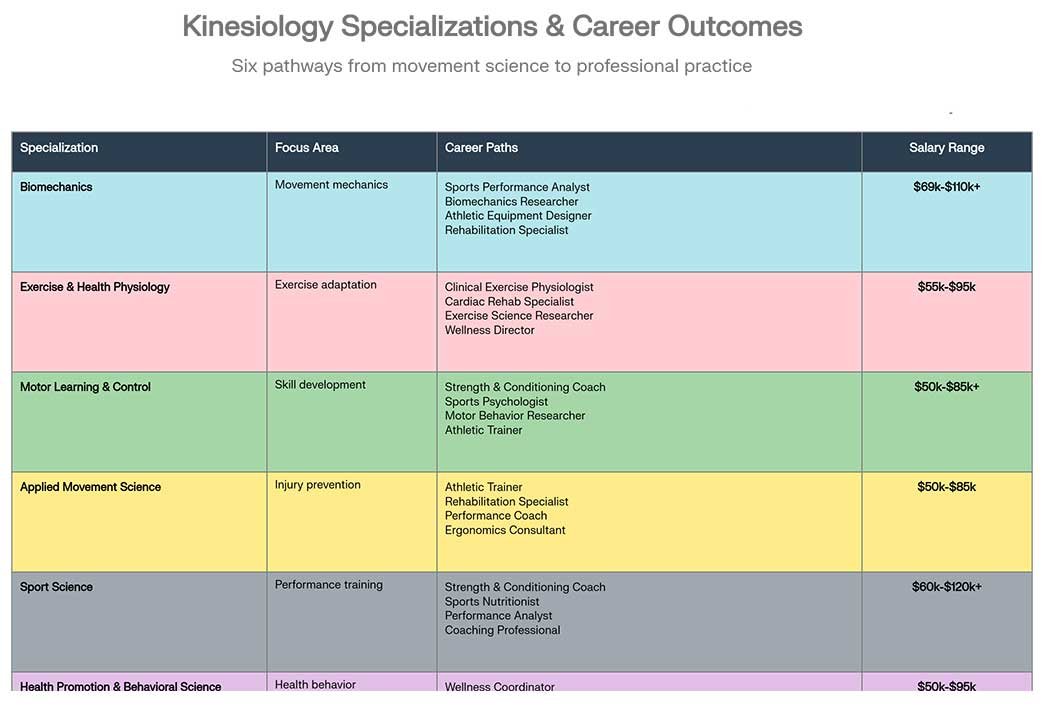
Specialization Pathways Chart – Grid layout showing 6 major BScKin specializations linked to career outcomes and salary potential.
1. Exercise Physiologist
Exercise physiologists develop and implement individualized exercise programs for clients with various health conditions, including cardiovascular disease, diabetes, obesity, and musculoskeletal disorders.
Typical Responsibilities:
- Design and supervise exercise rehabilitation programs
- Conduct fitness assessments and health evaluations
- Monitor client progress and adjust exercise prescriptions
- Collaborate with physicians and other healthcare professionals
- Maintain detailed client records and documentation
Education Requirements: Bachelor’s degree in kinesiology or exercise science; ACSM Certified Exercise Physiologist (ACSM EP-C) credential recommended
Work Settings: Hospitals, rehabilitation clinics, cardiac rehab centers, wellness facilities, corporate fitness programs
2. Strength and Conditioning Specialist
Strength and conditioning specialists work with athletes and active individuals to improve athletic performance, prevent injuries, and enhance physical capabilities through targeted training programs.
Typical Responsibilities:
- Assess athletes’ physical condition and performance metrics
- Design periodized training programs incorporating strength, power, and conditioning elements
- Coach proper lifting and exercise techniques
- Monitor athlete progression and adjust programs accordingly
- Collaborate with coaches, athletic trainers, and sports medicine professionals
Education Requirements: Bachelor’s degree in kinesiology or exercise science; NSCA Certified Strength and Conditioning Specialist (CSCS) certification essential
Work Settings: Professional sports teams, college athletic departments, high schools, private strength training facilities, military training centers
Salary Range: $60,000-$85,000+ annually, with higher earners in professional sports
3. Athletic Trainer
Athletic trainers provide emergency care, injury prevention, and rehabilitation services for athletes across various sports and physical activity settings.
Education Requirements: Bachelor’s degree in athletic training or kinesiology with additional athletic training certification; Board of Certification (BOC) exam required
Work Settings: High schools, colleges, professional sports teams, sports medicine clinics, military bases
Projected Growth: 13% growth through 2034, faster than average
4. Clinical Exercise Physiologist
Clinical exercise physiologists work in medical settings, developing evidence-based exercise programs for patients with chronic diseases, cardiovascular conditions, and metabolic disorders.
Typical Responsibilities:
- Conduct comprehensive health risk assessments
- Develop individualized exercise prescriptions
- Implement supervised exercise programs
- Monitor cardiovascular and metabolic responses to exercise
- Educate patients about exercise benefits and adherence strategies
Education Requirements: Bachelor’s degree in kinesiology or exercise science; ACSM Clinical Exercise Physiologist certification (ACSM CEP-C) required
Salary Range: $55,000-$75,000 annually; higher in cardiac and pulmonary rehab settings
Work Settings: Hospitals, cardiac rehabilitation centers, pulmonary rehab facilities, cancer centers, diabetes management programs
5. Wellness Program Coordinator/Manager
Wellness coordinators develop, implement, and manage health and fitness programs in corporate, government, and organizational settings aimed at improving employee health outcomes and reducing healthcare costs.
Typical Responsibilities:
- Design and launch wellness initiatives and fitness programs
- Conduct health risk assessments and provide personalized recommendations
- Promote healthy behaviors through educational workshops and campaigns
- Evaluate program effectiveness and ROI
- Manage wellness budgets and vendor relationships
Salary Range: $70,000-$95,000 annually in hospital systems and large corporate environments
Work Settings: Corporate offices, insurance companies, government agencies, universities, large employers
6. Rehabilitation Specialist
Rehabilitation specialists work with patients recovering from surgery, injury, or illness to restore mobility, strength, and functional independence through exercise and physical activity.
Typical Responsibilities:
- Develop rehabilitation exercise programs based on medical diagnosis
- Instruct patients in proper exercise technique and progression
- Monitor patient progress and modify programs as needed
- Document and report rehabilitation outcomes
Education Requirements: Bachelor’s degree in kinesiology or exercise science; additional certifications in rehabilitation specialties available
Entry-level Salary: $42,934 annually; increases with experience and additional certifications
7. Research Scientist/Academic Researcher
With a BScKin degree, graduates can pursue research positions investigating human movement, exercise science, sports performance, and health-related topics.
Typical Responsibilities:
- Design and conduct research studies on exercise physiology, biomechanics, or movement science
- Analyze data using statistical software and research methodologies
- Write research proposals and secure funding
- Publish findings in peer-reviewed journals
- Present research at scientific conferences
Education Requirements: Bachelor’s degree required; Master’s degree and PhD typically needed for advanced research positions
Salary Range: $60,000-$90,000 annually at the bachelor’s level; significantly higher with advanced degrees
Work Settings: Universities, research institutes, sports science centers, pharmaceutical companies
8. Biomechanics Specialist
Biomechanics specialists analyze human movement patterns using advanced technology and mathematical models to optimize performance, prevent injuries, and understand movement disorders.
Typical Responsibilities:
- Conduct movement analysis using motion capture and force plate technology
- Assess athletic movement patterns and identify deficiencies
- Provide recommendations for technique improvement
- Work with athletes, patients, and product design teams
- Conduct research on human movement mechanics
Entry-level Salary: Around $69,362 annually; research scientists and specialists in sports organizations can earn six figures
Work Settings: Sports teams, research institutions, rehabilitation clinics, equipment manufacturing companies, universities
9. Physical Therapist (with further education)
A BScKin degree provides excellent preparation for physical therapy graduate programs. Physical therapists diagnose and treat patients with physical impairments and disabilities through exercise, manual therapy, and other modalities.
Education Requirements: Bachelor’s degree in kinesiology or exercise science + Doctor of Physical Therapy (DPT) graduate degree
Salary Range: $101,020 median annual salary
Projected Growth: 14% growth, much faster than average
10. Occupational Therapist (with further education)
With a BScKin background, graduates can pursue occupational therapy graduate programs, helping people regain daily living skills and independence through therapeutic activities.
Education Requirements: Bachelor’s degree in kinesiology + Master’s in Occupational Therapy
Salary Range: $98,340 median annual salary
Projected Growth: 11% growth through 2033
11. Sports Performance Analyst
Sports performance analysts use data analytics and technology to assess athlete performance, identify training opportunities, and optimize competitive outcomes.
Median Salary: $75,189 annually; senior analysts in major league organizations can exceed $100,000+
Work Settings: Professional sports teams, college athletic programs, sports analytics companies
12. Additional Career Opportunities
- Fitness director or gym manager
- Personal trainer (with additional certifications)
- Corporate fitness consultant
- Ergonomics consultant ($60,000-$85,000 annually)
- Health and wellness coach ($50,000-$75,000+)
- Sports medicine clinic coordinator
- Chiropractor (with further professional education)
- Physician Assistant (with further professional education)
Salary Expectations by Role
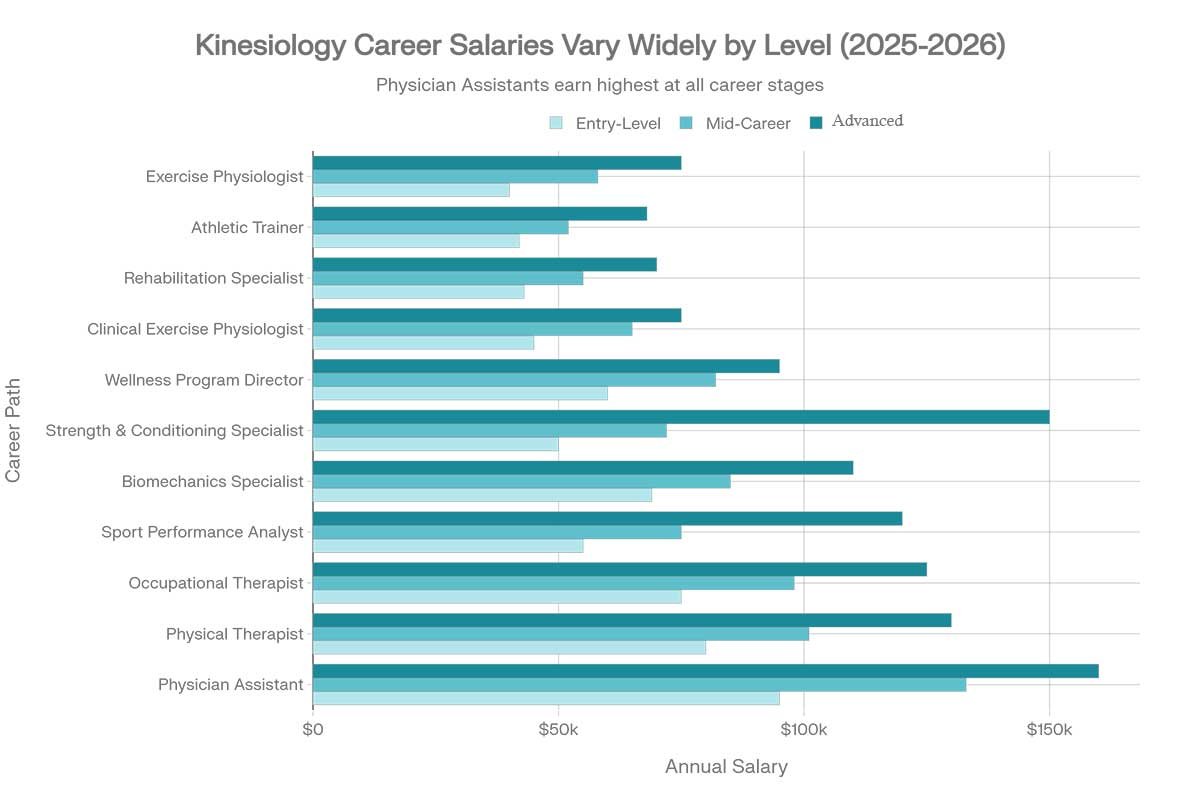
Understanding salary potential is crucial when choosing your career path. Here’s a comprehensive breakdown of average salaries for kinesiology graduates across various roles:
Immediate Post-Graduation Earnings
Most BScKin graduates start their careers in the mid-$40,000 to low-$50,000 range. Entry-level positions typically include:
- Junior exercise physiologists: $35,000-$45,000
- Fitness instructors/trainers: $35,000-$50,000
- Rehabilitation assistants: $40,000-$50,000
- Wellness program coordinators (entry-level): $45,000-$55,000
Mid-Career Earnings (5-10 years experience)
With experience and additional certifications, mid-career kinesiology professionals typically earn:
- Exercise physiologists: $50,000-$65,000
- Strength and conditioning specialists: $60,000-$75,000
- Senior rehabilitation specialists: $55,000-$70,000
- Wellness program managers: $65,000-$85,000
- Clinical exercise physiologists: $60,000-$75,000
Advanced and Specialized Roles
The highest earners in kinesiology include:
- Wellness program directors: $70,000-$95,000+
- Senior strength and conditioning coaches (professional sports): $70,000-$150,000+
- Research scientists with PhDs: $70,000-$110,000+
- Ergonomics consultants: $60,000-$85,000+
- Physical therapists: $101,000+ (requires DPT)
- Occupational therapists: $98,000+ (requires Master’s)
- Physician assistants: $133,000+ (requires PA program)
Salary Comparison Chart – Horizontal bar chart showing earnings across 11 career paths with entry-level through advanced salary ranges.
Factors Influencing Salary
Several factors significantly impact earning potential in kinesiology careers:
Geographic Location: Salaries vary considerably by region and country. Urban areas and states with higher costs of living typically offer higher wages.
Employer Type: Government positions often pay more than private sector jobs. Exercise physiologists in government roles earn approximately $88,000, compared to $56,000 in hospitals.
Specialization: Specialized roles (clinical exercise physiology, sports medicine, biomechanics research) command higher salaries than general fitness positions.
Education Level: Advanced degrees (Master’s, PhD) lead to substantially higher earnings, particularly in research and clinical leadership positions.
Certifications: Professional certifications such as ACSM EP-C, NSCA CSCS, and ACE-CPT increase earning potential and career advancement opportunities.
Experience: Earnings typically increase steadily with experience, with most professionals seeing significant jumps after 5-10 years in the field.
Top Universities Offering BScKin Programs
Selecting the right institution is crucial for quality education and career preparation. Here are leading universities known for excellent Bachelor of Science in Kinesiology programs:
Canadian Universities
University of Calgary (Alberta)
- Program: Bachelor of Science in Kinesiology
- Notable Features: Four major options including Biomechanics, Exercise & Health Physiology, Motor and Psychosocial Aspects of Movement, and General Kinesiology
- Strengths: Research-focused, excellent facilities, faculty expertise
- Website: kinesiology.ucalgary.ca
Brock University (Ontario)
- Program: Bachelor of Science in Kinesiology
- Notable Features: International double degree program with University of Portsmouth (UK)
- Strengths: Hands-on lab experience, practical field placements in clinical and sports settings
- Admission: Expected cutoff high 70s
- Website: brocku.ca
University of Toronto
- Program: Bachelor of Kinesiology (also offered as BScKin option)
- Notable Features: Located at St. George Campus with access to leading research hospitals
- Strengths: World-class research opportunities, proximity to healthcare facilities, diverse student clubs
- Facilities: Athletic Centre, Varsity Centre, Goldring Centre for High Performance Sport
- Website: kpe.utoronto.ca
University of Western Ontario (UWO)
- Program: Bachelor of Science (Honors Specialization) in Kinesiology
- Notable Features: Requires substantial science coursework from Faculty of Science
- Strengths: Rigorous academic program, excellent preparation for professional schools
- Website: uwo.ca
Simon Fraser University (British Columbia)
- Program: Kinesiology Major (Bachelor of Science)
- Notable Features: Science-focused curriculum
- Requirements: 2.5 minimum Science CGPA for continuance
- Website: sfu.ca
United States Universities
Arizona State University
- Program: Online Bachelor of Science in Kinesiology
- Notable Features: Online format for working adults
- Specializations: Available for various career paths
- Strengths: Flexible scheduling, expert faculty, comprehensive curriculum
- Website: asuonline.asu.edu
Cal Poly (California Polytechnic State University)
- Program: Bachelor of Science in Kinesiology
- Notable Features: Three concentration options: exercise science, health promotion, sport science
- Strengths: Hands-on learning, practical experience
- Website: kinesiology.calpoly.edu
University of Texas at Austin
- Program: Bachelor of Science in Kinesiology and Health
- Notable Features: Five major options including applied movement science, exercise science, health promotion and behavioral science, physical culture and sports studies, and sport management
- Strengths: Diverse specialization options, strong internship networks
- Website: utexas.edu
Indiana University
- Program: Bachelor of Science in Kinesiology (B.S.K.)
- Notable Features: Exercise Science major with excellent preparation for graduate programs
- Strengths: Comprehensive science foundation, clinical applications, strong faculty
- Website: indiana.edu
Top-Ranked Universities:
According to Masters Portal rankings, top universities for kinesiology include Harvard University, Johns Hopkins University, Stanford University, Yale University, University of Pennsylvania, University of Washington, and UCLA.
Professional Certifications for Kinesiology Graduates
Professional certifications enhance credibility, employment prospects, and earning potential. Here are the primary certifications pursued by Bachelor of Science in Kinesiology graduates:
ACSM Certifications (American College of Sports Medicine)
ACSM is the largest and most established fitness certifying organization, founded in 1954.
ACSM Certified Exercise Physiologist (ACSM EP-C)
- Focus: Clinical applications and health assessments
- Ideal for: Hospital settings, cardiac rehabilitation, chronic disease management
- Prerequisites: Bachelor’s degree in kinesiology or exercise science
- Exam components: Written exam covering exercise science, health assessment, and program design
ACSM Certified Personal Trainer (CPT)
- Focus: General fitness training and broad client health
- Ideal for: Commercial gym settings, personal training businesses
- Strengths: Emphasis on initial client screening, risk factor assessment, and holistic health
- Recognition: Highly respected in clinical and fitness environments
ACSM Clinical Exercise Physiologist (ACSM CEP-C)
- Focus: Advanced clinical exercise prescription
- Prerequisites: Bachelor’s degree + clinical hours
- Ideal for: Hospital-based programs, specialized rehabilitation
Benefits of ACSM Certification:
- Strong emphasis on scientific research and evidence-based practice
- Broad range of covered topics spanning exercise science, nutrition, and behavioral strategies
- Applicable in both clinical and fitness environments
- Highly respected in academic and university settings
NSCA Certifications (National Strength and Conditioning Association)
Founded in 1978, NSCA specializes in athletic performance and strength training.
Certified Strength and Conditioning Specialist (CSCS)
- Focus: Athletic performance enhancement, strength training, sports conditioning
- Ideal for: Professional sports teams, college athletic programs, athletic training facilities
- Prerequisites: Bachelor’s degree in fitness-related field required
- Exam Components: Exercise science, program design, sports-specific training
NSCA Certified Personal Trainer (NSCA CPT)
- Focus: Strength and conditioning with athletic focus
- Strengths: Advanced exercise programming, performance-based training models
Advantages of NSCA Certification:
- Deeper focus on strength programming and athletic performance
- Respected within athletic and sports communities
- Strong scientific foundation with research-driven content
- Excellent for career advancement in sports settings
NASM Certifications (National Academy of Sports Medicine)
NASM specializes in corrective exercise and performance enhancement.
NASM Certified Personal Trainer (CPT)
- Focus: Corrective exercise, injury prevention, performance enhancement
- Specialization: Optimum Performance Training (OPT) model
- Ideal for: General population training, injury recovery, performance optimization
- Recognition: Strong reputation in sports performance
Benefits:
- Structured OPT training model
- Emphasis on corrective exercise and movement dysfunction
- Practical, real-world applications
ACE Certification (American Council on Exercise)
ACE Health Coach Certification
- Focus: Health behavior change and holistic wellness
- Ideal for: Corporate wellness, community health programs
- Strength: Evidence-based fitness education and behavior change strategies
Job Market Trends and Growth Outlook
The kinesiology and exercise science field is experiencing robust growth with strong career prospects through 2034 and beyond.
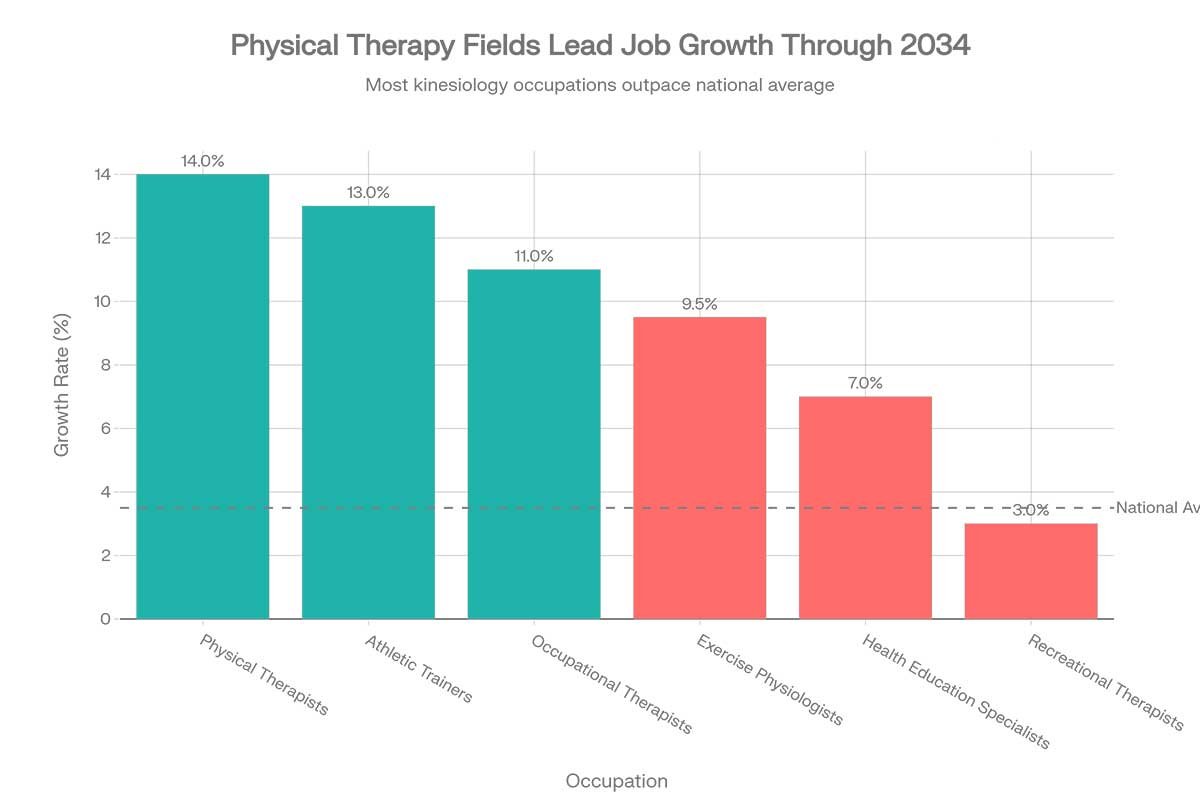
Job Growth Projections Chart – Vertical bar chart demonstrating 9-14% growth rates for kinesiology careers vs. 3.4% national average.
Overall Market Expansion
The job market for kinesiology-related positions is projected to expand by 10-15% over the next decade, significantly outpacing the average job growth for all occupations (approximately 3-4%). This growth is driven by several macro trends:
Aging Population: As the global population ages, demand for rehabilitation services, physical therapy, and chronic disease management increases substantially.
Preventive Health Focus: Healthcare systems increasingly emphasize preventive medicine and lifestyle interventions, expanding opportunities for exercise physiologists and wellness professionals.
Corporate Wellness Initiatives: Organizations invest heavily in employee health and wellness programs to reduce healthcare costs and improve productivity.
Sports Performance Technology: Advancement in biomechanics analysis and sports performance analytics creates new specialization opportunities.
Telehealth Expansion: Virtual fitness coaching and remote exercise programming open new career pathways and employment flexibility.
Specific Career Growth Rates
- Exercise Physiologists: 9-10% growth through 2034 (much faster than average)
- Occupational Therapists: 11% growth through 2033
- Athletic Trainers: 13% growth through 2034 (much faster than average)
- Physical Therapists: 14% growth (much faster than average)
- Recreational Therapists: 3% growth (as fast as average)
- Health Education Specialists: Above-average growth
Employment Rate for Graduates
Universities with co-operative education programs report exceptional employment outcomes:
- Wilfrid Laurier University: 99% employment rate for co-op students
- University of Victoria: Approximately 70% of co-op students graduate with a job offer
Advanced Degree Opportunities
For kinesiologists with advanced education:
- Master’s Degree: 27% job growth
- Doctoral Degree: 34% job growth
Skills and Competencies Developed
A Bachelor of Science in Kinesiology develops a comprehensive skill set valued across healthcare, sports, research, and wellness industries.
Technical and Scientific Skills
Exercise Physiology Expertise
- Understanding cardiovascular, respiratory, and metabolic responses to exercise
- Ability to design evidence-based exercise prescriptions
- Knowledge of exercise adaptations and physiological mechanisms
Biomechanics Analysis
- Motion analysis using technology and visual assessment
- Understanding of movement mechanics and force application
- Ability to identify movement deficiencies and dysfunction
Research Competencies
- Research design and methodology
- Data collection and statistical analysis
- Literature review and scientific writing
- Critical evaluation of scientific evidence
Assessment and Evaluation Skills
- Fitness testing and performance evaluation
- Health risk assessment and screening
- Movement quality assessment
- Functional capacity evaluation
Professional and Soft Skills
Client Communication and Education
- Ability to explain complex scientific concepts in accessible language
- Motivational interviewing and behavioral change strategies
- Development of effective client education materials
Program Design and Implementation
- Individualized program creation based on client needs and goals
- Program progression and periodization
- Outcome measurement and program modification
Clinical Reasoning
- Application of scientific knowledge to real-world scenarios
- Problem-solving and evidence-based decision-making
- Ability to adapt interventions based on client response
Collaboration and Teamwork
- Interdisciplinary communication with physicians, therapists, and coaches
- Documentation and professional communication
- Ability to work effectively within healthcare or sports teams
Technology Competency
- Motion capture and biomechanical analysis software
- Data analysis and statistical software
- Health information systems and medical documentation
- Fitness testing technology and equipment
International Study and Career Opportunities
The Bachelor of Science in Kinesiology is increasingly recognized internationally, with growing opportunities for study and practice across multiple countries.
Study Abroad Opportunities
Canada
Canada has positioned itself as a premier destination for kinesiology education. The profession is officially designated in Canada, with regulated qualifications for registered kinesiologists—a distinction not found in most other countries.
Top Canadian Universities:
- University of Calgary
- Brock University
- University of Toronto
- University of Western Ontario
- Simon Fraser University
Benefits for International Students:
- Professional designation as Registered Kinesiologist possible
- Relatively affordable education compared to the United States
- Work permit opportunities and pathway to permanent residency
- Multicultural society and high quality of life
United Kingdom
Universities like the University of Portsmouth offer sport and exercise science programs with strong international recognition.
United States
Leading research universities offer comprehensive kinesiology programs with opportunities for research, internships, and clinical experience.
Australia
Australia is an ideal destination for kinesiology students due to:
- Strong emphasis on sports and outdoor activities
- Fine universities with physical therapy and sports medicine programs
- Growing fitness and wellness industry
- Quality of life and cultural diversity
Career Opportunities Abroad
Canada
- Professional kinesiologist designation available after completing registration requirements
- Strong job market with employer demand
- Opportunities in healthcare, sports, corporate wellness, and education sectors
- Potential pathway to permanent residency through skilled worker programs
Australia
- Strong sports and fitness industry
- Quality healthcare system with demand for movement specialists
- Outdoor recreation and sports coaching opportunities
- Working holiday visas available for young professionals (18-30)
United Kingdom
- European employment opportunities
- Integration with European health and sports systems
- Research opportunities in exercise science
International Employer Demand
Major international organizations recruiting kinesiology graduates include:
- National sports federations
- Olympic training centers
- International healthcare organizations
- Multinational corporate wellness companies
- Research institutions
- University athletic programs
Work Permits and Visas
Canada
- International graduates of Canadian universities can apply for post-graduation work permits
- Potential pathway to permanent residency for skilled workers
- Express Entry system for skilled professionals
Australia
- Working Holiday Visas (subclass 417 or 462) for ages 18-30/35
- Skilled migration opportunities for in-demand occupations
- Employer sponsorship possibilities
United States
- Optional Practical Training (OPT) available for international graduates
- H-1B visa sponsorship possible for specialized roles
- Limited pathways to permanent residency
Admission Requirements and Prerequisites
Admission requirements vary by institution, but most universities with competitive BScKin programs have similar prerequisite expectations.
High School Prerequisites
Core Science Subjects Required:
- Physics 30 (grade 12 or equivalent)
- Chemistry 30 (grade 12 or equivalent)
- Biology 30 (grade 12 or equivalent, often recommended over physical education)
- Advanced Mathematics (Pre-calculus or Calculus recommended)
- English 30-1 (grade 12 or equivalent)
Academic Standards
Typical Admission Average: High 70s to low 80s
- University of Calgary: High 70s expected cutoff
- Wilfrid Laurier University: Low 80s admission range
- Most competitive programs: 80-85+
International Student Requirements
English Language Proficiency:
- Most Canadian and U.S. universities require proof of English proficiency for international students
- Common tests: TOEFL (Test of English as a Foreign Language) or IELTS (International English Language Assessment)
- Typical requirement: TOEFL 80+ or IELTS 6.5+
- Alternative: Three years of full-time education in English without ESL courses
Academic Credentials:
- High school diploma or equivalent qualification from your country
- Transcripts translated into English
- May require evaluation of foreign credentials
- Some universities accept International Baccalaureate (IB) or A-Levels
Application Process
Common Application Steps:
- Research and identify target universities
- Prepare transcripts and official documents
- Take standardized tests (SAT, ACT, TOEFL, IELTS if applicable)
- Complete university application forms
- Submit supplementary materials (personal statement, letters of recommendation)
- Participate in interviews if requested
- Apply for student visa (for international students)
GPA and Performance Standards
Many universities require maintaining a minimum GPA to continue in the program:
- Minimum 2.0-2.5 cumulative GPA required
- Science courses often require a minimum grade (C- or C) for continuance
- Some programs have cumulative science GPA requirements (2.5+)
Specializations and Majors Available
Most Bachelor of Science in Kinesiology programs offer specialized majors allowing students to focus on areas aligned with their career goals.
Common Specialization Areas
Biomechanics
- Focus: Analysis of human movement mechanics, force application, and motion optimization
- Coursework: Advanced biomechanics, motion analysis, computer modeling
- Career paths: Sports performance analysis, research, athletic equipment design
- Ideal for: Students interested in physics-based movement analysis
Exercise and Health Physiology
- Focus: Physiological responses to exercise, adaptation to training, clinical applications
- Coursework: Advanced exercise physiology, cardiac rehabilitation, metabolic assessment
- Career paths: Clinical exercise physiology, cardiac rehab, exercise science research
- Ideal for: Students pursuing healthcare and clinical careers
Motor Learning and Control
- Focus: Neurological basis of movement, skill development, motor behavior
- Coursework: Motor learning, neurophysiology, sport psychology
- Career paths: Coaching, sports psychology, rehabilitation
- Ideal for: Students interested in understanding learning and behavior change
Applied Movement Science
- Focus: Practical application of movement science principles
- Coursework: Functional movement assessment, injury prevention, performance enhancement
- Career paths: Athletic training, coaching, rehabilitation
- Ideal for: Students pursuing applied practice roles
Sport Science
- Focus: Comprehensive study of sport performance, training, and competition
- Coursework: Sport psychology, nutrition, performance analysis, coaching
- Career paths: Coaching, sports management, athlete development
- Ideal for: Students passionate about sports and athletic performance
Health Promotion and Behavioral Science
- Focus: Health behavior change, wellness programming, community health
- Coursework: Health psychology, program design, health education
- Career paths: Corporate wellness, community health, health coaching
- Ideal for: Students interested in public health and wellness
FAQs About Bachelor of Science in Kinesiology
Q1: How long does it take to complete a BScKin degree?
A: A Bachelor of Science in Kinesiology typically requires four years of full-time study (120 credit hours or approximately 40 courses). Some students may complete the degree in three years by taking accelerated course loads, while others may take five years if they enroll part-time or experience course delays.
Q2: Can I work while pursuing a BScKin degree?
A: Many students work part-time while studying kinesiology. However, the degree requires significant time commitment including lab work, field placements, and research projects. Most universities recommend limiting part-time work to 15-20 hours per week to maintain academic performance.
Q3: What’s the difference between a BScKin and a BSc Exercise Science degree?
A: While both are science-focused degrees examining human movement, Exercise Science typically emphasizes physiological and behavioral aspects of physical activity, while BScKin programs provide broader coverage including biomechanics, sport psychology, and health promotion. Specific differences depend on the institution.
Q4: Do I need a master’s degree after completing my BScKin?
A: A master’s degree is not required immediately after completing your BScKin. However, many graduates pursue advanced degrees to:
- Specialize in particular areas (biomechanics, exercise physiology)
- Pursue professional programs (physical therapy, occupational therapy, medicine)
- Advance into research or academic positions
- Increase earning potential and career advancement
A bachelor’s degree is sufficient for many entry-level positions in fitness, wellness, and rehabilitation.
Q5: What certifications should I pursue after graduating?
A: The certification you should pursue depends on your career goals:
- Clinical/healthcare roles: ACSM Certified Exercise Physiologist (ACSM EP-C)
- Athletic performance: NSCA Certified Strength and Conditioning Specialist (NSCA CSCS)
- General fitness: ACE Health Coach or NASM CPT
- Career-specific: Additional certifications in clinical specialties, athletic training, etc.
Most employers prefer candidates with at least one relevant certification.
Q6: What is the job outlook for kinesiology graduates?
A: The job outlook is excellent. The field is projected to grow 10-15% over the next decade, significantly outpacing average job growth. Specific roles like exercise physiologists (9-10% growth), occupational therapists (11% growth), and athletic trainers (13% growth) show even stronger growth. Unemployment rates in kinesiology-related fields are low (approximately 3%).
Q7: How much will a BScKin degree cost?
A: Costs vary significantly:
- Canadian Universities: $6,000-$15,000 CAD per year for domestic students; $25,000-$40,000 CAD for international students
- U.S. Universities: $10,000-$40,000 per year for in-state students; $30,000-$70,000 for out-of-state and international students
- Private Universities: Often higher costs
Many universities offer scholarships, bursaries, and financial aid to help offset costs.
Q8: Can I pursue a BScKin degree online?
A: Some universities offer online or hybrid Bachelor of Science in Kinesiology programs, particularly at the postgraduate level. However, most undergraduate BScKin programs require in-person attendance for:
- Laboratory work and experimentation
- Field placements and practical experience
- Supervised clinical components
Arizona State University offers an online option for working professionals.
Q9: What skills are most valuable in the kinesiology job market?
A: Employers prioritize:
- Evidence-based exercise prescription and program design
- Client communication and motivational skills
- Research literacy and critical thinking
- Technical competency (biomechanics software, assessment tools)
- Certification and continuing education
- Interdisciplinary collaboration
- Leadership and management abilities
Q10: Is a BScKin degree worth the investment?
A: For most students, yes. The degree provides:
- Strong job market with 10-15% growth outlook
- Multiple career pathways with good earning potential ($49,000-$95,000+ depending on role)
- Competitive employment rates (90%+ for co-op participants)
- Foundation for graduate and professional programs
- Meaningful work helping others improve health and wellness
- Long-term career stability
However, success depends on choosing a program aligned with your goals, maintaining strong academic performance, obtaining relevant certifications, and gaining practical experience through internships and field placements.
Q11: How do I choose between universities for my BScKin degree?
A: Consider:
- Specialization options: Does the university offer majors aligned with your career goals?
- Location and lifestyle: Where do you want to study?
- Co-op and internship opportunities: Can you gain practical experience?
- Facilities and equipment: Does the program have modern labs and research centers?
- Faculty expertise: Are professors active in research areas of interest?
- Admission requirements and costs: Does the program fit your academic background and budget?
- Graduate outcomes: What percentage of graduates find relevant employment?
- Reputation: Is the program recognized by employers and professional organizations?
Q12: What can I do immediately after completing my BScKin degree?
A: Graduate opportunities include:
- Entry-level positions: Fitness instructor, junior exercise physiologist, rehabilitation aide, wellness coordinator
- Professional certifications: Complete ACSM, NSCA, NASM, or ACE certifications to expand job options
- Graduate studies: Apply to master’s programs in exercise science, biomechanics, or related fields
- Professional programs: Apply to physical therapy, occupational therapy, or physician assistant programs
- Internships: Complete residency programs or internships in specialized areas
- International opportunities: Work abroad through working holiday visas or employer sponsorship
- Entrepreneurship: Develop a personal training business or fitness consulting practice
Conclusion
The Bachelor of Science in Kinesiology is an excellent choice for students passionate about human movement, exercise science, and health promotion. With a strong emphasis on scientific principles, practical application, and research skills, the degree opens diverse career pathways in healthcare, sports, wellness, research, and education.
The field offers robust job growth (10-15% through 2034), competitive salaries ranging from $49,000 to $95,000+ depending on specialization and experience, and meaningful work improving health outcomes. Whether you aspire to work as a clinical exercise physiologist, strength and conditioning specialist, athlete trainer, wellness coordinator, or researcher, the BScKin degree provides the foundational knowledge and credentials needed for success.
International opportunities are expanding, particularly in Canada where kinesiology is a regulated profession, and across Australia, the UK, and the United States. With the right combination of education, certifications, practical experience, and professional development, BScKin graduates are well-positioned for rewarding, stable careers in the rapidly expanding exercise science and health promotion industry.
Choose an institution aligned with your career goals, engage fully in coursework and practical experiences, pursue relevant professional certifications, and remain committed to evidence-based practice. These steps will maximize your career potential and contribution to the health and wellness of the populations you serve.


Leave a Reply
You must be logged in to post a comment.