
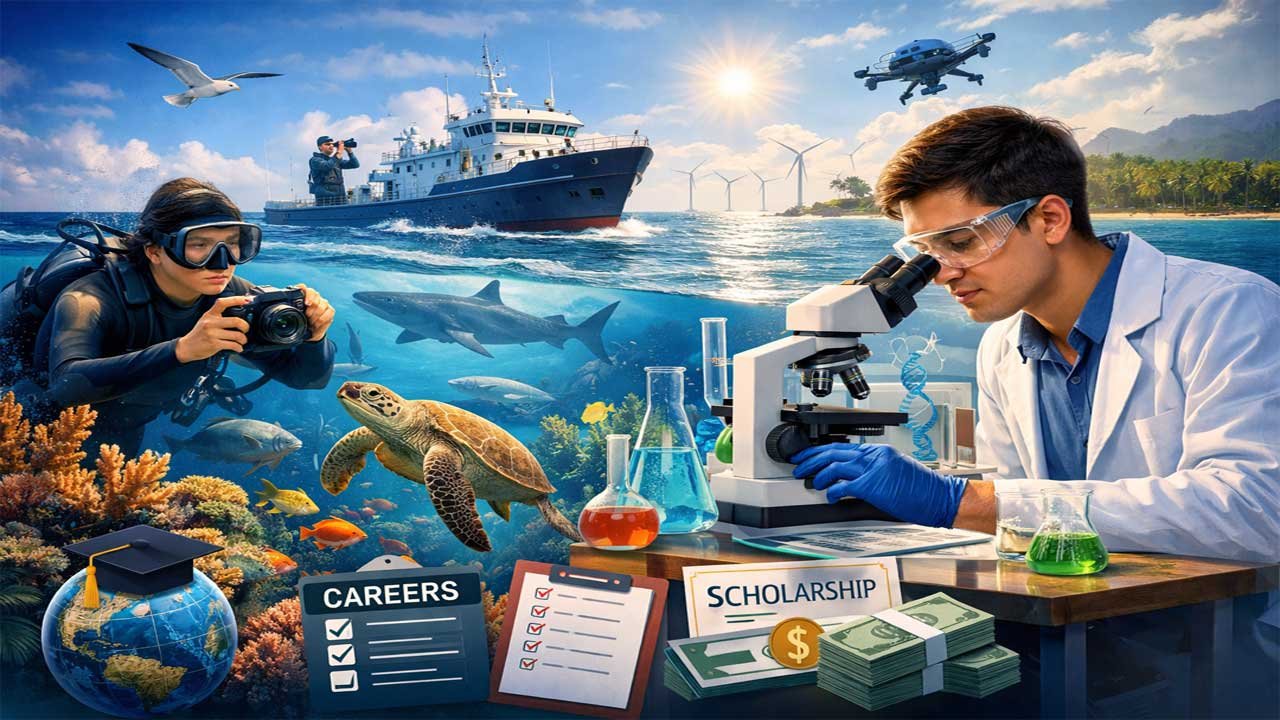
The Bachelor of Science in Marine Biology is a globally recognized undergraduate degree (typically 3–4 years) that combines core biological sciences with specialized training in marine organisms, ecosystems, conservation, and ocean processes, preparing students for careers addressing critical challenges such as climate change, biodiversity loss, and sustainable fisheries.
The program emphasizes fieldwork, laboratory research, data analysis, and increasingly, technology-driven skills like bioinformatics and programming, with study options across the USA, UK, Europe, Australia, and Asia, varying widely in cost, structure, and admission requirements.
While the career market is competitive and often favors candidates with postgraduate qualifications, graduates can pursue diverse pathways in research, aquaculture, environmental consulting, biotechnology, policy, data science, education, and conservation, with salaries ranging from modest entry-level roles to high-paying specialized positions, supported by extensive global scholarship and financial aid opportunities that make the degree accessible to students worldwide.
| Category | Information |
|---|---|
| Degree Name | Bachelor of Science (BSc) in Marine Biology |
| Study Level | Undergraduate |
| Duration | 3–4 years (UK/Australia: 3–4 years; USA/Canada: 4 years) |
| Eligibility | 10+2 with Biology (PCB preferred); equivalent international qualifications |
| Core Subjects | Marine Biology, Marine Ecology, Oceanography, Conservation Biology, Genetics, Statistics |
| Learning Format | Classroom study, laboratory work, field research, internships |
| Popular Study Destinations | USA, UK, Australia, Canada, Europe, India |
| Top Career Paths | Marine Biologist, Fisheries Scientist, Aquaculture Specialist, Environmental Consultant, Marine Biotechnologist |
| Average Salary Range | $28,000–$85,000 (can exceed $120,000 with data science or advanced roles) |
| Further Study Options | MSc Marine Biology, Oceanography, Marine Biotechnology, PhD |
| Job Market Outlook | Competitive but growing in conservation, aquaculture, biotech, and data-driven research |
| Scholarships Available | Government, university merit-based, Erasmus Mundus, NSF, Chevening |
| Key Skills Gained | Field research, data analysis, GIS, scientific writing, laboratory techniques |
| Ideal For | Students passionate about oceans, conservation, research, and environmental science |
Bachelor of Science in Marine Biology (BSc Marine Biology): Complete Guide to Programs, Careers & Scholarships
The Bachelor of Science in Marine Biology represents one of the most compelling career pathways for students passionate about ocean sciences, environmental conservation, and biological research. With global demand for marine scientists growing steadily across research institutions, government agencies, and private conservation organizations, a BSc in Marine Biology opens doors to diverse professional opportunities across international markets.
This comprehensive guide covers everything prospective students need to know about pursuing a marine biology degree—from program structures and admission requirements to career outcomes, salary expectations, and scholarship opportunities that can make your education more affordable, regardless of where you study globally.
What is a Bachelor of Science in Marine Biology?
A Bachelor of Science in Marine Biology is a four-year undergraduate program (three years in some countries like the UK and Australia) that combines theoretical biology education with practical marine field research. The degree equips students with scientific knowledge, research methodologies, and specialized skills to study marine organisms, ecosystems, and ocean-based biological processes.
The program emphasizes:
- Marine organism biology and taxonomy
- Marine ecology and ecosystem dynamics
- Oceanography and physical processes
- Conservation biology and environmental management
- Research methodology and data analysis
- Field research techniques and laboratory work
Marine biology differs fundamentally from general biology because it focuses specifically on saltwater environments—from coastal estuaries to deep-sea trenches—and the diverse organisms inhabiting these ecosystems, including microscopic phytoplankton, coral reefs, fish populations, and marine mammals.
BSc Marine Biology Program Duration & Structure
Duration by Country
| Country/Region | Bachelor’s Duration | Master’s Duration | Notes |
|---|---|---|---|
| USA & Canada | 4 years | 15 months – 2 years | Internship/placement year optional |
| UK | 3-4 years | 1-2 years | 4-year option includes placement year |
| Australia | 3-4 years | 1-2 years | Well-established coastal programs |
| India | 3-4 years | 2 years | Growing number of institutions |
| EU Countries | 3-4 years | 1-2 years | Erasmus Mundus programs available |
Typical Course Structure
Year 1: Foundations (120 credits/semester equivalent)
- Cell and Molecular Biology
- General Ecology and Conservation
- Marine Biology Fundamentals
- Marine Organisms and Biodiversity
- Evolution and Genetics
- Chemistry and Physics for Marine Sciences
Year 2: Specialization Begins (120 credits)
- Marine Ecology
- Marine Monitoring and Field Methods
- Biological Oceanography
- Analytical and Statistical Skills
- Marine Biodiversity
- Field Course (mandatory at many institutions)
Year 3: Advanced Specialization (120 credits)
- Applied marine conservation modules
- Specialized electives (Coral Reefs, Marine Mammals, Fisheries Science, etc.)
- Individual research project or honors thesis (30-40 credits)
- Advanced statistical analysis and bioinformatics
Year 4 (if applicable): Professional Development
- Industry placement year
- Study abroad opportunity
- Advanced research project
- Professional internship with research institutions
Admission Requirements for BSc Marine Biology Programs
Requirements for Indian Students (10+2 System)
Academic Eligibility:
- Minimum 55% aggregate marks in 10+2 (Class XII) examination
- Science stream with mandatory subjects:
- Biology (PCB: Physics, Chemistry, Biology)
- OR Physics, Chemistry, and Mathematics (PCM) with additional biology qualification
- Minimum age: 17 years at time of admission
- English language proficiency (minimum passing grades)
Selection Process:
- Merit-based selection for direct admission
- Entrance examination scores (where applicable)
- Personal statement or statement of purpose
- Teacher recommendations
Requirements for UK/International Students
Academic Requirements:
- A-Levels: ABB including Biology (Grade B minimum) + one additional science subject (Grade B minimum)
- Acceptable science subjects: Chemistry, Physics, Mathematics, Environmental Science, Geology, Psychology, Statistics
- BTEC: Extended Certificate (D grade) + AB in A-Level Biology and one further science
- Access to HE Diploma: 60 credits with 45 credits at Level 3 (30 distinctions + 15 merits)
- GCSE Requirements: English Language (Grade C/4), Mathematics (Grade C/4), Science (Grade C/4)
English Language Requirements:
- IELTS: 6.0-6.5 (institution dependent)
- TOEFL: 76-90
- Duolingo English Test accepted at many institutions
Requirements for USA Students
- High school diploma or equivalent
- SAT/ACT scores (varying by institution)
- GPA: 3.0+ (competitive programs often require 3.5+)
- Grade 12 (or equivalent) chemistry, biology, and mathematics
- Strong performance in science subjects
- Personal essay/statement of purpose
- Teacher recommendations (1-3)
Top Universities for BSc Marine Biology Worldwide
Tier 1: Globally Recognized Leaders
| University | Location | Program | Notable Features |
|---|---|---|---|
| University of Washington | Seattle, USA | BSc Marine Biology | Extensive field stations; early-career salaries avg. $58,000 |
| University of California, Santa Barbara (UCSB) | California, USA | Marine Biology Major | Leading research opportunities; coastal location |
| Duke University | Durham, USA | Biology (Marine Concentration) | Prestigious program; research-focused |
| University of Plymouth | Plymouth, UK | BSc (Hons) Marine Biology | Historic marine research; European hub |
| University of Southampton | Southampton, UK | Marine Biology (Hons) BSc | National Oceanography Centre partnership; £9,535/year UK |
| University of St. Andrews | St. Andrews, Scotland | BSc Marine Biology (Hons) | Scottish Oceans Institute; leading European program |
Tier 2: Strong Regional Programs with Value
| University | Location | Program | Advantage |
|---|---|---|---|
| Oregon State University | Corvallis, USA | BS Marine Biology | Strong fisheries focus; $13,119/year in-state |
| University of Maine | Orono, USA | BS Marine Biology | Research emphasis; $11,986/year in-state |
| Florida International University (FIU) | Miami, USA | BS Marine Biology | Caribbean and Gulf access; interdisciplinary approach |
| Brigham Young University Hawaii | Laie, Hawaii, USA | BS Biology (Marine Emphasis) | Most affordable USA program; $5,560/year |
| University of Exeter | Exeter, UK | BSc Marine Biology | Field trips to Azores and Spain; £9,790/year |
| Salford University | Salford, UK | BSc (Hons) Marine Biology | Modern facilities; £9,790/year UK, £18,120/year international |
International Programs & Erasmus Opportunities
IMBRSea (International Master of Marine Biological Resources)
- Organized by 11 European universities
- Erasmus Mundus scholarship program
- Focuses on blue bio-economy and marine resource sustainability
University of Haifa (Israel)
- MSc Marine Biology at edge of Eastern Mediterranean
- Leon H. Charney School of Marine Sciences
- International student focus
Program Costs & Tuition Fees
United Kingdom Universities (2026-2027)
| Institution | UK Students | International Students | Year-to-Year Increase |
|---|---|---|---|
| University of Plymouth | £9,790/year | £19,200/year | Inflation-linked |
| University of Southampton | £9,535/year | £30,300/year | Capped by UK Government |
| Salford University | £9,790/year | £18,120/year | Inflation adjustment |
| University of Exeter | £9,790/year | £31,200/year | Varies annually |
| University of Portsmouth | £9,790/year | £19,950/year | Subject to increase |
Additional UK Costs:
- Accommodation: £6,000-£9,000/year
- Living expenses: £13,000-£18,000/year
- Field trips (optional): £1,500-£2,000
- Scientific diving certification: £800-£860
- Practical boating skills: ~£710
United States Universities (2026-2027)
| Institution | In-State | Out-of-State |
|---|---|---|
| Brigham Young University (Hawaii) | $5,560/year | $5,560/year |
| University of Washington | $12,076/year | $39,906/year |
| Oregon State University | $13,119/year | $33,399/year |
| University of Maine | $11,986/year | $33,586/year |
| Texas A&M (Galveston) | $13,012/year | $40,896/year |
Additional USA Costs:
- On-campus accommodation: $10,000-$14,000/year
- Off-campus living: $8,000-$12,000/year
- Books and supplies: $1,200-$1,800/year
- Health insurance: $1,500-$3,000/year
India (Selected Institutions)
- Annual tuition: ₹40,000-₹150,000 ($480-$1,800 USD equivalent)
- Government universities (lower cost): ₹30,000-₹50,000/year
- Private universities: ₹100,000-₹200,000/year
- Living expenses (on-campus): ₹60,000-₹120,000/year
Australia
- Domestic students: AUD $12,000-$18,000/year
- International students: AUD $35,000-$50,000/year
Career Prospects & Job Outlook for Marine Biology Graduates
Employment Growth & Market Demand
According to the U.S. Bureau of Labor Statistics, employment for marine biologists, wildlife biologists, and zoologists is projected to grow 5% between 2018 and 2028. While modest, this growth reflects increasing global focus on:
- Climate change impacts on marine ecosystems
- Ocean conservation and marine protected areas
- Sustainable fisheries management
- Renewable ocean energy development
- Marine biotechnology innovations
However, the field remains highly competitive, with supply of graduates exceeding available positions. Success requires:
- Strong research publications and experience
- Advanced degrees (Master’s or PhD) for many positions
- Demonstrated data analysis and coding skills
- Geographic flexibility to relocate to marine research hubs
Average Salaries: Marine Biology Degree Holders
United States
| Career Stage | Annual Salary |
|---|---|
| Entry-level (0-3 years) | $28,867-$35,000 |
| Early career (5 years) | $47,233 |
| Mid-career average | $43,396 |
| Bottom 10% | $33,030 |
| Top 10% | $84,036+ |
| Data Scientist (highest-paying role) | $124,341 |
United Kingdom
| Specialization | Average Salary |
|---|---|
| Marine Ecologist | £48,000 |
| Fisheries Scientist | £49,000 |
| Marine Biotechnologist | £59,000 |
Canada (Government Sector)
- Entry-level position: $40,000 CAD
- Mid-career: $85,000 CAD
- Senior marine biologist: $105,000+ CAD
India
| Experience Level | Annual Salary (INR) |
|---|---|
| Entry-level (1-3 years) | ₹5,07,061 |
| Mid-career (5-8 years) | ₹6,50,000-₹7,50,000 |
| Senior level (8+ years) | ₹8,78,858 |
| Private sector (starting) | ₹12,000-₹20,000/month |
| Foreign organization (premium) | ₹75,000-₹1,00,000+/month |
Salary Growth Factors
- Highest-paying specialization: Data scientists in marine research ($124k+)
- Geographic advantage: Coastal regions, research hubs like UK’s Southampton/Plymouth, USA’s Pacific Northwest
- Advanced degrees: PhD holders earn 30-50% more than bachelor’s degree holders
- Private sector premium: Private consulting firms pay 20-40% above government agencies
- Specialization advantage: Marine mammal research, biotechnology, and fisheries management command premium salaries
Top Career Paths for Marine Biology Graduates
1. Research Scientist / Marine Biologist
- Primary employer: Universities, government research institutions, non-profits
- Typical salary: $47,000-$65,000 USD
- Requirements: Strong research background, published work, statistical skills
- Geographic hot spots: California, Florida, Washington State (USA), UK coastal universities, Australia
- Growth: Steady, driven by climate change research funding
2. Marine Biotechnologist
- Primary employer: Pharmaceutical companies, biotech firms, aquaculture companies
- Typical salary: $59,000-$85,000 (UK), higher in USA
- Focus: Developing pharmaceuticals, cosmetics, and agricultural products from marine resources
- Requirements: Laboratory skills, molecular biology knowledge, bioinformatics
- Market demand: Growing as ocean-derived medicines gain prominence
3. Aquaculture Specialist
- Primary employer: Fish farming companies, sustainable seafood producers, government agencies
- Typical salary: $48,000-$70,000 USD
- Requirements: Practical field experience, understanding of marine farming systems
- Geographic focus: Southeast Asia, Norway, Chile, Canada
- Growth: Rapidly expanding—aquaculture now produces 50% of global seafood
4. Environmental Consultant
- Primary employer: Environmental consulting firms, government agencies, corporations
- Typical salary: $55,000-$80,000 USD
- Focus: Assessing environmental impact of development projects, pollution control
- Requirements: Project management, communication skills, regulatory knowledge
- Industries: Oil and gas, renewable energy, coastal development, shipping
5. Fisheries Scientist
- Primary employer: Government fisheries departments, NOAA, international fisheries organizations
- Typical salary: $49,000-$75,000 (UK), similar globally
- Requirements: Statistical analysis, field research experience, data management
- Growth: Strong—sustainable fisheries management is global priority
- Geographic hubs: Coastal nations, Alaska, Canada, Scandinavia, Japan
6. Marine Policy Advisor
- Primary employer: Government agencies, international organizations (UN, IUCN), NGOs
- Typical salary: $60,000-$95,000 USD
- Requirements: Advanced degree often needed, policy writing experience, networking
- Impact: Shapes marine conservation legislation and international treaties
- Growth: Expanding as ocean governance becomes critical
7. Data Scientist in Marine Research
- Primary employer: Tech companies, research institutions, consulting firms
- Typical salary: $124,341 USD (highest-paying marine biology role)
- Requirements: Programming (Python, R), statistical modeling, machine learning
- Demand: Explosive growth due to big data in oceanography
- Competitive edge: Combine marine knowledge + computer science skills
8. Academic/University Professor
- Primary employer: Universities, research institutes
- Typical salary: $98,550+ USD (varies by rank and institution)
- Requirements: PhD, published research, teaching experience
- Requirements: PhD, published research, teaching experience
- Path: PhD (3-5 years) → Postdoctoral research → Tenure-track position
- Stability: Highly stable, but competitive positions
9. Marine Conservation Officer
- Primary employer: NGOs, national parks, conservation organizations, government
- Typical salary: $42,000-$65,000 USD
- Requirements: Field experience, passion for conservation, public engagement skills
- Geographic focus: Marine protected areas, coral reef restoration programs, whale research centers
Specializations & Research Focus Areas
Modern marine biology programs allow students to specialize in specific research areas:
Organism-Focused Specializations
- Ichthyology: Fish biology, behavior, ecology (highest demand in coastal states)
- Marine Mammalogy: Whale, dolphin, seal research and conservation
- Invertebrate Zoology: Coral, mollusk, and crustacean biology
- Phycology: Algae and seaweed research (applications in renewable energy)
- Microbiology: Marine microorganisms and disease ecology
Ecosystem-Focused Specializations
- Coral Reef Ecology: Ecosystem health, bleaching, restoration
- Kelp Forest Biology: Temperate marine ecosystem management
- Deep-Sea Biology: Extreme environment adaptation, bioluminescence
- Estuarine Ecology: Freshwater-saltwater transition zones
- Thermal Vent Ecology: Extreme environment life forms
Applied & Research-Driven Specializations
- Marine Biotechnology: Pharmaceutical and industrial applications
- Aquaculture Science: Sustainable fish and shellfish farming
- Conservation Biology: Species protection, habitat restoration
- Climate Change Oceanography: Ocean warming, acidification, biodiversity loss
- Marine Pollution & Toxicology: Microplastics, oil spills, chemical contamination
- Bioacoustics: Marine animal communication and noise pollution
- Marine Renewable Energy: Ocean wave and tidal energy ecosystems
Why Study Marine Biology? Key Advantages
1. Global Relevance & Career Security
Marine biology addresses planetary challenges—climate change, food security, biodiversity loss—ensuring sustained demand for qualified professionals across international markets.
2. Diverse Career Opportunities
From academic research to private sector biotech, government agencies to NGOs, marine biology graduates access varied career paths with salary ranges from $28k to $124k+.
3. Meaningful Impact
Research contributes directly to ocean conservation, species protection, and sustainable resource management—offering career satisfaction beyond financial metrics.
4. International Opportunities
Marine biology programs attract global students and facilitate international research collaborations, internships, and work opportunities across continents.
5. Emerging Technology Integration
Modern programs incorporate cutting-edge tools: environmental DNA analysis, bioinformatics, satellite oceanography, autonomous underwater vehicles, and AI-driven data analysis—enhancing job market competitiveness.
6. Growing Industry Sectors
- Blue economy expansion (aquaculture, marine renewable energy)
- Pharmaceutical development from marine organisms
- Climate adaptation and resilience research
- Sustainable seafood production
Financing Your Marine Biology Degree: Scholarships & Financial Aid
United Kingdom Scholarships
Government & Institutional Support:
- Student Finance England/Scotland: Tuition loans for UK/EU students
- Research Councils (BBSRC, NERC): Competitive PhD scholarships (£15,000-£18,000/year stipend)
- Erasmus+ Grants: Mobility funding for EU exchanges
University-Specific Scholarships:
- University of Plymouth Marine Scholarships
- Southampton University Excellence Scholarships (£2,000-£10,000)
- St. Andrews School of Biology Bursaries
United States Financial Aid
Federal Programs:
- FAFSA (Free Application for Federal Student Aid): Grants, loans, work-study
- Direct Subsidized Loans: Interest paid by government while in school
- Pell Grants: Up to $7,395/year for eligible low-income students
- TEACH Grants: For future teachers in high-need subjects
Competitive Scholarships:
- National Science Foundation (NSF) Scholarship: $25,000/year
- Barry M. Goldwater Scholarship: $7,500/semester for STEM students
- Marine Technology Society Scholarships: $2,500-$5,000
- Sigma Xi Grants-in-Aid of Research: $500-$5,000
- NOAA Scholarships: Internship + tuition support
University Merit Scholarships:
- University of Washington: Merit scholarships $5,000-$25,000/year
- Texas A&M Galveston: Marine science scholarships $3,000-$12,000/year
India & South Asia Scholarships
- Government of India Scholarships: Fellowships for merit-based students
- CSIR/UGC Research Fellowships: Post-graduation research support
- University Merit Scholarships: Institution-specific awards
- ICCR Scholarships: For international students studying in India
International/Global Scholarships
- Erasmus Mundus Joint Masters: Full tuition + monthly stipend (€1,000-€1,400) for EU programs
- IMBRSea Erasmus Mundus Program: Tuition waiver + €1,000/month living allowance
- Chevening Scholarships: UK government funding for international students
- Commonwealth Scholarships: For students from Commonwealth nations
- British Council Scholarships: Various programs for international study in UK
Funding Strategy Tips
- Start early: Begin scholarship search in final year before enrollment
- Combine sources: Mix government aid, institutional scholarships, and private grants
- Consider work-study: Part-time work (10-20 hours/week) + full tuition scholarships
- Explore research assistantships: Laboratory/field work often includes tuition waiver + stipend
- Gap year strategy: Work to save funds, build research experience, strengthen applications
- Internship-funded programs: Some universities offer paid internships that fund tuition
Application Process & Timeline
UK Universities Application Timeline
| Timeline | Action |
|---|---|
| April-September (Y12) | Research universities, attend open days, prepare UCAS application |
| September 15 | UCAS application deadline (early applications for best chances) |
| October-February | University interviews and assessments |
| March | Decision letters received |
| July | A-level exams; enter university in September |
| First Semester | Begin studies; confirm enrollment |
USA Universities Application Timeline
| Timeline | Action |
|---|---|
| Spring-Summer (Junior year) | SAT/ACT prep, research universities, campus visits |
| September-October (Senior year) | Take standardized tests; submit applications begin |
| January 15 | Regular decision deadline |
| March-April | Decision letters; scholarship notifications |
| May 1 | Enrollment deadline (Commitment Day) |
| August-September | Begin studies |
India University Applications
| Timeline | Action |
|---|---|
| Year-round | Merit-based merit-based/entrance exams |
| Post 10+2 results | Eligibility confirmation; entrance exam if required |
| 2-4 weeks | Merit list publication; admission offer |
| Variable | Document verification and enrollment |
Challenges & Realistic Expectations
Competition & Limited Positions
Marine biology is highly competitive. The number of qualified graduates far exceeds available research positions, particularly in prestigious institutions and government agencies. Success requires:
- Outstanding academic credentials
- Published research or conference presentations
- 2-3 internships during undergraduate years
- Strong networks in marine research community
- Geographic flexibility for job relocation
Funding Constraints in Research
Government research funding for marine science is limited and cyclical. Budget cuts directly impact:
- Availability of research positions
- Graduate student funding
- Field research opportunities
- Postdoctoral appointments
PhD Requirements for Advancement
Many rewarding positions now require advanced degrees (Master’s or PhD). A bachelor’s degree may limit you to:
- Junior technician roles ($35,000-$45,000)
- Entry-level consulting positions
- Educational outreach roles
Master’s degrees (additional 1-2 years) significantly enhance career prospects and earning potential.
Geographic Concentration of Opportunities
Top marine research hubs are concentrated in specific regions (California, Florida, UK coasts, Australia), requiring potential relocation. International students may face visa and work permit challenges.
Skills You’ll Develop
A BSc Marine Biology degree develops technical, analytical, and professional competencies:
Technical Skills
- Field sampling and specimen collection
- SCUBA diving and underwater observation
- Laboratory techniques (DNA extraction, cell culture, microscopy)
- Aquarium and marine facility management
- Scientific diving and boating
Analytical & Data Skills
- Statistical analysis (SPSS, R programming)
- Bioinformatics and genomic analysis
- GIS mapping and spatial analysis
- Data visualization and scientific writing
- Environmental monitoring and assessment
Research & Problem-Solving
- Literature review and critical evaluation
- Experimental design and hypothesis testing
- Problem identification and solution development
- Field research methodology
- Report writing and scientific communication
Professional & Transferable Skills
- Project management and team collaboration
- Public engagement and science communication
- Technical writing and publication
- Conference presentation skills
- Digital literacy and software proficiency
High-Demand Market Skills (Competitive Edge)
- Programming (Python, R, MATLAB)
- Machine learning and AI applications
- Coding for data analysis
- Geospatial analysis
- Bioinformatics platform experience
Distance Learning & Online Programs
For working professionals or students seeking flexibility, online marine biology education options have expanded significantly:
Online Master’s Degree Programs
- Texas A&M University Master’s in Marine Biology: Fully online, $14,000-$18,000 total
- University of Florida Online Graduate Certificates: Flexible, credential-based
- Open University (UK) Environmental Science Programs: Part-time, accredited
Limitations of Online Undergraduate Programs
Most universities require in-person field courses for bachelor’s degrees due to the practical, hands-on nature of marine biology. However, some alternatives include:
- Hybrid programs (online lectures + seasonal field courses)
- Online prerequisites + in-person final year
- Accelerated field-intensive summers
- Year-abroad options after online study
Considerations for Online Study
Advantages:
- Geographic flexibility
- Part-time study options
- Lower tuition fees (some programs)
- Access to international faculty
Disadvantages:
- Limited networking opportunities
- Reduced field experience
- Less access to laboratory facilities
- Potential employer perception issues
FAQs: Common Questions About BSc Marine Biology
Q1: What’s the job market realistically like for marine biology graduates?
A: The field is competitive. Supply exceeds demand, particularly for entry-level research positions. However, specialized roles (data science in marine research, aquaculture, environmental consulting) have stronger demand. Many successful graduates pursue master’s degrees or pivot to adjacent fields (environmental science, policy, education).
Q2: Is a Master’s degree necessary after a bachelor’s?
A: Not always, but it significantly enhances career prospects. A bachelor’s alone qualifies you for technician roles ($35k-$45k). A master’s opens senior researcher and management positions ($55k-$85k). A PhD is necessary for academic careers and specialized research roles ($75k-$124k+).
Q3: Can international students work after graduation?
A: This depends on country regulations:
- USA: Optional Practical Training (OPT) allows 12 months post-graduation work
- UK: Graduate Route visa permits 2 years post-graduation work
- Australia: Temporary Graduate visa allows up to 18-24 months
- Canada: Work permits vary by program; often 1-3 years available
- India: Job market primarily within India; limited international work access
Q4: What’s the best country to study marine biology?
A: It depends on priorities:
- Affordability: India, some USA state universities
- Quality/Prestige: USA (top research institutions), UK (Plymouth, Southampton, St. Andrews)
- Career prospects in local market: Australia, Canada, Scandinavia
- Research opportunities: USA (funding scale), UK (established programs), Australia
- Lifestyle/Cost of living: Portugal, Spain, Eastern Europe (emerging programs)
Q5: Do I need specific qualifications to get a marine biology degree?
A: Minimum requirements are science education (biology, chemistry) at secondary level. Competitive programs prefer:
- Strong grades in sciences (80%+)
- Leadership or volunteer experience
- Demonstrated passion for marine conservation
- Science fair or research project participation
Q6: What can I do with a marine biology degree besides research?
A: Many non-research career paths:
- Environmental consulting and policy
- Aquaculture and sustainable seafood production
- Aquarium and zoo management
- Science education and public outreach
- Environmental impact assessment
- Marine tourism and ecotourism
- Government environmental protection roles
- NGO conservation program management
Q7: How much will my marine biology degree cost globally?
A: Significant variation exists:
- USA in-state: $12,000-$13,000/year (total: $48k-$52k)
- USA out-of-state: $33,000-$40,000/year (total: $132k-$160k)
- UK: £9,500-£10,000/year (total: £28k-£30k) for home students; £18k-£31k/year for international
- India: $500-$2,000/year (total: $2k-$8k)
- Australia: AUD $12k-50k/year (total: AUD $48k-$200k depending on citizen status)
Q8: What’s the difference between marine biology and ocean sciences/oceanography?
A: Overlap exists but key differences:
- Marine Biology: Focus on organisms, ecosystems, and life processes in marine environments
- Oceanography: Broader field including physics, chemistry, geology of oceans in addition to biology
- Marine Science: Umbrella term for multidisciplinary ocean study
Many programs offer combinations (e.g., marine biology + physical oceanography).
Conclusion: Is a BSc Marine Biology Right for You?
A Bachelor of Science in Marine Biology represents an investment in a career addressing humanity’s most pressing environmental challenges. Whether you’re passionate about coral reef conservation, fish population sustainability, or developing marine biotechnology innovations, this degree opens pathways to meaningful work across global markets.
Choose this degree if you:
- Possess genuine passion for ocean science (not just aquarium visits)
- Excel in biology, chemistry, and analytical thinking
- Enjoy fieldwork and hands-on laboratory research
- Accept competitive job markets but value career meaning over guaranteed high salaries
- Embrace continued learning (many careers benefit from advanced degrees)
- Possess geographic flexibility for research opportunities
Consider alternatives if you:
- Prefer guaranteed high-income immediately after graduation
- Strongly dislike fieldwork or water activities
- Require stable, stationary employment
- Have limited budget for additional qualifications
- Prioritize work-life balance above professional challenge
Final Recommendations:
- Start with research: Gain internship/volunteer experience at aquariums, research stations, or conservation NGOs before committing to a degree
- Choose strategically: Consider program location, faculty research interests, and career placement records
- Develop complementary skills: Add programming, GIS, or data analysis abilities to differentiate yourself
- Plan financially: Pursue scholarships aggressively; consider studying in lower-cost countries or choosing affordable universities
- Network continuously: Build connections with faculty, researchers, and professionals—most opportunities emerge through personal networks
- Consider Master’s planning: Begin research on graduate programs during your bachelor’s; it dramatically improves career trajectory
The ocean is Earth’s final frontier, and marine biologists are frontier researchers advancing human understanding while protecting critical ecosystems. With proper preparation, strategic choices, and persistence, a BSc Marine Biology degree can launch a deeply rewarding international career.
Additional Resources
University Databases:
- QS World University Rankings (Earth & Marine Sciences)
- THE World University Rankings (Life Sciences)
- U.S. News Best Colleges (Marine Biology programs)
Career Information:
- Bureau of Labor Statistics Occupational Handbook (USA)
- Prospects.ac.uk (UK career information)
- Marine Biology Degree Programs Worldwide Directory
Funding Sources:
- FastWeb (scholarship database)
- Scholarship.com
- British Council Scholarships Portal
- Erasmus Mundus Portal
- National Science Foundation Scholarships
Professional Organizations:
- American Society of Limnology and Oceanography (ASLO)
- Ecological Society of America (ESA)
- Society for Integrative and Comparative Biology (SICB)
- Marine Technology Society
AUBSP Note: For current program details, tuition, and admission requirements, verify directly with individual universities or their official admissions portals.


Leave a Reply
You must be logged in to post a comment.