
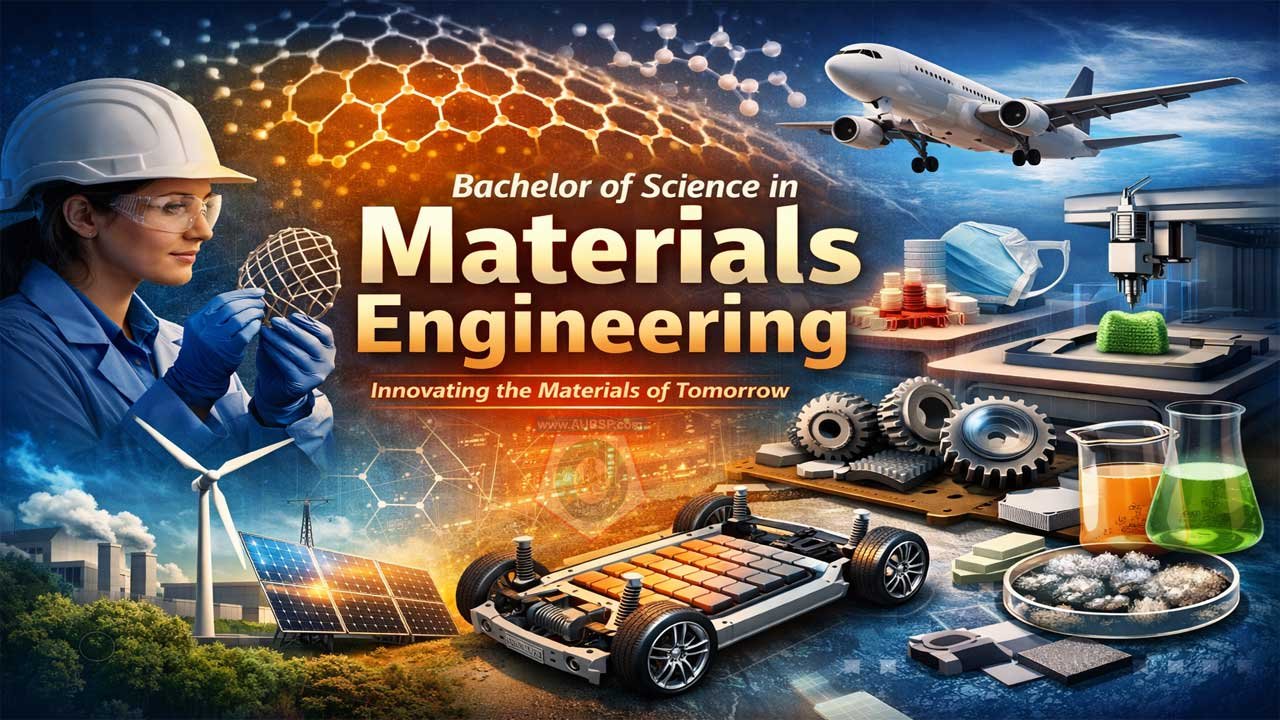
A Bachelor of Science in Materials Engineering (BScMatEng) is an interdisciplinary undergraduate degree that trains students to understand, design, process, and test materials such as metals, ceramics, polymers, composites, biomaterials, and nanomaterials for use in industries including aerospace, biomedical, energy, electronics, and automotive.
The program blends chemistry, physics, mathematics, and engineering principles, typically progressing from foundational sciences to advanced topics like structure–property relationships, materials processing, and specialization areas, and is often accredited by professional bodies such as IOM3 or ABET.
Graduates benefit from strong global demand, diverse career paths (e.g., materials engineer, metallurgist, process engineer, or research scientist), competitive salaries, and excellent prospects for postgraduate study, making BScMatEng a future-focused degree aligned with cutting-edge technologies and sustainable innovation.
| Category | Information |
|---|---|
| Degree Name | Bachelor of Science in Materials Engineering (BScMatEng) |
| Level | Undergraduate |
| Field | Materials Science and Engineering |
| Core Focus | Design, processing, testing, and selection of engineering materials |
| Main Materials Studied | Metals, ceramics, polymers, composites, biomaterials, nanomaterials |
| Core Subjects | Mathematics, physics, chemistry, materials science, engineering design, data analysis |
| Specializations | Nanomaterials, biomaterials, metals & alloys, ceramics & glass, polymers & composites |
| Accreditation Bodies | IOM3 (UK), ABET (USA) |
| Program Duration | 4 years (typical) |
| Top Employing Industries | Aerospace, biomedical, renewable energy, electronics, automotive |
| Common Job Roles | Materials engineer, metallurgist, process engineer, quality control engineer, research scientist |
| Job Outlook | ~6–7% growth (2024–2034) |
| Median Salary (USA) | ~$108,000 per year |
| Further Study Options | MSc or PhD in materials science, nanotechnology, biomaterials |
| Key Skills Developed | Materials characterization, problem-solving, lab research, modeling, project management |
What is a Bachelor of Science in Materials Engineering (BScMatEng)?
The Bachelor of Science in Materials Engineering (BScMatEng) is an undergraduate degree program that equips students with expertise in developing, processing, and testing materials used across industries ranging from aerospace to biomedical devices. This interdisciplinary field combines chemistry, physics, mathematics, and engineering principles to create innovative materials that meet specialized design requirements.
Materials engineers study the properties and structures of metals, ceramics, plastics, composites, and nanomaterials—including cutting-edge substances like graphene—to develop new materials that are lighter, greener, and stronger. The BScMatEng is accredited by leading professional bodies like the Institute of Materials, Minerals and Mining (IOM3), which recognizes the degree as meeting academic requirements for Incorporated Engineer (IEng) registration.
BScMatEng Program Structure and Curriculum
Year-by-Year Breakdown
| Year | Core Subjects | Focus Area |
|---|---|---|
| Year 1 | Mathematics, Physics, Chemistry, Computing, Basic Engineering | Building foundational knowledge in sciences |
| Year 2 | Engineering Science, Introduction to Materials Science, Data Analytics | Understanding material fundamentals |
| Year 3 | Materials Processing, Structure-Property Relationships, Materials Selection | Central concepts in materials engineering |
| Year 4 | Specialization (Nanomaterials/Biomaterials/Metals), Senior Design Project, Research Thesis | Advanced applications and industry preparation |
Specialization Options
The BScMatEng curriculum allows students to focus on areas aligned with their career interests:
- Nanomaterials and Nanotechnology – Research into graphene and other nanoscale materials
- Biomaterials – Special courses in biology and chemistry for medical applications
- Metals and Alloys – Traditional materials with applications in aerospace and automotive
- Ceramics and Glass – Heat-resistant materials for extreme environments
- Polymers and Composites – Lightweight materials for manufacturing
Top Universities for BScMatEng in 2026
Choosing the right university significantly impacts your career prospects. Here are the world’s leading institutions for Materials Engineering degrees:
| Rank | University | Location | Notable Features |
|---|---|---|---|
| 1 | Massachusetts Institute of Technology (MIT) | USA | World’s #1 for Materials Science research |
| 2 | Georgia Institute of Technology | USA | Strong industry connections and co-op programs |
| 3 | University of Illinois Urbana-Champaign | USA | 95% job placement rate for graduates |
| 4 | California Institute of Technology (Caltech) | USA | Extensive research focus |
| 5 | University of Manchester | UK | Europe’s largest Materials Science department |
| 6 | Stanford University | USA | Silicon Valley proximity |
| 7 | Johns Hopkins University | USA | 6:1 student-to-faculty ratio |
| 8 | University of Michigan | USA | Strong industry partnerships |
| 9 | Purdue University | USA | Renowned for engineering excellence |
| 10 | University of California, Berkeley | USA | Cutting-edge nanomaterials research |
Pro Tip: When selecting a BScMatEng program, look for accreditation by professional bodies like IOM3 (UK) or ABET (USA) to ensure your degree meets global industry standards.
BScMatEng Career Prospects and Job Outlook
Employment Growth
The job outlook for materials engineers is exceptionally promising. According to the U.S. Bureau of Labor Statistics, employment of materials engineers is projected to grow 6-7% from 2024 to 2034, faster than the average for all occupations. Approximately 1,500 job openings are projected each year on average over the decade, driven by the need to replace workers retiring or transferring to other fields.
Industries Hiring BScMatEng Graduates
Materials engineering graduates find opportunities across diverse sectors:
- Aerospace & Defense – Developing lightweight composites for aircraft
- Biomedical & Healthcare – Creating prosthetics, implants, and medical devices
- Renewable Energy – Solar panel materials and battery technology
- Electronics & Semiconductors – Computer chip manufacturing
- Automotive – Electric vehicle battery materials and lightweight structures
- Telecommunications – Advanced optical and electronic materials
In-Demand Roles
The most sought-after positions for BScMatEng graduates include:
- Materials Engineer – Core position developing and testing new materials
- Metallurgist – Specializing in metals and metal alloys
- Ceramic Engineer – Developing heat-resistant materials
- Process Engineer – Optimizing manufacturing processes
- Quality Control Engineer – Ensuring material standards
- Research Scientist – Advancing materials science frontier
BScMatEng Salary Expectations
Entry-Level Salaries (0-2 Years Experience)
| Region | Average Starting Salary |
|---|---|
| United States | $64,763 – $75,000 |
| United Kingdom | £28,000 – £32,000 |
| Europe (General) | €40,000 – €50,000 |
| Australia | AUD 65,000 – 75,000 |
Mid-Career Salaries (5-10 Years Experience)
| Region | Average Salary |
|---|---|
| United States | $90,000 – $108,310 |
| United Kingdom | £35,000 – £55,000 |
Senior-Level Salaries (10+ Years Experience)
Experienced materials engineers with chartered status can command substantial compensation:
- United States: $130,000+ annually
- United Kingdom: £65,000+ annually
- High-Technology Sectors: Salaries often exceed these averages in telecommunications, aerospace, and biomedical engineering
The median annual wage for materials engineers was $108,310 in May 2024 according to the latest U.S. Bureau of Labor Statistics data.
Admission Requirements for BScMatEng Programs
Academic Prerequisites
Most universities require prospective students to meet these criteria:
- High School Diploma with strong performance in Mathematics, Physics, and Chemistry
- Minimum GPA: 3.0 – 3.5 (on a 4.0 scale) for competitive programs
- Standardized Tests: SAT (1200+) or ACT (25+) for U.S. universities; A-Levels (AAA–ABB) for UK universities
Language Requirements (International Students)
- IELTS: Minimum overall band 6.0 – 6.5
- TOEFL iBT: Minimum score 80 – 90
Application Components
A strong BScMatEng application typically includes:
- Transcripts demonstrating STEM proficiency
- Personal statement explaining interest in materials science
- Letters of recommendation from science/mathematics teachers
- Extracurricular activities in engineering or science clubs
- Optional: Research experience or science fair participation
Why Choose BScMatEng Over Other Engineering Degrees?
Unique Advantages
The BScMatEng offers distinct benefits compared to traditional engineering disciplines:
- Interdisciplinary Nature – Combines chemistry, physics, and engineering for broader career options
- High Demand – Growing industries like renewable energy and biomedical technology require specialized materials
- Research Opportunities – 70% of students at top universities complete research with faculty
- Global Mobility – Materials engineering skills are transferable across countries and industries
- Future-Proof Career – Nanomaterials and biomaterials represent the cutting edge of technology
Comparison with Related Degrees
| Degree | Focus | Career Outcome |
|---|---|---|
| BScMatEng | Materials synthesis, processing, and characterization | Materials Engineer |
| Mechanical Engineering | Machine design and dynamics | Mechanical Engineer |
| Chemical Engineering | Chemical processes and reactions | Chemical Engineer |
| Physics | Fundamental physical laws | Research Scientist |
Frequently Asked Questions (FAQ)
Is BScMatEng a good career choice?
Yes. With a median salary exceeding $108,000 in the U.S. and projected 6% job growth through 2034, BScMatEng graduates enjoy excellent career prospects. The degree opens doors to high-growth industries including renewable energy, biomedical devices, and aerospace.
What is the difference between Materials Science and Materials Engineering?
Materials Science focuses on understanding material properties and structure. Materials Engineering applies this knowledge to design and manufacture products. The BScMatEng combines both aspects, providing a comprehensive education covering theory and practical application.
Can I pursue postgraduate studies after BScMatEng?
Absolutely. BScMatEng graduates frequently pursue Master\’s and PhD programs in specialized areas such as nanotechnology, biomaterials, or computational materials science. The degree provides an excellent foundation for advanced academic research.
What skills will I develop in a BScMatEng program?
Students develop competencies in:
- Materials characterization techniques
- Computational modeling and simulation
- Problem-solving and design thinking
- Laboratory research methods
- Communication and project management
Conclusion: Start Your BScMatEng Journey Today
The Bachelor of Science in Materials Engineering (BScMatEng) represents one of the most promising undergraduate pathways in 2026. With strong starting salaries, growing job demand, and opportunities to work on cutting-edge technologies like nanomaterials and biomaterials, this degree positions graduates for rewarding careers that make a tangible impact on society.
Whether you aspire to develop next-generation solar panels, lightweight aerospace components, or life-saving medical devices, the BScMatEng provides the foundation you need to succeed. Explore top programs at MIT, Georgia Tech, University of Manchester, and other leading institutions to begin your journey into this exciting field.
Ready to apply? Research accredited programs, prepare your application materials, and take the first step toward becoming a materials engineer who shapes the future of technology.


Leave a Reply
You must be logged in to post a comment.