
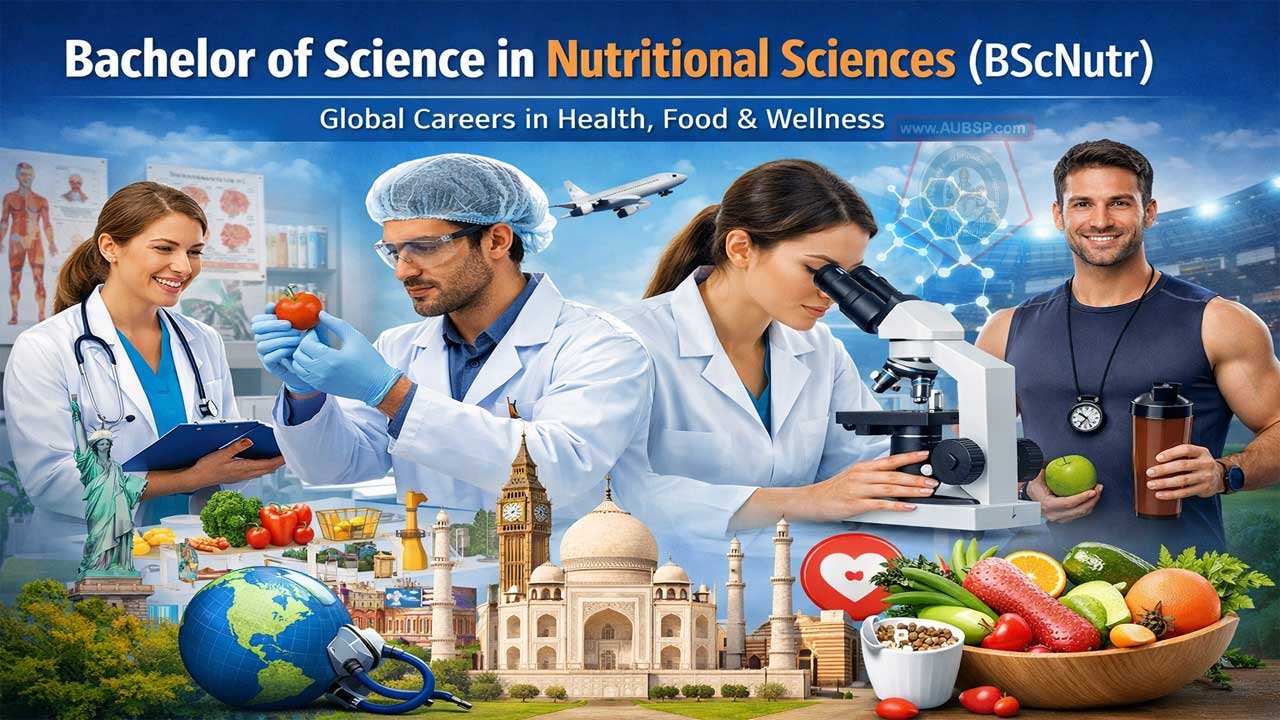
The Bachelor of Science in Nutritional Sciences (BScNutr) is a 3–4 year science-based undergraduate degree that blends biology, chemistry, food science, and health to prepare students for fast-growing global careers in healthcare, food industry, research, public health, and wellness.
With projected job growth of 5.5–6% through 2034, competitive median salaries (around $73,850 in the US and ₹3–8 LPA in India), and opportunities across countries and sectors, the degree offers strong return on investment and flexibility. Graduates can pursue diverse paths such as clinical and sports nutrition, food technology, corporate wellness, public health, research, entrepreneurship, and emerging high-income niches like personalized nutrition, nutrigenomics, gut health, telehealth, and GLP-1 medication support.
Accredited programs, practical training, and optional advancement through a master’s degree and Registered Dietitian Nutritionist (RDN) credential further enhance earning potential, global mobility, and long-term career security, making BScNutr one of the most future-proof and versatile science degrees today.
| Aspect | Details |
|---|---|
| Degree Name | Bachelor of Science in Nutritional Sciences (BScNutr) |
| Duration | 3–4 years (full-time) |
| Eligibility | High school with Physics, Chemistry, Biology (PCB) |
| Core Subjects | Nutrition science, biochemistry, physiology, food science, dietetics |
| Global Job Growth | ~5.5–6% projected through 2034 |
| Median Salary | USA: ~$73,850/year · India: ₹3–8 LPA |
| Top Career Options | Clinical dietitian, sports nutritionist, food technologist, public health nutritionist |
| Emerging Specializations | Personalized nutrition, nutrigenomics, gut health, GLP-1 support, telehealth |
| Top Employers | Hospitals, NGOs, food companies, wellness firms, research institutes |
| Higher Study Path | MSc / RDN (Registered Dietitian Nutritionist) |
| Global Opportunities | Healthcare, food industry, research, NGOs, entrepreneurship |
| Best For | Students seeking science-based, health-focused, global careers |
Bachelor of Science in Nutritional Sciences (BScNutr): Complete Career Guide for Global Students
The Bachelor of Science in Nutritional Sciences (BScNutr) has emerged as one of the most promising undergraduate degrees in the 21st century, offering exceptional career prospects across healthcare, corporate wellness, research, and international development sectors. With global job growth projected at 5.5-6% through 2034 and median salaries reaching $73,850 in the United States and ₹2-8 LPA in India, this program bridges science, health, and industry in unprecedented ways.
This comprehensive guide explores everything international students and career-seekers need to know about pursuing a BScNutr degree, from world-class universities to emerging specializations and high-paying career opportunities.
What is Bachelor of Science in Nutritional Sciences?
The Bachelor of Science in Nutritional Sciences is a 3-4 year undergraduate program designed to provide advanced knowledge of how food nutrients support human growth, metabolism, and disease prevention. Unlike general nutrition programs, BScNutr degrees offer rigorous scientific training combining biology, chemistry, food science, and health education.
Core Components of the Degree
Foundational Sciences: The program begins with anatomy, physiology, biochemistry, organic chemistry, and microbiology—providing the scientific foundation necessary to understand nutrient metabolism at molecular, cellular, and tissue levels.
Nutrition Specialization: Students explore food science, food preservation, dietetics, nutritional assessment, medical nutrition therapy, and therapeutic diet planning. This combination of theory and practice prepares graduates for clinical, community, and research roles.
Research & Professional Skills: Advanced students conduct independent research projects, participate in internships, and develop communication skills essential for translating nutrition science to diverse audiences.
Emerging Technologies: Modern BScNutr programs increasingly incorporate nutrigenomics (how genetics affect nutrition), digital health platforms, personalized nutrition science, and food systems sustainability.
Program Duration & Structure
| Aspect | Details |
|---|---|
| Duration | 3-4 years full-time undergraduate study |
| Entry Requirements | High school diploma with physics, chemistry, biology (PCB) |
| Total Credit Hours | Typically 120-130 credits |
| Practical Components | Laboratory work, field practicum, internships (200-500+ hours) |
| Capstone | Independent research project or supervised practice program |
Why Study Nutritional Sciences? Top Benefits
1. Growing Global Demand
The nutrition and dietetics field is experiencing explosive growth. The U.S. Bureau of Labor Statistics projects 5.5-6% job growth through 2034, faster than average for all occupations. This growth is driven by:
- Aging populations requiring specialized nutrition care
- Rise of chronic diseases (diabetes, cardiovascular disease, obesity)
- Corporate wellness initiatives expanding rapidly
- International development focus on malnutrition and food security
- Personalized medicine trends creating demand for nutrition specialists
2. Attractive Salary Potential
BScNutr graduates enjoy competitive compensation across global markets:
| Region | Entry Level | Median | Top 10% |
|---|---|---|---|
| USA | $48,830 | $73,850 | $101,760 |
| India | ₹2-3 LPA | ₹3-8 LPA | ₹10-15 LPA |
| Canada | CAD 35,000 | CAD 55,000 | CAD 75,000+ |
| UK | £22,000 | £35,000 | £55,000+ |
With advanced certifications (RDN, MSc), earning potential increases 25-40%.
3. Diverse Career Paths
Unlike narrow degree programs, BScNutr opens doors to multiple high-demand careers:
- Clinical dietitians in hospitals earn $45,000-$95,000+
- Sports nutritionists serving athletes earn $50,000-$80,000+
- Food technologists in industry earn $68,000-$124,000
- Public health nutritionists impact millions through policy work
- Research scientists driving innovation in personalized nutrition
- Corporate wellness managers leading company health initiatives
4. International Opportunities
With a BScNutr degree, you can work anywhere globally:
- International NGOs (UNICEF, FAO, World Health Organization)
- Global food companies (Unilever, Nestlé, Kerry Group)
- Telemedicine platforms serving clients worldwide
- Academic research institutions across continents
- Government health agencies in any country
5. Flexibility & Entrepreneurship
BScNutr graduates increasingly launch their own ventures:
- Private nutrition consultancy ($100,000-$200,000+ annual income)
- Online coaching and digital nutrition apps
- Specialized nutrition business (sports, pregnancy, aging)
- Food product development with nutritional focus
- Nutrition writing and content creation
Top Universities for Bachelor of Science in Nutritional Sciences
United States – Top Institutions
Tier 1 Research Universities:
- North Carolina State University – Highly ranked for nutrition program strength, strong research facilities, excellent placement rates
- University of California, Berkeley – World-class nutrition research, prestigious faculty, global recognition
- University of Arizona – Strong food science integration, excellent study abroad programs
- University of Washington, Seattle – Pacific Northwest leader, strong community health emphasis
- Cornell University, Human Ecology – Ivy League prestige, interdisciplinary approach combining food systems and nutrition
- University of Wisconsin–Madison – 58 faculty across 19+ departments, 80%+ student research participation
Excellent Value Programs:
- Colorado State University – Top 10 value, ACEND-accredited, hands-on learning focus
- Oregon State University – Flexible pre-dietetics to DPD pipeline, high value
- University of Texas at Austin – Combined BS/MS coordinated programs
- University of Northern Colorado – Affordable online option ($14,520 for DPP program)
Private Institutions:
- Boston University (Sargent College) – Strong clinical training, hospital partnerships
- University of North Carolina at Chapel Hill – Research-intensive, global health focus
International Universities
United Kingdom & Ireland:
- University College Cork (UCC) – BSc Nutritional Sciences, internationally recognized, focus on diet in disease prevention
- Ulster University – NICHE (Nutrition Innovation Centre), world-leading research (4* rated in REF14)
- Manchester Metropolitan University – ACEND accreditation path
Canada:
- McGill University – B.Sc. (Nutritional Sciences) with integrated 40-week internship
India:
- Tamil Nadu Agricultural University (TNAU) – B.Sc (Hons) Food Nutrition and Dietetics
- Symbiosis Pune – 4-year MSc program, industry-focused
- Chitkara University – 4-year B.Sc Nutrition & Dietetics, affordable
- SNDT Women’s University – B.Sc Food and Nutrition, well-established
Australia:
- University of Adelaide – Food science integration, strong international reputation
Program Accreditation to Consider
Look for ACEND-accredited programs (Accreditation Council for Education in Nutrition and Dietetics), as they ensure:
- Quality coursework meeting international standards
- Eligibility for RDN certification in the United States
- Recognition in multiple countries for credential reciprocity
- Supervised practice pathways built-in
Curriculum Overview: What You’ll Study
Year 1: Foundation Sciences
| Course | Credit Hours | Key Topics |
|---|---|---|
| Anatomy & Physiology | 6 | Human body systems, organ functions, cellular processes |
| Chemistry & Biochemistry | 6 | Organic chemistry, enzyme function, metabolic pathways |
| Food & Nutrition Basics | 3 | Macronutrients, micronutrients, dietary guidelines |
| Microbiology | 3 | Food-borne pathogens, food safety, fermentation |
| Research Methods | 3 | Study design, statistics, evidence evaluation |
Year 2: Applied Nutrition Science
- Food Science & Food Preservation
- Food Microbiology & Quality Assurance
- Lifecycle Nutrition (pregnancy, childhood, aging)
- Medical Nutrition Therapy
- Nutrient Metabolism (macro & micronutrients)
- Business & Management Fundamentals
Year 3: Specialization & Advanced Topics
- Dietetics & Patient Counseling
- Public Health Nutrition
- Sports Nutrition
- Food Service Management
- Community Nutrition Programs
- Nutrition Research Methods
- Emerging Topics (nutrigenomics, functional nutrition)
Year 4: Research & Professional Preparation
- Independent Research Project (14 weeks)
- Advanced Seminars (immunology, public health, sports nutrition)
- Supervised Practice/Internship (500-1000+ hours)
- Professional Development
- Capstone or Thesis
Practical Components Across All Years:
- Laboratory work in nutrition analysis
- Food service management practicum
- Community health field placements
- Clinical rotations (hospitals, clinics)
- Digital health application development
Emerging Specializations in Nutritional Sciences
The field is rapidly evolving, with new specializations creating high-demand career niches:
1. Personalized Nutrition & Nutrigenomics
What It Is: Using genetic testing and advanced technology to create individualized nutrition plans based on DNA analysis, metabolic type, and lifestyle factors.
Career Potential:
- Personalized Nutrition Consultants: ₹8-15 LPA in India, $70,000-$120,000 in US
- Genetic Counselor Assistants
- Digital health nutrition app developers
- Premium consultancy services commanding 25-40% higher fees
Key Skills: Genetics, bioinformatics, digital health platforms, data analysis
2. Gut Health & Microbiome Nutrition
What It Is: Specialized focus on how diet affects gut bacteria, immune function, and disease prevention.
Demand: Rapidly growing as research links microbiome to obesity, mental health, and chronic diseases
Career Roles:
- Gut health specialist in clinical settings
- Probiotic product development
- Functional food consultant
- Research positions in microbiome institutes
3. Sports Nutrition & Athletic Performance
What It Is: Optimizing nutrition for athletic performance, recovery, and injury prevention.
Earning Potential: ₹4-12 LPA in India; $50,000-$100,000+ in US with elite athletes
Growth Drivers:
- Rising athlete health awareness
- Corporate fitness programs
- Olympic training centers
- Professional sports franchises
4. GLP-1 Medication Support Specialization
What It Is: New expertise helping patients on GLP-1 drugs (Ozempic, Wegovy) navigate nutrition for optimal results.
Why It’s Booming: GLP-1 market projected to exceed $100 billion globally by 2030
Unique Opportunities:
- Telehealth GLP-1 nutrition coaching
- Private practice specialization
- Premium consultation fees ($200-500+/session)
- Rapidly growing market with limited specialists
5. Functional & Integrative Nutrition
What It Is: Holistic approach combining conventional nutrition with food as medicine, emphasizing prevention and wellness.
Career Paths:
- Functional medicine clinics
- Wellness centers & spas
- Corporate wellness programs
- High-income private practice
6. Public Health & Global Nutrition
What It Is: Addressing malnutrition, food security, and dietary disease in communities and developing nations.
Organizations Hiring:
- UNICEF, FAO, WHO, WFP
- International NGOs
- Government health ministries
- Academic research institutions
Salary Range: $50,000-$90,000 (varies by organization and location)
Career Paths & Job Opportunities for BScNutr Graduates
Healthcare Sector (Highest Demand)
Clinical Dietitian
What They Do: Assess patients’ nutritional needs, develop therapeutic diets, monitor recovery in hospital/clinical settings
Salary:
- Starting: $48,830-$50,000
- Median: $73,850
- Senior (8+ years): $85,200-$101,760
Work Settings: Hospitals, rehabilitation centers, nursing homes, outpatient clinics
Why It’s In Demand: Aging population, increased chronic diseases, emphasis on preventive care
Community Nutritionist
What They Do: Develop and implement nutrition programs for community health, disease prevention, nutrition education
Salary: ₹1.4-6 LPA (India); $45,000-$70,000 (USA)
Employers: Government health departments, NGOs, public health agencies, schools, universities
Growing Opportunity: With global focus on undernourishment and obesity, community nutrition roles are expanding rapidly
Sports Nutritionist
What They Do: Optimize nutrition for athletes, develop pre-competition plans, manage recovery protocols
Salary: ₹4-12 LPA (India); $50,000-$100,000+ (USA, especially with pro athletes)
Work Settings:
- Sports teams & leagues
- Athletic academies
- Fitness centers
- Private consultancy
- Telehealth coaching platforms
Why Growing: Athlete health awareness, corporate fitness programs, esports nutrition (emerging market)
Food Industry & Corporate Sector
Food Technologist
What They Do: Develop food products, ensure safety/quality, optimize shelf life, improve nutritional content
Salary:
- India: ₹2-8 LPA
- USA: $68,970 median; top 10% earn $124,660
Employers: Major food companies (Nestlé, Unilever, PepsiCo), startups, research labs
Skills Required: Food chemistry, regulatory compliance, product development, sensory analysis
Corporate Wellness Manager
What They Do: Lead company health initiatives, nutrition education, employee wellness programs
Salary: ₹4-25 LPA (India); $60,000-$120,000 (USA)
Demand: Rising as companies recognize wellness ROI and productivity gains
Food Safety & Regulatory Affairs Specialist
What They Do: Ensure regulatory compliance, manage food safety systems, handle product labeling
Salary: High-demand roles paying $70,000-$110,000+
Employers: FDA, FSSAI, international food companies, consultancies
Research & Academic Careers
Nutrition Researcher (Lab/Clinical)
What They Do: Conduct studies on nutrition, food science, disease prevention, microbiome, etc.
Salary: PhD graduates earn $75,000-$95,000+ starting; senior researchers $100,000-$150,000+
Opportunities:
- University research positions
- NIH/government research institutes
- Pharmaceutical companies (nutrition division)
- Harvard, MIT, Stanford, and other leading institutions
University Professor/Academic
What They Do: Teach, conduct research, publish findings, mentor students
Salary: $80,000-$150,000+
Career Progression: Assistant → Associate → Full Professor, with sabbaticals and research funding
Emerging & High-Income Opportunities
Private Nutrition Consultant
What They Do: Self-employed nutrition specialist serving individual clients or organizations
Earning Potential: $100,000-$300,000+ annually (varies widely)
Specializations: Sports, pregnancy, menopause, functional medicine, corporate consulting
Advantages:
- Complete autonomy
- Premium fees ($150-$500+/session)
- Scalable (group programs, digital products, online coaching)
- Global reach via telehealth
Telehealth Nutrition Coach
What They Do: Provide virtual nutrition counseling via apps, video calls, online platforms
Platforms: Telemedicine companies, wellness apps, independent platforms
Salary: $50,000-$150,000+ (commission-based or salaried)
Growth: Telehealth nutrition services are the fastest-growing segment in dietetics
Nutrition Product Developer
What They Do: Create health-focused food products, supplements, wellness beverages
Salary: $75,000-$120,000+ (varies by company size)
Skills: Nutrition science, regulatory knowledge, market research, innovation
Nutrition Writer/Content Creator
What They Do: Create nutrition content for media, blogs, social platforms, health companies
Income Potential: $60,000-$200,000+ (freelance rates $100-$500+/article)
Platforms: Freelance writing, content agencies, health brands, media companies
Admission Requirements & How to Apply
Academic Prerequisites
High School Qualifications:
- High school diploma or equivalent
- Minimum GPA: 3.0 (on 4.0 scale) for competitive programs
- Required subjects: Physics, Chemistry, Biology (PCB)
- Advanced Placement (AP) in science subjects beneficial
Minimum Entry Age: 17-18 years (varies by institution)
Standardized Tests (Varies by Country)
United States:
- SAT or ACT scores
- Some universities waive for international students with strong academics
India:
- JEE Main (for some institutions)
- NEST 2026 (Application deadline: Jan 5 – Apr 6, 2026)
- Merit-based admission via 12th marks
UK/Ireland:
- A-Levels or IB (International Baccalaureate)
- GCSE equivalency for some programs
English Language Proficiency (International Students)
- TOEFL iBT: 80+ score
- IELTS: 6.5+ overall band
- Duolingo English Test: 110+
Application Process
- Research & Shortlist universities based on accreditation, fees, location
- Prepare Documents:
- Academic transcripts
- Letters of recommendation (2-3)
- Personal statement/essay
- CV/Resume
- Standardized test scores
- English proficiency proof
- Submit Applications (typically October-January for fall admission)
- Interviews (some universities conduct interviews)
- Financial Documentation for visa purposes
- Accept Offer and complete enrollment
Typical Timeline
| Phase | Timeline |
|---|---|
| Research & Prepare | 6-9 months before |
| Submit Applications | Oct – Jan |
| Interviews/Decisions | Dec – Mar |
| Financial Arrangement | Mar – May |
| Visa Processing | Apr – Jun |
| Program Begins | Aug – Sep |
Cost of Education: Tuition & Fees Breakdown
United States
Public Universities (In-State):
- Annual Tuition & Fees: $5,443-$15,520
- Total 4-Year Cost: $21,772-$62,080
- Living Expenses: $15,000-$25,000/year
- Total 4-Year Investment: $80,000-$162,080
Public Universities (Out-of-State):
- Annual: $20,875-$35,290
- Total 4-Year: $83,500-$141,160
- Living Expenses: $15,000-$25,000/year
- Total 4-Year Investment: $143,500-$241,160
Private Universities:
- Annual: $40,000-$60,000+
- Total 4-Year: $160,000-$240,000+
- Living Expenses included in many cases
- Total 4-Year Investment: $160,000-$300,000+
Most Affordable Programs (2026-27):
- Morgan State University (Maryland): $4,114/year in-state
- Ohio University (Athens): $6,765/year in-state
- Appalachian State University (NC): $5,443/year in-state
India
Government Colleges:
- Annual Fees: ₹1,425-₹15,000 ($17-$180)
- Total 3-Year Cost: ₹4,275-₹45,000 ($51-$540)
- Living Expenses: ₹2-5 lakhs/year ($2,400-$6,000)
- Total 3-Year Investment: ₹6-15 lakhs ($7,200-$18,000)
Private Universities:
- Annual Fees: ₹11,250-₹1,01,500 ($135-$1,220)
- Total 3-Year Cost: ₹33,750-₹3,04,500 ($405-$3,660)
- Living Expenses: ₹2-5 lakhs/year
- Total 3-Year Investment: ₹6-15 lakhs ($7,200-$18,000)
Best Value (India):
- Quaide-E-Millath Govt College Chennai: ₹1,425/year
- SDNB Vaishnav College for Women: ₹2,410/year
- Open Universities: ₹4,100/year
Canada
- In-Province Tuition: CAD $6,000-$12,000/year
- Out-of-Province Tuition: CAD $15,000-$25,000/year
- Living Expenses: CAD $15,000-$25,000/year
- Total 4-Year Investment: CAD $84,000-$180,000
UK/Ireland
- Annual Tuition (International): £15,000-£25,000 (€18,000-€30,000)
- Living Expenses: £12,000-£18,000/year
- Total 3-Year Investment: £81,000-£129,000
Financial Aid & Scholarships
United States
- Federal Financial Aid: FAFSA-based loans, grants, work-study
- University Scholarships: Merit-based and need-based
- State Grants: Varies by residency
- Private Scholarships: Academy of Nutrition and Dietetics offers several
- Work-Study: Part-time on-campus employment
India
- Government Scholarships: Post-Matric scholarship for OBC/SC/ST
- University Merit Scholarships: For high-scoring students
- Sports Scholarships: For athletes
- Need-Based Assistance: Some private universities offer
Example: Chitkara University offers scholarships from 25-40% fee waiver for qualifying students
International
- Erasmus+ Grants: For EU students
- Commonwealth Scholarships: For Commonwealth nations
- Bilateral Agreements: Some countries offer exchange scholarships
- University International Awards: Many institutions offer partial/full scholarships
How to Become a Registered Dietitian Nutritionist (RDN) – Career Acceleration
To maximize earning potential and career opportunities, many BScNutr graduates pursue Registered Dietitian Nutritionist (RDN) credentials. This is now mandatory in the US as of 2026.
RDN Requirements (USA)
As of January 2026, all RDN candidates must complete:
- Master’s Degree from ACEND-accredited program in nutrition/dietetics (or related field)
- Supervised Practice Program: Minimum 1,000 hours (typically 6-12 months)
- Pass RDN Examination: Commission on Dietetic Registration (CDR) exam
- Continuing Education: Ongoing professional development
Program Pathways to RDN
| Pathway | Duration | Details |
|---|---|---|
| Didactic + DI | 2.5-3 years | Bachelor’s + Dietetic Internship |
| Coordinated Program (CP) | 3.5-4 years | Combined DPD + internship |
| Graduate Program (GP) | 2 years | Master’s with integrated internship |
| ISPP | 12-18 months | Individualized Supervised Practice Pathway |
Career Impact of RDN Credential
| Factor | Impact |
|---|---|
| Salary Premium | $25,000-$30,000 more than non-credentialed |
| Job Opportunities | 2-3x more positions available |
| State Licensure | Accepted in all 50 states |
| Advancement | Required for leadership/management roles |
| Global Recognition | Reciprocity agreements with many countries |
Job Market Trends & Future Outlook
Why Demand is Booming
1. Aging Population
- Global population 65+ growing 3x faster than overall population
- Seniors require specialized nutrition care for chronic diseases
- Long-term care facilities expanding rapidly
2. Chronic Disease Epidemic
- Type 2 diabetes, obesity, heart disease creating massive need
- Nutrition interventions are proven cost-effective
- Prevention focus in healthcare systems
3. Personalized Medicine Revolution
- Genetic testing making nutrition truly individualized
- Premium services commanding high fees
- Emerging billion-dollar market opportunity
4. Digital Health Transformation
- Telehealth nutrition services scaling globally
- AI-powered nutrition apps entering market
- Remote work enabling global income
5. Corporate Wellness Expansion
- Employers recognizing ROI on wellness programs
- Average corporate nutrition program spending: $10,000-$50,000+/year
- C-suite focus on employee health
6. GLP-1 Medication Boom
- Ozempic/Wegovy market exploding ($100B+ projected)
- Patients need nutrition guidance
- Limited specialist availability = premium pricing opportunities
Projected Job Growth by Specialization
| Specialization | Projected Growth | Reason |
|---|---|---|
| Telehealth Nutritionist | 25-35%+ | Remote work demand, accessibility |
| GLP-1 Support Specialist | 40%+ | Medication boom, emerging niche |
| Gut Health Expert | 20-30% | Microbiome research expansion |
| Sports Nutritionist | 15-20% | Athletic performance focus |
| Personalized Nutrition | 30%+ | Genomics advancement |
| Food Technologist | 10-15% | Food innovation, healthy products |
| Public Health Nutritionist | 8-12% | Government health initiatives |
Top Employers of BScNutr Graduates
Healthcare Organizations
- Hospital Systems: Mayo Clinic, Cleveland Clinic, Johns Hopkins, Singapore Health Services
- Wellness Centers: Canyon Ranch, Miraval, luxury spas worldwide
- Telemedicine Platforms: Ro, Noom, Calibrate Health, Amazon Care
Food & Beverage Companies
- Giants: Nestlé, Unilever, PepsiCo, General Mills, Danone, Kerry Group
- Startups: Oatly, Perfect Day, Impossible Foods, plant-based innovators
- Supplements: Gaia Herbs, Now Foods, Vitality Superfoods
Corporate Wellness
- Major Corporations: Google, Microsoft, Amazon, Facebook, McKinsey
- Wellness Platforms: Wellable, Virgin Pulse, Optum Health
International Organizations
- United Nations: UNICEF, FAO, WHO, WFP
- NGOs: Save the Children, World Food Programme, Action Against Hunger
- Government Agencies: FDA, USDA, FSSAI, Ministry of Health (all countries)
Research Institutions
- Universities: Harvard, MIT, Stanford, Cambridge, Oxford
- Government Labs: NIH, CDC, USDA
- Private Research: Nestle Research, Mondelez Research
Emerging Opportunities: The Future of Nutrition
AI & Digital Health Integration
Nutrition AI apps using machine learning to personalize nutrition recommendations. BScNutr graduates with coding skills are in high demand.
Salary Potential: $100,000-$200,000+ for nutrition + tech specialists
Food as Medicine Movement
Growing consumer interest in functional foods, nutraceuticals, and therapeutic nutrition driving product development and clinical applications.
Opportunity: High-income product development and clinical consulting roles
Menopause & Women’s Health Nutrition
Specialized nutrition for menopause symptoms emerging as major niche, driven by female health awareness.
Income Potential: $150,000-$250,000+ in premium private practice
Nutrigenomics & Genetic Testing
Combining DNA testing with personalized nutrition creating $10 billion+ market opportunity.
Growth Rate: 30%+ annually
Income Potential: $100,000-$300,000+ for specialized practitioners
Sustainability & Food Systems
Climate change, environmental sustainability, and food security creating nutrition roles focused on sustainable diets.
Employers: UN agencies, climate-focused NGOs, governments, innovative food companies
Skills Needed to Succeed
Technical Skills
- Human physiology & biochemistry mastery
- Food science & food safety knowledge
- Nutritional assessment & counseling
- Medical nutrition therapy
- Research design & statistics
- Regulatory compliance
- Digital health tool proficiency
Professional Skills
- Communication (writing, presentation, counseling)
- Leadership & project management
- Problem-solving & critical thinking
- Cultural competency
- Business & entrepreneurship
- Digital marketing (for private practitioners)
- Networking & relationship building
Emerging Skills
- Data analysis & AI literacy: Essential for personalized nutrition roles
- Coding/Digital development: For health app integration
- Social media marketing: For building client base, thought leadership
- Business acumen: For consultancy, product development
- Emotional intelligence: For telehealth coaching success
- Global health perspective: For NGO/international roles
Frequently Asked Questions
Q: Is a bachelor’s degree enough to work as a dietitian in the US?
A: As of 2024, no. You now need a master’s degree plus supervised practice plus RDN exam. However, a bachelor’s alone opens many nutrition roles (research, food industry, wellness coaching, etc.).
Q: Can I work internationally with a BScNutr degree?
A: Yes. Food companies, NGOs, research institutions, and wellness platforms hire globally. However, clinical dietitian roles may require country-specific registration.
Q: Which specialization has the best earning potential?
A: Personalized nutrition consulting, GLP-1 medication support, and sports nutrition with elite clients typically command highest fees ($150-$500+/session).
Q: How long is a typical BScNutr program?
A: 3-4 years full-time. Some universities offer accelerated 2-year pathways for graduates with related degrees.
Q: Is nutrition a growing field?
A: Yes. 5.5-6% projected job growth through 2034, faster than average. Demand exceeds supply in most markets.
Q: Can I become a nutritionist without a science degree?
A: In most countries, yes—but earning potential is significantly lower. Science-based BScNutr credentials are much more valuable.
Q: What is the salary difference between RDN and non-credentialed nutritionists?
A: RDNs earn $25,000-$30,000 more annually on average.
Q: Can I earn good income as a self-employed nutrition consultant?
A: Yes. Many earn $100,000-$300,000+ annually, especially with specialization and strong marketing.
Q: What is the job outlook for nutrition research careers?
A: Excellent. Microbiome research, personalized nutrition, and food systems research are well-funded globally.
Action Plan: Your Path to a BScNutr Career
Phase 1: Pre-Application (Now – 6 Months Before)
- [ ] Research 10-15 universities matching your budget, location, goals
- [ ] Verify ACEND accreditation for programs
- [ ] Check admission requirements (GPA, test scores, prerequisites)
- [ ] Prepare for SAT/ACT/TOEFL/IELTS
- [ ] Build strong academic profile (especially science GPA)
- [ ] Volunteer in nutrition/healthcare settings
Phase 2: Application (6-9 Months Before)
- [ ] Take standardized tests (SAT, ACT, TOEFL, etc.)
- [ ] Prepare personal statement highlighting motivation
- [ ] Request letters of recommendation (3-4)
- [ ] Compile academic transcripts
- [ ] Research financial aid opportunities
- [ ] Submit applications to target universities
Phase 3: Selection & Preparation (3-6 Months Before)
- [ ] Review acceptance offers
- [ ] Compare financial packages
- [ ] Make final university selection
- [ ] Secure housing/accommodation
- [ ] Arrange financial documentation
- [ ] Obtain student visa (if international)
Phase 4: Career Development (During Program)
- [ ] Maintain high GPA (3.5+)
- [ ] Pursue research opportunities
- [ ] Seek internships/practical placements
- [ ] Build mentorship with faculty
- [ ] Network with professionals
- [ ] Develop specialization interest by Year 2-3
Phase 5: Post-Graduation (Final Year + After)
- [ ] Consider Master’s/RDN pathway if goal is clinical dietetics
- [ ] Secure first position in target specialization
- [ ] Build professional network actively
- [ ] Continue learning (certifications, courses)
- [ ] Consider entrepreneurship if interested
Conclusion: Your Future in Nutritional Sciences
The Bachelor of Science in Nutritional Sciences represents one of the most future-proof and versatile degrees available today. With global job growth, competitive salaries, diverse career paths, and emerging opportunities in personalized nutrition, GLP-1 support, and digital health, BScNutr graduates are positioned to make exceptional incomes while genuinely improving human health.
Whether your passion is clinical nutrition, food innovation, sports performance, international development, or entrepreneurship, a BScNutr degree opens doors to meaningful, well-compensated careers in virtually every country and sector.
The time to start is now. The next decade belongs to nutrition professionals who combine rigorous science with entrepreneurial vision. Your BScNutr degree is the foundation for a career that matters.
Additional Resources
- Academy of Nutrition and Dietetics: www.eatright.org
- ACEND (Accreditation Standards): www.eatright.org/acend
- Commission on Dietetic Registration (RDN Exam): www.cdrnet.org
- International Union of Nutritional Sciences: www.iuns.org
- CareerExplorer Nutrition Guide: careerexplorer.com
- Bureau of Labor Statistics (US Jobs): bls.gov
- Nutrition Science Journals: The American Journal of Clinical Nutrition, Nutrients, Food & Function


Leave a Reply
You must be logged in to post a comment.