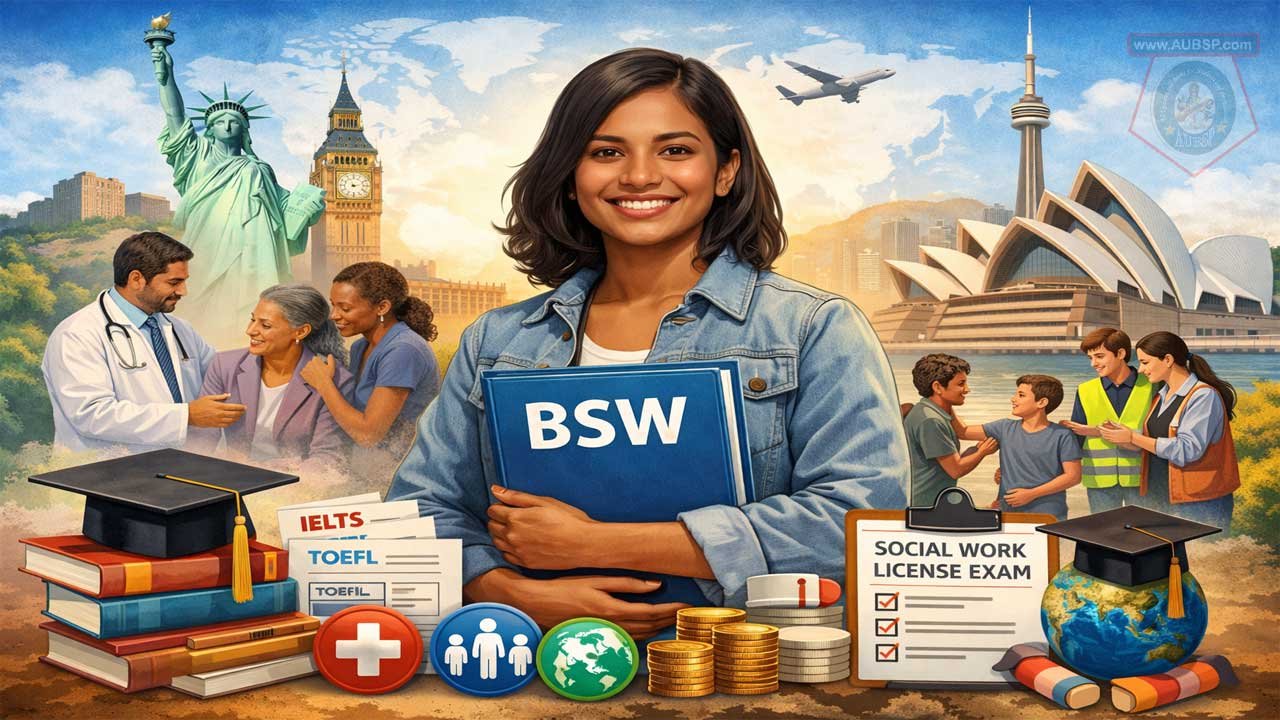
The Bachelor of Social Work (BSW) is a professional degree that prepares students to improve human well-being and promote social justice. It combines classroom learning with extensive supervised field training so students gain real practical skills.
The profession is regulated globally by organizations like the International Federation of Social Workers, and many countries require official registration to use the title “Social Worker.” International students must meet academic requirements, credential evaluations, and English language tests before admission. BSW programs differ by country but usually include hundreds of hours of field placement and strict health and background checks.
Although studying the degree can be expensive, scholarships and post-study work visas in countries such as the U.S., UK, Canada, and Australia help graduates gain work experience. After graduation, students may take licensing exams and work in areas like healthcare, education, and community services, where demand for social workers is steadily growing worldwide.
| Aspect | Details |
|---|---|
| Degree Name | Bachelor of Social Work (BSW) |
| Field | Social Work, Social Justice, Community Development |
| Global Professional Body | International Federation of Social Workers |
| Typical Duration | 3–4 years depending on country |
| Major Study Destinations | United States, United Kingdom, Canada, Australia |
| Core Learning Method | Classroom theory plus supervised field education |
| Minimum Field Training | 400–1,400 hours depending on country |
| Accreditation Bodies | Council on Social Work Education (USA), Australian Association of Social Workers, Canadian Association for Social Work Education |
| English Test Requirements | IELTS, TOEFL iBT, Duolingo, PTE Academic |
| Typical IELTS Requirement | 6.5 – 7.5 |
| Approx Annual Cost (International Students) | $36,500 – $65,000 including tuition and living expenses |
| Post-Study Work Options | OPT (USA), PGWP (Canada), Graduate Route (UK), Subclass 485 Visa (Australia) |
| Licensing Exam | Association of Social Work Boards Bachelors Exam |
| Career Areas | Healthcare, Mental Health, Child Welfare, Community Services, NGOs |
| Global Demand | High demand due to mental health and social welfare needs |
Bachelor of Social Work (BSW): Global Career Guide, Admission, Fees, Licensure & Job Opportunities
The Bachelor of Social Work (BSW) serves as the foundational professional credential for individuals aspiring to enter a field dedicated to the enhancement of human well-being and the pursuit of social justice. For the international student, the BSW is not merely an academic degree but a highly regulated professional passport that requires navigation through a complex landscape of accreditation, licensure, and cross-border reciprocity.
The profession is fundamentally distinct from other social sciences due to its “signature pedagogy,” which mandates a significant volume of supervised field education, ensuring that theoretical frameworks are translated into clinical and community-based competencies. As global society faces escalating crises—from climate-induced displacement to the mental health repercussions of systemic inequity—the demand for qualified social workers has reached an inflection point, with major economies reporting persistent shortages and projected employment growth far exceeding national averages.
The Regulatory Framework of Global Social Work
The practice of social work is governed by a global and national infrastructure that ensures practitioners adhere to the highest ethical and professional standards. At the apex of this structure is the International Federation of Social Workers (IFSW), a global body representing over three million professionals through more than 150 national associations.
The IFSW, founded in its current form in 1956, operates through a federated model divided into five geographic regions: Africa, Asia and Pacific, Europe, Latin America and Caribbean, and North America. This global organization holds special consultative status with the United Nations Economic and Social Council (ECOSOC) and is accredited to major international bodies including UNICEF, the World Health Organization (WHO), and the International Labour Organization (ILO).
For the international student, the concept of the “protected title” is the most critical regulatory factor. In jurisdictions such as the United Kingdom and the United States, it is a legal requirement to be registered with a national or state-level regulator to practice under the designation of “Social Worker”. Failure to understand these regulatory nuances can lead to significant barriers in post-graduation employment.
Professional Commissions and Global Standards
The IFSW maintains specialized commissions that directly impact BSW curriculum and ethics. These include the Education Commission, which develops global standards for social work education; the Ethics Commission, which maintains the Universal Declaration of Ethical Principles; and the Indigenous Commission, focused on the rights and practices of indigenous peoples.
This global oversight ensures that a BSW earned in one jurisdiction maintains a degree of thematic consistency with another, focusing on human rights, social cohesion, and the empowerment of marginalized populations.
Admission Architecture and Educational Equivalency
International admission into a BSW program requires a dual demonstration of academic capability and professional suitability. Universities meticulously evaluate international credentials to ensure they meet the domestic standards of a four-year bachelor’s degree in the United States or a three-year degree in the United Kingdom and Canada.
The Role of Credential Evaluation
Most institutions require international students to submit their transcripts to recognized evaluation agencies. In the United States and Canada, agencies such as World Education Services (WES), the International Credential Assessment Service (ICAS), and the Comparative Education Service (CES) are standard.
These evaluations provide a course-by-course breakdown and a GPA equivalency, which is essential for determining if the applicant has met prerequisite requirements in areas such as psychology, sociology, and political science. For example, the University of Waterloo (Renison) requires a minimum average of 70% in previous credentials for BSW eligibility.
English Language Proficiency Requirements
Given the clinical and communicative demands of social work, English proficiency thresholds for BSW programs are often higher than for general liberal arts degrees. Students must demonstrate the ability to speak, write, and understand complex documents to ensure they can practice safely and effectively in English-speaking environments.
| Test Type | Minimum Acceptable Score Range | Institutional Example |
|---|---|---|
| IELTS (Academic) | 6.5 – 7.5 | University at Buffalo (7.5) |
| TOEFL iBT | 90 – 100 | University at Buffalo (90) |
| Duolingo (DET) | 120 – 130 | University at Buffalo (120) |
| PTE Academic | 61 – 70 | University at Buffalo (61) |
Institutions may waive these requirements if the applicant has completed a minimum of four years of full-time education in an English-language school system or a country where English is the primary native language.
Professional Suitability and Affirmative Action
The BSW admission process frequently incorporates qualitative assessments of an applicant’s character and commitment to social justice. Statements of intent (typically 500–700 words) must address why the applicant is choosing social work at this specific juncture in their life. Furthermore, some Canadian institutions, such as Dalhousie University, implement Affirmative Action policies to ensure a diverse student body, specifically encouraging applications from Acadian, Aboriginal, African Canadian, and LGBTTQI+ individuals.
Structural Analysis of BSW Programs by Region
The structure of the BSW varies significantly between the major host countries, reflecting different national priorities in social welfare and professional training.
The United States: Generalist Practice and Advanced Standing
In the U.S., the BSW is designed to prepare students for generalist practice, where they engage with individuals, families, groups, and communities. A typical program requires 120 total credit hours, with the social work major accounting for approximately 50 credit hours. The curriculum is strictly regulated by the Council on Social Work Education (CSWE) Educational Policy and Accreditation Standards (EPAS).
A primary advantage of the U.S. BSW is the “Advanced Standing” pathway. Graduates of CSWE-accredited BSW programs can often complete a Master of Social Work (MSW) in just one year (or three semesters) instead of the traditional two years. This significantly accelerates the path to clinical licensure and higher-paying specialist roles.
Australia: The Four-Year Integrated Model
Australia’s BSW is traditionally a four-year undergraduate degree. The program is characterized by an intensive field education mandate of 1,000 hours, usually split into two 500-hour placements. Some universities, such as Charles Sturt University, offer integrated pathways with TAFE NSW, allowing students to earn a Diploma of Community Services after two years and a BSW after four. This dual-credentialing system enhances immediate employability in the community sector while the student completes their higher-level studies.
Canada: Prerequisite-Heavy Pathways
Canadian BSW programs often require students to complete a “pre-professional” year or 30-60 university credit hours before they can apply for formal admission to the social work major. Universities like the University of Waterloo and Toronto Metropolitan University place heavy emphasis on prerequisites such as Canadian Political Institutions and Social Justice and Mental Health. The duration of the program typically spans 2 to 3 years after the completion of initial university credits.
The United Kingdom: Statutory Focus and Post-Graduate Diplomas
In the UK, the BSW is typically a three-year degree. However, for those already holding a degree in a different field, fast-track programs like “Step Up to Social Work” offer a 14-month intensive route that leads to a Postgraduate Diploma (PGDip) in Social Work. These programs are highly selective and focus on child and family social work, requiring approximately 170 days of placement in a local authority.
Field Education: The Signature Pedagogy
Field education is the cornerstone of BSW training, providing students with the opportunity to apply classroom theory to real-world social problems. For international students, the practicum is often the most challenging yet rewarding component of the degree.
Placement Requirements and Clock Hours
The volume of required field education varies significantly by jurisdiction, often driven by the requirements of national accrediting bodies.
| Country | Accrediting Body | Minimum Field Education Hours | Typical Placement Structure |
|---|---|---|---|
| United States | CSWE | 400 Hours | Single agency in senior year |
| Australia | AASW | 1,000 Hours | Two distinct 500-hour placements |
| United Kingdom | Social Work England | 200 Days (approx. 1,400 hours) | Two placements in contrasting settings |
| Canada | CASWE-ACFTS | 700+ Hours (Variable) | Integrated throughout the degree |
Compliance, Health, and Safety
International students must meet rigorous compliance standards before entering a field agency. This process often includes:
- Criminal Background Checks: Verification of social security numbers and federal criminal records.
- Health Screenings: Evidence of immunity through titers for measles, mumps, and varicella. A history of immunization is often insufficient; blood work is mandatory.
- Drug Testing: Mandatory screenings for substances, including prescribed medical marijuana, which can lead to placement denial or removal.
- Tuberculosis (TB) Testing: Annual documentation of a clear TB screening.
The International Practicum
Some universities allow students to complete a portion of their field education abroad. For example, Florida State University offers international placements in Canada, the UK, and Ireland, though these are subject to varying availability. Students pursuing an international placement must be ready to cover significant additional costs, including travel, cultural liaison fees, and international supervision costs.
Financial Planning for the International BSW
The cost of a BSW for an international student includes tuition, mandatory fees, living expenses, and professional costs such as background checks and liability insurance.
Tuition and Mandatory Fees
International tuition rates are significantly higher than domestic rates. In the United States, estimated annual tuition for an undergraduate international student at a mid-tier public university is approximately $20,000, with total annual costs (including housing and insurance) reaching $36,500.
| Expense Category | Estimated Annual Cost (USD) | Source/Notes |
|---|---|---|
| Tuition and Fees | $20,000 – $45,000 | Varies by public/private status |
| Room and Board | $11,000 – $15,000 | Standard occupancy and meal plan |
| Insurance and Books | $3,500 | Mandatory health coverage |
| International Service Fee | $200 – $500 | Per semester; covers visa advising |
| Total Estimated Annual Cost | $36,500 – $65,000 | Dependent on location and lifestyle |
Scholarships and Funding Opportunities
While many federal grants are restricted to domestic citizens, international students can access a range of university-specific and external scholarships.
- Merit-Based University Awards: Many institutions automatically consider international applicants for scholarships based on GPA. For example, Bowling Green State University offers the “BG Success Scholarship” ($4,000/year) and “Freshman Academic Scholarships” (up to $8,000/year).
- Specialized Social Work Grants: The Davis-Putter Scholarship Fund supports students active in social change movements, while the Roothbert Fund provides support for students “motivated by spiritual values”.
- Regional and Government Scholarships: Programs like the UK’s GREAT Scholarships and Canada’s Emerging Leaders in the Americas Program (ELAP) provide significant funding for students from specific countries.
- Community and Alumni Awards: Toronto Metropolitan University offers the International Student Leadership Award ($10,000 CAD).
Professional Identity and Ethical Responsibilities
Entering the BSW program requires a commitment to a specific set of professional behaviors. Students are not only graded on their academic performance but also on their emotional stability and management, self-awareness, and respect for diversity.
The Student Review Process
Many Schools of Social Work, such as the University of Illinois, have a formalized “Student Review Process” with three levels of intervention :
- Level 1: Informal consultation between a student and faculty member to address concerns regarding behavior or professional standards.
- Level 2: A formal meeting involving the student, faculty advisor, and often the BSW Program Director to develop a “Student Improvement Plan.”
- Level 3: A comprehensive review that may result in the student’s dismissal from the program if the behavior is deemed incompatible with the profession’s values.
Ethical Frameworks and Communication
Social work is intrinsically tied to human rights and dignity. International students must adapt to the ethical codes of their host country, such as the NASW Code of Ethics in the U.S. or the Social Work England Professional Standards. A primary component of these standards is “Reflective Listening” and “Cultural Humility,” which requires students to recognize the complexity of cultural differences and engage in continuous self-reflection regarding their own biases.
Post-Graduation Work Rights and Migration Pathways
The ability to gain professional work experience post-graduation is a paramount consideration for international students. Governments have implemented various visa streams to retain skilled social work talent.
Australia: Subclass 485 Temporary Graduate Visa
The Subclass 485 visa allows international graduates to remain in Australia for 18 months to 4 years, depending on their qualification level.
- Bachelor’s Degree: Typically grants 2 years of stay-back work rights.
- Regional Incentives: Students who study and live in “Category 2” or “Category 3” regional areas may be eligible for an additional 1 to 2 years on their second post-study work permit.
- Eligibility: Must be under 35 years of age (exceptions apply for certain passport holders) and must have completed at least 92 weeks of registered study in Australia.
The United Kingdom: Graduate Route Visa
The UK’s Graduate Route is an unsponsored visa that allows BSW graduates to work, or look for work, at any skill level for two years.
- Recent Policy Changes: For applications made on or after January 1, 2027, the stay period for undergraduate and master’s graduates will be reduced to 18 months.
- Immigration Health Surcharge (IHS): Applicants must pay the IHS as part of their application, which is currently £1,035 per year (totaling £2,070 for a two-year visa).
North America: CPT, OPT, and PGWP
- United States: International students on F-1 visas utilize Optional Practical Training (OPT) for 12 months of post-graduate work. For their internships during the degree, they must obtain Curricular Practical Training (CPT) authorization, as even unpaid internships are considered “work” under U.S. immigration law.
- Canada: The Post-Graduation Work Permit (PGWP) allows graduates to work for any employer for up to three years, depending on the length of their program.
Licensure and Professional Certification
A BSW degree is the first step toward licensure, which is mandatory for most social work roles.
The ASWB Bachelors Exam
In the U.S. and Canada, the Association of Social Work Boards (ASWB) provides the standardized licensing exam.
- Exam Structure: 170 multiple-choice questions administered over four hours.
- Competency Levels: The exam is written at a 10th-grade reading level to ensure it measures social work knowledge rather than reading ability.
- Credential Evaluation: Internationally educated social workers must have their degrees evaluated for equivalency before they are authorized to sit for the exam.
Registration with Social Work England
For graduates in England, the registration process involves:
- Official Confirmation: Universities must send a “pass list” to Social Work England before an application can be processed.
- Online Application: Graduates create an online account, pay a scrutiny fee, and provide certified identification.
- Mandatory Declarations: Applicants must declare any health conditions or criminal cautions that may affect their ability to practice safely.
Economic Outlook: Salary and Employment Trends
The social work profession offers strong earning potential and job security, particularly in specialized and government sectors.
Salary Benchmarks in the United Kingdom
In the UK, social workers are employed by local authorities, the NHS, and private companies. NHS roles are structured according to “Bands,” offering clear progression.
| Employer Type / Grade | Starting Salary (GBP) | Experienced Salary (GBP) |
|---|---|---|
| Local Authority (Outside London) | £30,000 – £34,000 | £39,000 – £50,000+ |
| NHS Band 6 | £38,682 | £46,580 |
| NHS Band 7 (Senior) | £47,810 | £54,710 |
| Private Sector Director | £55,000 | £80,000+ |
Salary Benchmarks in Australia
Australian social worker salaries vary significantly by state and territory, with government roles often providing the highest compensation through state-specific health professional awards.
| State/Territory | Average Annual Salary (2026) | Entry-Level Government (AHP1/P1) |
|---|---|---|
| Northern Territory | $110,000 | $68,904 – $87,700 |
| Western Australia | $104,000 | $75,718 – $89,746 |
| South Australia | $99,000 | $71,217 – $86,938 |
| Victoria | $97,000 | $70,590 – $85,873 |
| New South Wales | $93,000 | $76,364 – $89,232 |
Salary Benchmarks in the United States
In the U.S., salary is heavily influenced by the specific metropolitan area and the field of practice (e.g., healthcare vs. school social work).
| Metropolitan Area | Healthcare Specialization (Mean) | Mental Health/Substance Abuse (Mean) |
|---|---|---|
| Napa, CA | $127,690 | N/A |
| San Luis Obispo, CA | $116,180 | $109,960 |
| San Jose, CA | $110,570 | $103,910 |
| New York, NY | $72,480 | $101,390 |
Cross-Border Reciprocity and International Practice
For the international social worker, understanding degree reciprocity is essential for mobility.
- U.S.-Canada Reciprocity: There is a mutual recognition agreement between the CSWE (USA) and the CASWE-ACFTS (Canada), whereby accredited BSW degrees are accepted as equivalent in both countries.
- Australia-New Zealand: The AASW and the NZ Social Workers Registration Board maintain a Mutual Recognition Agreement (MRA).
- The IFSW Global Voice: For countries without a mutual recognition agreement, the IFSW provides the framework for individual credential assessment through its member associations.
The Benefits of an International Social Work Career
Qualified BSW holders are finding increasing opportunities in “International Social Work,” focusing on global humanitarian issues such as migration, gender equity, and child rights. This career path often involves partnership with non-governmental organizations (NGOs) such as Save the Children or Doctors Without Borders. The skills gained during a BSW—high-risk decision-making, crisis intervention, and cultural humility—are universally applicable and in high demand worldwide.
Challenges and Strategic Adaptations for International Students
Academic journals highlight that international social work students often face barriers in field placements, including cultural barriers, emotional burdens, and sometimes a disconnect between classroom theory and the realities of human suffering in the field.
Navigating Cultural Contexts
Students studying in the Global North may encounter social work models that are heavily individualized or neoliberal, which may contrast with more collective, community-based approaches in their home countries. Developing “Cultural Competence” and “Translocal Awareness” is therefore a critical professional skill, allowing students to adapt their practice to diverse community norms.
Professional Self-Care
Social work is emotionally taxing. Programs emphasize the importance of self-care to prevent burnout, particularly when working with vulnerable populations such as refugees or victims of domestic violence. Engaging in regular supervision sessions, where students can reflect on their emotional responses to challenging cases, is a mandatory component of field education.
Synthesized Conclusion: The Global Professional Outlook
The Bachelor of Social Work (BSW) is a versatile and high-demand credential that prepares international students for a career at the intersection of clinical practice and social advocacy. While the path to qualification is rigorous—marked by intensive field education requirements, stringent health and background compliance, and complex licensing examinations—it offers a clear trajectory toward professional licensure and global mobility.
The economic outlook for social workers remains robust, with salaries in government and healthcare sectors reflecting the profession’s critical role in maintaining social stability. Furthermore, the “Advanced Standing” pathways in North America and the “Graduate Route” visas in the UK provide strategic advantages for students looking to maximize their educational and professional ROI. As global societal needs evolve, the social worker who possesses both a BSW and a nuanced understanding of international practice will be uniquely positioned to lead transformative change in diverse communities across the globe.
FAQs about Bachelor of Social Work
What is a Bachelor of Social Work (BSW)?
A Bachelor of Social Work (BSW) is an undergraduate professional degree that prepares students to work in social services, helping individuals, families, and communities improve their well-being and access support systems.
How long does it take to complete a BSW degree?
The BSW usually takes 3 to 4 years to complete depending on the country and university structure.
Is field training required in a BSW program?
Yes. Field education is a core part of the degree and students must complete supervised placements that range from about 400 to more than 1,000 hours.
Who regulates social work globally?
The profession is globally supported by organizations such as the International Federation of Social Workers, which promotes ethical standards and professional development.
What English tests are required for international students?
Most universities require IELTS, TOEFL, PTE Academic, or Duolingo English Test scores to prove language proficiency.
Can BSW graduates pursue higher studies?
Yes. Many graduates continue with a Master of Social Work (MSW), and in countries like the United States they may qualify for advanced standing programs that shorten the master’s duration.
Is a license required to work as a social worker?
In many countries, graduates must pass licensing exams such as those offered by the Association of Social Work Boards and register with professional regulators before practicing.
What careers can you pursue with a BSW?
Graduates can work in healthcare, schools, mental health services, community organizations, child welfare agencies, and international NGOs.
Are scholarships available for international BSW students?
Yes. Universities, private foundations, and government programs often offer merit-based or need-based scholarships to international students.
Is there global demand for social workers?
Yes. Demand for social workers is increasing worldwide due to growing needs in mental health services, social welfare programs, and community support systems.


Leave a Reply
You must be logged in to post a comment.