
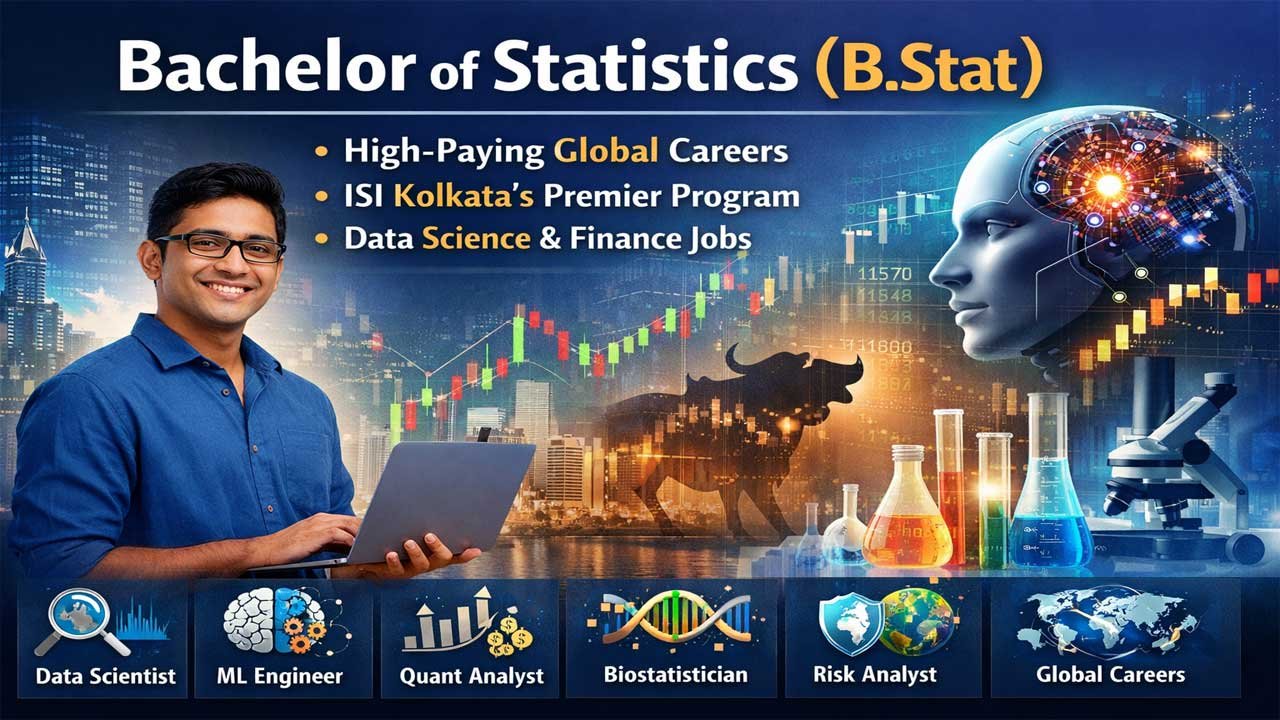
The Bachelor of Statistics (B.Stat) is a highly valuable undergraduate degree in 2026 that prepares students for strong, flexible, and well-paid careers in a data-driven world.
It focuses on mathematics, probability, data analysis, and programming, making graduates suitable for roles like data scientist, machine learning engineer, quantitative analyst, biostatistician, and risk analyst across industries such as tech, finance, healthcare, government, and AI.
The ISI B.Stat program in India is especially prestigious, extremely selective, low-cost, and known for excellent placements and global recognition. Graduates earn high salaries in India and even higher abroad or in remote international roles, with strong long-term growth and job security. Overall, B.Stat offers one of the best returns on investment among undergraduate degrees, combining global opportunities, future-proof skills, and wide career choice for students strong in math and problem-solving.
| Aspect | Information |
|---|---|
| Degree | Bachelor of Statistics (B.Stat) |
| Duration | 3 years (Honours) |
| Core Skills | Statistics, Mathematics, Data Analysis, Programming (Python, R, SQL) |
| Top Institute (India) | Indian Statistical Institute (ISI), Kolkata |
| ISI Seats | ~50 seats nationwide |
| Acceptance Rate | ~1.25% (Highly competitive) |
| Major Career Paths | Data Scientist, ML Engineer, Quant, Biostatistician, Risk Analyst |
| Starting Salary (India) | ₹12–15 LPA (ISI average) |
| Starting Salary (Global) | $80,000–$120,000+ |
| Highest-Paying Roles | Quantitative Finance, ML Engineering, AI Research |
| Global Opportunities | USA, UK, Canada, EU, Singapore + Remote jobs |
| ROI | Among the highest of any undergraduate degree in India |
| Future Outlook | Very strong due to AI, ML, healthcare, fintech growth |
Bachelor of Statistics (B.Stat): Complete Guide to Career Prospects, Salary & Global Opportunities 2026
The Bachelor of Statistics (B.Stat) degree has emerged as one of the most valuable undergraduate qualifications in the data-driven economy of 2026. Unlike traditional STEM degrees, a statistics degree opens doors across virtually every industry—from Wall Street investment banks to Silicon Valley tech companies, from pharmaceutical corporations to government agencies. Yet many students and career changers remain unaware of the extraordinary earning potential and career flexibility this degree offers.
This comprehensive guide explores every dimension of pursuing a B.Stat degree, particularly the prestigious Indian Statistical Institute (ISI) B.Stat program, and reveals why statistics graduates command six-figure salaries in developed markets while simultaneously securing stable, well-compensated positions globally.
What is a Bachelor of Statistics (B.Stat)?
Program Overview
A Bachelor of Statistics is a three-year honors degree that combines rigorous mathematical theory with practical data analysis techniques. Unlike a general BSc in Statistics offered at most universities, a B.Stat program—particularly ISI’s flagship program—emphasizes theoretical foundations paired with real-world applications.
The curriculum covers:
- Probability Theory & Statistical Methods – Understanding distribution, inference, and hypothesis testing
- Linear Algebra & Matrix Theory – Foundations for machine learning and data science
- Numerical Analysis & Computational Statistics – Practical implementation using programming
- Survey Sampling & Design of Experiments – Applied methodology for real-world data collection
- Time Series & Stochastic Processes – Advanced modeling for temporal data
- Statistical Computing – Programming in R, Python, and specialized statistical software like SAS and SPSS
ISI B.Stat: India’s Premier Statistics Program
The Indian Statistical Institute (ISI) Kolkata B.Stat program stands apart as the gold standard in India and is internationally recognized. Established in 1960, ISI has trained statisticians who now hold positions at Harvard, Stanford, MIT, and leading global corporations. The institute is classified as an institution of national importance by the Indian Parliament.
Why ISI B.Stat is Different:
- Ultra-selective: Only 50 seats nationwide (fewer than many Ivy League programs proportionally)
- Internationally acclaimed: Graduates work in leading universities, tech companies, and research institutions globally
- Rigorous curriculum: Balances pure mathematical theory with applied problem-solving
- Research emphasis: Students engage with active research projects and faculty mentorship
- Placement record: Consistently 100% placement with strong compensation packages
ISI B.Stat Admission Requirements & Process 2026
Eligibility Criteria
To apply for the ISI B.Stat program, candidates must:
- Have completed Class 12 (10+2) or equivalent secondary education
- Include Mathematics and English as subjects
- No minimum percentage requirement (though competitive candidates typically score 75%+ in Class 12)
- International students may also apply
Admission Test Structure
The ISI Admission Test, held in May 2026, comprises two stages:
| Aspect | Details |
|---|---|
| Section A (UGA) | 30 multiple-choice questions, 120 marks, 2-hour duration |
| Section B (UGB) | 8 descriptive problems, 80 marks, 3-hour duration |
| Marking (Section A) | +4 correct, +1 unattempted, 0 incorrect |
| Marking (Section B) | No negative marking |
| Qualifying Score (2025) | Section A: ≥77 marks (General), ≥69.3 (OBC), ≥53.9 (SC/ST) |
Only candidates clearing Section A proceed to Section B evaluation. The combined score determines final admission ranks.
Competition & Admission Statistics
The ISI B.Stat program is extraordinarily competitive:
- Total applicants: Approximately 4,000+ candidates annually
- Available seats: 50 (25 General, 14 OBC, 7 SC/ST, 4 PwD)
- Acceptance rate: Approximately 1.25% (comparable to elite universities)
- Geographic diversity: Candidates from across India and select international locations
This extreme competitiveness reflects the program’s prestige and the high demand for its graduates.
Career Prospects: Where Statistics Graduates Work
Industry Demand & Job Growth
The statistics field is experiencing explosive growth. According to the U.S. Bureau of Labor Statistics, employment in statistics and related fields is projected to grow 30% through 2030, significantly outpacing the average growth rate for all occupations. In India, the data analytics market alone is expected to expand by 35.8% from 2025-2030, with statistics professionals at the forefront.
Fastest-growing sectors for statistics professionals:
- Artificial Intelligence & Machine Learning – Every ML/AI system requires statistical modeling
- Healthcare & Biotechnology – Clinical trials, epidemiology, biostatistics
- Finance & Banking – Risk management, fraud detection, credit modeling
- E-commerce & Consumer Tech – Recommendation systems, A/B testing, user analytics
- Government & Public Policy – Census data, policy analysis, epidemiological modeling
- Climate & Environmental Science – Climate modeling, environmental impact assessment
Primary Career Paths for B.Stat Graduates
1. Data Scientist
Role: Design predictive models, analyze complex datasets, communicate insights to stakeholders
Salary (United States): $122,738/year average; senior roles reach $300,000+
Salary (India): ₹18-28 LPA (₹1.8-2.8 million), senior: ₹90 LPA+
Growth: 34% job growth through 2034
Top employers: Google, Amazon, Microsoft, Goldman Sachs, JPMorgan Chase
2. Machine Learning Engineer
Role: Build production ML systems, optimize algorithms, deploy at scale
Salary (United States): $130,000-$170,000 base
Salary (India): ₹25-35 LPA; senior: ₹1+ crore ($120,000+)
Growth: Among the fastest-growing tech roles
Top employers: Meta, Google, Nvidia, OpenAI, autonomous vehicle companies
3. Quantitative Analyst (Quant)
Role: Develop mathematical models for financial instruments, manage portfolio risk
Salary (United States): $147,000 average; senior quants: $200,000-$500,000+
Salary (India): ₹20-32 LPA
Growth: Sustained high demand in hedge funds and investment banks
Compensation: Highest-paying option for statistics graduates; significant bonuses
4. Biostatistician
Role: Analyze clinical trial data, support medical research, ensure regulatory compliance
Salary (United States): $86,000-$139,000 median; can reach $150,000+ in pharma
Salary (India): ₹18-22 LPA
Growth: 8% job growth (faster than average) in healthcare sector
Top employers: FDA, NIH, Pfizer, Moderna, major pharmaceutical companies, research hospitals
5. Epidemiologist
Role: Track disease patterns, analyze public health data, inform policy decisions
Salary (United States): Entry: $60,000-$75,000; mid-level: $80,000-$100,000; senior: $105,000-$130,000+
Growth: 30% job growth projected through 2030
Demand: Heightened post-pandemic; government agencies, NGOs, research institutions
Global opportunities: WHO, CDC, international public health organizations
6. Financial Risk Analyst
Role: Model credit risk, market risk; develop risk management frameworks
Salary (United States): $100,000-$180,000 depending on specialization
Salary (India): ₹15-25 LPA
Growth: Increasing regulatory requirements drive consistent demand
Top employers: JPMorgan Chase, HSBC, Barclays, McKinsey, Accenture
7. Actuarial Scientist
Role: Assess financial risk using statistics and mathematics; price insurance/pension products
Salary (United States): $114,000 median; senior: $150,000+
Growth: 23% projected through 2032
Note: Requires passing actuarial certification exams; B.Stat provides strong foundation
Top employers: Insurance companies, pension funds, consulting firms
8. Data Engineer
Role: Build data infrastructure, pipelines, and warehousing systems
Salary (United States): $120,000-$155,000
Salary (India): ₹12-22 LPA
Growth: Critical role as data volumes explode
Top employers: Cloud providers (AWS, Google Cloud, Azure), tech giants, fintech
Global Salary Comparison: B.Stat Graduates Worldwide
| Role | Entry Level (USD) | Mid-Career (USD) | Senior (USD) | India (LPA) |
|---|---|---|---|---|
| Data Analyst | $50,000-$60,000 | $75,000-$90,000 | $110,000+ | ₹5-8 |
| Data Scientist | $80,000-$100,000 | $120,000-$150,000 | $250,000+ | ₹18-28 |
| ML Engineer | $110,000-$130,000 | $160,000-$200,000 | $300,000+ | ₹25-35 |
| Quantitative Analyst | $120,000-$150,000 | $200,000-$350,000 | $500,000+ | ₹20-32 |
| Biostatistician | $70,000-$85,000 | $95,000-$120,000 | $150,000+ | ₹18-22 |
| Epidemiologist | $60,000-$75,000 | $85,000-$110,000 | $150,000+ | ₹12-18 |
Key insight: U.S. and Western European markets offer 2-3x higher compensation than India, but India’s rapidly growing tech sector provides strong growth trajectories and lower cost of living.
Why ISI B.Stat Graduates Command Premium Salaries
1. Rigor & Prestige
ISI’s reputation stems from decades of academic excellence. Employers recognize that ISI B.Stat graduates have survived an elite selection process and possess deep statistical foundations.
2. Theoretical Depth + Practical Skills
Unlike many statistics programs that emphasize statistics software (R, Python, SAS) over mathematics, ISI maintains rigorous mathematical training combined with modern computing skills. This dual proficiency is rare and highly valued.
3. Research Exposure
ISI emphasizes original research. Students work on faculty research projects, publish papers, and develop the analytical maturity that separates top performers from average analysts.
4. International Recruitment
Top tech companies (Google, Amazon, Microsoft), investment banks (Goldman Sachs, Morgan Stanley), and pharmaceutical corporations actively recruit from ISI because the institution has consistently produced high-caliber talent.
5. Alumni Network
ISI alumni hold senior positions at leading institutions worldwide. This creates networking opportunities, mentorship, and direct pathways to top employers.
Critical Skills for Statistics Graduates in 2026
To maximize earning potential and career opportunities, B.Stat graduates should develop expertise in:
Essential Programming Languages
Python – The dominant language in data science, machine learning, and AI
- Libraries: scikit-learn, TensorFlow, PyTorch, pandas, NumPy
- Proficiency level: Intermediate-advanced
R – Industry standard in statistics, particularly pharma/biostatistics
- Packages: ggplot2, dplyr, shiny, caret
- Proficiency level: Intermediate-advanced
SQL – Universal database querying skill across all data roles
- Relational databases, query optimization
- Proficiency level: Advanced
SAS/SPSS – Clinical trials, pharmaceutical industry, regulatory compliance
- Particularly valuable for biostatistician roles
- Proficiency level: Intermediate
Advanced Technical Skills
- Machine Learning Algorithms – Linear regression, logistic regression, decision trees, random forests, gradient boosting, neural networks
- Statistical Modeling – Time series analysis, survival analysis, Bayesian inference, causal inference
- Data Visualization – Tableau, Power BI, matplotlib, ggplot2, interactive dashboards
- Cloud Computing – AWS, Google Cloud Platform, Azure for scalable data processing
- Natural Language Processing (NLP) – Text analysis, sentiment analysis, language models (increasingly AI-driven)
- Deep Learning – Neural networks, CNNs, RNNs for complex pattern recognition
Soft Skills (Often Overlooked, Highly Valuable)
- Communication – Translating complex analyses into actionable insights for non-technical stakeholders
- Business Acumen – Understanding industry context, ROI, competitive dynamics
- Project Management – Coordinating multi-team data initiatives
- Domain Expertise – Deep knowledge in finance, healthcare, e-commerce, etc.
Companies pay premium salaries for professionals who can bridge statistics and business. A data scientist earning $80,000 who can only write code becomes a data scientist earning $200,000+ when they can explain why their analysis matters to the CFO.
The Remote Work Revolution: Global Opportunities
Explosive Growth in Remote Statistics Roles
Since 2021, remote analytics and statistics positions have increased by over 40%, fundamentally changing the job market. This shift has profound implications for graduates:
Before: Only local job markets mattered; geographic arbitrage favored expensive cities (San Francisco, New York, London)
Now: Indian statistics graduates can compete for remote U.S. positions (paying $120,000-$200,000) while living in lower cost-of-living regions
Remote Job Availability
As of January 2026:
- 2,000+ active remote statistics positions available globally
- Salary range: $50,000-$250,000+ annually
- Geographic flexibility: U.S., Europe, Singapore, Australia, Canada all hiring remote roles
Companies Hiring Remote Statistics Professionals
- Tech: Google, Amazon, Meta, Netflix, Stripe, Figma, Notion
- Finance: Goldman Sachs, JPMorgan Chase, Citadel, Robinhood, Vanguard
- Healthcare: Teladoc, CVS Health, UnitedHealth, Tempus AI, Genentech
- Specialized roles: McKinsey Analytics, Deloitte Consulting, Boston Consulting Group
How to Access Remote Opportunities
- Build portfolio projects on GitHub demonstrating your skills
- Develop communication skills – Remote work requires crystal-clear written and verbal communication
- Obtain certifications (optional but valuable) – Google Data Analytics, AWS Certified Data Analytics, Coursera specializations
- Network aggressively – LinkedIn, industry conferences, alumni networks become critical
- Specialize in high-demand niches – AI/ML, clinical data science, fintech analytics
Highest-Paying Specializations for Statistics Graduates
1. Quantitative Finance (Highest Compensation Ceiling)
Roles: Quantitative analyst, algorithmic trader, risk modeler
Salary potential: $150,000-$500,000+ (with bonuses reaching $1 million+)
Requirements:
- Advanced knowledge of derivatives pricing, portfolio optimization, stochastic calculus
- Strong programming (C++, Python)
- Understanding of financial markets
Employers: Hedge funds (Citadel, Tower Research, Jane Street), investment banks, proprietary trading firms
Reality check: Highly competitive, requires sustained excellence in quantitative interviews
2. Machine Learning Engineering (Tech Sector)
Roles: ML engineer, AI engineer, deep learning specialist
Salary potential: $130,000-$400,000 (including stock options)
Requirements:
- Advanced machine learning, deep learning, NLP
- Software engineering practices
- System design expertise
Employers: FAANG companies (Facebook, Apple, Amazon, Netflix, Google), AI startups, autonomous vehicle companies
Advantages: Stock options often exceed salary; strong career growth; flexible work culture
3. Clinical/Pharmaceutical Statistics
Roles: Biostatistician, clinical statistician, regulatory statistician
Salary potential: $100,000-$180,000 (higher in specialized roles)
Requirements:
- Understanding of clinical trial design, survival analysis, statistical inference
- Knowledge of regulatory requirements (FDA, EMA)
- SAS proficiency highly valued
Employers: Pharmaceutical companies (Pfizer, Moderna, Johnson & Johnson), contract research organizations, FDA
Advantages: Job security, meaningful work (impacts patient health), international opportunities
4. Fintech/Risk Analytics
Roles: Risk analyst, credit modeler, pricing analyst, data scientist (fintech)
Salary potential: $100,000-$250,000
Requirements:
- Understanding of financial instruments, risk modeling
- Python/R programming
- Knowledge of regulatory frameworks (Basel III, etc.)
Employers: Fintech startups, traditional banks (digital divisions), insurance companies
Advantages: Rapidly growing sector, significant innovation, entrepreneurial environment
5. AI/ML Research (Academia + Industry)
Roles: Research scientist, ML researcher, AI researcher
Salary potential: $150,000-$350,000+ (in industry research labs)
Requirements:
- PhD typically required (ISI graduates can pursue PhD)
- Publication record in top conferences
- Deep theoretical knowledge
Employers: DeepMind, OpenAI, Meta AI Research, Microsoft Research, Google Brain, academic institutions
Advantages: Work on cutting-edge problems; significant influence on AI development
B.Stat vs. BSc Statistics vs. B.Stat (International Programs)
| Aspect | ISI B.Stat | BSc Statistics (Most India Universities) | Statistics (Western Universities) |
|---|---|---|---|
| Selectivity | Ultra-selective (1.25% acceptance) | Moderate (20-30% acceptance) | Varies (5-40% depending on institution) |
| Curriculum | Theory-heavy, rigorous | Application-focused | Balanced theory & application |
| Employer Recognition | Exceptional, global | Good in India | Strong, globally accepted |
| Average Starting Salary (India) | ₹12-15 LPA | ₹5-8 LPA | N/A (different geography) |
| International Opportunities | Excellent | Good | Excellent |
| Programming Focus | Moderate | Moderate | High (R, Python emphasis) |
| Research Emphasis | Very high | Moderate | High at research universities |
| Study Abroad Options | Limited | Limited | Common |
Verdict: ISI B.Stat is the premium option in India. For international education, U.S. universities (UC Berkeley, CMU, University of Chicago) offer strong programs with high post-graduation employment.
Cost Analysis: Is B.Stat Worth the Investment?
ISI B.Stat Program Costs
| Cost Component | Amount (INR) |
|---|---|
| Annual Tuition | ₹8,000-₹10,000 |
| Hostel Fees (if applicable) | ₹40,000-₹60,000 annually |
| Books & Materials | ₹30,000-₹50,000 annually |
| Miscellaneous | ₹20,000-₹30,000 annually |
| Total per year | ₹100,000-₹150,000 |
| 3-year total | ₹3-4.5 lakhs |
Comparison:
- Private statistics programs: ₹3-5 lakhs annually
- U.S. university statistics programs: $40,000-$60,000 annually
- Online statistics bootcamps: ₹1-3 lakhs for 3-6 months
Return on Investment (ROI)
ISI B.Stat ROI calculation:
- Total 3-year investment: ₹3.5 lakhs
- Average starting salary (India): ₹12-15 LPA
- Career trajectory: ₹12 LPA → ₹25 LPA (5 years) → ₹50 LPA+ (10 years)
- Salary differential (B.Stat vs. BSc Statistics): ₹5-10 LPA extra annually = ₹50+ lakhs over career
International perspective:
- ISI B.Stat graduate securing remote U.S. role: $150,000+ = ₹1.25+ crore annually
- 3-year investment breakeven: ~2 weeks of first-year salary
Conclusion: From a purely financial standpoint, B.Stat is one of the highest-ROI undergraduate degrees available in India. Even accounting for the opportunity cost of 3 years of forgone income, the degree pays for itself within months of employment.
Top 10 Highest-Paying Jobs for Statistics Graduates (2026)
| Rank | Job Title | Average Salary (USD) | Salary (INR) | Growth |
|---|---|---|---|---|
| 1 | Quantitative Analyst (Hedge Fund) | $250,000-$500,000 | ₹2-4 crore+ | Moderate |
| 2 | Machine Learning Engineer (FAANG) | $180,000-$300,000 | ₹1.5-2.5 crore | Very High |
| 3 | Data Scientist (Tech/Finance) | $140,000-$250,000 | ₹1.2-2 crore | High |
| 4 | AI/ML Research Scientist | $150,000-$350,000 | ₹1.2-3 crore | Very High |
| 5 | Risk Analytics Director | $130,000-$220,000 | ₹1-1.8 crore | Moderate |
| 6 | Actuarial Scientist (Senior) | $120,000-$200,000 | ₹1-1.6 crore | Moderate |
| 7 | Financial Analyst (Senior, Fintech) | $120,000-$200,000 | ₹1-1.6 crore | High |
| 8 | Biostatistician (Pharma) | $110,000-$160,000 | ₹90 lakh-₹1.3 crore | Moderate |
| 9 | Data Engineer (Big Data) | $120,000-$180,000 | ₹1-1.5 crore | Very High |
| 10 | Business Intelligence Manager | $100,000-$160,000 | ₹80 lakh-₹1.3 crore | Moderate |
Critical insight: The highest-paying opportunities for statistics graduates increasingly require advanced degrees (MS/PhD) and technical specialization. A B.Stat graduate with a strong work ethic can reach these roles within 5-7 years of career progression.
Key Sectors Driving Demand for Statistics Professionals
1. Healthcare & Biotechnology (Highest Growth)
Why they hire statisticians:
- Clinical trial design and analysis
- Drug efficacy evaluation
- Regulatory submissions to FDA/EMA
- Real-world evidence analysis
- Epidemiological research
Salary range: $80,000-$160,000
Growth: Accelerating post-pandemic; government funding for healthcare R&D
Companies: Pfizer, Moderna, Johnson & Johnson, Novartis, GSK, Mayo Clinic, Cleveland Clinic
2. Artificial Intelligence & Machine Learning
Why they hire statisticians:
- Statistical foundations underpin ML algorithms
- Model validation and uncertainty quantification
- A/B testing and experimentation
- Recommender system optimization
- Predictive analytics
Salary range: $120,000-$350,000
Growth: Explosive; demand far exceeds supply
Companies: Google, Amazon, Meta, OpenAI, Mistral, Anthropic, autonomous vehicle startups
3. Finance & Banking
Why they hire statisticians:
- Credit risk modeling
- Market risk assessment
- Fraud detection
- Portfolio optimization
- Algorithmic trading
Salary range: $120,000-$500,000
Growth: Sustained; regulatory requirements ensure stable demand
Companies: Goldman Sachs, JPMorgan Chase, Citadel, Tower Research, Two Sigma, Robinhood
4. E-commerce & Consumer Tech
Why they hire statisticians:
- Personalization algorithms
- Demand forecasting
- A/B testing platform
- Customer lifetime value modeling
- Supply chain optimization
Salary range: $110,000-$250,000
Growth: High; increasing data sophistication
Companies: Amazon, Netflix, DoorDash, Uber, Airbnb, Shopify, Stripe
5. Government & Public Policy
Why they hire statisticians:
- Census and survey design
- Policy impact evaluation
- Economic analysis
- Environmental monitoring
- Social research
Salary range: $70,000-$120,000
Growth: Moderate but stable
Agencies: CDC, EPA, Bureau of Labor Statistics, Bureau of Census, state health departments, policy think tanks
6. Insurance & Actuarial
Why they hire statisticians:
- Underwriting models
- Claims analysis
- Pricing optimization
- Risk assessment
Salary range: $100,000-$200,000
Growth: Moderate; merger activity consolidates roles
Companies: UnitedHealth, CVS, Aetna, MetLife, Munich Re, Berkshire Hathaway
7. Telecommunications & Internet (India-specific boom)
Why they hire statisticians:
- Network optimization
- Customer churn prediction
- Revenue assurance
- Data monetization
Salary range (India): ₹12-25 LPA
Growth: Very high; Jio, Airtel, Vodafone expanding data science teams
Common Misconceptions About Statistics Careers
Myth 1: “Statistics jobs are boring desk work”
Reality: Modern statistics roles are creative, high-impact, and directly influence business strategy. You’re solving real problems that affect millions of users.
Myth 2: “You need a PhD to earn six figures”
Reality: Many B.Stat graduates (or those with a B.Stat + MS) earn $150,000+ within 5-7 years. PhDs provide faster trajectory to research roles but aren’t necessary for high pay in industry.
Myth 3: “Statistics is dead because of AI/ChatGPT”
Reality: AI amplifies demand for statisticians. Understanding statistical foundations is critical for interpreting AI outputs, avoiding biases, and designing robust systems. Companies are hiring more statisticians, not fewer.
Myth 4: “Only quants earn big money”
Reality: While finance offers the highest ceiling, data scientists in tech, biostatisticians in pharma, and risk analysts in banking all earn $150,000-$250,000+.
Myth 5: “Statistics degree limits you to statistics jobs”
Reality: Statistics opens doors to product management, consulting, entrepreneurship, and executive roles. The analytical thinking transfers across disciplines.
How to Prepare for ISI B.Stat Entrance Exam
Syllabus Overview
Section A (MCQ) covers:
- Algebra: Polynomials, complex numbers, inequalities
- Calculus: Differentiation, integration, limits
- Geometry & Trigonometry: Coordinate geometry, trigonometric identities
- Discrete Mathematics: Set theory, combinatorics, graph theory
- Probability: Basic probability, distributions, conditional probability
Section B (Descriptive) tests:
- Mathematical problem-solving and reasoning
- Proofs and logical argumentation
- Applied mathematics in real-world contexts
Preparation Strategy
- Master foundations – Ensure 10+2 level mathematics is crystal clear
- Practice problem-solving – ISI tests reasoning, not memorization
- Take mock tests – Understand time management and stress handling
- Study past papers – 15 years of ISI papers available online; invaluable resource
- Join coaching (optional) – Some prefer self-study; coaching can accelerate learning
- Maintain consistency – 6-12 months of dedicated prep yields best results
Recommended Resources
- Books: TMH ISI Entrance Guide, S.L. Loney (geometry), Arihant (algebra)
- Online: Khan Academy (foundational concepts), YouTube channels dedicated to ISI prep
- Communities: Reddit r/Indian_Academia, ISI admission forums
- Mentorship: Connect with ISI seniors and alumni
Career Progression: From B.Stat to Executive Roles
Typical 10-Year Career Trajectory (High-Performing B.Stat Graduate)
Years 1-2 (Junior Data Analyst/Scientist)
- Salary: ₹8-12 LPA (India) or $60,000-$80,000 (U.S.)
- Role: Execute analysis, learn domain, build technical skills
- Focus: Mastery of tools, business understanding
Years 3-5 (Senior Data Scientist)
- Salary: ₹18-30 LPA (India) or $120,000-$180,000 (U.S.)
- Role: Lead projects, mentor juniors, strategic analysis
- Focus: Business impact, leadership development
Years 6-10 (Manager/Principal/Director)
- Salary: ₹40-80 LPA (India) or $200,000-$350,000 (U.S.)
- Role: Manage teams, set strategy, drive organizational impact
- Focus: Leadership, business strategy, innovation
Beyond 10 years (VP/C-Suite)
- Salary: ₹1+ crore (India) or $300,000-$1M+ (U.S.)
- Role: Executive leadership, board participation, strategic decisions
- Focus: Company strategy, shareholder value, industry influence
How to Accelerate Career Progression
- Develop domain expertise – Become an expert in one industry (healthcare, finance, etc.)
- Build leadership skills – Take on mentorship roles early; signal ambition
- Pursue advanced degrees strategically – MS or MBA can accelerate promotion timelines (but not always necessary)
- Specialize in high-demand niches – AI/ML, causal inference, real-time analytics command premiums
- Demonstrate business impact – Quantify the value you’ve driven; this matters more than technical prowess
- Network relentlessly – Most senior roles are filled through networks, not job postings
- Consider lateral moves – Switching companies/industries can accelerate salary growth
International Opportunities: Working Abroad with a B.Stat
Countries with Highest Demand (& Salaries)
| Country | Base Salary (USD) | Visa Type | Ease of Hiring | Notes |
|---|---|---|---|---|
| United States | $80,000-$350,000+ | H-1B, EB | Moderate | Highest absolute pay; visa cap competition |
| United Kingdom | £50,000-£150,000 | Skilled Worker | Easy | Post-Brexit visa available; tech hubs in London, Manchester |
| Canada | CAD $75,000-$200,000 | Express Entry | Very easy | Points-based immigration; favorable to international talent |
| Germany | €50,000-€140,000 | EU Blue Card | Moderate | Growing tech scene; lower cost of living than Western Europe |
| Singapore | SGD $80,000-$200,000 | Employment Pass | Moderate | APAC tech hub; favorable tax regime; English-speaking |
| Australia | AUD $80,000-$200,000 | Skilled Migration | Easy | Points-based system; high quality of life |
| Switzerland | CHF 120,000-$300,000 | Residence Permit | Moderate | Highest absolute salaries; very high cost of living |
Visa Pathways for ISI B.Stat Graduates
Primary strategy: Pursue MS (2 years) in target country, then work visa
- U.S.: MS → OPT (3 years work authorization) → H-1B
- U.K.: MS → Graduate visa (3 years) → Skilled Worker
- Canada: MS → PGWP (3 years) → Express Entry (path to permanent residence)
- Australia: MS → Post-study visa (2+ years) → Points-based migration
Alternative: Direct work visa sponsorship by multinational companies (increasingly common for data science roles)
Future Outlook: Statistics & AI in 2030
Emerging Trends
- Causal Inference Prominence – Moving beyond prediction to understanding cause-effect relationships
- AI Explainability – Statistical rigor essential for interpretable AI systems
- Automated Machine Learning – AutoML tools reduce routine data science work, increase demand for advanced practitioners
- Privacy-Preserving Analytics – Federated learning, differential privacy becoming table-stakes
- Real-Time Analytics – Stream processing and real-time modeling increasingly important
- Cross-Disciplinary Roles – Statistics merging with domain expertise (e.g., “climate data scientist,” “healthcare AI specialist”)
How B.Stat Graduates Should Prepare
- Stay current with AI/ML – The statistical foundation is evergreen; AI tools are tools
- Develop communication skills – As automation increases, human-centered skills become differentiators
- Build portfolios – GitHub projects, Kaggle competitions, personal blog showcasing work
- Consider dual specialization – Combine statistics with domain expertise (healthcare, finance, climate, etc.)
- Pursue advanced degrees if interested in research – PhD valuable for research roles, less critical for industry
Conclusion: Why B.Stat is a Strategic Career Choice
The Bachelor of Statistics degree, particularly from prestigious institutions like ISI, represents one of the highest-return educational investments available. It combines:
- Exceptional earning potential – Comparable to or exceeding engineering/MBA graduates
- Global opportunities – Statistics skills are universally valued; remote work opens global markets
- Career flexibility – Applicable across every industry and discipline
- Future-proof foundation – As AI/ML dominate, statistical thinking becomes more valuable, not less
- Intellectual satisfaction – Solving real-world problems through data
For ambitious students who excel at mathematics and enjoy problem-solving, a B.Stat degree opens doors to a dynamic, intellectually engaging, and financially rewarding career.
The statistics field isn’t just about numbers—it’s about understanding the world through data and using that understanding to drive meaningful impact. In 2026 and beyond, that skill set is more valuable than ever.
Frequently Asked Questions
Q: Can I work internationally immediately after B.Stat?
A: Difficult directly from B.Stat. Most countries require work visa sponsorship, which is easier with an MS degree. Alternative: secure employment with multinational company first, then transfer internationally.
Q: What’s the difference between B.Stat and MS Statistics?
A: B.Stat provides foundations; MS Statistics adds specialization and advanced coursework. ISI B.Stat + MS from Indian university ≈ MS from top U.S. university in terms of employer perception. For international careers, U.S. MS is often preferable due to visa pathways.
Q: Should I pursue a PhD after B.Stat?
A: Only if interested in research or academia. Industry roles rarely require PhD; MS or direct work are more economically rational. PhD adds 4-5 years and opportunity cost; evaluate based on specific goals.
Q: Is learning programming essential?
A: Absolutely. Statistics without programming is increasingly obsolete. Python and R are non-negotiable. SAS valuable for pharma. SQL essential across all roles.
Q: Can statistics graduates transition into AI/ML?
A: Yes, easily. Statistical foundations are essential for ML. Many ML engineers started as statisticians. Add deep learning courses (fastai, Andrew Ng’s ML specialization) to transition.
Q: What if I don’t get into ISI?
A: Pursue BSc Statistics from a good university (Delhi University, Presidency College, etc.) or consider B.Tech in data science. Success depends more on your initiative, project portfolio, and networking than on the degree brand.


Leave a Reply
You must be logged in to post a comment.