
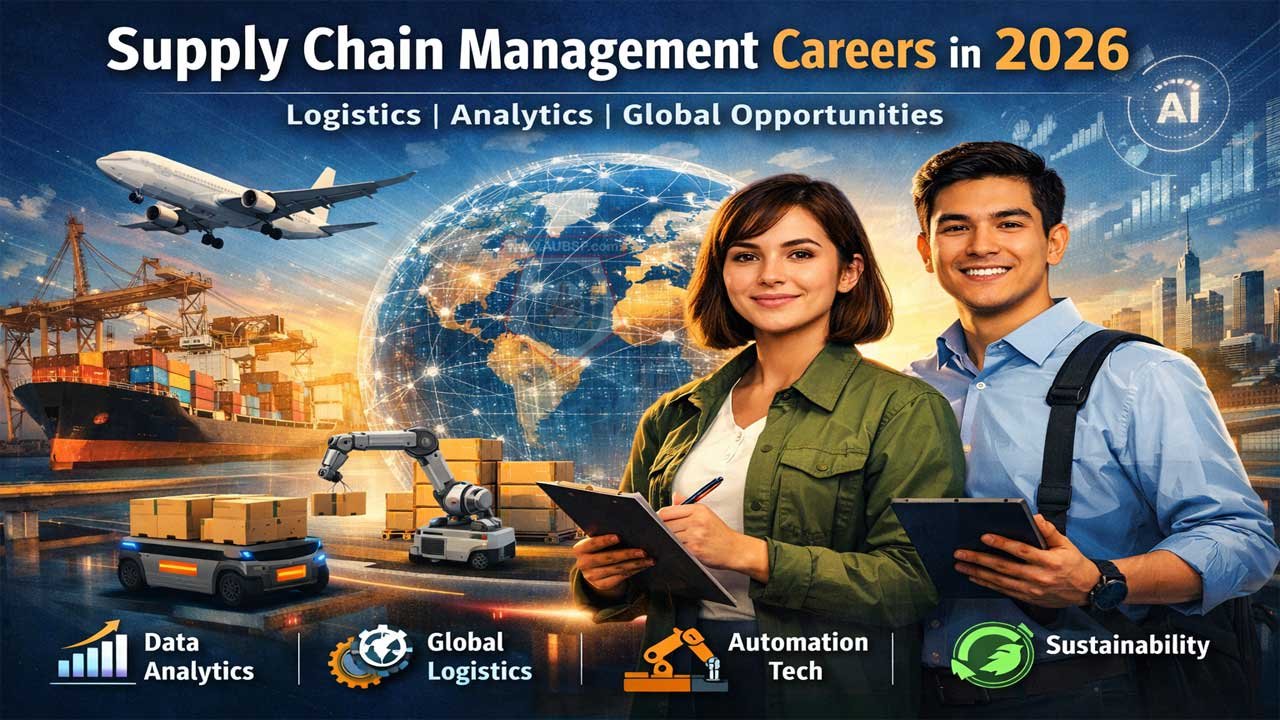
The global economy in 2026 is highly connected and depends on strong supply chains to keep goods, information, and money moving smoothly. A Bachelor of Supply Chain Management (BSCM) has become an important degree because businesses now rely on supply chain experts for strategy and leadership, not just operations.
The program teaches students how to manage logistics, procurement, production, data analysis, and risk using both theory and practical experience such as internships and simulations. Universities around the world offer strong programs, especially in the U.S., Europe, Canada, and Asia, each focusing on different industry strengths. Graduates have good career opportunities, high salaries, and roles like supply chain analyst, logistics manager, or procurement specialist.
New technologies such as AI, digital twins, automation, and sustainable practices are shaping the field, making analytical and technological skills essential. Overall, a BSCM is a valuable degree with strong job demand, global career options, and long-term growth potential.
| Information | Details |
|---|---|
| Degree Name | Bachelor of Supply Chain Management (BSCM) |
| Field of Study | Business, Logistics & Operations Management |
| Duration | 3–4 years (depending on country/university) |
| Core Subjects | Procurement, Logistics, Operations Management, Data Analytics, Global Supply Chain |
| Key Skills Gained | Data analysis, problem-solving, inventory planning, negotiation, risk management |
| Learning Method | Lectures, case studies, simulations, internships, industry projects |
| Top Study Destinations | USA, Canada, UK, Netherlands, Singapore |
| Career Roles | Supply Chain Analyst, Logistics Manager, Procurement Officer, Operations Analyst |
| Starting Salary (Global Avg.) | $65,000–$85,000 USD per year (entry level) |
| Job Demand | High and growing worldwide due to digital transformation |
| Emerging Technologies | AI forecasting, Digital Twins, Automation, IoT, Data Analytics |
| Industry Sectors | Manufacturing, Retail, Technology, Healthcare, Aerospace, E-commerce |
| Work Opportunities | Global careers with strong placement and internship options |
| ROI (Return on Investment) | High due to strong salary growth and demand |
| Future Trends | Sustainable supply chains, automation, AI-driven decision making |
Bachelor of Supply Chain Management (BSCM): Career Scope, Courses, Salary & Global Opportunities in 2026
The global economy in 2026 operates as an extraordinarily complex and hyper-connected biological system, where the traditional boundaries of commerce have been superseded by sophisticated, data-driven logistical architectures. At the core of this industrial metamorphosis lies the Bachelor of Supply Chain Management (BSCM), a degree that has evolved from a secondary business specialization into a primary strategic discipline essential for the resilience and competitive advantage of modern enterprises.
Supply chain management, in its most academic form, is defined as the systematic oversight of the multi-directional flow of goods, services, information, and financial capital. It involves the intricate planning and execution of processes that facilitate inventory management, logistics, storage, transportation, and robust risk management—all of which serve as the fundamental pillars of contemporary business success.
As the world enters a period of significant operational pressure characterized by shifting market conditions, rising consumer expectations, and maturing digital technologies, the role of the supply chain professional has transitioned from a back-office administrative function to a front-line leadership position responsible for navigating geopolitical and environmental volatility.
The Academic Architecture of Modern Supply Chain Education
The curriculum of a premier Bachelor of Supply Chain Management program is meticulously engineered to provide a holistic understanding of integrated supply chain principles, bridging the chasm between theoretical business frameworks and the high-stakes reality of global operations.
This educational journey begins with foundational concepts in operations management and procurement, eventually escalating into advanced quantitative methodologies such as statistical modeling, data warehousing, data mining, and stochastic optimization. The pedagogical objective is to empower students to view the supply chain not as a series of isolated transactions, but as a strategic asset that can anticipate change rather than merely reacting to it.
Foundational Pillars and Core Subjects
The modern BSCM curriculum is designed around several critical value-adding components that enhance global competitiveness. These components integrate topics from manufacturing operations, purchasing, and physical distribution into a unified, interdisciplinary program.
| Curricular Pillar | Representative Coursework | Core Learning Objectives |
|---|---|---|
| Strategic Procurement | SCM 371: Procurement and Supply Management; SCM 460: Procurement Contracting. | Mastery of the procurement cycle, supplier relationship management, negotiation strategies, and commodity planning. |
| Operations Management | SCM 372: Manufacturing and Service Operations; Lean Methodology. | Optimization of production planning, demand management, master scheduling, and organizational efficiency. |
| Logistics & Distribution | SCM 373: Logistics and Transportation; Global Supply Chain Management. | Management of the physical movement of goods, facility design, carrier selection, and transportation costing. |
| Quantitative Analytics | SCM 475: Data Analytics in SCM; Statistical Modeling; Decision Modeling. | Application of forecasting, aggregate planning, and optimization techniques to drive data-informed decision-making. |
| Strategic Integration | SCM 470: Integrated SCM Capstone; Global Supply Network Management. | Synthesis of sourcing, operations, and logistics to provide end-to-end solutions for complex business problems. |
The depth of this education is further enriched by specialized modules that address the nuances of modern commerce. For example, Michigan State University offers specific courses on Customs, Compliance, and Security (SCM 461) and Supply Chain Enterprise Resource Planning (ERP) Applications (SCM 463), ensuring that students are prepared for the regulatory and technological realities of international trade.
Similarly, programs like the BSBA in Global Supply Chain Management at Rider University merge coursework from operations, marketing, business analytics, and information systems to foster an interdisciplinary perspective.
Pedagogy and Experiential Learning Models
The evolution of supply chain education has shifted toward an experiential learning model, where theoretical concepts are brought to life through hands-on projects, industry collaborations, and sophisticated simulations. Programs such as those at the Harbert College of Business emphasize internships, case competitions, and analytical projects to deepen proficiency in inventory control, performance analysis, and production scheduling. In 2026, the use of end-to-end supply chain management simulations (SCM 462) has become a standard requirement, allowing students to experience the ripple effects of their decisions in a risk-free, digital environment.
Collaboration with industry partners is another hallmark of top-tier BSCM programs. At Michigan State, the experiential learning course (SCM 472) involves integrated analysis and problem-solving in collaboration with engineering departments, reflecting the cross-functional nature of real-world supply chains. All students at Florida Gulf Coast University are required to complete an internship or industry project, ensuring they graduate with the practical skills vital for success in procurement, strategic sourcing, and logistics management. This focus on practical application is crucial, as employers increasingly seek graduates who can demonstrate immediate value in identifying inefficiencies and proposing sustainable solutions.
The Global University Landscape: Regional Hubs of Excellence
For international students, the choice of a BSCM program is often dictated by the economic strengths and industry affiliations of the host country. The global landscape features several distinct regions of academic excellence, each offering unique advantages in terms of research productivity, alumni networks, and work authorization pathways.
The North American Stronghold: Innovation and Scale
The United States continues to dominate the global supply chain management market, holding a 31.3% share in 2025. This economic dominance is reflected in its academic institutions, which are consistently ranked among the best in the world for their industry-relevant curricula and innovative research.
| University / School | Key Rankings & Accolades | Unique Selling Propositions (USPs) |
|---|---|---|
| MIT Center for Transportation & Logistics | Consistently ranked #1 globally by QS and Gartner. | Pioneer in supply chain research; 10-month intensive Master’s programs; 95-96% placement rate. |
| University of Tennessee (Haslam) | #1 Graduate SCM program in the U.S. (Gartner 2024); one of the largest undergraduate majors. | Massive alumni network; strong focus on industry-relevant curriculum and talent development. |
| Michigan State University (Broad) | Consistently ranked in the top 3 globally; 408 degrees awarded in 2023. | Comprehensive integration of manufacturing, purchasing, and logistics; robust career placement. |
| Arizona State University (W. P. Carey) | Rising rapidly in rankings; strong focus on analytics and data-driven SCM. | STEM-designated program; small class sizes; strong industry ties with companies like Boeing. |
| Auburn University (Harbert) | #7 National ranking; #8 Global ranking in faculty research productivity. | 40 years of supply chain education; emphasis on logistics and operations management training. |
A critical advantage for international students in the U.S. is the designation of several BSCM programs as STEM (Science, Technology, Engineering, and Mathematics) degrees. This classification allows students on F-1 visas to apply for a 24-month STEM-OPT extension, providing a total of 36 months of work authorization in the U.S. after graduation—a significant benefit for those seeking to gain professional experience in the world’s largest consumer market.
In Canada, the supply chain sector is expanding rapidly, supported by favorable immigration pathways such as Express Entry, which favors supply chain professionals. The University of British Columbia (UBC) Sauder School of Business offers a prestigious Bachelor of Commerce with a specialization in operations and logistics, featuring a robust Co-op program where 88% of graduates are hired within six months. Canada’s proximity to the American market and its participation in the USMCA trade agreement make it an ideal hub for students interested in North American trade dynamics.
The European Hub: Logistics, Trade, and Sustainability
European countries, particularly the Netherlands and the United Kingdom, are undisputed leaders in maritime trade, efficient port operations, and strategic procurement. These regions offer BSCM programs that emphasize the global and socio-political dimensions of logistics.
- Erasmus University Rotterdam (Netherlands): Located in Europe’s largest port city, it offers a world-class curriculum in global logistics and trade focus.
- WU Vienna University of Economics and Business (Austria): A top-ranked European program highly sought after by consulting firms and manufacturers.
- Northumbria University (UK): Offers a BA (Hons) in Business and Supply Chain Management with a 4-year sandwich option that includes a year-long placement or study abroad.
- Cranfield School of Management (UK): Boasts one of the largest specialist logistics and supply chain management faculties in Europe, with programs co-designed alongside senior industry professionals.
European programs often place a stronger emphasis on sustainability and the ethical challenges of global distribution. For instance, the University of Sussex and Cardiff University offer specialized modules in sustainable supply chain management, reflecting the stringent regulatory environment of the European Union.
The Asia-Pacific Gateway: Hub-Centric Logistics
Singapore serves as the premier gateway to Asian markets, including China, India, and Southeast Asia. Studying supply chain management in Singapore is often compared to studying finance in London; students are at the epicenter of global trade routes.
- National University of Singapore (NUS): Home to the world-renowned MSc in Supply Chain Management and strong undergraduate offerings in operations.
- Nanyang Technological University (NTU): Features strong logistics and operations programs with unparalleled industry connections to the world’s busiest container ports.
- The Hong Kong Polytechnic University: Offers a highly-ranked BBA in International Shipping and Transport Logistics, focusing on the vibrant logistics ecosystem of the Pearl River Delta.
The Asia-Pacific region is estimated to hold the highest compound annual growth rate (CAGR) in the SCM market through 2034, driven by evolving manufacturing and logistics sectors in India and ASEAN nations.
Navigating International Admissions: Requirements and Strategic Planning
For the international applicant, the journey toward a BSCM degree requires a high degree of strategic planning, typically commencing 12 to 18 months prior to the intended start date. Admissions committees at top business schools employ holistic evaluation criteria, considering academic performance, standardized test scores, English proficiency, and personal attributes such as leadership and community involvement.
Standardized Testing and Academic Eligibility
While many undergraduate programs have transitioned to test-optional policies, highly selective institutions still utilize standardized tests to assess quantitative and analytical readiness.
| Degree Level | Typical GPA Requirements | Standardized Test Benchmarks |
|---|---|---|
| Undergraduate (U.S./Global) | 2.0 – 3.4 on a 4.0 scale; top programs require 3.0+. | SAT/ACT often required for selective business schools; SAT Math scores are highly weighted. |
| Graduate/Accelerated Masters | Minimum 3.0, though competitive candidates often have 3.3+. | GRE (320+) or GMAT (650+) scores are common for top-tier master’s programs. |
| Transfer Applicants | Minimum 2.0 – 2.5 on college-level coursework. | Evaluation focuses on prerequisite courses in Math, Statistics, and Business. |
Academic backgrounds in engineering, business, economics, and mathematics are considered ideal for supply chain studies. Furthermore, a strong quantitative or analytical ability must be evidenced throughout educational records, with particular attention paid to success in challenging quantitative courses.
English Language Proficiency Benchmarks
Verification of English proficiency is a non-negotiable requirement for international students whose native language is not English. Minimum score requirements vary based on the institution’s selectivity and the intensity of the curriculum.
- TOEFL iBT: Most bachelor’s programs require a score of 64 to 80, while elite programs like the University of Washington’s Master of SCM require a minimum of 92.
- IELTS Academic: An overall band score of 6.0 is standard for undergraduate entry, while graduate or high-tier programs often mandate a 6.5 to 7.0.
- PTE Academic: Typically requires a score between 50 and 65.
- Duolingo English Test: Increasingly accepted, with minimum scores ranging from 110 to 125.
Global Application Timelines and Systems
Understanding the specific deadlines of various national application systems is critical for ensuring equal consideration.
- United Kingdom (UCAS): Applications for 2026 entry open on September 2, 2025. The equal consideration deadline for most undergraduate courses is January 14, 2026. Late applications can be submitted until June 30, after which candidates enter the “Clearing” cycle.
- United States: Most universities operate on a two-semester system (Fall/Spring). Fall application deadlines for top programs often occur in early January, with notifications issued by mid-May.
- Singapore (NUS/NTU): The application period for the 2026/2027 academic year typically runs from early December 2025 to late February 2026.
- Canada: Deadlines vary by province (e.g., OUAC in Ontario) and institution. UBC Sauder’s final application deadline for 2026 was extended to late January.
Economic Outcomes: Compensation Benchmarks and Career Trajectories
The economic value of a Bachelor of Supply Chain Management is underscored by the clear and sustained high demand for skilled professionals across the global job market. Employment for logisticians and supply chain managers is projected to surge by 17% to 18% through 2034, driven by the integration of emerging technologies and the evolution of complex inventory systems.
Global Salary Comparison by Region and Experience
Graduates with a BSCM degree often qualify for mid-level management roles and specialized positions that offer some of the highest starting salaries in the business field.
| Region | Entry-Level Salary (0-3 Years) | Mid-Career Salary (5-10 Years) | Senior/Director Level (15+ Years) |
|---|---|---|---|
| United States | $65,000 – $85,000 USD | $100,000 – $130,000 USD | $150,000 – $350,000+ USD |
| Singapore | SGD 55,000 – 85,000 | SGD 110,000 – 160,000 | SGD 200,000 – 500,000+ |
| United Kingdom | £28,204 – £35,733 | £45,000 – £60,000 | £80,000 – £120,000+ |
| Canada | CAD 58,000 – 65,000 | CAD 72,000 – 88,000 | CAD 96,000 – 150,000+ |
Salaries are significantly influenced by the industry of employment. For instance, supply chain managers in the pharmaceutical, technology, and aerospace sectors tend to earn more than those in retail or manufacturing. In the UK, senior supply chain directors can earn upwards of £82,308, while logistics managers in high-demand hubs like Milton Keynes or London see average annual pay of £55,206 and £49,010 respectively.
Sector-Specific Professional Roles
A BSCM degree opens doors to a diverse array of positions across all sectors of the economy, including healthcare, manufacturing, and the public sector.
- Supply Chain Analyst: Responsible for data analysis, demand forecasting, and inventory reporting to identify inefficiencies.
- Procurement Officer/Manager: Sourcing materials and services, negotiating purchase orders, and evaluating vendor performance.
- Logistics Coordinator/Planner: Tracking shipments, preparing documentation, and troubleshooting delays to ensure smooth flow.
- Operations Analyst: Monitoring logistical data to improve process efficiency and reduce operational friction.
- Inventory Specialist: Managing stock levels to balance carrying costs with consumer service requirements.
The career ladder in this field is well-defined, with clear paths to executive roles such as Vice President of Operations or Chief Supply Chain Officer (CSCO), positions that now exist in almost every Fortune 500 company.
Technological Paradigm Shifts and Emerging Trends in 2026
The landscape of 2026 is defined by a profound shift from focusing solely on resilience to delivering total value across the business through “connected intelligence”. Global investment in digital transformation is projected to reach $3.4 trillion in 2026, with supply chain modernization being a top priority.
Agentic AI and Autonomous Decision-Making
Artificial Intelligence has moved beyond simple analytics into “Agentic AI”—autonomous systems that ingest supplier data, track regulatory changes, and flag sustainability risks in real time. These systems are now the first true digital collaborators, capable of rerouting freight, adjusting inventory levels, and even negotiating pricing with suppliers without human intervention. By 2026, nearly 70% of large organizations are expected to adopt AI-based forecasting, using platforms like SAP Business AI to resolve exceptions before they escalate into disruptions.
Digital Twins and Predictive Resilience
The utilization of Digital Twins—real-time virtual models of the supply chain—has reshaped strategic planning. These models allow supply chain leaders to run scenario tests and “what-if” simulations, assessing how a new tariff policy or a climate event would impact distribution. This shift allows organizations to move from reactive responses to proactive resilience models that incorporate not just financial data, but also emissions exposure and human rights performance.
Robotics and Warehouse Intelligent Ecosystems
Smart factories and connected warehouses are now standard. Approximately 60% of new automation deployments in 2026 involve Autonomous Mobile Robots (AMRs), signaling a shift toward fully integrated operations. These robots, along with Goods-to-Person automated storage and retrieval systems (ASRS), maximize vertical space and speed up replenishment during seasonal surges. The integration of IoT sensors and edge computing allows these systems to detect bottlenecks and keep material flow moving efficiently.
Sustainability and Circularity as Strategic Imperatives
Environmental, Social, and Governmental (ESG) considerations have become the core of supply chain design. Organizations are reimagining logistics to favor low-carbon solutions, such as electric fleets, rail expansion, and optimized routing.
The Circular Supply Chain Model
Leading-edge firms are adopting circular models that prioritize waste reduction, material reuse, and lowered emissions. This shift is driven not only by regulatory pressure, such as the upcoming EU AI Act and sustainability reporting mandates, but also by the need for strategic advantage. Measurable impact indicators, from avoided disruptions to reduced material use, are now essential for securing financing and building stakeholder trust.
Ethical Sourcing and Human Rights
Sustainable procurement now incorporates social indicators, monitoring deforestation risk and supplier disclosures in real time. AI agents are increasingly used to track these metrics, ensuring that global supply networks remain compliant with evolving human rights standards. This holistic approach to sustainability clarification ensures that it is no longer viewed as a cost center but as a source of strategic resilience and efficiency.
Financial Planning: Costs, Scholarships, and ROI
The financial investment required for a BSCM degree varies significantly by country and the type of institution.
| Country / Region | Average Undergraduate Tuition (International) | Average Living Expenses (Annual) |
|---|---|---|
| United States | $30,000 – $60,000 USD | $15,000 – $25,000 USD |
| Canada | $25,000 – $45,000 CAD | $15,000 – $20,000 CAD |
| United Kingdom | £15,000 – £28,000 GBP | £12,000 – £18,000 GBP |
| Singapore | $30,000 – $45,000 SGD | $12,000 – $18,000 SGD |
Despite these costs, the return on investment (ROI) remains exceptionally high, with graduates often securing starting salaries that exceed the national average by over 50%.
Scholarship Opportunities for International Students
International students can access a wide array of merit-based and industry-sponsored scholarships.
- Institutional Scholarships: Many schools, like the W. P. Carey School of Business, offer specific scholarships ranging from $1,000 to $5,000 for supply chain majors. UBC offers the International Major Entrance Scholarship (IMES) and the Outstanding International Student (OIS) Award.
- Industry Awards: Organizations such as the Institute for Supply Management (ISM) and global companies like Boeing provide financial support to students who demonstrate passion and potential in the field.
- Specific Interest Awards: Scholarships are often targeted toward students with unique interests in aerospace, cybersecurity, or public procurement.
Synthesized Analysis and Strategic Recommendations
The Bachelor of Supply Chain Management stands as one of the most vital academic qualifications in the 2026 global economy. For international students, the convergence of high salary growth, geopolitical complexity, and technological innovation makes this degree a exceptionally safe and high-yielding investment.
Strategic Takeaways for Future Professionals
- Prioritize STEM Designation: International students, particularly in the U.S., should prioritize STEM-designated programs to maximize their post-graduation work authorization through the 36-month OPT period.
- Focus on Analytical Skillsets: Success in the 2026 job market requires more than logistical knowledge; it demands proficiency in data analytics, AI-powered decision modeling, and cybersecurity resilience.
- Leverage Global Hubs: Students should choose their study destination based on industry alignment—the U.S. for tech-driven SCM, Singapore for maritime and Asian market access, or the Netherlands for procurement and logistics expertise.
- Embrace Sustainability: Understanding sustainable supply chain management is no longer optional. Professionals who can integrate ESG metrics into core business operations will be highly sought after for leadership roles.
- Proactive Application Management: Given the competitive nature of top-tier programs and the complexities of international visas, students must strictly adhere to the timelines of systems like UCAS, OUAC, and NUS.
The modern supply chain professional is the guardian of the global flow of value. By obtaining a BSCM, students are not just learning to manage goods; they are learning to architect the systems that sustain the modern world, ensuring they are prepared for a dynamic, future-proof career in one of the most versatile business majors available today.
FAQs about Bachelor of Supply Chain Management
What is a Bachelor of Supply Chain Management (BSCM)?
A Bachelor of Supply Chain Management is a business degree that focuses on managing the flow of goods, services, information, and finances from suppliers to customers efficiently.
What subjects are included in a BSCM program?
Common subjects include logistics, procurement, operations management, inventory control, transportation, data analytics, and global supply chain strategy.
What career options are available after a BSCM degree?
Graduates can work as supply chain analysts, logistics coordinators, procurement managers, operations analysts, inventory planners, or supply chain consultants.
Is supply chain management a good career choice in 2026?
Yes, it is a high-demand field due to global trade growth, digital transformation, and the need for efficient logistics and risk management.
What skills do students gain from this degree?
Students develop analytical thinking, problem-solving, data analysis, negotiation, planning, communication, and technology-based decision-making skills.
Which countries are best for studying supply chain management?
Popular destinations include the United States, Canada, the United Kingdom, the Netherlands, and Singapore because of strong industry connections and career opportunities.
Do BSCM students need strong math or analytics skills?
Basic to intermediate math and analytical skills are helpful because the program involves forecasting, statistics, and data-driven decision-making.
What is the average salary after completing a BSCM degree?
Entry-level salaries typically range from $65,000 to $85,000 USD annually, depending on location, industry, and experience.
Are internships important in supply chain management studies?
Yes, internships provide practical experience and help students gain industry exposure, making them more employable after graduation.
How is technology changing supply chain careers?
Technologies like AI, automation, digital twins, and data analytics are improving forecasting, logistics planning, and operational efficiency, creating new career opportunities.
Is supply chain management suitable for international students?
Yes, the degree offers global career mobility, strong job demand, and work opportunities across multiple industries worldwide.
What industries hire supply chain management graduates?
Graduates are hired in manufacturing, e-commerce, healthcare, retail, technology, aerospace, and logistics companies.


Leave a Reply
You must be logged in to post a comment.