
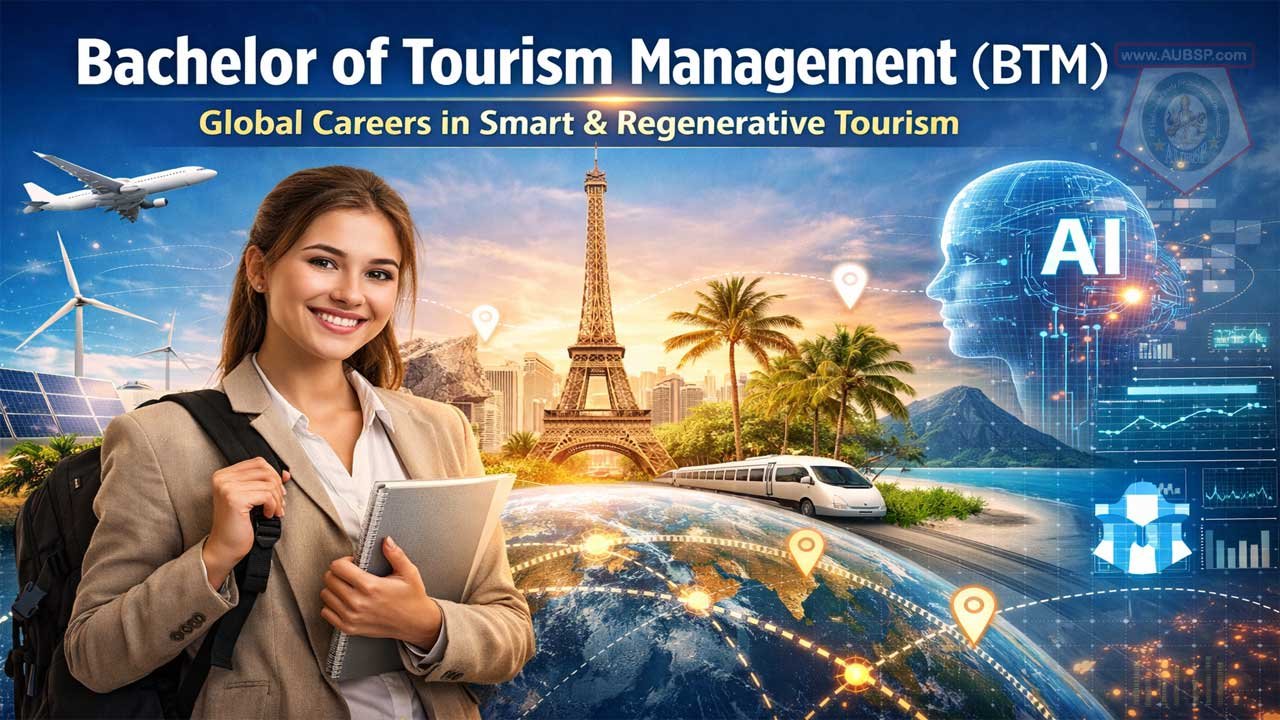
The global tourism industry is growing fast and may reach $11 trillion by 2033, according to the World Travel and Tourism Council. It now focuses on smart technology, AI, and regenerative tourism. A Bachelor of Tourism Management (BTM) is a business degree that teaches students how to manage destinations, not just hotels.
Tourism management looks at travel, marketing, and sustainability, while hospitality management focuses on hotels and guest services. Top schools are in Switzerland, the US, the UK, Canada, and Australia. Students study business, marketing, analytics, and sustainable planning over four years. English tests like IELTS or TOEFL are usually required for admission.
Graduates can work in events, sustainability, analytics, or luxury travel. Technology like AI, blockchain, VR, and AR is changing the industry. The field is moving from sustainable tourism to regenerative tourism, which aims to improve places, not just protect them. Overall, a BTM offers strong global career opportunities in a fast-changing industry.
| Category | Information |
|---|---|
| Degree Name | Bachelor of Tourism Management (BTM) |
| Industry Value | Over $10 trillion globally |
| Future Projection | Expected to reach $11 trillion by 2033 (World Travel and Tourism Council) |
| Study Duration | 3–4 years |
| Core Focus | Destination management, travel logistics, marketing, sustainability |
| Key Subjects | Business fundamentals, tourism marketing, revenue management, analytics, sustainable planning |
| Technology Trends | AI, blockchain, VR/AR, smart tourism systems |
| English Requirement | IELTS 6.0–6.5 / TOEFL iBT 79–88 (varies by university) |
| Top Study Destinations | Switzerland, USA, UK, Australia, Canada |
| Career Paths | Destination marketer, event manager, sustainability manager, revenue analyst |
| Entry-Level Salary | $35,000–$65,000 (region dependent) |
| Senior-Level Salary | $80,000–$150,000+ (role & location dependent) |
| Industry Employment | ~10% of global jobs |
Bachelor of Tourism Management (BTM) Guide 2026: Career, Salary, Top Universities & Future Trends
The global tourism and hospitality landscape has entered a phase of unprecedented structural realignment. As of 2023, the sector was valued at over $10 trillion, with professional projections by the World Travel and Tourism Council (WTTC) indicating a rise to $11 trillion by 2033.
This growth is not merely quantitative but qualitative, as the industry shifts toward a “smart” ecosystem dominated by artificial intelligence, blockchain-enabled transparency, and a transition from passive sustainability to active regenerative tourism. Within this context, the Bachelor of Tourism Management (BTM) has emerged as a critical academic credential, transcending its vocational origins to become a rigorous, interdisciplinary business degree.
Tourism currently accounts for approximately 10% of global employment, necessitating a workforce capable of navigating complex geopolitical risks, environmental mandates, and a rapidly evolving digital consumer landscape.
The Academic Architecture of Tourism Management
The modern Bachelor of Tourism Management is designed to equip students with a multi-dimensional understanding of how destinations attract, manage, and retain visitors. Unlike traditional hospitality programs that focus heavily on the minutiae of service delivery within a single property, the BTM adopts a “macro” perspective, viewing tourism as a complex socioeconomic phenomenon. This involves the integration of business fundamentals—such as accounting, business law, and microeconomics—with industry-specific modules including destination marketing, sustainable planning, and revenue optimization.
Distinction Between Tourism and Hospitality Management
While the terms are often used interchangeably in casual discourse, they represent distinct professional and academic focuses. Hospitality management centers on the operational aspects of providing accommodation, food, and beverage services, emphasizing guest satisfaction within specific settings like hotels or restaurants. In contrast, tourism management encompasses the broader logistics of travel, destination promotion, and the management of attractions and events intended to draw tourists to a specific region.
| Parameter | Hospitality Management | Tourism Management |
|---|---|---|
| Core Focus | Accommodation, dining, and guest service quality. | Promotion, destination marketing, and travel logistics. |
| Primary Goal | Enhancing guest satisfaction during a stay. | Creating seamless travel experiences and managing regional impacts. |
| Academic Emphasis | Operations, food & beverage management, and personnel oversight. | Travel trends, cultural impacts, and sustainable destination development. |
| Key Job Roles | Hotel Manager, Restaurant Manager, Executive Chef. | Destination Marketer, Tour Operator, Sustainable Tourism Expert. |
The intersection of these fields is increasingly evident in the “experience economy,” where the quality of hospitality services (the stay) is inseparable from the tourism attractions (the reason for the visit). However, for a student, the choice of degree dictates the level of analysis; a BTM student will spend more time studying how a city can manage its carrying capacity and environmental footprint, while a hospitality student will focus on maximizing revenue per available room (RevPAR).
Institutional Profiles and Global Ranking Excellence
Prospective students seeking international traffic for tourism education typically prioritize institutions that appear in the top echelons of global rankings, such as the QS World University Rankings by Subject: Hospitality and Leisure Management. Switzerland continues to maintain a virtual monopoly on the highest-ranked schools, though institutions in the United States, United Kingdom, Australia, and Asia are gaining significant ground.
The Swiss Paradigm of Excellence
Switzerland is widely considered the birthplace of luxury hospitality and tourism education, a tradition that dates back 150 years. The Swiss model is defined by its “preparatory year” concept and the integration of intensive hands-on training with high-level business strategy.
| Global Rank | Institution | Country | Key Feature |
|---|---|---|---|
| 1 | EHL Hospitality Business School | Switzerland | Renowned for luxury hospitality and global prestige. |
| 2 | Les Roches Global Hospitality Education | Switzerland | Focuses on entrepreneurship and innovation. |
| 3 | Swiss Hotel Management School (SHMS) | Switzerland | Emphasizes international hotel management in a historical setting. |
| 5 | César Ritz Colleges Switzerland | Switzerland | Specializes in tourism and entrepreneurship. |
| 6 | Glion Institute of Higher Education | Switzerland | Known for event, sport, and entertainment management. |
Institutions like EHL have established a rigorous standard where graduates are expected to exhibit “Rigor, precision, and discretion,” traits carried over from Swiss cultural characteristics into the global industry.
Leading Destinations in North America and Oceania
The United States and Australia offer a more research-centric and data-driven approach to tourism management. The University of Nevada, Las Vegas (UNLV), located in one of the world’s primary tourism laboratory environments, ranks fourth globally. Its William F. Harrah College of Hospitality is deeply integrated with the gaming and entertainment sectors.
In Australia, Griffith University and the University of Queensland lead the region. Griffith is particularly noted for its abundance of real-life workshops and engagement opportunities outside the classroom, which are crucial for navigating the Australian “Year 12” equivalent academic environment.
| University | Location | Notable Strength |
|---|---|---|
| UNLV | Las Vegas, USA | Gaming, entertainment, and urban tourism. |
| NYU | New York City, USA | Real estate, marketing analytics, and event management. |
| Griffith University | Gold Coast, Australia | Sustainable tourism and industry-integrated learning. |
| University of Surrey | Guildford, UK | High citations per paper and food/beverage research. |
| SAIT | Calgary, Canada | Applied, hands-on training with high employment rates. |
Curricular Deep Dive: The Four-Year Academic Journey
The curriculum of a Bachelor of Tourism Management is meticulously structured to move from foundational business literacy to advanced strategic planning and niche specialization. Analyzing the course overview from a top-tier institution like the University of South Carolina provides a blueprint for the BTM experience.
Year 1: Foundations and Personal Development
The first year is typically focused on establishing a broad liberal arts and business foundation. Students engage with the basic principles of management, mathematics, and foreign languages. Introductory courses such as “Foundations of Tourism” provide the historical and conceptual framework of the industry.
Year 2: Operational and Legal Competency
In the second year, the focus shifts toward the mechanics of the industry. Core business requirements such as accounting, economics, and business law are completed. This is also where students begin to explore specific sectors like “Club Management,” “Conference and Meeting Planning,” and “Resort Development and Management”. These courses teach essential skills in budgeting, vendor negotiations, and site selection, preparing students for the logistical challenges of managing large-scale operations.
Year 3: Strategy, Marketing, and Field Application
The third year often includes a mandatory professional development seminar and the first major internship. Specialized modules like “Festival Planning and Management” and “Services Management” introduce the concepts of risk management and audience engagement. Marketing courses at this level move beyond basics to focus on “Placemaking and Destination Branding,” teaching students how to create a unique value proposition for a city or region.
Year 4: Leadership and Advanced Analytics
The final year is dedicated to senior-level strategy and data-driven decision-making. Students take courses in “Hospitality/Tourism Analytics,” where they learn to leverage big data to predict industry trends and optimize operations. Financial management and “Revenue Management” are critical at this stage, focusing on strategic pricing to maximize profitability. The capstone of many programs is a module on “Sustainable Tourism Planning,” which challenges students to synthesize all they have learned to create environmentally and socially responsible tourism models.
| Specific Course Title | Year | Core Learning Objective |
|---|---|---|
| Hospitality/Tourism Analytics | 4 | Using data collection and interpretation to drive strategic business outcomes. |
| Sustainable Tourism Planning | 4 | Applying policy and planning principles to meet the needs of diverse stakeholders. |
| Revenue Management | 4 | Optimizing pricing and distribution channels to maximize profitability. |
| Tourism Information Technology | 4 | Understanding the role of modern tech like reservation systems and CRM. |
International Admission Requirements for the 2026-2027 Cycle
Securing a place in a top BTM program requires meeting rigorous academic and linguistic standards. As the industry becomes more globalized, universities are increasing their expectations for English proficiency and prior academic performance.
English Language Proficiency
For non-native speakers, proof of English proficiency is a non-negotiable requirement. Institutions vary in their acceptable scores, with top-tier schools like the University of Surrey or Griffith University demanding an IELTS score of 6.5, with no sub-score below 6.0.
| Test Type | Standard Entry Requirement | Premium/Direct Entry Requirement |
|---|---|---|
| IELTS (Academic) | 6.0 – 6.5. | 7.0 – 7.5. |
| TOEFL iBT | 79 – 88. | 95 – 101. |
| PTE (Academic) | 58 – 67. | 76 – 79. |
| Duolingo | 110 – 120. | 130 – 140. |
Academic Prerequisites and Pathways
Students are typically expected to have completed secondary education comparable to an Australian Year 12 or British A-Levels with a GPA ranging from 2.7 to 3.0 on a 4.0 scale. Some Swiss institutions like EHL use a 20-point scale, requiring a minimum of 12/20, while also prioritizing students who have taken higher-level (HL) subjects in mathematics and natural sciences in the International Baccalaureate (IB).
For those who do not meet these criteria, “Admission Pathways” are increasingly common. Griffith University, for instance, allows students to complete a foundation or diploma program at Griffith College, which then provides direct entry into the second year of the bachelor’s degree. Similarly, EHL offers a 12-week bridge semester called “Essentials for Hospitality & Business Studies” for students with gaps in math or English.
Career Outcomes and Global Salary Potential
A Bachelor of Tourism Management serves as a gateway to some of the fastest-growing job sectors in the global economy. By 2033, it is projected that one in eight new jobs globally will be in the leisure and hospitality sector.
Salary Ranges by Region
The earning potential for BTM graduates is highly dependent on geographic location, years of experience, and the specific niche within the industry.
| Position | Region | Entry-Level Salary | Senior-Level Salary |
|---|---|---|---|
| Hotel General Manager | USA | $65,500. | $104,500 – $150,000+. |
| Event Planner/Manager | Europe | €35,000. | €50,000+. |
| Tourism Management | Ontario, CAN | $37,000 (CAD). | $99,500 (CAD). |
| Destination Marketer | Europe | €45,000. | €65,000+. |
| Sustainability Manager | Global | €50,000. | €80,000+. |
In the United States, the average annual salary for tourism management professionals as of February 2026 is approximately $83,385, with top earners in the 90th percentile making over $103,965. Key factors influencing these numbers include education level—with 54.7% of high earners holding a bachelor’s degree—and specialized skills such as auditing or workplace safety.
Diversity of Career Paths
The BTM degree opens doors beyond traditional hotel management. Graduates are increasingly finding roles in “emerging digital-hospitality sectors” and “experience-led” travel companies.
- Event Management: Coordinating everything from corporate conferences to music festivals. In Europe, event planners are among the most in-demand tourism professionals.
- Sustainability and Regeneration: Managing the environmental impact of tourism. This sub-sector is growing 3x faster than the industry average.
- Revenue and Data Analytics: Using predictive models to optimize pricing for airlines, cruise lines, and resorts.
- Bespoke Luxury Advisory: Serving high-net-worth individuals (HNWIs) by designing hyper-personalized, “intentional restoration” experiences.
- Museum and Cultural Site Direction: Overseeing the operations, finance, and curation of major cultural attractions, with salaries ranging up to $121,500 in the US.
The Smart Revolution: Technology Trends for 2026-2027
The integration of advanced technologies is fundamentally reinventing the tourism business model. Students entering a BTM program in 2026 will need to be proficient in a “Smart Ecosystem” that prioritizes data and automated efficiency.
Artificial Intelligence and Agentic AI
Generative AI is shifting from being a novelty to a “non-negotiable” business tool. Employers anticipate that 39% of core industry skills will change by 2030 due to AI. In 2026, “Agentic AI” will begin to transform daily operations. These AI agents do not just answer questions; they perform tasks—managing dynamic pricing, responding to complex booking inquiries, and optimizing marketing spend across multiple channels. For DMOs (Destination Marketing Organizations), AI is used to consolidate data from diverse sources to demonstrate economic impact to stakeholders.
Blockchain and Digital Governance
Blockchain technology is being embraced for its capacity to enhance security and transparency in a sector that relies heavily on trust. Beyond secure payments, blockchain is used for:
- Supply Chain Transparency: Tracking the environmental impact and emissions of travel providers.
- Decentralized Ratings: Creating immutable review systems that cannot be manipulated by fraudulent data.
- Smart Contracts: Automating insurance payouts for flight delays or managing loyalty programs across different airlines and hotel chains.
Immersive Technology: AR, VR, and the Metaverse
The “Experience Economy” is increasingly moving into mixed reality. Virtual Reality (VR) is used to offer “immersive heritage exploration,” allowing potential travelers to explore destinations before booking. Augmented Reality (AR) enhances the on-site visitor experience, providing interactive historical context or wayfinding in complex attractions like theme parks or museums.
The Paradigm Shift: From Sustainable to Regenerative Tourism
One of the most profound shifts in tourism management is the transition from “minimizing harm” (sustainability) to “actively healing” (regeneration). Spain’s Sustainable Tourism Strategy 2030 is a leading example of this paradigm shift, where vacations are used as a tool for environmental and social restoration.
Defining Regenerative Tourism
Regenerative tourism views travel as an opportunity to restore ecosystems and support local communities. While sustainable tourism might focus on reducing plastic use at a resort, a regenerative approach would involve the resort actively engaging in reforestation projects or supporting the development of new economic opportunities for local residents.
| Metric of Success | Sustainable Tourism | Regenerative Tourism |
|---|---|---|
| Core Philosophy | Do no harm / Minimize impact. | Leave the place better than you found it. |
| Goal | Stability and minimal footprint. | Net-positive social and ecological outcomes. |
| Traveler Role | Passive observer (Leave no trace). | Active participant in restoration. |
| Primary Focus | Resource efficiency (water, energy). | Holistic wellbeing of the destination and residents. |
In 2026, luxury travel brands like Ritz-Carlton and Four Seasons are increasingly positioning themselves as partners in this movement, offering experiences like medical wellness retreats and conservation-driven adventures that prioritize “meaning over materialism”.
Scholarships and Financial Aid for International Students
The high cost of international education can be mitigated through a variety of scholarships designed for the 2026-2027 academic year. These range from government-funded full rides to institutional merit-based awards.
Government and Multi-National Programs
| Scholarship Name | Region | Value | Focus |
|---|---|---|---|
| Study in Canada Scholarships | Canada | Full (incl. airfare, living). | Short-term exchange for select countries. |
| Erasmus Mundus Joint Masters | Europe | Full tuition + monthly stipend. | Sustainable tourism and heritage. |
| Australia Awards Scholarships | Australia | Full funding. | Students from developing partner countries. |
| Government of Ireland International | Ireland | Full funding. | High-achieving international students. |
Institutional and Industry-Specific Scholarships
Many of the world’s top hospitality schools provide significant financial aid to maintain a diverse student body. EHL, Les Roches, and Glion all offer merit-based and need-based scholarships. In the United States, the American Bus Association (ABA) and the AHLA Foundation provide scholarships specifically for students pursuing careers in travel and lodging.
- Catching The Dream Scholarship: $5,000 for Native American students in tourism.
- ABA Academic Merit Scholarship: $5,000 for students in travel and tourism.
- Scotiabank Mobility Scholarships: $2,500 for students at Toronto Metropolitan University.
- The Club Foundation Joe Perdue Scholarship: $5,000 for students pursuing club management careers.
Applicants are generally required to submit an essay demonstrating their passion for the industry, maintain a minimum GPA of 2.5 to 3.0, and provide letters of recommendation.
Synthesized Conclusions for the 2026–2030 Era
The Bachelor of Tourism Management has evolved into a strategic business degree that sits at the intersection of data science, environmental policy, and cultural diplomacy. As the industry approaches an $11 trillion valuation by 2033, the demand for educated professionals who can navigate the complexities of “Smart” and “Regenerative” tourism will only intensify.
For prospective students, the decision to pursue a BTM offers a path toward a global career with significant upward mobility. The industry is no longer characterized by “low-paying service roles” but by high-level executive positions in revenue management, destination branding, and sustainability strategy.
For educational institutions, the challenge lies in maintaining a curriculum that keeps pace with technological acceleration. Success in 2026 and beyond will be defined by an institution’s ability to integrate AI literacy, blockchain governance, and regenerative ethics into a traditional business framework. Those who succeed will not only attract international traffic but will shape the future of a more resilient, equitable, and restorative global tourism sector.
FAQs about Bachelor of Tourism Management
What is a Bachelor of Tourism Management (BTM)?
A Bachelor of Tourism Management is a business-focused degree that teaches students how to manage destinations, travel systems, tourism marketing, and sustainable development on a regional or global level.
What is the difference between tourism management and hospitality management?
Tourism management focuses on destination marketing, travel planning, and managing tourist attractions, while hospitality management focuses on hotel, restaurant, and guest service operations within a property.
How long does it take to complete a BTM degree?
Most Bachelor of Tourism Management programs take three to four years to complete, depending on the country and university structure.
What are the admission requirements for international students?
Students usually need secondary school completion equivalent to A-Levels or Year 12, a GPA around 2.7–3.0, and proof of English proficiency such as IELTS or TOEFL scores.
What careers can I pursue with a BTM degree?
Graduates can work as destination marketers, event managers, tourism analysts, sustainability managers, tour operators, or revenue managers in hotels, airlines, and travel companies.
Is tourism management a good career choice for the future?
Yes. The industry is growing rapidly and is projected to reach $11 trillion by 2033, according to the World Travel and Tourism Council, creating strong global job opportunities.
What skills will I learn in a BTM program?
Students develop skills in marketing, business management, data analytics, communication, sustainability planning, and the use of technology such as AI and smart tourism systems.
Can I specialize in sustainability or technology within tourism?
Yes. Many programs now offer courses in sustainable tourism planning, tourism analytics, digital marketing, and emerging technologies like AI and blockchain.


Leave a Reply
You must be logged in to post a comment.