
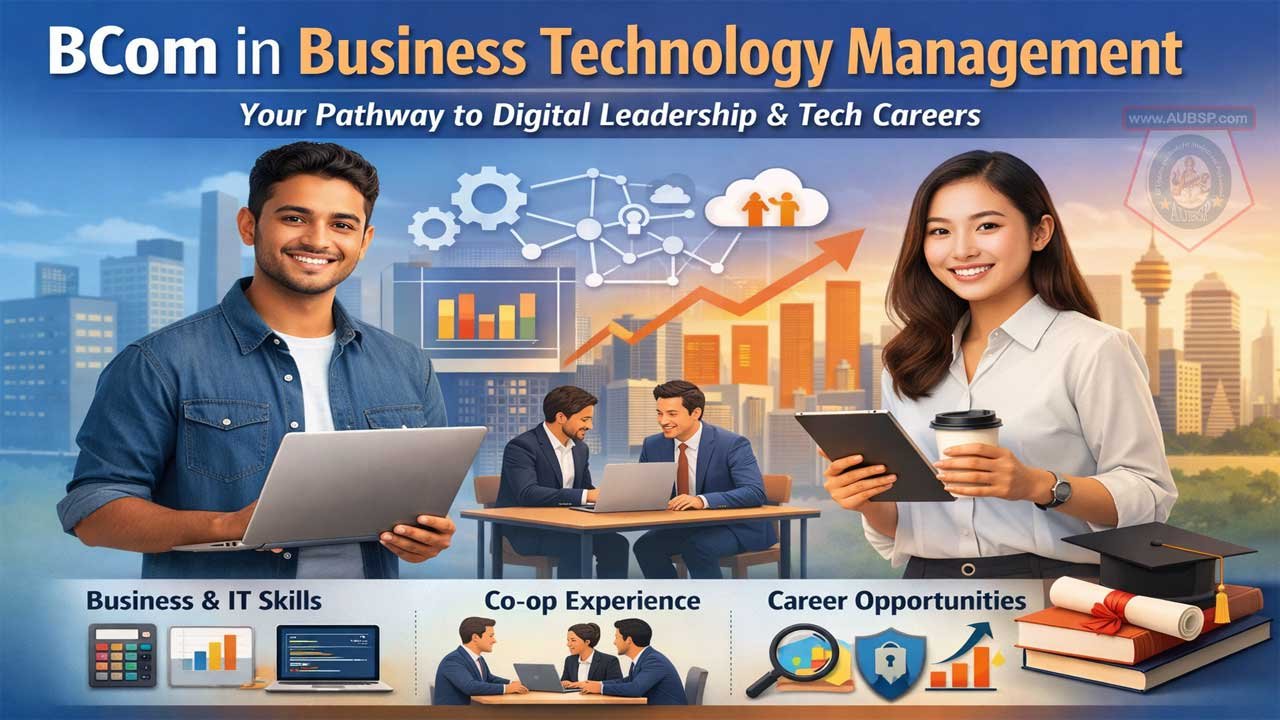
The Bachelor of Commerce in Business Technology Management (BCom BTM) is a modern business degree that combines technology knowledge with management skills. It was created in Canada to solve the gap between computer science experts and traditional business graduates.
The program teaches students how to use digital technologies, data, and information systems to improve business performance. Students study business basics, computing, data analysis, and IT project management over four years. Many programs also include co-op work terms, allowing students to gain real industry experience and earn income while studying.
Graduates often work as business systems analysts, IT project managers, data analysts, or technology consultants. With strong demand for digital skills, BTM graduates usually find good job opportunities and competitive salaries in sectors like finance, technology, healthcare, and consulting.
| Aspect | Details |
|---|---|
| Degree Name | Bachelor of Commerce (BCom) in Business Technology Management (BTM) |
| Degree Level | Undergraduate |
| Duration | 4 years (5 years with co-op in some universities) |
| Field of Study | Business, Information Systems, Technology Management |
| Main Focus | Combining business strategy with information technology and digital systems |
| Popular Study Destination | Canada |
| Typical Admission Requirement | Strong academic record with Grade 12 mathematics |
| English Language Requirement | IELTS 6.5+ or equivalent (TOEFL / Duolingo accepted by many universities) |
| Key Subjects | Accounting, Economics, Information Systems, Database Management, IT Project Management |
| Work-Integrated Learning | Co-op or internship opportunities available in many programs |
| Average Tuition (International) | CAD $30,000 – $65,000 per year |
| Career Roles | Business Systems Analyst, IT Project Manager, Data Analyst, Technology Consultant |
| Entry-Level Salary | CAD $55,000 – $70,000 per year |
| Top Study Cities | Toronto, Vancouver, Montreal, Calgary, Edmonton |
BCom Business Technology Management in Canada: Course, Universities, Fees, Career Scope
The global labor market is witnessing a profound structural realignment characterized by the erosion of traditional boundaries between technical engineering and organizational management. As enterprises accelerate their digital transformation initiatives, the demand for professionals who can simultaneously speak the language of software development and strategic finance has reached an all-century high.
The Bachelor of Commerce in Business Technology Management (BCom BTM) is the definitive academic response to this industrial evolution, particularly within the Canadian context where it was formalized as a national standard to address the critical talent gap between pure computer science and general management.
For the international student, the BCom BTM represents more than just a degree; it is a strategic entry point into a high-growth ecosystem. Unlike a standard Bachelor of Commerce, which may focus on the traditional silos of accounting or marketing, or a Bachelor of Science in Computer Science, which prioritizes the underlying mathematical and algorithmic architecture of computing, the BTM framework operates at the intersection of both. It prepares individuals to lead, innovate, and optimize the use of information and communication technologies (ICT) to drive organizational performance.
The Genesis and Standardized Evolution of Business Technology Management
The formalization of the BTM designation was a collaborative endeavor initiated in 2009 by Technation (formerly the Information Technology Association of Canada) in partnership with leading academic institutions and sector associations. This initiative was born from a recurring industry critique: new ICT graduates often lacked the foundational business skills required to manage teams and budgets, while traditional business graduates were frequently unequipped to navigate the complexities of digital infrastructure. By defining a set of national learning outcomes and competency standards, Technation established a “job-ready” profile that ensures graduates are capable of leading technology-driven business transformations from day one.
The evolution of the curriculum has transitioned from the legacy focus of Management Information Systems (MIS)—which often emphasized the maintenance of existing IT assets—to the forward-looking BTM model, which prioritizes digital leadership, change management, and the strategic deployment of emerging technologies such as artificial intelligence (AI) and cloud computing. This transition reflects the current reality that technology is no longer a support function but the primary engine of competitive advantage.
Accreditation and Quality Assurance Mechanisms
For the international scholar, choosing an accredited program is paramount to ensuring that their education will be recognized by global employers and professional bodies. In Canada, the Business Technology Management Accreditation Council (BTMAC), an autonomous body associated with the Canadian Information Processing Society (CIPS), evaluates programs based on rigorous quality indicators. This process scrutinizes the curriculum’s alignment with industry needs, the reputation of the faculty, the robustness of student support services, and the track record of graduate outcomes.
| Accrediting Body | Role in BTM Ecosystem | Primary Benefit to Students |
|---|---|---|
| Technation (formerly ITAC) | Defined national BTM learning outcomes and competency standards. | Ensures the curriculum matches current industry hiring requirements. |
| BTMAC / CIPS | Conducts rigorous institutional and program-level accreditation reviews. | Provides professional recognition and bridges the gap to designations like ITCP. |
| AACSB / EQUIS | International business school accreditors found at top Canadian universities. | Signals global excellence in management education and research quality. |
Programs that maintain these accreditations often provide students with an additional certificate upon graduation, signaling to the market that the individual has mastered the “minimum profile” for digital leadership as requested by industry leaders.
Institutional Landscapes: Top Destinations for BTM in Canada
Canada offers a diverse array of institutions hosting BTM programs, each with unique geographic and industrial advantages. For international students, the choice of university often dictates the nature of their local professional network and the sectors they will most likely enter upon graduation.
The Ontario Corridor: Hub of Innovation and Finance
Ontario serves as the primary engine of the Canadian technology sector, with Toronto often referred to as “Silicon Valley North.” The concentration of financial institutions, tech startups, and government headquarters creates a high-density environment for BTM talent.
- Toronto Metropolitan University (TMU): Located in the heart of downtown Toronto, the Ted Rogers School of Management houses the largest BTM program in the country. The program is notable for its massive co-op network and its specialized “Industry Prep Program,” which uses live actor simulations to train students in workplace conflict resolution.
- University of Toronto (Rotman): Recognized globally for its research excellence, the Rotman School provides a highly prestigious environment for commerce students looking to specialize in data analytics and digital strategy.
- Wilfrid Laurier University (Lazaridis): Located in the Waterloo tech cluster, Laurier’s BTM program emphasizes small class sizes and close mentorship from industry executives. Its location provides proximity to global tech giants like Google and Blackberry.
- University of Ottawa (Telfer): As the center of Canadian policy and a growing tech hub, uOttawa offers BTM students unique opportunities in both public sector digital transformation and private sector healthcare analytics.
The Western Frontier: Energy, Tech, and Affordability
The western provinces, particularly British Columbia and Alberta, offer a compelling mix of world-class academic standards and high-growth labor markets, often with a lower cost of living than the Toronto area.
- University of British Columbia (UBC Sauder): Consistently ranked as one of the top business schools globally, Sauder’s BTM option is tailored for tech-savvy students with a focus on digital business and consumer behavior.
- University of Alberta: Known for its fixed tuition model for international students, which provides financial predictability, the Alberta School of Business focuses on operational analysis and the strategic use of IT in large-scale enterprises.
- University of Calgary (Haskayne): Situated in Canada’s energy capital, Haskayne offers a blend of traditional management theory and technical information systems topics, preparing students for the modernization of the energy and logistics sectors.
The Quebec Market: Cultural Dynamism and Strategic Value
Montreal has emerged as a global center for artificial intelligence and creative industries. Institutions here provide BTM programs that are deeply integrated into this innovative ecosystem.
- Concordia University (John Molson): A pioneer in BTM education, John Molson provides a highly flexible BComm structure that allows students to combine their BTM major with minors in areas like finance or human resources.
- HEC Montréal: One of the oldest business schools in Canada, HEC provides a bilingual or French-immersion environment for BTM students looking to enter the European or Quebec markets.
Curricular Architecture: The Four-Year Roadmap
The BCom BTM curriculum is structured to progressively build a student’s capability, moving from foundational business concepts to complex technical integrations. This interdisciplinary approach ensures that by the senior year, students can act as strategic consultants to an organization’s leadership.
Year One: The Foundations of Commerce and Computation
The first year is designed to provide a “broad brush” understanding of how a modern business operates. International students often find this year critical for acclimating to the North American business mindset.
- Accounting and Finance Fundamentals: Understanding the accounting model, transaction analysis, and financial information processing is essential for later evaluating the ROI of IT projects.
- Economics: Principles of Micro and Macroeconomics introduce students to how prices are determined and how resources are allocated in diverse economic environments.
- Computing Foundations: Many top-tier programs, such as the University of Alberta, require BTM majors to take introductory computation courses early, covering the foundations of algorithms and programming methodologies.
- Professional Communication: Mastering the art of persuasive writing and business reporting is a core requirement, as BTM graduates must frequently translate technical jargon for non-technical executives.
Year Two: Bridging Business Processes and Digital Systems
In the second year, the focus shifts toward the intersection of organizational behavior and technical infrastructure.
- Organizational Behaviour: Students analyze how individuals and groups behave within organizations, focusing on leadership, power dynamics, and team efficiency—all of which are vital for managing IT teams.
- Foundations of Information Systems: This course introduces the role of hardware, software, and networks as levers for competitive advantage.
- Statistical Methods: Proficiency in quantitative analysis is developed here, using spreadsheet software and statistical techniques to make decisions under conditions of uncertainty.
Year Three: Technical Specialization and Systems Analysis
Year three is often considered the most rigorous, as students dive into the “hard” technical courses of the BTM major.
- Systems Analysis and Design: This is a cornerstone BTM course where students learn the kritische stages of the systems development lifecycle (SDLC), from requirements gathering to system implementation and maintenance.
- Database Management: Students learn to design and develop relational databases using SQL, focusing on data integrity, security, and the architecture required to support large-scale business applications.
- Telecommunications and Networking: An in-depth look at the infrastructure that enables global business connectivity, including cloud computing and secure data transmission protocols.
Year Four: Strategic Leadership and the Capstone
The final year focuses on high-level strategy and the integration of emerging technologies into the enterprise.
- IT Project Management: Students master Agile and Scrum methodologies, learning to manage the constraints of scope, time, and budget for complex digital initiatives.
- Senior Management Perspectives: This course prepares students to think like a Chief Information Officer (CIO), focusing on IT governance, ethics, and long-term technological roadmapping.
- The Capstone Project: A senior-level practicum where teams of students work with corporate partners to solve an actual business challenge. Examples include designing a prototype AI-driven logistics tool or auditing a firm’s cybersecurity posture.
Admissions and Enrollment: A Global Comparative View
International students face a multi-layered admission process that evaluates academic prowess, mathematical aptitude, and English language proficiency. Unlike some other disciplines, BTM programs place a disproportionate emphasis on mathematics due to the analytical nature of the degree.
Standardized Testing and Prerequisite Requirements
| Requirement Category | Typical International Benchmark | Specific Institutional Nuances |
|---|---|---|
| Academic Average | Mid-80s to Low-90s (equivalent to Grade 12). | UBC Sauder considers Grade 11 and 12 results holistically. |
| Mathematics | Grade 12 Calculus or equivalent. | TMU specifically prefers Calculus and Vectors (MCV4U). |
| English (IELTS) | 6.5 Overall (no band < 6.0). | University of Toronto often requires 7.0 or higher. |
| English (TOEFL) | 90 – 100 Overall (minimums per section). | UBC requires minimums of 22 in Reading/Listening and 21 in Writing/Speaking. |
| English (Duolingo) | 115 – 125. | Rapidly growing acceptance as a convenient online alternative. |
The importance of the “Personal Profile” and “Video Interview” in elite programs like UBC Sauder cannot be overstated. These components allow the admissions team to assess qualities such as leadership, community involvement, and the ability to perform under pressure—traits that are indispensable for future technology managers.
Pathways for Non-Traditional and Transfer Students
International students who do not meet direct entry requirements may utilize several bridging pathways.
- Foundation Programs: Institutions like UCL in the UK or various Canadian colleges offer one-year foundation courses that prepare students for the academic rigors of a BTM degree.
- College Transfers: Completing a 3-year Advanced Diploma in Business Administration at a public Canadian college with a minimum 3.0 GPA can allow for direct entry into the third year of a BTM degree at universities like TMU.
- International Year One: Dedicated programs for international students provide a soft landing by combining English language support with credit-bearing academic courses in commerce.
Economic Logistics: The True Cost of Studying in Canada
For the international student, the financial plan must account for tuition, mandatory school fees, and the rapidly rising cost of living in urban centers. Strategic selection of a province can lead to savings of tens of thousands of dollars over a four-year period.
Tuition and Mandatory Expenses
Tuition for specialized business programs at top-tier universities is significantly higher than for general arts or science degrees. In 2026, international students should anticipate annual tuition between $30,000 and $65,000 CAD.
| Expense Type | Projected Annual Cost (CAD) | Relevance and Implications |
|---|---|---|
| International Tuition | $40,000 – $65,000. | Business and engineering remain the most expensive undergraduate majors. |
| Mandatory Health Insurance | $1,050. | Universal requirement for study permit holders; coverage is non-negotiable. |
| Books and Supplies | $1,250. | Technical courses often require expensive software licenses or professional texts. |
| Winter Clothing | $500 (one-time). | Essential for students moving from tropical or temperate climates. |
Living Costs and Geographic Arbitrage
The Canadian government requires international students to demonstrate proof of funds amounting to at least $22,895 for living expenses (excluding tuition). However, real-world data for 2026 suggests that in cities like Toronto or Vancouver, a single student needs closer to $32,000-$35,000 to live comfortably.
| City / Location | Shared Housing Cost (Annual) | Independent Living (Annual) | Monthly Transit Pass |
|---|---|---|---|
| Toronto, ON | $27,600+. | $41,400+. | $156. |
| Vancouver, BC | $21,600+. | $39,600+. | $100+. |
| Montreal, QC | $17,280+. | $30,000+. | $104. |
| Calgary, AB | $17,160+. | $24,000+. | $126. |
| Edmonton, AB | ~$16,000. | ~$22,000. | ~$100. |
Provinces like Alberta are particularly attractive for their lack of provincial sales tax (saving students 8% on most purchases) and relatively affordable rental markets. Conversely, Ontario and BC offer the highest density of tech jobs, potentially providing a higher long-term ROI despite the upfront costs.
The Co-operative Advantage: Work-Integrated Learning
One of the most powerful features of the BCom BTM in Canada is the co-operative education (co-op) model. Unlike standard internships, co-op is a structured program where students are often treated as full-time junior employees during their work terms.
The Mechanics of the Co-op Program
In a 5-year BTM co-op program, a student typically completes four to five work terms, totaling 16 to 20 months of relevant professional experience.
- Employment Rates: The BTM major consistently reports some of the highest employment rates in business schools, often exceeding 90% during peak seasons.
- Earnings Potential: Students can earn an average of $3,400 to $4,200 CAD per month. Over the course of a degree, a BTM student can earn upwards of $50,000 to $60,000, significantly reducing student debt.
- Industry Partners: Large-scale employers such as the Royal Bank of Canada (RBC), TD Bank, CIBC, Deloitte, and various federal ministries are legacy partners of BTM co-op programs.
Legal and Immigration Requirements for Co-op
For international students, participating in co-op requires navigating specific Canadian immigration protocols.
- The Co-op Work Permit: This is a distinct permit required for any work that is a mandatory part of the academic program. It is usually valid for the same duration as the study permit and allows for full-time work during the scheduled work terms.
- Eligibility: Students must be in good academic standing and have a valid study permit. The university provides a letter confirming the work requirement.
- Tuition and Fees: While students do not pay full tuition during co-op terms, they usually pay a “Co-op Program Fee” (ranging from $500 to $1,600 per term) to cover the costs of job boards, coordination, and prep programs.
Career Pathing: From Graduation to Digital Leadership
The versatility of the BTM degree prepares graduates for an expansive range of roles. As industries move toward an “analytics-driven” model, the ability to extract knowledge from both structured and unstructured data has become a baseline requirement for management.
Dominant Roles for BTM Graduates
| Role | Core Objective | Sector Demand |
|---|---|---|
| Business Systems Analyst | Bridging business needs with technical specifications to optimize workflows. | High: Finance, Healthcare, Retail. |
| IT Project Manager | Leading digital projects using Agile/Scrum; managing risks and stakeholders. | Strong: Tech Startups, Government, SaaS. |
| Cybersecurity Analyst | Safeguarding organizational data and ensuring compliance with privacy regulations. | Rapid Growth: Banking, High-Security Sectors. |
| Data / BI Analyst | Visualizing data to guide strategic decisions; building predictive models. | Critical: E-commerce, Logistics, Marketing. |
| Tech Consultant | Advising clients on digital transformation and emerging technology adoption. | Competitive: Management Consulting Firms. |
Salary Trends and Projections
The financial outlook for BTM graduates is exceptionally positive. Median salaries for technology managers in the United States and Canada are well above the national averages for all occupations.
- Entry-Level: Most BTM graduates can expect starting salaries between $55,000 and $70,000 CAD.
- Mid-Career: Within 3-5 years, professionals often reach $85,000 to $110,000 CAD as they transition into senior analyst or team lead roles.
- Senior Leadership: Chief Information Officers (CIOs) or Chief Technology Officers (CTOs) can earn between $171,000 and $250,000+ CAD, depending on the size of the enterprise.
The “AI premium” is another factor influencing compensation. Professionals with verifiable skills in AI integration and prompt engineering are seeing average salary increases of up to 56% compared to peers without these competencies.
Global Context: Comparing the Canadian BTM to Global Equivalents
International students should understand how the Canadian BTM relates to degree systems in other major study-abroad destinations. While the core mission of bridging business and tech is universal, the nomenclature and specific focus can vary.
The United States: Management Information Systems (MIS)
In the U.S., the Bachelor of Science in Management Information Systems (MIS) is the most traditional equivalent. These programs are often housed in engineering or business schools.
- Focus: MIS typically places a heavy emphasis on the “information systems” themselves—database administration, network security, and enterprise resource planning (ERP).
- Market: The U.S. market offers high starting salaries (avg. $73,695) but has a more complex immigration landscape for international students compared to Canada’s Post-Graduation Work Permit (PGWP) program.
Australia: Business Information Systems (BIS)
Australian universities, such as UNSW or Monash, offer the Bachelor of Commerce with a major in Business Information Systems (BIS).
- Focus: BIS is similar to BTM in its practical orientation, often incorporating training in software like SAP.
- Accreditation: Programs are often accredited by the Australian Computer Society (ACS) rather than a dedicated BTM council.
The United Kingdom: IT Management for Business (ITMB)
The UK’s ITMB degrees were also designed in collaboration with employers to address the skills gap.
- Focus: These degrees place a high value on leadership and team-working skills, with “Extended Projects” and industry-led workshops being a core part of the final year.
- Prestige: Entry into programs at institutions like UCL or Manchester is extremely competitive, requiring top-tier A-level grades or equivalent IB scores.
The Convergence of AI, Digital Ethics, and Future Work
The “Next-Gen” BTM programs are increasingly integrating themes of digital ethics, sustainability, and human-AI collaboration. The realization that “technology alone is not enough” has led to a curricular shift toward the “responsible” implementation of innovation.
- AI Literacy: Future technology managers must understand not just how to build an AI model, but the ethical implications of data bias and the governance required for automated decision-making.
- Digital Sustainability: Companies are increasingly prioritizing ESG (Environmental, Social, and Governance) goals. BTM graduates are being tasked with reducing the carbon footprint of data centers and using IT to optimize resource consumption.
- Resilient Infrastructure: In an era of increasing cyber threats and climate-related disruptions, the role of the Business Continuity Analyst is becoming vital. BTM programs now emphasize risk mitigation and information contingency planning as core competencies.
Synthesis of Strategic Recommendations for International Scholars
The decision to pursue a Bachelor of Commerce in Business Technology Management is a strategic investment in long-term adaptability. The hybrid professional—one who possesses technical fluency, analytical depth, and managerial vision—is the architect of the modern economy.
For the prospective international student, success in this field is predicated on three key pillars:
- Mathematical Foundation: Prioritizing high-level math during secondary school is the single most important factor for admission and academic success.
- Geographic Strategy: Balancing the prestige of a university with the regional cost of living and specific industry clusters (e.g., Toronto for finance, Calgary for energy, Montreal for AI) can significantly enhance the financial feasibility of the degree.
- Experiential Engagement: Participating in co-op is not just about the paycheck; it is about securing a “career head start” that often leads to permanent employment offers before the graduation ceremony.
The BTM framework offers a future-proof foundation that allows graduates to move seamlessly between roles in IT, operations, consulting, and entrepreneurship. As technology becomes indistinguishable from business strategy, the BTM graduate remains uniquely equipped to lead organizations through the complexities of the digital age. The convergence of high graduate salaries, rapid employment growth, and the availability of work-integrated learning makes the BCom BTM one of the most compelling academic choices for the 21st-century global scholar.
Comparative Data Tables for Decision Support
To aid in institutional selection, the following tables provide a granular look at the competitive landscape for BTM studies in Canada for the 2026-2027 academic cycle.
University Profile and Prestige Concordance
| University | BTM Program Status | Faculty Reputation (Peer/Global) | Regional Industry Strengths |
|---|---|---|---|
| UBC Sauder | High Competition. | Tier 1 Global. | Digital Media, Tech, ESG. |
| U of Toronto | High Competition. | Tier 1 Global. | Fintech, AI, Global Markets. |
| TMU (TRSM) | Moderate/High. | Tier 1 National. | Banking, Public Sector, Consulting. |
| Concordia | Moderate. | Tier 1 National. | Aerospace, AI, Creative Tech. |
| U of Alberta | Moderate. | Tier 1 National. | Operations, Supply Chain, Energy. |
| uOttawa | Moderate. | Tier 2 National. | Gov-Tech, Health-Analytics. |
English Language Proficiency Concordance (Minimums)
| University | IELTS | TOEFL iBT | Duolingo (DET) | PTE Academic |
|---|---|---|---|---|
| U of Alberta | 6.5 (6.0 min). | 90 (21 min). | 120 (100 min). | 61. |
| UBC Sauder | 6.5 (6.0 min). | 90 (22 R/L, 21 W/S). | 125. | 65. |
| TMU | 6.5. | 92+. | 115+. | 60. |
| Concordia | 7.0. | 90+. | 120. | 60+. |
| uOttawa | 6.5. | 86+. | 120. | 60. |
2026 Cost of Living Breakdown (Estimated Monthly in CAD)
| Budget Item | Toronto / Vancouver | Montreal / Ottawa | Calgary / Edmonton |
|---|---|---|---|
| Shared Housing | $1,200 – $1,600. | $800 – $1,100. | $700 – $1,000. |
| Groceries / Food | $400 – $500. | $350 – $450. | $300 – $400. |
| Public Transit | $100 – $156. | $104. | $100 – $126. |
| Phone / Internet | $130 – $150. | $130 – $150. | $120 – $140. |
| Miscellaneous | $250 – $400. | $200 – $350. | $200 – $350. |
| TOTAL (Monthly) | $2,100 – $2,800 | $1,600 – $2,150 | $1,450 – $2,050 |
By weaving these disparate data points into a cohesive strategy, the international student can navigate the Canadian educational landscape with clarity. The BCom BTM is not merely an undergraduate degree; it is a meticulously crafted developmental journey designed to produce the leaders who will define the technological and economic boundaries of the future.
Candidates are encouraged to begin their preparation at least 12-18 months in advance, focusing on mathematical excellence and the cultivation of a robust personal profile to secure admission into these globally competitive programs.
FAQs about BCom in Business Technology Management
What is a BCom in Business Technology Management?
A BCom in Business Technology Management is a business degree that combines management studies with information technology skills. It prepares students to manage digital systems and lead technology-driven business projects.
What subjects are taught in a BTM program?
Students usually study accounting, economics, business communication, information systems, database management, statistics, networking, and IT project management.
How long does a BCom BTM degree take to complete?
Most programs take four years to complete. Some universities offer co-op programs that extend the duration to about five years with paid work terms.
What career opportunities are available after a BTM degree?
Graduates can work as business systems analysts, IT project managers, data analysts, cybersecurity analysts, or technology consultants in industries like finance, healthcare, and technology.
Is co-op important in a BTM program?
Yes, co-op programs allow students to gain real work experience during their studies. Many students earn income and secure job offers before graduation.
What are the admission requirements for international students?
Students typically need strong academic grades, especially in mathematics, and proof of English proficiency such as IELTS, TOEFL, or Duolingo scores.
What is the average tuition fee for international students in Canada?
International students usually pay between CAD $30,000 and $65,000 per year depending on the university and program.
What is the starting salary for BTM graduates?
Most graduates earn starting salaries between CAD $55,000 and $70,000 per year, with higher salaries possible as they gain experience.
Which countries offer similar programs to BTM?
Similar programs include Management Information Systems (MIS) in the United States, Business Information Systems (BIS) in Australia, and IT Management for Business (ITMB) in the United Kingdom.
Is BTM a good degree for the future?
Yes, BTM is considered a future-focused degree because businesses increasingly rely on digital technologies, data analytics, and IT systems for growth and decision-making.


Leave a Reply
You must be logged in to post a comment.