
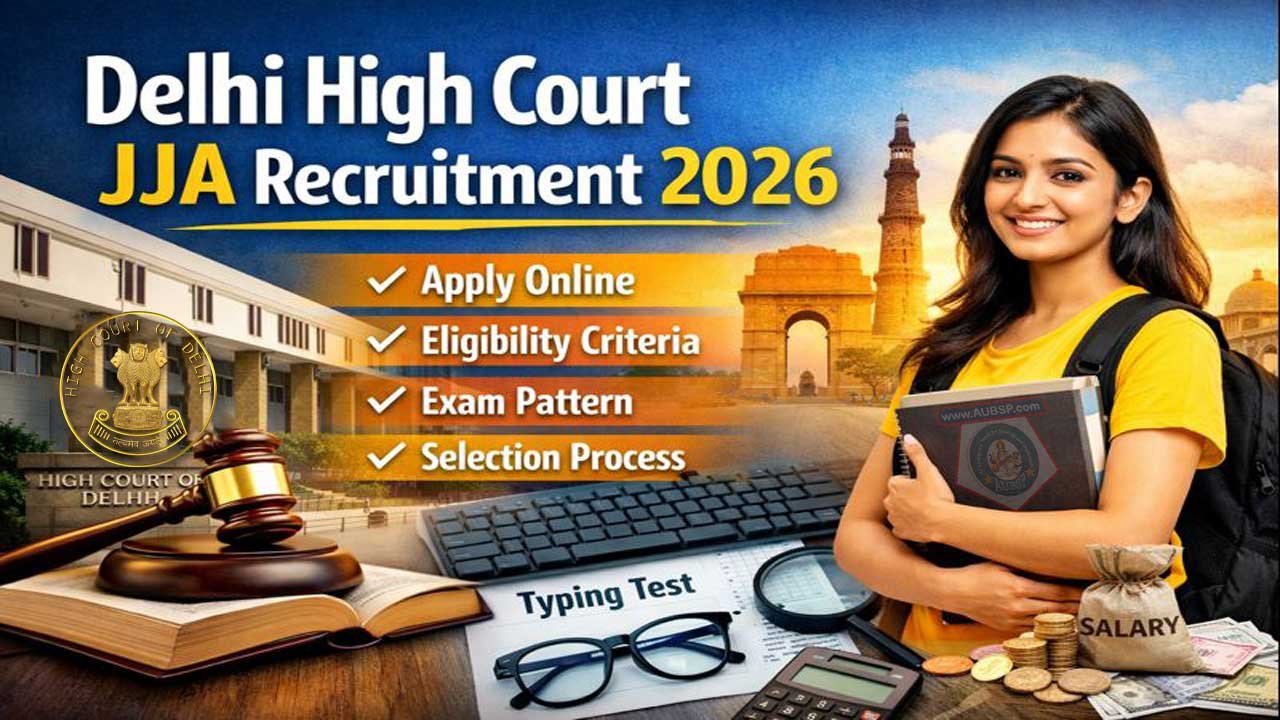
The Delhi High Court is recruiting 152 Junior Judicial Assistants/Restorers (Group B) in 2026 through an online process, offering a Level 6 7th CPC pay scale with government benefits. Graduates with a minimum English typing speed of 35 WPM and aged 18–32 years (with category relaxations) can apply between 4–23 Feb 2026.
The four-stage selection process includes a 120-mark objective Preliminary exam (qualifying), a 100-mark descriptive Main exam (counts toward merit), an English typing test (qualifying), and a 15-mark interview (counts toward merit). Vacancies are category-wise distributed, with PwBD reservation, and fees are ₹1,500 (Gen/OBC/EWS) and ₹1,300 (SC/ST/PwBD).
Candidates must meet strict document, photo, and signature requirements, can correct forms within a paid correction window, and should prepare across English, general awareness, reasoning, typing accuracy, and interview knowledge of the judiciary and Constitution.
Delhi High Court Junior Judicial Assistant Recruitment 2026: Complete Guide to 152 Government Job Vacancies
The Delhi High Court has opened doors to a prestigious career opportunity with 152 Junior Judicial Assistant (JJA) vacancies in 2026. If you’re searching for a stable, well-paying government job in the Indian judiciary system, this comprehensive guide covers everything you need to know about the recruitment process, eligibility criteria, selection stages, and proven preparation strategies.
Delhi High Court JJA Recruitment 2026 Overview
The Delhi High Court has released an official notification for recruiting Junior Judicial Assistant (JJA) and Restorer positions to strengthen its administrative and judicial support services. This is an exceptional opportunity for job seekers looking to build a career in the Indian judiciary system.
| Aspect | Details |
|---|---|
| Recruiting Body | Delhi High Court |
| Post Name | Junior Judicial Assistant (JJA) / Restorer |
| Total Vacancies | 152 |
| Job Type | Group ‘B’ Government Job |
| Pay Level | Level 6 – 7th CPC Pay Matrix |
| Salary Range | ₹35,400 – ₹1,12,400 + allowances |
| Application Mode | Online only |
| Application Dates | 4 Feb – 23 Feb 2026 |
| Educational Qualification | Graduate from recognized university |
| Typing Requirement | 35 WPM in English |
| Age Limit | 18–32 years (relaxation for reserved categories) |
| Selection Stages | Prelims → Mains (Descriptive) → Typing Test → Interview |
| Prelims Exam | 120 MCQs, 120 marks, negative marking |
| Main Exam | 100 marks descriptive paper |
| Typing Test | 10 minutes, 35 WPM, 3% error limit |
| Interview Marks | 15 marks |
| Final Merit Based On | Mains + Interview |
| Application Fee | ₹1500 (Gen/OBC/EWS), ₹1300 (SC/ST/PwBD) |
| Official Website | delhihighcourt.nic.in |
Important Dates for Delhi High Court JJA Recruitment 2026
Meeting deadlines is crucial in government job recruitment. Missing even a single deadline can disqualify you from the entire process. Here’s the complete timeline:
| Event | Date & Time |
|---|---|
| Notification Release Date | 31 January 2026 |
| Online Application Start Date | 4 February 2026 (11:00 AM) |
| Last Date to Submit Application | 23 February 2026 (11:00 PM) |
| Last Date for Online Fee Payment | 23 February 2026 (11:55 PM) |
| Application Correction Window Opens | 24 February 2026 |
| Application Correction Window Closes | 27 February 2026 (8:00 PM) |
| Admit Card Download | To be announced later |
| Examination Date | To be announced later |
| Result Declaration | To be announced later |
Important Note: The Delhi High Court advises candidates to submit their applications well before the closing date to avoid technical issues and server overload during the final hours.
Eligibility Criteria for Junior Judicial Assistant Position
Before investing time in preparation, ensure you meet all the essential eligibility requirements as of 23 February 2026 (the application closing date).
Essential Educational Qualification
- Graduate Degree: Candidates must hold a Bachelor’s degree from any university or institution recognized by the Government of India or approved by Government Regulatory Bodies.
- Typing Speed Requirement: Minimum typing speed of 35 words per minute (WPM) on a computer using English language.
Important Notes:
- All educational qualifications must be from institutions recognized by the Government of India
- Final examination results must be declared on or before 23 February 2026
- The typing speed requirement is mandatory and non-negotiable
- No alternative qualifications are accepted
Age Limit (as on 01 January 2026)
- Minimum Age: 18 years (born not later than 01 January 2008)
- Maximum Age: 32 years (born not earlier than 02 January 1994)
Age Relaxation for Reserved Categories
| Category | Age Relaxation |
|---|---|
| Scheduled Castes (SC) | 5 years relaxation |
| Scheduled Tribes (ST) | 5 years relaxation |
| Other Backward Classes – Non-Creamy Layer (OBC-NCL) | 3 years relaxation |
| Persons with Benchmark Disability (PwBD) – General/EWS | 10 years relaxation |
| PwBD – OBC Category | 13 years relaxation |
| PwBD – SC/ST Category | 15 years relaxation |
| Ex-Servicemen (ESM) | 3 years relaxation (after deducting military service period) |
| Disabled Defence Service Personnel | Up to 45 years (50 years for SC/ST) |
| In-Service Candidates | No upper age limit (if already serving in Delhi High Court) |
Vacancy Distribution: Category-wise Breakdown
The Delhi High Court has carefully allocated 152 vacancies across different categories to ensure equal opportunity and diversity:
| Category | General (Gen) | Economically Weaker Section (EWS) | OBC-NCL | SC | ST | Total |
|---|---|---|---|---|---|---|
| Vacancies | 62 | 12 | 44 | 20 | 14 | 152 |
Persons with Benchmark Disability (PwBD) Reservation
Out of the total 152 vacancies, 10 vacancies (approximately 6.6%) are reserved for candidates with benchmark disability (40% or above):
| Disability Category | Vacancies Reserved |
|---|---|
| Blind (B) / Low Vision (LV) | 1% (approximately 2) |
| Deaf (D) / Hard of Hearing (HH) | 1% (approximately 2) |
| Locomotor Disabilities | 1% (approximately 2) |
| Autism Spectrum Disorder (ASD) / Specific Learning Disability | 1% (approximately 2) |
| Multiple Disabilities | 1% (approximately 2) |
Application Fee Structure
Understanding the fee structure helps you plan your finances for the application process. Remember, the fee is non-refundable under any circumstances.
Examination Fee
| Candidate Category | Examination Fee |
|---|---|
| General / OBC-NCL / EWS Candidates | ₹1,500 + Transaction Charges |
| SC / ST / PwBD Candidates | ₹1,300 + Transaction Charges |
Application Correction Charges
If you need to modify or correct your application after submission:
- First Correction: ₹200 (non-refundable)
- Second Correction: ₹500 (non-refundable)
- Total Correction Attempts Allowed: Maximum 2 corrections during the correction window
Payment Methods Accepted
- UPI (Unified Payments Interface)
- Net Banking
- Credit Card
- Debit Card
Crucial Points:
- Transaction charges are applicable in addition to the examination fee
- Once paid, fees cannot be refunded or adjusted against any other examination
- Application without prescribed fee will be rejected without any consideration
- SBI helpdesk is available for payment-related grievances
Delhi High Court JJA Selection Process: 4-Stage Examination
The recruitment process is divided into four distinct stages, each designed to evaluate specific skills and competencies. Success requires preparation for each stage independently.
Stage I: Preliminary Examination (Computer-Based Test)
Objective: Screen candidates based on general knowledge, language proficiency, and reasoning abilities.
Exam Details:
- Total Questions: 120 Multiple Choice Questions
- Total Marks: 120
- Duration: 120 minutes (2 hours)
- Negative Marking: 0.25 marks deducted for each incorrect answer
- Question Language: English only
Exam Structure:
| Section | Questions | Marks | Topics Covered |
|---|---|---|---|
| English Language & Comprehension | 45 | 45 | Vocabulary, Synonyms, Antonyms, Comprehension Passages, Idioms & Phrases, One-Word Substitution, Gender, Degrees, Prepositions, Articles, Fill in the Blanks, Sentence Shuffling, Error Spotting, Active/Passive Voice, Direct/Indirect Speech |
| General Awareness & Current Affairs | 45 | 45 | Static (30 Questions): Constitution of India, Indian Judiciary, Sports, Art & Culture, History, Polity, Geography, Science, National/International Organizations, Famous Personalities, Important Days, Inventions. Current (15 Questions): Latest news and events |
| General Intelligence & Reasoning | 30 | 30 | Analogies, Similarities & Differences, Classification, Problem-Solving, Decision Making, Relationships, BODMAS, Percentage, Profit & Loss, Discount, Simple & Compound Interest, Time-Speed-Distance, Time & Work, Ratio & Proportion |
Qualifying Marks:
- General Category: 60 marks (50% of 120)
- Reserved Category (SC/ST/OBC-NCL/EWS): 54 marks (45% of 120)
- PwBD Candidates: 54 marks (45% of 120)
Important Note: Stage I is a qualifying stage only. Your marks in this stage will NOT be counted in your final merit list.
Progression to Next Stage:
Candidates who clear Stage I will be shortlisted in the ratio of 15 times the number of vacancies in each category for the Main (Descriptive) Examination.
Stage II: Main (Descriptive) Examination
Objective: Assess writing skills, language proficiency, grammar, and translation capabilities.
Exam Details:
- Total Marks: 100
- Duration: 120 minutes (2 hours)
- Language: English only
- Exam Type: Descriptive (subjective answers)
Exam Structure:
| Part | Subsection | Word Count/Questions | Marks |
|---|---|---|---|
| Part A | Essay Writing | 250 words | 40 |
| Part A | Letter Writing | 1 letter | 10 |
| Part B | Grammar | Multiple questions | 30 |
| Part B | Translation | 25 words | 20 |
| TOTAL | 100 |
Passing Marks:
- General Category: 50 marks (50%)
- Reserved Category (SC/ST/OBC-NCL/EWS): 45 marks (45%)
- PwBD Candidates: 45 marks (45%)
Progression to Next Stage:
Candidates clearing Stage II will be shortlisted in the ratio of 6 times the number of vacancies in each category for the English Typing Test.
Stage II Marks Contribute to Final Merit List: YES – Your Main Exam score will be added to your Interview score to determine your final ranking.
Stage III: English Typing Test
Objective: Verify your typing speed and accuracy as per the job requirements.
Test Specifications:
- Duration: 10 minutes
- Minimum Required Speed: 35 words per minute (WPM)
- Error Allowance: Maximum 3% errors permitted
- Calculation Method: “Characters with spaces” formula
- Testing Format: Computer-based using standard keyboards
Detailed Scoring Criteria:
If you type at 35 WPM with acceptable error rates, you’ll receive 15 marks out of 15. The scoring is calculated based on:
- Words Typed: Total keystrokes including spaces
- Accuracy Rate: Error percentage must not exceed 3%
- Rounding Off: Errors between 0.01-0.49% rounded to 0.5%, between 0.51-0.99% rounded to 1.0%
Pro Tip: Focus on accuracy over speed. A typing speed of 40-45 WPM with less than 1% error is considered excellent and will guarantee you the full 15 marks.
Important Notes:
- Stage III is a qualifying stage only
- Marks will NOT be included in final merit calculation
- All successful candidates will be called for the Interview
Stage IV: Interview
Objective: Assess personality, communication skills, subject knowledge, and suitability for the judicial position.
Interview Details:
- Total Marks: 15
- Interview Type: Viva voce (face-to-face)
- Minimum Qualifying Marks: No minimum marks required
- Panel: Conducted by senior judicial officers
Interview Preparation Areas:
- Judicial system and court procedures
- Constitution of India
- Personal qualities and motivations
- Communication skills
- Problem-solving abilities
- Current affairs knowledge
Stage IV Marks Contribute to Final Merit List: YES – Interview marks will be added to Stage II (Main Exam) marks for final ranking.
Salary, Pay Grade, and Benefits
Pay Structure and Remuneration
| Aspect | Details |
|---|---|
| Classification | Group ‘B’ Non-Gazetted Post |
| Pay Level | 6th Level of 7th Central Pay Commission (CPC) Pay Matrix |
| Entry Salary Range | ₹35,400 – ₹112,400 per month (approximate, subject to 7th CPC) |
| Pay Band | Structured under 7th CPC guidelines |
| Allowances | Dearness Allowance (DA), House Rent Allowance (HRA), Travel Allowance (TA), etc. |
Additional Benefits for Junior Judicial Assistants
- Job Security: Permanent government position with tenure protection
- Pension: Defined Benefit Pension scheme
- Gratuity: Lump sum gratuity at retirement
- Medical Benefits: Comprehensive health insurance coverage
- Leave Benefits: Casual, Earned, and Sick leave as per government rules
- Increments: Annual pay increments as per government guidelines
How to Apply: Step-by-Step Online Application Process
Before You Start: Pre-Application Checklist
- [ ] Verify your educational qualifications
- [ ] Check your age eligibility
- [ ] Determine your category (General/OBC/SC/ST/EWS/PwBD)
- [ ] Gather required documents
- [ ] Prepare a color passport-size photograph (not more than 3 months old)
- [ ] Arrange left-hand thumb impression scan
- [ ] Prepare your digital signature
Online Application Process (Valid from 4 February 2026)
Step 1: Create Registration Account
- Visit the official website: www.delhihighcourt.nic.in
- Click on “Recruitment” or “Job Openings” section
- Look for “Junior Judicial Assistant/Restorer Recruitment 2026”
- Click on “Apply Online” link
- Register using your email ID and mobile number
- Note down your system-generated Registration/Application Number
Step 2: Complete Biographical Information
Fill in the following details accurately:
- Full name (exactly as per matriculation certificate)
- Father’s name / Spouse name (exactly as per official documents)
- Date of birth (exactly as per matriculation certificate)
- Category (General/OBC-NCL/SC/ST/EWS)
- PwBD status (if applicable)
- Permanent residential address
- Current mailing address
- Contact details (email and mobile phone)
Step 3: Fill Educational Qualifications
- Bachelor’s degree details (name of degree, university, year of passing)
- Any additional qualifications or certifications
Step 4: Upload Mandatory Documents
All documents must be uploaded in JPEG format with specified file sizes:
| Document | Format | File Size | Dimensions/Specifications |
|---|---|---|---|
| Passport-size Photograph | JPEG | 100-200 KB | 3.5 cm width × 4.5 cm height. Without cap/mask/spectacles. Not more than 3 months old |
| Left Hand Thumb Impression | JPEG | 50-200 KB | Clear impression. If unavailable, right hand thumb impression acceptable |
| Digital Signature | JPEG | 50-150 KB | Clear and legible. Capital letter name NOT accepted as signature |
Critical Warnings:
- Improper or unclear photographs will result in application cancellation
- Illegible signatures will lead to rejection
- Documents that don’t meet specifications will be rejected
- Ensure high image quality before uploading
Step 5: Select Your Category
- Choose the appropriate category for reservation (if applicable)
- Ensure valid certificates will be produced at verification stage
- Note: No category change will be entertained after submission
Step 6: Review Application Details
- Carefully review all entered information
- Verify document uploads
- Check for spelling errors or omissions
- Ensure accuracy in name, date of birth, and qualifications
Step 7: Submit Application
- Click “Submit” button after final review
- Do NOT close the page until you see the confirmation message
- Save or print the Confirmation Page for future reference
Step 8: Pay Examination Fee
- After successful application submission, you’ll be directed to payment gateway
- Select your payment method (UPI, Net Banking, Credit Card, or Debit Card)
- Complete payment within the specified deadline
- Deadline: 23 February 2026 (11:55 PM)
- Keep transaction receipt for records
- Application is ONLY successful after fee payment and confirmation page generation
Step 9: Download Confirmation Page
- After successful fee payment, a Confirmation Page will be generated
- Download and save this page for future reference
- Do NOT send printed copies to the Delhi High Court
- Keep this page for admit card download and other purposes
Application Correction Window: How to Modify Your Application
If you made mistakes while filling your application, you have a limited opportunity to correct them.
Correction Window Details:
- Opens: 24 February 2026
- Closes: 27 February 2026 (8:00 PM)
Correction Process
- Login to your account using your Registration/Application Number
- You can make corrections up to 2 times during the window period
- Each correction requires additional payment:
- 1st Correction: ₹200
- 2nd Correction: ₹500
- After the second correction, NO FURTHER CHANGES are allowed
- Latest corrected application will be treated as final; previous versions will be cancelled
Important Reminders:
- Correction charges are non-refundable
- Requests via post, fax, email, or in-person will NOT be entertained
- After correction window closes, no changes are possible
- Double-check all details before making corrections to avoid losing your correction opportunities
Exam Syllabus and Preparation Strategy
English Language & Comprehension: Preparation Guide
Topics Covered (45 Questions, 45 Marks):
- Vocabulary Building
- Synonyms and antonyms
- One-word substitution
- Idioms and phrases
- Word meanings and usage
- Grammar and Sentence Construction
- Articles (a, an, the)
- Prepositions and their usage
- Subject-verb agreement
- Tenses (past, present, future)
- Gender and degrees of adjectives
- Nouns and pronouns
- Sentence Manipulation
- Shuffling of sentence parts
- Spotting errors in sentences
- Active and passive voice conversion
- Direct and indirect speech conversion
- Reading Comprehension
- Passage-based questions
- Reading for main ideas
- Inferential comprehension
- Contextual meaning
Preparation Tips:
- Read newspapers daily to improve vocabulary and comprehension
- Practice at least 10 sentence error spotting exercises daily
- Solve 3-4 comprehension passages weekly
- Maintain a vocabulary notebook with at least 20 new words daily
- Focus on common idioms and phrases used in formal English
- Practice voice and narration conversion regularly
Recommended Preparation Time: 4-5 weeks with 1-2 hours daily practice
General Awareness and Current Affairs: Study Plan
Static Knowledge Topics (30 Questions, 30 Marks):
- Constitution of India
- Fundamental Rights and Duties
- Directive Principles of State Policy
- Amendments and their significance
- Structure and organization of courts
- Indian Judiciary
- Supreme Court, High Courts, and District Courts
- Judicial independence and impartiality
- Types of jurisdiction
- Important legal landmarks
- Indian History and Polity
- Independence movement and key figures
- Government structure (Executive, Legislative, Judicial)
- Central and state governments
- Electoral system
- Geography
- Major rivers, mountains, and plateaus
- Climatic regions
- Natural resources
- Important landmarks
- Art and Culture
- Major art forms and dances
- Historical monuments
- UNESCO World Heritage Sites in India
- Traditional crafts
- Sports and Games
- National and international sporting events
- Olympic games
- Commonwealth Games
- Indian sports personalities
- Science and Technology
- Basic scientific concepts
- Recent technological developments
- Space missions
- Medical advances
- National and International Organizations
- United Nations and its agencies
- World Bank, IMF, WHO
- SAARC, BRICS, G20
- Indian government organizations
Current Affairs Topics (15 Questions, 15 Marks):
- Latest government policies
- Recent international events
- Economic developments
- Appointments of important officials
- Awards and recognition
- Natural disasters and humanitarian issues
Preparation Strategy:
- Read newspapers (The Hindu, Indian Express) for 30 minutes daily
- Follow news websites (BBC, Reuters, PTI)
- Watch news channels for 15-20 minutes daily
- Maintain current affairs notebook weekly
- Revise static topics weekly
- Practice mock tests covering current affairs monthly
Recommended Preparation Time: 6-8 weeks with 1 hour daily practice
General Intelligence and Reasoning: Practice Guide
Topics Covered (30 Questions, 30 Marks):
- Analogies (Verbal and Non-Verbal)
- Word analogies
- Number analogies
- Image-based analogies
- Similarities and Differences
- Finding common traits
- Spotting odd ones out
- Comparing concepts
- Classification
- Categorizing items
- Finding odd items in a group
- Logical grouping
- Problem-Solving and Decision-Making
- Logical puzzles
- Sequence problems
- Arrangement questions
- Relationships and Codes
- Blood relations
- Direction-based questions
- Coding and decoding
- Mathematical Reasoning
- BODMAS (Order of operations)
- Percentages and profit/loss calculations
- Discount and markup
- Simple and compound interest
- Time, speed, and distance problems
- Time and work problems
- Ratio and proportion
Practice Recommendations:
- Solve at least 20 reasoning questions daily
- Practice each topic type separately before mixing
- Learn mathematical shortcuts and tricks
- Maintain a formula notebook for quick revision
- Solve previous SSC and High Court examination papers
- Take mock tests weekly to assess speed and accuracy
- Focus on accuracy over speed initially
Recommended Preparation Time: 6-8 weeks with 1.5-2 hours daily practice
Typing Test Mastery: Complete Preparation Strategy
The typing test is often the most challenging stage for many candidates. Here’s a comprehensive guide to master it.
Understanding the Typing Test Format
| Parameter | Specification |
|---|---|
| Test Duration | 10 minutes |
| Minimum Speed Required | 35 words per minute (WPM) |
| Calculation Method | Characters with spaces |
| Error Allowance | Maximum 3% |
| Scoring | 15 marks (but qualifying only) |
| Keyboard Type | Standard computer keyboard (may vary between flat and raised keys) |
Detailed Typing Test Scoring Criteria
Speed Calculation Formula:
- Total characters typed (including spaces) ÷ 5 = Total words typed
- Total words typed ÷ 10 (minutes) = WPM
Example: If you type 3,500 characters in 10 minutes:
- 3,500 ÷ 5 = 700 words
- 700 ÷ 10 = 70 WPM
Error Allowance Rounding:
- Errors between 0.01-0.49%: Rounded to 0.5%
- Errors between 0.51-0.99%: Rounded to 1.0%
- Maximum acceptable errors: 3% of total characters typed
Achievement Milestones:
- 35-40 WPM with <1% error: 10-12 marks
- 40-50 WPM with <1% error: 12-15 marks
- 50+ WPM with <1% error: Full 15 marks
Step-by-Step Typing Test Preparation Plan
Phase 1: Keyboard Familiarization (Week 1-2)
Goal: Learn touch typing technique
- Practice Touch Typing Method
- Place your hands on the home row (ASDFGH and JKLO)
- Learn finger placement for each key
- Practice without looking at the keyboard
- Focus on muscle memory development
- Keyboard Layout Practice
- Spend 15 minutes daily practicing letter placement
- Use typing tutor applications
- Practice one finger at a time initially
- Gradually increase speed
- Tools for Phase 1:
- Keybr.com (free typing tutor)
- TypingMaster
- Ratatype
- Dedicated typing practice YouTube tutorials
Phase 2: Speed Building (Week 3-4)
Goal: Achieve 35+ WPM consistently
- Daily Practice Schedule
- Morning session: 30 minutes (warm-up exercises)
- Evening session: 45 minutes (target speed practice)
- Weekend: 1 hour focused practice
- Practice Methodology
- Type at comfortable speed (don’t rush initially)
- Focus on accuracy over speed
- Gradually increase typing speed by 2-3 WPM weekly
- Practice with different keyboard types if possible
- Recommended Typing Speed Targets
- Week 3: 25-30 WPM
- Week 4: 30-35 WPM
- Week 5-6: 35-40 WPM
- Week 7-8: 40-50 WPM
Phase 3: Accuracy and Stamina (Week 5-8)
Goal: Achieve 35+ WPM with <1% error for 10 minutes
- Accuracy-First Approach
- Maintain typing accuracy at 99%+
- Reduce errors gradually
- Quality over quantity principle
- Stamina Building
- Practice full 10-minute tests weekly
- Build hand and mental endurance
- Practice typing for extended periods without breaks
- Real Test Simulation
- Use Soni Typing Tutor or Testmentor
- Set parameters: 10 minutes duration, 1200+ word limit
- Font size: 32-34 pixels (matches actual exam)
- Practice on the exact same keyboard type if possible
- Preparation Tools for Phase 3:
- Soni Typing Tutor (free, widely used for government exams)
- Testmentor (specialized for judicial exams)
- IndiaTyping.com
- Typing Test Exam (specialized government exam typing)
Phase 4: Mock Testing and Refinement (Week 8-12)
Goal: Achieve 40+ WPM with <1% error consistently
- Weekly Mock Tests
- Take at least 3 full-length mock typing tests weekly
- Time them to match actual exam timing
- Analyze performance after each test
- Performance Tracking
- Maintain a record of your WPM and error percentage
- Identify problem areas (frequently mistyped words)
- Focus on improving weak areas
- Mental Preparation
- Build confidence through consistent practice
- Manage exam anxiety
- Practice meditation or breathing exercises before tests
Advanced Typing Test Tips and Tricks
Tip 1: Keyboard Selection
- Practice on both flat-key and raised-key keyboards
- Buy an external keyboard to practice if using a laptop
- Ensure the keyboard feels comfortable for long practice sessions
- The actual exam may have any type of keyboard, so versatility is crucial
Tip 2: Pronunciation While Typing
- Pronounce each letter/word mentally while typing
- This improves accuracy and reduces mistakes
- Helps develop a connection between thought and typing action
- Reduces errors like “the” typed as “hte” or “without” as “wihtout”
Tip 3: Keystrokes Management
- Minimum keystrokes requirement: approximately 1,750 per 10-minute test
- This ensures you’re maintaining the required minimum speed
- If keystrokes fall below 1,750, your typing may not be evaluated
Tip 4: Strategic Reading Approach
- Read 3 words at a time from the passage
- Type the 3 words while looking at your keyboard
- Repeat this process throughout the test
- Helps maintain accuracy and reduces errors
Tip 5: Error Management
- You can afford maximum 3% errors
- For a 10-minute test at 35 WPM (1,750 characters), you can make approximately 52 mistakes
- Focus on minimizing careless errors
- Proofread as you type rather than at the end
Tip 6: Speed vs. Accuracy Philosophy
- Initial Focus: Accuracy (aim for 99%+ accuracy even at 25 WPM)
- Progressive Focus: Speed development comes naturally with practice
- Ideal Balance: 40+ WPM with <1% error
- Never sacrifice accuracy for speed
Tip 7: Paragraph Completion Strategy
- The actual exam has very long passages designed to test endurance
- You likely won’t complete the entire passage in 10 minutes
- Focus on typing as much as you can accurately
- Don’t rush to complete the passage
Tip 8: Pre-Exam Warm-up
- Arrive at exam center 15 minutes early
- Do light hand stretches
- Practice typing a short warm-up test (2-3 minutes)
- Ensure keyboard and monitor are properly positioned
Common Typing Test Mistakes to Avoid
| Mistake | Impact | Solution |
|---|---|---|
| Rushing and making errors | Exceeds 3% error limit | Practice with accuracy focus |
| Not completing minimum keystrokes | Test not evaluated | Maintain consistent typing speed |
| Poor keyboard positioning | Wrist strain and reduced accuracy | Adjust chair and keyboard height |
| Looking at keyboard constantly | Slower typing speed | Practice touch typing |
| Not practicing on similar keyboard | Shock during actual exam | Practice on varied keyboards |
| Irregular practice schedule | Muscle memory doesn’t develop | Practice daily for consistency |
| Ignoring common spelling errors | Repeated mistakes | Maintain error log and focus on corrections |
Interview Preparation for Judicial Position
The interview stage has 15 marks and focuses on assessing your suitability for the judicial position. Here’s a comprehensive preparation guide.
Interview Assessment Criteria
Interviewers typically evaluate:
- Communication Skills
- Clarity and confidence in expression
- Fluency in English
- Professional tone and vocabulary
- Subject Knowledge
- Understanding of judicial system
- Knowledge of Constitution
- Awareness of current legal developments
- Problem-Solving Ability
- Analytical thinking
- Logical reasoning
- Decision-making capability
- Personal Qualities
- Honesty and integrity
- Dedication and commitment
- Work ethic and discipline
- Situational Awareness
- Current affairs knowledge
- Understanding of social issues
- Awareness of government policies
Common Interview Questions for Judicial Positions
Personal Background Questions:
- “Tell us about yourself”
- “Why do you want to join the judiciary?”
- “What are your career goals?”
- “Describe a challenging situation you’ve overcome”
- “What are your strengths and weaknesses?”
Constitution and Judicial System Questions:
- “Can you explain the hierarchy of Indian courts?”
- “What are the functions of the Supreme Court?”
- “What is the difference between criminal and civil cases?”
- “Explain the importance of judicial independence”
- “What do you understand by the Constitution of India?”
Current Affairs and General Knowledge Questions:
- “What recent judicial developments interest you?”
- “Can you comment on any recent Supreme Court judgment?”
- “How should the judicial system evolve?”
- “What are the challenges facing the Indian judiciary?”
Situational Questions:
- “A party approaches you with a bribe. How would you handle it?”
- “You discover procedural errors in a case. What would you do?”
- “How would you manage high case backlog?”
- “Describe how you’d handle conflicting instructions”
Interview Preparation Strategy
Phase 1: Research (1-2 weeks)
- Study recent Supreme Court and High Court judgments
- Read about judicial reforms and challenges
- Follow legal news websites and law journals
- Understand the role of Junior Judicial Assistant clearly
Phase 2: Practice (2-3 weeks)
- Practice mock interviews with friends or mentors
- Record yourself answering questions
- Work on eliminating verbal fillers (“um,” “uh,” “like”)
- Develop confident body language
Phase 3: Final Preparation (1 week)
- Revise key facts about Indian judiciary
- Polish your answers to common questions
- Get adequate sleep before the interview
- Practice professional dressing and etiquette
Interview Day Tips
Before the Interview:
- Arrive 10-15 minutes early
- Ensure professional appearance
- Carry all required documents
- Keep a pen and notepad
- Avoid using mobile phone
During the Interview:
- Make confident eye contact
- Speak clearly and at moderate pace
- Listen carefully to questions
- Take 2-3 seconds to think before answering
- Maintain professional posture
- Smile naturally
- Avoid negative language or complaints
After the Interview:
- Thank the panel respectfully
- Wait for dismissal before leaving
- Do not discuss interview details immediately
- Maintain positive attitude while results are awaited
Document Verification and Additional Requirements
Documents Required During Application
Mandatory Upload at Application Stage:
- Passport-size Photograph (color, 3.5 cm × 4.5 cm, <3 months old)
- Thumb Impression (left hand, in JPEG format)
- Digital Signature (clear and legible in JPEG format)
Documents Required for Interview and Document Verification
Bring original documents and 2-3 photocopies of each:
- Educational Qualification Documents
- Bachelor’s degree certificate
- Marksheets of all years
- Graduation certificate
- Transcripts
- Age Proof Documents
- Matriculation certificate (MUST MATCH APPLICATION)
- Birth certificate
- Any government-issued ID
- Category Certificates (if applicable)
- SC/ST Certificate: Issued by competent authority with authority stamp
- OBC-NCL Certificate: Issued by competent authority of NCT Delhi
- EWS Certificate: Income and Asset Certificate in prescribed format
- PwBD Certificate: Disability certificate issued by CMO/Civil Surgeon
- Residential Address Proof
- Aadhaar Card
- Voter ID
- Utility bills
- Passport
- Identity Proof (Minimum 2)
- Aadhaar Card or E-Aadhaar printout
- Driving License
- Voter ID Card
- PAN Card
- Passport
- Photographs
- 2 original color passport-size photographs (same as uploaded in application)
- Additional Documents
- No Objection Certificate (if currently employed in government service)
- Disability certificate (if claiming PwBD benefits)
- Medical fitness certificate (after selection)
Important Reminders for Document Submission
- All dates of birth must match exactly across all documents
- Spelling of names must be identical in all documents
- Certificates must be original with proper seals and signatures
- Any discrepancies will result in immediate rejection
- Keep photocopies organized in a folder
FAQs About Delhi High Court JJA Recruitment 2026
Eligibility Questions
Q1: I have a Bachelor’s degree but not from an Indian university. Am I eligible?
A: Only graduates from universities/institutions recognized by the Government of India or approved by Government Regulatory Bodies are eligible. Check with the Delhi High Court if your qualification is recognized.
Q2: Can I apply if I’ll be completing my graduation before the application closing date?
A: Yes, but only if you complete your graduation and your results are declared on or before 23 February 2026 (the application closing date).
Q3: What if I’m 33 years old? Can I still apply?
A: Applicants must not be over 32 years as of 01 January 2026. If you’re currently 33, you’re not eligible. However, if you belong to SC/ST/OBC/EWS/PwBD categories, age relaxation may apply.
Q4: Is the typing speed of 35 WPM mandatory?
A: Yes, this is an essential qualification. You must demonstrate at least 35 WPM before or while applying.
Application Questions
Q5: Can I apply offline or through email?
A: No, only online applications submitted through the official website are accepted. Offline applications will be rejected.
Q6: I missed the application deadline. Can I still apply?
A: No, the deadline is strict and no late applications are accepted. Plan carefully to meet all deadlines.
Q7: What if I make a mistake in my application?
A: You have until 27 February 2026 (8:00 PM) to correct your application. You can make up to 2 corrections by paying correction charges (₹200 for first, ₹500 for second).
Q8: Is the application fee refundable?
A: No, the examination fee is non-refundable under any circumstances, even if you don’t appear for the exam.
Exam Questions
Q9: Will there be negative marking in the Preliminary Exam?
A: Yes, there’s 25% negative marking. For each wrong answer, 0.25 marks will be deducted.
Q10: What language will the examinations be conducted in?
A: The medium of all examinations (Preliminary, Main, and Typing Test) is English only.
Q11: How many times can I attempt this recruitment?
A: The notification doesn’t specify any limit on attempts, but be aware that candidates involved in malpractice are debarred from all future High Court recruitment processes.
Q12: Will the exam be conducted in multiple shifts?
A: The notification doesn’t specifically mention this, but if it is, score normalization will be done to ensure fairness.
Selection and Interview Questions
Q13: What is the selection ratio? How many candidates will be called for the interview?
A: From Stage I, 15 times the number of vacancies will be called for Stage II. From Stage II, 6 times the number of vacancies will be called for Stage III. All candidates clearing Stage III will be called for Stage IV (Interview).
Q14: Is the interview compulsory for selection?
A: Yes, all candidates clearing the Typing Test must appear for the interview. Your final merit list is based on Stage II (Main Exam) + Stage IV (Interview) marks.
Q15: Will I receive any allowance while preparing for the exam or attending tests?
A: No, no Travel and Daily Allowance (TNDA) will be provided for any stage of the examination.
Document and Verification Questions
Q16: Can I submit attested photocopies instead of originals during document verification?
A: No, you must bring original documents for verification. Photocopies should be brought as supporting copies.
Q17: What if my category certificate is from outside Delhi?
A: If you’re applying under OBC category, your OBC certificate must be issued by the competent authority of NCT Delhi for castes recognized/notified as OBC by the Government of NCT Delhi. Certificates from outside Delhi may not be accepted for OBC-NCL category.
Q18: Can my family member submit documents on my behalf during verification?
A: This is generally not acceptable. You should personally appear with all original documents unless otherwise specified in the admit card instructions.
Questions About Persons with Disability (PwBD)
Q19: I’m a candidate with 45% disability. Can I get extra time and scribe facility?
A: Yes, if you have benchmark disability of 40% or more. You’re eligible for either:
- Scribe facility, OR
- Compensatory time of 40 minutes without scribe
You’ll need to submit a certificate from CMO/Civil Surgeon and an affidavit in the prescribed format.
Q20: How do I apply for scribe facility?
A: Mention in your online application if you wish to use a scribe facility. Submit a prescribed certificate and affidavit at least 5 days before your exam or bring them on exam day.
Post-Selection Questions
Q21: When will the final results be announced?
A: The notification states dates will be “announced later through public notice on the official website.” Keep checking delhihighcourt.nic.in regularly.
Q22: Will selected candidates be called for medical examination?
A: Yes, medical fitness is typically required before final appointment. However, this is not mentioned in the current notification, so confirm with the High Court.
Q23: Do selected candidates need to produce a No Objection Certificate (NOC)?
A: If you’re employed in any government organization, you must produce an NOC before the interview stage.
Q24: What is the service location for this recruitment?
A: The posts are for the Delhi High Court, based in New Delhi.
Conclusion: Your Path to Success
The Delhi High Court Junior Judicial Assistant recruitment of 2026 represents a significant career opportunity for educated job seekers aspiring to work in India’s premier judicial institution. With 152 vacancies, competitive selection process, and attractive government benefits, this recruitment can be a life-changing opportunity.
Your Success Formula:
- ✓ Understand and meet all eligibility criteria
- ✓ Apply online before 23 February 2026 (11:00 PM)
- ✓ Prepare comprehensively for all four exam stages
- ✓ Master the typing test through consistent, focused practice
- ✓ Develop strong subject knowledge for written exams
- ✓ Prepare thoroughly for the interview
- ✓ Gather all required documents for verification
Remember: Success in competitive government exams requires dedication, strategic preparation, and consistency. Start your preparation immediately, maintain a disciplined study schedule, and believe in your abilities.
The judiciary plays a crucial role in upholding justice and the Constitution. As a Junior Judicial Assistant, you’ll contribute significantly to this noble mission. All the best in your preparation!


Leave a Reply
You must be logged in to post a comment.