
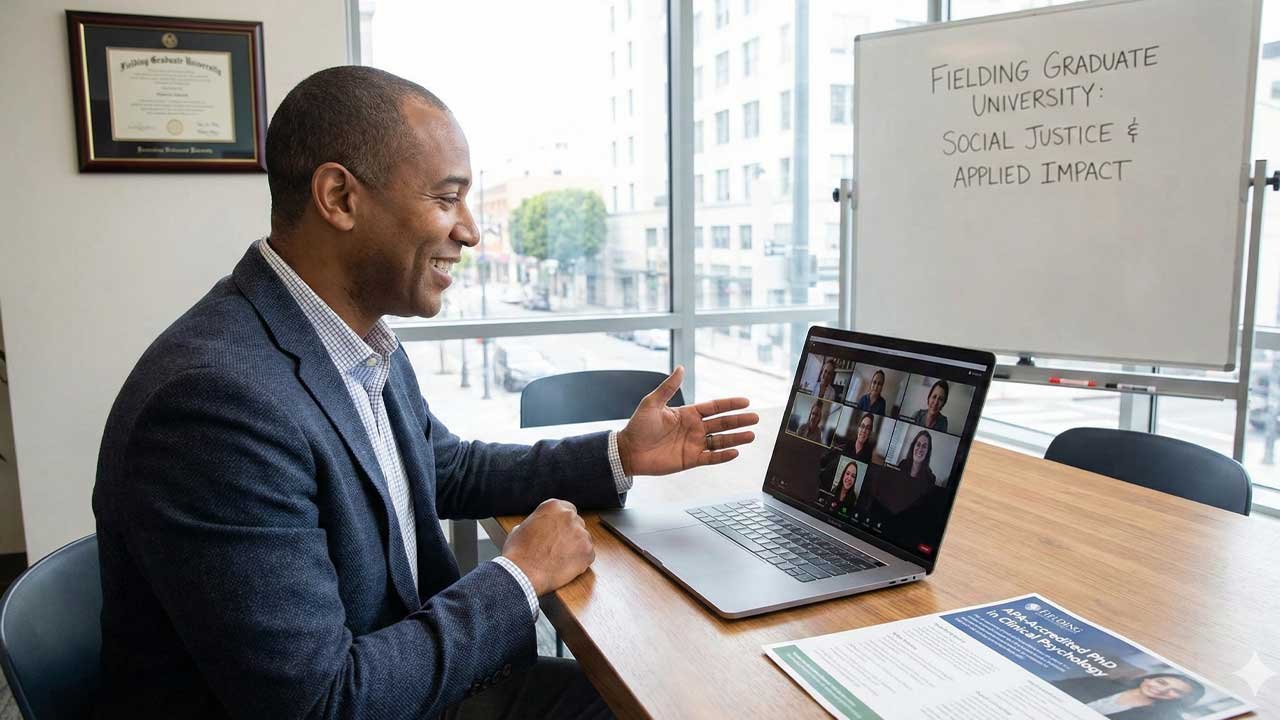
Fielding Graduate University is a WASC-accredited institution founded in 1974 that pioneered a rigorous distributed learning model designed for working professionals who want advanced degrees without pausing their careers.
Known especially for housing the only APA-accredited distributed PhD in Clinical Psychology, Fielding integrates scholarship and real-world practice across psychology, leadership, education, organizational development, and media psychology, emphasizing social justice, equity, and applied impact. Its programs blend online learning, limited in-person intensives, close faculty mentoring, and robust digital infrastructure, attracting experienced professionals from around the world.
With strong accreditation, recognized innovation, flexible pacing, and a global scholar-practitioner community, Fielding offers a credible alternative to traditional residential graduate education for those seeking flexibility, relevance, and meaningful professional and social impact.
| Category | Information |
|---|---|
| Institution Name | Fielding Graduate University |
| Founded | 1974 |
| Location | Santa Barbara, California (distributed/global model) |
| Accreditation | WASC Senior College and University Commission (WSCUC) |
| Notable Program Accreditation | APA-accredited PhD in Clinical Psychology (since 1991) |
| Learning Model | Distributed learning (online, live virtual sessions, limited in-person intensives) |
| Primary Focus | Graduate education for working professionals |
| Degrees Offered | PhD, EdD, Master’s degrees, Certificates |
| Flagship Programs | PhD in Clinical Psychology, EdD in Leadership for Change |
| Unique Distinction | Only APA-accredited distributed Clinical Psychology PhD in the U.S. |
| Typical Time to Completion | EdD: ~3 years; PhD: 5–7 years |
| Student Profile | Mid- to late-career professionals, global cohorts |
| Alumni Network | 7,500+ graduates worldwide |
| Mission Emphasis | Scholar-practitioner model, social justice, applied impact |
| Technology & Resources | Moodle LMS, Zoom, SPSS, Qualtrics, 100k+ e-books, 42k+ journals |
| Financial Aid | Federal loans, scholarships, military & veterans benefits |
| Ideal For | Professionals seeking flexible, accredited graduate education without career interruption |
Fielding Graduate University: The Complete Guide to Accredited Distributed Learning Programs
Redefining Graduate Education for the Modern Professional
For over 50 years, Fielding Graduate University has pioneered an innovative approach to higher education that challenges the traditional ivory tower model. Founded in 1974 in Santa Barbara, California, Fielding has established itself as a leader in graduate education by creating rigorous, academically excellent programs specifically designed for working professionals who refuse to pause their careers to pursue advanced degrees.
With more than 7,500 alumni distributed across the globe, Fielding has earned recognition from prestigious institutions including the Carnegie Foundation (Community Engagement Classification) and accreditation from the WASC Senior College and University Commission. The university’s distinctive distributed learning model—a sophisticated blend of in-person and digital instruction—has attracted scholars, practitioners, and change agents from diverse professional backgrounds.
The university’s commitment extends beyond academic credentials. Its mission centers on educating leaders, scholars, and practitioners for a more just and sustainable world. This philosophy permeates every program, from its flagship APA-accredited Clinical Psychology PhD to its innovative Doctor of Education degree in Leadership for Change.
Why Fielding Graduate University Stands Apart: The Distributed Learning Advantage
The Only APA-Accredited Distributed Psychology PhD
Fielding’s most distinctive credential is its PhD in Clinical Psychology, which holds the remarkable distinction of being the only American Psychological Association (APA)-accredited clinical psychology doctoral program that employs a distributed learning model. This innovation, accredited by the APA since 1991, fundamentally transforms what’s possible for psychology students who cannot relocate or leave their professional responsibilities.
The program typically requires 5-6 years for completion, compared to traditional doctoral programs that demand full-time, on-campus presence. Despite the distributed format, Fielding maintains full academic rigor. Students complete 600 hours of clinical practicum and a three-month internship under supervision by licensed clinical neuropsychologists. This combination of flexibility and clinical intensity attracts experienced mental health professionals seeking to deepen their expertise.
Scholar-Practitioner Integration
Unlike traditional academic programs that prioritize pure research, Fielding explicitly integrates professional practice into its educational philosophy. The scholar-practitioner model recognizes that students bring valuable wisdom, professional experience, and real-world expertise to their graduate studies. Faculty—many of whom maintain active clinical or organizational practices—help students align their research interests with their professional objectives and career aspirations.
This approach is particularly valuable for students investigating applied problems within their fields. A school administrator pursuing an EdD can research systemic change in her own school district. A licensed psychologist can study neuropsychological assessment patterns within her existing practice. The dissertation research becomes not just an academic exercise but a contribution to solving real-world problems.
Flexible Learning Technologies
Fielding’s infrastructure supports distributed scholarship through cutting-edge academic technologies. The university provides students with:
- Learning.Fielding.edu: A Moodle-based learning management system (79+ million users globally) supporting interactive assignments, recorded lectures, and live virtual sessions
- ZOOM Pro accounts: For real-time video conferencing with faculty and cohorts
- Advanced software access: SPSS statistical analysis (for doctoral students), Qualtrics survey platforms, and Turnitin plagiarism detection
- Comprehensive digital library: 100,000+ e-books, 42,000+ full-text scholarly journals, and 80+ specialized databases
This technological infrastructure removes geographic barriers without sacrificing academic intensity or faculty interaction.
Academic Offerings: Four Schools of Excellence
School of Psychology: Innovation in Clinical Training
The School of Psychology spans 47 years of excellence in psychology education and research. Its diverse offerings serve both aspiring psychologists and experienced mental health professionals seeking specialization.
PhD in Clinical Psychology
The flagship program serves adults, many of whom have already trained or worked in mental health fields. Students select from four specialized concentrations:
- Forensic Psychology: For those working at the intersection of psychology and criminal justice
- Neuropsychology: Focusing on the biological bases of behavior and assessment
- Health Psychology: Addressing the psychological factors in medical conditions and wellness
- Social Justice and Diversity: For practitioners committed to culturally sensitive, equitable mental health care
The curriculum encompasses psychology’s scientific foundations (history, affective, biological, cognitive, developmental, and social bases of behavior), research methodologies, psychological assessment, and therapeutic practice. Students train in multiple theoretical orientations through the Practicum Case Seminar series, including Psychodynamic, Humanistic/Experiential, and Cognitive Behavioral approaches.
Media Psychology: PhD, Master’s, and Certificates
In an era where technology fundamentally shapes human experience, Fielding’s Media Psychology program applies psychological principles to understand, predict, and influence how people interact with technology and media. The program earned recognition as among the nation’s Best Online Master’s in Psychology by Intelligent.com (2021).
The PhD explores how technology transforms individuals, organizations, and society. The 40-credit Master’s degree (no GRE required) serves professionals in digital marketing, UX design, tech companies, and entertainment. Certificate options emphasize either Media Neuroscience or Brand Psychology and Audience Engagement—both high-value specializations in the attention economy.
Applied Psychology and Infant/Early Childhood Development
The PhD in Applied Psychology applies psychological theories to real-world organizational and social settings, while the Infant, Child, and Family Mental Health program takes a multi-disciplinary approach to development, mental health, and neurodiversity. Both serve professionals seeking to deepen expertise in specialized areas.
Certificate and Respecialization Programs
For professionals already holding relevant degrees, Fielding offers:
- Postbaccalaureate Certificate in Clinical Psychology: A one-year bridge program that strengthens competitiveness for Clinical Psychology PhD admission
- Postdoctoral Respecialization in Clinical Psychology: Allows practitioners with doctorates in other fields (counseling, social work, marriage and family therapy) to transition to licensed clinical psychology
- Neuropsychology Specialization Training: For licensed psychologists expanding their scope of practice
School of Leadership Studies: Change at Scale
The School of Leadership Studies prepares scholar-practitioners to lead systemic transformation across educational institutions, nonprofits, community organizations, and human services systems. Its three primary programs share a Common Doctoral Framework while allowing deep specialization.
Doctor of Education (EdD) Leadership for Change
Fielding’s redesigned EdD in Leadership for Change is now a fully online, 64-credit program designed for completion in approximately three years. It represents Fielding’s commitment to meeting the needs of experienced educators and leaders ready to deepen their impact in complex, fast-changing systems.
The curriculum emphasizes four academic topics:
- Effective Communication: Essential for change leadership
- Approaches to Inquiry: Research methodologies for educational and organizational contexts
- Leadership for Change Praxis: Translating theory into action-oriented change
- Research Methodologies: Preparing for dissertation research
The program structure accommodates diverse learning styles. Students complete requirements through doctoral papers, multimedia presentations, collaborative projects, or independent research. Faculty assessors provide written feedback on student work against both course-level and doctoral-level competencies. The only residency requirement is a New Student Orientation (typically 2-3 days), making the program genuinely accessible to working administrators and educators.
Optional concentrations allow specialization in areas including:
- Evidence-Based Coaching
- Community College Leadership
- Higher Education Leadership and Governance
- Media, Technology, and Innovation
- Organization Development
- Reflective Practice and Supervision
PhD in Organizational Development & Change (ODC)
This multidisciplinary degree prepares scholar-practitioners to become thought leaders and change agents across profit, nonprofit, and public sector organizations. ODC professionals work in organizational consulting, change management, human resources, and strategic leadership roles.
PhD in Human Development
Positioned at the intersection of psychology, education, and human services, the Human Development PhD serves professionals committed to understanding and advancing individual and collective development across the lifespan.
Fielding’s Center for Social Innovation and Impact
Beyond individual programs, Fielding operates specialized centers advancing systemic change:
- Institute for Social Innovation (ISI): Advancing social innovation research and practice
- Marie Fielder Center for Democracy, Leadership, and Education: Focused on democratic governance and educational leadership
- Alonso Centers for Psychodynamic Studies: Supporting advanced training in psychodynamic approaches
- Center for the Advancement of STEM Leadership (CASL): A partnership earning a $9 million National Science Foundation grant for leadership development in science, technology, engineering, and mathematics
These centers provide research opportunities and specialized training for students interested in deep engagement with particular change domains.
Accreditation, Recognition, and Rankings
Institutional Accreditation
Fielding holds accreditation from the WASC Senior College and University Commission (WSCUC), the most respected regional accrediting body for colleges and universities in California and the broader Western region. This accreditation ensures that:
- Degrees meet rigorous academic standards
- Federal financial aid eligibility
- Transfer of credits is respected by other institutions
- The university demonstrates ongoing quality improvement
Program-Specific Accreditations
Beyond institutional accreditation, Fielding’s programs hold specialized recognition:
- Clinical Psychology PhD: Full accreditation by the American Psychological Association (APA Commission on Accreditation) since 1991
- Evidence-Based Coaching Certificates: ICF Accredited Coach Training Program (ACTP) recognition
- Top 100 Degree Producer for Minorities: Fielding’s Clinical Psychology program appears on Diverse Issues in Higher Education’s prestigious list
Rankings and Honors
While Fielding doesn’t prioritize national rankings, it has earned recognition from respected sources:
- #11 on BestPsychologyDegrees.com’s Top 20 Most Innovative Psychology Degree Programs
- #220 (tie) in Clinical Psychology by U.S. News & World Report
- Best Online Master’s in Media Psychology – Intelligent.com 2021
- Best Doctorate in Clinical Psychology – Intelligent.com 2021
- Carnegie Foundation Community Engagement Classification
- UN-supported Principles for Responsible Management Education member
These accolades reflect Fielding’s commitment to innovation rather than traditional prestige hierarchies.
Admissions and Application Process
Application Timeline
Fielding operates on a rolling admissions calendar with specific program deadlines:
- Doctoral Programs (PhD, EdD): July 23 application deadline for Fall enrollment
- Master’s & Certificates: July 23 application deadline for Fall enrollment
Early application is recommended, as popular programs fill quickly.
Eligibility and Prerequisites
General eligibility requires a bachelor’s degree from an accredited institution. Specific programs have additional requirements:
- Clinical Psychology PhD: Typically requires 18+ hours in psychology coursework (prerequisites vary). The Postbaccalaureate Certificate in Clinical Psychology serves those without sufficient psychology background.
- EdD Leadership for Change: Designed for educators, administrators, organizational leaders, and professionals with significant work experience
- Media Psychology: Open to professionals in digital marketing, technology, entertainment, and related fields
- Organizational Development & Change: Serves organizational leaders, HR professionals, and change management specialists
Application Components
A complete application includes:
- Application form and $75 non-refundable fee
- Transcripts from all post-secondary institutions
- Personal statement addressing your educational goals and professional objectives
- Resume/CV highlighting relevant experience
- Letters of recommendation (typically 2-3, depending on program)
- GRE scores (may be waived for some programs; not required for Media Psychology Master’s)
- For Clinical Psychology PhD: Additional psychology-specific prerequisites and clinical experience considerations
The Office of Admissions offers live chat support and accepts applications through the website, making the process user-friendly for geographically dispersed applicants.
Timeline to Completion
Program lengths vary by degree type and student circumstances:
| Program | Typical Duration |
|---|---|
| EdD Leadership for Change | 3 years (64 credits) |
| PhD Clinical Psychology | 5-6 years |
| Master’s degrees | 2 years |
| Certificates | 1 year |
| Overall PhD average | 7.5 years |
Fielding’s flexibility means students can adjust enrollment intensity based on their circumstances. A student juggling a full-time career might complete their PhD more slowly but with lower stress; someone on sabbatical might accelerate.
Tuition, Fees, and Financial Aid: Affordability for Working Professionals
Tuition Structure (2025 Academic Year)
Fielding’s tuition is competitive with comparable universities while remaining accessible for working professionals. The academic year comprises three terms, allowing flexible enrollment.
Doctoral Programs (Per Term)
| Program | Cost |
|---|---|
| EdD Leadership for Change | $8,960/term |
| PhD Clinical Psychology | $10,385/term |
| PhD Applied Psychological Science | $9,990/term |
| PhD Organizational Development & Change | $9,990/term |
| PhD Human Development | $9,990/term |
| PhD Psychology (General) | $9,990/term |
Master’s and Certificate Programs (Per Credit)
| Program | Cost |
|---|---|
| Master’s programs (most) | $765/credit |
| Evidence-Based Coaching Certificate | $800/credit |
| Postdoctoral Neuropsychology | $4,360/term |
| Postdoctoral Respecialization Clinical Psych | $1,040/credit |
Annual Costs and Budgets
- Average annual tuition and fees: $22,260 (across all programs)
- Cost of Attendance (COA): Includes tuition plus estimates for books/supplies, room, board, and personal expenses
- Books/supplies allowance: $500/term (doctoral), $25/credit (Master’s)
- Room, board, personal expenses: ~$3,000/month
- Transportation estimates: Variable ($400/month to $3,300/program depending on program type)
The three-term year structure means students can control costs by adjusting enrollment intensity. A doctoral student taking two terms per year at $10,000/term spends $20,000 annually on tuition, while one taking three terms spends $30,000.
Financial Aid and Funding Options
Federal Financial Aid
Fielding is approved for Federal Student Aid through the U.S. Department of Education. Graduate students are eligible for:
- Federal Stafford Loans: Up to $20,500 annually, $138,500 lifetime maximum
- Federal Graduate PLUS Loans: For additional borrowing needs (credit-checked)
- Income-Driven Repayment Plans: Making monthly payments proportional to income
Scholarships
Fielding offers scholarship opportunities, though the amount and availability vary by program and student circumstances. The Office of Financial Aid helps students identify and apply for all available scholarships.
Military and Veterans Benefits
- Veterans Benefits: GI Bill and other VA benefits are accepted
- Military Tuition Assistance (TA): Active-duty service members can use military educational benefits
- Vocational Rehabilitation: For veterans with service-related disabilities
International Funding
- Canadian Provincial Student Aid: Fielding is an approved institution for aid from Canadian provinces
- International student loans: Available through some lenders
Monthly Payment Plans
Fielding offers monthly payment plans for eligible students, allowing payments to be spread across the term ($50 nonrefundable sign-up fee). This is particularly valuable for working professionals managing cash flow alongside educational expenses.
Total Cost of Ownership
To estimate realistic total costs for degree completion, consider:
- EdD (3 years, 64 credits): Approximately $26,880 in tuition alone ($8,960 × 3 terms/year × 3 years), plus living expenses and books
- PhD Clinical Psychology (6 years, ~120 credits): Approximately $60,000-$62,000 in tuition ($10,385 × 3 terms/year × 2 credits/term × 6 years), plus living and transportation
However, many students reduce these costs through scholarships, financial aid, employer sponsorship, or spreading enrollment across longer timeframes.
Fielding’s Distributed Learning Model: How It Works
Blending In-Person and Digital Learning
Fielding’s distributed learning model is not synonymous with “fully online.” Instead, it strategically blends:
- Synchronous online sessions: Live ZOOM courses with real-time interaction with faculty and cohorts
- Asynchronous digital content: Pre-recorded lectures, readings, and course materials accessible 24/7
- In-person intensives: Limited but meaningful face-to-face experiences (e.g., 2-3 day residencies, workshops)
- Small group seminars: Virtual and occasional in-person seminar discussions
- One-on-one faculty mentoring: Regular videoconference meetings with advisors and dissertation chairs
This blend accommodates professionals in different life situations. A busy executive might watch recorded lectures during early morning hours and engage in live seminars when possible. A clinical trainee might prioritize in-person practicum components while completing coursework flexibly.
Technology Infrastructure Supporting Scholarship
Fielding invests substantially in the technological infrastructure supporting distributed scholars:
- Moodle-based Learning Management System (Learning.Fielding.edu): One of the world’s most widely used and reliable LMS platforms
- ZOOM integration: Providing institutional-grade video conferencing
- Specialized research software: SPSS (for statistical analysis), Qualtrics (for surveys), Turnitin (for plagiarism checking)
- Comprehensive digital library: 100,000+ e-books, 42,000+ full-text journals accessible globally
- 24/7 technical support: Available via email and Zoom during extended business hours
This technological sophistication allows students in different time zones and countries to engage meaningfully with faculty and peers.
Global Community of Scholars
With 7,500+ alumni across the world, Fielding has built a genuinely international scholarly community. Distributed learning attracts:
- International professionals: Bringing diverse cultural perspectives to cohorts
- Career-advanced practitioners: Often 15-25 years into their professions when enrolling
- Geographic diversity: Faculty and students in 50+ countries offer perspectives unavailable in traditional, geographically-bound programs
For example, a Clinical Psychology cohort might include a psychologist from Australia, a Brazilian mental health administrator, a Swiss organizational consultant, and a U.S.-based licensed therapist—all engaging in rigorous academic conversation about their shared field.
Career Outcomes and Alumni Success Stories
Fielding’s Scholar-Practitioner Graduates
Fielding alumni have built impressive careers across psychology, education, organizational development, and leadership. Notable achievements include:
- Emmy Award winners in entertainment and media fields
- Order of Canada recipients for transformative healthcare leadership
- Organizational consulting leaders working with Fortune 500 companies
- Licensed clinical psychologists in private practice and institutional settings
- Educational administrators and superintendents implementing systemic change
- Nonprofit and social innovation leaders advancing social justice causes
- Academic faculty in universities worldwide
The alumni network provides ongoing professional development through events, publications, and collaborative research opportunities.
Career Impact by Program
Clinical Psychology PhD Graduates
Graduates work as:
- Licensed clinical psychologists in private practice
- Healthcare system administrators and clinical directors
- Forensic psychologists in legal/criminal justice contexts
- Neuropsychologists specializing in assessment and brain-behavior relationships
- Academic researchers publishing in peer-reviewed journals
- Clinical supervisors and trainers for other professionals
EdD Leadership for Change Graduates
Alumni occupy leadership roles including:
- School principals and district superintendents driving systemic educational change
- Community college administrators implementing equity-focused initiatives
- Nonprofit executive directors leading social justice organizations
- University administrators shaping higher education policy
- Organizational development consultants facilitating organizational transformation
Media Psychology Graduates
Alumni work in:
- User experience (UX) research at major technology companies
- Digital marketing and audience analytics
- Entertainment industry psychology and production
- Educational technology design and implementation
- Media psychology consulting for content creators
Return on Investment
While Fielding doesn’t aggressively market ROI data, the investment in a doctoral or master’s degree typically yields:
- Salary advancement: Many professionals report 20-40% salary increases post-graduation
- Career transitions: Many use their degrees to transition into new professional roles or advance within their fields
- Professional credentialing: Credentials open doors previously closed without advanced degrees
- Intellectual growth: Students consistently report significant personal and professional transformation
- Network effects: Access to 7,500+ alumni provides ongoing professional networking and collaboration opportunities
Student Experience: Beyond Academics
Comprehensive Student Support Services
Fielding recognizes that distributed students require robust support infrastructure. The Office of Student Services provides:
- Academic advising: Personalized guidance on course selection, pacing, and degree planning
- Disability accommodations: Support for students with documented disabilities
- Counseling and mental health resources: Supporting student wellbeing
- Library services: Reference librarians helping students navigate 80+ databases and millions of resources
- Career services: Preparing students for professional advancement and transitions
Community and Belonging
Despite being geographically distributed, Fielding deliberately builds community:
- Cohort-based learning: Many courses bring together stable cohorts of 8-15 students, enabling lasting relationships
- Periodic Doctoral Seminars: Some programs require annual 2-3 day in-person intensives, providing face-to-face connection
- Online forums and groups: Moodle-based spaces for peer discussion and connection
- Social events: Virtual and occasional in-person gatherings for networking and relationship building
- Alumni engagement: Ongoing events, webinars, and publications connecting current and former students
Student testimonials consistently emphasize the unexpected sense of community and belonging—many students report that the peer relationships at Fielding exceed what they experienced at traditional, in-person universities.
Intellectual and Personal Growth
Students value Fielding’s approach to intellectual rigor combined with practical relevance:
- Faculty expertise: Professors bring active research and professional practice to classrooms, not just theoretical knowledge
- Customization: Many programs allow students to shape their learning around their unique professional contexts and interests
- Dissertation integration: Dissertation research often directly addresses challenges students face in their professional work
- Critical thinking development: Programs emphasize questioning assumptions, evaluating evidence, and developing nuanced perspectives
- Social justice integration: Education isn’t treated as separate from social responsibility; programs explicitly connect learning to equity and sustainability
Fielding in Context: How It Compares to Traditional Universities
Distributed Learning vs. Traditional Residential Models
| Dimension | Fielding (Distributed) | Traditional Residential |
|---|---|---|
| Location flexibility | Work and study anywhere globally | Must relocate/commute to campus |
| Time flexibility | Asynchronous options; paced learning | Synchronous schedules; less flexibility |
| Career continuation | Can maintain employment/practice | Often requires career pause |
| Cost | Generally lower (no relocation) | Higher (room/board costs) |
| Faculty interaction | Personalized mentoring, one-on-one | Large lectures, limited personal contact |
| Peer diversity | International, career-advanced | Often younger, from same region |
| Practicum/clinical training | Embedded within existing work | Separate clinical placements |
| Degree prestige | Equally rigorous, specialized recognition | Traditional hierarchy focus |
Fielding’s Accreditation Standing
Fielding’s WASC accreditation and APA-accredited clinical psychology program place it in the same institutional category as most prestigious regional universities. However, Fielding’s distributed model and social justice focus position it differently in the academic hierarchy. Rather than competing on traditional prestige metrics, Fielding attracts professionals specifically seeking:
- Flexibility without sacrificing rigor
- Scholar-practitioner integration
- Social justice orientation
- Diverse, international peer groups
- Faculty accessibility
- Practical application of learning
Challenges and Honest Considerations
Is Fielding Right for You?
While Fielding excels for many professionals, potential students should honestly assess:
Fielding is excellent if you:
- Are a working professional who cannot pause your career for graduate study
- Value social justice and equity in your education
- Seek mentoring relationships with accessible faculty
- Work in psychology, education, or organizational leadership
- Want to apply learning directly to your professional challenges
- Appreciate diversity of thought and international perspectives
- Can self-motivate with minimal structure
Fielding may be less ideal if you:
- Seek maximum geographic prestige (e.g., Ivy League brand recognition)
- Require intensive in-person mentoring and daily faculty interaction
- Need extensive campus resources (sports, Greek life, residential community)
- Prefer a fully online experience with no in-person requirements
- Seek highly specialized training in certain narrow fields
- Want guaranteed employment placement post-graduation
Realistic Considerations
Time to completion: While Fielding enables flexibility, students should anticipate realistic timelines. A PhD typically requires 5-7+ years, not 3 years, even with flexibility.
Self-discipline requirement: Distributed learning requires significantly more self-direction than traditional programs. Students who thrive with external structure may struggle.
Cost accumulation: Longer completion timelines mean higher cumulative costs, even with lower per-term tuition.
Geographic isolation: Despite technology, some students report occasional isolation, particularly in programs with limited in-person contact.
Credential recognition: While Fielding degrees are fully accredited, some employers prioritize traditional institutional prestige. However, in psychology and education, accreditation status matters far more than Fielding’s relative prestige.
Fielding’s Future and Recent Developments
Leadership Transition
In February 2025, Fielding appointed Dr. John L. Bennett as Interim President. Bennett is a Fielding alumnus (Human and Organizational Development, 2006) and former Board member, bringing deep understanding of the university’s mission and current state.
Curriculum Innovation
Fielding continues evolving its programs based on changing professional demands:
- EdD redesign: The newly redesigned EdD in Leadership for Change features updated curriculum emphasizing systemic inequality, diversity, and contemporary change leadership
- Media Psychology expansion: Growth in Media Psychology offerings reflects increasing professional demand
- Concentration options: Doctoral programs continue expanding specialized concentrations addressing emerging fields
Partnerships and Centers
Fielding maintains strategic partnerships with other institutions, such as:
- University of the Virgin Islands (Creative Leadership doctorate)
- University of the District of Columbia (Urban Leadership & Entrepreneurship)
- Tulane University’s Payson Center (Social development focus)
These partnerships extend Fielding’s reach while maintaining its core values.
Conclusion: Change the World. Start with Yours.™
Fielding Graduate University represents a genuine alternative to traditional graduate education—not a compromise, but a different model optimized for different values and life circumstances. Its 50-year track record demonstrates that rigorous, accredited graduate education can flourish outside the traditional residential model, particularly when grounded in social justice, scholar-practitioner integration, and genuine commitment to adult learners.
For working professionals seeking advanced education, Fielding offers:
- Flexibility without sacrificing rigor: Programs maintain full accreditation and academic intensity while accommodating careers
- Accessibility: Distributed learning removes geographic barriers, making education possible for professionals worldwide
- Relevance: Scholar-practitioner integration ensures learning directly connects to professional challenges
- Community: Despite geographic distribution, Fielding builds meaningful scholarly communities around shared values
- Impact: Graduates advance their fields while contributing to social and ecological justice
Whether pursuing a Clinical Psychology PhD, an EdD in Leadership for Change, or a specialized Master’s degree, Fielding attracts professionals ready to deepen their expertise while continuing to contribute to their fields and communities.
The university’s motto—”Change the world. Start with yours.™”—captures its essential philosophy. Education isn’t a separate life phase but an integration of professional development, personal growth, and commitment to broader social good. In an era of increasing specialization and fragmentation, Fielding’s emphasis on scholar-practitioners who ground academic excellence in practical impact offers a refreshing alternative.
For those seriously considering graduate education while maintaining professional responsibilities, an honest evaluation of Fielding’s programs, accreditation, and alumni outcomes makes clear why thousands of professionals worldwide have chosen to pursue their advanced degrees through this distinctive institution.


Leave a Reply
You must be logged in to post a comment.