
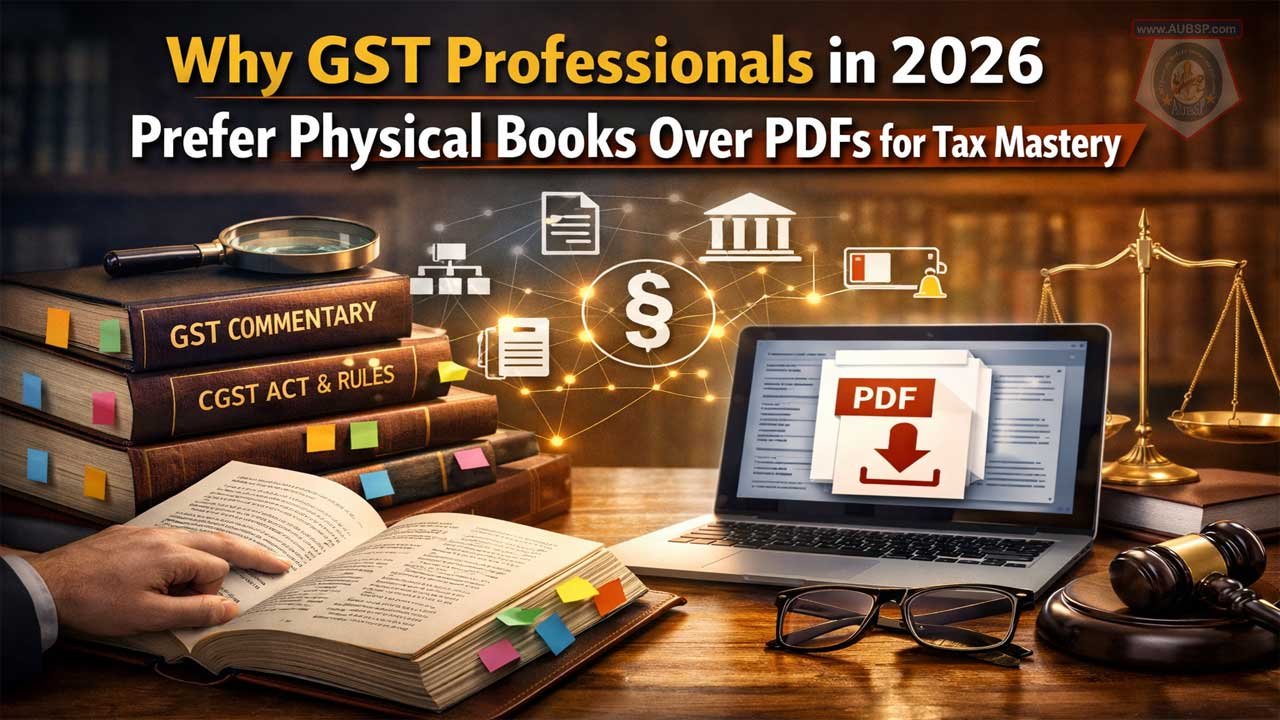
Why GST Professionals in 2026 Prefer Physical Books Over PDFs for Tax Mastery: We live in an era where AI can draft legal summaries in seconds and cloud-based ERP systems automate tax compliance. Yet, walk into the office of any successful Chartered Accountant, tax lawyer, or GST practitioner in 2026, and you will inevitably find their desk dominated by thick, heavily tabbed, physical GST commentaries.
While PDF editions offer undeniable portability and a quick Ctrl+F search function, they have failed to dethrone the printed book in the realm of complex taxation. For professionals navigating the labyrinth of the Goods and Services Tax, the preference for physical books isn’t driven by mere nostalgia—it is a highly practical, cognitive, and strategic choice.
Today, we shall provide you a detailed breakdown of why GST readers continue to choose physical books over PDF editions.
The Tactics of Complex Cross-Referencing
GST law is not read linearly like a novel. Interpreting a single issue often requires a practitioner to simultaneously cross-reference a Section of the CGST Act, a specific CGST Rule, a corresponding Notification, a clarifying Circular, and recent Tribunal or High Court case laws.
- The Physical Advantage: With a physical book, a reader can keep one finger on Section 16 (Input Tax Credit), another on Rule 36, and flip to a case law index all at once. This tactile, multi-page manipulation is seamless.
- The PDF Limitation: In a PDF, jumping between page 145, page 890, and page 1,200 requires continuous scrolling, clicking back-and-forth, or opening multiple instances of the same heavy file. This creates digital friction, breaking the practitioner’s train of thought during complex legal analysis.
Cognitive Mapping and Retention
Studies consistently show that the human brain relies on spatial memory to absorb complex, dense information.
“Remembering whether a specific proviso was on the bottom-left of a page or near a specific flowchart helps cement the material in the mind.” When tax students or professionals read a physical book, the fixed pages create “landmarks.” In a PDF, the text is a continuous, scrolling waterfall with no physical boundaries.
For mastering intricate tax formulas, understanding the nuances of the Time of Supply, or memorizing Reverse Charge Mechanisms, the physical structure of a book drastically improves comprehension and long-term retention. Opening a physical book also psychologically triggers a “time to focus” state, blocking out the multitasking noise of the digital world.
Screen Fatigue and the Digital Overload
In 2026, a tax professional’s daily life is already overwhelmingly digital. Between reconciling data in Excel, filing returns on the often-sluggish GST Portal, analyzing digital ledgers, and answering client emails, their screen time is maxed out.
Staring at a bright screen to read a 2,000-page PDF of statutory commentary introduces severe eye strain and mental fatigue. Switching to a physical book offers much-needed sensory relief, allowing professionals to study the law deeply without the harsh glare of a monitor or the constant distraction of incoming desktop notifications.
Courtroom and Client-Meeting Authority
In high-stakes environments like a GST Appellate Tribunal or a boardroom meeting with a client facing a massive tax notice, the medium matters.
- Reliability: A physical book never runs out of battery, doesn’t require Wi-Fi, and won’t suddenly crash or force an software update right when you need to cite a crucial sub-section.
- Gravitas: A lawyer or CA pulling out a heavily annotated, highlighted physical commentary commands respect. It visually demonstrates preparation, depth of knowledge, and authority.
- Agility: With physical sticky notes and color-coded flags protruding from the edges, a practitioner can instantly snap the book open to the exact precedent they need to show a judge or tax officer.
Tax Economics: The GST on GST Books
Ironically, the very tax these professionals study plays a role in their purchasing habits. In India, printed educational books and textbooks generally enjoy a 0% GST (exempt) or lower tax brackets, making them highly cost-effective.
Conversely, digital publications, e-books, and online databases are heavily categorized as digital services, often attracting a standard 18% GST. Because premium tax commentaries are already expensive, the addition of an 18% tax on a PDF edition frequently makes the physical book a more attractive, tangible investment for the price.
The 2026 “Hybrid” Evolution
Publishers haven’t ignored the digital revolution; they’ve adapted to it. In 2026, readers don’t have to choose between static print and dynamic digital updates. Today’s physical GST books come equipped with QR codes at the end of chapters.
If a new Notification or Circular amends a section, the practitioner simply scans the code with their phone to see the real-time updates. This gives professionals the best of both worlds: the cognitive and tactile benefits of print, backed by the real-time accuracy of the cloud.
Comparison Summary: Physical vs. PDF
| Feature | Physical GST Book | PDF Edition |
| Deep Reading & Focus | High (Zero digital distractions) | Low (Prone to notifications/fatigue) |
| Cross-Referencing | Excellent (Tactile page holding) | Poor (Clunky scrolling/tab switching) |
| Searchability | Good (Relies on index/flags) | Superior (Ctrl+F instant search) |
| Eye Strain | Low (Ambient light) | High (Screen glare) |
| Courtroom Reliability | 100% reliable (No tech failure) | Vulnerable to battery/software issues |
| Tax Implications | Often GST Exempt (0%) | Usually taxed at 18% GST |
While PDFs are excellent for quick, targeted word searches or carrying on a flight, they simply cannot replace the structural, cognitive, and practical advantages of physical paper.
For the GST professional in 2026, their physical books aren’t just reading material—they are their primary tools of the trade.


Leave a Reply
You must be logged in to post a comment.