
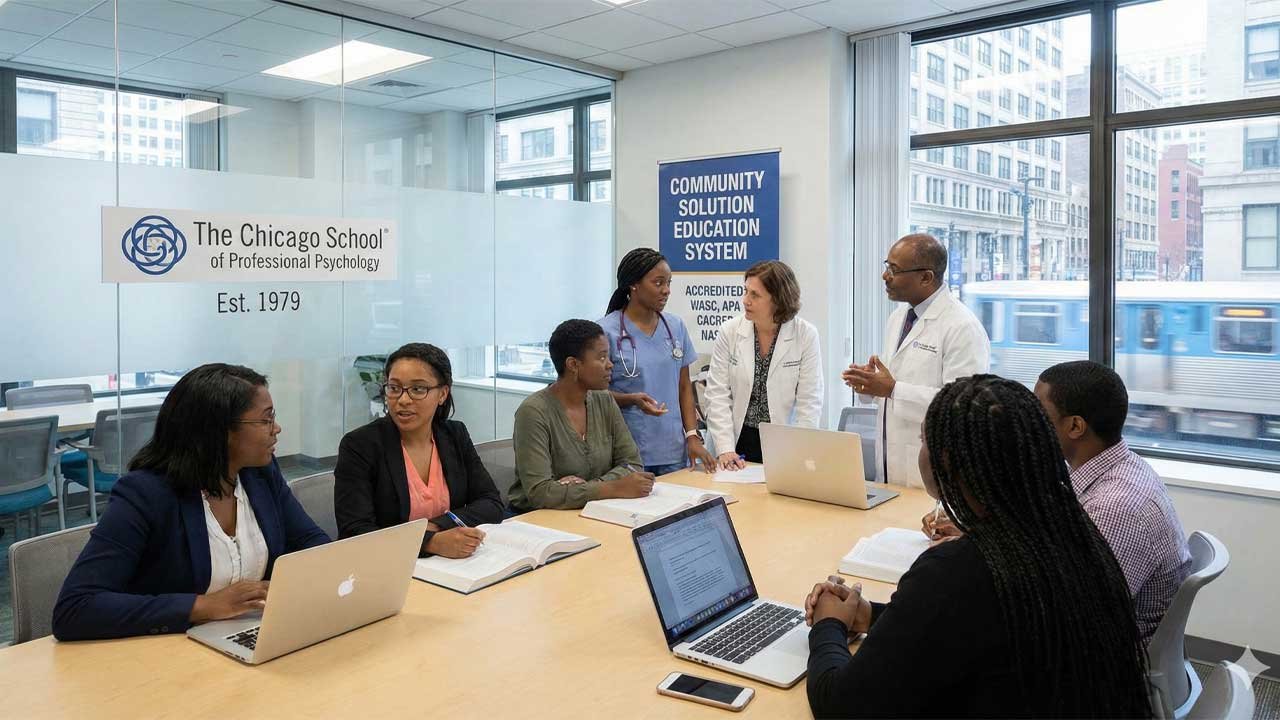
The Chicago School of Professional Psychology, founded in 1979, is a nationally recognized institution built on a practitioner-scholar model that emphasizes hands-on clinical training, community service, and cultural competence alongside rigorous academics.
With seven U.S. campuses, online programs, and more than 40 accredited degree offerings, it holds institutional accreditation from WASC and programmatic accreditations from bodies such as the APA, CACREP, NASP, and others, underscoring its commitment to quality and licensure readiness. Nearly half of its students identify as people of color and one-third are first-generation college students, supported by over $10 million in annual scholarships.
Known for high internship placement rates (92–100%), strong career outcomes, and extensive community partnerships, the school prepares graduates to work across clinical, organizational, educational, military, forensic, and global settings. As part of The Community Solution Education System, The Chicago School continues to expand access to psychology and health careers while maintaining its core mission of practical impact, diversity, and service to underserved populations.
| Category | Information |
|---|---|
| Institution Name | The Chicago School of Professional Psychology |
| Founded | 1979 |
| Educational Model | Practitioner-Scholar (hands-on, applied training) |
| Campuses | Chicago, Los Angeles, San Diego, Washington D.C., Dallas, Anaheim, New Orleans + Online |
| Accreditation (Institutional) | WASC Senior College and University Commission (through 2027) |
| Program Accreditations | APA, CACREP, NASP, COAMFTE, ABAI |
| Programs Offered | 40+ undergraduate, graduate, doctoral, and certificate programs |
| Student Diversity | 47% students of color; 33% first-generation students |
| Internship Placement Rate | 92–100% (by campus/program) |
| Alumni Network | 20,000+ graduates worldwide |
| Annual Scholarships | $10+ million awarded |
| Notable Recognitions | President’s Community Service Honor Roll; Military Friendly School |
| System Affiliation | The Community Solution Education System |
| Global Reach | 200+ international students from 31 countries |
The Chicago School of Professional Psychology: Transforming Education Through Practical Impact and Community Commitment
Established over 45 years ago, The Chicago School of Professional Psychology stands as a pioneering institution that has fundamentally transformed how psychology professionals are educated and trained.
Unlike traditional research-focused universities, The Chicago School embraced a revolutionary practitioner-scholar model that prioritizes hands-on experience alongside rigorous academic preparation—a philosophy that continues to define its educational excellence today.
A Legacy Built on Innovation and Service
The Chicago School’s origins tell the story of visionary psychologists who recognized a gap in psychology education. Founded in 1979 by a group of innovative practitioners, the institution began with a simple but powerful premise: psychology students needed more than theoretical knowledge—they needed real-world clinical experience in urban settings serving diverse populations. This commitment to practical training distinguished The Chicago School from the beginning and remains its defining characteristic.
Since its founding, the institution has grown from a single Chicago location to a comprehensive educational system spanning seven campuses nationwide, including locations in Los Angeles, San Diego, Washington D.C., Dallas, Anaheim, and New Orleans, plus robust online offerings. This expansion reflects both the growing demand for psychology professionals and The Chicago School’s success in its educational model.
The institution’s commitment to service excellence has earned recognition beyond academia. The Chicago School has been named to the President’s Higher Education Community Service Honor Roll for six consecutive years and received the Military Friendly award recognition for three years in a row, attestations to its dedication to serving underrepresented populations and building partnerships with the communities it serves.
Understanding the Accreditation Advantage
For prospective students evaluating psychology programs, accreditation is paramount—it signals quality, rigor, and career readiness. The Chicago School maintains robust accreditation credentials across multiple bodies that validate its programs’ quality.
Institutional Accreditation: The Western Association of Schools and Colleges (WASC) Senior College and University Commission has accredited The Chicago School since 2011, with the most recent reaffirmation in 2017 extending approval through 2027. This institutional-level accreditation confirms that the entire university meets rigorous standards for educational effectiveness and institutional capacity.
Program-Specific Accreditation: Beyond institutional approval, The Chicago School’s flagship programs carry accreditation from the American Psychological Association (APA), the gold standard in psychology education. The Chicago campus’ Clinical Psychology Psy.D. program received full APA accreditation in 1992 and has maintained this status continuously. Additional campuses have secured APA accreditation: Los Angeles (2018), Washington D.C. (2024), Anaheim (2021), and Dallas (2024 on contingency status).
The school also maintains specialized accreditations for other programs: the Council for Accreditation of Counseling and Related Educational Programs (CACREP) for counseling programs, the National Association of School Psychologists (NASP) for school psychology, the Commission on Accreditation for Marriage and Family Therapy Education (COAMFTE) for family therapy, and the Association for Behavior Analysis International (ABAI) for Applied Behavior Analysis programs.
This multi-layered accreditation demonstrates that The Chicago School’s commitment to quality extends across its entire portfolio of 40+ graduate, undergraduate, and certificate programs.
A Diverse and Inclusive Learning Community
The Chicago School’s commitment to diversity and cultural competence has defined its mission since 1979. It was among the first psychology programs to offer specialized courses in cultural issues in assessment and intercultural psychotherapy, establishing the Center for Inter-Cultural Clinical Psychology in 1988—decades before diversity training became standard in graduate education.
Today, this legacy translates into a genuinely diverse student body: 47% of The Chicago School’s students identify as people of color, and one in three students are first-generation college students. This composition creates a rich learning environment where students from varied backgrounds engage with each other and serve communities that often have been historically underserved by mental health services.
The institution supports this diversity through dedicated scholarships. The EmpowerEd Scholarship specifically recognizes students demonstrating commitment to fostering diversity, equity, and inclusion, while the Global Impact Scholarship serves high-achieving international students. With more than $10 million in scholarships awarded annually, The Chicago School actively removes financial barriers for talented students regardless of background.
Career Outcomes and Professional Preparation
The ultimate measure of an educational institution’s effectiveness lies in where its graduates succeed. The Chicago School’s alumni have built careers across diverse sectors and leadership positions. Graduates work as clinical psychologists in private practice, organizational consultants in Fortune 500 companies, school psychologists in urban districts, military psychologists serving veterans, applied behavior analysts in healthcare settings, and leadership roles in nonprofits and government agencies.
The institution conducts rigorous annual assessments of alumni employment outcomes to evaluate its educational impact—a practice it has maintained since 2011. These assessments provide prospective students with transparent data about career trajectories and professional success.
The school boasts impressive internship placement rates. Depending on the campus, 92-100% of students secure clinical internships, which are essential prerequisites for licensure as psychologists. This high placement rate reflects both the quality of student preparation and The Chicago School’s extensive partnerships with training sites across healthcare systems, community mental health centers, Veterans Affairs facilities, correctional programs, and specialized treatment centers.
The Practitioner-Scholar Model: Theory Meets Practice
What distinguishes The Chicago School’s educational approach from traditional graduate psychology programs is its explicit rejection of the research-intensive PhD model in favor of the practitioner-scholar philosophy. Rather than positioning research production as the ultimate goal, The Chicago School prioritizes training professionals who can immediately apply psychological knowledge to real-world human challenges.
This philosophical difference translates into concrete pedagogical choices. Students begin clinical training early in their programs, typically by the second year, accumulating hundreds of hours of direct client contact under supervision. Faculty practitioners—licensed psychologists actively engaged in clinical work—teach courses and mentor students, bringing current practice knowledge into classroom discussions.
The curriculum emphasizes graduated responsibility. Students progress from observation and co-therapy to increasingly independent service provision with ongoing supervision, ensuring competency development while maintaining professional standards and client welfare.
Specialized Programs Addressing Contemporary Health Needs
The Chicago School recognized that psychology education must evolve to address emerging mental health challenges and societal needs. The institution now offers specialized training tracks and concentrations enabling students to develop focused expertise aligned with their career goals.
Available specializations include Clinical Forensic Psychology (preparing graduates for forensic evaluations, risk assessment, and correctional psychology work), Marital and Family Therapy (systems-focused intervention for relationship challenges), Latino Mental Health, Child and Adolescent Psychology, Neuropsychology, Sport and Exercise Psychology, Gerontology (elder mental health), Addictions Counseling, and Military Psychology serving veterans and active-duty populations.
Master’s programs span additional areas: Industrial/Organizational Psychology for those interested in organizational development and consulting, International Psychology for professionals seeking to provide services in global contexts, and Applied Behavior Analysis for those working in evidence-based behavioral intervention. The institution also offers emerging programs including a Doctor of Osteopathic Medicine (DO) program with pre-accreditation status.
Financial Accessibility and Scholarship Support
Graduate education in psychology is an investment. Doctoral programs typically require 3-5 years of full-time study, with annual tuition ranging from $46,525 to $55,204 depending on the program and campus. Understanding this financial reality, The Chicago School has made accessibility a priority through multiple scholarship pathways.
Institutional Scholarships range from $1,000 to $30,000, awarded based on academic merit, leadership potential, financial need, and community impact. Specific opportunities include:
- Dean’s Undergraduate Scholarship ($3,000): For incoming students with 3.0+ GPA
- Master’s Merit Scholarship ($10,000): For graduate students with 3.2+ undergraduate GPA
- EmpowerEd Scholarship ($3,000): For students demonstrating diversity and inclusion commitment
- Future Leaders in Public Health Scholarship ($5,000): For Master of Public Health students
- Global Impact Scholarship (15% tuition discount): For high-achieving international students (3.5+ GPA)
- Global Partners Scholarship (20% tuition discount): For students from partner institutions internationally
Beyond institutional scholarships, The Chicago School assists students in identifying external funding sources through its Office of Financial Aid, recognizing that comprehensive financial planning requires multiple resources.
The Community Solution: Collaborative Excellence
Since 2009, The Chicago School has been part of The Community Solution Education System, an innovative nonprofit coalition of six universities working together through integrated operations and shared resources. This collaboration model—built on “radical cooperation” rather than institutional competition—creates advantages students cannot access elsewhere.
The Community Solution encompasses more than 13,500 students across six institutions in 12 metropolitan locations, creating a collaborative learning community that transcends any single university’s boundaries. Cross-functional teams partner across campuses, new program collaborations emerge from aligned priorities, and shared resources improve operational efficiency while expanding educational access.
This approach has enabled The Chicago School to expand its portfolio from its founding focus on clinical psychology to more than 40 degree programs spanning psychology, counseling, public health, applied behavior analysis, medicine, and emerging fields. Students benefit from the collective strength of six educational institutions while maintaining each university’s unique identity and mission focus.
Global Engagement and International Student Experience
The Chicago School serves an increasingly international student population—more than 200 international students from 31 countries currently study across the institution’s campuses. This global presence reflects both the universal nature of mental health challenges and the school’s commitment to developing culturally competent professionals prepared to work in international settings.
The institution’s approach to international student support is comprehensive, encompassing specialized scholarships, culturally responsive programming, and partnerships with universities worldwide. International students participate in unique experiences that foster cultural exploration and practical learning, with a four-pillar model guiding engagement: student mobility, community integration, alumni engagement, and service.
For those pursuing degrees with international focus, The Chicago School offers specific programs: a Master of Arts in International Psychology and a Ph.D. in International Psychology with specializations in Organizations and Systems and Trauma Services, preparing graduates to address psychological challenges in global contexts.
Student Success and Alumni Impact
The Chicago School’s 20,000+ alumni worldwide represent a powerful testimonial to the institution’s educational impact. Each year, these graduates contribute more than one million hours of service to communities through their professional work, whether in clinical treatment, organizational development, educational leadership, or policy advocacy.
Student testimonials underscore the value of the practitioner-scholar approach. Recent graduate Orson Morrison, Psy.D., notes: “The field of psychology is just an amazing, exciting career path that you can do so much with. As a psychologist, I’m amazed by all the things I can do professionally. There are so many ways in which you can apply the learning you’ve gotten from being a psychology student.”
Career Services at The Chicago School provides comprehensive support to students and alumni seeking professional positions. Resources include resume and cover letter assistance, interview preparation, job search strategies, and access to Handshake, a recruiting platform connecting graduates with employers across sectors. The institution also welcomes employers seeking talented psychology professionals trained in evidence-based practice and cultural competence.
Looking Forward: Continuous Evolution and Excellence
The Chicago School’s commitment to accreditation excellence extends into the future. The institution is currently preparing for its next WASC reaffirmation in 2027, engaging in comprehensive self-study and institutional assessment to demonstrate ongoing compliance with rigorous standards for educational effectiveness and institutional capacity.
The institution continues expanding access to psychology careers through emerging programs addressing healthcare workforce shortages. The Doctor of Osteopathic Medicine program, in pre-accreditation status, represents the school’s evolution beyond psychology to address integrated health needs. Simultaneously, Applied Behavior Analysis programs have secured Association for Behavior Analysis International Verified Course Sequence status, positioning graduates for the Board Certified Behavior Analyst (BACB) credential increasingly required in healthcare settings.
Choosing Your Path: Why The Chicago School Matters
Prospective students considering psychology education face important decisions about institutional fit, program quality, career preparation, and financial feasibility. The Chicago School addresses these concerns through its comprehensive approach to psychology training.
Quality Assurance: Robust accreditation from WASC and APA provides confidence that the institution meets rigorous standards and that your degree will be recognized by licensing boards and employers nationally.
Practical Preparation: The practitioner-scholar model ensures you graduate with both theoretical knowledge and real-world clinical experience—a combination employers and clients value highly.
Diversity and Inclusion: A student body where 47% identify as people of color and one in three are first-generation students creates an intellectually rich environment preparing you for careers serving diverse populations.
Career Readiness: With 92-100% internship placement rates and comprehensive career services support, The Chicago School actively prepares graduates for professional success.
Accessibility: More than $10 million in annual scholarships remove financial barriers for talented students regardless of socioeconomic background.
Community Engagement: As part of The Community Solution Education System, you access resources and partnerships spanning six universities and 13,500+ students.
Conclusion: Making an Impact Through Psychology
The Chicago School of Professional Psychology’s 45+ year history demonstrates a clear commitment to a singular mission: training psychology professionals who create positive impact for individuals, organizations, and communities. From its founding emphasis on urban, real-world training to its current status as a multi-campus institution with over 40 programs, The Chicago School has consistently evolved to address changing mental health needs while maintaining its core commitment to educational excellence, diversity, and service.
For aspiring psychology professionals seeking an institution that balances rigorous academic preparation with practical clinical training, that prioritizes diversity and cultural competence, and that demonstrates genuine commitment to removing financial barriers through robust scholarship support, The Chicago School of Professional Psychology represents a compelling choice. Its accredited programs, experienced faculty practitioners, extensive community partnerships, and transparent commitment to student success and alumni outcomes make it an institution where educational quality and practical preparation intersect.
Whether your career path leads to clinical psychology, forensic work, organizational consulting, school psychology, international mental health, or emerging integrated health fields, The Chicago School provides the educational foundation to succeed and the values framework to make meaningful contributions to the world.
FAQs about The Chicago School of Professional Psychology
What is The Chicago School of Professional Psychology?
The Chicago School of Professional Psychology is a nonprofit institution founded in 1979 that focuses on training psychology and behavioral health professionals through applied, practitioner-focused education.
When was The Chicago School founded?
The institution was established in 1979 by practicing psychologists who identified the need for hands-on clinical training in psychology education.
What educational model does The Chicago School use?
The Chicago School uses a practitioner-scholar model that emphasizes real-world application, supervised clinical experience, and professional readiness alongside academic learning.
Is The Chicago School of Professional Psychology accredited?
Yes, the institution is accredited by the WASC Senior College and University Commission, and many of its programs also hold specialized professional accreditations.
Which programs are APA accredited at The Chicago School?
Clinical Psychology Psy.D. programs at multiple campuses, including Chicago, Los Angeles, Anaheim, Washington D.C., and Dallas, hold APA accreditation or contingency status.
What other program accreditations does The Chicago School hold?
Programs are accredited by CACREP, NASP, COAMFTE, and ABAI, depending on the field of study.
How many campuses does The Chicago School have?
The Chicago School operates seven physical campuses across the United States and also offers robust online programs.
Where are The Chicago School campuses located?
Campuses are located in Chicago, Los Angeles, San Diego, Washington D.C., Dallas, Anaheim, and New Orleans.
Does The Chicago School offer online degrees?
Yes, many undergraduate, master’s, doctoral, and certificate programs are available fully online or in hybrid formats.
What degrees does The Chicago School offer?
The school offers bachelor’s, master’s, doctoral, and certificate programs across psychology, counseling, applied behavior analysis, public health, and related fields.
How many programs are offered at The Chicago School?
There are more than 40 degree and certificate programs available across multiple disciplines.
What is the student diversity like at The Chicago School?
Approximately 47% of students identify as people of color, and about one in three students are first-generation college students.
Does The Chicago School support diversity and inclusion?
Yes, diversity and cultural competence have been core to the institution’s mission since its founding, supported by curriculum, scholarships, and community engagement.
What scholarships does The Chicago School offer?
The school offers institutional, merit-based, diversity-focused, international, and program-specific scholarships totaling over $10 million annually.
Are there scholarships for international students?
Yes, international students may qualify for scholarships such as the Global Impact Scholarship and Global Partners Scholarship.
How much does tuition cost at The Chicago School?
Tuition varies by program and campus, with doctoral programs typically ranging from approximately $46,000 to $55,000 per year.
Does The Chicago School offer financial aid?
Yes, students can access federal financial aid, institutional scholarships, and assistance identifying external funding sources.
What are internship placement rates at The Chicago School?
Internship placement rates range from 92% to 100%, depending on the campus and program.
Why are internships important at The Chicago School?
Internships provide required supervised clinical hours for licensure and ensure students graduate with real-world professional experience.
Who teaches at The Chicago School?
Courses are taught by licensed practitioners and subject-matter experts actively working in their professional fields.
Does The Chicago School prepare students for licensure?
Yes, curricula are designed to align with licensure requirements in psychology, counseling, and related professions.
What career paths do graduates pursue?
Graduates work in private practice, hospitals, schools, nonprofits, government agencies, corporations, military settings, and international organizations.
How large is The Chicago School alumni network?
The institution has more than 20,000 alumni worldwide.
Does The Chicago School track graduate outcomes?
Yes, the school conducts annual alumni employment outcome assessments to measure career success and program effectiveness.
What is The Community Solution Education System?
It is a nonprofit collaboration of six universities that share resources and operate through a model of cooperative excellence.
How does The Community Solution benefit students?
Students benefit from expanded resources, cross-institution collaboration, and access to a broader academic network.
Does The Chicago School serve military and veteran students?
Yes, the institution has received Military Friendly recognition and offers support for military-affiliated students.
Are there international programs at The Chicago School?
Yes, the school offers degrees such as International Psychology and supports global learning experiences.
How many international students attend The Chicago School?
More than 200 international students from over 30 countries study across its campuses.
What makes The Chicago School different from traditional universities?
Its focus on applied training, early clinical exposure, diversity, and community service distinguishes it from research-heavy institutions.
Does The Chicago School emphasize community engagement?
Yes, students and alumni contribute significant service hours annually through clinical and community-based work.
What is the mission of The Chicago School?
The mission is to educate professionals who create positive change through psychology, behavioral science, and integrated health care.


Leave a Reply
You must be logged in to post a comment.