
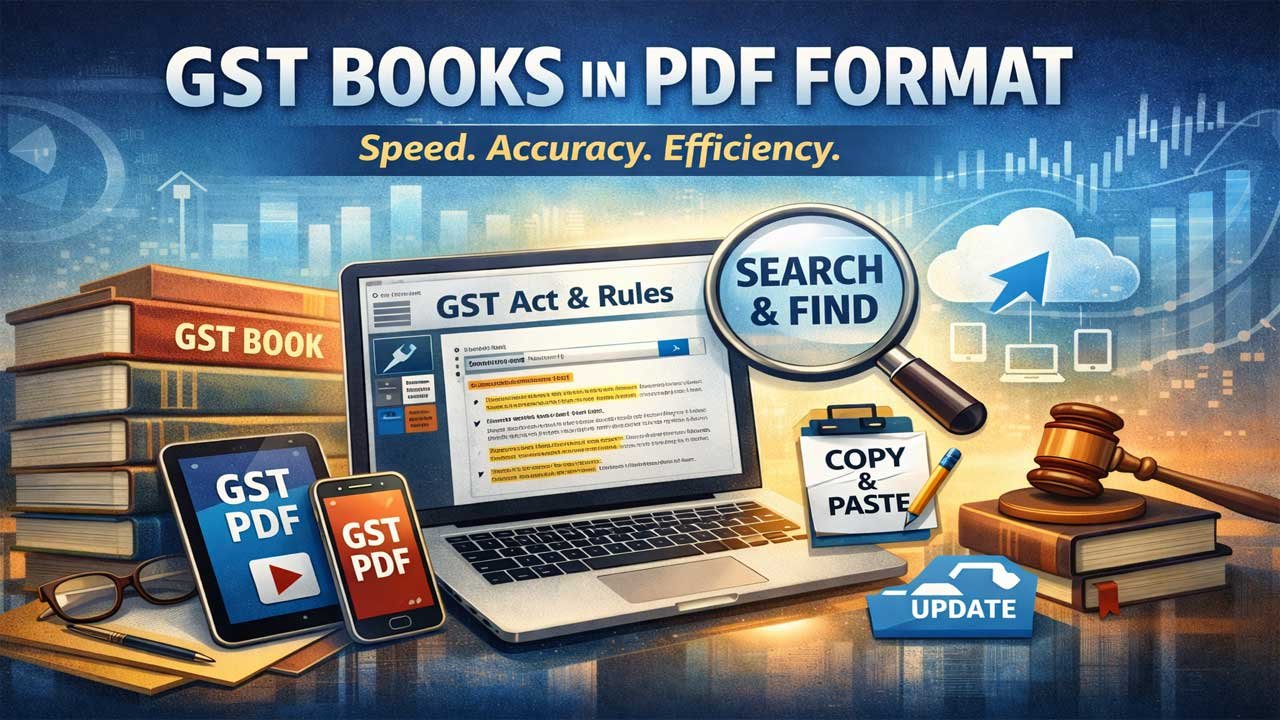
GST books in PDF format have become the gold standard for modern professionals because they transform static legal texts into fast, dynamic, and highly efficient working tools.
PDFs offer powerful search and hyperlinking features that enable instant cross-referencing across sections, rules, notifications, and case laws, drastically reducing research time and errors. They integrate seamlessly into professional workflows through easy copy-paste for drafting, stay current through clean digital updates, and provide customizable reading options like zoom, dark mode, and text-to-speech.
Combined with cloud syncing that allows access across devices anytime, PDFs outperform physical books in accuracy, accessibility, cost, and productivity, making them an essential asset in the fast-changing GST environment.
The Digital Advantage: Why the PDF Format is the Gold Standard for GST Resources
In the intricate and ever-evolving landscape of the Goods and Services Tax (GST), information is not just power—it is the currency of your profession. Whether you are a Chartered Accountant arguing a case, a student memorizing the complexities of Input Tax Credit, or a CFO managing compliance, the medium you use to access information matters.
While the traditional hardbound commentary has served us for decades, the GST Book in PDF format has emerged as the superior tool for the modern professional. It transforms a static text into a dynamic, interactive database.
Here is an in-depth look at why you should make the switch.
1. Precision and Speed: The “Search” Superpower
The GST landscape is vast, comprising the CGST, SGST, IGST, and UTGST Acts, alongside thousands of notifications. Finding a needle in this haystack using a physical index is slow and prone to human error.
- Global Search Capabilities: Beyond a simple “Ctrl+F,” modern PDF readers allow for advanced search. You can search for specific phrases like “blocked credits” across multiple PDF files simultaneously within a folder.
- Contextual Discovery: When searching for a specific section (e.g., “Section 16”), a PDF search will instantly show you not just the section, but every instance where it is referenced—in case laws, circulars, or other chapters—giving you a 360-degree view instantly.
2. The Power of Hyperlinking: Navigating the Maze
GST law is deeply interconnected. A Section refers to a Rule, which refers to a Notification, which leads to a specific Form.
- The “One-Click” Workflow: High-quality GST PDFs come with internal hyperlinks. Instead of keeping five fingers holding different pages in a physical book, you simply click the link mentioned in the text (e.g., “See Rule 86B”), and the PDF jumps immediately to that Rule.
- External Connectivity: Many digital books link directly to the official CBIC portal or legal databases. If a case law is cited, a single click can take you to the full judgment text online, a feat impossible with paper.
3. Workflow Integration: Copy, Paste, Draft
For practitioners, reading is only half the job; the other half is drafting opinions, appeals, and emails.
- Seamless Drafting: With a physical book, you must manually type out sections to quote them in your emails or legal drafts, risking typos. With a PDF, you can copy and paste the exact legal text directly into your Word document or Outlook email. This ensures 100% accuracy in your legal citations and saves massive amounts of typing time.
4. Dynamic Updates vs. Static Obsolescence
In the GST regime, a book is often outdated the moment it leaves the printing press due to the frequency of Council meetings and notifications.
- Real-Time Relevance: Digital authors often provide “live” PDFs or supplementary files that integrate seamlessly. You don’t need to buy a new ₹2,000 book every six months.
- Cleanliness: In a physical book, updating means sticking messy addendum slips onto pages. In a PDF, the text is updated cleanly, maintaining readability.
5. Accessibility and Customization
Not everyone studies or works the same way. Physical books offer a “one-size-fits-all” font and layout.
- Visual Comfort: PDFs allow you to zoom in on complex tables or fine print, reducing eye strain. You can also use “Reflow Mode” on mobile devices to make text fit the screen perfectly, or switch to “Dark Mode” for late-night study sessions without the glare.
- Text-to-Speech: Tired of reading? Most PDF readers have a “Read Aloud” feature. You can listen to the GST provisions while commuting or driving, turning downtime into study time.
6. Cloud Sync: Your Library, Everywhere
A comprehensive GST library can fill an entire bookshelf.
- Device Agnosticism: Store your PDF on cloud services like Google Drive or OneDrive. You can start reading a chapter on your office desktop, highlight a key point on your tablet during your commute, and review it on your phone right before a meeting. Your library follows you, not the other way around.
Comparative Analysis: The Professional Impact
| Feature | Physical Book | PDF / Digital Book | Professional Impact |
|---|---|---|---|
| Cross-Referencing | Manual (Page flipping) | Hyperlinked (Instant jump) | Faster understanding of linked provisions. |
| Drafting | Manual Typing | Copy-Paste | Zero transcription errors; faster turnaround. |
| Storage | Physical Shelf Space | Digital / Cloud | Zero clutter; infinite library size. |
| Preservation | Paper yellows/tears | Immortal | Notes are backed up and never lost. |
| Cost | High (Print/Ship) | Low | Budget-friendly for students & firms. |
Expert Tip: How to Maximize Your GST PDF
The Dual-Screen Setup: For the ultimate productivity hack, open your GST PDF on one monitor (or one side of your screen) and your drafting document (Word/Email) on the other. Use the PDF’s sidebar “Table of Contents” to navigate rapidly while you draft.
Conclusion
Embracing GST books in PDF format is not just about saving paper; it is about optimizing your cognitive load. It frees you from the mechanical tasks of flipping pages and searching indices, allowing you to focus entirely on interpretation, analysis, and strategy. In the fast-paced world of taxation, the PDF is your most agile partner.


Leave a Reply
You must be logged in to post a comment.