
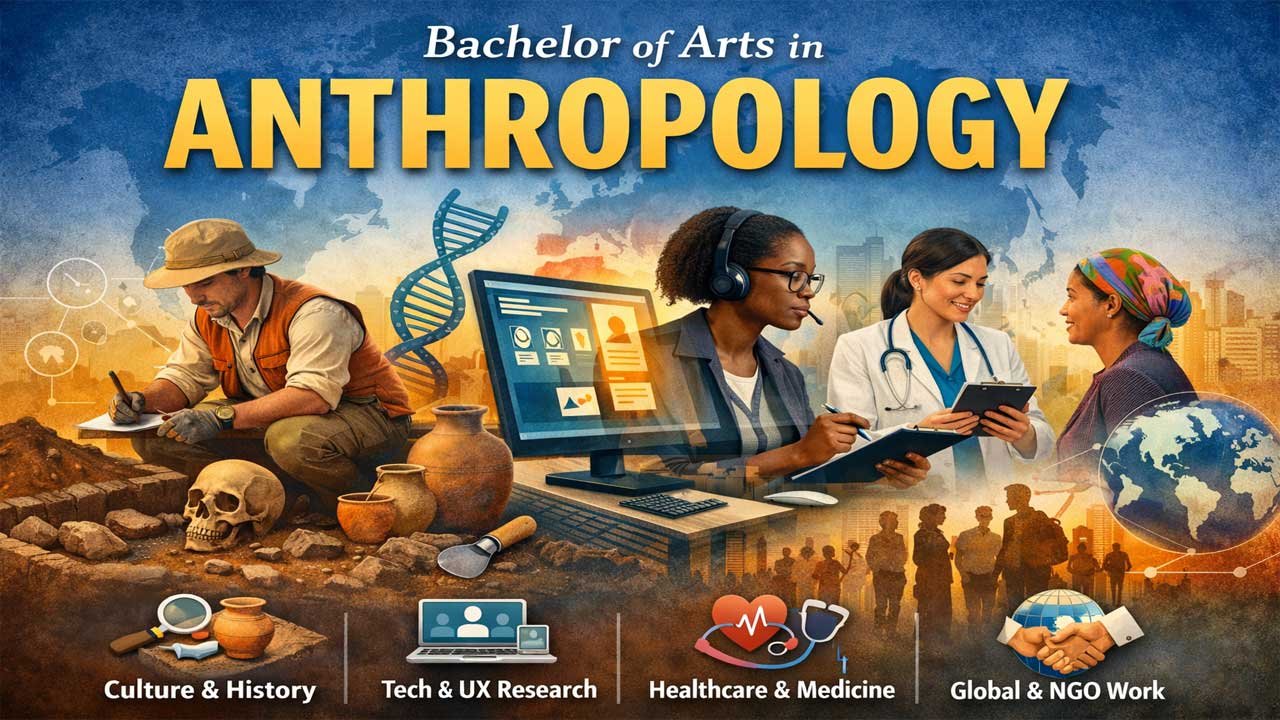
The Bachelor of Arts in Anthropology (BAAnth) represents one of the most intellectually rewarding and surprisingly versatile degrees in higher education today. Once perceived as purely academic or research-focused, anthropology has evolved into a discipline with significant real-world applications across technology companies, healthcare organizations, international development agencies, and corporate sectors worldwide. This comprehensive guide explores what makes this degree valuable, how to pursue it globally, and why it’s experiencing renewed demand in 2026.
For students seeking a degree that combines scientific rigor with humanistic inquiry, develops critical thinking skills applicable across industries, and opens doors to unexpected career opportunities—especially in emerging fields like user experience research and cultural resource management—the BAAnth offers compelling value.
What is a Bachelor of Arts in Anthropology?
Anthropology is the scientific and humanistic study of humanity in all its biological, social, cultural, and linguistic dimensions. A BAAnth degree provides students with comprehensive knowledge spanning four major subfields: biological anthropology, cultural anthropology, archaeology, and linguistic anthropology.
Unlike engineering or accounting degrees with narrowly defined career paths, the BAAnth teaches students to understand human behavior through multiple analytical lenses. This breadth is precisely why employers across diverse industries increasingly value anthropology graduates.
Core Areas of Study
Biological Anthropology: Examines human evolution, comparative primate biology, forensic analysis, and how evolutionary history shapes modern human biology.
Cultural Anthropology: Analyzes cultural systems, social institutions, belief systems, and how people navigate contemporary issues like globalization, health disparities, and technological change.
Archaeology: Studies material culture, human settlement patterns, and cultural heritage preservation through excavation and analysis.
Linguistic Anthropology: Investigates language as a cultural system and its role in shaping human thought and social relationships.
Degree Structure
Most BAAnth programs require 120–180 credit hours completed over three to four years. Programs typically include:
- Foundation courses (30–40 credits): Core introductions to each subfield plus research methods and statistics
- Depth courses (40–60 credits): Upper-level specialized courses allowing students to focus on specific interests
- Electives and concentrations (30–50 credits): Options in applied anthropology, medical anthropology, digital anthropology, or others
Many universities offer specialized emphases. For example, UC Davis provides Evolutionary, Sociocultural, and General emphases, each with tailored coursework. University of Washington offers five distinct options including Archaeological Sciences, Human Evolutionary Biology, and Indigenous Archaeology.
Top Universities Offering Bachelor of Arts in Anthropology Globally
The quality of anthropology programs varies significantly worldwide. Leading institutions combine rigorous academic training with applied fieldwork opportunities and strong industry connections.
United States
Top-Tier Research Universities:
- Harvard University: Offers graduate programs with medical anthropology specialization
- UC Davis: Comprehensive program with multiple emphasis options and strong field school
- University of Washington: Five specialization options; strong emphasis on contemporary applications
- University of Chicago: Historically significant program with international research opportunities
- Columbia University: Focuses on contemporary global issues
Online & Accessible Programs:
- Arizona State University (Online): Full BA in anthropology with 39 classes, 120 credit hours; next start March 2026
- Oregon State University (Online): Includes archaeology field school option and GIS training
- Southern New Hampshire University (Online): 91.6% student satisfaction rating; affordable online tuition
- University of Florida (Online): Upper division transfer options available
United Kingdom
- University College London (UCL): Offers BSc in Anthropology with Year Abroad option, covering evolutionary, social, and material culture perspectives
- University of Cambridge: Renowned social anthropology programs at graduate level
- University of Sussex: Focuses on contemporary global challenges; accepts international qualifications
Canada
- University of British Columbia: 42-credit major requirement with distinct options
- University of Toronto: Strong research program with international partnerships
Australia
- Deakin University: Offers bachelor’s, master’s, and doctoral degrees with world-class facilities
- University of Melbourne: Top-ranked anthropology program
Admission Requirements & Eligibility Criteria
Admission standards vary by institution and country level (bachelor’s vs. graduate).
Typical Undergraduate Requirements
High School Qualifications:
- High school diploma or equivalent (typically with strong grades in humanities and sciences)
- For international students in UK universities: 85–88% on Australian ATAR or equivalent; Canadian students need 70–75% from grade 12 courses
Prerequisites (vary by program):
- Introductory anthropology or social science course
- Statistics or quantitative reasoning course
- Some programs require language proficiency
Application Materials:
- Completed application form
- High school transcripts
- Essays or personal statements describing interest in anthropology
- Letters of recommendation
For Online Programs
Online programs offer more flexible admission requirements. For example, Florida’s online program admits:
- Fresh start students (0–11 college credits) via standard freshman requirements
- Transfer students (12+ credits) with 2.5+ GPA
- Upper division transfers with at least three anthropology courses and 2.5 GPA
Graduate Program Requirements
MA/MSc programs typically require:
- Bachelor’s degree in related field (anthropology preferred but not required)
- Statement of purpose
- Letters of recommendation
- GRE scores (for most US programs)
- Language proficiency for international students
Program Options & Specializations
Modern BAAnth programs increasingly offer specializations aligned with current industry demand.
Archaeological Sciences
Focuses on methods, theory, and field excavation techniques. Graduates often enter cultural resource management (CRM)—a billion-dollar industry created by the 1966 National Historic Preservation Act. These positions involve assessing development projects for archaeological significance before construction.
Medical Anthropology
Examines health systems, disease patterns, healing practices, and cultural beliefs about the body. Perfect for students interested in public health, international development, or healthcare consulting.
Emerging opportunity: Medical anthropologists are increasingly employed by pharmaceutical companies, hospitals, and public health agencies to develop culturally appropriate health interventions and understand patient populations.
Digital & Applied Anthropology
Studies human behavior in digital spaces, technology adoption, and cultural impacts of technological change. This specialization directly prepares students for UX research roles.
Cultural Resource Management & Indigenous Archaeology
Focuses on cultural heritage preservation and indigenous perspectives on archaeological practice. Directly applicable to government agencies, NGOs, and consulting firms working on development projects.
Globalization & International Development
Analyzes how globalization shapes local cultures, economies, and societies. Prepares students for international NGOs, development organizations, and policy work.
Career Opportunities: Where BAAnth Graduates Work
One of the most surprising aspects of the anthropology degree is the diversity of career paths. The term “anthropologist” appears in few job titles—instead, graduates leverage anthropological training across sectors.
Technology & User Experience (UX) Research
This is the fastest-growing sector for anthropology graduates. Companies like Google, Microsoft, Intel, and IBM employ substantial numbers of anthropologists.
Why anthropologists excel in UX research:
- Trained in ethnographic fieldwork (observing people in natural environments)
- Skilled at interpreting human behavior and identifying unstated needs
- Excellent at listening to stakeholders and building empathy
- Understand cultural context and diverse user perspectives
- Can design culturally appropriate interfaces and features
UX Research Salary: $64,200–$75,100+ annually, with significant variation by company and experience level.
Important caveat: While UX is growing, some tech companies reduced UX hiring in late 2024–2025. Graduates should develop complementary technical skills (Python, R, GIS, data analysis) to remain competitive.
Cultural Resource Management (CRM)
Archaeological and historical consulting firms employ anthropologists to assess development projects under Section 106 of the National Historic Preservation Act. This is a billion-dollar industry with a current shortage of qualified professionals.
CRM Career Path:
- Entry-level: Field technician ($35,000–$45,000/year) plus seasonal bonuses
- Mid-level: Project manager ($50,000–$65,000/year)
- Senior: Principal investigator ($65,000–$85,000+/year)
Requirements: Bachelor’s degree plus field school experience and GIS competency. Growing shortage means strong job prospects.
Medical Anthropology & Healthcare
Healthcare organizations, pharmaceutical companies, and international public health agencies hire medical anthropologists to:
- Design culturally competent health interventions
- Conduct ethnographic research on patient populations
- Develop health promotion campaigns
- Analyze healthcare disparities
- Improve clinical care delivery
Salary: $50,000–$70,000+ depending on role and institution.
Government & Policy
Federal, state, and local government agencies employ anthropologists in:
- Foreign service and diplomacy
- Community development programs
- Environmental policy
- Urban planning
- Justice and law enforcement (forensic anthropology)
US Federal Government Salary: $92,980 median, significantly higher than private sector entry positions.
Academic & Research
Universities, think tanks, and research institutes employ anthropologists as professors, researchers, and research administrators. This path typically requires a master’s degree or PhD.
NGOs & International Development
Organizations like the Peace Corps, World Bank, and international NGOs employ anthropologists for:
- Program design and evaluation
- Community engagement
- Cultural impact assessment
- Organizational development
Salary Expectations: Global Perspectives
United States
| Role | Entry-Level | Mid-Career (5+ years) | Senior |
|---|---|---|---|
| UX Researcher | $64,200/year | $80,000–$95,000 | $100,000–$150,000+ |
| Archaeologist (private CRM) | $38,000–$45,000 | $55,000–$70,000 | $75,000–$100,000+ |
| Federal Government | $43,000–$50,000 | $65,000–$85,000 | $90,000–$120,000+ |
| University Research | $45,000–$55,000 | $60,000–$80,000 | $75,000–$110,000+ |
| California (general average) | – | $158,118/year (varies by role) | – |
Sources: CareerExplorer, ZipRecruiter, BLS Occupational Handbook.
India
The Indian job market for anthropology graduates has expanded significantly, particularly in corporate research, healthcare, and development sectors.
| Experience Level | Government | Corporate/Research | NGO/Development |
|---|---|---|---|
| Entry (0–2 years) | ₹3.5–5 lakhs | ₹4–6 lakhs | ₹3.5–5 lakhs |
| Mid-career (3–7 years) | ₹6–10 lakhs | ₹8–12 lakhs | ₹6–9 lakhs |
| Senior (8+ years) | ₹12–18 lakhs | ₹15–25 lakhs | ₹12–20 lakhs |
Source: Translational Health Science Institute 2025 Data
United Kingdom & Australia
UK and Australian programs similarly place graduates in competitive markets. London-based roles tend to pay £28,000–£40,000 starting salary, with opportunities in cultural institutions, NGOs, and research organizations.
Job Market Outlook 2026 & Beyond
Overall Growth
Jobs in anthropology are projected to grow by 5% between 2023 and 2033, approximately in line with average occupational growth. This modest growth masks significant sectoral variation:
- Declining: Traditional academic positions remain constrained by limited grant funding and university hiring freezes
- Growing: CRM, UX research, healthcare, tech sector, NGO work
- Volatile: UX research hiring fluctuates with tech industry cycles
Emerging Opportunities
Technology & AI: As companies integrate generative AI, anthropologists are increasingly valued for understanding cultural context and ensuring AI systems don’t perpetuate biases. This represents a major growth area through 2026–2027.
Healthcare & Medical Research: Post-COVID expansion in public health, pandemic preparedness, and health equity initiatives creates demand for cultural competency expertise.
Policy & Governance: Governments increasingly recognize need for anthropological perspectives on migration, climate adaptation, and social cohesion.
Competitive Factors
The job market is competitive but not saturated. Key differentiators:
- Technical skills: GIS, R, Python, statistics—increasingly required
- Field experience: Internships, field schools, and demonstrated research
- Specialization: Medical anthropology, digital anthropology, or CRM experience opens more doors than generalist BA
- Networking: Many positions filled through professional connections rather than job boards
- Geographic flexibility: Willingness to relocate improves prospects significantly
Is a BAAnth Degree Worth It? Return on Investment Analysis
Cost Considerations
Public Universities (US):
- In-state: $12,000–$25,000/year ($48,000–$100,000 total for 4 years)
- Out-of-state: $28,000–$45,000/year
Private Universities:
- $40,000–$60,000+/year ($160,000–$240,000 for 4 years)
Online Programs:
- $15,000–$35,000 total (SNHU, ASU, OSU, UF)
International Programs:
- UK: £25,000–£35,000 total for 3 years
- Australia: AUD 30,000–$50,000 total
Graduate School: MA/MSc programs add $20,000–$60,000+ and 1–2 years
Financial ROI Calculation
Scenario 1: Public University, Immediate Employment in UX Research
- Cost: $80,000 (total student loans)
- Starting salary: $65,000/year
- 5-year earnings: $330,000 gross
- Rough ROI: Break-even by year 2; positive ROI thereafter
Scenario 2: Private University, CRM Archaeologist Path
- Cost: $200,000 (total student loans including field schools)
- Starting salary: $40,000/year
- 10-year earnings: $650,000 gross (accounting for raises)
- ROI: Positive after ~5 years; modest lifetime gains
Scenario 3: Federal Government Career
- Cost: $80,000
- Starting salary: $48,000/year; median 15-year career: $750,000+ (includes federal pension)
- ROI: Excellent, with job security and benefits
Non-Financial Benefits
Beyond salary, anthropology graduates report:
- Intellectual fulfillment: 89% of students surveyed said they’d pursue the degree again despite financial concerns
- Career flexibility: The degree opens unexpected opportunities; graduates work in law, business, policy, nonprofits, and tech
- Cultural competency: Increasingly valuable as organizations prioritize diversity and inclusion
- Problem-solving skills: Anthropological training develops systems thinking applicable to any field
Online vs. On-Campus Programs: Comparative Analysis
| Factor | Online | On-Campus |
|---|---|---|
| Cost | $15,000–$35,000 | $50,000–$240,000+ |
| Flexibility | High; study at own pace | Lower; fixed schedule |
| Fieldwork | Limited or optional | Integrated throughout |
| Networking | Primarily virtual | Strong in-person connections |
| Hands-on labs | Simulated or recorded | Live lab experiences |
| Faculty interaction | Asynchronous mostly | Synchronous meetings |
| Employer recognition | Growing acceptance | Traditional preference |
| Career outcomes | Similar for most roles | Slightly better for CRM/archaeology |
Recommendation:
- Pursue on-campus for: Archaeology/CRM focus (field schools essential), academic career aspirations
- Choose online for: Working professionals, international students, UX/tech focus, budget constraints
How to Choose the Right Program: Selection Criteria
Geographic Considerations
Proximity to field opportunities: CRM-focused students benefit from universities near construction/development projects. Archaeology-focused students should prioritize schools with strong field school partnerships.
Climate/cultural access: Biological anthropology students studying primates or human adaptation benefit from proximity to relevant ecosystems or populations.
Internship hubs: UX research candidates should prioritize universities in tech centers (San Francisco Bay Area, Seattle, Austin, Boston).
Program Structure
Specialization alignment: Does the program offer emphasis areas matching your interests?
Flexibility: Can you customize coursework or pursue independent research?
Graduate pipeline: Does the program support students pursuing advanced degrees?
Practical Factors
Cost: Calculate realistic total cost including living expenses, not just tuition
Scholarship availability: Top universities often have larger endowments enabling financial aid
Employment support: Does the university provide career coaching, internship connections, and alumni network access?
Class size: Smaller upper-level classes provide better mentoring and research opportunities
Getting Started: Application Timeline & Preparation
Pre-Application (6–12 months before)
- Explore interests: Take introductory anthropology courses or audit online courses to confirm fit
- Build relevant skills: Learn GIS, basic statistics, or a foreign language
- Research programs: Visit university websites, read student reviews, connect with current students
- Gain experience: Volunteer with museums, archaeological digs, NGOs, or research projects
- Take standardized tests (if required): SAT/ACT for undergraduate; GRE for graduate
Application Phase (3–6 months before enrollment)
- Prepare materials: Transcripts, essays, letters of recommendation
- Write compelling statement of purpose: Explain genuine interest in anthropology and career goals
- Request letters: From teachers/professors who know your work well
- Submit early: Most programs review applications on rolling basis
- Prepare for interviews: Some programs conduct interviews; practice discussing your interests coherently
Post-Acceptance
- Confirm financing: Understand loans, grants, scholarships
- Connect with admitted students: Join online communities to build social connection before arriving
- Plan logistics: Housing, visa (if international), orientation
- Plan first courses: Meet with advisor about course selection
Skills You’ll Develop: Career-Readiness Outcomes
The BAAnth develops both academic and professional skills highly valued by employers:
Hard Skills
- Research design & methodology: Conduct rigorous investigations
- Data analysis: Qualitative and quantitative approaches
- GIS & geospatial analysis: Map cultural patterns and resources
- Statistics: Understand and apply quantitative methods
- Technical writing: Communicate findings clearly to diverse audiences
- Foreign language proficiency: Bilingualism increasingly required in international roles
Soft Skills
- Cross-cultural communication: Understand diverse perspectives
- Empathy & active listening: Interpret unspoken needs and motivations
- Systems thinking: Recognize interconnections and holistic patterns
- Critical thinking: Question assumptions and evaluate evidence
- Flexibility & adaptability: Navigate ambiguous fieldwork situations
- Project management: Coordinate complex research initiatives
- Collaboration: Work effectively in interdisciplinary teams
These skills transfer directly to UX research, policy analysis, program management, and organizational development roles.
Emerging Specializations to Watch
1. Digital Anthropology & AI Ethics
As artificial intelligence reshapes society, organizations need anthropologists to ensure systems reflect cultural values and avoid embedded biases. This field is experiencing rapid growth and commands premium salaries ($75,000–$110,000+).
2. Climate & Environmental Anthropology
Climate change adaptation, environmental justice, and sustainability initiatives increasingly employ anthropologists to understand community resilience and cultural dimensions of environmental change.
3. Migration & Refugee Studies
Growing international migration creates demand for anthropologists who understand displacement, cultural integration, and diaspora communities. NGOs, governments, and international organizations actively hire in this area.
4. Corporate Anthropology
Large corporations (Microsoft, Intel, Google, Accenture, Samsung) employ full-time anthropologists in strategy, market research, and organizational development. Salaries range from $80,000–$150,000+.
Student Testimonials & Success Stories
“I graduated with a BA in Anthropology and thought I’d pursue academia. Instead, I took a UX research internship at a tech startup. That led to full-time work at Microsoft in their AI ethics team. I now earn $95,000 in my third year, and my anthropology background is exactly why I was hired. I never would have predicted this career path.” — Sarah M., University of Washington graduate
“The anthropology degree taught me to listen deeply and see systems holistically. After graduation, I worked for three years in CRM, then transitioned to consulting. Now I manage a team of 12 doing cultural impact assessments for major infrastructure projects. Salary has grown to $140,000, and job security is excellent.” — James K., UC Davis graduate
“I completed the online ASU program while working full-time. The flexibility was crucial. I then earned my MPH and now work as a medical anthropologist for a public health department, designing culturally appropriate health interventions. Total cost was under $40,000; I’ve already earned that back multiple times over.” — Priya S., Arizona State University Online
Addressing Common Concerns
“Is Anthropology Too Academic / Not Practical Enough?”
Reality: While anthropology has deep theoretical roots, modern programs increasingly emphasize applied work. Internships, field schools, and industry partnerships are standard. The “impractical” reputation persists mainly in academia-only departments—avoid those if you want career flexibility.
“Won’t I Struggle Finding Jobs Compared to Business/Engineering Majors?”
Reality: The job market is competitive but not saturated. Anthropology graduates are actually more hire-able than some technical majors because they develop rare soft skills employers desperately need (empathy, communication, systems thinking). The key: develop technical skills too (GIS, coding, statistics).
“Do I Really Need a Master’s Degree?”
Reality: Depends on career path. UX researchers, policy analysts, and corporate roles often accept BA+experience. CRM archaeologists and academic positions typically require MA/MSc. Evaluate before committing to additional debt.
“Is This Degree Useful International Outside the US?”
Reality: Absolutely. UK and Australian programs are globally recognized. Canada, Australia, and India have growing private sectors employing anthropologists. International NGOs actively recruit anthropologists globally. Just research target country’s job market before enrolling.
Conclusion: Why Choose Anthropology in 2026?
The Bachelor of Arts in Anthropology has transformed from a primarily academic pursuit into a pragmatic degree opening doors across technology, healthcare, policy, and business. In a world increasingly shaped by cultural diversity, technological disruption, and complex global challenges, anthropologists bring irreplaceable expertise.
Choose this degree if you:
- Are genuinely curious about human behavior and cultural diversity
- Want flexibility to pursue diverse career paths
- Value intellectual depth alongside practical application
- Are willing to develop complementary technical skills
- Seek meaningful work addressing real-world problems
Avoid this degree if you:
- Need absolute job placement guarantees (any liberal arts degree has inherent uncertainty)
- Lack patience for ambiguity and complexity (anthropology embraces both)
- Expect high earnings immediately (delayed gratification required)
- Dislike fieldwork and want purely desk-based study
For students who fit the profile, a BAAnth offers intellectual growth, career flexibility, and increasingly, solid financial outcomes. The degree is undergoing a renaissance—employers are finally recognizing what anthropologists have always known: understanding human behavior is fundamental to solving the world’s problems.
FAQ: Bachelor of Arts in Anthropology
Q: How long does it take to earn a BAAnth?
A: Typically 3–4 years for full-time students. Online programs may take longer depending on pace.
Q: Can I earn a BAAnth online?
A: Yes. ASU, Oregon State, SNHU, University of Florida, and others offer fully online programs with identical degrees to on-campus.
Q: What’s the average starting salary?
A: $38,000–$65,000 depending on sector and location. Tech/UX roles pay higher; CRM entry-level pays lower.
Q: Do I need to speak multiple languages?
A: Not always required for the degree, but bilingualism significantly improves job prospects and salary potential.
Q: Can I work while earning my BAAnth?
A: Yes, especially in online programs or evening/weekend format. Many universities offer flexible scheduling.
Q: Is anthropology harder than other degrees?
A: Not necessarily “harder,” but requires strong writing, critical thinking, and comfort with ambiguity. Reading load is substantial.
Q: Should I double major?
A: Double majoring in anthropology + business, data science, or public health increases job prospects and salary without significantly more cost.
Q: Can I transition from another degree to anthropology?
A: Yes. Many universities accept transfer students. Some programs have conditional admission for those lacking prerequisites.
Q: What’s the difference between BA and BS in Anthropology?
A: BA emphasizes humanistic perspectives and offers more flexibility; BS focuses on scientific rigor and specialized training. Both are valuable; choose based on career goals.
Q: Is anthropology worth it compared to more “practical” degrees?
A: Research shows social science graduates earn comparably to technical majors over a lifetime, with significantly higher life satisfaction reported. ROI depends heavily on career path chosen.
Ready to explore anthropology programs? Start by researching universities offering the specialization matching your interests, connect with current students, and consider taking an introductory course to confirm your passion for the discipline. Your unique perspective and skills as an anthropologist will be increasingly valuable in an interconnected, culturally complex world.


Leave a Reply
You must be logged in to post a comment.