
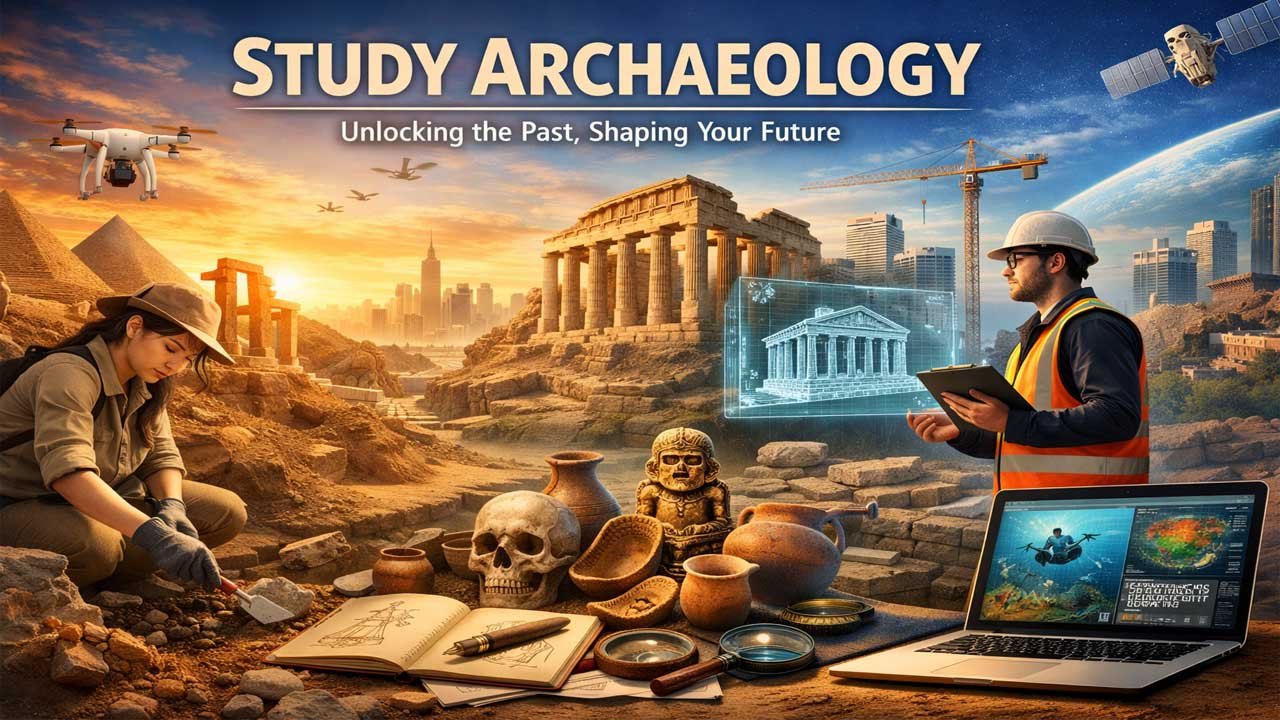
The Bachelor of Arts in Archaeology (BAArch) is a three-year undergraduate degree that blends humanities, science, fieldwork, and digital tools to study human history through material remains while preparing students for growing global careers in cultural resource management, heritage conservation, museums, and academia.
With strong job demand driven by infrastructure projects and heritage laws, international mobility, modern skills like GIS and 3D modeling, and long-term salary growth, BAArch offers a meaningful and future-ready career path for students interested in history, technology, and preserving the past.
Bachelor of Arts in Archaeology (BAArch): Complete Career & Admission Guide 2026
The Bachelor of Arts in Archaeology (BAArch) is a prestigious three-year undergraduate degree that combines humanities, scientific methods, and field experience to unlock humanity’s past.
As infrastructure projects expand globally and cultural resource management (CRM) becomes increasingly critical, archaeology has shifted from a purely academic discipline to a thriving profession with growing employment opportunities. This comprehensive guide explores what a BAArch degree entails, career prospects, salary expectations, and why it’s an excellent choice for international students in 2026-2027.
| Aspect | Information |
|---|---|
| Degree Name | Bachelor Of Arts In Archaeology (BAArch) |
| Duration | 3–4 Years |
| Core Focus | Archaeological Theory, Fieldwork, Cultural Interpretation |
| Study Mode | Full-Time Undergraduate |
| Mandatory Fieldwork | Minimum 70 Days |
| Popular Specializations | Bioarchaeology, Digital Archaeology, CRM, Underwater Archaeology |
| Top Career Sectors | Cultural Resource Management, Heritage, Museums, Academia |
| Entry-Level Salary (India) | ₹4–5 Lakh Per Year |
| Mid-Level Salary (Global) | $60,000–$90,000 Per Year |
| Job Market Trend | Strong Growth Driven By Infrastructure And Heritage Laws |
| Key Skills | Excavation, GIS, Research Writing, Data Analysis, 3D Modeling |
| Top Employers | ASI, UNESCO, Universities, CRM Firms |
| Global Mobility | High – Recognized Internationally |
| Technology Integration | GIS, LiDAR, Drones, VR, 3D Scanning |
| Best For | History Lovers, Field-Oriented Learners, Tech-Adaptive Students |
What is a Bachelor of Arts in Archaeology?
The BAArch is a three to four-year undergraduate program designed to provide comprehensive training in archaeological theory, methods, and practice. Unlike a Bachelor of Science in Archaeology, which emphasizes laboratory analysis and scientific techniques, the BA focuses on the humanities aspects—cultural context, historical interpretation, and ethical practices in archaeological research.
Program Duration: 3 years (most universities)
Study Structure: Divided into 4-6 semesters with compulsory core modules and optional specializations
Key Components: Lectures, seminars, practical lab work, fieldwork (typically 70 days minimum), and dissertation writing
Students learn how to excavate, document, analyze, and interpret material culture—artifacts, architecture, biological remains, and cultural landscapes—to understand human behavior and societal development across time periods ranging from prehistoric to industrial-era archaeology.
Core Curriculum: What You’ll Study
Compulsory Modules
Most BAArch programs require foundational knowledge in:
- Archaeological Theory and Interpretation: Understanding how archaeologists construct narratives from material evidence
- Fieldwork and Post-Excavation Methods: Hands-on training in survey, excavation, documentation, and laboratory analysis
- Principles of Archaeology: Scientific dating methods, stratigraphy, and context analysis
- Ancient History and Cultural Studies: Contextualizing material remains within historical frameworks
- Research Methods: Data collection, analysis, and scholarly writing
- Dissertation: A 10,000-word independent research project in your final year
Optional Specializations
You can customize your degree based on interests:
| Specialization | Focus Area |
|---|---|
| Classical Archaeology | Ancient Greece, Rome, and Mediterranean civilizations |
| Bioarchaeology | Human skeletal remains, dietary analysis, disease patterns |
| Underwater/Marine Archaeology | Submerged sites, shipwrecks, coastal settlements |
| Digital Archaeology | 3D modeling, GIS analysis, virtual reconstruction, AR/VR |
| Prehistoric Archaeology | Human origins, Paleolithic to Neolithic periods |
| Historical Archaeology | Post-historic cultures with written records |
| Environmental Archaeology | Human-environment interaction, ancient climate |
| Geoarchaeology | Soil science, stratigraphy, LiDAR, ground-penetrating radar |
| Cultural Resource Management (CRM) | Heritage preservation and compliance archaeology |
| Zooarchaeology | Animal remains and ancient subsistence patterns |
| Urban Archaeology | City development, infrastructure archaeology |
Admission Requirements: Getting Into a BAArch Program
In India
Eligibility: Class 12 pass with minimum 50% aggregate from a recognized board
Entrance Exams:
- CUET UG (Common University Entrance Test)
- IPU CET
- University-specific entrance exams
- Some institutions offer merit-based admission
Top Indian Universities Offering BAArch:
- M.S. University of Baroda
- Banaras Hindu University
- Calcutta University
- University of Madras
- St. Xavier’s College
In the UK
A-Level Requirements: ABB (minimum), with at least one essay-based subject
IB: 30+ points with higher-level subjects
GCSE/IGCSE: Grade 6/B in English Language and Grade 4/C in Mathematics
English Language Proficiency: IELTS 7.0 (6.5 in each sub-test) or equivalent
Top UK Universities:
- University of Cambridge
- University of Oxford
- University College London (UCL)
- Durham University
- University of Manchester
- University of Newcastle
In the USA
High School Diploma: Required, with strong grades in humanities and sciences
SAT/ACT: Varies by institution; top universities typically expect 1500+ SAT scores
Preferred Subjects: History, English, sciences (chemistry, biology)
Leading US Institutions:
- Harvard University
- Stanford University
- University of California, Berkeley
- Yale University
- University of Pennsylvania
International Student Requirements
Most countries require:
- Official transcripts and diploma verification
- English language proficiency test (IELTS/TOEFL)
- Statement of purpose explaining interest in archaeology
- Letters of recommendation
- Valid passport
Career Opportunities and Job Market
Growing Employment Sector: Cultural Resource Management (CRM)
The fastest-growing segment in archaeology is Cultural Resource Management, driven by infrastructure projects, urban development, and heritage preservation initiatives. According to recent data, demand for CRM archaeologists is extremely strong, with estimates suggesting up to 8,000 new full-time positions opening in the coming years across the United States alone. Universities are not producing graduates quickly enough to meet this demand, creating excellent career prospects for BAArch graduates.
Career Paths After BAArch
| Career Role | Typical Responsibilities | Salary Range |
|---|---|---|
| Field Technician | Excavation, survey, documentation | ₹2-3 LPA (India); $30,000-45,000 (USA) |
| Archaeologist | Site direction, analysis, reporting | ₹3.5-6 LPA (India); $50,000-70,000 (USA) |
| CRM Specialist | Compliance archaeology, project management | ₹4-7 LPA (India); $55,000-85,000 (USA) |
| Heritage Manager | Site conservation, public engagement | ₹5-9 LPA (India); $60,000-90,000 (USA) |
| Museum Curator | Collections management, exhibitions | ₹4-8 LPA (India); $45,000-75,000 (USA) |
| GIS Specialist | Spatial analysis, digital mapping | ₹4.8-7 LPA (India); $65,000-95,000 (USA) |
| Academic/Professor | Teaching, research, publication | ₹7.8-12+ LPA (India); $70,000-120,000 (USA) |
| Heritage Consultant | Private conservation projects | ₹5-10 LPA (India); $60,000-100,000 (USA) |
Salary Expectations by Experience Level
In India:
- Fresher (0-2 years): ₹4.26 lakh/year
- Junior (2-5 years): ₹5.70 lakh/year
- Mid-level (5-10 years): ₹8.32 lakh/year
- Senior (10-15 years): ₹12.06 lakh/year
- Expert (15+ years): ₹18 lakh/year and above
Internationally:
- USA: $58,000-$80,000 (median $64,910 as of 2024)
- UK: £20,000-£40,000
- Australia: AUD 50,000-AUD 90,000
- Canada: CAD 40,000-CAD 80,000
Top Employers in India: Archaeological Survey of India (ASI), Indian Council of Historical Research (ICHR), Tata Institute of Social Sciences, National Archives of India, UNESCO
Job Market Growth
- Employment Growth (USA): 4% from 2024-2034 (average for all occupations)
- Annual Openings: Approximately 800 positions per year
- Demand Drivers: Infrastructure rebuilding, real estate development, heritage conservation, sustainability initiatives
Modern Skills: Digital Archaeology Integration
The archaeology profession is undergoing rapid transformation through technology. BAArch programs increasingly integrate digital tools that enhance career competitiveness:
Essential Digital Skills
Geographic Information Systems (GIS)
- Spatial mapping and site analysis
- Predictive modeling for site location
- Data visualization and analysis
- Creates strong competitive advantage for CRM careers
3D Modeling and Virtual Reconstruction
- 3D scanning and photogrammetry
- Virtual reality (VR) site reconstruction
- Augmented reality (AR) artifact visualization
- Increasingly used in museums and public outreach
Data Analytics and Computational Methods
- Database management of archaeological collections
- Statistical analysis of artifacts
- Machine learning for pattern recognition
- Digital ethnography
Remote Sensing Technologies
- LiDAR (Light Detection and Ranging)
- Ground-penetrating radar (GPR)
- Aerial photography and drone surveying
- Geophysical prospection
Universities like Cambridge, Oxford, and UCL now emphasize digital archaeology in their curricula, recognizing that modern archaeologists must be comfortable with both traditional excavation and cutting-edge computational analysis.
Fieldwork and Internship Opportunities
Fieldwork Experience: A Core Component
One of the major attractions of BAArch programs is mandatory fieldwork experience:
- Duration: Typically 70 days minimum (spread across three years)
- Types: Excavation, survey, laboratory work, museum studies, digital fieldwork
- Locations: Vary widely—recent programs include sites in Greece, Portugal, Romania, Spain, Tunisia, Morocco, Turkmenistan, and across the UK and USA
- Funding: Partially funded at most institutions; additional costs for international sites
Paid Internship Programs
Many organizations offer paid internships for archaeology students:
| Organization | Position Type | Duration | Benefits |
|---|---|---|---|
| Montpelier (USA) | Field & Lab Archaeology | 3-10 months | Full benefits, free housing, $15,000-25,000/year |
| Crow Canyon Archaeological Center | Field/Lab Archaeology | 5 weeks+ | Paid, access to 170-acre campus, research library |
| ASOR-affiliated Projects | Fieldwork | Variable | $2,000 scholarships per project |
| Archaeological Resource Management Firms | CRM Positions | Full-time | $35,000-60,000/year starting |
Career Advantage: Students with internship experience often secure job offers before graduation, making paid internships an excellent pathway to employment.
Fees and Costs: An International Comparison
Annual Tuition Fees (2026-27)
| Country/Institution | Home Students | International Students |
|---|---|---|
| UK Universities | ||
| University of Cambridge | £9,535 | £36,500 |
| University College London | £9,535 | £36,500 |
| University of Manchester | £9,535 | £27,800 |
| University of Newcastle | £9,535 | £25,000 |
| University of Aberdeen | £10,000 | £22,000 |
| USA Universities | Variable | $40,000-70,000 |
| India Universities | ₹50,000-2,00,000/year | ₹1,00,000-3,00,000/year |
Additional Costs
- Equipment: ~£300-500 (trowel, tent, sleeping bag, boots, jackets)
- Fieldwork: Partially funded; additional costs for premium international sites
- Books and Materials: £500-1,000/year
- Living Expenses: Varies by location; estimate £1,200-1,800/month in UK
Scholarship and Funding Opportunities
International Scholarships Available in 2026-2027
ASOR Fieldwork Scholarships
- Amount: $2,000 per project
- Eligibility: Open to international students
- Projects: Western Asia and Mediterranean archaeology
- Total funding 2026: Over $250,000 in scholarships/grants
Archaeological Institute of America (AIA)
- Jane C. Waldbaum Field School Scholarship: $1,000
- American Archaeology Abroad: $1,500
- Portal Greece Fellowship: Various amounts
- Application Deadline: November 1, 2026
University-Specific Scholarships
- University of Aberdeen Global Scholarship: £8,000 for international postgraduate students
- Most UK universities offer departmental bursaries for merit-based candidates
- Many institutions provide contextual admission offers with reduced entrance requirements
Additional Funding Sources
- Fulbright (US citizens studying abroad)
- Gilman International Scholarship (for Pell Grant-eligible students)
- Phi Kappa Phi Study Abroad: $1,000 grants
- British Council scholarships (for Commonwealth students)
- Government education loans (varies by home country)
Cumulative Support: Since 2007, over $1 million has been awarded to 900+ researchers and students through ASOR alone.
Why Choose a BAArch in 2026?
1. Strong Job Market
Unlike many humanities degrees, archaeology is experiencing genuine employment growth. The CRM sector is particularly booming due to infrastructure expansion, environmental regulations, and cultural heritage protection laws. Companies are actively recruiting and struggling to find qualified archaeologists.
2. Global Career Mobility
Archaeological skills are internationally recognized. You can work on excavations in Greece, conduct heritage management in Australia, contribute to museum collections in Canada, or pursue academic careers across Europe and beyond. The skills acquired are transportable worldwide.
3. Competitive Salary Growth
While entry-level positions may seem modest, archaeology offers strong salary progression. Professionals with 15+ years of experience earn ₹18 lakh+ in India or $100,000+ internationally. CRM directors and senior heritage managers command premium salaries, especially in urban development hotspots.
4. Technology Integration
Modern archaeology is no longer purely manual digging. GIS, 3D modeling, VR reconstruction, and data analytics are core skills that increase earning potential and job security. These technical competencies are also transferable to other sectors.
5. Meaningful Work
Unlike purely commercial careers, archaeology preserves human heritage, contributes to scientific knowledge, and often involves community engagement. Many graduates report high job satisfaction despite moderate starting salaries.
6. Government Career Pathway (Especially for Indian Students)
In India, organizations like ASI and ICHR offer stable government employment with pension benefits, job security, and structured salary progression. The government sector historically values archaeology and continues recruiting.
7. Diverse Specializations
Whether you prefer analyzing human bones (bioarchaeology), diving to explore shipwrecks (underwater archaeology), or mapping ancient cities with drones (digital archaeology), the field offers multiple paths suited to different interests.
The Future of Archaeology: 2026 Trends
Recent industry analysis identifies key trends shaping archaeological careers:
- Renewable Infrastructure Projects: Archaeological input is crucial for wind farms, solar installations, and green energy infrastructure—creating new CRM demand
- Workforce Leadership Development: The field is addressing shortage of skilled archaeologists through targeted recruitment and mentorship
- Social Value Focus: Public benefit and community heritage engagement are becoming primary drivers in archaeological projects
- Nature Recovery Integration: Archaeology increasingly intersects with ecological restoration and climate adaptation work
- Immersive Storytelling: Museums and heritage sites employ VR/AR to engage public audiences, requiring digitally-skilled archaeologists
These trends create diverse career opportunities beyond traditional excavation-based roles.
Conclusion: Is BAArch Right for You?
The Bachelor of Arts in Archaeology is ideal for students who:
- Have genuine curiosity about human history and cultural diversity
- Prefer hands-on, practical learning with fieldwork opportunities
- Want meaningful careers in heritage preservation or scientific research
- Seek international career mobility and global experiences
- Are comfortable with technology and emerging digital tools
- Value job security in growing sectors (CRM, heritage management)
- Can manage modest starting salaries with strong long-term progression
The archaeology profession has transformed dramatically in the past decade. It’s no longer a niche academic field but a thriving industry driven by infrastructure projects, cultural tourism, heritage legislation, and technological innovation. With growing employment demand, competitive salaries at mid-to-senior levels, and opportunities for global impact, a BAArch degree represents a smart investment in your future.
Whether you pursue fieldwork in Mediterranean classical sites, analyze human remains to understand ancient health, map undiscovered settlements with LiDAR technology, or manage heritage conservation projects, a career in archaeology offers purpose, intellectual stimulation, and genuine job security in 2026 and beyond.
FAQs
What is a Bachelor of Arts in Archaeology (BAArch)?
A BAArch is an undergraduate degree focusing on archaeological theory, methods, fieldwork, and cultural interpretation to study human history through material remains.
How long does a BAArch program take to complete?
Most programs take three years, though some universities offer four-year options.
What subjects are covered in a BAArch course?
Students study archaeological theory, excavation methods, ancient history, research methods, and complete a final-year dissertation.
What is the difference between BA in Archaeology and BSc in Archaeology?
BA focuses on humanities, culture, and interpretation, while BSc emphasizes laboratory science and technical analysis.
Is fieldwork compulsory in BAArch programs?
Yes, most programs require at least 70 days of supervised fieldwork.
What skills do students gain from BAArch?
Excavation techniques, documentation, research writing, data analysis, GIS mapping, and cultural interpretation.
What are the main specializations available in archaeology?
Options include bioarchaeology, underwater archaeology, digital archaeology, prehistoric archaeology, and cultural resource management.
Who can apply for a BAArch program in India?
Students who pass Class 12 with at least 50% marks and meet entrance exam or merit criteria.
What are the admission requirements in the UK?
Typically ABB at A-level, strong English proficiency, and relevant academic background.
Is BAArch suitable for international students?
Yes, it is widely offered globally with strong international career opportunities.
What career options are available after BAArch?
Archaeologist, CRM specialist, heritage manager, museum curator, GIS analyst, academic, and consultant.
What is Cultural Resource Management (CRM)?
CRM involves managing and protecting archaeological sites during construction and development projects.
Is archaeology a growing profession?
Yes, especially in CRM, heritage management, and infrastructure-related projects.
What is the starting salary for archaeology graduates in India?
Fresh graduates typically earn around ₹4–5 lakh per year.
What is the average salary for archaeologists in the USA?
Median salaries range from $58,000 to $80,000 annually.
Can archaeology lead to government jobs?
Yes, especially in India through organizations like ASI and ICHR.
Are internships important in archaeology?
Yes, internships greatly improve job prospects and practical experience.
Do archaeology students use modern technology?
Yes, tools like GIS, LiDAR, drones, 3D modeling, and VR are widely used.
Is archaeology only about excavation?
No, it includes research, digital analysis, conservation, museum work, and heritage management.
What are the tuition fees for BAArch abroad?
International fees range from £22,000 to £36,500 in the UK and $40,000 to $70,000 in the USA.
Are scholarships available for archaeology students?
Yes, many international and university-based scholarships support archaeology students.
Can archaeology graduates work internationally?
Yes, archaeological skills are globally transferable and recognized.
Is archaeology a stable career choice?
Yes, due to infrastructure growth, heritage laws, and expanding CRM demand.
What kind of students succeed in archaeology?
Those curious about history, comfortable with fieldwork, research-oriented, and adaptable to technology.
Does archaeology involve travel?
Yes, many programs and careers involve international fieldwork and site visits.
Can archaeology lead to academic careers?
Yes, graduates can pursue postgraduate studies and become lecturers or researchers.
What is digital archaeology?
It uses technology like GIS, 3D scanning, and virtual reconstruction to study and present archaeological data.
Is archaeology physically demanding?
Fieldwork can be physically intensive, but many roles are research- and office-based.
What industries hire archaeologists?
Construction firms, museums, universities, heritage bodies, government agencies, and private consultancies.
Is BAArch suitable for students interested in technology?
Yes, modern archaeology heavily integrates digital tools and data analysis.
What is the future outlook for archaeology careers?
Strong growth is expected due to infrastructure projects, renewable energy development, and heritage protection.
Does archaeology offer long-term salary growth?
Yes, senior professionals earn significantly higher salaries with experience.
Is archaeology meaningful work?
Yes, it contributes to preserving human heritage and advancing historical knowledge.
Can archaeology link with environmental studies?
Yes, environmental archaeology studies human–environment interactions and climate history.
Are museum careers possible after BAArch?
Yes, graduates can work as curators, conservators, and collections managers.
Is postgraduate study necessary for advancement?
Often yes, especially for academic, senior research, and leadership roles.
Can archaeology combine with tourism careers?
Yes, heritage tourism and site management are important employment sectors.
Is BAArch suitable for students from science backgrounds?
Yes, especially for specializations like geoarchaeology and bioarchaeology.
Does archaeology involve teamwork?
Yes, most projects require collaboration with scientists, historians, engineers, and local communities.
Is archaeology affected by modern infrastructure growth?
Yes, development projects significantly increase demand for archaeological assessments and monitoring.
Can archaeology skills transfer to other careers?
Yes, research, data analysis, GIS, and project management skills are widely transferable.


Leave a Reply
You must be logged in to post a comment.