
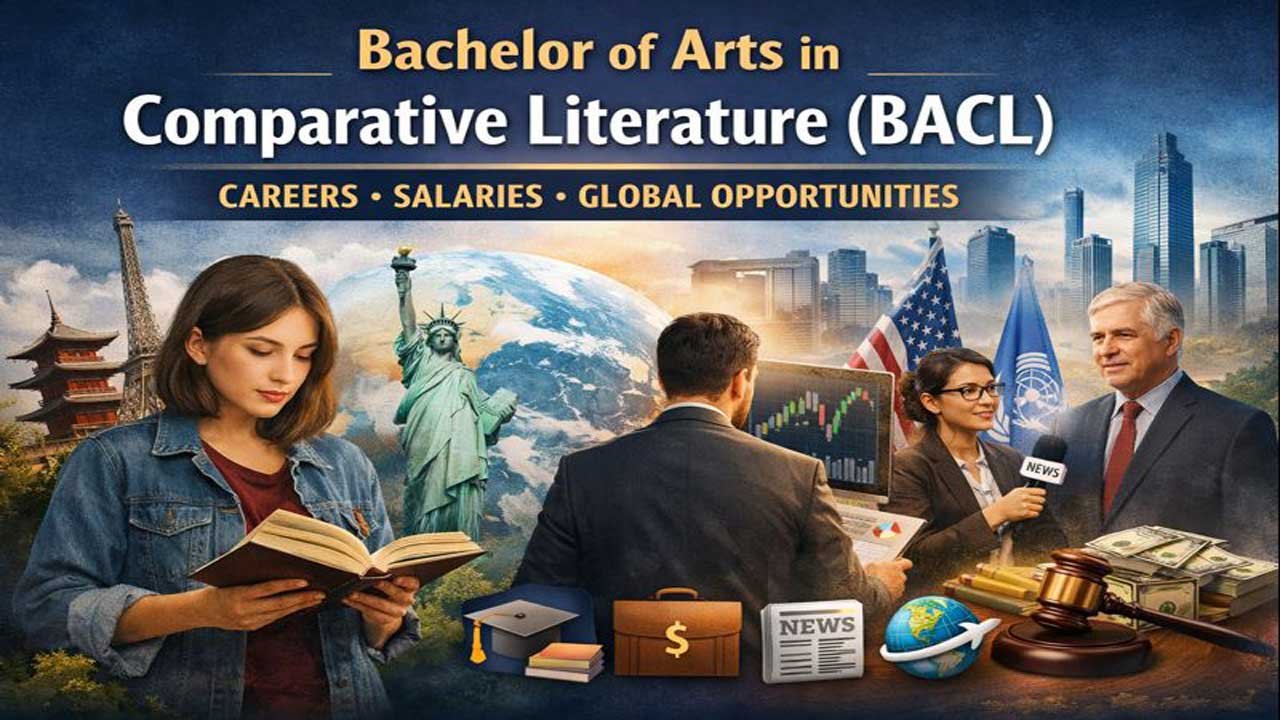
A Bachelor of Arts in Comparative Literature (BACL) is a globally oriented, interdisciplinary degree that builds high-value skills—critical thinking, cultural intelligence, advanced writing, and multilingual competence—that remain in strong demand in 2026 as automation reshapes the job market.
Contrary to stereotypes, alumni enter diverse and often lucrative fields including academia, management consulting, finance, law, publishing, media, diplomacy, government, and international organizations, with many reaching leadership or six-figure roles mid-career, especially when paired with advanced degrees like a JD, MBA, or PhD.
While starting salaries tend to be lower than in STEM or business, long-term earning potential, career flexibility, and international mobility are significant advantages. Best suited for intellectually curious students willing to commit to language study and strategic career planning, a BACL offers future-proof, transferable skills and strong preparation for graduate study and global careers.
| Category | Details |
|---|---|
| Degree Name | Bachelor of Arts in Comparative Literature (BACL) |
| Duration | 3–4 years (varies by country and university) |
| Core Focus | World literatures, cultural studies, literary theory, multilingual analysis |
| Language Requirement | Proficiency in 1 foreign language + reading knowledge of a second (typical) |
| Key Skills Developed | Critical thinking, advanced writing, cultural intelligence, research & synthesis |
| Top Career Paths | Academia, management consulting, finance, law, publishing, journalism, diplomacy, government, NGOs |
| Top Employers | McKinsey, BCG, major banks, global media houses, universities, UN, NGOs |
| Starting Salary (US) | $35,000–$50,000/year |
| Mid-Career Salary (US) | $80,000–$200,000+ (consulting, law, senior academia) |
| Starting Salary (India) | ₹15,000–₹30,000/month |
| Mid-Career Salary (India) | ₹60,000–₹1,00,000+/month |
| Top Universities | Harvard, Princeton, Yale, Columbia, Stanford, UC Berkeley, University of Chicago |
| Further Study Options | MA / PhD in Comparative Literature, JD (Law), MBA, IR, Publishing |
| Best Suited For | Students seeking global careers, intellectual depth, and long-term flexibility |
| ROI Outlook | Moderate short-term, strong long-term with specialization or graduate study |
Bachelor of Arts in Comparative Literature (BACL): Career Paths, Salary, and Global Opportunities in 2026
A Bachelor of Arts in Comparative Literature (BACL) is increasingly recognized as a powerful pathway into diverse, high-earning careers—despite common misconceptions that liberal arts degrees lead nowhere. In an era where artificial intelligence automates technical skills, employers desperately need what comparative literature graduates uniquely deliver: critical thinking, cultural intelligence, and sophisticated communication abilities.
The evidence is striking. Princeton’s comprehensive study of Comparative Literature alumni found that approximately one-third pursue successful careers in education and academia, while another third advance into business and finance roles—many rising to partner or director positions at firms like McKinsey, Boston Consulting Group, and major financial institutions. Meanwhile, journalists, editors, lawyers, diplomats, and international relations professionals with comparative literature backgrounds command competitive salaries and unparalleled job security.
If you’re considering this degree—whether for international opportunities, career flexibility, or genuine intellectual passion—this comprehensive guide reveals the real-world outcomes, earnings potential, and strategic advantages of a BACL degree in 2026.
What Is a Bachelor of Arts in Comparative Literature?
Comparative literature is the scholarly study of literary and cultural expression across linguistic, national, geographic, and disciplinary boundaries. Unlike traditional English literature programs, which focus on a single language tradition, comparative literature majors engage with multiple literary traditions simultaneously—reading works in original languages and translation while analyzing their interconnections with history, philosophy, politics, and the arts.
The discipline is fundamentally interdisciplinary. Students examine how literature reflects and shapes cultural movements, historical shifts, religious traditions, international relations, and even scientific developments. A typical BACL student might analyze Japanese postcolonial poetry, European modernism, and Latin American magical realism in the same semester—all while studying the underlying cultural frameworks that produced them.
Key Characteristics of BACL Programs
Multilingual Requirement: Most programs require proficiency in at least one foreign language and reading knowledge of a second. This is not optional—it’s central to the discipline.
Interdisciplinary Approach: Coursework extends beyond literature into cultural studies, history, anthropology, philosophy, translation studies, and critical theory.
Global Perspective: Unlike region-specific programs, comparative literature emphasizes worldwide traditions—Asian, African, Middle Eastern, Latin American, and European literatures equally.
Writing-Intensive: Students complete substantial research papers, critical essays, and often a senior thesis, developing professional-grade writing and analytical skills.
Top Universities Offering Comparative Literature Degrees
The strongest BACL programs globally include elite and public research institutions. Based on comprehensive rankings and academic reputation:
| Institution | Location | Estimated Tuition | Acceptance Rate | Strengths |
|---|---|---|---|---|
| Columbia University | New York, USA | $22,000–$25,000 | 3.5% | Rigorous curriculum; global faculty; NYC publishing/media connections |
| Princeton University | New Jersey, USA | $18,000–$22,000 | 6% | Prestigious alumni network; strong graduate placement; career development support |
| Harvard University | Massachusetts, USA | $40,000–$50,000 | 13% | Extensive language options; leading scholars; excellent for pre-law/pre-graduate study |
| Yale University | Connecticut, USA | $35,000–$45,000 | 8% | Four specialized concentrations: Cultural Studies, Intensive Language, Film, Literary Translation |
| UC Berkeley | California, USA | $14,000–$17,000 (CA residents) | 8% | Research-focused; diverse faculty; strong international connections |
| University of Chicago | Illinois, USA | $35,000–$40,000 | 12% | Theory-intensive; rigorous seminars; strong humanities reputation |
| Stanford University | California, USA | $40,000–$48,000 | 4% | Well-funded; excellent graduate outcomes; Silicon Valley connections for tech/entrepreneurship |
| Georgetown University | Washington, DC, USA | $30,000–$35,000 | 12% | Global and Comparative Literature focus; international relations opportunities; DC policy connections |
India-Based Programs:
- University of Calcutta (Department of Comparative Indian Language and Literature)
- Delhi University (M.A. in Comparative Indian Literature)
- Multiple Indian institutions offering comparative literature at both undergraduate and postgraduate levels
BACL Career Paths: Where Do Graduates Go?
One of the most compelling reasons to pursue a BACL degree is the breadth of career opportunities. Research from Princeton University tracking Comparative Literature alumni reveals a striking distribution across sectors:
Education & Academia (~33%)
Graduates become professors, university lecturers, and researchers at prestigious institutions including Yale, Harvard, Stanford, Columbia, Oxford, and universities across Asia and Europe. Salaries for tenure-track professors range from $60,000 to $100,000+ annually in the US, with senior positions reaching $150,000+.
Business & Finance (~30%)
Contrary to stereotype, comparative literature majors excel in corporate environments. They work at:
- Management Consulting: McKinsey & Company, Boston Consulting Group, Frontier Venture Capital
- Finance: Investment banking, venture capital, corporate finance
- Technology: Product management, strategic planning at major tech firms
- Marketing & Communications: Brand strategy, corporate communications, market research
The skills—synthesizing complex information, seeing situations from multiple perspectives, persuasive writing—directly translate to business contexts.
Writing, Editing & Publishing (~12%)
- Publishing Houses: Editors at Simon & Schuster, Oxford University Press, St. Martin’s Press, Scientific Publishing Services
- Media & Journalism: New York Times, The New Yorker, People Magazine, India Today, HT Media, Times of India Group
- Content Creation: Technical writing, copywriting, creative writing, screenwriting
Law (~11%)
BACL graduates pursue law school and work as attorneys, judges, and legal analysts. The research, argumentation, and writing skills developed through comparative literature directly support legal work.
Other Professional Paths (~14%)
- Diplomacy & International Relations: Foreign Service, United Nations, international NGOs
- Film & Media: Screenwriting, film direction, story production, curation
- Government: Federal, state, and local government; policy analysis
- Nonprofit & NGO Sector: Program management, advocacy, cultural organizations
Salary and Earning Potential
The earning potential for BACL graduates varies significantly based on career path, geographic location, and experience level. Here’s what the data shows:
Starting Salaries by Career Path
| Career Path | Geographic Region | Starting Salary | Mid-Career (10 years) |
|---|---|---|---|
| Education/Academia (High School Teacher) | USA | $35,000–$45,000 | $55,000–$75,000 |
| Education/Academia (University Professor) | USA | $55,000–$70,000 | $80,000–$120,000+ |
| Publishing Editor | USA | $35,000–$50,000 | $60,000–$100,000 |
| Management Consultant | USA | $65,000–$90,000 | $120,000–$200,000+ |
| Journalist (Entry-level) | USA | $30,000–$45,000 | $50,000–$80,000 |
| Content Writer | India | ₹15,000–₹30,000/month | ₹40,000–₹60,000/month |
| Government/Civil Service | India | ₹25,000–₹40,000/month | ₹60,000–₹1,00,000/month |
| University Professor | India | ₹37,400–₹67,000/month | ₹50,000–₹100,000+/month |
Comparative Literature vs. Other Bachelor’s Degrees
| Degree Type | Average Annual Income (US) |
|---|---|
| Comparative Literature | $44,500 |
| Business Administration | $62,856 |
| Engineering | $106,980 |
| Bachelor’s Degree (All Fields) | $66,000 |
Important Note: While starting salaries for BACL are modest compared to engineering or business, many graduates earn significantly more after gaining experience—especially those entering management consulting, law, publishing, or academia. The advantage lies in career flexibility and long-term earning potential rather than immediate post-graduation compensation.
Essential Skills You Develop
Beyond specific knowledge of world literatures, a BACL degree cultivates transferable skills that employers across industries value—especially as automation increases demand for uniquely human capabilities:
Critical Thinking & Analytical Reasoning
The ability to read complex texts, identify underlying arguments, and evaluate evidence from multiple perspectives is directly applicable to law, consulting, policy analysis, and business strategy.
Multicultural Competence & Global Understanding
In an increasingly globalized economy, understanding different cultural frameworks, historical contexts, and worldviews is invaluable. BACL graduates possess genuine cultural literacy—not stereotypes, but nuanced understanding built through deep reading and study.
Written Communication Excellence
Comparative literature programs demand exceptional writing across multiple formats: analytical essays, creative pieces, research papers, and presentations. This translates directly to professional communication in any field.
Research & Synthesis
Students learn to locate original sources, evaluate scholarship, synthesize diverse viewpoints, and construct evidence-based arguments—skills central to any knowledge work.
Adaptability & Intellectual Flexibility
The discipline trains the mind to work across disciplines, languages, and conceptual frameworks. This flexibility is exactly what employers seek in leadership and problem-solving roles.
International Communication
Foreign language proficiency combined with cultural understanding enables careers in diplomacy, international business, and global organizations.
Is a Comparative Literature Degree Worth It? A Realistic Assessment
The Case For:
- Unmatched Career Flexibility – Unlike engineering or accounting degrees tied to specific fields, BACL opens doors across education, business, law, publishing, diplomacy, and nonprofit sectors.
- Future-Proof Skills – As AI automates technical work, the human skills BACL develops (critical thinking, creativity, communication, cultural intelligence) become increasingly valuable.
- Strong Graduate School Preparation – BACL majors have competitive success rates entering law school, MBA programs, and PhD programs in humanities and beyond.
- International Career Opportunities – The global nature of the discipline and multilingual training make graduates attractive for international roles.
- Intellectual Satisfaction – For those passionate about literature, philosophy, and culture, the degree offers deep engagement with meaningful questions about human experience.
The Case Against:
- Lower Starting Salaries – Compared to STEM and business fields, BACL graduates start at lower salaries ($35,000–$50,000 vs. $65,000–$90,000).
- Requires Advanced Credentials for Top Academic Roles – Becoming a university professor typically requires a PhD, which involves 5–7 years of additional study.
- Language Requirement Can Be Challenging – Proficiency in one foreign language and reading knowledge of a second is demanding; this is a genuine commitment, not a simple elective.
- Niche Job Market in Some Regions – In areas with limited publishing, government, or international business, BACL-specific opportunities may be fewer.
- Long Path to High Income – While mid-career earnings are strong, it takes 10+ years to reach top salaries in most BACL-related fields.
Verdict: A BACL degree is worth pursuing if you (1) have genuine intellectual interest in literature and culture, (2) are willing to gain additional skills (law degree, MBA, etc.) for specific career goals, or (3) seek career flexibility and are prepared for modest starting salaries. It’s less ideal if your primary goal is maximizing starting salary or entering a narrow technical field immediately after graduation.
Admission Requirements
Typical admission requirements for selective BACL programs include:
Undergraduate (Bachelor’s) Level
- High school diploma or equivalent
- GPA: 3.0 or higher (for competitive schools, often 3.5+)
- SAT/ACT scores (typically higher-tier schools require 1350+/SAT or 30+/ACT)
- Essays demonstrating intellectual curiosity and writing ability
- Demonstration of strong reading and writing skills
- For international students: TOEFL or IELTS if English is not primary language
Graduate (Master’s) Level
- Bachelor’s degree with strong GPA (typically 3.5+)
- Master’s degree in Comparative Literature, English, Linguistics, or related field
- Language proficiency in at least one foreign language
- Writing sample (research paper or essay)
- Statement of purpose explaining research interests
- Letters of recommendation from academics
Note: Specific requirements vary significantly by institution. Consult individual university websites for precise admission criteria.
Specializations and Areas of Focus
While many BACL programs maintain flexibility, some universities offer specialized concentrations:
Yale’s Four Concentrations:
- Literature and Comparative Cultures – Core focus on literature with cultural context
- Intensive Language – Deep proficiency in one or more foreign languages
- Film & Visual Studies – Literature in cinematic and visual media
- Literary Translation – Theory and practice of translation between languages
Other Common Focus Areas:
- Postcolonial Literature – Examining literatures from formerly colonized regions and their engagement with colonial power
- Gender and Sexuality Studies – Literary analysis through feminist and queer theory
- World Literatures – Asian, African, Middle Eastern, and Indigenous literatures
- Literary Theory & Criticism – Advanced engagement with structuralism, deconstruction, psychoanalytic criticism, Marxist theory
- Digital Humanities – Literature in digital age; computational analysis of texts
- Transnational Literature – Cross-border literary movements and migrant writers
Graduate Study and Advanced Degrees
Many BACL undergraduates continue to graduate programs:
Master’s Degrees
- M.A. in Comparative Literature (2 years)
- M.A. in English with Comparative Literature focus
- M.A. in Cultural Studies
- M.A. in Translation Studies
Doctoral Programs
- Ph.D. in Comparative Literature (5–7 years)
- Top programs: Yale, UC Berkeley, Stanford, Columbia, University of Southern California, Cornell, NYU
Professional Graduate Programs
- Law School (JD)
- MBA Programs
- Graduate programs in publishing, diplomacy, international relations
Research & Teaching Fellowships
- UGC NET (National Eligibility Test) in India qualifies graduates for Junior Research Fellowship (JRF) with stipend support
- Many universities offer teaching assistantships and research fellowships covering tuition + living stipend
Frequently Asked Questions About BACL Degrees
Q: Do I have to be fluent in multiple languages before starting a BACL program?
A: No, but you must be willing to achieve proficiency. Most programs provide language coursework. However, strong language aptitude and previous study are advantageous.
Q: What’s the difference between Comparative Literature and English Literature?
A: English Literature focuses on literature written in English, while Comparative Literature emphasizes works across multiple languages and national traditions. Comparative Literature is broader but more demanding; English provides more focused depth.
Q: Can I double major in Comparative Literature and another subject?
A: Yes, many students double major in Comparative Literature and related fields like French, Spanish, Philosophy, Creative Writing, History, or Theater.
Q: Is there job demand for Comparative Literature graduates?
A: Not a single “Comparative Literature job”—instead, graduates qualify for diverse roles in education, publishing, business, law, government, and international organizations. Employer demand for the skills (writing, analysis, cultural intelligence) is strong and growing.
Q: How much do Comparative Literature professors earn?
A: In the US, university professors earn $60,000–$120,000+ annually depending on rank (assistant/associate/full professor) and institution. Entry-level teaching positions pay $35,000–$50,000.
Q: Is Comparative Literature valued internationally?
A: Yes. The discipline originated in Europe and remains strong globally. BACL graduates find opportunities in universities, publishing, media, and organizations worldwide. International education enhances career prospects.
Q: What if I want to work in publishing after BACL?
A: Publishing is a natural fit. Entry-level positions include editorial assistant ($30,000–$35,000), with progression to editor ($50,000–$100,000+). Internships during undergraduate study are crucial for breaking in.
Q: Can BACL lead to high-income careers?
A: Yes, though not immediately after graduation. Management consulting (McKinsey, BCG), law, and senior publishing/media roles command six-figure salaries. MBA or JD credentials often unlock these paths.
Q: What are the job prospects for BACL graduates in India?
A: Strong growth in education (university teaching, coaching institutes), publishing (Indian presses expanding), media (journalism), and content creation. Starting salaries are ₹15,000–₹30,000/month, with significant growth potential.
Conclusion: Is a BACL Degree Your Path?
A Bachelor of Arts in Comparative Literature is far more than “studying books.” It’s a rigorous discipline that develops critical thinking, cultural intelligence, and communication excellence—capabilities that drive success across law, business, publishing, diplomacy, education, and countless other fields.
The evidence is clear: Princeton’s alumni data shows that BACL graduates earn competitive salaries, achieve leadership positions, and report high career satisfaction. They’re the editors at major publishing houses, consultants at elite firms, professors at leading universities, and lawyers influencing policy.
If you’re intellectually curious about global culture and literature, prepared for modest starting salaries, and seeking a degree that offers genuine career flexibility, a BACL degree is an investment in your future capabilities.
Ready to apply? Research the top programs listed in this guide, take the SAT/ACT, strengthen your language skills, and craft a compelling essay demonstrating your passion for comparative literature. For graduate study, consider the UGC NET exam (India) or GRE (US) alongside your BACL degree.
Your next chapter in global literature and culture awaits.


Leave a Reply
You must be logged in to post a comment.